
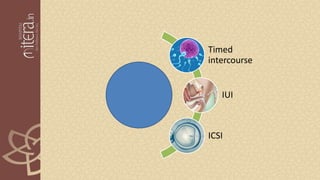

Ovulation
induction
Timed
intercourse
IUI
ICSI
Ovarian folliculogenesis – review
of physiology & concept of
ovulation induction
Dr. Raju Nair
Head- Reproductive Medicine
Mitera Hospital
Kottayam
Ovulation …. Historic perspective
• 5th Century B.C. - Hipocrates
– Generation occurred through joining of the male ejaculate and
female menstrual blood
• 15th Century A.D. – William Harvey
– Ex ovo omnia: All things come from the egg
• 17th Century A.D. – Regnier de Graaf
– Ovary : the producer of eggs
• 1827 A.D. – Karl Ernst von Baer
– Egg : The follicle itself is not the egg. Oocyte is enclosed within
the ovarian follicle
• Ovary is a dynamic organ
• Human ovarian follicular dynamics studies
– is based on the synergistic use of
• Histology
• Endocrinology
• Ultrasonography
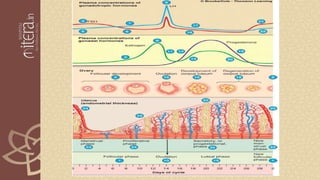
• Ovarian cycle
• Uterine cycle
• HPO- Axis
• 2 cell -2 gonadotropin theory
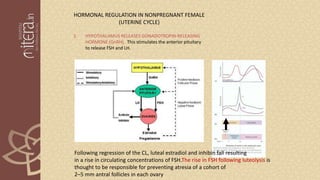
HORMONAL REGULATION IN NONPREGNANT FEMALE
(UTERINE CYCLE)
1. HYPOTHALAMUS RELEASES GONADOTROPIN-RELEASING
HORMONE (GnRH). This stimulates the anterior pituitary
to release FSH and LH.
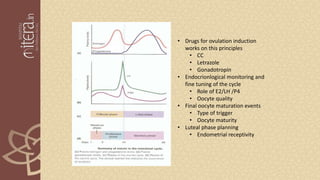
Following regression of the CL, luteal estradiol and inhibin fall resulting
in a rise in circulating concentrations of FSH.The rise in FSH following luteolysis is
thought to be responsible for preventing atresia of a cohort of
2–5 mm antral follicles in each ovary
• Drugs for ovulation induction
works on this principles
• CC
• Letrazole
• Gonadotropin
• Endocrionlogical monitoring and
fine tuning of the cycle
• Role of E2/LH /P4
• Oocyte quality
• Final oocyte maturation events
• Type of trigger
• Oocyte maturity
• Luteal phase planning
• Endometrial receptivity
Ovulation
Dominance
Selection
Recruitment
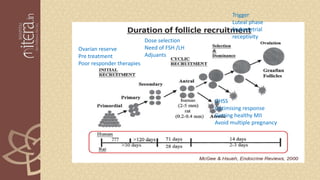
Ovarian reserve
Pre treatment
Poor responder therapies
Dose selection
Need of FSH /LH
Adjuants
OHSS
Optimising response
Getting healthy MII
Avoid multiple pregnancy
Trigger
Luteal phase
Endometrial
receptivity
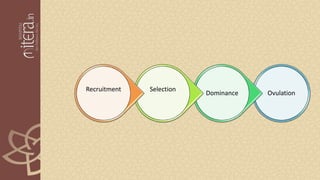
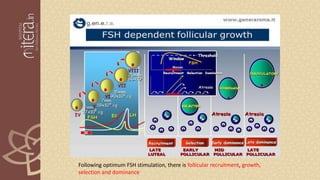
Following optimum FSH stimulation, there is follicular recruitment, growth,
selection and dominance
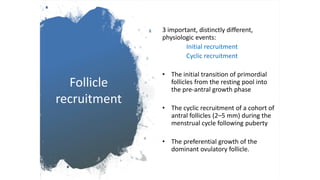
Follicle
recruitment
3 important, distinctly different,
physiologic events:
Initial recruitment
Cyclic recruitment
• The initial transition of primordial
follicles from the resting pool into
the pre-antral growth phase
• The cyclic recruitment of a cohort of
antral follicles (2–5 mm) during the
menstrual cycle following puberty
• The preferential growth of the
dominant ovulatory follicle.
Antral follicle recruitment
Antral follicles 2–5 mm develop continuously,
while others have proposed that ‘cohorts’ or
‘waves’ of antral follicles develop in a cyclic
manner during the menstrual cycle.
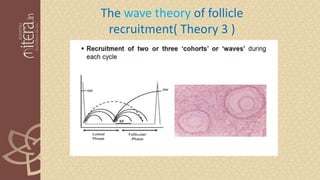
Three separate theories of follicular recruitment
have been proposed.
– Continuous recruitment (Theory 1)
– Single recruitment episode (Theory 2)
– Follicular waves (Theory 3)
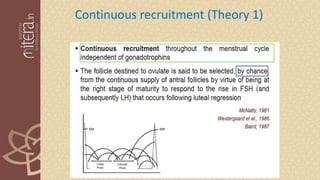
Continuous recruitment (Theory 1)
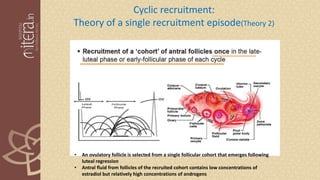
Cyclic recruitment:
Theory of a single recruitment episode(Theory 2)
• An ovulatory follicle is selected from a single follicular cohort that emerges following
luteal regression
• Antral fluid from follicles of the recruited cohort contains low concentrations of
estradiol but relatively high concentrations of androgens
The wave theory of follicle
recruitment( Theory 3 )
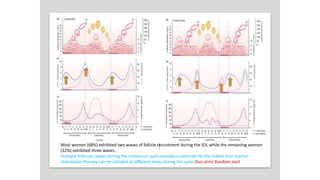
Most women (68%) exhibited two waves of follicle recruitment during the IOI, while the remaining women
(32%) exhibited three waves.
multiple follicular waves during the menstrual cycle provides a rationale for the notion that ovarian
stimulation therapy can be initiated at different times during the cycle-Duo stim/ Random start
Follicle selection
Preferential growth of a species-specific
number of large antral follicles from the
recruited cohort
– Follicle divergence
– Follicle dominance
Why one follicle get dominant ?
• Antral fluid from follicles of the recruited cohort
contains low concentrations of estradiol but
relatively high concentrations of androgens
– Concept used in poor responder
• DHEA
• Testosterone
• AI
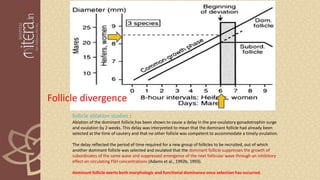
follicle ablation studies :
Ablation of the dominant follicle,has been shown to cause a delay in the pre-ovulatory gonadotrophin surge
and ovulation by 2 weeks. This delay was interpreted to mean that the dominant follicle had already been
selected at the time of cautery and that no other follicle was competent to accommodate a timely ovulation.
The delay reflected the period of time required for a new group of follicles to be recruited, out of which
another dominant follicle was selected and ovulated that the dominant follicle suppresses the growth of
subordinates of the same wave and suppressed emergence of the next follicular wave through an inhibitory
effect on circulating FSH concentrations (Adams et al., 1992b, 1993).
dominant follicle exerts both morphologic and functional dominance once selection has occurred.
Follicle divergence
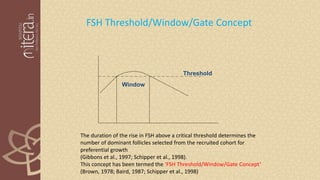
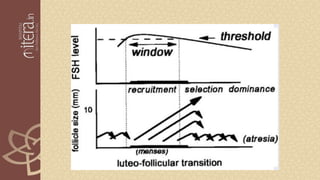
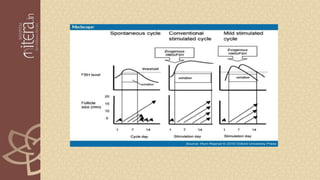
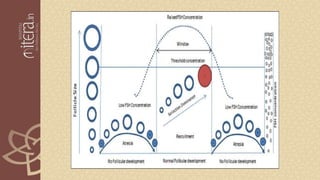
FSH Threshold/Window/Gate Concept
Threshold
Window
The duration of the rise in FSH above a critical threshold determines the
number of dominant follicles selected from the recruited cohort for
preferential growth
(Gibbons et al., 1997; Schipper et al., 1998).
This concept has been termed the ‘FSH Threshold/Window/Gate Concept’
(Brown, 1978; Baird, 1987; Schipper et al., 1998)
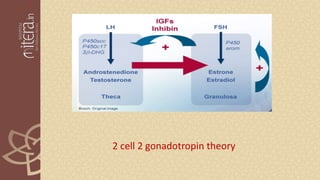
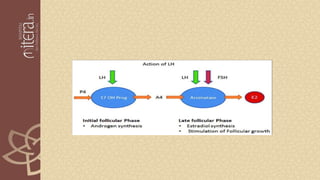
2 cell 2 gonadotropin theory
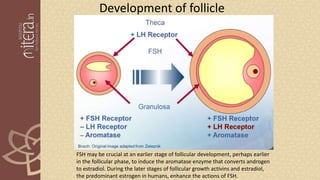
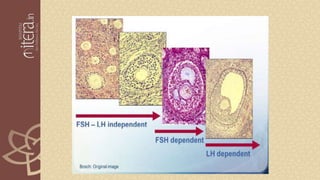
Development of follicle
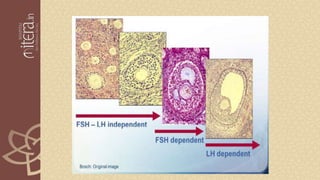
FSH may be crucial at an earlier stage of follicular development, perhaps earlier
in the follicular phase, to induce the aromatase enzyme that converts androgen
to estradiol. During the later stages of follicular growth activins and estradiol,
the predominant estrogen in humans, enhance the actions of FSH.
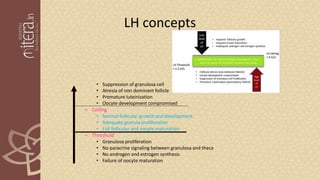
LH concepts
• Suppression of granulosa cell
• Atresia of non dominant follicle
• Premature luteinization
• Oocyte development compromised
– Ceiling
• Normal follicular growth and development
• Adequate granula proliferation
• Full follicular and oocyte maturation
– Threshold
• Granulosa proliferation
• No paracrine signaling between granulosa and theca
• No androgen and estrogen synthesis
• Failure of oocyte maturation
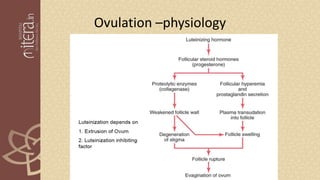
Ovulation –physiology
Conclusion…
• Concepts of physiology is very important in reproductive
medicine
• Role FSH and LH in folliculogenesis is the basis of entire
ovulation induction protocols
• Newer modalities of treatment and novel ideas start by
adapting the knowledge of physiology to clinical practice
folliculogenesis.pptx

folliculogenesis.pptx

  • 2.
  • 3.
    Ovarian folliculogenesis –review of physiology & concept of ovulation induction Dr. Raju Nair Head- Reproductive Medicine Mitera Hospital Kottayam
  • 4.
    Ovulation …. Historicperspective • 5th Century B.C. - Hipocrates – Generation occurred through joining of the male ejaculate and female menstrual blood • 15th Century A.D. – William Harvey – Ex ovo omnia: All things come from the egg • 17th Century A.D. – Regnier de Graaf – Ovary : the producer of eggs • 1827 A.D. – Karl Ernst von Baer – Egg : The follicle itself is not the egg. Oocyte is enclosed within the ovarian follicle
  • 5.
    • Ovary isa dynamic organ • Human ovarian follicular dynamics studies – is based on the synergistic use of • Histology • Endocrinology • Ultrasonography
  • 6.
    • Ovarian cycle •Uterine cycle
  • 7.
    • HPO- Axis •2 cell -2 gonadotropin theory
  • 9.
    HORMONAL REGULATION INNONPREGNANT FEMALE (UTERINE CYCLE) 1. HYPOTHALAMUS RELEASES GONADOTROPIN-RELEASING HORMONE (GnRH). This stimulates the anterior pituitary to release FSH and LH. Following regression of the CL, luteal estradiol and inhibin fall resulting in a rise in circulating concentrations of FSH.The rise in FSH following luteolysis is thought to be responsible for preventing atresia of a cohort of 2–5 mm antral follicles in each ovary
  • 10.
    • Drugs forovulation induction works on this principles • CC • Letrazole • Gonadotropin • Endocrionlogical monitoring and fine tuning of the cycle • Role of E2/LH /P4 • Oocyte quality • Final oocyte maturation events • Type of trigger • Oocyte maturity • Luteal phase planning • Endometrial receptivity
  • 11.
  • 12.
    Ovarian reserve Pre treatment Poorresponder therapies Dose selection Need of FSH /LH Adjuants OHSS Optimising response Getting healthy MII Avoid multiple pregnancy Trigger Luteal phase Endometrial receptivity
  • 14.
    Following optimum FSHstimulation, there is follicular recruitment, growth, selection and dominance
  • 15.
    Follicle recruitment 3 important, distinctlydifferent, physiologic events: Initial recruitment Cyclic recruitment • The initial transition of primordial follicles from the resting pool into the pre-antral growth phase • The cyclic recruitment of a cohort of antral follicles (2–5 mm) during the menstrual cycle following puberty • The preferential growth of the dominant ovulatory follicle.
  • 16.
    Antral follicle recruitment Antralfollicles 2–5 mm develop continuously, while others have proposed that ‘cohorts’ or ‘waves’ of antral follicles develop in a cyclic manner during the menstrual cycle. Three separate theories of follicular recruitment have been proposed. – Continuous recruitment (Theory 1) – Single recruitment episode (Theory 2) – Follicular waves (Theory 3)
  • 17.
  • 18.
    Cyclic recruitment: Theory ofa single recruitment episode(Theory 2) • An ovulatory follicle is selected from a single follicular cohort that emerges following luteal regression • Antral fluid from follicles of the recruited cohort contains low concentrations of estradiol but relatively high concentrations of androgens
  • 19.
    The wave theoryof follicle recruitment( Theory 3 )
  • 20.
    Most women (68%)exhibited two waves of follicle recruitment during the IOI, while the remaining women (32%) exhibited three waves. multiple follicular waves during the menstrual cycle provides a rationale for the notion that ovarian stimulation therapy can be initiated at different times during the cycle-Duo stim/ Random start
  • 21.
    Follicle selection Preferential growthof a species-specific number of large antral follicles from the recruited cohort – Follicle divergence – Follicle dominance
  • 22.
    Why one follicleget dominant ? • Antral fluid from follicles of the recruited cohort contains low concentrations of estradiol but relatively high concentrations of androgens – Concept used in poor responder • DHEA • Testosterone • AI
  • 23.
    follicle ablation studies: Ablation of the dominant follicle,has been shown to cause a delay in the pre-ovulatory gonadotrophin surge and ovulation by 2 weeks. This delay was interpreted to mean that the dominant follicle had already been selected at the time of cautery and that no other follicle was competent to accommodate a timely ovulation. The delay reflected the period of time required for a new group of follicles to be recruited, out of which another dominant follicle was selected and ovulated that the dominant follicle suppresses the growth of subordinates of the same wave and suppressed emergence of the next follicular wave through an inhibitory effect on circulating FSH concentrations (Adams et al., 1992b, 1993). dominant follicle exerts both morphologic and functional dominance once selection has occurred. Follicle divergence
  • 24.
    FSH Threshold/Window/Gate Concept Threshold Window Theduration of the rise in FSH above a critical threshold determines the number of dominant follicles selected from the recruited cohort for preferential growth (Gibbons et al., 1997; Schipper et al., 1998). This concept has been termed the ‘FSH Threshold/Window/Gate Concept’ (Brown, 1978; Baird, 1987; Schipper et al., 1998)
  • 28.
    2 cell 2gonadotropin theory
  • 29.
    Development of follicle FSHmay be crucial at an earlier stage of follicular development, perhaps earlier in the follicular phase, to induce the aromatase enzyme that converts androgen to estradiol. During the later stages of follicular growth activins and estradiol, the predominant estrogen in humans, enhance the actions of FSH.
  • 31.
    LH concepts • Suppressionof granulosa cell • Atresia of non dominant follicle • Premature luteinization • Oocyte development compromised – Ceiling • Normal follicular growth and development • Adequate granula proliferation • Full follicular and oocyte maturation – Threshold • Granulosa proliferation • No paracrine signaling between granulosa and theca • No androgen and estrogen synthesis • Failure of oocyte maturation
  • 33.
  • 34.
    Conclusion… • Concepts ofphysiology is very important in reproductive medicine • Role FSH and LH in folliculogenesis is the basis of entire ovulation induction protocols • Newer modalities of treatment and novel ideas start by adapting the knowledge of physiology to clinical practice