Sternberg theory
Presented by
Syeda Hadeesa Zahra
Mamun Fazal Karim
Presented to Sitara Kanwal
History of
Sternberg theory
• Robert J. Sternberg, a well-
known psychologist whose
research often focuses on
human intelligence and
creativity.
• The triarchic theory of
intelligence proposes that there
are three distinct types of
intelligence: practical, distinct,
and analytical.
Origin
• Sternberg proposed his theory in
1985 as an alternative to the idea
of the general intelligence factor.
The general intelligence
factor, also known as g, is what
intelligence tests typically
measure. It refers only to
“academic intelligence.”
Triarchic Theory
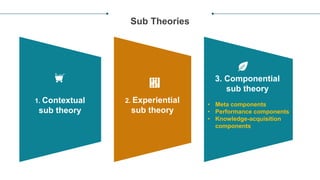
The triarchic theory is comprised of Three sub theories, each of which
relates to a specific kind of Intelligence:
• The contextual sub theory, which corresponds to practical
intelligence, or the ability to successfully function in one’s
environment;
• The experiential sub theory, which corresponds to creative
intelligence, or the ability to deal with novel situations or issues.
• The componential sub theory, which corresponds to analytical
intelligence, or the ability to solve problems.
Triarchic Theory
of Intelligence Key Takeaways
The triarchic theory of intelligence originated as an alternative to the
concept of general intelligence factor, or g factor.
The theory, proposed by psychologist Robert J. Sternberg, contends that
there are three types of intelligence: practical (the ability to get along in
different contexts), creative (the ability to come up with new ideas), and
analytical (the ability to evaluate information and solve problems).
The theory is comprised of three sub theories: contextual,
experiential, and componential. Each sub theory corresponds to
one of the three proposed types of intelligence.
5
intelligence
• Sternberg argued that practical intelligence a person’s ability to
react and adapt to the world around them as well as creativity are
equally important when measuring an individual's overall
intelligence. He also argued that intelligence isn’t fixed, but
rather comprises a set of abilities that can be
developed. Sternberg's assertions led to the creation of his
theory.
Sub Theories
1. Contextual
sub theory
2. Experiential
sub theory
3. Componential
sub theory
• Meta components
• Performance components
• Knowledge-acquisition
components
Sub Theories
Contextual sub theory Experiential sub theory
Sternberg broke his theory down into the following three sub theories:
According to the experiential sub theory,
people are creatively intelligent to the
extent that they can cope with relative
novelty and automatize routine aspects of
tasks.
A novel situation is one that has not been
experienced before.
The problem with novelty and automation
is that being skilled in one component
does not ensure that you are skilled in the
other.
The contextual sub theory says that
intelligence is intertwined with the
individual’s environment. Thus,
intelligence is based on the way one
functions in their everyday circumstances,
including one’s ability to a) adapt to one’s
environment, b) select the best
environment for oneself, or c) shape the
environment to better fit one’s needs
and desires.
Sub Theories
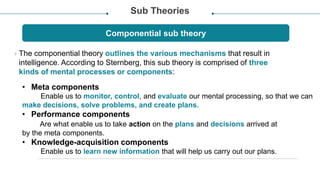
Componential sub theory
• Meta components
Enable us to monitor, control, and evaluate our mental processing, so that we can
make decisions, solve problems, and create plans.
• Performance components
Are what enable us to take action on the plans and decisions arrived at
by the meta components.
• Knowledge-acquisition components
Enable us to learn new information that will help us carry out our plans.
› The componential theory outlines the various mechanisms that result in
intelligence. According to Sternberg, this sub theory is comprised of three
kinds of mental processes or components:
Kinds of Intelligence
Practical intelligence
Sternberg called one’s ability
to successfully interact with
the everyday world practical
intelligence. Practical
intelligence is related to the
contextual sub theory.
Practically intelligent people
are especially adept at
behaving in successful
ways in their external
environment.
.
Creative intelligence
The experiential sub
theory is related to creative
intelligence, which is one’s
ability to use existing
knowledge to create new
ways to handle new
problems or cope in new
situations.
.
Analytical intelligence
The componential sub
theory is related to
analytical intelligence,
which is essentially
academic intelligence.
Analytical intelligence is
used to solve problems
and is the kind of
intelligence that is
measured by a standard
IQ test
.
Critiques
There have been a number of critiques and challenges to
Sternberg’s triarchic theory of intelligence over the years.
For example, educational psychologist the theory lacks a
solid empirical basis and observes that the data used to
back up the theory is meager. In addition, some scholars
argue that practical intelligence is redundant with the
concept of job knowledge, a concept that is more robust
and has been better researched. Finally, Sternberg’s own
definitions and explanations of his terms and concepts
have at times been imprecise.
Thank You

Sternberg theory.pptx

  • 1.
    Sternberg theory Presented by SyedaHadeesa Zahra Mamun Fazal Karim Presented to Sitara Kanwal
  • 2.
    History of Sternberg theory •Robert J. Sternberg, a well- known psychologist whose research often focuses on human intelligence and creativity. • The triarchic theory of intelligence proposes that there are three distinct types of intelligence: practical, distinct, and analytical. Origin • Sternberg proposed his theory in 1985 as an alternative to the idea of the general intelligence factor. The general intelligence factor, also known as g, is what intelligence tests typically measure. It refers only to “academic intelligence.”
  • 3.
    Triarchic Theory The triarchictheory is comprised of Three sub theories, each of which relates to a specific kind of Intelligence: • The contextual sub theory, which corresponds to practical intelligence, or the ability to successfully function in one’s environment; • The experiential sub theory, which corresponds to creative intelligence, or the ability to deal with novel situations or issues. • The componential sub theory, which corresponds to analytical intelligence, or the ability to solve problems.
  • 4.
    Triarchic Theory of IntelligenceKey Takeaways The triarchic theory of intelligence originated as an alternative to the concept of general intelligence factor, or g factor. The theory, proposed by psychologist Robert J. Sternberg, contends that there are three types of intelligence: practical (the ability to get along in different contexts), creative (the ability to come up with new ideas), and analytical (the ability to evaluate information and solve problems). The theory is comprised of three sub theories: contextual, experiential, and componential. Each sub theory corresponds to one of the three proposed types of intelligence.
  • 5.
    5 intelligence • Sternberg arguedthat practical intelligence a person’s ability to react and adapt to the world around them as well as creativity are equally important when measuring an individual's overall intelligence. He also argued that intelligence isn’t fixed, but rather comprises a set of abilities that can be developed. Sternberg's assertions led to the creation of his theory.
  • 6.
    Sub Theories 1. Contextual subtheory 2. Experiential sub theory 3. Componential sub theory • Meta components • Performance components • Knowledge-acquisition components
  • 7.
    Sub Theories Contextual subtheory Experiential sub theory Sternberg broke his theory down into the following three sub theories: According to the experiential sub theory, people are creatively intelligent to the extent that they can cope with relative novelty and automatize routine aspects of tasks. A novel situation is one that has not been experienced before. The problem with novelty and automation is that being skilled in one component does not ensure that you are skilled in the other. The contextual sub theory says that intelligence is intertwined with the individual’s environment. Thus, intelligence is based on the way one functions in their everyday circumstances, including one’s ability to a) adapt to one’s environment, b) select the best environment for oneself, or c) shape the environment to better fit one’s needs and desires.
  • 8.
    Sub Theories Componential subtheory • Meta components Enable us to monitor, control, and evaluate our mental processing, so that we can make decisions, solve problems, and create plans. • Performance components Are what enable us to take action on the plans and decisions arrived at by the meta components. • Knowledge-acquisition components Enable us to learn new information that will help us carry out our plans. › The componential theory outlines the various mechanisms that result in intelligence. According to Sternberg, this sub theory is comprised of three kinds of mental processes or components:
  • 9.
    Kinds of Intelligence Practicalintelligence Sternberg called one’s ability to successfully interact with the everyday world practical intelligence. Practical intelligence is related to the contextual sub theory. Practically intelligent people are especially adept at behaving in successful ways in their external environment. . Creative intelligence The experiential sub theory is related to creative intelligence, which is one’s ability to use existing knowledge to create new ways to handle new problems or cope in new situations. . Analytical intelligence The componential sub theory is related to analytical intelligence, which is essentially academic intelligence. Analytical intelligence is used to solve problems and is the kind of intelligence that is measured by a standard IQ test .
  • 10.
    Critiques There have beena number of critiques and challenges to Sternberg’s triarchic theory of intelligence over the years. For example, educational psychologist the theory lacks a solid empirical basis and observes that the data used to back up the theory is meager. In addition, some scholars argue that practical intelligence is redundant with the concept of job knowledge, a concept that is more robust and has been better researched. Finally, Sternberg’s own definitions and explanations of his terms and concepts have at times been imprecise.
  • 11.