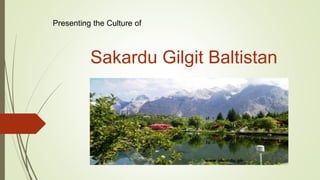
Sakardu Gilgit Baltistan
Presenting the Culture of
Geography of Sakardu Gilgit Baltistan:
 Gilgit Baltistan is located in between the great mountain ranges of the world , the
Himalayas, Karakoram, Pamir and Hindukush.
 GB covers an area of 72,971 sq km.
 Gilgit Baltistan population is approximately 2 million.
 GB lies in between the Karakoram and Himalayas mountains. There are
thousands of glaciers in these mountains. Indus river originates from Himalayas.
Shyok river originates from Karakoram.
History:
 Traced from rock carvings which are painted on different
rocks in GB.
 The famous rock carvings are located in Chilas.
 Paintings include animal painting, signs, scripts ,structures
and buildings.
 Names of kings and their history are written in the form of
paintings on the rocks.
Languages:
 More than six different languages are spoken in GB.
 Shina language is primarily spoken in Diamer, Astore, Gilgit ,Ghizer and Nagar.
 Balti language is spoken in Skardu, Shigar , Kharmang and Ghanche in Baltistan
division. Balti is a branch of Tibetan language. Tibetan language is spoken in Tibet,
Nepal. Bhutan, Sikkim India, western provinces of China and Ladakh.
 Brushaski language is spoken in Hunza Yasin and Nagar valley.
Cultures and Festivals:
 Religious cultures include,
 Eid ul Fitr
 Eid ul Azha
 Eid Milad un Nabi
 Cultural Festivals include,
 Jashn e Baharan
 Shandoor Polo Festival
 Babusar Polo Festival
Family System:
 The Gilgit Baltistan’s people way of life is mostly the joint family system.
 Which signifies their deep love for the family's solidarity and welfare.
Marriage System:
 Marriages are solemnized in presence of Nikah khwa and witnesses.
 Life partners are commonly selected within the family.
 A negligible fraction of love marriages, all marriages are arranged.
 Divorce rate is very low.
Marriage Events:
 Marriage include three main events,
 Mehndi
 Barat
 Walima
Dressing:
 Men usually wear white shalwar kameez with white gilgiti cap.
 Women usually wear,
 Loose kameez Shalwar
 Cap with some silver touch
 Silver Jewelry with Antique stones
Dance:
 The famous trio band music is played in this region. On the rhythm of this loud
music, men love to dance in their typical way.
 This dance is performed by more than one man wear some old style dresses and
wear local hat and dance.
Sword Dance:
 This unique dance is performed by men taking one sword in right and Shield in left.
One to six participants as pair can dance.
Cow Boy Dance:
 This unique dance is performed by a man wear earlier period dress, long leather
shoes and a stick has in hand.
Music:
 There are different types of music including,
 Alghani: The people of Gilgit, Ghizer Yasin, Puniyal, and Gupis call this rhythm as
Alghani.
 Ajoli: During departure of bride and groom from house this rhythm is used in
different parts of Gilgit.
 Souse: A martial rhythm and it has a fast rhythm and is used specially in sword
dances.
 Dani: Dani is the name of a traditional music used in Hunza which links to Tibet,
Baltistan and Laddakh
Musical Instruments:
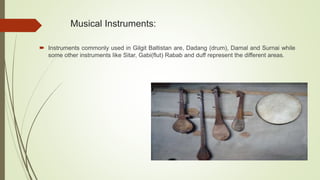
 Instruments commonly used in Gilgit Baltistan are, Dadang (drum), Damal and Surnai while
some other instruments like Sitar, Gabi(flut) Rabab and duff represent the different areas.
Food:
 Marzan
 Hrsapkhur
 Kiseer
 Drum fiti
 Prapo
 Rgearatee roti
 Namkeen tea
 Balay
Sports:
 Polo
 Neza Bazi
 Tapoo
 Ip Ip
THANK YOU!
Group Members:
 Arooj Iftikhar_ F2019141045
 Syeda Hadeesa Zahra_ F2019141021
 Benish Mushtaq_ F2019141097
 Maida_ F2019141038
 Nabeeha Zulfiqar_ F2019141095

culture representation

  • 1.
  • 2.
    Geography of SakarduGilgit Baltistan:  Gilgit Baltistan is located in between the great mountain ranges of the world , the Himalayas, Karakoram, Pamir and Hindukush.  GB covers an area of 72,971 sq km.  Gilgit Baltistan population is approximately 2 million.  GB lies in between the Karakoram and Himalayas mountains. There are thousands of glaciers in these mountains. Indus river originates from Himalayas. Shyok river originates from Karakoram.
  • 3.
    History:  Traced fromrock carvings which are painted on different rocks in GB.  The famous rock carvings are located in Chilas.  Paintings include animal painting, signs, scripts ,structures and buildings.  Names of kings and their history are written in the form of paintings on the rocks.
  • 4.
    Languages:  More thansix different languages are spoken in GB.  Shina language is primarily spoken in Diamer, Astore, Gilgit ,Ghizer and Nagar.  Balti language is spoken in Skardu, Shigar , Kharmang and Ghanche in Baltistan division. Balti is a branch of Tibetan language. Tibetan language is spoken in Tibet, Nepal. Bhutan, Sikkim India, western provinces of China and Ladakh.  Brushaski language is spoken in Hunza Yasin and Nagar valley.
  • 5.
    Cultures and Festivals: Religious cultures include,  Eid ul Fitr  Eid ul Azha  Eid Milad un Nabi  Cultural Festivals include,  Jashn e Baharan  Shandoor Polo Festival  Babusar Polo Festival
  • 6.
    Family System:  TheGilgit Baltistan’s people way of life is mostly the joint family system.  Which signifies their deep love for the family's solidarity and welfare.
  • 7.
    Marriage System:  Marriagesare solemnized in presence of Nikah khwa and witnesses.  Life partners are commonly selected within the family.  A negligible fraction of love marriages, all marriages are arranged.  Divorce rate is very low.
  • 8.
    Marriage Events:  Marriageinclude three main events,  Mehndi  Barat  Walima
  • 9.
    Dressing:  Men usuallywear white shalwar kameez with white gilgiti cap.  Women usually wear,  Loose kameez Shalwar  Cap with some silver touch  Silver Jewelry with Antique stones
  • 10.
    Dance:  The famoustrio band music is played in this region. On the rhythm of this loud music, men love to dance in their typical way.  This dance is performed by more than one man wear some old style dresses and wear local hat and dance.
  • 11.
    Sword Dance:  Thisunique dance is performed by men taking one sword in right and Shield in left. One to six participants as pair can dance.
  • 12.
    Cow Boy Dance: This unique dance is performed by a man wear earlier period dress, long leather shoes and a stick has in hand.
  • 13.
    Music:  There aredifferent types of music including,  Alghani: The people of Gilgit, Ghizer Yasin, Puniyal, and Gupis call this rhythm as Alghani.  Ajoli: During departure of bride and groom from house this rhythm is used in different parts of Gilgit.  Souse: A martial rhythm and it has a fast rhythm and is used specially in sword dances.  Dani: Dani is the name of a traditional music used in Hunza which links to Tibet, Baltistan and Laddakh
  • 14.
    Musical Instruments:  Instrumentscommonly used in Gilgit Baltistan are, Dadang (drum), Damal and Surnai while some other instruments like Sitar, Gabi(flut) Rabab and duff represent the different areas.
  • 15.
    Food:  Marzan  Hrsapkhur Kiseer  Drum fiti  Prapo  Rgearatee roti  Namkeen tea  Balay
  • 16.
    Sports:  Polo  NezaBazi  Tapoo  Ip Ip
  • 17.
  • 18.
    Group Members:  AroojIftikhar_ F2019141045  Syeda Hadeesa Zahra_ F2019141021  Benish Mushtaq_ F2019141097  Maida_ F2019141038  Nabeeha Zulfiqar_ F2019141095