Chapter 5 Structure and Preparation
of Alkenes - Elimination Reactions
• .
• 1. Carbon-carbon double bonds do not freely rotate
like carbon-carbon single bonds. Why?
• A. The double bond is much stronger and thus more
difficult to rotate.
• B. Overlap of the two 2p orbitals of the bond would
be lost.
• C. The shorter bond length of the double bond makes
it more difficult for the attached groups to pass each
other.
• D. Overlap of the sp2 orbitals of the carbon-carbon
bond would be lost.
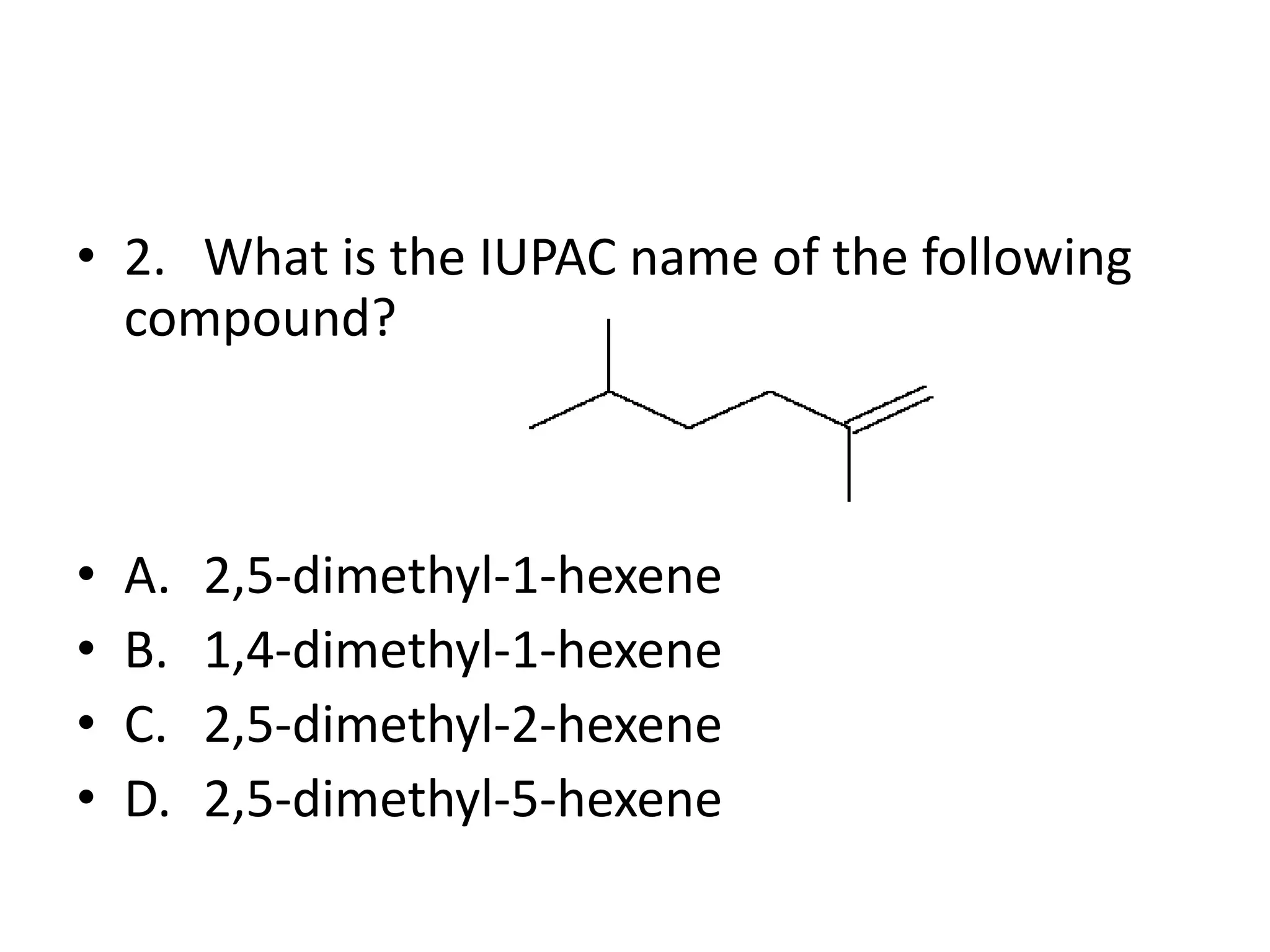
• 2. What is the IUPAC name of the following
compound?

•
•
•
•

A.
B.
C.
D.

2,5-dimethyl-1-hexene
1,4-dimethyl-1-hexene
2,5-dimethyl-2-hexene
2,5-dimethyl-5-hexene
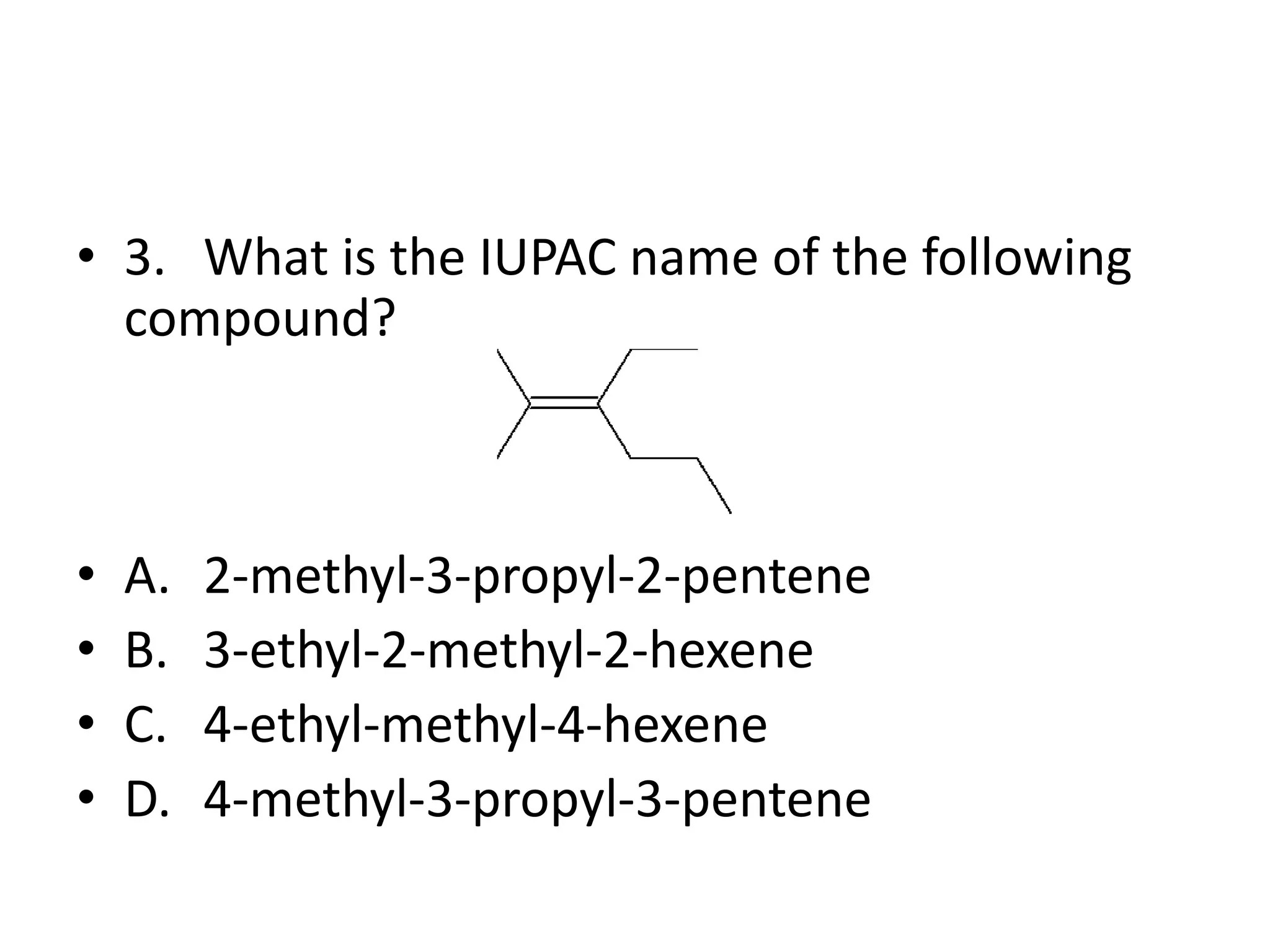
• 3. What is the IUPAC name of the following
compound?

•
•
•
•

A.
B.
C.
D.

2-methyl-3-propyl-2-pentene
3-ethyl-2-methyl-2-hexene
4-ethyl-methyl-4-hexene
4-methyl-3-propyl-3-pentene
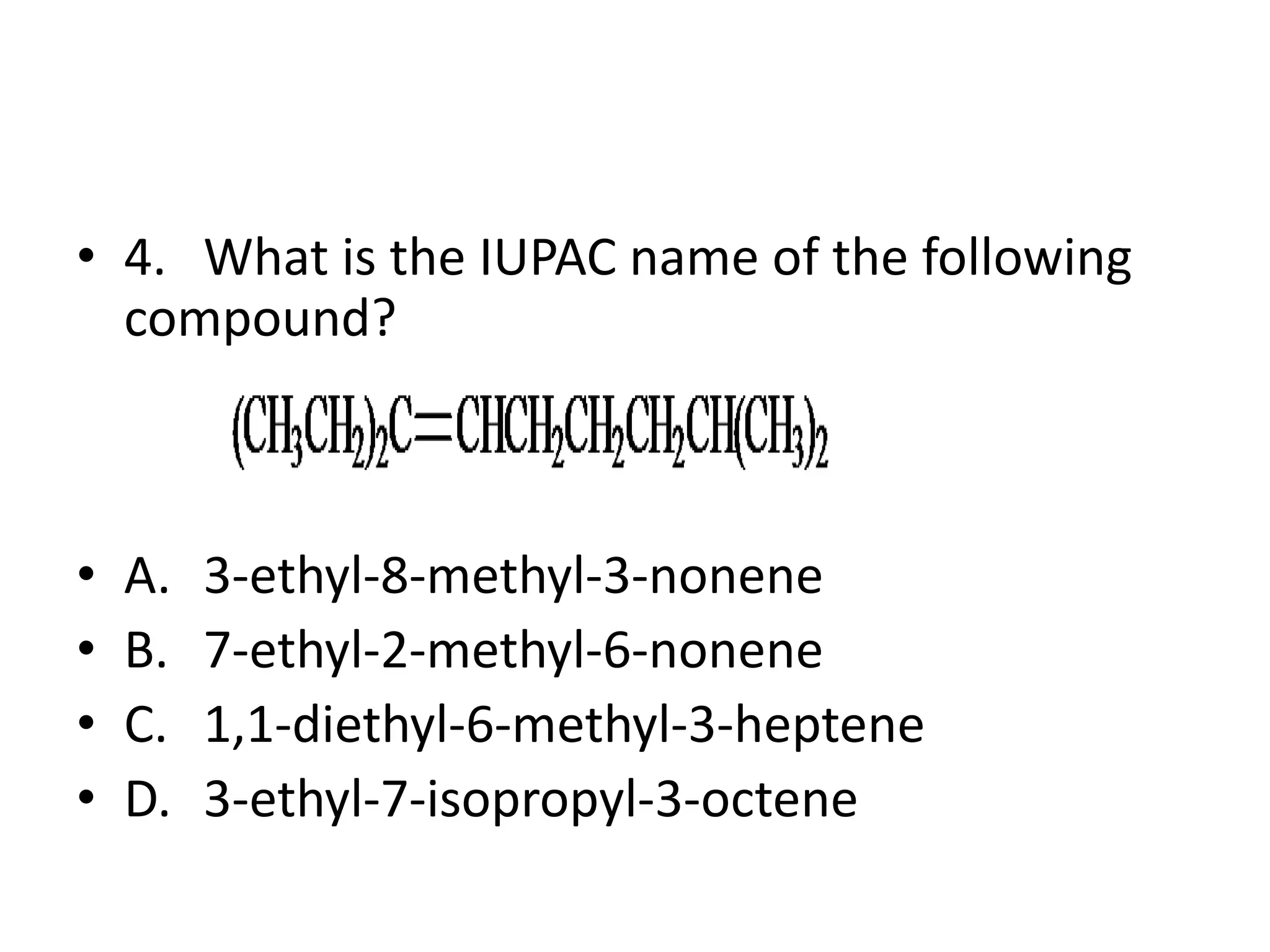
• 4. What is the IUPAC name of the following
compound?

•
•
•
•

A.
B.
C.
D.

3-ethyl-8-methyl-3-nonene
7-ethyl-2-methyl-6-nonene
1,1-diethyl-6-methyl-3-heptene
3-ethyl-7-isopropyl-3-octene
5. How many isomeric alkenes of formula
C4H8, including stereoisomers, are possible?
•
•
•
•
•

A.
B.
C.
D.

two
three
four
five
6. How many isomeric alkenes of formula
C5H10, including stereoisomers, are possible?
•
•
•
•

A.
B.
C.
D.

three
four
five
six
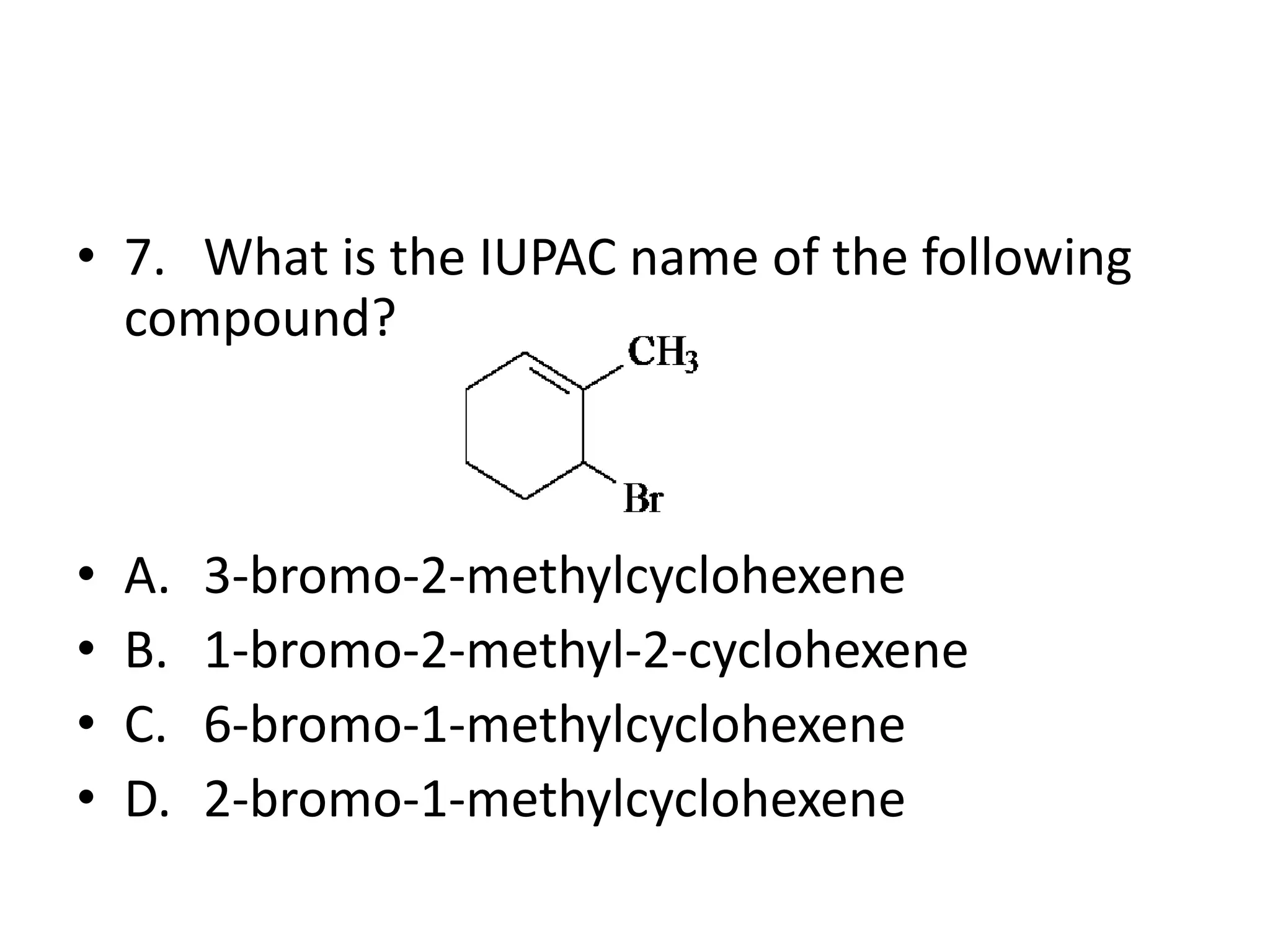
• 7. What is the IUPAC name of the following
compound?

•
•
•
•

A.
B.
C.
D.

3-bromo-2-methylcyclohexene
1-bromo-2-methyl-2-cyclohexene
6-bromo-1-methylcyclohexene
2-bromo-1-methylcyclohexene
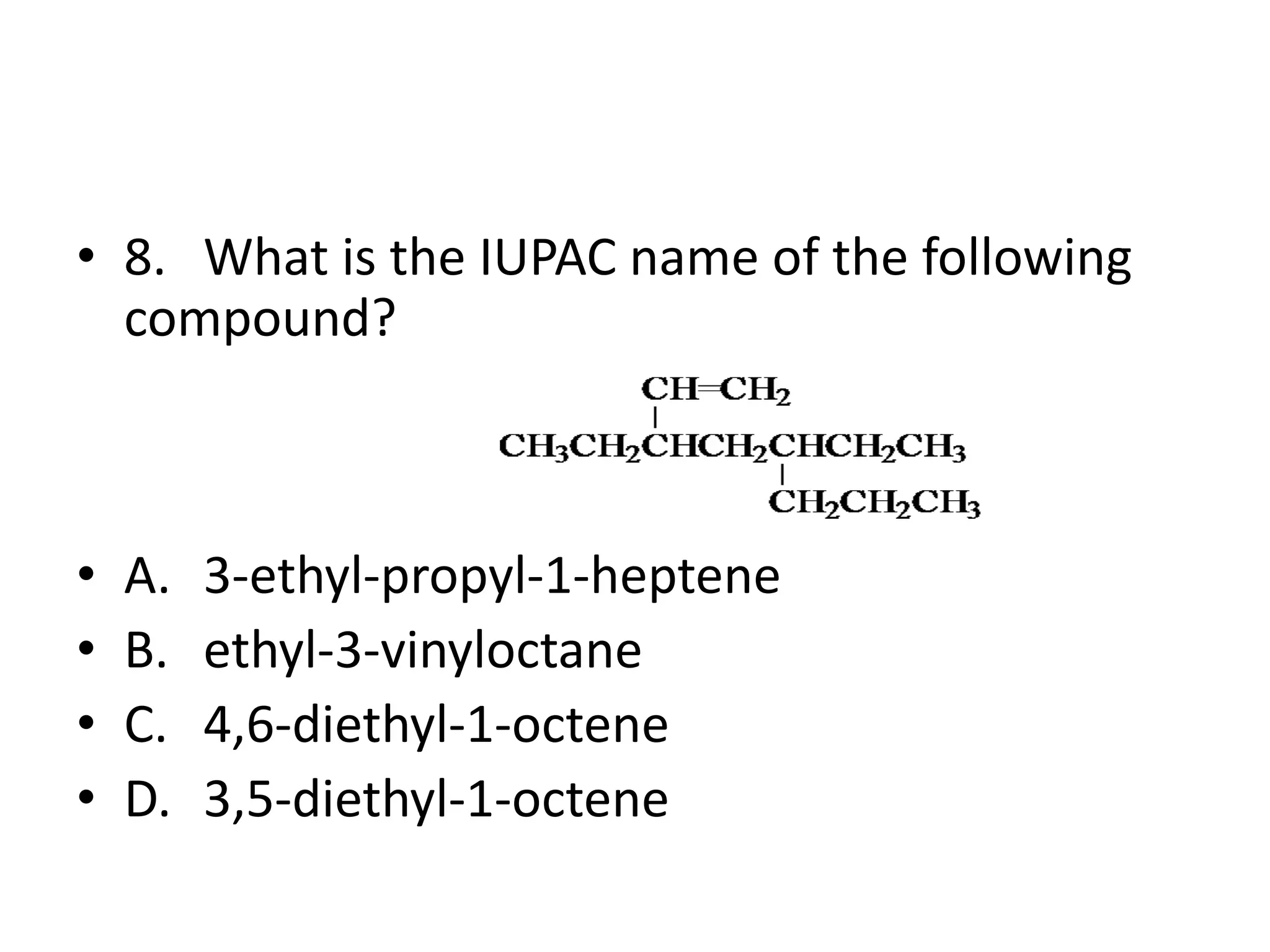
• 8. What is the IUPAC name of the following
compound?

•
•
•
•

A.
B.
C.
D.

3-ethyl-propyl-1-heptene
ethyl-3-vinyloctane
4,6-diethyl-1-octene
3,5-diethyl-1-octene
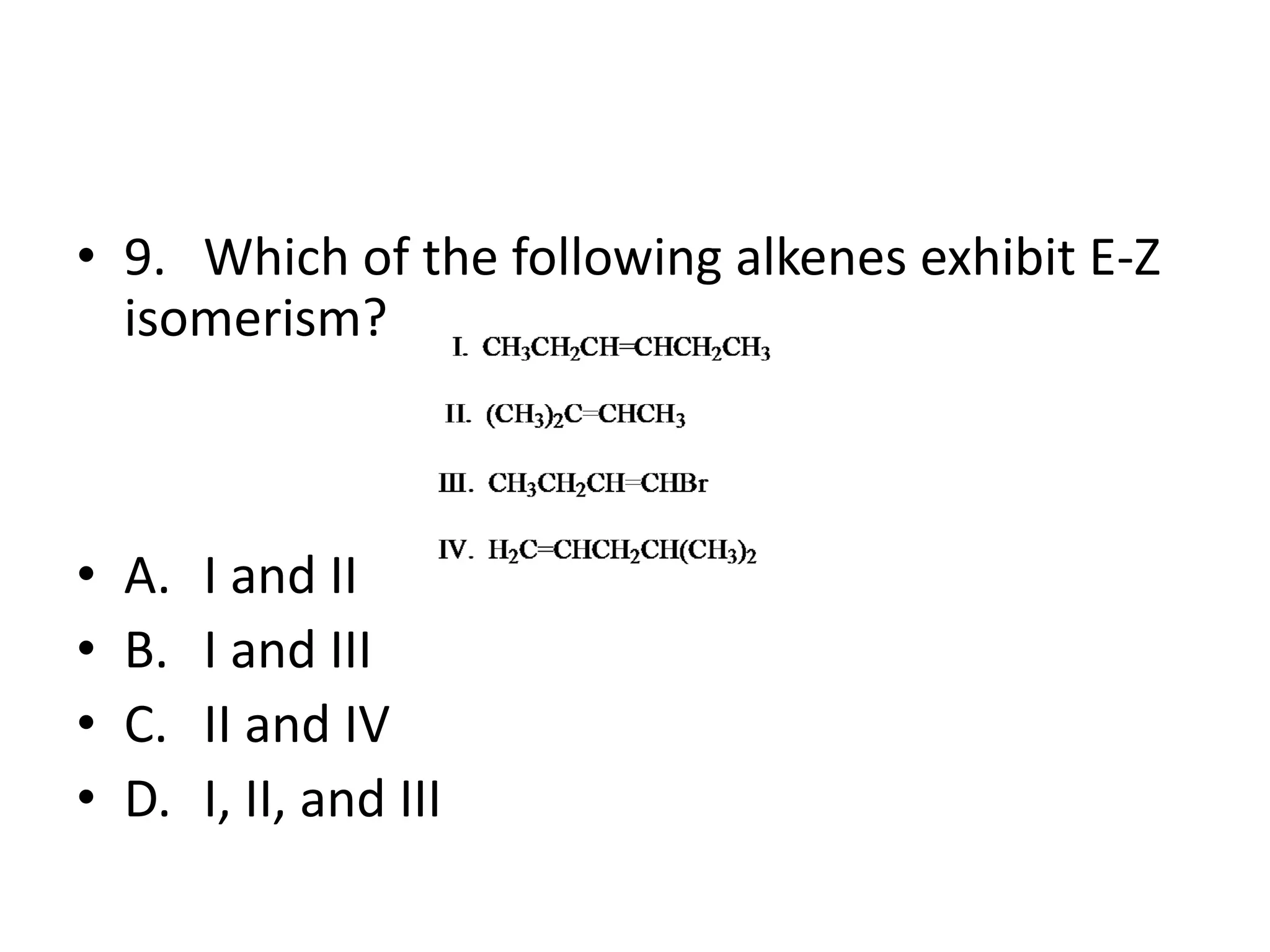
• 9. Which of the following alkenes exhibit E-Z
isomerism?

•
•
•
•

A.
B.
C.
D.

I and II
I and III
II and IV
I, II, and III
• 10. Which of the following alkenes exhibit E-Z
isomerism?
I. 1-chloropropene II. 2-chloropropene III. 3chloropropene
•
•
•
•

A.
B.
C.
D.

only I
I and II
II and III
I and III
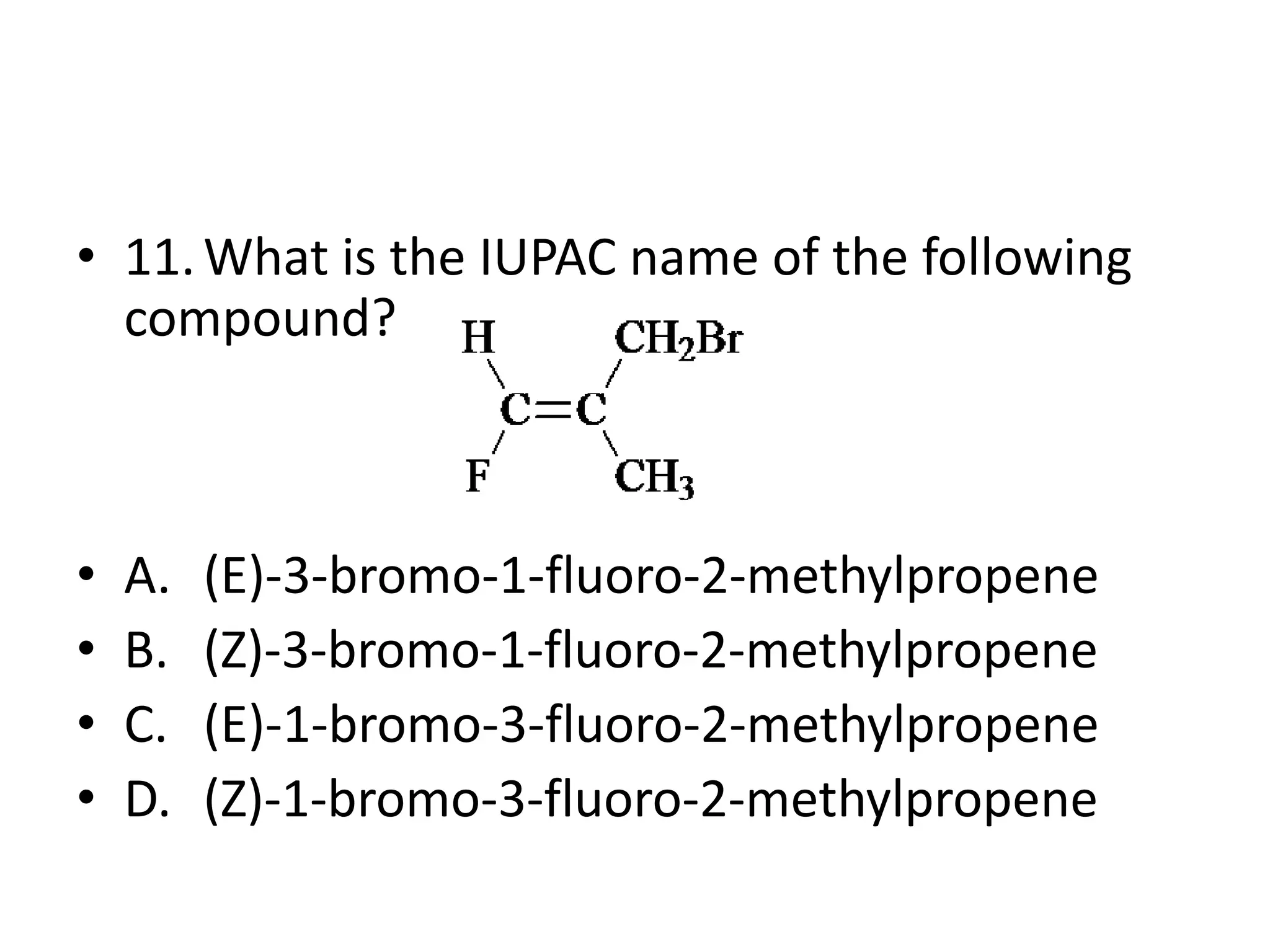
• 11. What is the IUPAC name of the following
compound?

•
•
•
•

A.
B.
C.
D.

(E)-3-bromo-1-fluoro-2-methylpropene
(Z)-3-bromo-1-fluoro-2-methylpropene
(E)-1-bromo-3-fluoro-2-methylpropene
(Z)-1-bromo-3-fluoro-2-methylpropene
• 12. Which of the following C6H12 isomers has
the highest heat of combustion?
•
•
•
•

A.
B.
C.
D.

1-hexene
trans-3-hexene
cis-3-hexene
2-methyl-2-pentene
• 13. Identify the major organic product
expected from the acid-catalyzed dehydration
of 2-methyl-2-pentanol.

•
•
•
•

A.
B.
C.
D.

2-methyl-1-pentene
2-methyl-2-pentene
3-methyl-1-pentene
cis-3-methyl-2-pentene
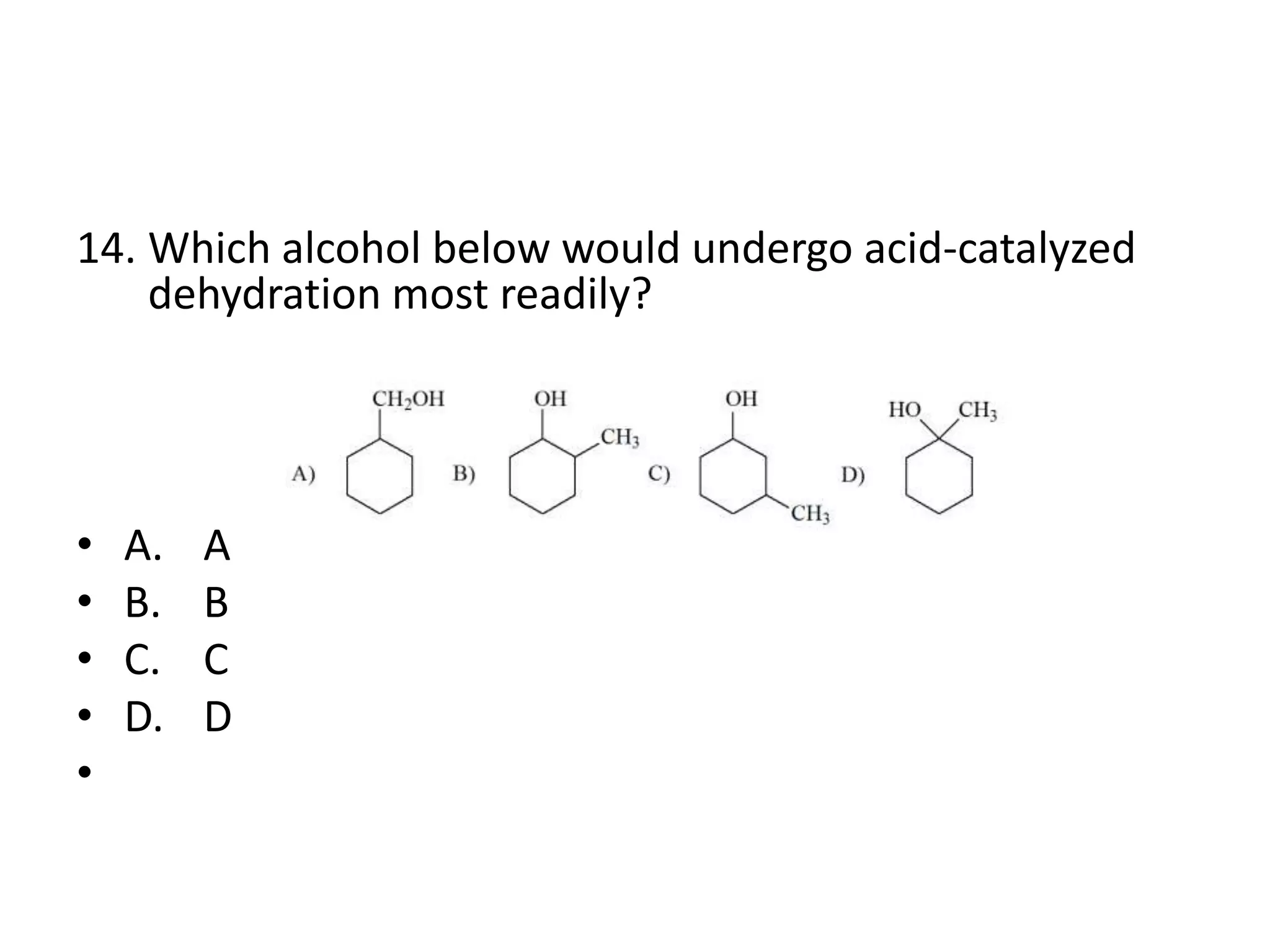
14. Which alcohol below would undergo acid-catalyzed
dehydration most readily?

•
•
•
•
•

A.
B.
C.
D.

A
B
C
D
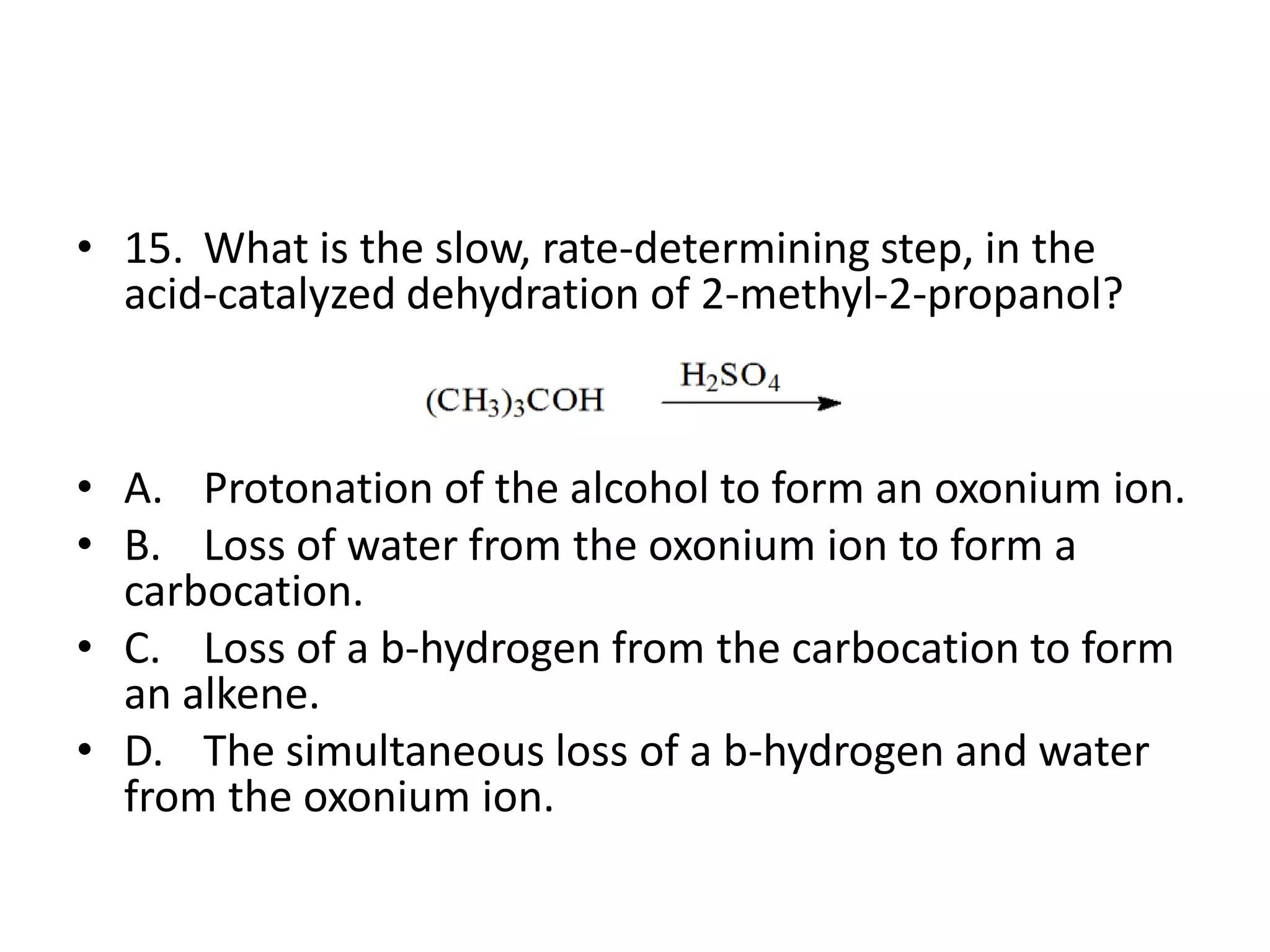
• 15. What is the slow, rate-determining step, in the
acid-catalyzed dehydration of 2-methyl-2-propanol?

• A. Protonation of the alcohol to form an oxonium ion.
• B. Loss of water from the oxonium ion to form a
carbocation.
• C. Loss of a b-hydrogen from the carbocation to form
an alkene.
• D. The simultaneous loss of a b-hydrogen and water
from the oxonium ion.
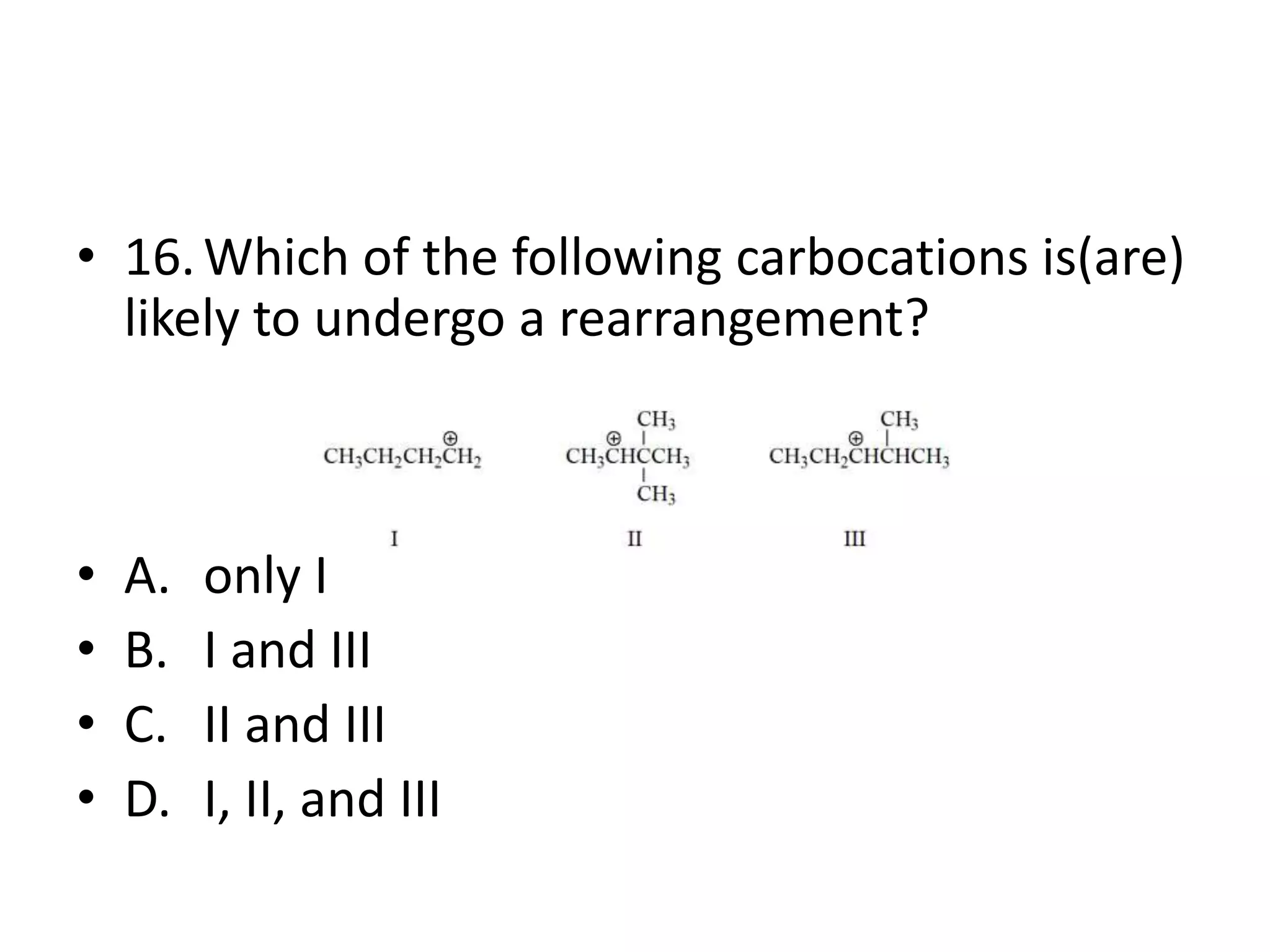
• 16. Which of the following carbocations is(are)
likely to undergo a rearrangement?

•
•
•
•

A.
B.
C.
D.

only I
I and III
II and III
I, II, and III
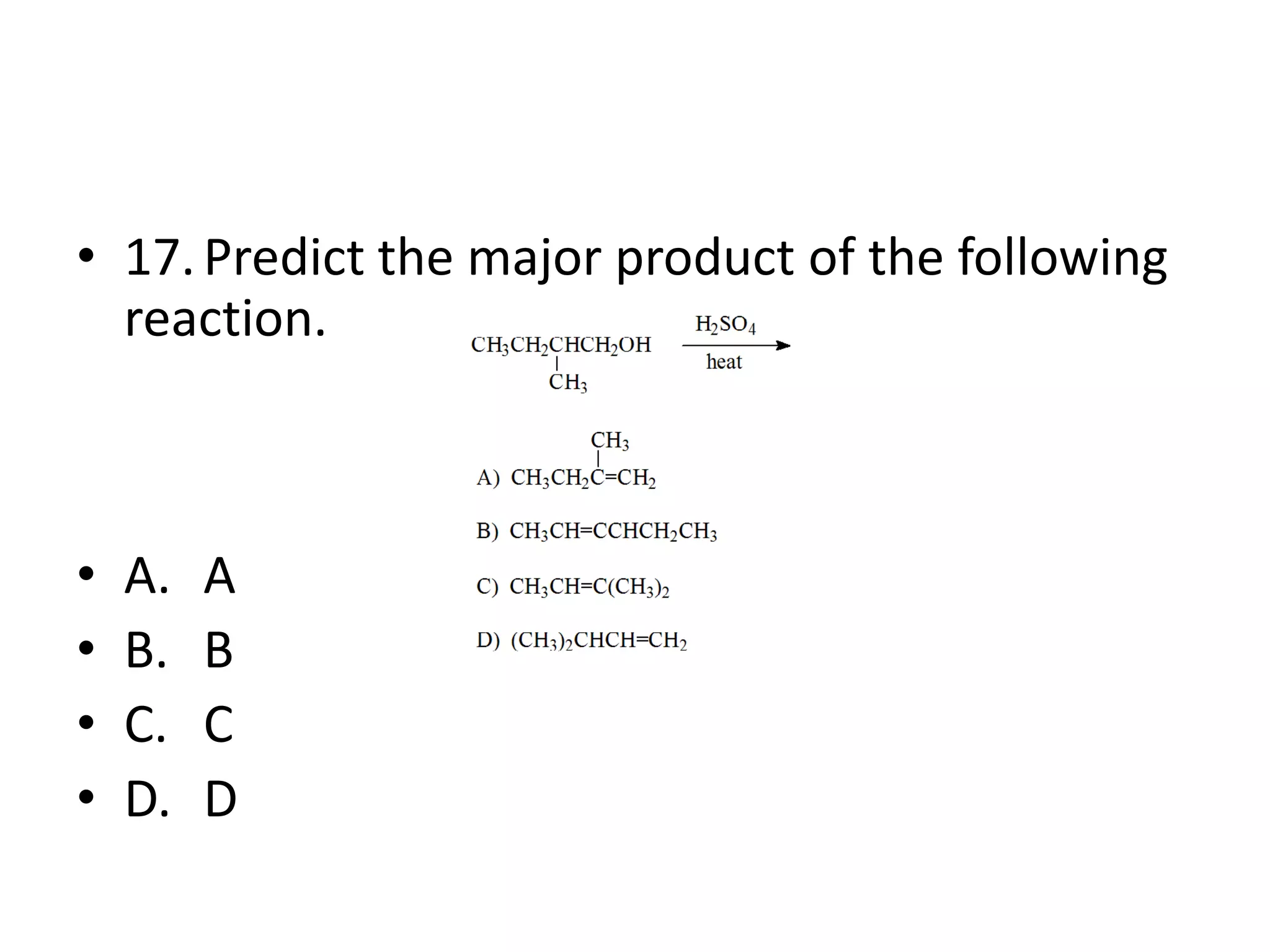
• 17. Predict the major product of the following
reaction.

•
•
•
•

A.
B.
C.
D.

A
B
C
D

Folder test bank is orgo chapter 5

  • 1.
    Chapter 5 Structureand Preparation of Alkenes - Elimination Reactions • .
  • 2.
    • 1. Carbon-carbondouble bonds do not freely rotate like carbon-carbon single bonds. Why? • A. The double bond is much stronger and thus more difficult to rotate. • B. Overlap of the two 2p orbitals of the bond would be lost. • C. The shorter bond length of the double bond makes it more difficult for the attached groups to pass each other. • D. Overlap of the sp2 orbitals of the carbon-carbon bond would be lost.
  • 3.
    • 2. Whatis the IUPAC name of the following compound? • • • • A. B. C. D. 2,5-dimethyl-1-hexene 1,4-dimethyl-1-hexene 2,5-dimethyl-2-hexene 2,5-dimethyl-5-hexene
  • 4.
    • 3. Whatis the IUPAC name of the following compound? • • • • A. B. C. D. 2-methyl-3-propyl-2-pentene 3-ethyl-2-methyl-2-hexene 4-ethyl-methyl-4-hexene 4-methyl-3-propyl-3-pentene
  • 5.
    • 4. Whatis the IUPAC name of the following compound? • • • • A. B. C. D. 3-ethyl-8-methyl-3-nonene 7-ethyl-2-methyl-6-nonene 1,1-diethyl-6-methyl-3-heptene 3-ethyl-7-isopropyl-3-octene
  • 6.
    5. How manyisomeric alkenes of formula C4H8, including stereoisomers, are possible? • • • • • A. B. C. D. two three four five
  • 7.
    6. How manyisomeric alkenes of formula C5H10, including stereoisomers, are possible? • • • • A. B. C. D. three four five six
  • 8.
    • 7. Whatis the IUPAC name of the following compound? • • • • A. B. C. D. 3-bromo-2-methylcyclohexene 1-bromo-2-methyl-2-cyclohexene 6-bromo-1-methylcyclohexene 2-bromo-1-methylcyclohexene
  • 9.
    • 8. Whatis the IUPAC name of the following compound? • • • • A. B. C. D. 3-ethyl-propyl-1-heptene ethyl-3-vinyloctane 4,6-diethyl-1-octene 3,5-diethyl-1-octene
  • 10.
    • 9. Whichof the following alkenes exhibit E-Z isomerism? • • • • A. B. C. D. I and II I and III II and IV I, II, and III
  • 11.
    • 10. Whichof the following alkenes exhibit E-Z isomerism? I. 1-chloropropene II. 2-chloropropene III. 3chloropropene • • • • A. B. C. D. only I I and II II and III I and III
  • 12.
    • 11. Whatis the IUPAC name of the following compound? • • • • A. B. C. D. (E)-3-bromo-1-fluoro-2-methylpropene (Z)-3-bromo-1-fluoro-2-methylpropene (E)-1-bromo-3-fluoro-2-methylpropene (Z)-1-bromo-3-fluoro-2-methylpropene
  • 13.
    • 12. Whichof the following C6H12 isomers has the highest heat of combustion? • • • • A. B. C. D. 1-hexene trans-3-hexene cis-3-hexene 2-methyl-2-pentene
  • 14.
    • 13. Identifythe major organic product expected from the acid-catalyzed dehydration of 2-methyl-2-pentanol. • • • • A. B. C. D. 2-methyl-1-pentene 2-methyl-2-pentene 3-methyl-1-pentene cis-3-methyl-2-pentene
  • 15.
    14. Which alcoholbelow would undergo acid-catalyzed dehydration most readily? • • • • • A. B. C. D. A B C D
  • 16.
    • 15. Whatis the slow, rate-determining step, in the acid-catalyzed dehydration of 2-methyl-2-propanol? • A. Protonation of the alcohol to form an oxonium ion. • B. Loss of water from the oxonium ion to form a carbocation. • C. Loss of a b-hydrogen from the carbocation to form an alkene. • D. The simultaneous loss of a b-hydrogen and water from the oxonium ion.
  • 17.
    • 16. Whichof the following carbocations is(are) likely to undergo a rearrangement? • • • • A. B. C. D. only I I and III II and III I, II, and III
  • 18.
    • 17. Predictthe major product of the following reaction. • • • • A. B. C. D. A B C D