Structure and Preparation of
Alkenes: Elimination Reactions
Alkene Nomenclature
First identify the longest continuous chain that includes
the double bond.
Replace the -ane ending of the corresponding unbranched
alkane with -ene.
Number the chain in the direction that gives the lowest
number to the first carbon of the alkene.
Alkene Nomenclature
Alkenes take precedence over
alkyl- and halo-substituents
when numbering the carbons.
The longest contiguous carbon chain including the alkene
takes precedence over a longer chain that does not
include the alkene.
Alkene Nomenclature
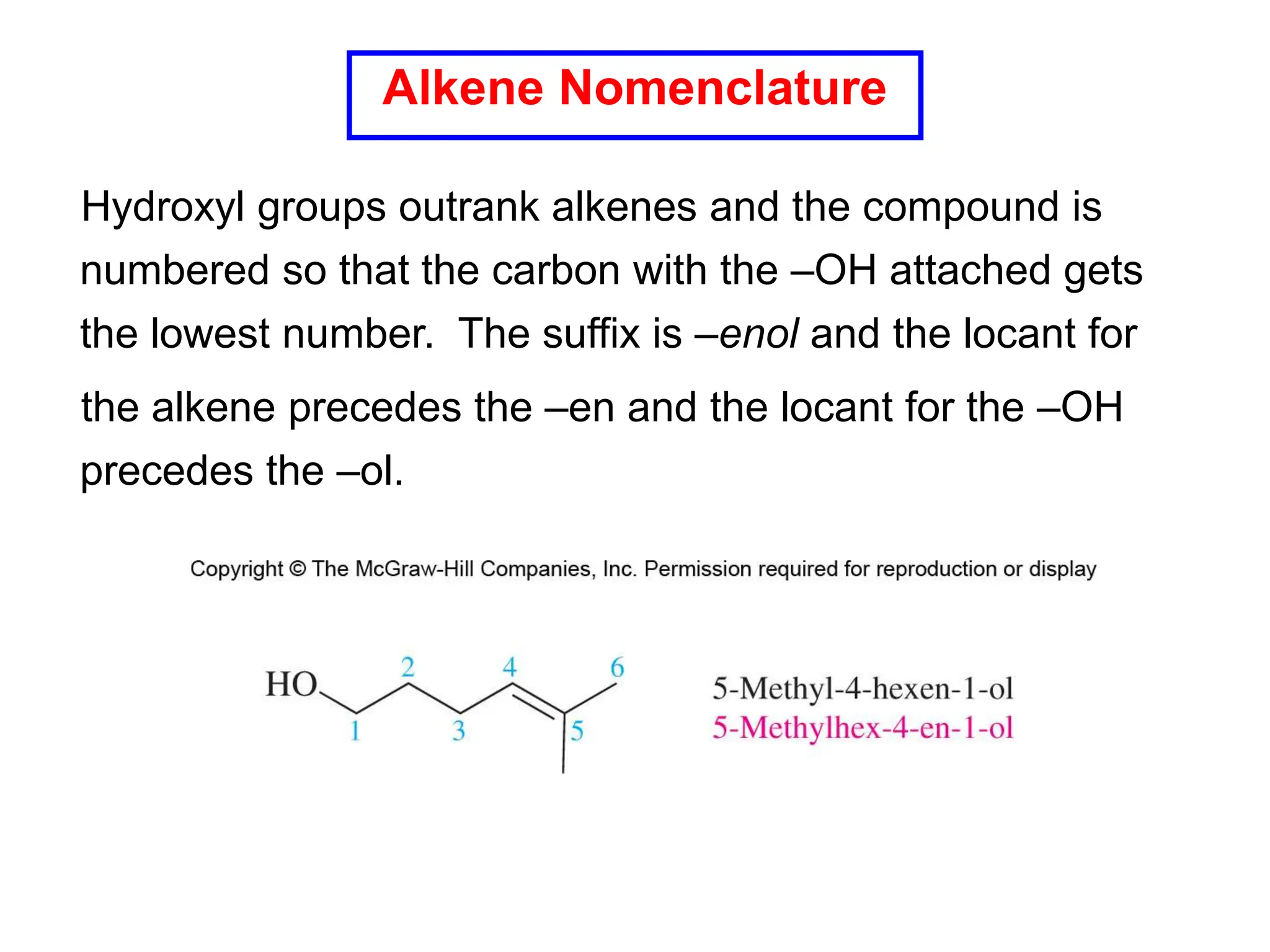
Hydroxyl groups outrank alkenes and the compound is
numbered so that the carbon with the –OH attached gets
the lowest number. The suffix is –enol and the locant for
the alkene precedes the –en and the locant for the –OH
precedes the –ol.
Practice Question
Name the alkene below according to the
IUPAC system.
A) 2-bromo-5-heptane
B) 6-bromo-2-heptene
C) 2-bromo-5-heptene
D) 5-bromo-2-heptene
E) 6-bromo-6-methyl-2-hexene
Common Names
Some common names are acceptable.
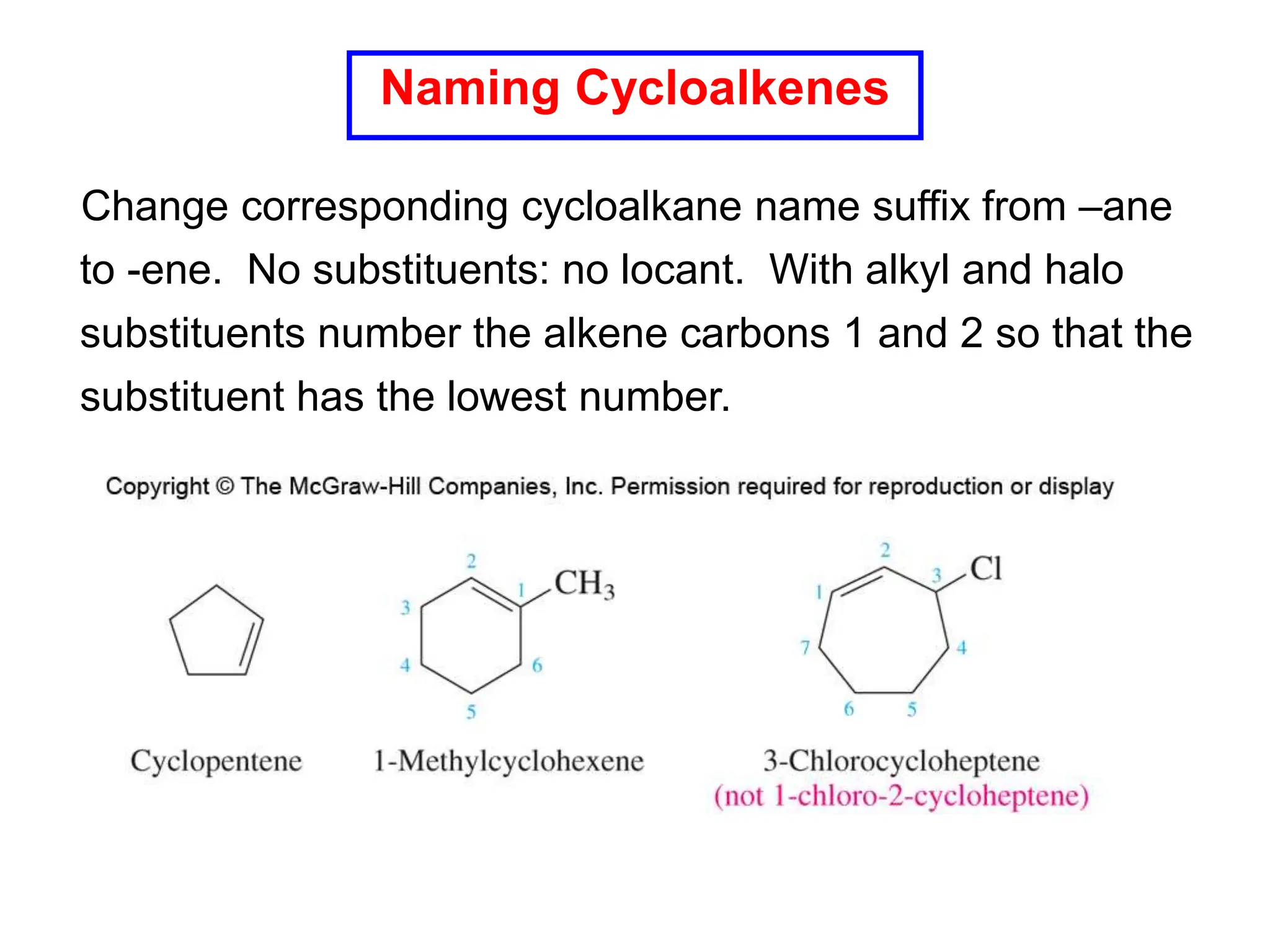
Naming Cycloalkenes
Change corresponding cycloalkane name suffix from –ane
to -ene. No substituents: no locant. With alkyl and halo
substituents number the alkene carbons 1 and 2 so that the
substituent has the lowest number.
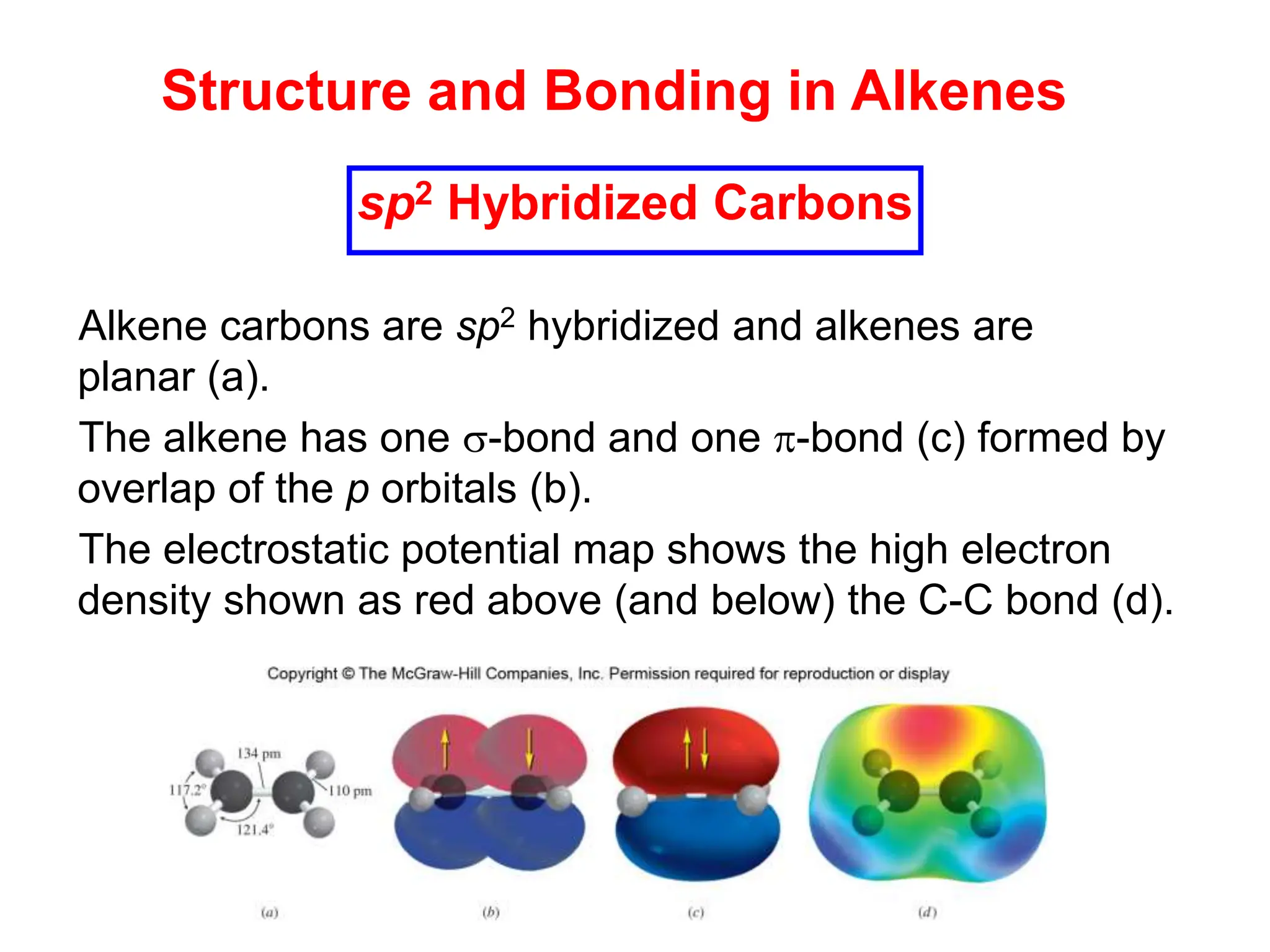
sp2 Hybridized Carbons
Alkene carbons are sp2 hybridized and alkenes are
planar (a).
The alkene has one s-bond and one p-bond (c) formed by
overlap of the p orbitals (b).
The electrostatic potential map shows the high electron
density shown as red above (and below) the C-C bond (d).
Structure and Bonding in Alkenes
Bond Strength
The C=C double bond is stronger and shorter than a single
bond.
The p bond is weaker than a s bond.
Isomers of C4H8
The four isomers are:
1-Butene is a constitutional isomer of the other three.
Cis- and trans-2-butene are stereoisomers: same
connectivity but a different arrangement in space.
Practice Question
Which alkene can have cis/trans
stereoisomers?
A) B)
C) D)
Cis and Trans Isomers
Rotation about double bonds is restricted so
interconversion or rotation about a double bond
is not possible.
E-Z Nomenclature
Some alkenes are too complex to name using cis or trans.
For these alkenes the E-Z system is used.
The two atoms directly connected to each alkene are
compared. The atom with higher atomic number has
higher priority. The position of the high priority groups
are compared. If they are on the same side the compound
is (Z) – otherwise it is (E).
E-Z Nomenclature
This system is the Cahn-Ingold-Prelog (CIP) system.
When two atoms directly attached to the same carbon of
the double bond are identical, compare the atoms attached
to these two on the basis of their atomic numbers.
Precedence is determined at the first point of difference:
Compare the atoms connected to the two carbons on the
right and ethyl [⎯ C(C,H,H)] outranks methyl [⎯ C(H,H,H)]
E-Z Nomenclature
Compare the atoms directly connected to the two carbons
on the right and ⎯ CH(CH3)2 [⎯ C(C,C,H)] outranks
⎯ CH2CH2OH [⎯ C(C,H,H)].
The oxygen is NOT considered because the first point of
difference was reached with the first carbon. The O is
on the second carbon.
E-Z Nomenclature
Compare the atoms directly connected to the two carbons
on the right one by one, never as a group. Because oxygen
has a higher atomic number than carbon, ⎯ CH2OH
[⎯ C(O,H,H)] outranks ⎯ C(CH3)3 [⎯ C(C,C,C)].
The oxygen IS the first point of difference.
E-Z Nomenclature
A multiply bonded atom is considered as two bonds to that
atom. The group ⎯ CH = O [⎯ C(O,O,H)] outranks
⎯ CH2OH [⎯ C(O,H,H)]
Stability of Alkenes
The heat of combustion of alkenes can be used to
determine relative stabilities. Alkenes with the lowest
heat of combustion are most stable.
Stability of Alkenes
The most important factors governing alkene stability are:
1. Degree of substitution of C=C (an electronic effect);
2. van der Waals strain in the cis stereoisomer (a steric
effect)
3. Chain branching increases stability.
Highly substituted double bonds are more stable than
isomers with less substituted double bonds.
Trans alkenes are more stable than the cis stereoisomers.
Stability of Alkenes
The general trend is: more substituted alkenes are more
stable than less substituted alkenes.
tetrasubstituted monosubstituted
disubstituted
trans
trisubstituted disubstituted
cis
Stability of Alkenes
Trans alkenes are more stable than the cis stereoisomers.
Steric strain between the methyl groups in the cis isomer.
With larger groups the effect is more pronounced.
Cycloalkenes
Cyclopropene has the most strained of the cycloalkenes
because the sp2 hybridized carbon prefers a bond angle
of 120o. Cyclobutene has less ring strain and the other
larger rings have negligible ring strain.
cyclopropene cyclohexene
Cyclooctene
Cyclooctene can exist as either a cis or trans isomer.
Smaller cycloalkenes can only have an alkene with a cis
conformation .
When there are more than 12 carbons in the ring, trans-
cycloalkenes are more stable than cis.
Cis and trans-cyclododecene are almost equal in stability.
trans-Cyclododecene cis-Cyclododecene
Cyclododecene
Preparation of Alkenes:
Elimination Reactions
The elimination of two substituents from adjacent
carbons (a and b) forms alkenes.
The process is b-elimination.
Dehydration of Alcohols
The elimination where X=OH and Y=H is dehydration.
Catalyzed by strong acids.
Selective reaction: when one product is preferentially formed.
Regioselective reactions proceed preferentially in one
direction.
Dehydration of 2-methyl-2-butanol is regioselective forming
the more substituted alkene.
Regioselectivity in Alcohol Dehydration:
The Zaitsev Rule
Zaitsevs Rule
Zaitsevs rule states that the alkene formed in greatest
amount is the one that corresponds to removal of the
hydrogen from the β carbon having the fewest
hydrogens.
Alternatively it is stated that β elimination reactions of
alcohols yield the most highly substituted alkene as the
major product.
Stereoselectivity in Alcohol Dehydration
A stereoselective reaction yields one stereoisomer in
preference to another.
Dehydration normally favors the more stable trans
stereoisomer.
Practice Question
What is the major product of the dehydration
of 2-methylcyclohexanol?
A) 1-methylcyclohexene
B) 2-methylcyclohexene
C) 3-methylcyclohexene
D) cyclohexene
E) 2-methylcyclohexane
E2 Dehydrohalogenation
Dehydrohalogenation is loss of a H and halogen from an
alkyl halide. This is a b-elimination reaction. A strong
base like sodium ethoxide (NaOCH2CH3) is needed.
General equation:
The rate is dependent on the concentration of the base
and the alkyl halide so it is termed an E2 reaction.
Dehydrohalogenation of Alkyl Halides
Dehydrohalogenation
For primary alcohols a strong but more hindered base is
preferred.
Selectivity of Dehydrohalogenation
Dehydrohalogenation follows the Zaitsev rule. The more
substituted alkene is preferentially formed.
The reaction is also stereoselective preferentially forming
the more stable trans stereoisomer.
Formation of cycloalkenes
Dehydrohalogenation of cycloalkyl halides leads to
cycloalkenes. Cis cyloalkenes are formed if the ring has
10 or fewer C atoms. Larger ring sizes give a mixture of
cis and trans
The Leaving Group
The halide anion that leaves the alkyl halide is known as
the leaving group.
The choice of halogen affects the rate constant for this
reaction in the order below. The C-I bond is weakest
and iodide is the best leaving group. Fluoride is not a
good leaving group.
The Leaving Group
The halide anion that leaves the alkyl halide is known as
the leaving group.
The choice of halogen affects the rate constant for this
reaction in the order below. The C-I bond is weakest
and iodide is the best leaving group. Fluoride is not a
good leaving group.
The E1 Mechanism of
Dehydrohalogenation of Alkyl Halides
The E2 elimination is a concerted reaction. In contrast
the E1 reaction has a step by step mechanism. The
reaction equation “looks” similar.
The E1 Dehydrohalogenation
The first step is the slow ionization of the alkyl halide.
Since a carbocation is formed this will not happen with a
primary alkyl halide. This is the slow rate determining step.
It is unimolecular so the reaction is termed E1.
Step 1. Ionization.
The E1 Dehydrohalogenation
The second step is similar to step 3 in the E1 dehydration
of alcohols.
Step 2. Deprotonation (of a primary H).
Step 2’. Deprotonation (of a secondary H).
E1 vs E2
The E1 elimination generally only occurs with a tertiary
alkyl halide with a weak base (not charged). The rate of
an E1 reaction is given by:

Alkene Chemistry Properties and Formation.pptx

  • 1.
    Structure and Preparationof Alkenes: Elimination Reactions
  • 2.
    Alkene Nomenclature First identifythe longest continuous chain that includes the double bond. Replace the -ane ending of the corresponding unbranched alkane with -ene. Number the chain in the direction that gives the lowest number to the first carbon of the alkene.
  • 3.
    Alkene Nomenclature Alkenes takeprecedence over alkyl- and halo-substituents when numbering the carbons. The longest contiguous carbon chain including the alkene takes precedence over a longer chain that does not include the alkene.
  • 4.
    Alkene Nomenclature Hydroxyl groupsoutrank alkenes and the compound is numbered so that the carbon with the –OH attached gets the lowest number. The suffix is –enol and the locant for the alkene precedes the –en and the locant for the –OH precedes the –ol.
  • 5.
    Practice Question Name thealkene below according to the IUPAC system. A) 2-bromo-5-heptane B) 6-bromo-2-heptene C) 2-bromo-5-heptene D) 5-bromo-2-heptene E) 6-bromo-6-methyl-2-hexene
  • 6.
    Common Names Some commonnames are acceptable.
  • 7.
    Naming Cycloalkenes Change correspondingcycloalkane name suffix from –ane to -ene. No substituents: no locant. With alkyl and halo substituents number the alkene carbons 1 and 2 so that the substituent has the lowest number.
  • 8.
    sp2 Hybridized Carbons Alkenecarbons are sp2 hybridized and alkenes are planar (a). The alkene has one s-bond and one p-bond (c) formed by overlap of the p orbitals (b). The electrostatic potential map shows the high electron density shown as red above (and below) the C-C bond (d). Structure and Bonding in Alkenes
  • 9.
    Bond Strength The C=Cdouble bond is stronger and shorter than a single bond. The p bond is weaker than a s bond.
  • 10.
    Isomers of C4H8 Thefour isomers are: 1-Butene is a constitutional isomer of the other three. Cis- and trans-2-butene are stereoisomers: same connectivity but a different arrangement in space.
  • 11.
    Practice Question Which alkenecan have cis/trans stereoisomers? A) B) C) D)
  • 12.
    Cis and TransIsomers Rotation about double bonds is restricted so interconversion or rotation about a double bond is not possible.
  • 13.
    E-Z Nomenclature Some alkenesare too complex to name using cis or trans. For these alkenes the E-Z system is used. The two atoms directly connected to each alkene are compared. The atom with higher atomic number has higher priority. The position of the high priority groups are compared. If they are on the same side the compound is (Z) – otherwise it is (E).
  • 14.
    E-Z Nomenclature This systemis the Cahn-Ingold-Prelog (CIP) system. When two atoms directly attached to the same carbon of the double bond are identical, compare the atoms attached to these two on the basis of their atomic numbers. Precedence is determined at the first point of difference: Compare the atoms connected to the two carbons on the right and ethyl [⎯ C(C,H,H)] outranks methyl [⎯ C(H,H,H)]
  • 15.
    E-Z Nomenclature Compare theatoms directly connected to the two carbons on the right and ⎯ CH(CH3)2 [⎯ C(C,C,H)] outranks ⎯ CH2CH2OH [⎯ C(C,H,H)]. The oxygen is NOT considered because the first point of difference was reached with the first carbon. The O is on the second carbon.
  • 16.
    E-Z Nomenclature Compare theatoms directly connected to the two carbons on the right one by one, never as a group. Because oxygen has a higher atomic number than carbon, ⎯ CH2OH [⎯ C(O,H,H)] outranks ⎯ C(CH3)3 [⎯ C(C,C,C)]. The oxygen IS the first point of difference.
  • 17.
    E-Z Nomenclature A multiplybonded atom is considered as two bonds to that atom. The group ⎯ CH = O [⎯ C(O,O,H)] outranks ⎯ CH2OH [⎯ C(O,H,H)]
  • 18.
    Stability of Alkenes Theheat of combustion of alkenes can be used to determine relative stabilities. Alkenes with the lowest heat of combustion are most stable.
  • 19.
    Stability of Alkenes Themost important factors governing alkene stability are: 1. Degree of substitution of C=C (an electronic effect); 2. van der Waals strain in the cis stereoisomer (a steric effect) 3. Chain branching increases stability. Highly substituted double bonds are more stable than isomers with less substituted double bonds. Trans alkenes are more stable than the cis stereoisomers.
  • 20.
    Stability of Alkenes Thegeneral trend is: more substituted alkenes are more stable than less substituted alkenes. tetrasubstituted monosubstituted disubstituted trans trisubstituted disubstituted cis
  • 21.
    Stability of Alkenes Transalkenes are more stable than the cis stereoisomers. Steric strain between the methyl groups in the cis isomer. With larger groups the effect is more pronounced.
  • 22.
    Cycloalkenes Cyclopropene has themost strained of the cycloalkenes because the sp2 hybridized carbon prefers a bond angle of 120o. Cyclobutene has less ring strain and the other larger rings have negligible ring strain. cyclopropene cyclohexene
  • 23.
    Cyclooctene Cyclooctene can existas either a cis or trans isomer. Smaller cycloalkenes can only have an alkene with a cis conformation .
  • 24.
    When there aremore than 12 carbons in the ring, trans- cycloalkenes are more stable than cis. Cis and trans-cyclododecene are almost equal in stability. trans-Cyclododecene cis-Cyclododecene Cyclododecene
  • 25.
    Preparation of Alkenes: EliminationReactions The elimination of two substituents from adjacent carbons (a and b) forms alkenes. The process is b-elimination.
  • 26.
    Dehydration of Alcohols Theelimination where X=OH and Y=H is dehydration. Catalyzed by strong acids.
  • 27.
    Selective reaction: whenone product is preferentially formed. Regioselective reactions proceed preferentially in one direction. Dehydration of 2-methyl-2-butanol is regioselective forming the more substituted alkene. Regioselectivity in Alcohol Dehydration: The Zaitsev Rule
  • 28.
    Zaitsevs Rule Zaitsevs rulestates that the alkene formed in greatest amount is the one that corresponds to removal of the hydrogen from the β carbon having the fewest hydrogens. Alternatively it is stated that β elimination reactions of alcohols yield the most highly substituted alkene as the major product.
  • 29.
    Stereoselectivity in AlcoholDehydration A stereoselective reaction yields one stereoisomer in preference to another. Dehydration normally favors the more stable trans stereoisomer.
  • 30.
    Practice Question What isthe major product of the dehydration of 2-methylcyclohexanol? A) 1-methylcyclohexene B) 2-methylcyclohexene C) 3-methylcyclohexene D) cyclohexene E) 2-methylcyclohexane
  • 31.
    E2 Dehydrohalogenation Dehydrohalogenation isloss of a H and halogen from an alkyl halide. This is a b-elimination reaction. A strong base like sodium ethoxide (NaOCH2CH3) is needed. General equation: The rate is dependent on the concentration of the base and the alkyl halide so it is termed an E2 reaction. Dehydrohalogenation of Alkyl Halides
  • 32.
    Dehydrohalogenation For primary alcoholsa strong but more hindered base is preferred.
  • 33.
    Selectivity of Dehydrohalogenation Dehydrohalogenationfollows the Zaitsev rule. The more substituted alkene is preferentially formed. The reaction is also stereoselective preferentially forming the more stable trans stereoisomer.
  • 34.
    Formation of cycloalkenes Dehydrohalogenationof cycloalkyl halides leads to cycloalkenes. Cis cyloalkenes are formed if the ring has 10 or fewer C atoms. Larger ring sizes give a mixture of cis and trans
  • 35.
    The Leaving Group Thehalide anion that leaves the alkyl halide is known as the leaving group. The choice of halogen affects the rate constant for this reaction in the order below. The C-I bond is weakest and iodide is the best leaving group. Fluoride is not a good leaving group.
  • 36.
    The Leaving Group Thehalide anion that leaves the alkyl halide is known as the leaving group. The choice of halogen affects the rate constant for this reaction in the order below. The C-I bond is weakest and iodide is the best leaving group. Fluoride is not a good leaving group.
  • 37.
    The E1 Mechanismof Dehydrohalogenation of Alkyl Halides The E2 elimination is a concerted reaction. In contrast the E1 reaction has a step by step mechanism. The reaction equation “looks” similar.
  • 38.
    The E1 Dehydrohalogenation Thefirst step is the slow ionization of the alkyl halide. Since a carbocation is formed this will not happen with a primary alkyl halide. This is the slow rate determining step. It is unimolecular so the reaction is termed E1. Step 1. Ionization.
  • 39.
    The E1 Dehydrohalogenation Thesecond step is similar to step 3 in the E1 dehydration of alcohols. Step 2. Deprotonation (of a primary H). Step 2’. Deprotonation (of a secondary H).
  • 40.
    E1 vs E2 TheE1 elimination generally only occurs with a tertiary alkyl halide with a weak base (not charged). The rate of an E1 reaction is given by: