1
• The two major classes of isomers are constitutional
isomers and stereoisomers.
Constitutional/structural isomers have different
IUPAC names, the same or different functional
groups, different physical properties and different
chemical properties.
Stereoisomers differ only in the way the atoms are
oriented in space. They have identical IUPAC names
(except for a prefix like cis or trans). They always
have the same functional group(s).
• A particular three-dimensional arrangement is called a
configuration.
• Stereoisomers differ in configuration.
Stereochemistry
2
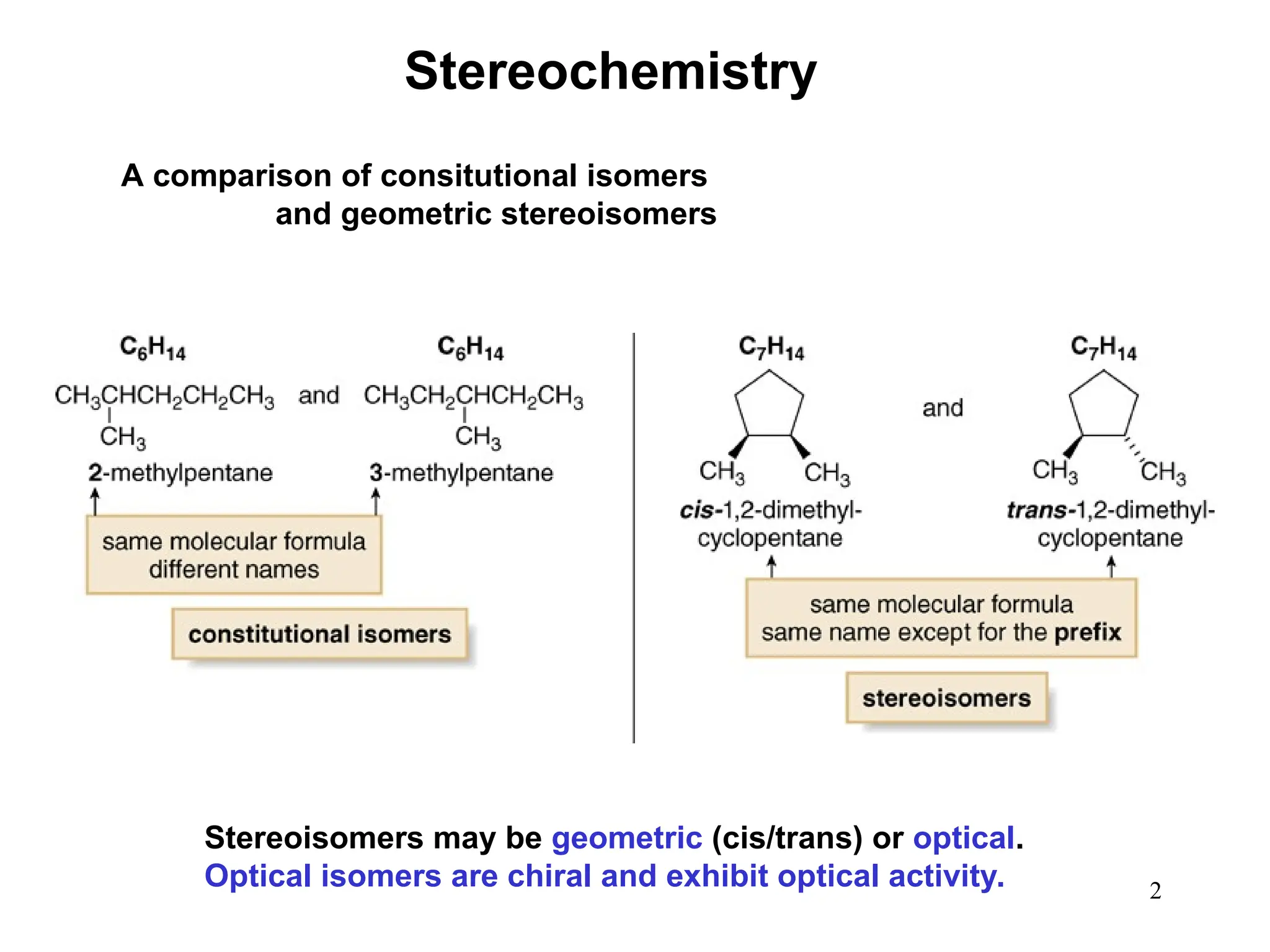
A comparison of consitutional isomers
and geometric stereoisomers
Stereochemistry
Stereoisomers may be geometric (cis/trans) or optical.
Optical isomers are chiral and exhibit optical activity.
3
• Although everything has a mirror image, mirror
images may or may not be superimposable.
• A molecule or object that is superimposable on its
mirror image is said to be achiral (lacking-chirality).
• A molecule or object that is not superimposable on
its mirror image is said to be chiral.
• Generally, a chiral carbon atom is sp3
with four
different attachments.
Stereochemistry
Chiral and Achiral Molecules:
4
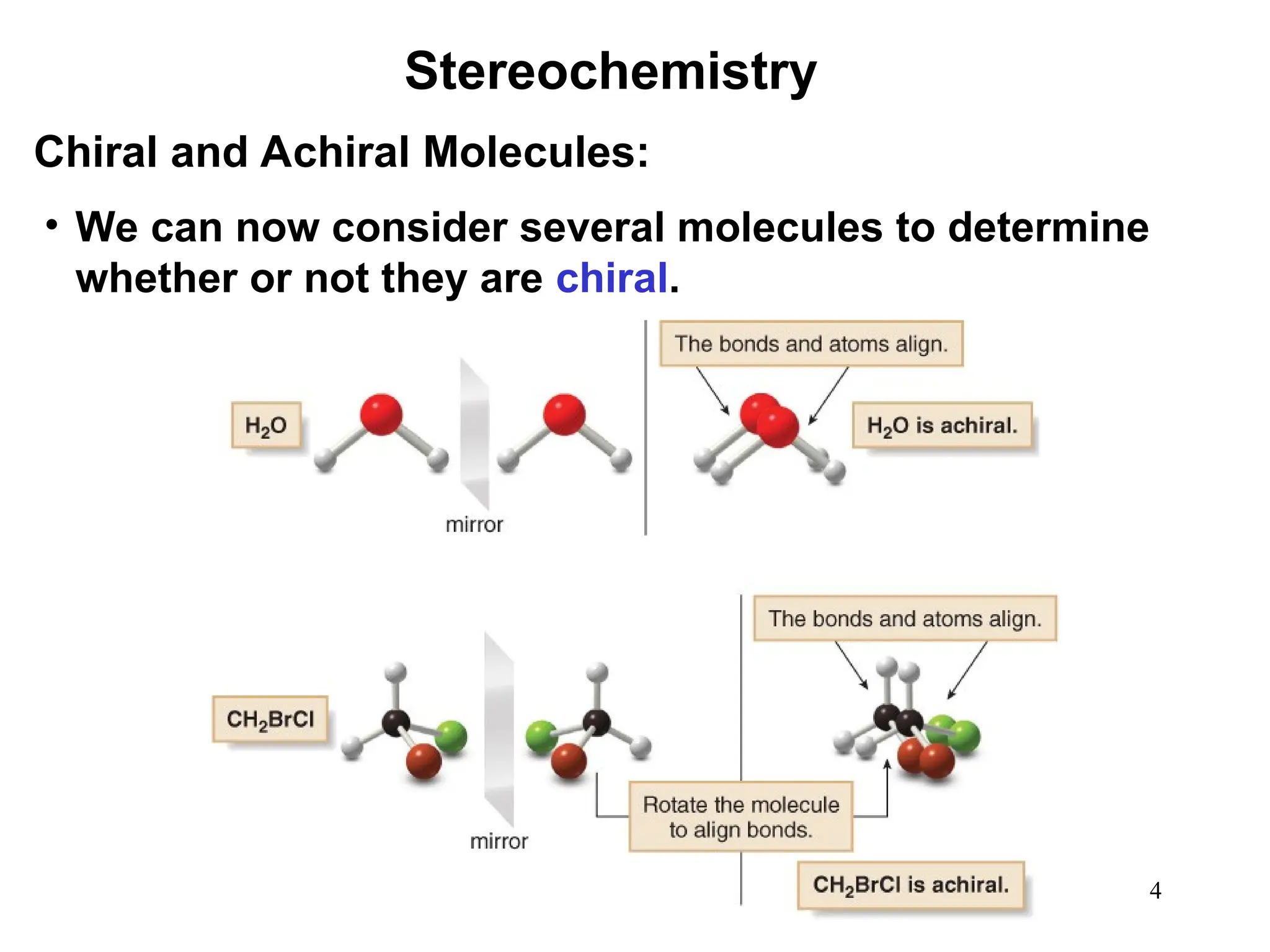
• We can now consider several molecules to determine
whether or not they are chiral.
Stereochemistry
Chiral and Achiral Molecules:
5
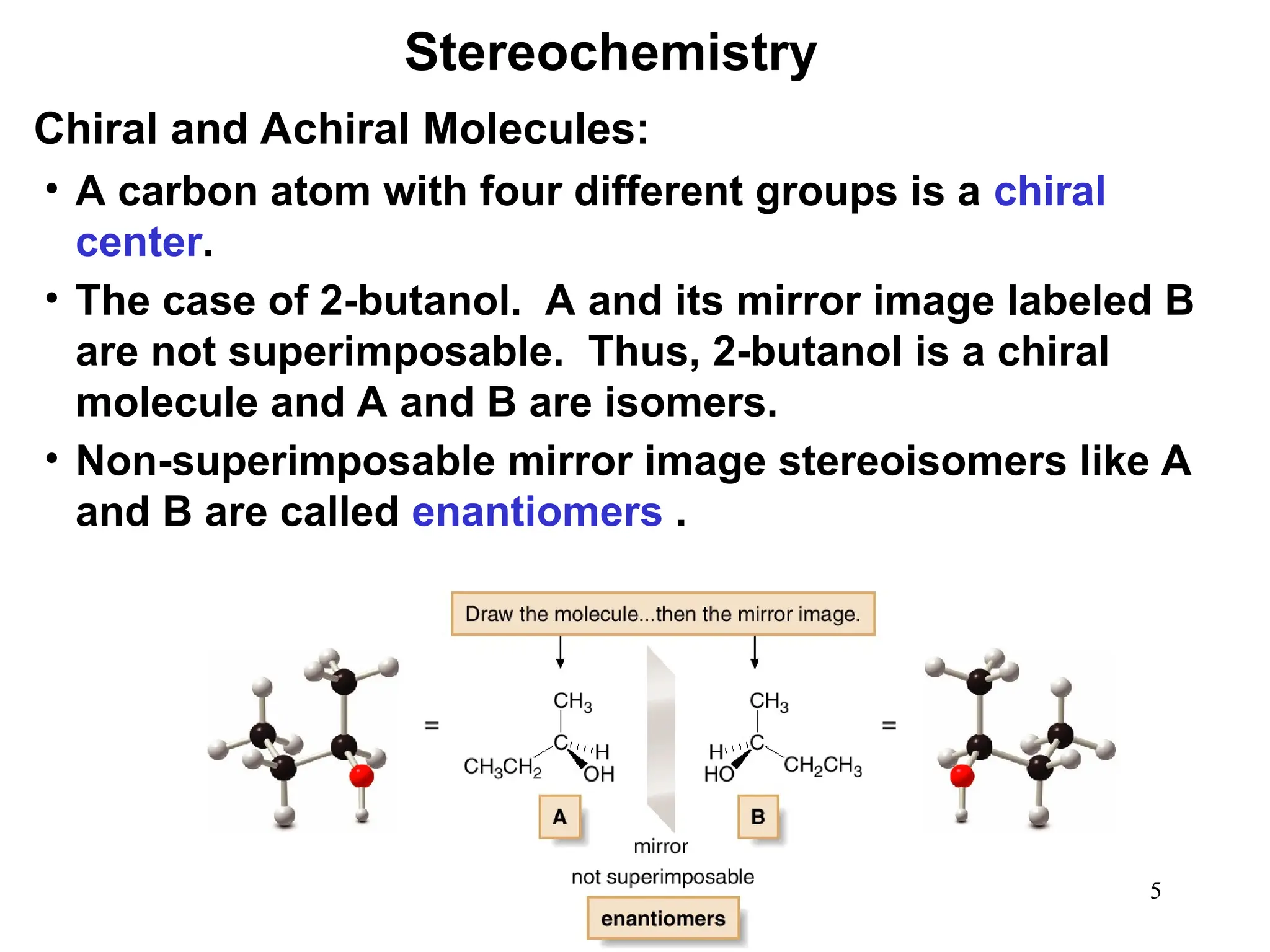
• A carbon atom with four different groups is a chiral
center.
• The case of 2-butanol. A and its mirror image labeled B
are not superimposable. Thus, 2-butanol is a chiral
molecule and A and B are isomers.
• Non-superimposable mirror image stereoisomers like A
and B are called enantiomers .
Stereochemistry
Chiral and Achiral Molecules:
6
• In general, a molecule with no stereogenic centers will
not be chiral. There are exceptions to this that will be
considered in Chapter 17.
• With one stereogenic center, a molecule will always be
chiral.
• With two or more stereogenic centers, a molecule may
or may not be chiral.
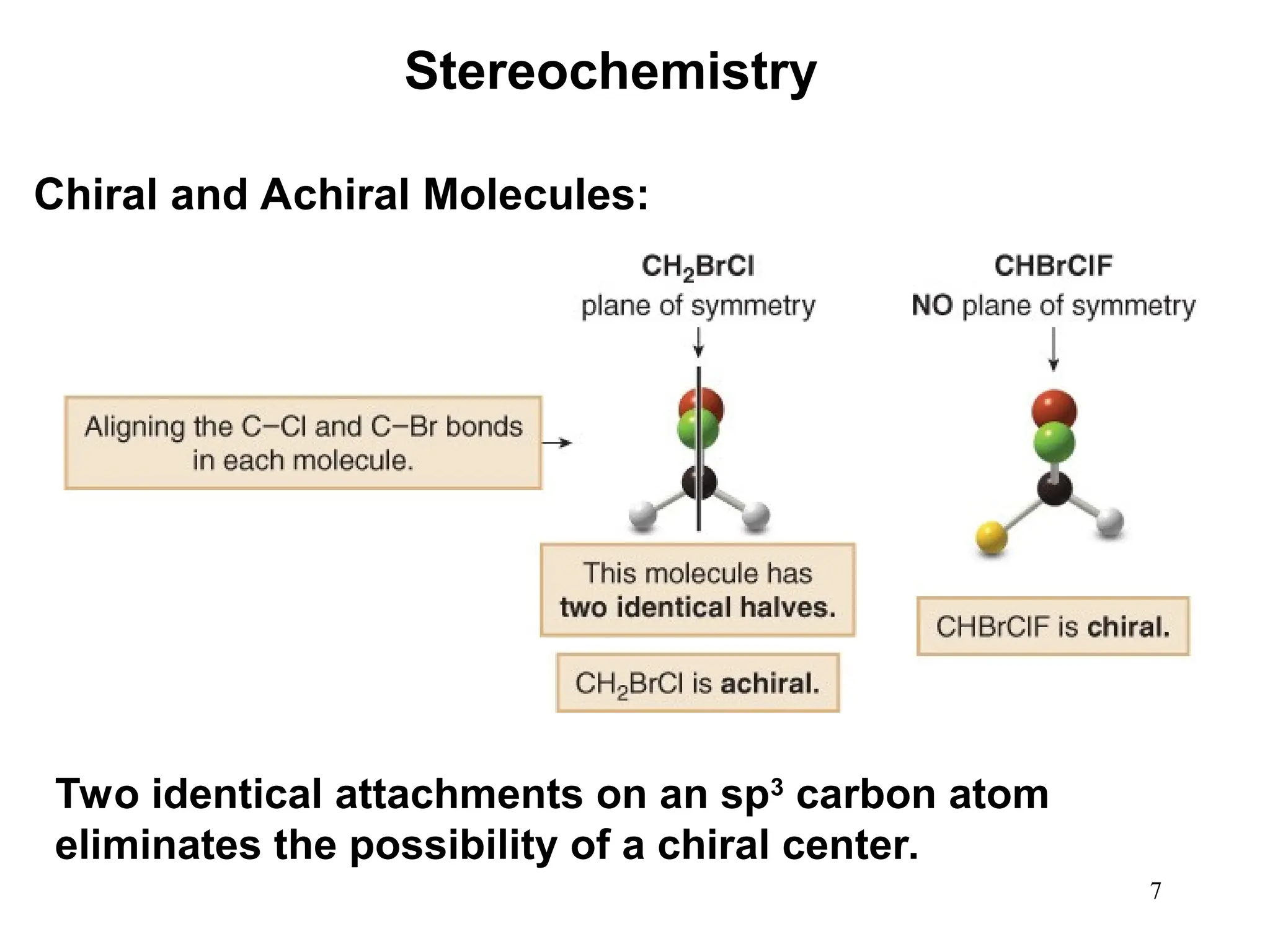
• Achiral molecules usually contain a plane of symmetry
but chiral molecules do not.
• A plane of symmetry is a mirror plane that cuts the
molecule in half, so that one half of the molecule is a
reflection of the other half.
Stereochemistry
Chiral and Achiral Molecules:
7
Stereochemistry
Chiral and Achiral Molecules:
Two identical attachments on an sp3
carbon atom
eliminates the possibility of a chiral center.
8
Summary of the Basic Principles of Chirality
• Everything has a mirror image. The fundamental
question is whether the molecule and its mirror image
are superimposable.
• If a molecule and its mirror image are not
superimposable, the molecule and its mirror image are
chiral.
• The terms stereogenic center and chiral molecule are
related but distinct. In general, a chiral molecule must
have one or more stereogenic centers.
• The presence of a plane of symmetry makes a molecule
achiral.
Stereochemistry
9
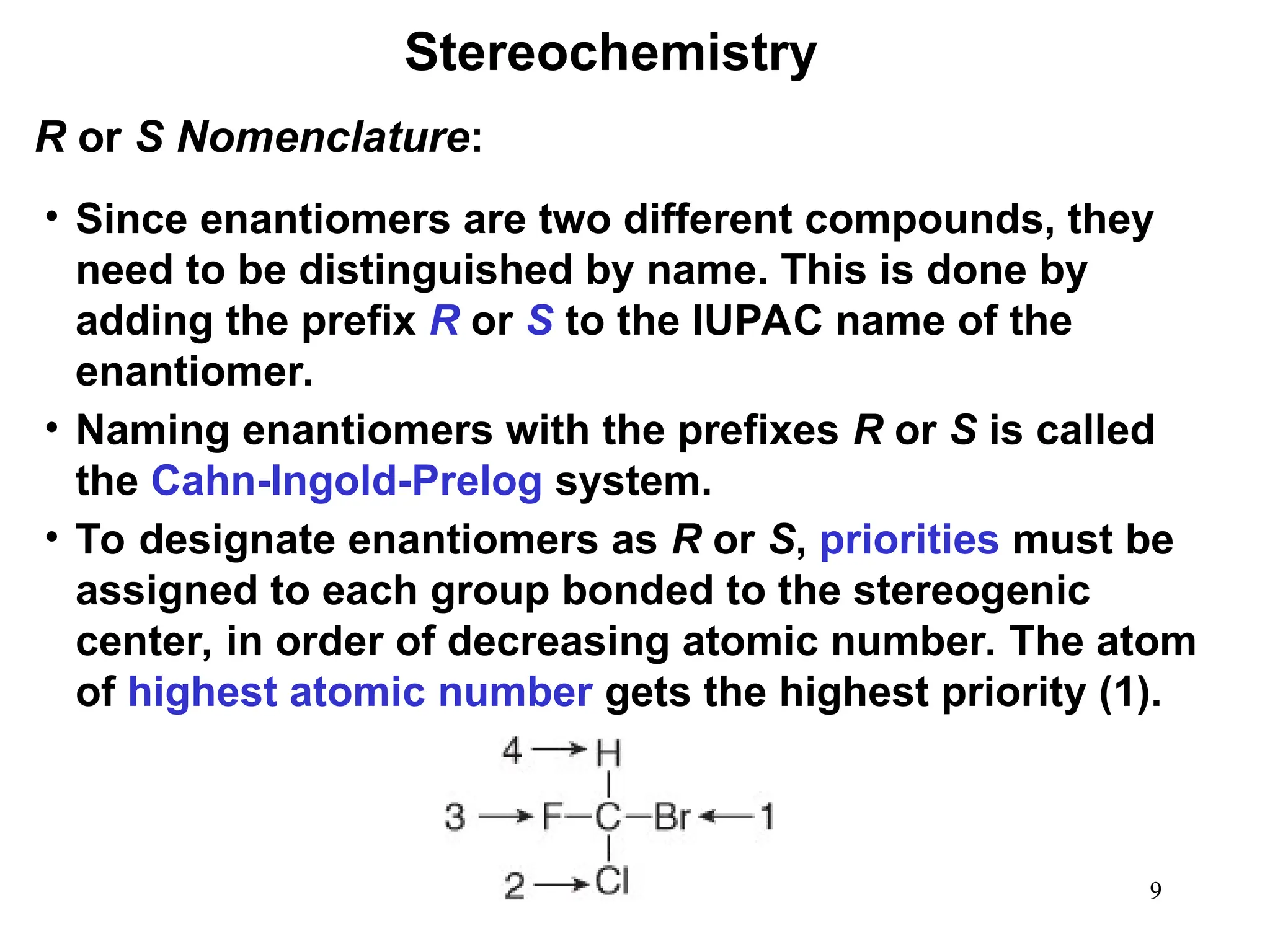
• Since enantiomers are two different compounds, they
need to be distinguished by name. This is done by
adding the prefix R or S to the IUPAC name of the
enantiomer.
• Naming enantiomers with the prefixes R or S is called
the Cahn-Ingold-Prelog system.
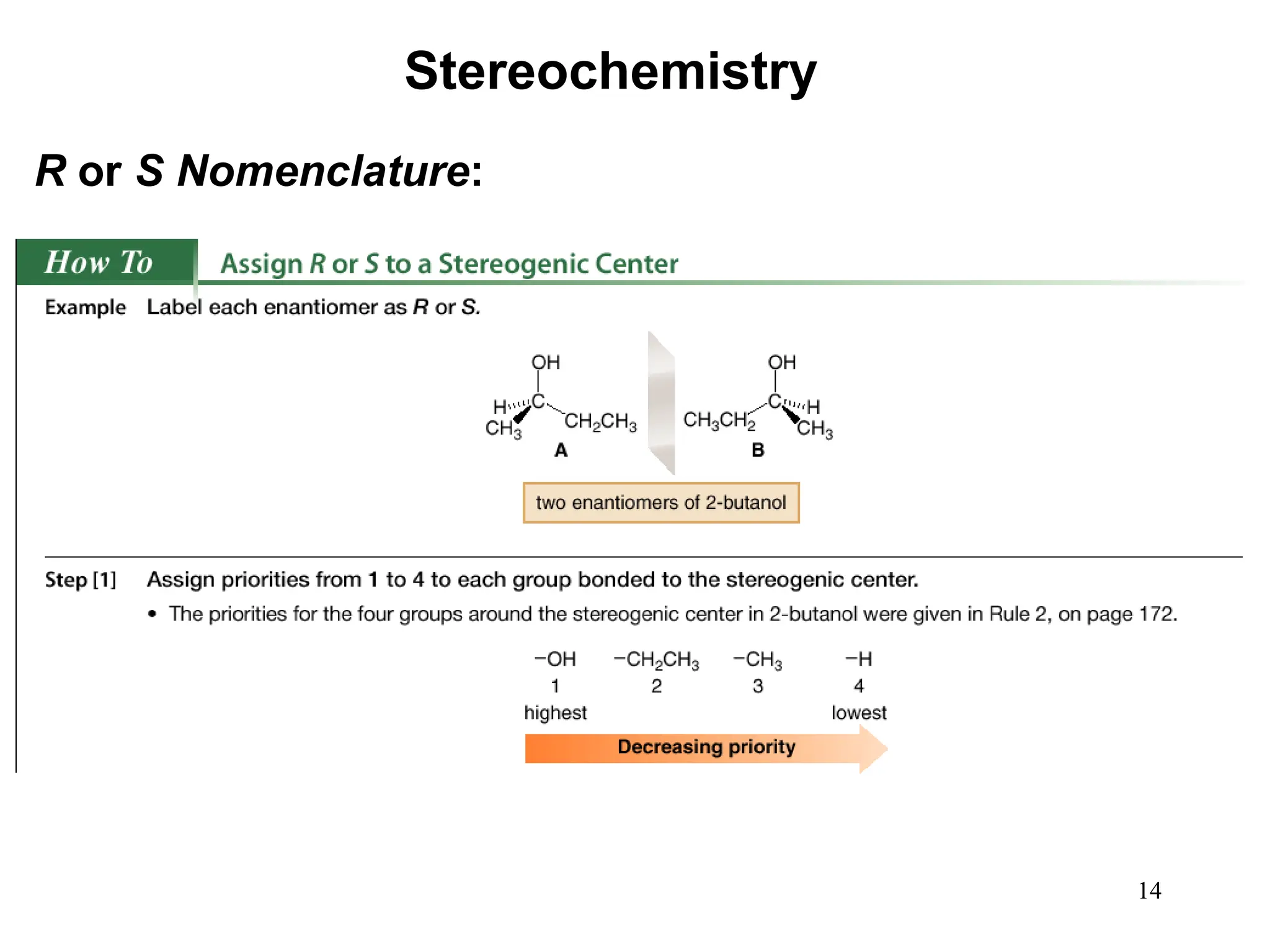
• To designate enantiomers as R or S, priorities must be
assigned to each group bonded to the stereogenic
center, in order of decreasing atomic number. The atom
of highest atomic number gets the highest priority (1).
R or S Nomenclature:
Stereochemistry
10
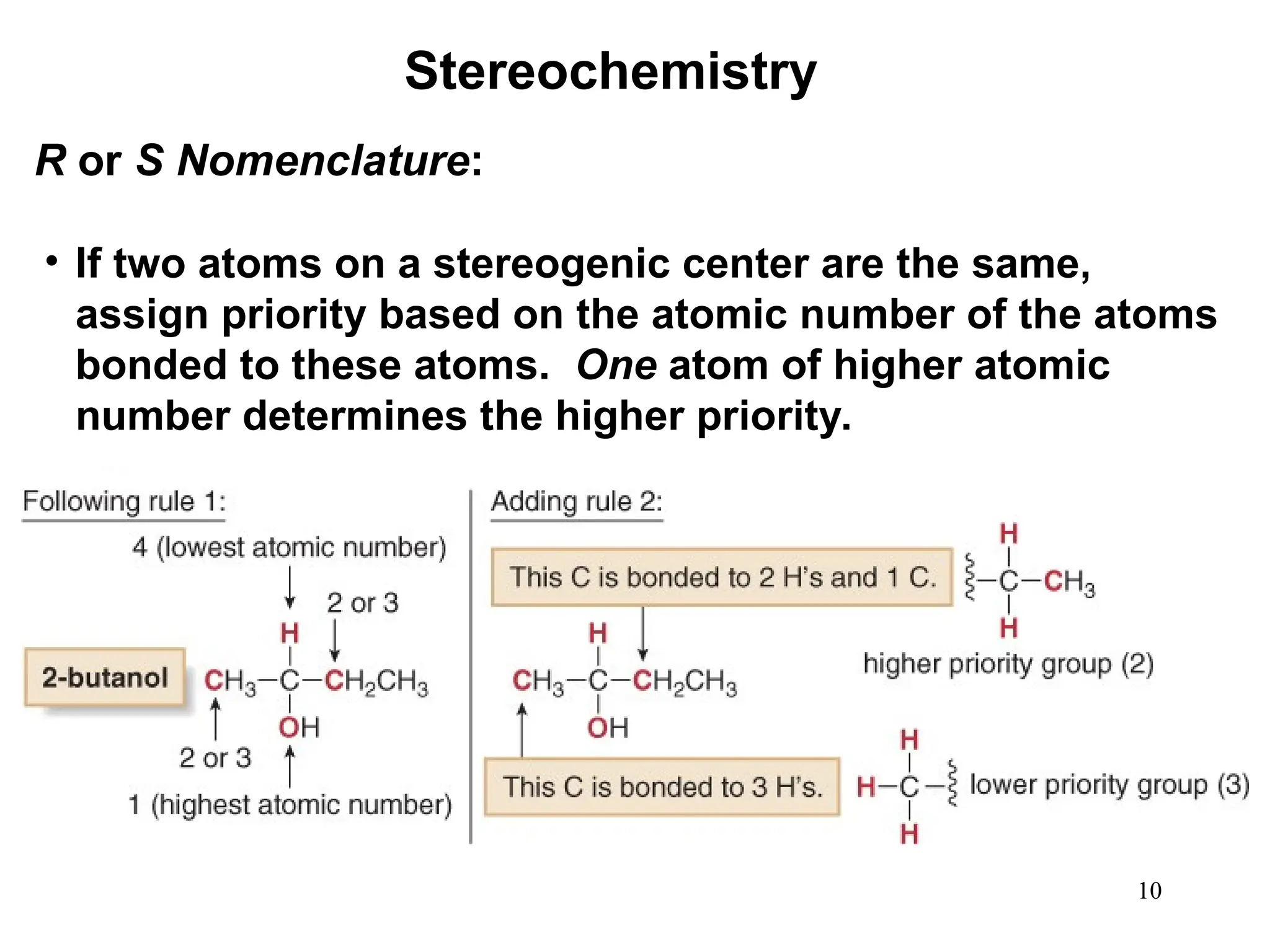
• If two atoms on a stereogenic center are the same,
assign priority based on the atomic number of the atoms
bonded to these atoms. One atom of higher atomic
number determines the higher priority.
Stereochemistry
R or S Nomenclature:
11
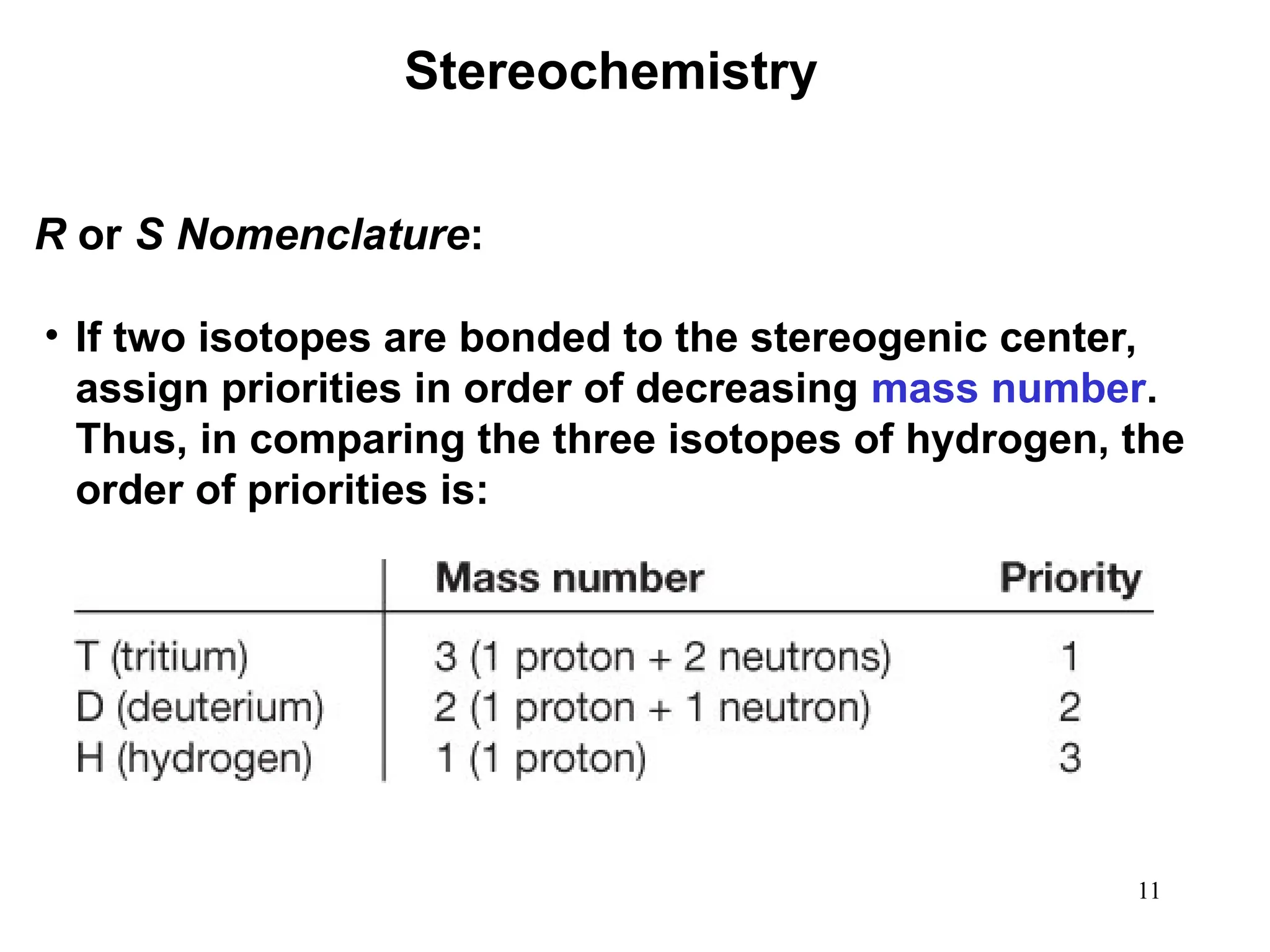
• If two isotopes are bonded to the stereogenic center,
assign priorities in order of decreasing mass number.
Thus, in comparing the three isotopes of hydrogen, the
order of priorities is:
Stereochemistry
R or S Nomenclature:
12
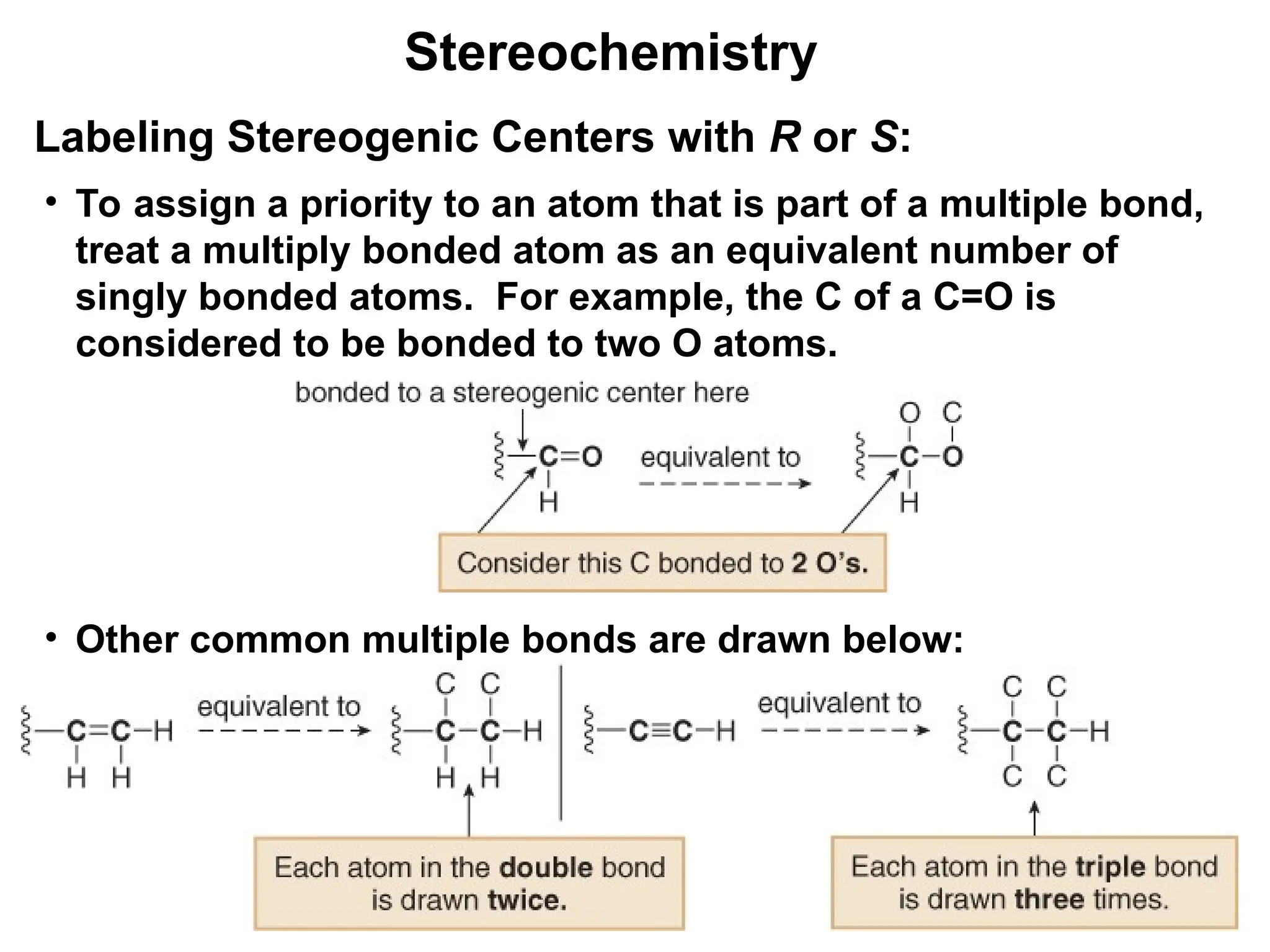
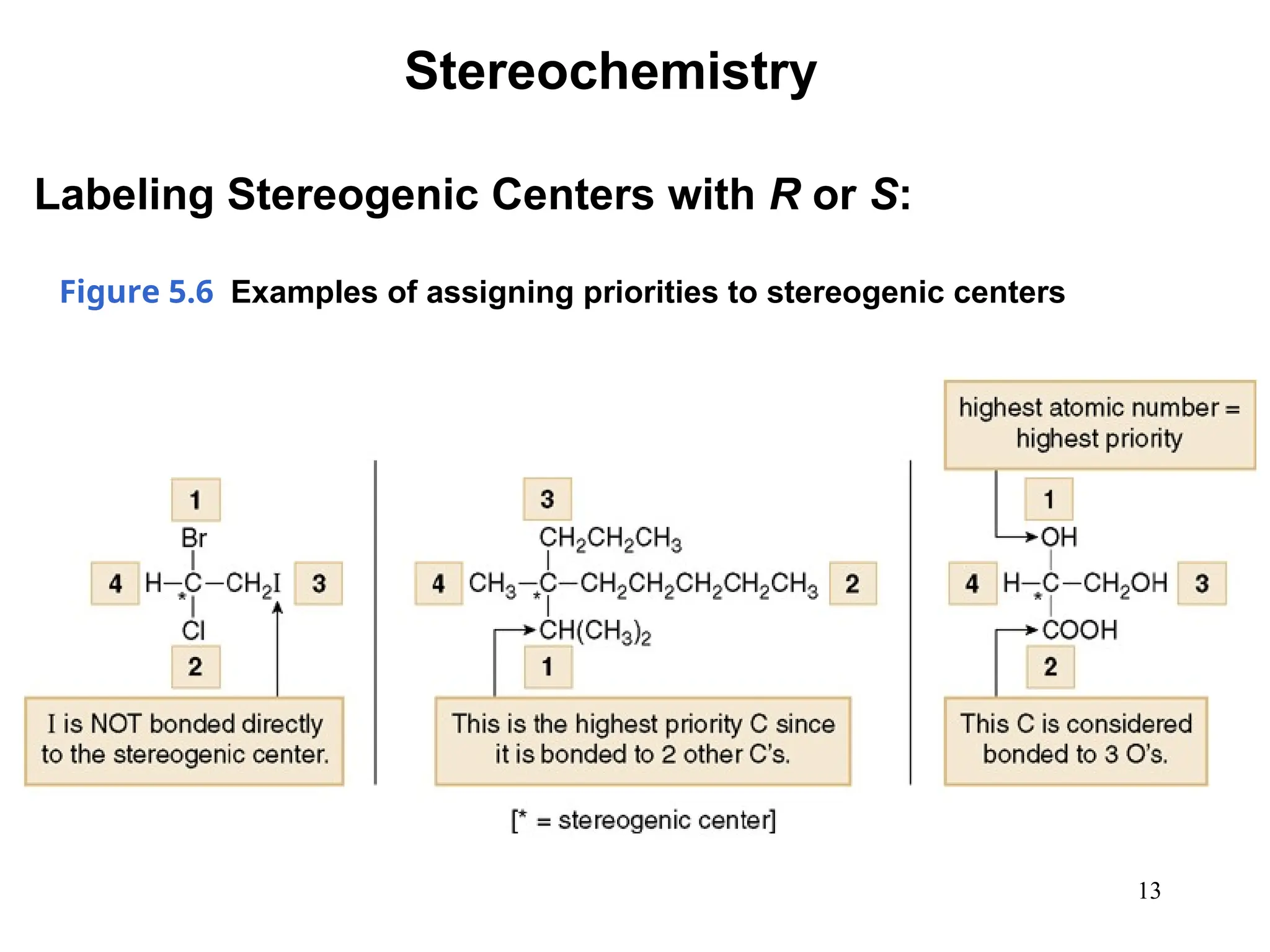
• To assign a priority to an atom that is part of a multiple bond,
treat a multiply bonded atom as an equivalent number of
singly bonded atoms. For example, the C of a C=O is
considered to be bonded to two O atoms.
• Other common multiple bonds are drawn below:
Stereochemistry
Labeling Stereogenic Centers with R or S:
13
Figure 5.6 Examples of assigning priorities to stereogenic centers
Stereochemistry
Labeling Stereogenic Centers with R or S:
14
Stereochemistry
R or S Nomenclature:
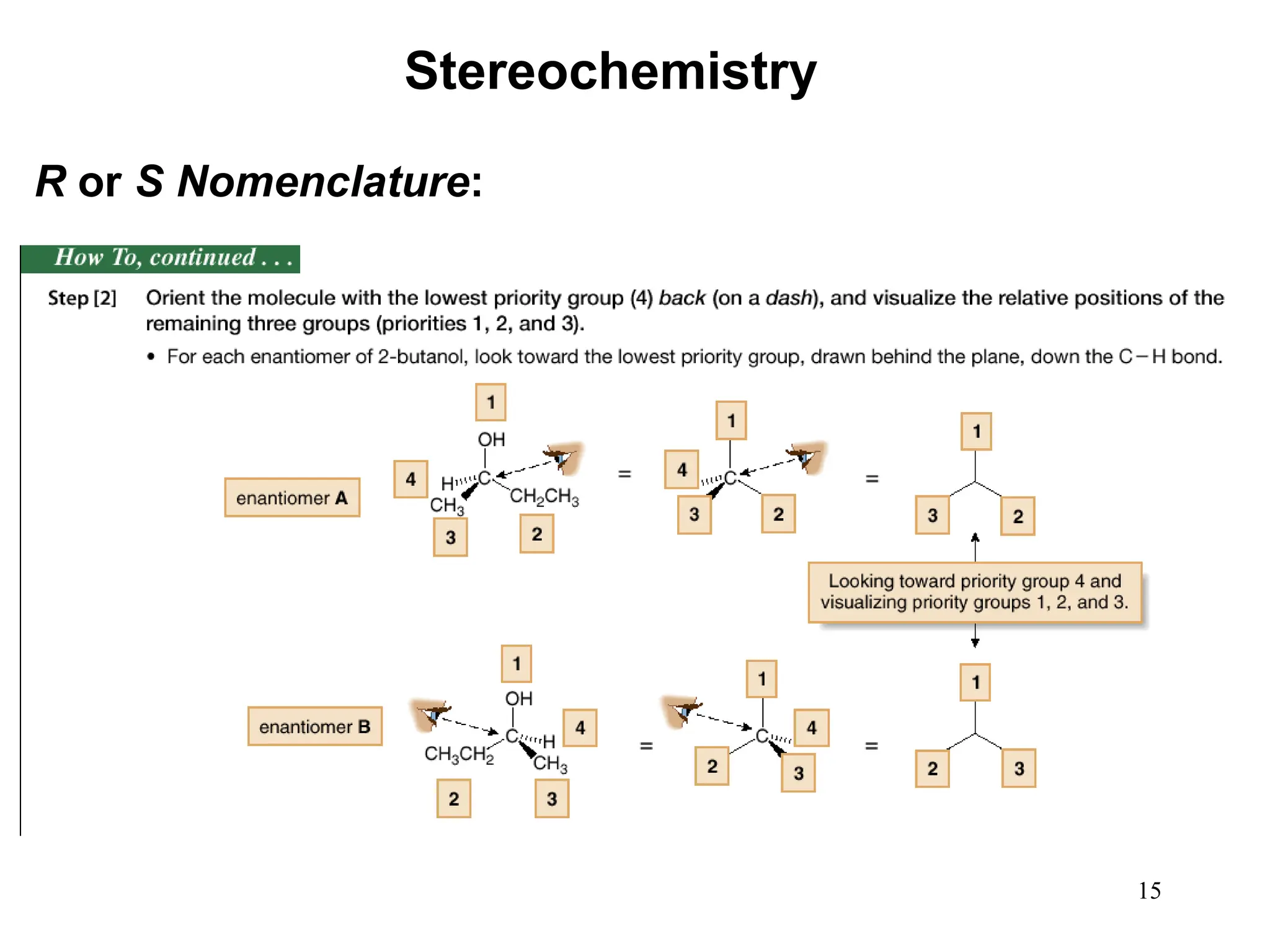
15
Stereochemistry
R or S Nomenclature:
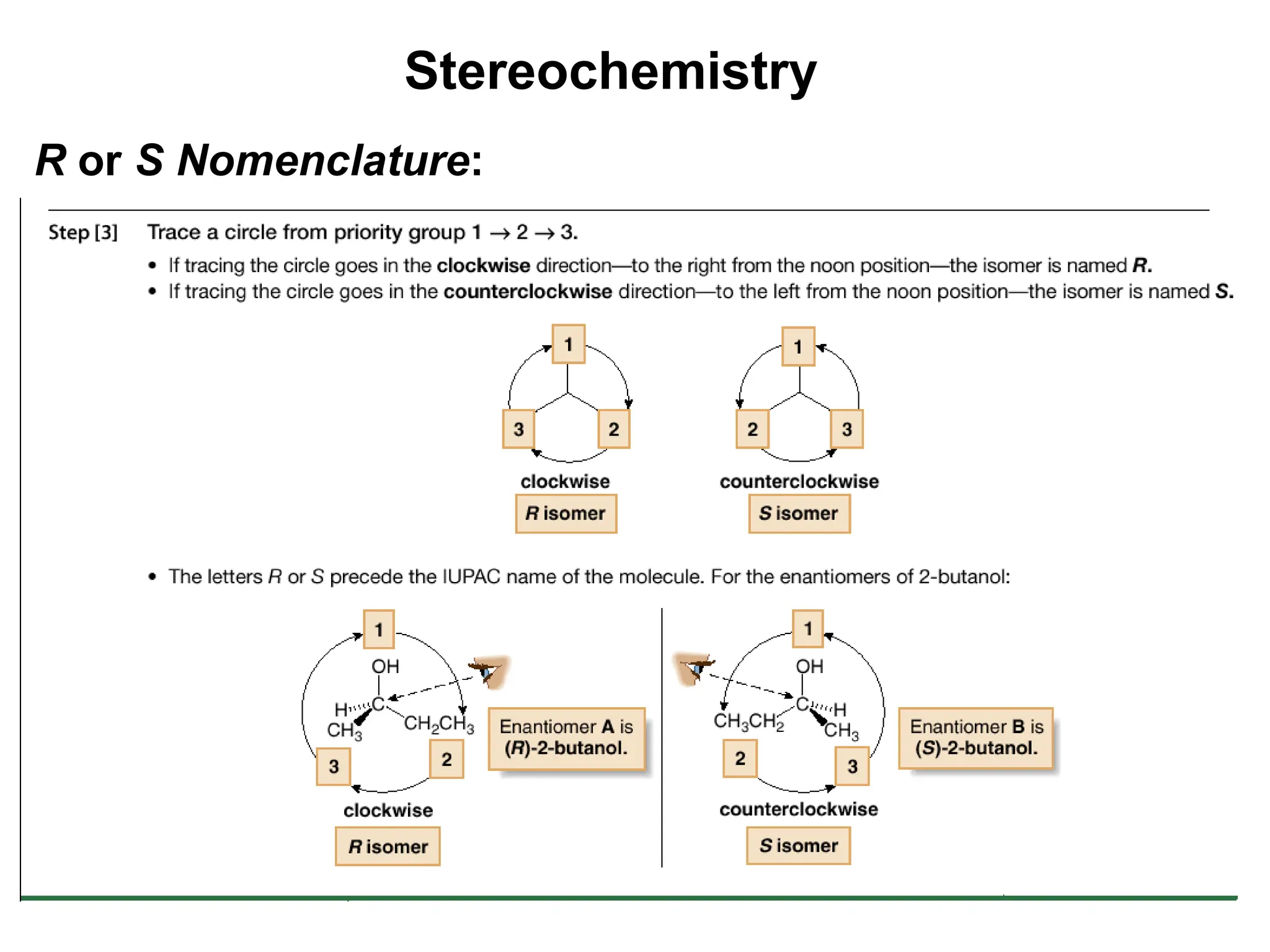
16
Stereochemistry
R or S Nomenclature:
17
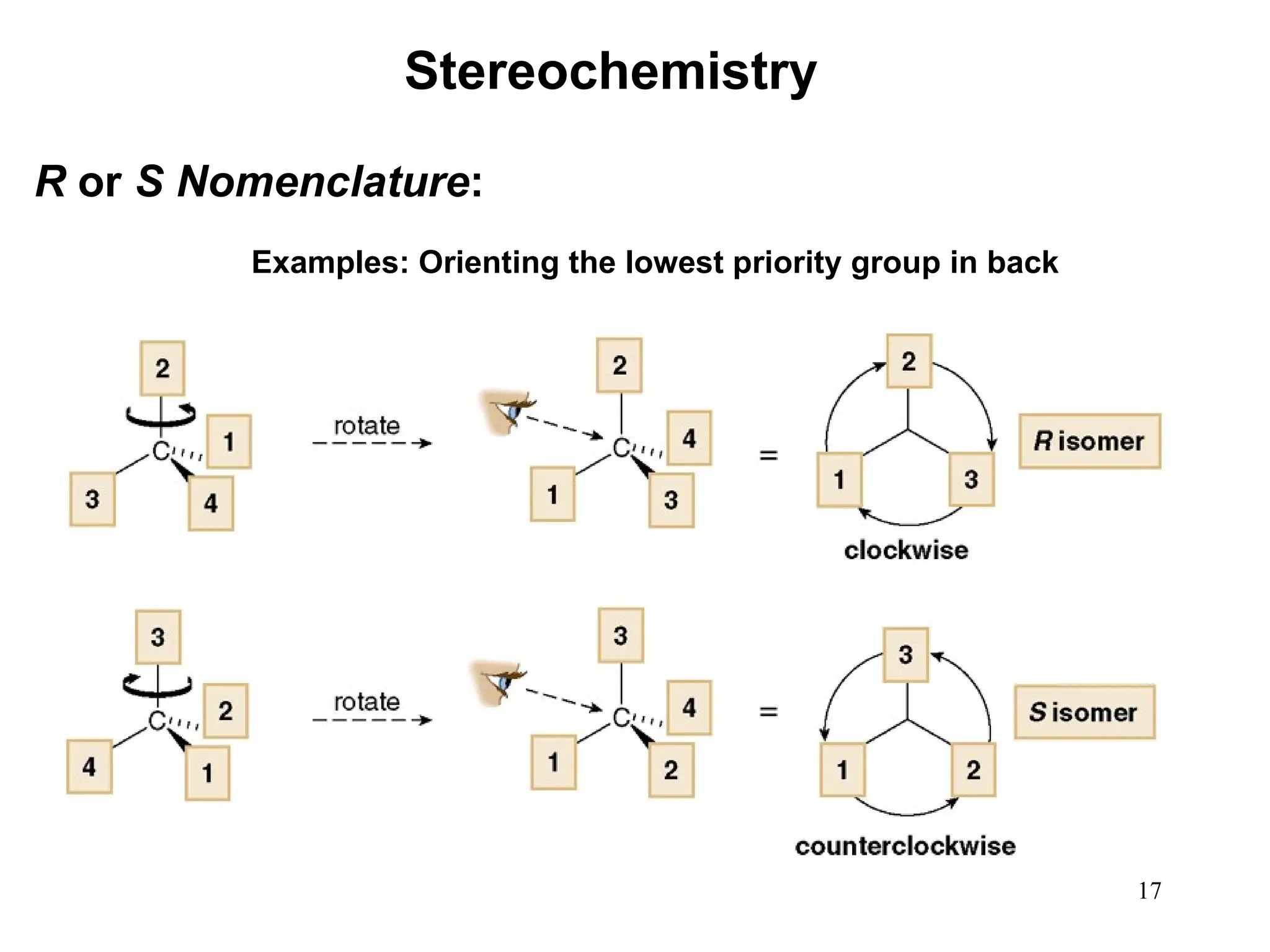
Examples: Orienting the lowest priority group in back
Stereochemistry
R or S Nomenclature:
18
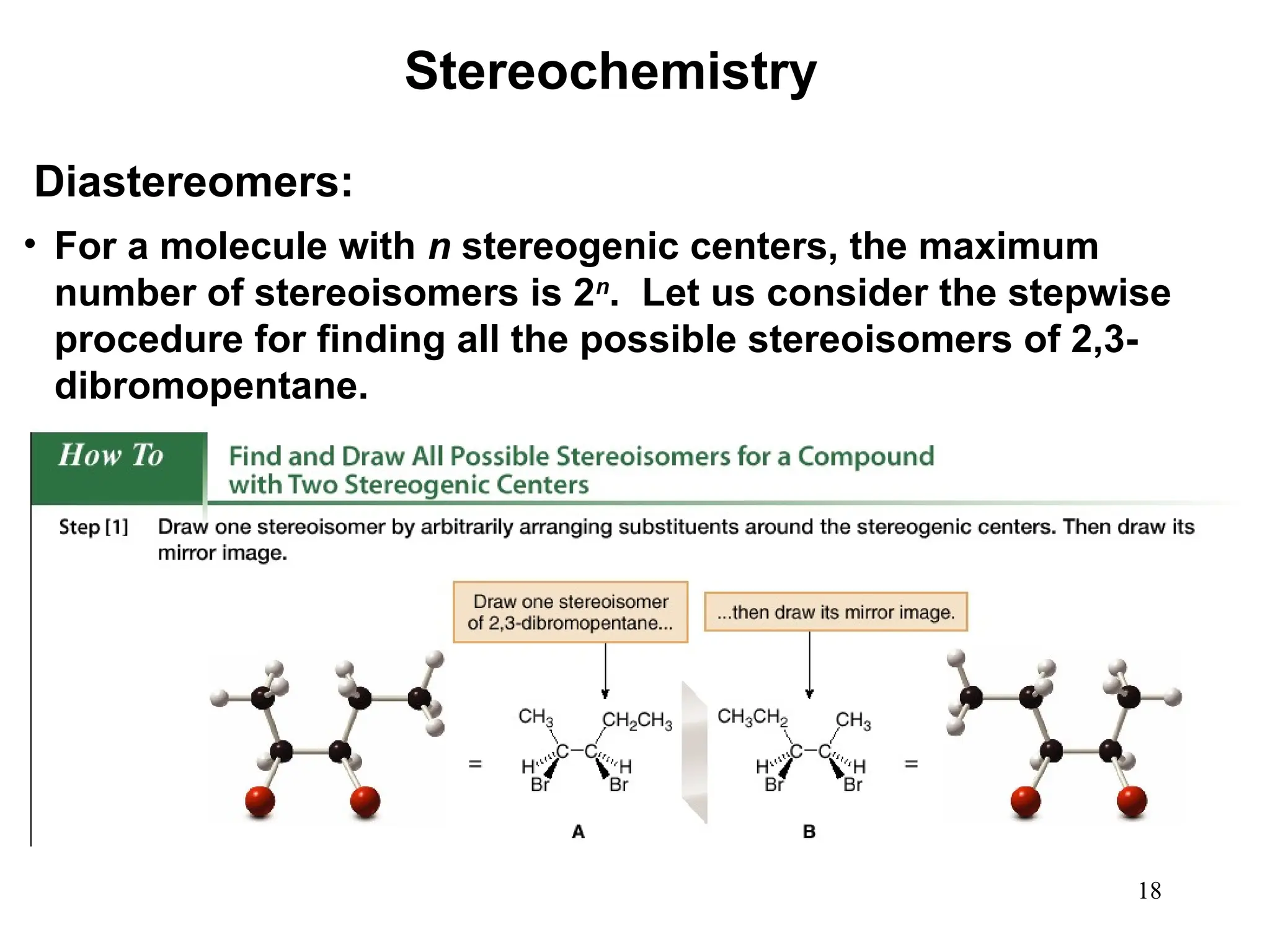
• For a molecule with n stereogenic centers, the maximum
number of stereoisomers is 2n
. Let us consider the stepwise
procedure for finding all the possible stereoisomers of 2,3-
dibromopentane.
Stereochemistry
Diastereomers:
19
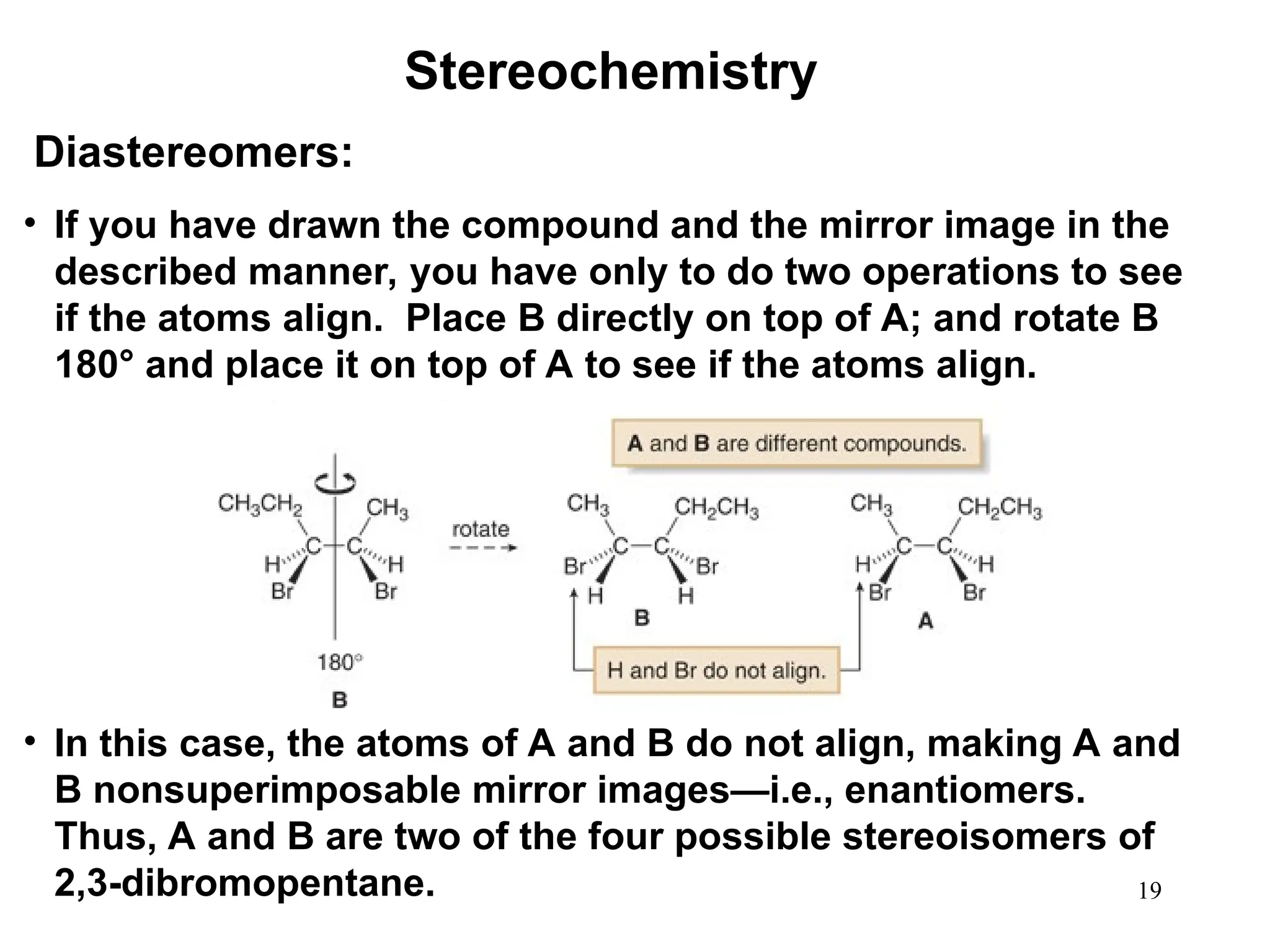
• If you have drawn the compound and the mirror image in the
described manner, you have only to do two operations to see
if the atoms align. Place B directly on top of A; and rotate B
180° and place it on top of A to see if the atoms align.
• In this case, the atoms of A and B do not align, making A and
B nonsuperimposable mirror images—i.e., enantiomers.
Thus, A and B are two of the four possible stereoisomers of
2,3-dibromopentane.
Stereochemistry
Diastereomers:
20
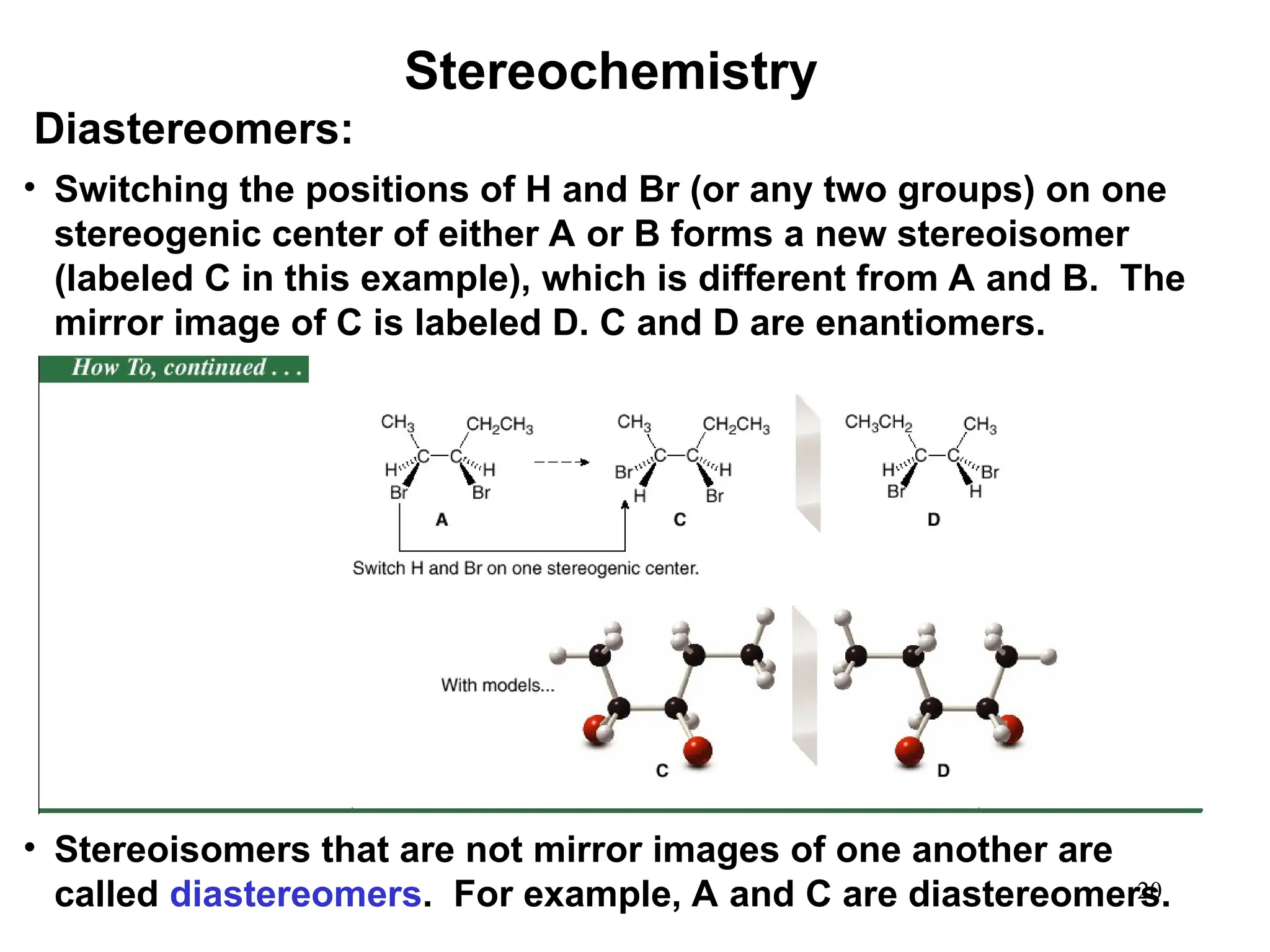
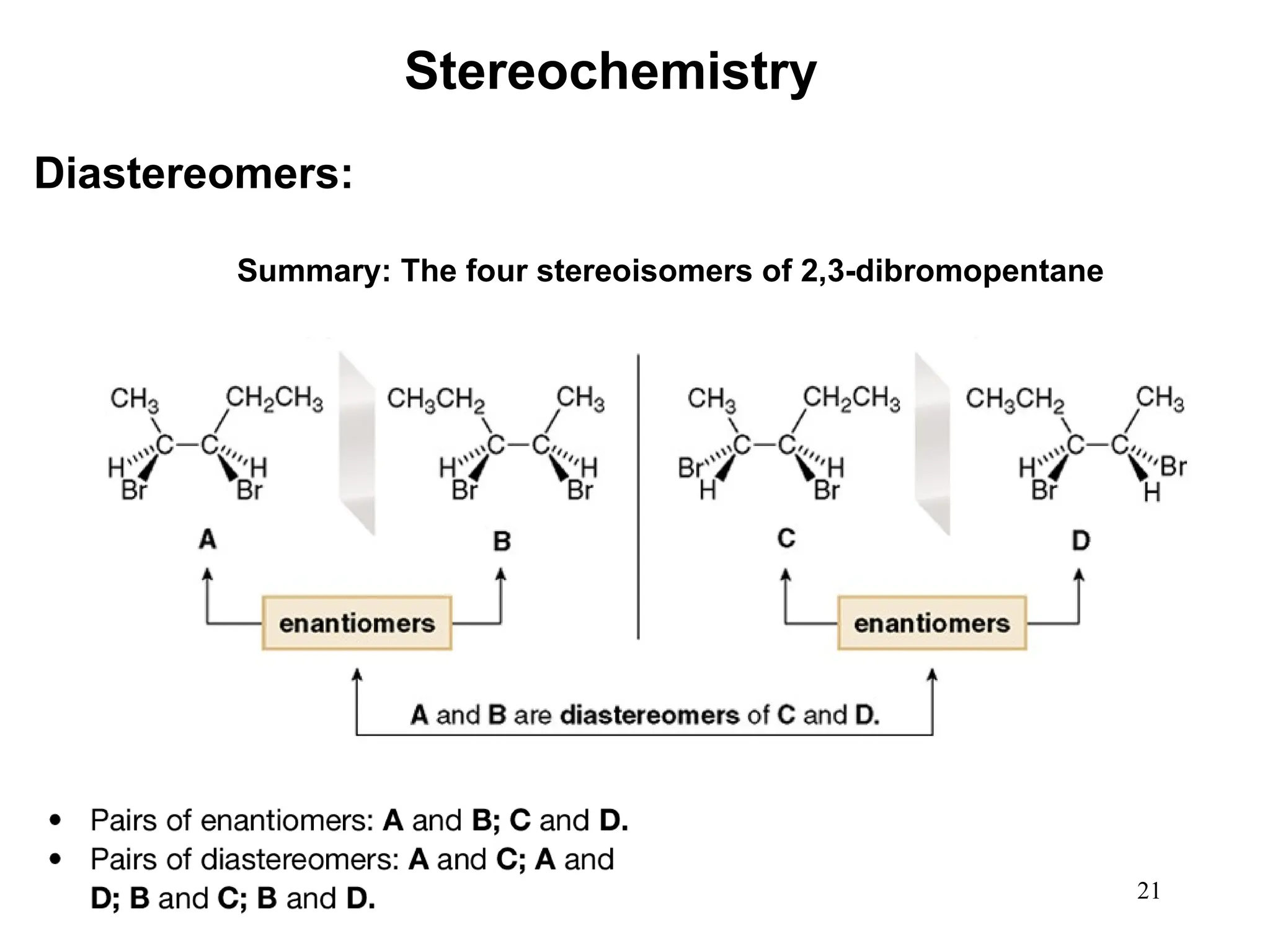
• Switching the positions of H and Br (or any two groups) on one
stereogenic center of either A or B forms a new stereoisomer
(labeled C in this example), which is different from A and B. The
mirror image of C is labeled D. C and D are enantiomers.
• Stereoisomers that are not mirror images of one another are
called diastereomers. For example, A and C are diastereomers.
Stereochemistry
Diastereomers:
21
Summary: The four stereoisomers of 2,3-dibromopentane
Stereochemistry
Diastereomers:
22
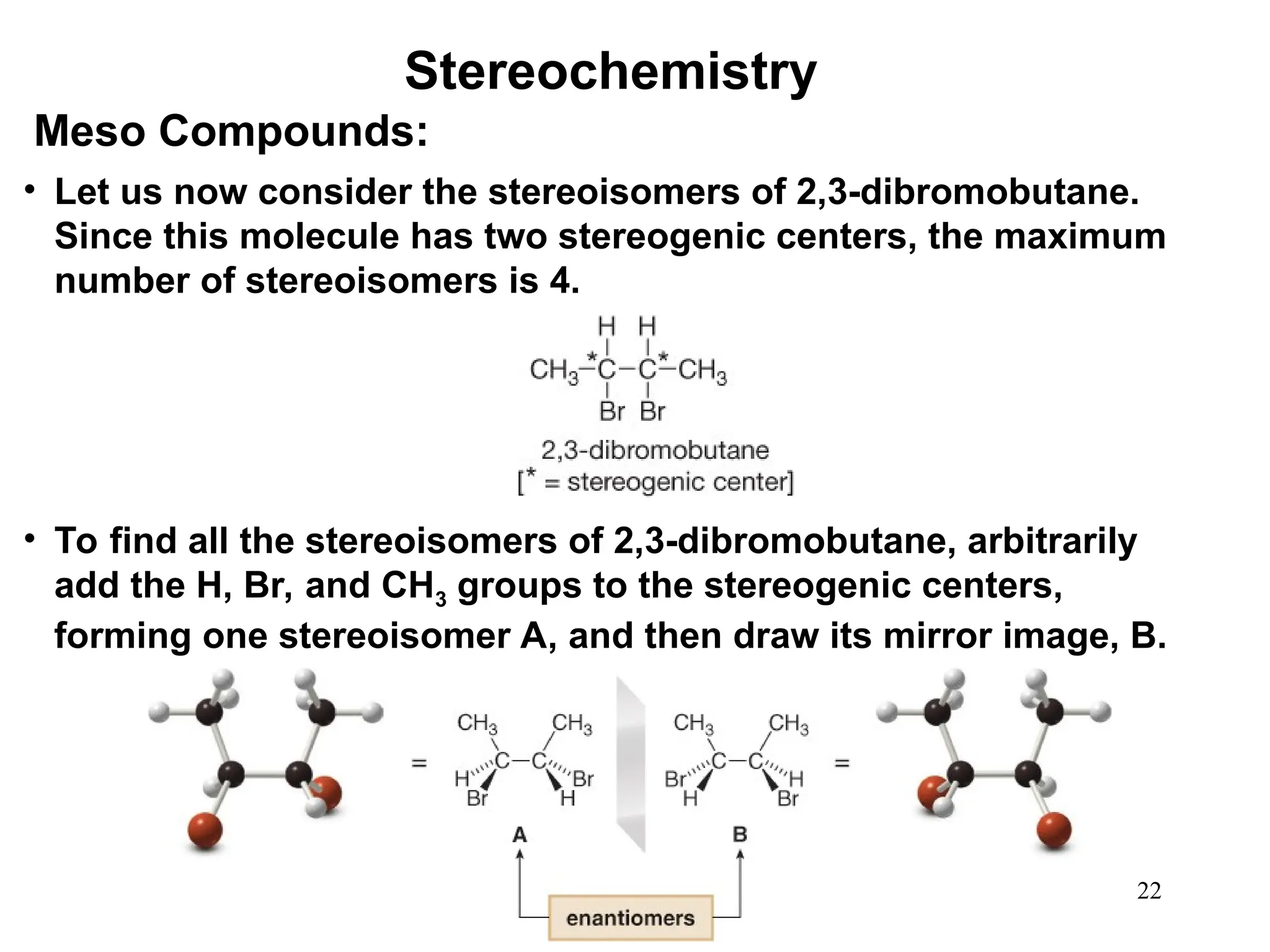
• Let us now consider the stereoisomers of 2,3-dibromobutane.
Since this molecule has two stereogenic centers, the maximum
number of stereoisomers is 4.
Meso Compounds:
• To find all the stereoisomers of 2,3-dibromobutane, arbitrarily
add the H, Br, and CH3 groups to the stereogenic centers,
forming one stereoisomer A, and then draw its mirror image, B.
Stereochemistry
23
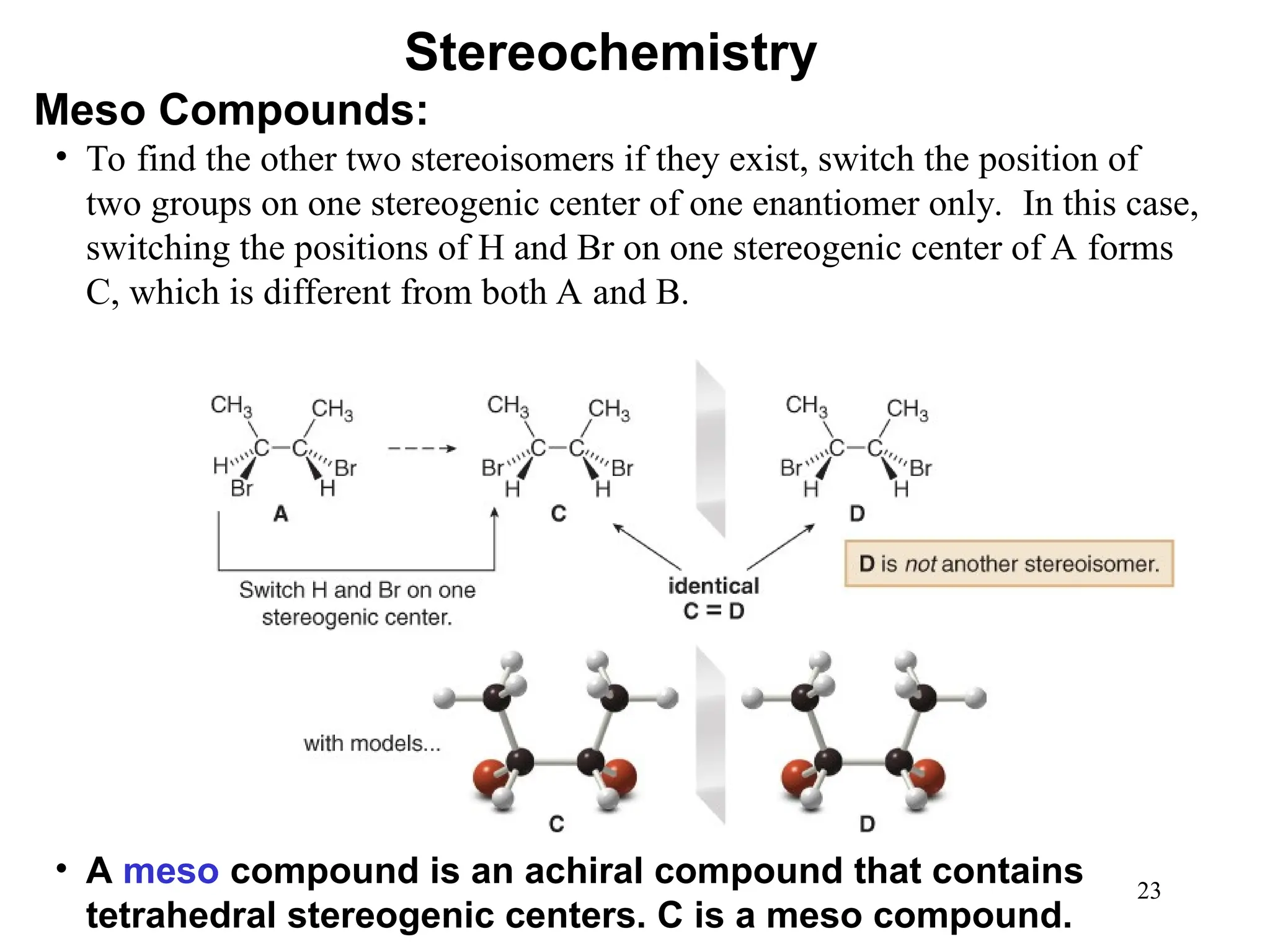
• To find the other two stereoisomers if they exist, switch the position of
two groups on one stereogenic center of one enantiomer only. In this case,
switching the positions of H and Br on one stereogenic center of A forms
C, which is different from both A and B.
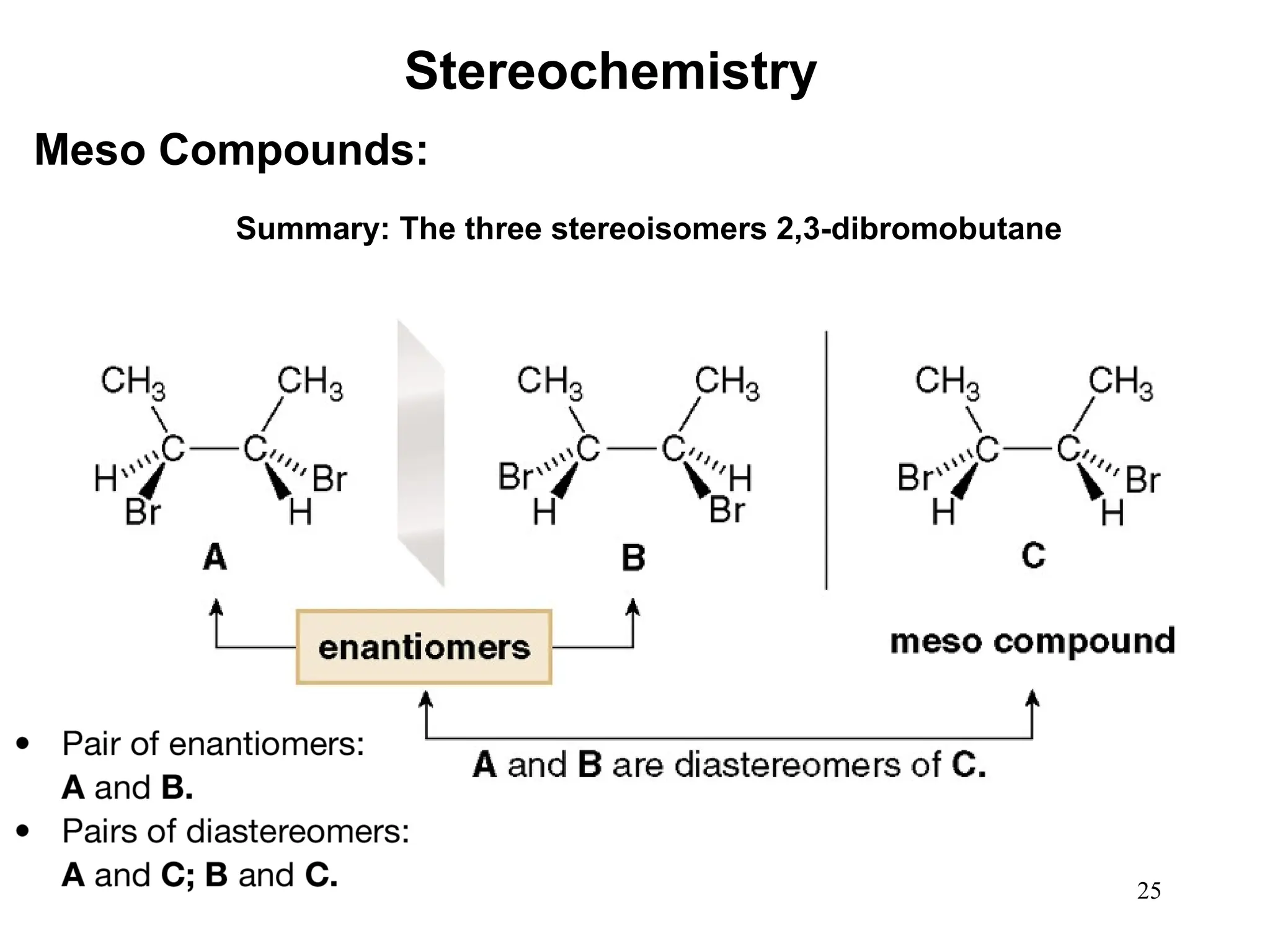
• A meso compound is an achiral compound that contains
tetrahedral stereogenic centers. C is a meso compound.
Stereochemistry
Meso Compounds:
24
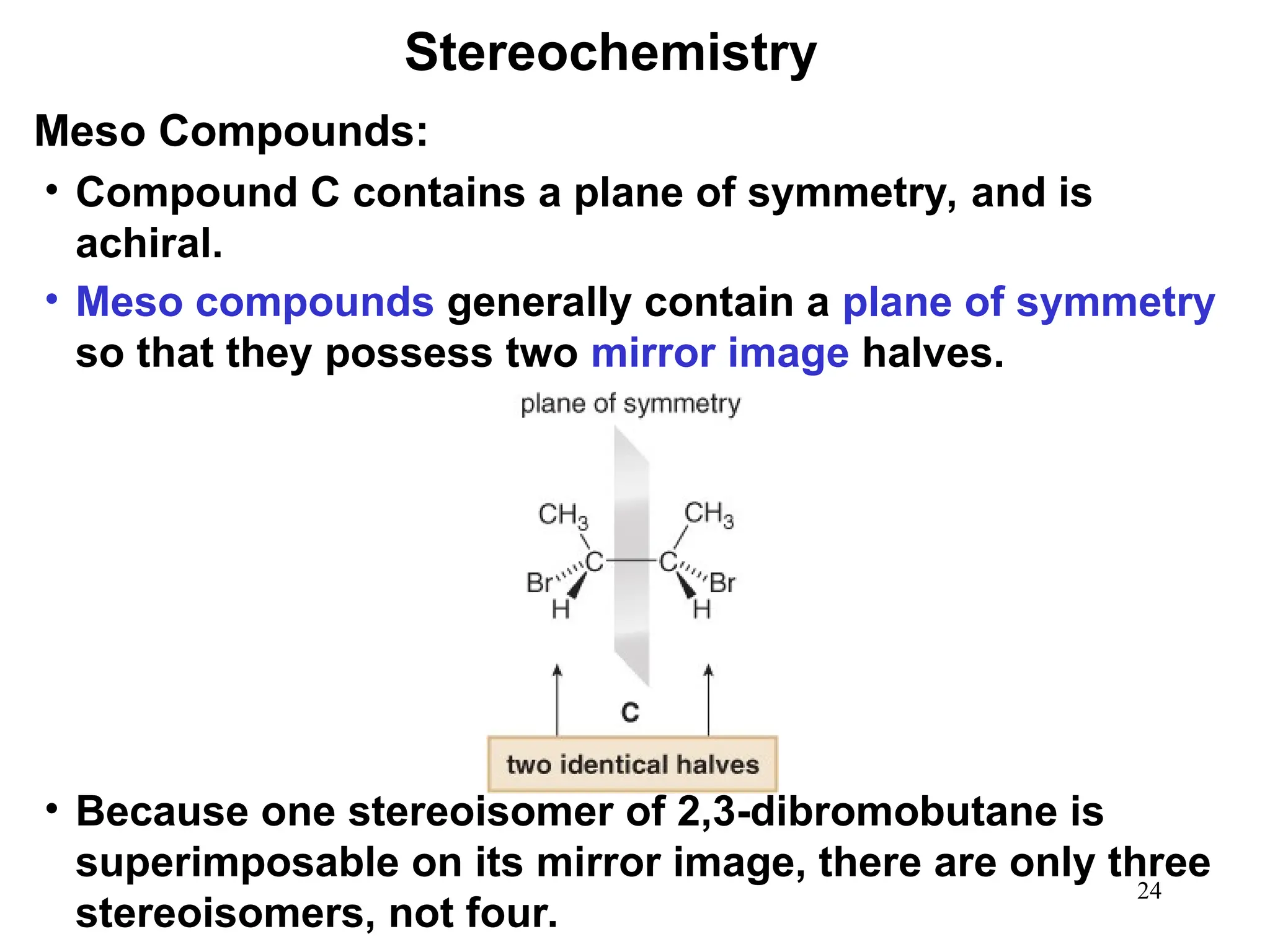
• Compound C contains a plane of symmetry, and is
achiral.
• Meso compounds generally contain a plane of symmetry
so that they possess two mirror image halves.
• Because one stereoisomer of 2,3-dibromobutane is
superimposable on its mirror image, there are only three
stereoisomers, not four.
Stereochemistry
Meso Compounds:
25
Summary: The three stereoisomers 2,3-dibromobutane
Stereochemistry
Meso Compounds:
26
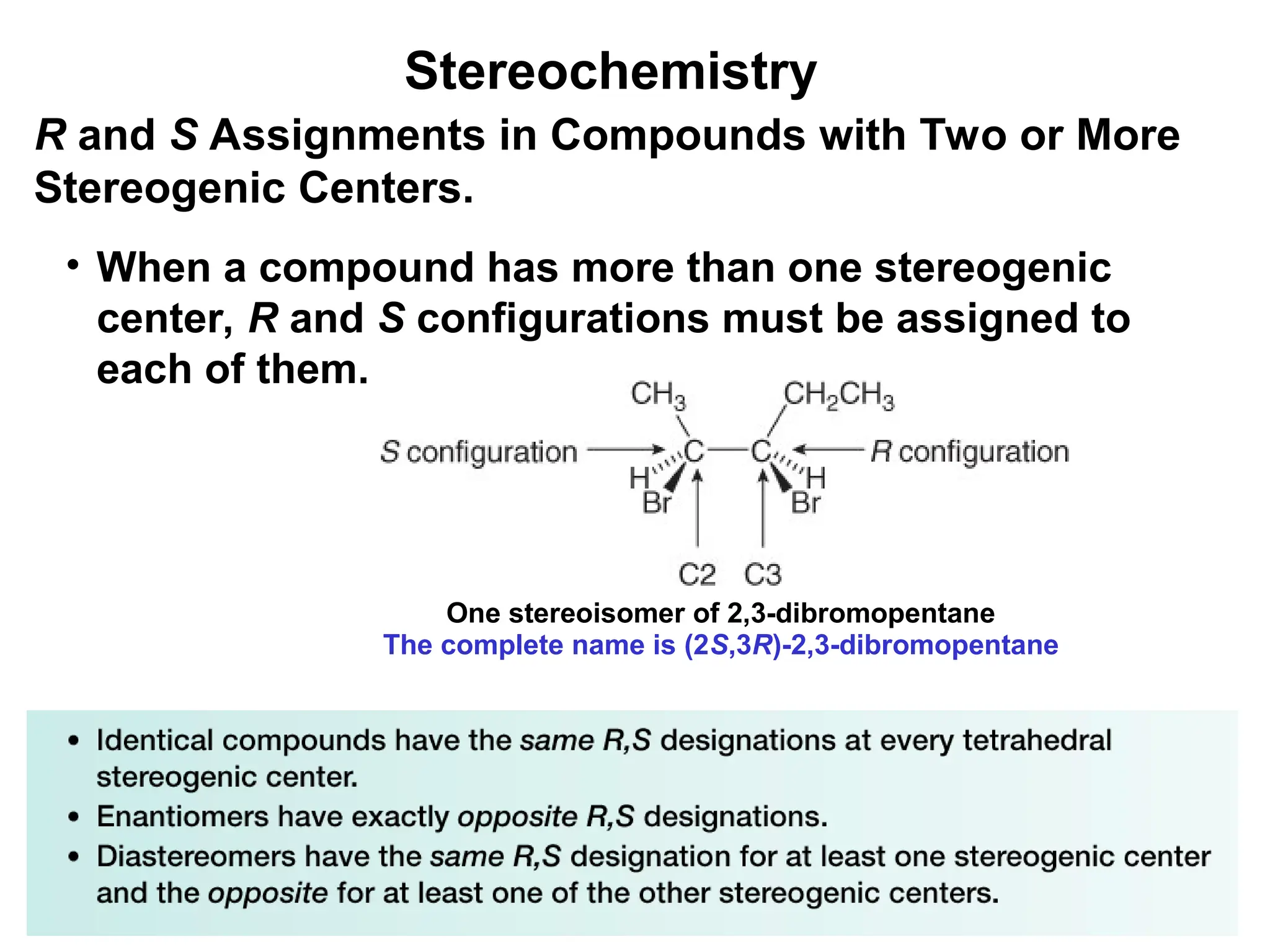
• When a compound has more than one stereogenic
center, R and S configurations must be assigned to
each of them.
R and S Assignments in Compounds with Two or More
Stereogenic Centers.
One stereoisomer of 2,3-dibromopentane
The complete name is (2S,3R)-2,3-dibromopentane
Stereochemistry
27
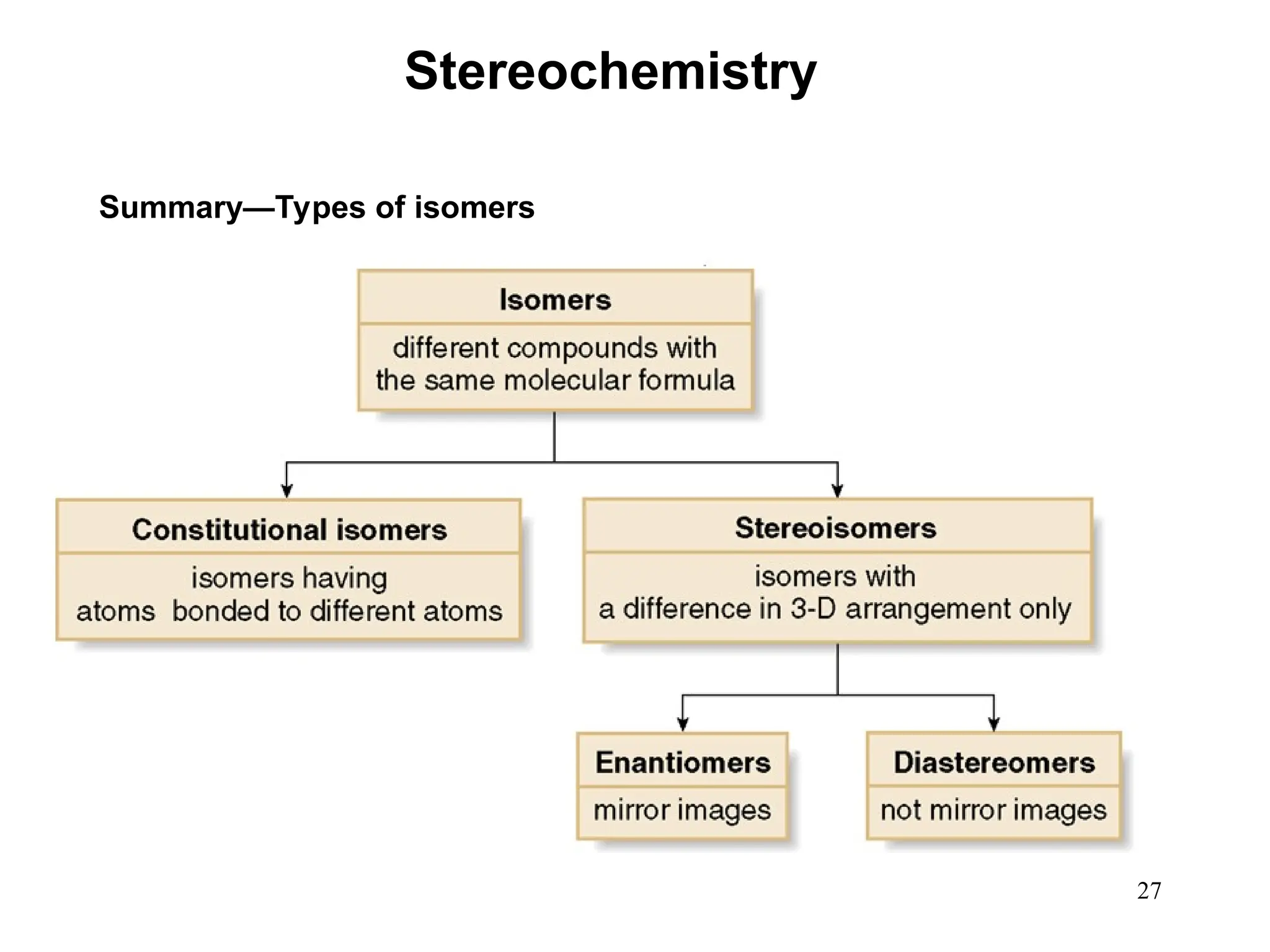
Summary—Types of isomers
Stereochemistry
28
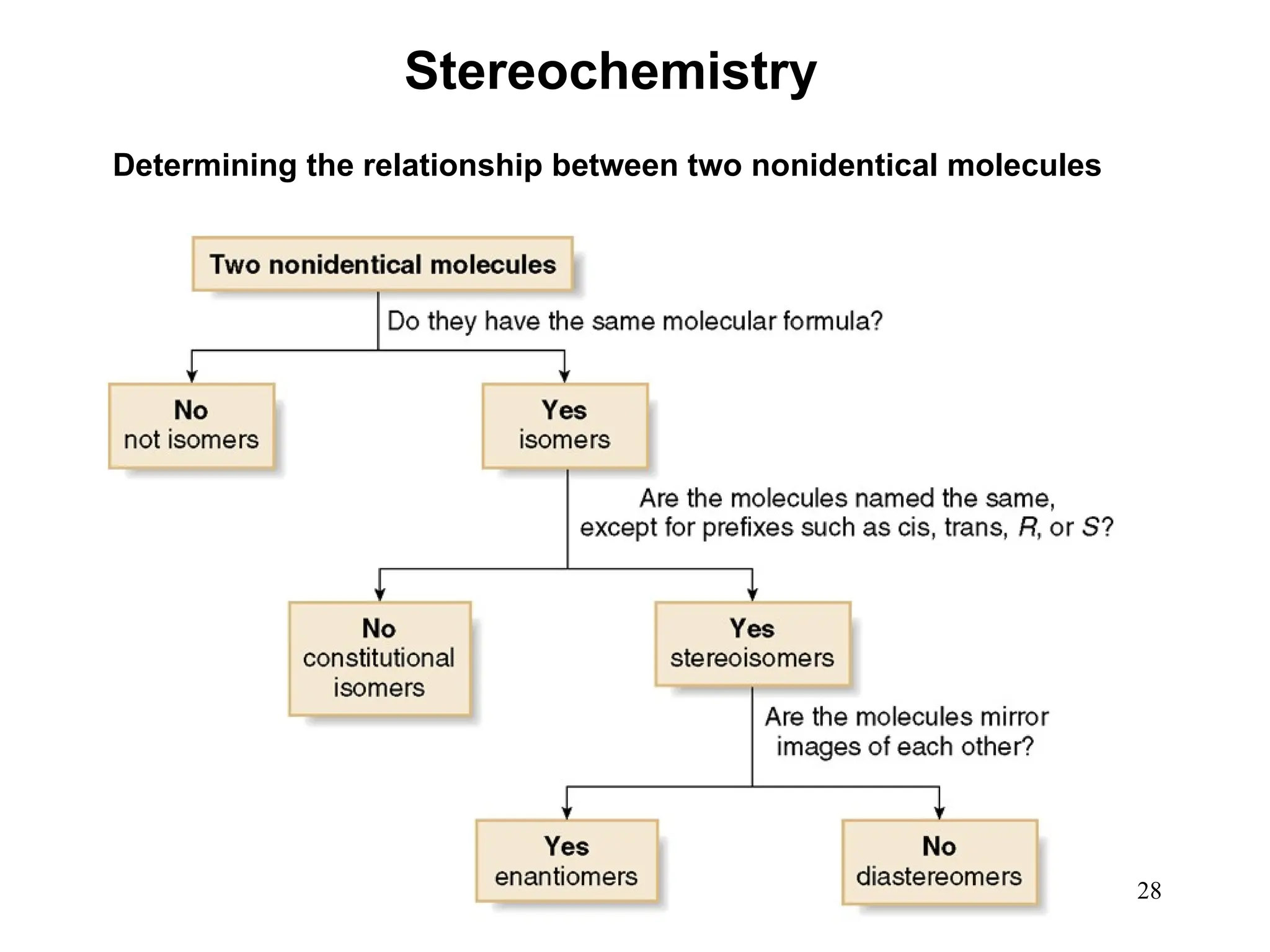
Determining the relationship between two nonidentical molecules
Stereochemistry
29
• The chemical and physical properties of two enantiomers
are identical except in their interaction with chiral
substances.
• The physical property that differs is the behavior when
subjected to plane-polarized light ( this physical property is
often called an optical property).
• Plane-polarized (polarized) light is light that has an electric
vector that oscillates in a single plane.
• Plane-polarized light arises from passing ordinary light
through a polarizer.
Optical Activity
Stereochemistry
30
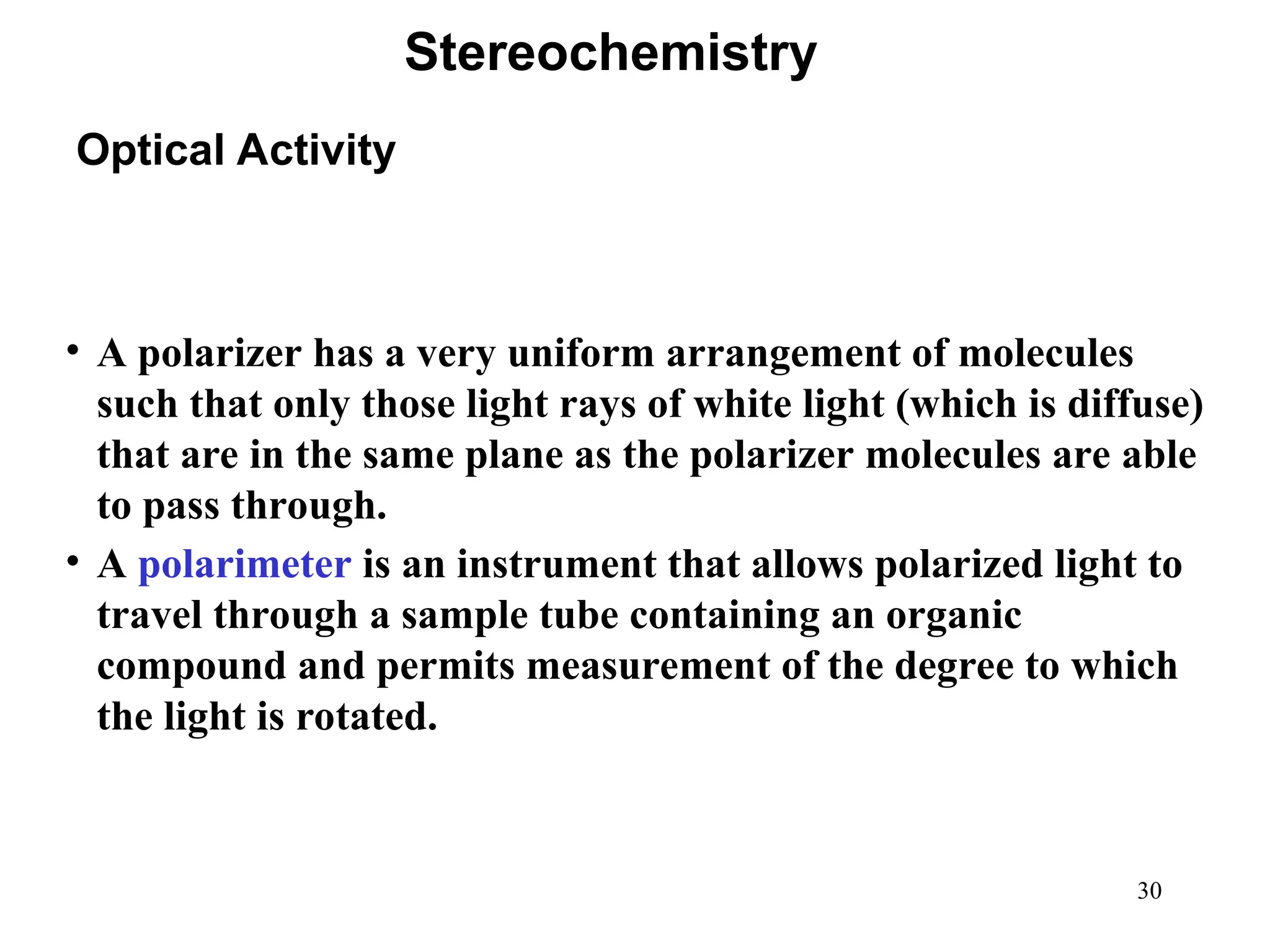
• A polarizer has a very uniform arrangement of molecules
such that only those light rays of white light (which is diffuse)
that are in the same plane as the polarizer molecules are able
to pass through.
• A polarimeter is an instrument that allows polarized light to
travel through a sample tube containing an organic
compound and permits measurement of the degree to which
the light is rotated.
Optical Activity
Stereochemistry
31
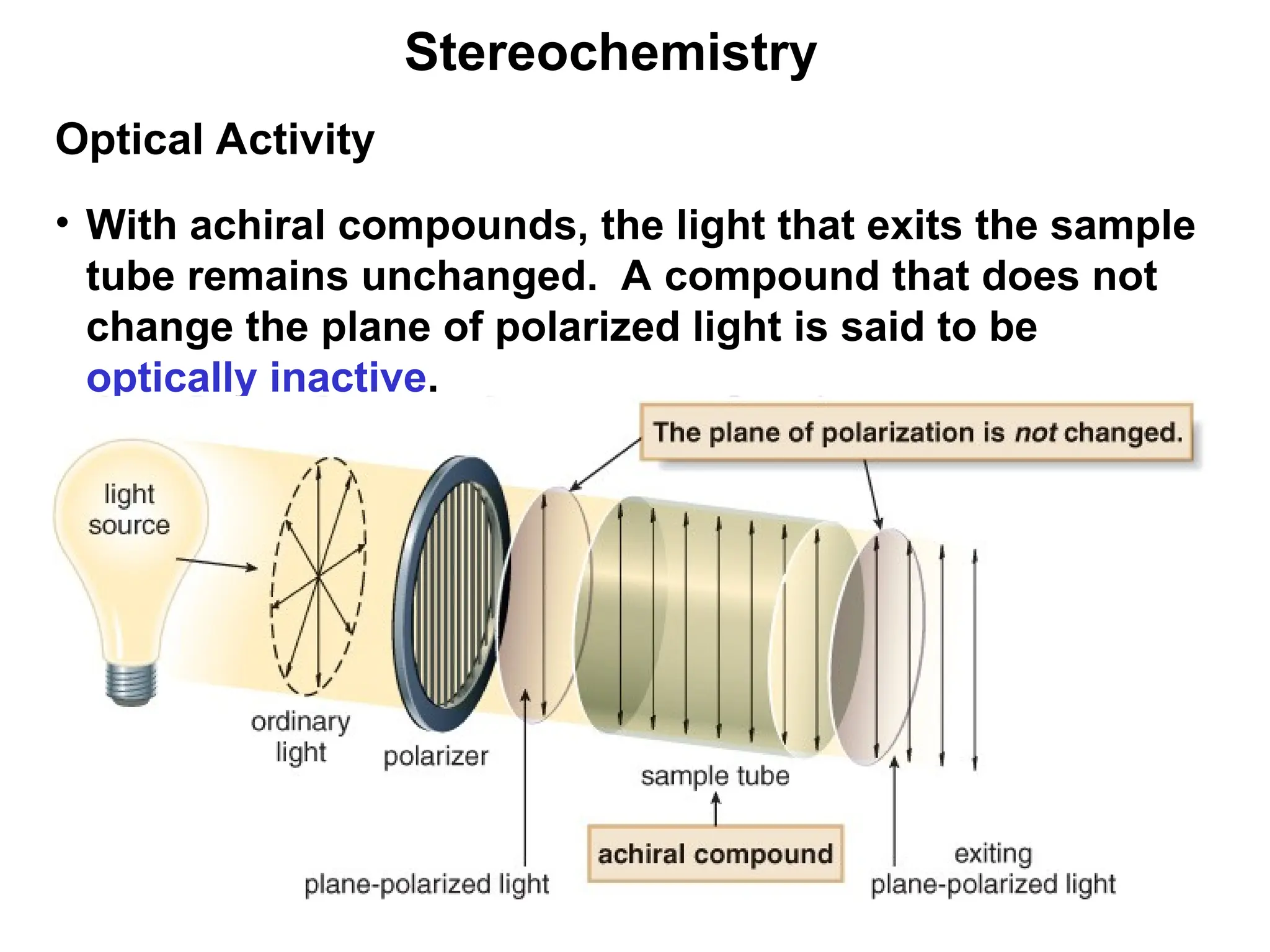
• With achiral compounds, the light that exits the sample
tube remains unchanged. A compound that does not
change the plane of polarized light is said to be
optically inactive.
Optical Activity
Stereochemistry
32
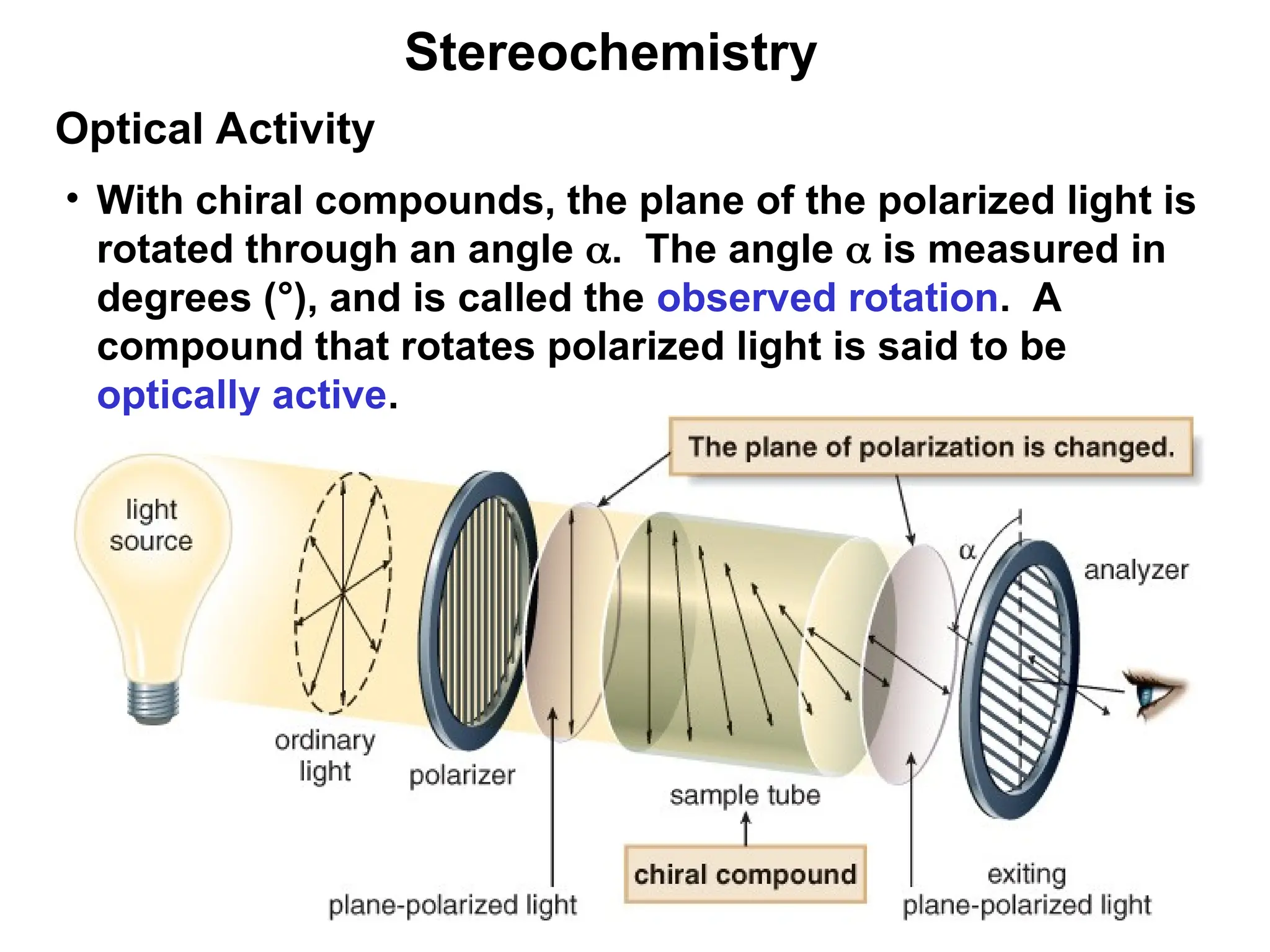
• With chiral compounds, the plane of the polarized light is
rotated through an angle . The angle  is measured in
degrees (°), and is called the observed rotation. A
compound that rotates polarized light is said to be
optically active.
Optical Activity
Stereochemistry
33
• The rotation of polarized light can be clockwise or
counterclockwise.
• If the rotation is clockwise (to the right of the noon position), the
compound is called dextrorotatory. The rotation is labeled d or
(+).
• If the rotation is counterclockwise, (to the left of noon), the
compound is called levorotatory. The rotation is labeled l or (-).
• Two enantiomers rotate plane-polarized light to an equal extent
but in opposite directions. Thus, if enantiomer A rotates
polarized light +5°, the same concentration of enantiomer B
rotates it –5°.
• No relationship exists between R and S prefixes and the (+) and
(-) designations that indicate optical rotation.
Optical Activity
Stereochemistry

stereochemistry ppt for youtube channel.ppt

  • 1.
    1 • The twomajor classes of isomers are constitutional isomers and stereoisomers. Constitutional/structural isomers have different IUPAC names, the same or different functional groups, different physical properties and different chemical properties. Stereoisomers differ only in the way the atoms are oriented in space. They have identical IUPAC names (except for a prefix like cis or trans). They always have the same functional group(s). • A particular three-dimensional arrangement is called a configuration. • Stereoisomers differ in configuration. Stereochemistry
  • 2.
    2 A comparison ofconsitutional isomers and geometric stereoisomers Stereochemistry Stereoisomers may be geometric (cis/trans) or optical. Optical isomers are chiral and exhibit optical activity.
  • 3.
    3 • Although everythinghas a mirror image, mirror images may or may not be superimposable. • A molecule or object that is superimposable on its mirror image is said to be achiral (lacking-chirality). • A molecule or object that is not superimposable on its mirror image is said to be chiral. • Generally, a chiral carbon atom is sp3 with four different attachments. Stereochemistry Chiral and Achiral Molecules:
  • 4.
    4 • We cannow consider several molecules to determine whether or not they are chiral. Stereochemistry Chiral and Achiral Molecules:
  • 5.
    5 • A carbonatom with four different groups is a chiral center. • The case of 2-butanol. A and its mirror image labeled B are not superimposable. Thus, 2-butanol is a chiral molecule and A and B are isomers. • Non-superimposable mirror image stereoisomers like A and B are called enantiomers . Stereochemistry Chiral and Achiral Molecules:
  • 6.
    6 • In general,a molecule with no stereogenic centers will not be chiral. There are exceptions to this that will be considered in Chapter 17. • With one stereogenic center, a molecule will always be chiral. • With two or more stereogenic centers, a molecule may or may not be chiral. • Achiral molecules usually contain a plane of symmetry but chiral molecules do not. • A plane of symmetry is a mirror plane that cuts the molecule in half, so that one half of the molecule is a reflection of the other half. Stereochemistry Chiral and Achiral Molecules:
  • 7.
    7 Stereochemistry Chiral and AchiralMolecules: Two identical attachments on an sp3 carbon atom eliminates the possibility of a chiral center.
  • 8.
    8 Summary of theBasic Principles of Chirality • Everything has a mirror image. The fundamental question is whether the molecule and its mirror image are superimposable. • If a molecule and its mirror image are not superimposable, the molecule and its mirror image are chiral. • The terms stereogenic center and chiral molecule are related but distinct. In general, a chiral molecule must have one or more stereogenic centers. • The presence of a plane of symmetry makes a molecule achiral. Stereochemistry
  • 9.
    9 • Since enantiomersare two different compounds, they need to be distinguished by name. This is done by adding the prefix R or S to the IUPAC name of the enantiomer. • Naming enantiomers with the prefixes R or S is called the Cahn-Ingold-Prelog system. • To designate enantiomers as R or S, priorities must be assigned to each group bonded to the stereogenic center, in order of decreasing atomic number. The atom of highest atomic number gets the highest priority (1). R or S Nomenclature: Stereochemistry
  • 10.
    10 • If twoatoms on a stereogenic center are the same, assign priority based on the atomic number of the atoms bonded to these atoms. One atom of higher atomic number determines the higher priority. Stereochemistry R or S Nomenclature:
  • 11.
    11 • If twoisotopes are bonded to the stereogenic center, assign priorities in order of decreasing mass number. Thus, in comparing the three isotopes of hydrogen, the order of priorities is: Stereochemistry R or S Nomenclature:
  • 12.
    12 • To assigna priority to an atom that is part of a multiple bond, treat a multiply bonded atom as an equivalent number of singly bonded atoms. For example, the C of a C=O is considered to be bonded to two O atoms. • Other common multiple bonds are drawn below: Stereochemistry Labeling Stereogenic Centers with R or S:
  • 13.
    13 Figure 5.6 Examplesof assigning priorities to stereogenic centers Stereochemistry Labeling Stereogenic Centers with R or S:
  • 14.
  • 15.
  • 16.
  • 17.
    17 Examples: Orienting thelowest priority group in back Stereochemistry R or S Nomenclature:
  • 18.
    18 • For amolecule with n stereogenic centers, the maximum number of stereoisomers is 2n . Let us consider the stepwise procedure for finding all the possible stereoisomers of 2,3- dibromopentane. Stereochemistry Diastereomers:
  • 19.
    19 • If youhave drawn the compound and the mirror image in the described manner, you have only to do two operations to see if the atoms align. Place B directly on top of A; and rotate B 180° and place it on top of A to see if the atoms align. • In this case, the atoms of A and B do not align, making A and B nonsuperimposable mirror images—i.e., enantiomers. Thus, A and B are two of the four possible stereoisomers of 2,3-dibromopentane. Stereochemistry Diastereomers:
  • 20.
    20 • Switching thepositions of H and Br (or any two groups) on one stereogenic center of either A or B forms a new stereoisomer (labeled C in this example), which is different from A and B. The mirror image of C is labeled D. C and D are enantiomers. • Stereoisomers that are not mirror images of one another are called diastereomers. For example, A and C are diastereomers. Stereochemistry Diastereomers:
  • 21.
    21 Summary: The fourstereoisomers of 2,3-dibromopentane Stereochemistry Diastereomers:
  • 22.
    22 • Let usnow consider the stereoisomers of 2,3-dibromobutane. Since this molecule has two stereogenic centers, the maximum number of stereoisomers is 4. Meso Compounds: • To find all the stereoisomers of 2,3-dibromobutane, arbitrarily add the H, Br, and CH3 groups to the stereogenic centers, forming one stereoisomer A, and then draw its mirror image, B. Stereochemistry
  • 23.
    23 • To findthe other two stereoisomers if they exist, switch the position of two groups on one stereogenic center of one enantiomer only. In this case, switching the positions of H and Br on one stereogenic center of A forms C, which is different from both A and B. • A meso compound is an achiral compound that contains tetrahedral stereogenic centers. C is a meso compound. Stereochemistry Meso Compounds:
  • 24.
    24 • Compound Ccontains a plane of symmetry, and is achiral. • Meso compounds generally contain a plane of symmetry so that they possess two mirror image halves. • Because one stereoisomer of 2,3-dibromobutane is superimposable on its mirror image, there are only three stereoisomers, not four. Stereochemistry Meso Compounds:
  • 25.
    25 Summary: The threestereoisomers 2,3-dibromobutane Stereochemistry Meso Compounds:
  • 26.
    26 • When acompound has more than one stereogenic center, R and S configurations must be assigned to each of them. R and S Assignments in Compounds with Two or More Stereogenic Centers. One stereoisomer of 2,3-dibromopentane The complete name is (2S,3R)-2,3-dibromopentane Stereochemistry
  • 27.
  • 28.
    28 Determining the relationshipbetween two nonidentical molecules Stereochemistry
  • 29.
    29 • The chemicaland physical properties of two enantiomers are identical except in their interaction with chiral substances. • The physical property that differs is the behavior when subjected to plane-polarized light ( this physical property is often called an optical property). • Plane-polarized (polarized) light is light that has an electric vector that oscillates in a single plane. • Plane-polarized light arises from passing ordinary light through a polarizer. Optical Activity Stereochemistry
  • 30.
    30 • A polarizerhas a very uniform arrangement of molecules such that only those light rays of white light (which is diffuse) that are in the same plane as the polarizer molecules are able to pass through. • A polarimeter is an instrument that allows polarized light to travel through a sample tube containing an organic compound and permits measurement of the degree to which the light is rotated. Optical Activity Stereochemistry
  • 31.
    31 • With achiralcompounds, the light that exits the sample tube remains unchanged. A compound that does not change the plane of polarized light is said to be optically inactive. Optical Activity Stereochemistry
  • 32.
    32 • With chiralcompounds, the plane of the polarized light is rotated through an angle . The angle  is measured in degrees (°), and is called the observed rotation. A compound that rotates polarized light is said to be optically active. Optical Activity Stereochemistry
  • 33.
    33 • The rotationof polarized light can be clockwise or counterclockwise. • If the rotation is clockwise (to the right of the noon position), the compound is called dextrorotatory. The rotation is labeled d or (+). • If the rotation is counterclockwise, (to the left of noon), the compound is called levorotatory. The rotation is labeled l or (-). • Two enantiomers rotate plane-polarized light to an equal extent but in opposite directions. Thus, if enantiomer A rotates polarized light +5°, the same concentration of enantiomer B rotates it –5°. • No relationship exists between R and S prefixes and the (+) and (-) designations that indicate optical rotation. Optical Activity Stereochemistry