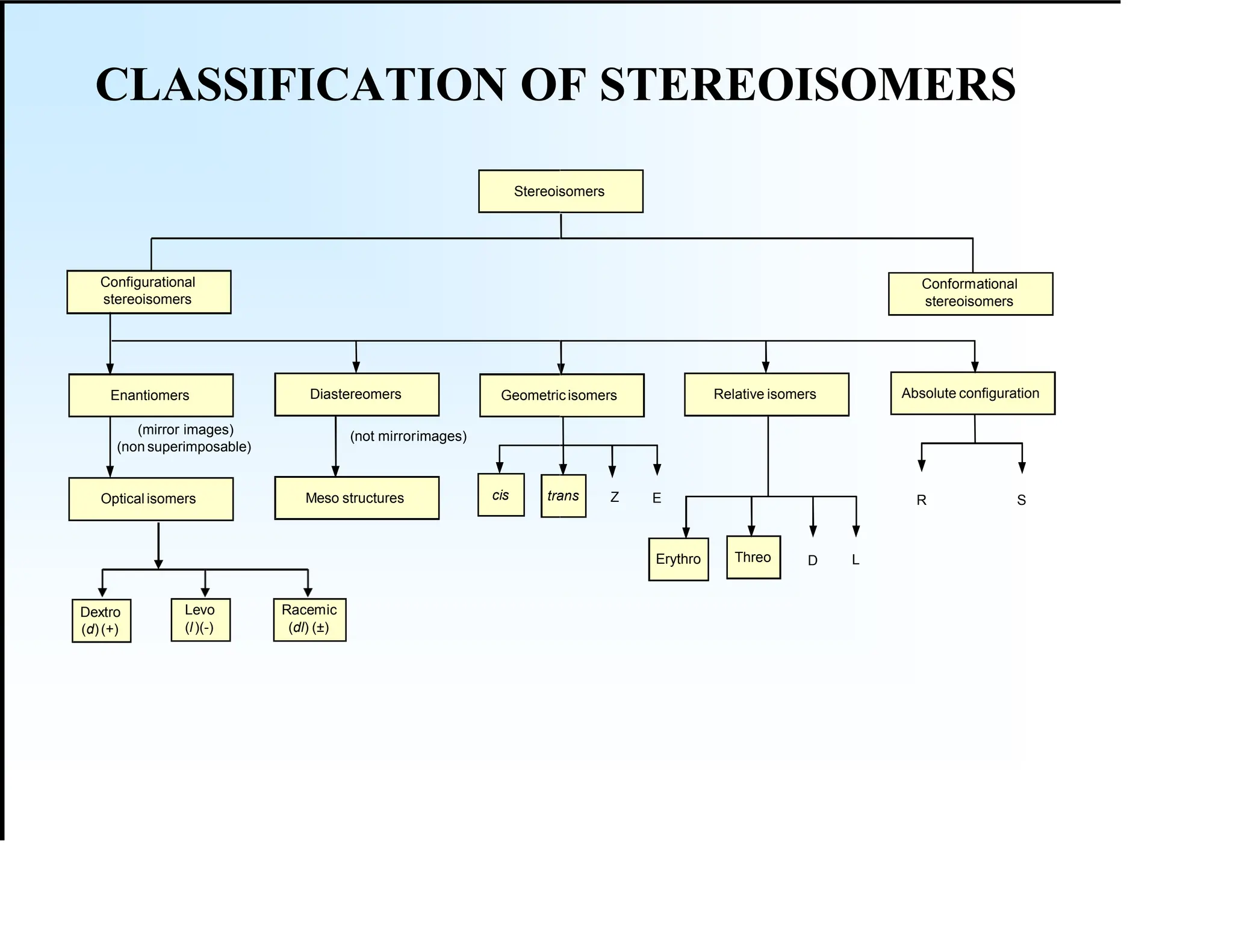
Configurational
stereoisomers
Enantiomers Diastereomers
Optical isomers Meso structures
(mirror images)
(non superimposable)
(not mirrorimages)
Dextro
(d)(+)
Levo
(l )(-)
Racemic
(dl) (±)
cis
CLASSIFICATION OF STEREOISOMERS
Stereoisomers
Conformational
stereoisomers
Geometricisomers Relative isomers Absolute configuration
trans Z E
Erythro Threo D L
R S
o
C2H5
Cl H
CH3
H C*
Cl
C*
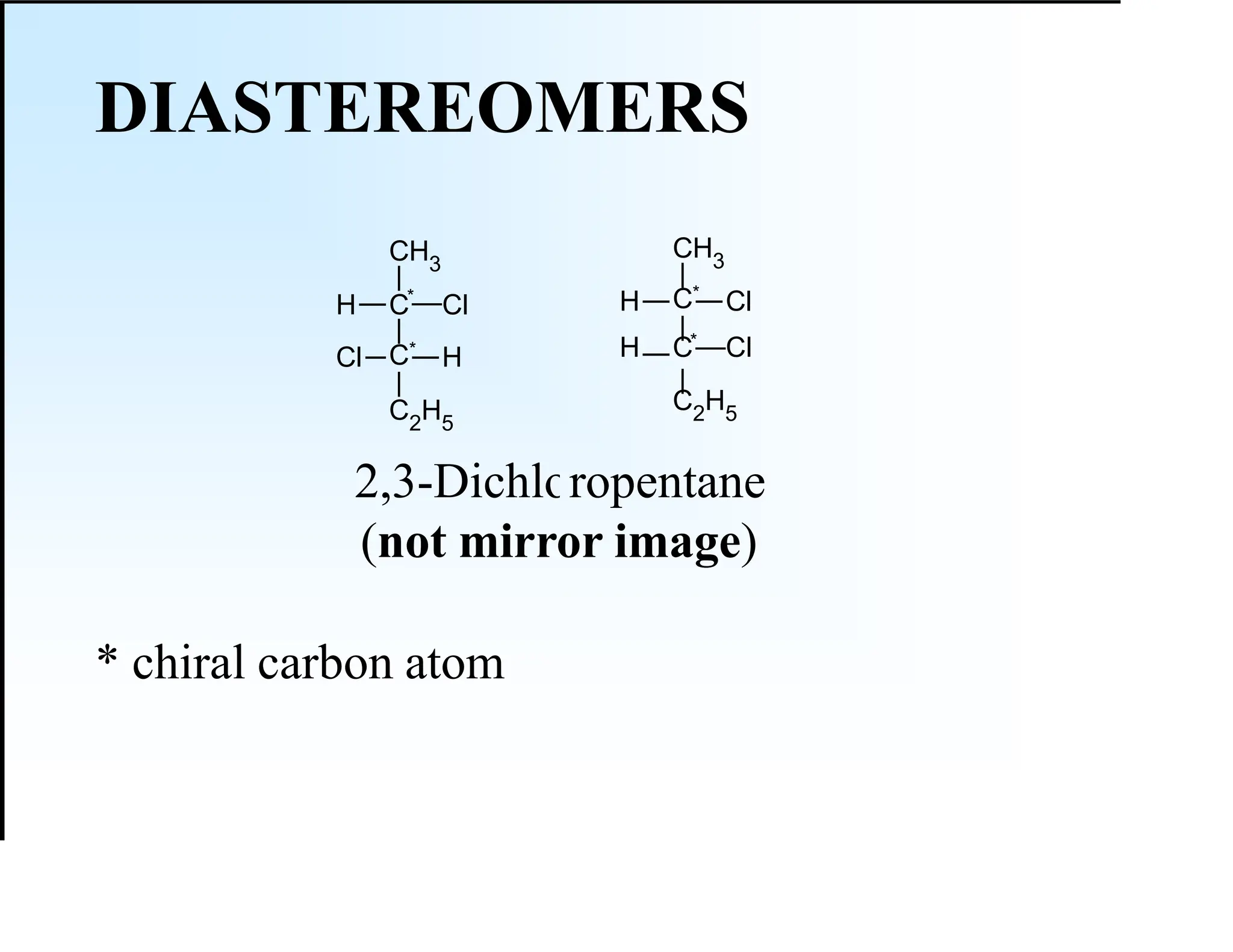
DIASTEREOMERS
2,3-Dichl ropentane
(not mirror image)
* chiral carbon atom
H Cl
CH3
C*
H C*
Cl
C2H5
d
c
DIASTEREOMERS
• Diastereomers have ifferent physical
properties.
• Chemical properties are not identical.
• May be optically ina tive.
• The phenomenon of formation of
diastereomers is called
diastereoisomerism.
n
MESO STRUCTURES
• Molecules have symmetric end – the term
Meso is used.
• Meso means combining form middle,
intermediate.
• A Meso compound is one whose molecules
are supeimposable o their mirror images
even though they contain chiral centers.
• A Meso compound is optically inactive.
MESO STRUC
CH3
H C Cl
H C Cl
CH3
2,3-Dichlorobutane
• Superimposable; turned end-for-end a
Meso compound (in same plane).
TURES
CH3
Cl C H
Cl C H
CH3
MESO STRUCTURES
• In meso structure one half of the molecule isthe
mirror image of the other half.
CH3
H C Cl
H C Cl
CH3
2,3-Dicholorobutane
• In meso compounds two chiral centershave
opposite configuration.
GEOMETRIC ISOMERISM
• The phenomenon of forming geometric
isomers is called geometric isomerism.
• A pair of geometric isomers, are, then
diastereomers, as they are not mirror
images.
• Geometric isomers, interconverted – in
principle – by rotation about a double bond.
• Geometric isomers have different physical
and frequently different chemical
reactivities.
I
GEOMETRIC SOMERS
• Science of properties and relations of lines
(bond).
• Not require chiral carbon atom.
• The particular kind of diastereomers that
owe their existence to hindered rotation
about double bonds are called geometric
isomers.
C
C
H CH3
GEOMETRIC ISOMERS
• The configurations of the isomeric
2-butenes
H
cis-2-Butene trans-2-Butene
(not mirror image)
• cis – (Latin: on this side or same side oridentical
groups)
• trans – (Latin: across or opposite)
C
C
CH3 H3C H
CH3
H
In cis-trans isomers
• there is no rotation
around the double bond
in alkenes.
• groups attached to the
double bond are fixed
relative to each other.
You can make a
“double bond” with
your fingers with both
Cis-Trans Isomers
e
e
Two isomers are possible
when
groups are attached to th
double bond are different.
• In a cis isomer, groups
are attached on the
same side of the doubl
bond.
• In the trans isomer, the
Cis-Trans Isomers
Example
cis-trans isomerism: (Geometrical)
Like atoms/groups on the same side of the double bond: cis
like atoms/groups on the opposite side of the double bond: trans
Cl H
C C
H
Cl
1,1-Dichloroethene
NO cis- OR trans-
C C
H
C l
H
H
C C
Br
H
trans-
H
Cl
C C
H H
Cl Br
CH3
Cl
C C
H3C
Br
c is -
is it trans- , cis- or neither?
CH3
3
C C
CH
Cl
Br
As expected, if one C atom that contributes to the double bond
bears 2 identical atoms / groups, no cis or trans isomerism
Chloroethene
C C
Cl
H
H
H
NO cis- OR trans-
c is -
Cl
CH3
C C
H3C
Br
trans-
H
C C
H
Cl
Br
neither
neither
c
I al
2-bromopropene
(not cis or trans)
C C
dentic
H Br
H CH3
H
H
H Br
Cis-Trans Isomerism
• Alkenes cannot have is-trans isomers if a
carbon atom in the double bond is attached
to identical groups.
Identical
1,1-dibromoethene
(not cis or trans)
C C
H Br
Br
H
T
cis
C C
Br Br
H H
Naming Cis- rans Isomers
The prefixes cis or trans are placed in front of
the alkene name when there are cis-trans
isomers.
C C
Br H
Br
H
H
H
cis-Decalin
H
H
trans-Decalin
T
H
H
cis-Decalin
H
H
trans-Decalin
Naming Cis- rans Isomers
C C
CH3 H
H
C C
Br Br
H H
A.
B.
C C
CH3
CH3
Cl
Cl
H
C.
Learning Check
Name each, using cis-trans prefixes when needed.
C C
CH3 H
H
C C
Br Br
dibH
romoethH
ene
A.
B.
C C
CH3
CH3
Cl
Cl
H
C.
Solution
cis-1,2-
trans-2-butene
1,1-dichloropropene
o
Erythro and Threo is mers
• Used for molecules having non-symmetric
ends.
• Generally used in Fischer projection.
• Not mirror images.
• Resembles with diastereomers.
RELATIVE
CONFIGURATION
side
(Z)-1-Bromo-
1-chloropropene
C
C
H
H C
3
Br Cl
I
e
H
GEOMETRIC SOMERS
Z AND E
• Z German : Zusammen = together, same
side
• E German : entgeg n = opposite, opposite
(E)-1-Bromo-
1-chloropropene
C
C
H
C
3
Cl Br
Priority
CH3 > H
Br > Cl
C C
• Answer: They
Entgegen
higher
higher
lower
C C
are ranked in order of
Zusammen
lower
lower
decreasing atomic number.
lower higher higher
Question: How are substituents ranked?
The E-Z Notational System
s
If the alkene has 4 different
unsaturated carbon atoms,
ubstituents attached to the
Br
C C
Cl
e.g.
If the two atoms of higher priority are
on the same side of the double bond,
the alkene is designated (Z) (from the
German word Zusammen,
meaning together).
H F
It is impossible to decide whether this compound is cis or trans
(E) / (Z) system:
Rule 1: Examine the 2 atoms bonded directly to a specific sp2 carbon & decide which has
a higher priority (atomic number) .
If the two atoms of higher priority are on opposite sides, the alkene is
designated (E) (from the German word Entgegen, meaning opposite)
C C
Br
H
CH3
CH2OH
(E)-
C C
Br
H
CH2CH2CH2
CH2CH
CH3
e.g. *
* CH3
(E)-
t
C
C C
Br
H
Cl
F
(Z)
Br
H
Z or E ?
Rule 2: If there is a tie, consider the atoms attached to the tie. e.g
3H 3X1 = 3
2H,O 2+8 = 1
0
H3 2H,C = 2X1 + 1X6 = 8
H,2C = 1X1 + 2X6 = 13
E/Z system could be applied to all types of alkenes i.e. it may replace cis/trans
system. However, the latter does not always replace the former.
If needed, go to the second atom…e c.
C C
CH3
Cl
(E)
CH2OH
Erythrose
H
H
OH
OH
Same side
(Erythro)
O H
• Two like functional groups
Erythro and Threo isomers
CH2OH
Threose
HO
H
H
OH
Opposite side
(Threo)
H O
RELATIVE
CONFIGURATION
D and Lisomers
• Used for molecules having non symmetric
ends.
• Orientation of –H and –OH on chiral carbon
which is farther most from the primary
chiral carbon.
• Generally used in Fischer projection.
D and L isomers
CH2OH
D-Glucose
O
H
HO
H
H
OH
H
OH
OH D
H
L
CH2OH
L-Glucose
O
H
HO
H
HO
OH
H
OH
H
H
g
ABSOLUTE CONFIGURATION
R and S isomers
• Suggested by Cahn, Ingold and Prelog
(CIP).
• R Latin : rectus = ri ht
• S Latin : sinister = left
R.S. Cahn (The Chemical Society, London)
Sir Christopher Ingold (University
College, London)
R and S isomers
• V. Prelog (Eidgenossiche Technische
Hochschule, Zurich)
• CIP system most frequently used for
designating absolute configurations of
chiral compounds.
e
R and S isomers
• Sequence rules
1)Arrange the ligands associated with an
element of chirality into order of priority.
Priority Rules
• Higher atomic numb r is given higher
priority.
• Higher atomic mass is given higher
priority.
R and S isomers
cis > trans
[(R, R)] or (S, S)] > [(R, S) or (S, S)].
I > Br > Cl
2) View the molecule with the lowest priority
group pointing away from the viewer.
3) Count the remaining ligands in order of
decreasing priority.
R and S isomers
o
n
Br
I C Cl
H
R
• If the path traced is clockwise, the (R) absolute
configuration is assigned.
• If the path traced is c unterclockwise, the (S)
absolute configuratio is assigned.
Bromochloroiodomethane
Cl C I
Br
H
S
Priority
I > Br > Cl > H
R and S isomers
R
B
3
Cl
I
H
Br
S
Atoms
priority
I > r > Cl > H
At. No. 53 5 17 1
At. Wt. 126.91 79.91 35.06 1.008
Cl I
H
Br
Priority
I > Br > Cl > H
R and S isomers
o
CH2CH3
HO H
CH3
(-)-2-Butanol
CH3
HO
CH2CH3
H
Relative configuration
(R)-2-Butanol (S)-2-Butanol
Absolute c nfiguration
CH2CH3
H OH
CH3
(+)-2-Butanol
CH2CH3
H
H3C OH
Priority
HO > CH3CH2 >CH3
Forms of representin
Noncyclic
compounds
Ethane
Empirical
formula
CH3
(C:H; 1:3)
g
e
2 Contd.
organic compounds
Mol cular
formula
Structural
formula
C H6
Cyclic
compounds
Chain formula
(normal chain)
Fischer formula
Andiron formula
(Sawhorse drawing)
Dimensional formula
(Wedge-and-dash
drawing)
H
H H
H H
H
H H
H
H
H
H
C
H
H
C
H
H
H
H
Ethane
for
S
m
3
H C CH3
Ball & Stick
formula
Newman
projection
Electronic
formula
tructural
ula
H
H
H
H
H
H
H H
H
H C C
H H
Emperical
formula m
CH2
Contd.
Cyclic compounds
Cyclohexane
Structural
formula
Molecular
for ula
C6H12
Chain formula
Ball and
Stick formula
h
w
e
N
Polygon
formula
Cyclo exane
structural formula
Ha orth
proj ction
Wedge-and-
dash drawing
ewman
projection
Chair
formula
H
H
H
H
H
H
H
H
H
H
H
H
m
Eclipsed
Staggered
Skew
Anti
Gauche
Confor ational
Stereoisomers
Chair
Boat
Twist boat
Half chair
h
H
H
H
H
H H
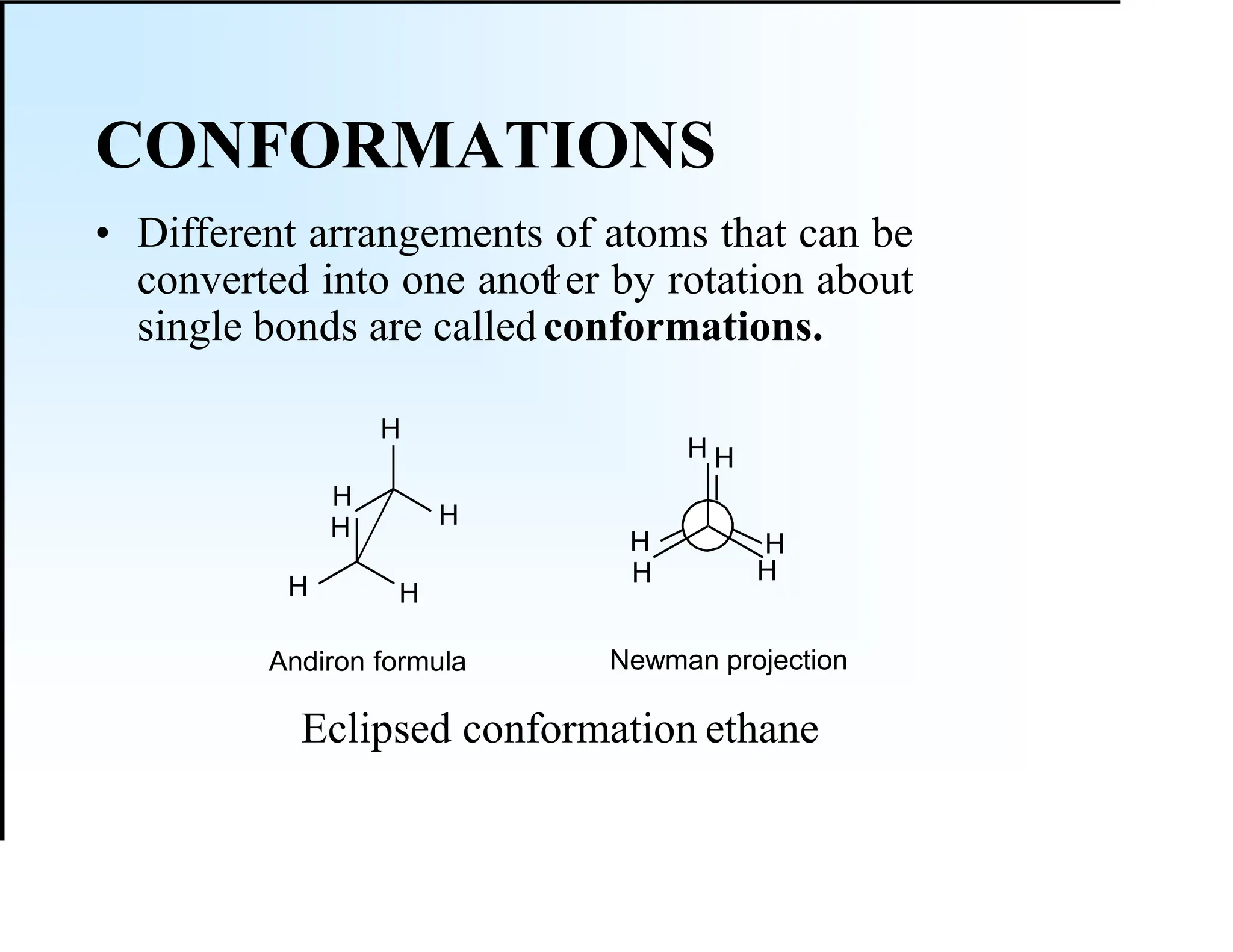
CONFORMATIONS
• Different arrangements of atoms that can be
converted into one anot er by rotation about
single bonds are calledconformations.
H
H
H
H
H H
Andiron formula Newman projection
Eclipsed conformation ethane
o
m
H
H
H
H
H
H
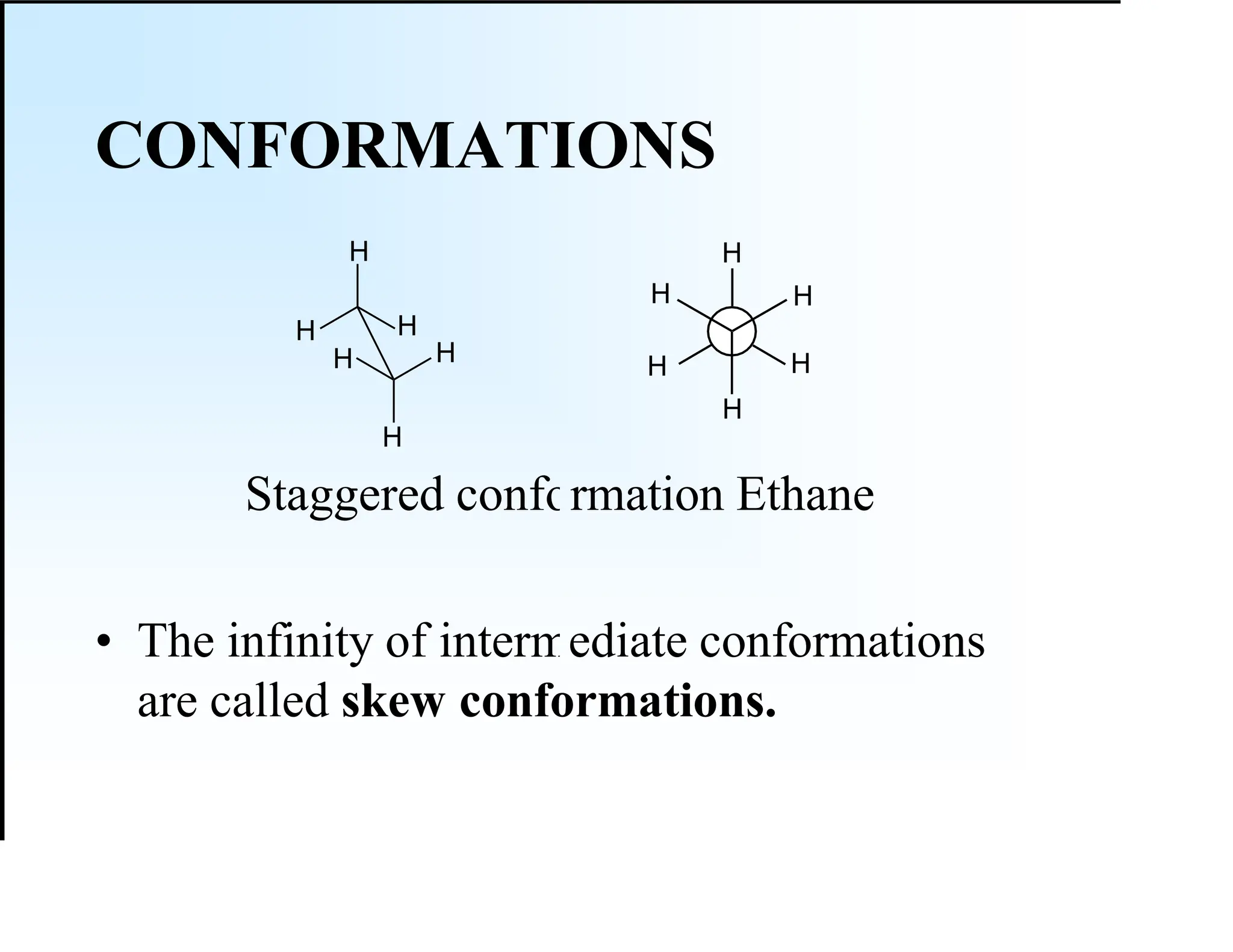
CONFORMATIONS
Staggered conf rmation Ethane
• The infinity of inter ediate conformations
are called skew conformations.
H
H
H
H
H
H
H
H
C
C
a
CONFORMATIONS
Anti conform tion n-Butane
H3
H
H
H3
e
CH3
H
H
H3C
H
H
CONFORMATIONS
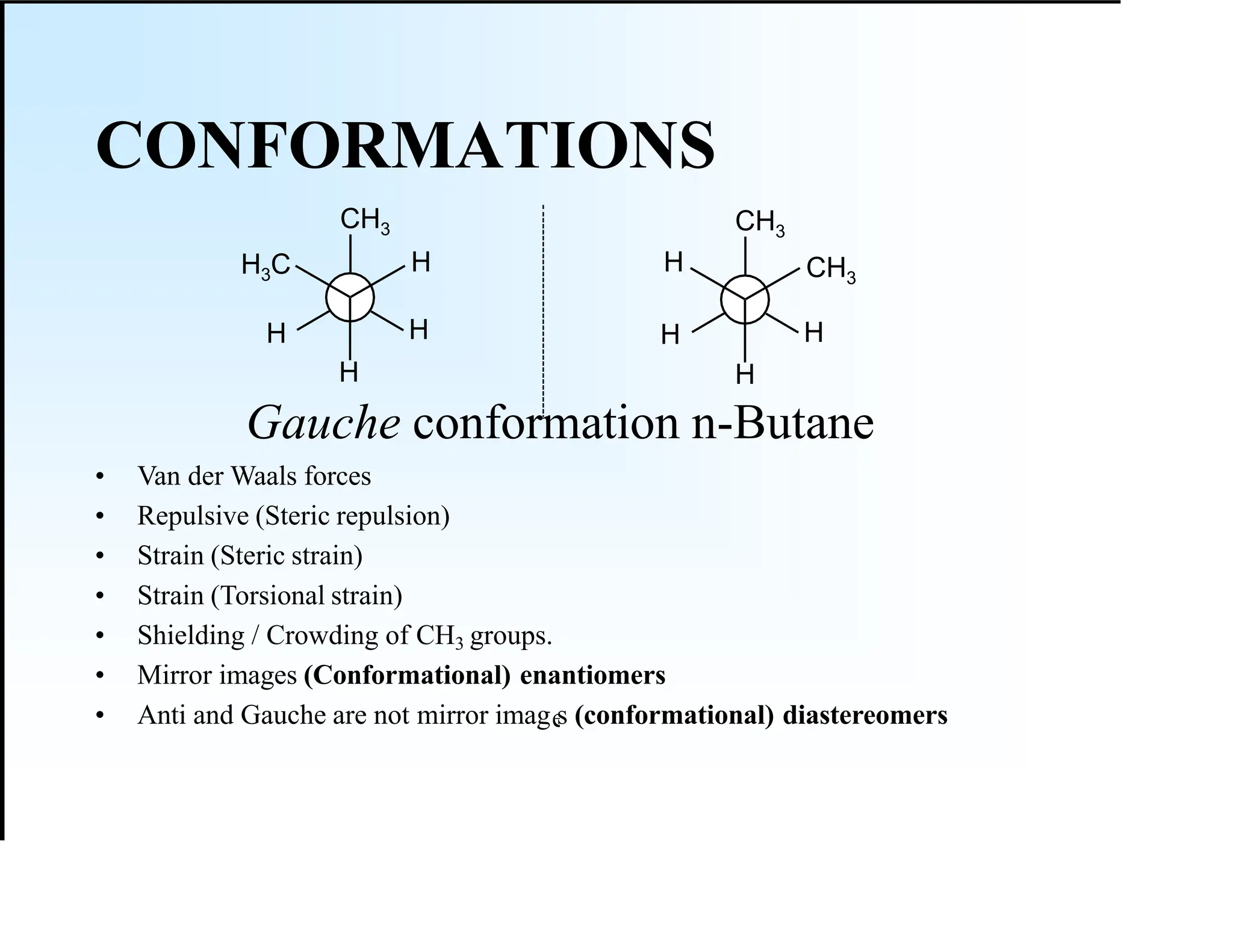
Gauche conformation n-Butane
• Van der Waals forces
• Repulsive (Steric repulsion)
• Strain (Steric strain)
• Strain (Torsional strain)
• Shielding / Crowding of CH3 groups.
• Mirror images (Conformational) enantiomers
• Anti and Gauche are not mirror imag s (conformational) diastereomers
H
CH3
H
H
CH3
H
e
o
CONFORMATIONAL
ISOMERS / CONFORMERS
• Different conformations corresponding to
energy minima are called conformational
isomers or conform rs.
• Conformational isomers are
interconvertable by rapid rotations about
one or more single b nds (C-C).
Potential energy changes during rotation about the carbon-carbon single
bond of ethane.
o
Potential energy changes during rotati n about the C(2)-C(3) bond of
n-butane.
Potential energy relationships among conformations of cyclohexane.
Chair
Twist-boat
CONFORMATIONS OF
CYCLOHEXANE
Boat
Half-chair
a
a
a
e
e
e
CHAIR CONFORMER OF
CYCLOHEXANE
a
a
a
e
e
e
axis
F
e
CHAIR FORM MOST
STABLE CON ORMATION
• Symmetrical
• Compact
• Completely free of strain-angle/torsional/ Van der
Waals forces (strain/torsion/repulsion).
• Every angle is the tetrahedral angle.
• Every C-C bond precise staggering.
• Energy minima
• No crowding of hydrog n atoms.
Newman projection formula:
Ethane(Staggered)
Anti conformation; 180 o tortional angle
H
H H
H
H
c
Staggerd
(Most stable)
180o
Sawhorse &Newman projection
formula: Ethane
H H H
H H
H
H
H H
H
H
Gau h Conformation
60 o
H H
Eclipsed
Least stable
0 o
e
p
Conformational Isom rism in Cyclohexane:
Cyclohexane exists in two puckered conformations, the boat and chair
forms, that have tetrahedral bond angles. The boat form is less stable and
not preferred because of interactions between the two end or flagpole
carbons and because the hydrogens on the other adjacent carbons are
eclipsed. In the preferred chair form, atoms on adjacent carbons are
staggered and there are no flagpole type interactions. There are two
orientations of hydrogens in the chair conformation. Axial hydrogens are
oriented directly above or below the "plane" of the ring in an alternating
arrangement. Equatorial hydrogens rotrude out along the perimeter of
the ring.
F
g
e
n
CHAIR FORM MOST
STABLE CON ORMATION
• Everything just fits ( eometrical demands).
• Architectural perfection.
• Cyclohexane chairs in the structure of
diamond.
• Diamond most stable form of carbon and the
hardest substance known.
• Replacing one methyl ne group with oxygen
make up the most abu dant building block of
the organic world, D-glucose.
F
CHAIR FORM MOST
STABLE CON ORMATION
• Appearance of chair form in diamond
HO
H
HO H
F
D
2
CHAIR FORM MOST
STABLE CON ORMATION
-D-(+)-Glucopyranose
• Appearance of chair form in
-D-(+)-Glucopyranose
OH
H
CH2OH
O
H
H
OH 
O
O
H
HO
H
H
H
OH 
H
OH
OH D
CH2OH
-D-(+)-Glucose
GLUCOSE
NOMENCLATURE
FISCHER PROJECTI N
O
H
 HO
HO
H
H
H
H
OH
OH D
CH2OH
-D-(+)-Glucose
O
O
H
OH 
H
OH
H
H
HO
H
L HO
CH2OH
-L-(+)-Glucose
FISCHER PROJECTI N
O
H
H
OH
H
H
 HO
HO
H
L HO
CH2OH
-L-(+)-Glucose
HAWORTH
PROJECTION
O
2
CH OH
H
OH
H
OH H
H
OH 
H OH
-D-(+)-Glucopyranose
O
H
HO
H
HO
OH
2
H H
H
OH 
CH2OH
CHAIR
CONFORMER
D
-D-(+)-Glucopyranose
HAWORTH
PROJECTION
D
O
2
CH OH
H
OH
H
OH H
H
OH 
H OH
-D-(+)-Glucopyranose
CHAIR
CONFORMER
D
H
HO
H
HO
OH
CH2OH
O
H
H
H
OH 
-D-(+)-Glucopyranose
HAWORTH
PROJECTION
O
H
H
OH
H
OH 
CH2
OH L
OH H
H OH
-L-(+)-Glucopyranose
CHAIR
CONFORMER
O
H
HO
H
HO
H
CH OHOH
H
H
OH 
2
L
-L-(+)-Glucopyranose
O
HAWORTH
PROJECTION
C
H
ONFORMER
H
OH
CH2OH L
OH H
H OH
OH
H

-L-(+)-Glucopyranose
CHAIR
O
H
HO
H
HO
H
2
L
CH OH OH
H
H
OH 
-L-(+)-Glucopyranose
Ethane
Make a model of ethane, C2H6. Rotate the two carbons relative to each
other around the carbon-carbon bond. Make the staggered and eclipsed
conformations.
Bromoethane
Geometrical isomerism in oximes
STEREO
CHEMISTRY OF
SOME DRUG
MOLECULES
m
Configurations
CONFUSING ‘C’
Che istry
Carbon
Compounds
Chirality
Conformations
e
n
◼ Stereoisomers
◼ Chirality
◼ (R) and (S) Nomenclature
◼ Depicting Asymm tric Carbons
◼ Diastereomers
◼ Fischer Projectio s
◼ Stereochemical Relationships
◼ Optical Activity
◼ Resolution of Enantiomers
e
Types of Stereoisomers
◼ Two types of stereoisomers:
◼ enantiomers
◼two compounds that are nonsuperimposable
mirror images of each other
◼ diastereomers
◼Two stereoisomers that are not mirror
images of each other
◼Geometric isomers (cis-trans isomers) are
one type of diast reomer.
Enantiomers
be superimposed.
◼ Enantiomers are nonsuperimposable mirror
images.
◼ Molecules are nonsuperimposable if there is no
orientation in which all atoms of both molecules
can
s
Identical
Superimposable
Same spatial
arrangement
Same atom
connectivity
All I omers
Enantiomers
Non-superimposable
Diastereomers
Non-superimposable
Different spatial
arrangement
Same spatial
arrangement
Same atom
connectivity
Same atom
connectivity
Stereoisomers
Chiral
-
◼ Enantiomers are chiral:
◼ Chiral:
◼Not superimposable on its mirror image
◼ Many natural and man made objects are chiral:
◼ hands
◼ scissors
◼ screws (left-handed vs. right-handed threads)
Right hand threads
slope up to the right.
Chiral
◼ Some molecules are chiral:
Asymmetric
(chiral) carbon
◼ no asymmetric C
◼ 1 asymmetric C
◼ > 2 asymmetric C
Asymmetric Carbons
◼ The most common feature that leads to
chirality in organic compounds is the presence
of an asymmetric (or chiral) carbon atom.
◼ A carbon atom that is bonded to four
different groups
◼ In general:
usually achiral
always chiral
may or may not be
chiral
c
H OH H H
H C C C C H
H H H H
Br
Br
Asymmetric Carbons
Example: Identify all asymmetric carbons
present in the following ompounds.
H3C
CH3
CH CH
2 3
H H H
Br CH3
Br
H
Achiral
◼ Many molecules and objects are achiral:
◼ identical to its mirror image
◼ not chiral
H H
Cl Cl
H H
Cl Cl
symmetry
Internal Plane of Symmetry
◼ Cis-1,2-dichlorocyclopentane contains two
asymmetric carbons but is achiral.
◼ contains an internal mirror plane of
H H
Cl Cl
◼ Any molecule that has an internal mirror plane
of symmetry is achiral even if it contains
asymmetric carbon atoms.
s
Internal Plane of Symmetry
◼ Cis-1,2-dichlorocyclopentane is a meso
compound:
◼ an achiral compound that contains chiral
centers
◼ often contains an internal mirror plane of
symmetry
C C
CO2H
H
OH
H
HO
HO2C
CO2H
H
OH
H
C C
HO
HO2C
F
C
H Br
H3CH2C
Internal Plane of Symmetry
Example: Which of the following compounds contain
an internal mirror plane of symmetry?
C
H
Cl
H
F
H
H3C
CH3
H
F
C
CH2CH3
H
Br
Chiral vs. Achiral
◼ To determine if a compound is chiral:
◼ 0 asymmetric carbons:
◼ 1 asymmetric carbon:
Usually achiral
Always chiral
◼ 2 asymmetric carbons: Chiral or achiral
◼Does the compound have an internal plane
of symmetry?
– Yes: ach ral
– No:
– If mirror image is non-
superimposable, then it’s chiral.
– If mirror image is superimposable,
then it’s achiral.
Identifying Chiral Carbons in a Molecule
◼ Step 1: Locate the tetrahedral carbons
(carbons with four atoms bonded to them).
◼ Step 2: Inspect the tetrahedral carbons.
Determine if the four groups attached to the
tetrahedral carbons are different.
◼ Step 3: Assign the chiral centers. Typically, an
asterisk is drawn next to the chiral carbon.
4.5 Isomerism in Organic Compounds
h
The Consequences of C irality
◼ Biological receptors are “handed.”
◼ A chiral molecule can fit only into a complementary
receptor.
◼ In many pharmaceuticals, only a single enantiomer
has biological activity.
◼ In some cases, one enantiomer of a drug can be
beneficial and the other harmful.
4.5 Isomerism in Organic Compounds
c
d
o
The Consequences of Chirality
◼ This was the case with thalidomide.
◼ One enantiomer was effe tive in alleviating the
symptoms of morning sickness.
◼ The mirror image was teratogenic.
◼ The drug was initially sol as a 50:50 mixture of
the enantiomers; many m thers who took it later
gave birth to babies with severe birth defects.
4.5 Isomerism in Organic Compounds
M
Conformationally obile Systems
◼ Alkanes and cycloalkanes are conformationally
mobile.
◼ rapidly converting from one conformation to
another
◼ In order to determine whether a cycloalkane is
chiral, draw its most symmetrical conformation
(a flat ring).
Chiral vs. Achiral
Br
H
Br H H
Br
CH3CHCH2CH2CH3
chiral or achiral.
Cl
C
y
Example: Identify the following molecules as
H
Br
CH3
CH3C H2CH3
Cl Br
H
C C
CH3CH2 H
Br
CH2CH3
trans-1,3-dibromoc clohexane
ethylcyclohexane
a
(R) And (S) Nomenclature
◼ Stereoisomers are different compounds and
often have different properties.
◼ Each stereoisomer must have a unique name.
◼ The Cahn-Ingold-Prelog convention is used to
identify the configuration of each asymmetric
carbon atom present in a stereoisomer.
◼ (R) and (S) configur tion
Natural alanine
(S)-alanine
CO2H
C
H3C
H
NH2
(R) and (S) Nomenclature
◼ The two enantiomers of alanine are:
Unnatural alanine
(R)-alanine
H
H2N
CO2H
C
CH3
(R) and (S) Nomenclature
◼ Assign a numerical priority to each group
bonded to the asymmetric carbon:
◼ group 1 = highest priority
◼ group 4 = lowest priority
◼ Rules for assigning priorities:
◼ Compare the first atom in each group (i.e.
the atom directly bonded to the asymmetric
carbon)
◼Atoms with higher atomic numbers have
higher priority
C
H3
C
OCH CH
2 3
Cl1
2
3
H
4
(R) and (S) Nomenclature
Example priorities:
I > Br > Cl > S > F > O > N > 13C > 12C > 3H > 2H >
1H
NH2
1 F
2
3 CH
3
C H 4
C
CH3CH2
CH(CH3)2 > CH2
(
C
3
1
(R) and (S) Nomenclature
◼ In case of ties, use the next atoms along the
chain as tiebreakers.
2 CH CH Br
2 2
CH CH )
3 2
H2Br > CH3CH2
H4
e
c
C Y C Y
Y C
O
CH2OH
OH
H
1
2
C
C
3
4 H
(R) and (S) Nomenclature
◼ Treat double and tripl bonds as if both atoms
in the bond were dupli ated or triplicated:
C Y C
Y
C Y
Y C
2
CH OH
OH
C O
O C H
C 1
2
3
4 H
◼ Clockwise arrow
◼ Counterclockwise arrow
(R) and (S) Nomenclature
◼ Using a 3-D drawing or model, put the 4th
priority group in back.
◼ Look at the molecule along the bond between
the asymmetric carbon and the 4th priority
group.
◼ Draw an arrow from the 1st priority group to
the 2nd group to the 3rd group.
(R) configuration
(S) configuration
1 2
3
R
2 1
3
S
With group #4 rotated away:
Cl
H F
Br
1
2
3
4
Cl
Br
F
1
2
3
rotate #4 away
(S)-configuration
2
Naming from the Perspective Formula
3
1. Rank the groups bonded to the asymmetric carbon
1
4
2. If the group (or atom) with the lowest priority is
bonded by hatched wedge,
o
3. If necessary, rotate the m lecule so that the lowest
priority group (or atom) is bonded by a hatched wedge
4. You can draw group 1 to group 2, passing group 4,
but never 3
Cl
CH3
H Br
H3C
(R) and (S) Nomenclature
◼ When naming compounds containing multiple
chiral atoms, you must give the configuration
around each chiral atom:
◼ position number and configuration of each
chiral atom in numerical order, separated by
commas, all in ( ) at the start of the
compound name
H
(2S, 3S)-2-bromo-3-chlorobutane
Step 1:
e
m
the asymmetric carbon.
CH3
C*
H
Depicting Structur s with Asymmetric
Carbons
Example: Draw a 3-dimensional formula for (R)-
2-chloropentane.
Identify the asym etric carbon.
Cl
Step 2: Assign priorities to each group attached to
CH2CH2CH3
3 2 2
CH CH CH3
Cl
1
2
3 CH C
H 4
Step 4: Place the highest
e
p
H
H
Depicting Structur s with Asymmetric
Carbons
Step 3: Draw a “skeleton” with the asymmetric carbon
in the center and the lowest priority group attached to
the “dashed” wedge (i.e. pointing away from you).
C
C
riority group at the top.
Cl
e
C
H
CH3
Depicting Structur s with Asymmetric
Carbons
Step 5: For (R) configuration, place the 2nd and
3rd priority groups around the asymmetric
carbon in a clockwise direction.
Cl
CH2CH2CH3
Step 6: Double-check your structure to make
sure that it has the right groups and the right
configuration.
e
C
HO2CCH
CH3
Depicting Structur s with Asymmetric
Carbons
Example: The R-enantiomer of ibuprofen is not
biologically active but is rapidly converted to the
active (S) enantiomer by the body. Draw the
structure of the R-enantiomer.
CH2CH( H3)2
e
a
Depicting Structur s with Asymmetric
Carbons
Example: Captopril, used to treat high blood
pressure, has two asymmetric carbons, both with
the S configuration. Dr w its structure.
O
N C CHCH2SH
CH3
CO2H
Stereospecific and stereoselective
reaction
constitutional isomer
A regioselective reaction: preferential formation ofone
A specific example is a halohydrin formation reaction with
2-propenylbenzene
A stereoselective reaction: preferential formation ofa
stereoisomer
A stereospecific reaction: each stereoisomeric reactant
produces a different stereoisomeric product or adifferent
set of products
All stereospecific reactions are stereoselective
Not all stereoselective reactions are stereospecific
CH3CH=CHCH3
* *
+ Br2 → CH3CHCHCH3
Br Br
2,3-dibromobutane
2-butene
2 geometric isomers
cis- and trans-
3 stereoisomers
(S,S)-, (R,R)-, and (R,S)-
meso-
H

CH3
/
C = C
/
CH3

H
trans-2-butene
CH3
H Br
Br
Br
H H
CH3
(S,S)
CH3 CH3
 /
C = C
/
H

H
cis-2-butene
CH3 CH3
H
Br
Br
H
H Br
CH3
(R,R)
CH3
meso
H

CH3
/
C = C
/ 
CH3 H
+ Br2 →
trans-2-butene
A reaction that yields predominately one stereoisomer (or
one pair of enantiomers) of several diastereomers is called a
stereoselective reaction. In this case the meso- product is
produced and not the other two diastereomers.
CH3
H Br
H Br
CH3
meso-2,3-dibromobutane
only product
H

H
/ H
C = C + Br2 →
/ 
CH3 CH3
Br
cis-2-butene (S,S)-
CH3 CH3
Br Br H
+
H H Br
CH3 CH3
& (R,R)-2,3-dibromobutane
racemic modification only products
A reaction in which stereochemically different molecules
react differently is called a stereospecific reaction. In this
case the cis- and trans- stereoisomers give different
products.
e
mechanism for the reaction.
The fact that the addition of halogens to alkenes is both
stereoselective and stereospecific gives us additional
information about the stereoch mistry of the addition and the
C C C
C C
C anti-addition
C C syn-addition
H
C CH3
H
H3C C
CH3
C H
H
H3C C
Br2
Br2
Is the addition of Br2 syn or anti?
CH3
H
CH3
Br
H
Br
CH3
Br
CH3
H
H
Br
CH3
H
H
CH3
Br
Br
+
H X H X
|
 /
C = C
CH3 |
X H
→ H C — C
H
CH3 anti-addition of X2
to the cis-isomer
/  C
H
3 |
CH3 X CH3
X
Note: must rotate about C-C to get to the Fischer projection!
CH3
X
| H H X
H C — C CH3 X C — C H X H
3
| |
C CH3 H X
CH3
H X CH3 X
|
 /
C = C
/ 
CH3 X H
CH3
CH3 |
X H
CH3
→ H C — C H anti-addition of X2
to the trans-isomer
|
X
Note: must rotate about C-C to get to the Fischer projection!
CH3
X
| CH3 H H
H C — C H X C — C X H X
3
| |
C CH3 H X
CH3
H3C
H
H3C
H anti-
Br
3
H C H
Br2
H
H3C
CH
3
H
Br2
anti-
Br
H3C H
CH3
H
CH3
Br
H
Br
Br
H3C H
H
H3C Br
Br
H3C H
Br
H CH3
H
H3C Br
H
H3C Br
CH
H
H
CH3
3
Br
Br
rotate about C2-C3 to get to
Fischer projection!
o
In determining whether a stere selective addition is syn- or
anti- you cannot simply look at the Fischer projection.
Remember it is often necessary to rotate about a carbon-
carbon bond to get a molecule into the conformation that
corresponds to the Fischer projection! Use your model kit to
verify!
n
1) C C + X X
What does the stereochemistr tell us about the mechanism
of addition of halogens to alke es?
RDS
C C
X
2) X +
anti-addition
C C
X
+ X
"halonium ion"
X
C C
X
Hydroxylation of alkenes:
CH3CH=CHCH3 + KMnO4
2-butene
2 geometric isomers
* *
→ CH3CH-CHCH3
OH OH
2,3-butanediol
3 stereoisomers
→
cis-2-butene +
trans-2-butene +
CH3
H OH HO
H
HO H
CH3
(S,S)
mp 19oC
KMnO4 2,3-butanediol
KMnO4 → 2,3-butanediol
mp 34oC
mp 19oC
2,3-butanediol ( mp 19oC ) is separable into enantiomers.
CH3 CH3
H H
OH H
OH
OH
CH3
(R,R)
CH3
meso
mp 34oC
H
HO
CH3
C C
cis-2-butene + KMnO4
H3C CH3
H H
H3C H
C C
H CH3
→ meso-2,3-dihydroxybutane mp 34o
CH3
H
H
OH
OH
CH3
trans-2-butene + KMnO4 → (S,S) & (R,R)-2,3-dihydroxybutane mp 19o
CH3 CH3
H
OH + HO
H H OH
CH3
stereoselective and stereospecific
Is hydroxylation with KMnO4 syn- or anti-?
H O O CH3
 /
C = C

H
CH3
/
CH3
|
OH OH
| |
→ H C — C CH3 syn-oxidation of
H the trans-isomer
Note: must rotate about C-C to get to the Fischer projection!
OH OH CH3
| | H OH
H C — C CH3 HO C — C H HO
CH3 H
H
|
CH3 CH3 H OH
CH3
H O O H
 /
CH3
/
CH3

CH3
O
H
OH H
| |
C = C → H C — C H
CH3
syn-oxidation of
the cis-isomer
Note: no rotation necessary to get to Fischer projection!
OH OH CH3
| | H H
H C — C H HO C — C OH H OH
CH3 CH3
3
| |
C CH3 H OH
CH3
cis-2-butene +
trans-2-butene +
HCO3H
HCO3H
CH3
H OH HO
HO H H
CH3
(S,S)
mp 19oC
→ 2,3-butanediol
→ 2,3-butanediol
mp 19oC
mp 34oC
2,3-butanediol mp 19oC is separable into enantiomers.
CH3 CH3
H OH
H
OH
CH3
(R,R)
H OH
CH3
meso
mp 34oC
h
R
Oxidation with KMnO4 syn-oxidation
cis-2-butene → meso-2,3-di ydroxybutane
trans-butene → (S,S)- & (R,R)-2,3-dihydroxybutane
Oxidation with HCO2OH gives the opposite
cis-2-butene → (S,S)- & (R, )-2,3-dihydroxybutane
trans-2-butene → meso-2,3-dihydroxybutane
Oxidation with HCO2OH is anti-oxidation.
| |
— C — C —
| |
O O
Mn
O O
| |
— C — C —
O
hydroxylation with KMnO4
is syn- because of an intermediate
permanganate addition product.
hydroxylation with HCO2OH
is anti- because of an intermediate
epoxide.
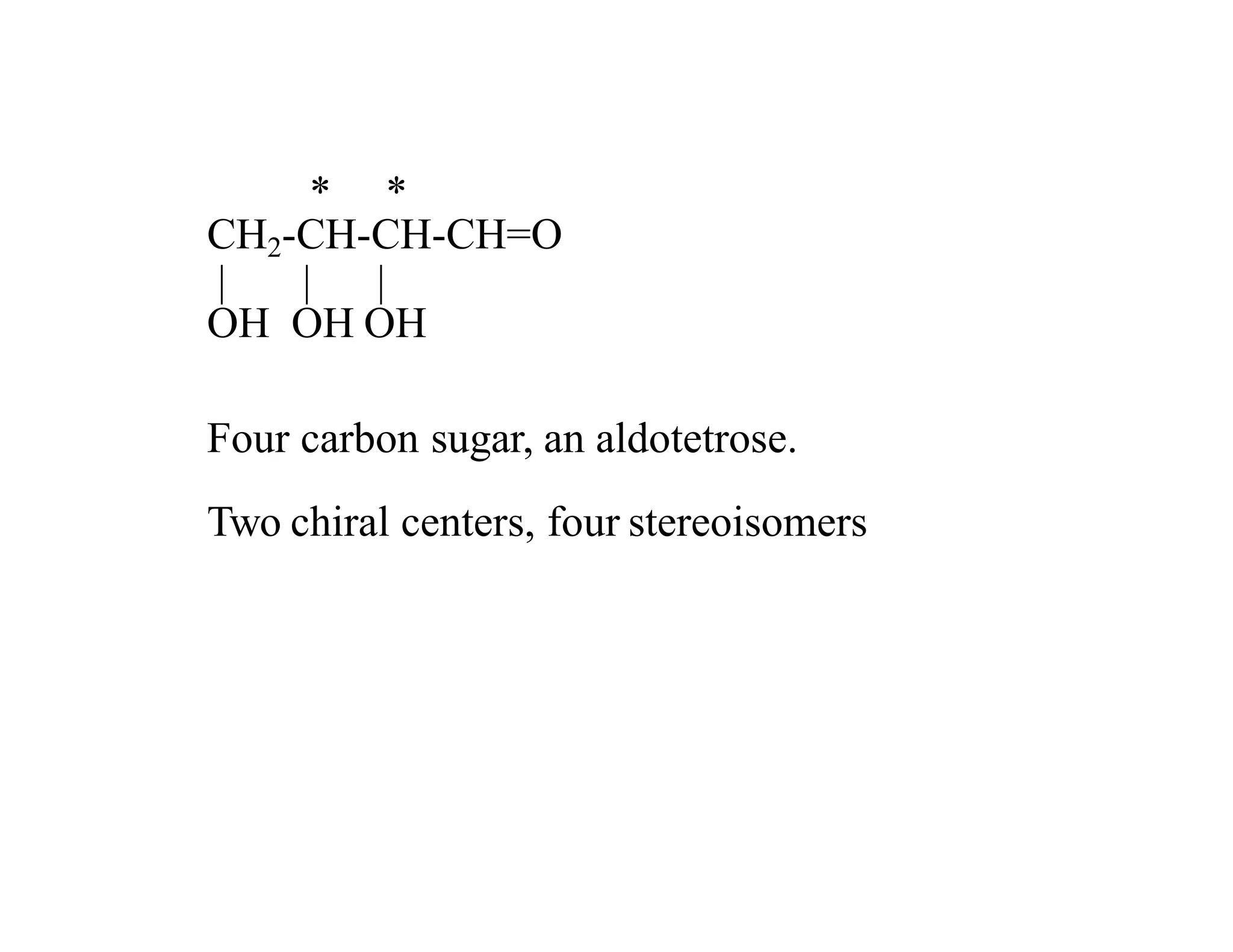
* *
CH2-CH-CH-CH=O
| | |
OH OH OH
Four carbon sugar, an aldotetrose.
Two chiral centers, four stereoisomers
CHO
H H
H
H
H
OH
OH
CH2OH
D-erythrose
CHO
HO H
H OH
CH2OH
D-threose
CHO
O
O
H
H
CH2OH
L-erythrose
CHO
H
O
OH
H
CH2OH
L-threose
X
X
“erythro-”
X
X
“threo-”
X
X
X
X
* *
C6H5CHCHC6H5
Br CH3
c
1-bromo-1,2-diphenylpropane
4 stereoisomers
+ KOH(al ) → C6H5CH=CC6H5
CH3
1,2-diphenylpropene
2 stereoisomers
(E)- & (Z)-
dehydrohalogenation of an alkyl halide via E2 mechanism
C6H5 C6H5
CH3
Br
CH3 H H
H H Br
C6H5
C6H5
erythro-
CH3
/
C6H5

C = C
/
H

C6H5
(E)-
C6H5 C6H5
H
CH3 H H
Br Br
CH3
H
C6H5 C6H5
threo-
C6H5 C6H5
/
C = C

/
H

CH3
(Z)-
C6H5 C6H5
H
H
CH3
Br
Br
CH3 H
H
C6H5 C6H5
erythro-
KOH(alc)
→
C6H5

C = C
/
H
C6H5
/

CH3
(Z)-
C6H5 C6H5
H CH3
H
H
CH3 H
Br Br
C6H5 C6H5
threo-
KOH(alc)
→
C6H5

C = C
/
H
CH3
/

C6H5
(E)-
B
CH3 H |
Br H |
H
C6H5
HO-
erythro-
E2 is both stereoselective and stereospecific.
100% anti-elimination of the H & Br:
C6H5
r
H
/
CH3
C6H5 C — C H
C6H5
CH3

C = C
/ 
C6H5 C6H5
(Z)-
C6H5
CH3 H
H Br
C6H5
Br
CH3 |
C6H5 C — C C6H5
| H
H
C6H5
/
CH3

C = C
/ 
C6H5 CH3
HO-
threo- (E)-
Once again, you must rotate about the C—C bond in the
Fischer projection to get the H & Br anti to one another.
e
e
E2 is an anti-elimination. The hydrogen and the halogen must
be on opposite sides of the molecule before the E2 elimination
can take place. This makes sense as both the base and the
leaving group are negatively charged. Therefore they would
try to be as far apart as possibl . In addition, the leaving
group is large and there is mor room for the removal of the
adjacent proton if it is on the opposite side from the leaving
group.
X
C C
H
base:
100% anti-elimination!
C
Mechanism = elimination, bimolecular E2
RDS
C + H:base + :X
CH3
H
H
CH3
CH3
D
CH3
D
Br Br
H
H
base
CH3
D
H
CH3
CH3
H
CH3
H
Br Br
D
H
base
C C
3
H
C
CH
H3C H D CH3
H C
CH3
C C
3
H
C
CH
H3C D H CH3
H C
CH3
+
+
Addition of halogens
to alkenes
anti-addition
Hydoxylation with
KMnO4
syn-oxidation
Hydroxylation with
HCO2OH
anti-oxidation
Dehydrohalogenation
of alkyl halides E2
anti-elimination
Conformational Isomers
◼ Isomers that differ as a result of sigma bond
rotation of C-C bond in alkanes
Bond Rotation and Newman Projections
◼ As carbon-carbon bond rotates, interconvert
between staggered and eclipsed conformers
Eclipsed conformer is 12.0 kJ/mol higher in energy
('free' rotation at room temperature)
Torsional Strain Energy
Force that opposes rotation due to the repulsion
of bonding electrons
◼ We do not observe perfectly free rotation
◼ There is a barrier to rotation, and some
conformers are more stable than others
◼ Small energy barrier easily overcome at RT
◼ Each eclipsed H-H costs 4 kJ/mol of
Torsional Energy
Strain Energy in Alkanes
◼ Torsional Strain
◼ Steric strain- repulsive interaction occurring between
atoms that are forced closer together than their
atomic radii allow
In Class: Conformations of Higher and
Branched Alkanes
◼ Propane
◼ Butane
◼ 2-methylbutane
◼ 2-chlorobutane
◼ draw conformers (id most/least stable)
◼ define anti and gauche staggered conformers
◼ predict relative energies and draw diagrams
◼ determine relative percentages of conformers
What does E tell us?
◼ G = -RTlnK
= -2.303RTlogK
◼ which can rearrange to
(1 kcal = 4.14 kJ)
logK = -G/1.36
or
where R = 0.001987 kcal/K*mol
T = 298 K
K = 10 -(G/1.36)
less stable K = 10 -(-0.9/1.36) = 4.5
0.9 kcal
more stable
0.0 kcal
G = -0.9 kcal/mol
(product - reactant)
so product : reactant is 4.5:1
or 82% pdt and 18% reactant
What does E tell us?
Cycloalkanes
◼ Cycloalkanes are alkanes that have carbon atoms
that form a ring (called alicyclic compounds)
◼ Simple cycloalkanes rings of ⎯CH2⎯ units, (CH2)n,
or CnH2n
Cis-Trans Isomerism in Cycloalkanes
◼ Rotation about C-C bonds in cycloalkanes is limited by the
ring structure
◼ Rings have two “faces” and substituents are labeled as to
their relative facial positions
◼ There are two different 1,2-dimethyl-cyclopropane
isomers, one with the two methyls on the same side (cis)
of the ring and one with the methyls on opposite sides
(trans)
Stereoisomers
◼ Compounds with atoms connected in the same order
but which differ in three-dimensional orientation, are
stereoisomers
◼ The terms “cis” and “trans” should be used to specify
stereoisomeric ring structures
cis-1-isopropyl-3-methylcyclohexane
Cl
trans-1,2-dichlorocyclobutane
Cl
Summary: Types of Strain
◼ Angle strain - expansion or compression of bond
angles away from most stable
◼ Torsional strain - eclipsing of bonds on neighboring
atoms
◼ Steric strain - repulsive interactions between
nonbonded atoms in close proximity
◼ RING STRAIN = combination of Angle Strain +
Torsional Strain
Conformations of Cycloalkanes
Cyclopropane
◼ 3-membered ring must have planar structure
◼ Symmetrical with C–C–C bond angles of 60°
◼ Requires that sp3 based bonds are bent (and
weakened)
◼ All C-H bonds are eclipsed
Bent Bonds of Cyclopropane
◼ In cyclopropane, the C-C bond is displaced
outward from internuclear axis
Cyclobutane
◼ Cyclobutane has less angle strain than cyclopropane
but more torsional strain because of its larger number
of ring hydrogens
◼ Cyclobutane is slightly bent out of plane - one carbon
atom is about 25° above
◼ The bend increases angle strain but decreases
torsional strain
Cyclopentane
◼ Planar cyclopentane would have no angle strain but
very high torsional strain
◼ Actual conformations of cyclopentane are nonplanar,
reducing torsional strain
◼ Four carbon atoms are in a plane
◼ The fifth carbon atom is above or below the plane –
looks like an envelope
Conformations of Cyclohexane
◼ Substituted cyclohexanes occur widely in nature
◼ The cyclohexane ring is free of angle strain and
torsional strain
◼ The conformation is has alternating atoms in a
common plane and tetrahedral angles between all
carbons
◼ This is called a chair conformation
All bond angles 109.5o, and all hydrogens staggered
How to Draw Chair Cyclohexane
The Hofmann Elimination
a quaternary ammonium hydroxide is the reactant
and an alkene is the product
is an anti elimination
the leaving group is a trialkylamine
the regioselectivity is opposite to the Zaitsev rule.
Ag2O H2O, CH3OH
N
N
+
CH2 (CH3)3
–
HO
Quaternary Ammonium Hydroxides
are prepared by treating quaternary ammmonium
halides with moist silver oxide
CH2N(CH3)3 I
–
(69%)
160°C
N
N
+
CH2 (CH3)3
–
HO
The Hofmann Elimination
on being heated, quaternary ammonium
hydroxides undergo elimination
CH2 N(CH3)3
+ + H2O
Mechanism
H
CH2
+
N(CH3)3
H
– ••
•O
•
•
••
H
O
•
•
H
• N(CH3)3
CH2
heat
e
u
HO
–
CH3CHCH2CH3
+N(CH3)3
Regios lectivity
Elimination occurs in the direction that gives
the less-substituted do ble bond. This is called
the Hofmann rule.
CH3CH CHCH3
H2C CHCH2CH3 (95%)
+
(5%)
e
o
Regios lectivity
Steric factors seem to control the regioselectivity.
The transition state that leads to 1-butene is
less crowded than the ne leading to cis
or trans-2-butene.
+N(CH3)3
H
H
H H
CH3CH2
largest group is between t
e
w
Regios lectivity
C
C
H
H
CH3CH2 H
o H atoms
major product
e
+N(CH3)3
H
H
H
CH3
CH3
Regios lectivity
C
C
CH3 H
H CH3
largest group is between an
H atom and a methyl group
minor product
Electrophilic Aromatic Substitution in
Arylamines
2-D representations of stereoisomer's
(line drawings, Fischer projections, Haworth projections)
You must be able to draw tetrahedral carbons properly!!
LINEAR ALKANES: You should draw the carbon backbone in the plane of
the paper, and draw substituents either coming towards you (with wedges)
or going away from you (with dashes). Note that each carbon should look
like a tetrahedron.
H
C
2
HO C
OH
CH3
In the plane of the paper
and in the same plane
as the tetrahedral carbon
(adjacent position off the
tetrahedral carbon)
Wedge: projecting out
of the plane of the paper
toward you
Dash: projecting behind
the plane of the paper
away from you
Dash and Wedge are on
adjacent position off the
tetrahedral carbon
Correct
H
C
Incorrect
H
••
• •
HO2C
OH
CH3
H
C
CO2H
3
H C
HO C
HO2C
3
Cl
Cl
Cl
Cl
OH OH
Br
Br
OH Br
CH
O
H
OH
Br
Fischer projection formulas represent 3 - D tetrahedral
carbon atoms and their substituent's in two dimensions.
• The molecule is drawn in the form of a cross.
•The tetrahedral carbon is in the plane of the paper at the
center of the cross
•Atoms connected to the tetrahedral carbon by horizontal
bonds are behind the plane of the paper.
Atoms connected to the tetrahedral carbon by vertical
bonds are in front of the plane of the paper
Fischer Projections - representation of a three-dimensional
molecule as a flat structure. A tetrahedral carbon is represented
by two crossed lines:
vertical line is going back
behind the plane of the
paper (away from you)
horizontal line is coming
out of the plane of the
page (toward you)
carbon
substituent
(R)-lactic acid
(S)-lactic acid
CO2H
CH3
HO H
3
H C
CO2H
H
OH
CO2H
CH3
H OH
H3C
CO2H
H
OH
OH
H
CO2H
CH3
H
HO
CO2H
CH3
Haworth projection
A Haworth projection is a common way of writing a
structural formula to represent the cyclic structure of
monosaccharides with a simple three-dimensional
perspective. Organic chemistry and especially biochemistry
are the areas of chemistry that use the Haworth projection
the most.
The Haworth projection was named after the English
chemist Sir Norman Haworth.
A Haworth projection has the
following characteristics:
➢Carbon is the implicit
type of atom. In the
example on the right, the
atoms numbered from 1 to
6 are all carbon atoms.
Carbon 1 is known as the
anomeric carbon.
➢Hydrogen atoms on carbon are implicit. In the example,
atoms 1 to 6 have extra hydrogen atoms not depicted.
➢A thicker line indicates
atoms that are closer to the
observer. In the example on
the right, atoms 2 and 3
(and their corresponding OH
groups) are the closest to
the observer. Atoms 1 and 4
are farther from the
observer. Atom 5 and the
other atoms are the farthest.
➢The groups below the plane of the ring in Haworth projections
correspond to those on the right-hand side of a Fischer
projection. This rule does not apply to the groups on the two
ring carbons bonded to the endocyclic oxygen atom.
Haworth Projections of Glucopyranose Anomers
O
CH2OH
OH
O
CH2OH
up (top)
beta
down (bottom)
alpha
OH
OH
OH
OH
OH
OH
OH
-D-(+)-Glucopyranose -D-(+)-Glucopyranose
There are certain rules that are to be followed while making the
Fischerprojection
Rule no 1) User should view the molecule from the same place
while making the projection i.e. top right, top left, bottom right,
bottom left.
Rule no 2) In Fischer projection the atoms/bonds which are in the
horizontal line should come out of the plane while those are in
vertical line shouldbegoinginsidethe plane.
Rule no 3) While rotating the bonds about any atom (chiral) the
stereochemistryof the moleculedoesnot changes.
H3C
CH3
H2N
HO
H
Cl
CH3
CH3
NH2
OH
H
Cl
Initial display of thepage final display of thepage
C H 3
C l
H
N H 2
C H 3
T L 2
H O
C H 3
H
C l
N H 2
C H 3
T L 3
H O
C H 3
N H 2
O H
C H 3
T L 4
H
C l
CH3
OH
H2N
H
Cl
TL1
3
H C Cl
HO
H2N CH3
H3C
H
TL0
CO2H
90 ° OH
CH3
HO2C
H OH °
Manipulation of Fischer Projections
1. Fischer projections can be rotated by 180°only!
a 90°rotation inverts the stereochemistry and is illegal!
H
CO2H CH3
OH HO H
CH3
(R)
CO2H
(R)
CH3
OH
CO2H
(S)
H
CO2H
HO H
CH3
(S)
180 ° 180 °
CH3
(R)
H
(S)
2. If one group of a Fischer projection is held steady, the other
three groups can be rotated clockwise or counterclockwise.
CO H
CH3
H
2
OH
2
CO H
HO CH3
hold
steady
(R)
H
(R)
hold
steady
HO
CO2H H
H HO2C OH
CH3
(S)
CH3
(S)
Assigning R and S Configuration to Fischer Projections
1. Assign priorities to the four substitutents according to the
Cahn-Ingold-Prelog rules
2. Perform the two allowed manipulations of the Fischer
projection to place the lowest priority group at the top
(or bottom).
3. If the priority of the groups 1→2→3 are clockwise then assign
the center as R, if 1→2→3 are counterclockwise then assign
the center as S.
place at
2
1 H2N
2
CO H
CH3
3
H 4
the top
hold steady
rotate other
three groups
counterclockwise
HO2C NH2 1
2
CH3
3
4
H
1-2-3 counterclockwise = S
H
H N
CH3
3
2
CO2H
4
2
1
1-2-3 clockwise = R
3
NH2
2
CO2H
1
CH
3
4 H
CO2H
2
H N CH
2
3
3
H
4
1
Enantiomers must have the opposite configuration at all
chiral centers.
In general, enantiomers have identical physical properties
except optical rotation (which is equal in magnitude but opposite
in sign). Diastereomers may have completely different physical
properties.
For a molecule with n chiral centers, there are 2n number of
stereoisomers possible, not including geometric stereoisomers
of double bonds.
Erythro: substituents on same side of a Fischer projection
i.e., (2R, 3R)- and (2S, 3S)-threonine
Threo: substituents on opposite sides of a Fischer projection
i.e., (2S, 3R)- and (2R, 3S)-threonine
Diels-Alder Reaction
◆ Diels-Alder reaction: A cycloaddition reaction of
a conjugated diene and certain types of double
and triple bonds.
• dienophile: Diene-loving.
• Diels-Alder adduct: The product of a Diels-Alder
reaction.
Diels-Alder adduct
3-Buten-2-one
(a dienophile)
1,3-Butadiene
(a diene)
+
O O
Diels-Alder Reaction
• Alkynes also function as dienophiles.
Diels-Alder adduct
+
1,3-butadiene
(a diene)
COOEt
COOEt
COOEt
• Cycloaddition reaction: A reaction in which two
reactants add together in a single step to form a cyclic
product.
COOEt
Diethyl
2-butynedioate
(a dienophile)
Diels-Alder Reaction
• We write a Diels-Alder reaction in the following way:
Diene Dieno- Adduct
phile
• The special value of D-A reactions are that they:
1. form six-membered rings.
2. form two new C-C bonds at the same time.
3. are stereospecific and regioselective.
Note the reaction of butadiene and ethylene gives only
traces of cyclohexene.
Diels-Alder Reaction
• The conformation of the diene must be s-cis.
s-t rans
conformation
(lower in energy)
s-cis
conformation
(higher in energy)
Monosaccharides:Stereoisomer
Nomenclature
Epimers:-
• Epimers are a specific type of stereoisomer that
have multiple stereocenters, but only differ from
one another by the configuration at one of the
stereogenic centers.
• α-D-glucopyranose
β-D-glucopyranose
Epimers are optical isomers that differ in the configuration of asingle
carbon atom
For example, D-galactose and D-mannose are epimers of D-glucose.
D-Galactose is an epimer of D-glucose becausethe two sugarsdiffer
only in the configuration atC-4.
D-Mannose is an epimer of D-glucose becausethe two sugarsdiffer
only in the configuration atC-2.
Doxorubicin and epirubicin are two epimers that areused asdrugs
Anomers:-
While an epimer is one of a pair of stereoisomers that differ in
configuration at only one chiral (stereogenic)center.
an anomer is actually an epimer (also a cyclic saccharide) that differs
in configuration, especially at the acetal or hemiacetal carbon (refer
to the image below to differentiate between acetal and hemiacetal
carbons).
An anomer is a kind of stereoisomer; anomers are saccharides or
glycosides that are epimers, which are distinct from each other in
the configuration at C-2, if they are ketoses, or in the configuration
of C-1,if they arealdoses.
Atropisomerism:
The Axis of Chirality
Outline of the presentation
1. Introduction
2. Conditions for Atropisomerism
3. Nomenclature of Atropisomers
4. Classification of Atropisomers
5. Methods to study Atropisomerism
6. Methods for Atroposelective Conversion
7. Uses of Atropisomers
8. Conclusion
▪ Though “optical activity due to axial chirality” was first reported by Christie and
Kenner in 1922,1 but the term “Atropisomerism” was coined by Richard Kuhn later
in 1933.2
▪ From Greek: a – not
tropos – to turn
▪ Atropisomerism is that kind of isomerism, where the conformers (called
atropisomers) can be isolated as separate chemical species and which arise from
restricted rotation about a single bond.
▪ Axis of Chirality: An axis about which a set of atoms/functional groups/ligands is
held so that it results in a spatial arrangement that is not superimposable on its
mirror image.
Richard Kuhn (1900-1967)
Nobel Laureate in chemistry (1938)
Introduction
1. Two necessary preconditions for axial chirality are:
i. a rotationally stable axis
ii. Presence of different substituents on both sides of the axis
2. Atropisomers are recognised as physically separable species when, at a given temperature, they have a half life
of atleast 1000 s (16.7 min) [τ ≥ 1000 s].
3. The minimum required free energy barriers at different temperatures are asbelow.
∆G200K = 61.6kJmol-1
∆G300K = 93.5kJmol-1
∆G350K = 109 kJmol-1
4. The configurational stability of axially chiral biaryl compounds is mainly determined by three following factors:
i. The combined steric demand of the substituents in the proximity of the axis
ii. The existence, length, and rigidity of bridges
iii. Atropsiomerization mechanism different from a merely physical rotation about the axis, e.g.
photochemically or chemically inducedprocesses.
Conditions for Atropisomerism
Nomenclature of Atropisomers
1. Notations used for Atropisomers:
aR (axially Rectus) or P (plus)
aS (axially Sinister) or M (minus)
2. Priority of the substituents are determined by the CIP rule.
3. Here it is assumed that priority of A>B and A’>B’.
Classification of Atropisomers
The following classification is based upon the basic structure of the “Biaryl Atropisomers”.
1. Based on the famous atropisomer antiboiotic ”VANCOMYCIN”, it is explained in a
limerick.
It's a chemical stroke of good luck
When a hindered rotation gets
stuck.
If conformers are cool,
Atropisomers rule
When Gram-positive germs run amuck.
2. Atropisomers are abundant in nature and their structural variety is broad ranging from
simple biphenyls to highly
complex glycopeptides.
3. Quite a number of powerful and reliable methods have been developed for the
construction of the chiral biaryl axis.
4. However, atropoenantioselective methods are still rare.
5. With the steadily growing number of natural products with chiral biaryl axis, both further
refinement of the existing methods and development of novel strategies are necessary
to address their syntheses.
Conclusion
Stereochemistry and Drug Action
✓ Isomers and types of isomers
➢ Constitutional Isomers
• Functional Group Isomers
• Positional Isomers
• Geometric Isomers
➢ Stereoisomers
• Enantiomers
• Diastereomers
• Meso Compounds
➢ Conformational Isomers
• Eclipsed, gauche, staggered, syn-clinal, anti-clinalforms
• Chair, boat, pseudo-chair, skew-boat
Stereochemistry and Drug Action
✓ Functional Group Isomers
Same molecular formula, but different functional groups,
e.g., n-propanol and methyl ethyl ether
O
CH3
NH2
CH3
HN O
O
3,4-MDA
(Ecstasy)
OCH2CH3
phenacetin
(analgesic)
✓ Positional Isomers
Same molecular formula, same functional groups, but different positions of
functional groups, e.g., n-propanol and i-propanol
Ph COOEt
N
CH3
Ph
COOEt
N
CH3
Mepiridine
(Analgesic) (not analgesic)
Stereochemistry and Drug Action
✓ Geometric Isomers (cis/trans)
Same molecular formula, same functional groups, same positions, but different
orientation around a double bond or on a ring.
An important criteria to exhibit geometric isomerism is that the isomers cannot
be interconverted through mere rotation around a single bond.
H
OH
H
HO
H
HO
H
HO
cis-DES
trans-DEC
(Estrogenic) (non estrogenic)
Stereochemistry and Drug Action
✓ Geometric Isomers (cis/trans) … other examples
N
H3C
H
N
Triprolidine (E)
Trans isomer, i.e., E, is 1000-times more histaminic than cis, Z
Me
Me
OH
Me
Vitamin A has all E double bonds, any Z
would make it inactive!
Stereochemistry and Drug Action
✓ Identify chiral centers (carbon, nitrogen, phosphorus)
HO
OH
NH2
HO
Nor-epinephrine
O O
CH3
O
OH Ph
warfarin
HO
N
quinine
*
* N
* * *
*
*
CH3
H3C
*
*
H C
3
CH3
HO
H C
3
cholesterol
*
*
*
*
*
*
N
H
CH3
HO
9R
O
5R
6S
HO
13S
14R
morphine
Stereochemistry and DrugAction
Thalidomide is racemic. One enantiomer is effective against morning
sickness, whereas the other is teratogenic.
The S enantiomer causes birth defects, while the R enantiomer is effective
against morning sickness.
Ethambutol: Whereas the (S,S)-(+)-enantiomer is used to treat tuberculosis,
the (R,R)-(–)-ethambutol causes blindness.
Naproxen: (S)-(+)-naproxen is used to treat arthritis pain, but (R)-(–)-
naproxen causes liver poisoning with no analgesic effect.
Methorphan: The L-isomer of methorphan, levomethorphan, is a potent
opioid analgesic, while the D-isomer, dextromethorphan, is a dissociative
cough suppressant.
Stereochemistry and DrugAction
✓ Why do chiral molecules react differently with biological molecules?
A majority of biomolecules (amino acids, proteins, sugars, nucleic acids)
are chiral. And in nature, they exist in only one of two possible
enantiomeric forms. For example, (-) amino acids are predominant in
living systems; (+) forms, on the other hand, occur only rarely (e.g., in
antibiotic peptides).
In contrast, most monosaccharides exist only in dextrorotatory forms.
Also, an amino acid such as threonine has two optical centers and four
enantiomers, but of the latter, only one form is commonly found in nature.
All these indicate a preference for one form among all forms of a given
molecule.
The laevorotatory amino acids always give rise to right-handed helical
proteins. Dextrorotatory amino acids, on the other hand, always give the
right to left-handed proteins. A mixture of both forms cannot form helices at
all.
Similarly, the genetic material deoxyribonucleic acid is always coiled as a
right-handed helix.

Unit-IV_Stereochemistry and its types.pdf

  • 1.
    Configurational stereoisomers Enantiomers Diastereomers Optical isomersMeso structures (mirror images) (non superimposable) (not mirrorimages) Dextro (d)(+) Levo (l )(-) Racemic (dl) (±) cis CLASSIFICATION OF STEREOISOMERS Stereoisomers Conformational stereoisomers Geometricisomers Relative isomers Absolute configuration trans Z E Erythro Threo D L R S
  • 2.
    o C2H5 Cl H CH3 H C* Cl C* DIASTEREOMERS 2,3-Dichlropentane (not mirror image) * chiral carbon atom H Cl CH3 C* H C* Cl C2H5
  • 3.
    d c DIASTEREOMERS • Diastereomers haveifferent physical properties. • Chemical properties are not identical. • May be optically ina tive. • The phenomenon of formation of diastereomers is called diastereoisomerism.
  • 4.
    n MESO STRUCTURES • Moleculeshave symmetric end – the term Meso is used. • Meso means combining form middle, intermediate. • A Meso compound is one whose molecules are supeimposable o their mirror images even though they contain chiral centers. • A Meso compound is optically inactive.
  • 5.
    MESO STRUC CH3 H CCl H C Cl CH3 2,3-Dichlorobutane • Superimposable; turned end-for-end a Meso compound (in same plane). TURES CH3 Cl C H Cl C H CH3
  • 6.
    MESO STRUCTURES • Inmeso structure one half of the molecule isthe mirror image of the other half. CH3 H C Cl H C Cl CH3 2,3-Dicholorobutane • In meso compounds two chiral centershave opposite configuration.
  • 7.
    GEOMETRIC ISOMERISM • Thephenomenon of forming geometric isomers is called geometric isomerism. • A pair of geometric isomers, are, then diastereomers, as they are not mirror images. • Geometric isomers, interconverted – in principle – by rotation about a double bond. • Geometric isomers have different physical and frequently different chemical reactivities.
  • 8.
    I GEOMETRIC SOMERS • Scienceof properties and relations of lines (bond). • Not require chiral carbon atom. • The particular kind of diastereomers that owe their existence to hindered rotation about double bonds are called geometric isomers.
  • 9.
    C C H CH3 GEOMETRIC ISOMERS •The configurations of the isomeric 2-butenes H cis-2-Butene trans-2-Butene (not mirror image) • cis – (Latin: on this side or same side oridentical groups) • trans – (Latin: across or opposite) C C CH3 H3C H CH3 H
  • 10.
    In cis-trans isomers •there is no rotation around the double bond in alkenes. • groups attached to the double bond are fixed relative to each other. You can make a “double bond” with your fingers with both Cis-Trans Isomers
  • 11.
    e e Two isomers arepossible when groups are attached to th double bond are different. • In a cis isomer, groups are attached on the same side of the doubl bond. • In the trans isomer, the Cis-Trans Isomers
  • 12.
    Example cis-trans isomerism: (Geometrical) Likeatoms/groups on the same side of the double bond: cis like atoms/groups on the opposite side of the double bond: trans
  • 13.
    Cl H C C H Cl 1,1-Dichloroethene NOcis- OR trans- C C H C l H H C C Br H trans- H Cl C C H H Cl Br CH3 Cl C C H3C Br c is - is it trans- , cis- or neither? CH3 3 C C CH Cl Br As expected, if one C atom that contributes to the double bond bears 2 identical atoms / groups, no cis or trans isomerism Chloroethene C C Cl H H H NO cis- OR trans- c is - Cl CH3 C C H3C Br trans- H C C H Cl Br neither neither
  • 14.
    c I al 2-bromopropene (not cisor trans) C C dentic H Br H CH3 H H H Br Cis-Trans Isomerism • Alkenes cannot have is-trans isomers if a carbon atom in the double bond is attached to identical groups. Identical 1,1-dibromoethene (not cis or trans) C C H Br Br H
  • 15.
    T cis C C Br Br HH Naming Cis- rans Isomers The prefixes cis or trans are placed in front of the alkene name when there are cis-trans isomers. C C Br H Br H
  • 16.
  • 17.
    C C CH3 H H CC Br Br H H A. B. C C CH3 CH3 Cl Cl H C. Learning Check Name each, using cis-trans prefixes when needed.
  • 18.
    C C CH3 H H CC Br Br dibH romoethH ene A. B. C C CH3 CH3 Cl Cl H C. Solution cis-1,2- trans-2-butene 1,1-dichloropropene
  • 19.
    o Erythro and Threois mers • Used for molecules having non-symmetric ends. • Generally used in Fischer projection. • Not mirror images. • Resembles with diastereomers. RELATIVE CONFIGURATION
  • 20.
    side (Z)-1-Bromo- 1-chloropropene C C H H C 3 Br Cl I e H GEOMETRICSOMERS Z AND E • Z German : Zusammen = together, same side • E German : entgeg n = opposite, opposite (E)-1-Bromo- 1-chloropropene C C H C 3 Cl Br Priority CH3 > H Br > Cl
  • 21.
    C C • Answer:They Entgegen higher higher lower C C are ranked in order of Zusammen lower lower decreasing atomic number. lower higher higher Question: How are substituents ranked? The E-Z Notational System
  • 22.
    s If the alkenehas 4 different unsaturated carbon atoms, ubstituents attached to the Br C C Cl e.g. If the two atoms of higher priority are on the same side of the double bond, the alkene is designated (Z) (from the German word Zusammen, meaning together). H F It is impossible to decide whether this compound is cis or trans (E) / (Z) system: Rule 1: Examine the 2 atoms bonded directly to a specific sp2 carbon & decide which has a higher priority (atomic number) . If the two atoms of higher priority are on opposite sides, the alkene is designated (E) (from the German word Entgegen, meaning opposite)
  • 23.
    C C Br H CH3 CH2OH (E)- C C Br H CH2CH2CH2 CH2CH CH3 e.g.* * CH3 (E)- t C C C Br H Cl F (Z) Br H Z or E ? Rule 2: If there is a tie, consider the atoms attached to the tie. e.g 3H 3X1 = 3 2H,O 2+8 = 1 0 H3 2H,C = 2X1 + 1X6 = 8 H,2C = 1X1 + 2X6 = 13 E/Z system could be applied to all types of alkenes i.e. it may replace cis/trans system. However, the latter does not always replace the former. If needed, go to the second atom…e c. C C CH3 Cl (E)
  • 24.
    CH2OH Erythrose H H OH OH Same side (Erythro) O H •Two like functional groups Erythro and Threo isomers CH2OH Threose HO H H OH Opposite side (Threo) H O
  • 25.
    RELATIVE CONFIGURATION D and Lisomers •Used for molecules having non symmetric ends. • Orientation of –H and –OH on chiral carbon which is farther most from the primary chiral carbon. • Generally used in Fischer projection.
  • 26.
    D and Lisomers CH2OH D-Glucose O H HO H H OH H OH OH D H L CH2OH L-Glucose O H HO H HO OH H OH H H
  • 27.
    g ABSOLUTE CONFIGURATION R andS isomers • Suggested by Cahn, Ingold and Prelog (CIP). • R Latin : rectus = ri ht • S Latin : sinister = left R.S. Cahn (The Chemical Society, London) Sir Christopher Ingold (University College, London)
  • 28.
    R and Sisomers • V. Prelog (Eidgenossiche Technische Hochschule, Zurich) • CIP system most frequently used for designating absolute configurations of chiral compounds.
  • 29.
    e R and Sisomers • Sequence rules 1)Arrange the ligands associated with an element of chirality into order of priority. Priority Rules • Higher atomic numb r is given higher priority. • Higher atomic mass is given higher priority.
  • 30.
    R and Sisomers cis > trans [(R, R)] or (S, S)] > [(R, S) or (S, S)]. I > Br > Cl 2) View the molecule with the lowest priority group pointing away from the viewer. 3) Count the remaining ligands in order of decreasing priority.
  • 31.
    R and Sisomers o n Br I C Cl H R • If the path traced is clockwise, the (R) absolute configuration is assigned. • If the path traced is c unterclockwise, the (S) absolute configuratio is assigned. Bromochloroiodomethane Cl C I Br H S Priority I > Br > Cl > H
  • 32.
    R and Sisomers R B 3 Cl I H Br S Atoms priority I > r > Cl > H At. No. 53 5 17 1 At. Wt. 126.91 79.91 35.06 1.008 Cl I H Br Priority I > Br > Cl > H
  • 33.
    R and Sisomers o CH2CH3 HO H CH3 (-)-2-Butanol CH3 HO CH2CH3 H Relative configuration (R)-2-Butanol (S)-2-Butanol Absolute c nfiguration CH2CH3 H OH CH3 (+)-2-Butanol CH2CH3 H H3C OH Priority HO > CH3CH2 >CH3
  • 34.
    Forms of representin Noncyclic compounds Ethane Empirical formula CH3 (C:H;1:3) g e 2 Contd. organic compounds Mol cular formula Structural formula C H6 Cyclic compounds
  • 35.
    Chain formula (normal chain) Fischerformula Andiron formula (Sawhorse drawing) Dimensional formula (Wedge-and-dash drawing) H H H H H H H H H H H H C H H C H H H H Ethane for S m 3 H C CH3 Ball & Stick formula Newman projection Electronic formula tructural ula H H H H H H H H H H C C H H
  • 36.
  • 37.
    Chain formula Ball and Stickformula h w e N Polygon formula Cyclo exane structural formula Ha orth proj ction Wedge-and- dash drawing ewman projection Chair formula H H H H H H H H H H H H
  • 38.
  • 39.
    h H H H H H H CONFORMATIONS • Differentarrangements of atoms that can be converted into one anot er by rotation about single bonds are calledconformations. H H H H H H Andiron formula Newman projection Eclipsed conformation ethane
  • 40.
    o m H H H H H H CONFORMATIONS Staggered conf rmationEthane • The infinity of inter ediate conformations are called skew conformations. H H H H H H
  • 41.
  • 42.
    e CH3 H H H3C H H CONFORMATIONS Gauche conformation n-Butane •Van der Waals forces • Repulsive (Steric repulsion) • Strain (Steric strain) • Strain (Torsional strain) • Shielding / Crowding of CH3 groups. • Mirror images (Conformational) enantiomers • Anti and Gauche are not mirror imag s (conformational) diastereomers H CH3 H H CH3 H
  • 43.
    e o CONFORMATIONAL ISOMERS / CONFORMERS •Different conformations corresponding to energy minima are called conformational isomers or conform rs. • Conformational isomers are interconvertable by rapid rotations about one or more single b nds (C-C).
  • 44.
    Potential energy changesduring rotation about the carbon-carbon single bond of ethane.
  • 45.
    o Potential energy changesduring rotati n about the C(2)-C(3) bond of n-butane.
  • 46.
    Potential energy relationshipsamong conformations of cyclohexane.
  • 47.
  • 48.
  • 49.
    F e CHAIR FORM MOST STABLECON ORMATION • Symmetrical • Compact • Completely free of strain-angle/torsional/ Van der Waals forces (strain/torsion/repulsion). • Every angle is the tetrahedral angle. • Every C-C bond precise staggering. • Energy minima • No crowding of hydrog n atoms.
  • 50.
    Newman projection formula: Ethane(Staggered) Anticonformation; 180 o tortional angle
  • 51.
    H H H H H c Staggerd (Most stable) 180o Sawhorse&Newman projection formula: Ethane H H H H H H H H H H H Gau h Conformation 60 o H H Eclipsed Least stable 0 o
  • 52.
    e p Conformational Isom rismin Cyclohexane: Cyclohexane exists in two puckered conformations, the boat and chair forms, that have tetrahedral bond angles. The boat form is less stable and not preferred because of interactions between the two end or flagpole carbons and because the hydrogens on the other adjacent carbons are eclipsed. In the preferred chair form, atoms on adjacent carbons are staggered and there are no flagpole type interactions. There are two orientations of hydrogens in the chair conformation. Axial hydrogens are oriented directly above or below the "plane" of the ring in an alternating arrangement. Equatorial hydrogens rotrude out along the perimeter of the ring.
  • 53.
    F g e n CHAIR FORM MOST STABLECON ORMATION • Everything just fits ( eometrical demands). • Architectural perfection. • Cyclohexane chairs in the structure of diamond. • Diamond most stable form of carbon and the hardest substance known. • Replacing one methyl ne group with oxygen make up the most abu dant building block of the organic world, D-glucose.
  • 54.
    F CHAIR FORM MOST STABLECON ORMATION • Appearance of chair form in diamond
  • 55.
    HO H HO H F D 2 CHAIR FORMMOST STABLE CON ORMATION -D-(+)-Glucopyranose • Appearance of chair form in -D-(+)-Glucopyranose OH H CH2OH O H H OH 
  • 56.
    O O H HO H H H OH  H OH OH D CH2OH -D-(+)-Glucose GLUCOSE NOMENCLATURE FISCHERPROJECTI N O H  HO HO H H H H OH OH D CH2OH -D-(+)-Glucose
  • 57.
    O O H OH  H OH H H HO H L HO CH2OH -L-(+)-Glucose FISCHERPROJECTI N O H H OH H H  HO HO H L HO CH2OH -L-(+)-Glucose
  • 58.
    HAWORTH PROJECTION O 2 CH OH H OH H OH H H OH H OH -D-(+)-Glucopyranose O H HO H HO OH 2 H H H OH  CH2OH CHAIR CONFORMER D -D-(+)-Glucopyranose
  • 59.
    HAWORTH PROJECTION D O 2 CH OH H OH H OH H H OH H OH -D-(+)-Glucopyranose CHAIR CONFORMER D H HO H HO OH CH2OH O H H H OH  -D-(+)-Glucopyranose
  • 60.
    HAWORTH PROJECTION O H H OH H OH  CH2 OH L OHH H OH -L-(+)-Glucopyranose CHAIR CONFORMER O H HO H HO H CH OHOH H H OH  2 L -L-(+)-Glucopyranose
  • 61.
    O HAWORTH PROJECTION C H ONFORMER H OH CH2OH L OH H HOH OH H  -L-(+)-Glucopyranose CHAIR O H HO H HO H 2 L CH OH OH H H OH  -L-(+)-Glucopyranose
  • 62.
    Ethane Make a modelof ethane, C2H6. Rotate the two carbons relative to each other around the carbon-carbon bond. Make the staggered and eclipsed conformations.
  • 63.
  • 67.
  • 68.
  • 69.
  • 70.
    e n ◼ Stereoisomers ◼ Chirality ◼(R) and (S) Nomenclature ◼ Depicting Asymm tric Carbons ◼ Diastereomers ◼ Fischer Projectio s ◼ Stereochemical Relationships ◼ Optical Activity ◼ Resolution of Enantiomers
  • 71.
    e Types of Stereoisomers ◼Two types of stereoisomers: ◼ enantiomers ◼two compounds that are nonsuperimposable mirror images of each other ◼ diastereomers ◼Two stereoisomers that are not mirror images of each other ◼Geometric isomers (cis-trans isomers) are one type of diast reomer.
  • 72.
    Enantiomers be superimposed. ◼ Enantiomersare nonsuperimposable mirror images. ◼ Molecules are nonsuperimposable if there is no orientation in which all atoms of both molecules can
  • 73.
    s Identical Superimposable Same spatial arrangement Same atom connectivity AllI omers Enantiomers Non-superimposable Diastereomers Non-superimposable Different spatial arrangement Same spatial arrangement Same atom connectivity Same atom connectivity Stereoisomers
  • 74.
    Chiral - ◼ Enantiomers arechiral: ◼ Chiral: ◼Not superimposable on its mirror image ◼ Many natural and man made objects are chiral: ◼ hands ◼ scissors ◼ screws (left-handed vs. right-handed threads) Right hand threads slope up to the right.
  • 75.
    Chiral ◼ Some moleculesare chiral: Asymmetric (chiral) carbon
  • 76.
    ◼ no asymmetricC ◼ 1 asymmetric C ◼ > 2 asymmetric C Asymmetric Carbons ◼ The most common feature that leads to chirality in organic compounds is the presence of an asymmetric (or chiral) carbon atom. ◼ A carbon atom that is bonded to four different groups ◼ In general: usually achiral always chiral may or may not be chiral
  • 77.
    c H OH HH H C C C C H H H H H Br Br Asymmetric Carbons Example: Identify all asymmetric carbons present in the following ompounds. H3C CH3 CH CH 2 3 H H H Br CH3 Br H
  • 78.
    Achiral ◼ Many moleculesand objects are achiral: ◼ identical to its mirror image ◼ not chiral H H Cl Cl H H Cl Cl
  • 79.
    symmetry Internal Plane ofSymmetry ◼ Cis-1,2-dichlorocyclopentane contains two asymmetric carbons but is achiral. ◼ contains an internal mirror plane of H H Cl Cl ◼ Any molecule that has an internal mirror plane of symmetry is achiral even if it contains asymmetric carbon atoms. s
  • 80.
    Internal Plane ofSymmetry ◼ Cis-1,2-dichlorocyclopentane is a meso compound: ◼ an achiral compound that contains chiral centers ◼ often contains an internal mirror plane of symmetry
  • 81.
    C C CO2H H OH H HO HO2C CO2H H OH H C C HO HO2C F C HBr H3CH2C Internal Plane of Symmetry Example: Which of the following compounds contain an internal mirror plane of symmetry? C H Cl H F H H3C CH3 H F C CH2CH3 H Br
  • 82.
    Chiral vs. Achiral ◼To determine if a compound is chiral: ◼ 0 asymmetric carbons: ◼ 1 asymmetric carbon: Usually achiral Always chiral ◼ 2 asymmetric carbons: Chiral or achiral ◼Does the compound have an internal plane of symmetry? – Yes: ach ral – No: – If mirror image is non- superimposable, then it’s chiral. – If mirror image is superimposable, then it’s achiral.
  • 83.
    Identifying Chiral Carbonsin a Molecule ◼ Step 1: Locate the tetrahedral carbons (carbons with four atoms bonded to them). ◼ Step 2: Inspect the tetrahedral carbons. Determine if the four groups attached to the tetrahedral carbons are different. ◼ Step 3: Assign the chiral centers. Typically, an asterisk is drawn next to the chiral carbon. 4.5 Isomerism in Organic Compounds
  • 84.
    h The Consequences ofC irality ◼ Biological receptors are “handed.” ◼ A chiral molecule can fit only into a complementary receptor. ◼ In many pharmaceuticals, only a single enantiomer has biological activity. ◼ In some cases, one enantiomer of a drug can be beneficial and the other harmful. 4.5 Isomerism in Organic Compounds
  • 85.
    c d o The Consequences ofChirality ◼ This was the case with thalidomide. ◼ One enantiomer was effe tive in alleviating the symptoms of morning sickness. ◼ The mirror image was teratogenic. ◼ The drug was initially sol as a 50:50 mixture of the enantiomers; many m thers who took it later gave birth to babies with severe birth defects. 4.5 Isomerism in Organic Compounds
  • 86.
    M Conformationally obile Systems ◼Alkanes and cycloalkanes are conformationally mobile. ◼ rapidly converting from one conformation to another ◼ In order to determine whether a cycloalkane is chiral, draw its most symmetrical conformation (a flat ring).
  • 87.
    Chiral vs. Achiral Br H BrH H Br CH3CHCH2CH2CH3 chiral or achiral. Cl C y Example: Identify the following molecules as H Br CH3 CH3C H2CH3 Cl Br H C C CH3CH2 H Br CH2CH3 trans-1,3-dibromoc clohexane ethylcyclohexane
  • 88.
    a (R) And (S)Nomenclature ◼ Stereoisomers are different compounds and often have different properties. ◼ Each stereoisomer must have a unique name. ◼ The Cahn-Ingold-Prelog convention is used to identify the configuration of each asymmetric carbon atom present in a stereoisomer. ◼ (R) and (S) configur tion
  • 89.
    Natural alanine (S)-alanine CO2H C H3C H NH2 (R) and(S) Nomenclature ◼ The two enantiomers of alanine are: Unnatural alanine (R)-alanine H H2N CO2H C CH3
  • 90.
    (R) and (S)Nomenclature ◼ Assign a numerical priority to each group bonded to the asymmetric carbon: ◼ group 1 = highest priority ◼ group 4 = lowest priority ◼ Rules for assigning priorities: ◼ Compare the first atom in each group (i.e. the atom directly bonded to the asymmetric carbon) ◼Atoms with higher atomic numbers have higher priority
  • 91.
    C H3 C OCH CH 2 3 Cl1 2 3 H 4 (R)and (S) Nomenclature Example priorities: I > Br > Cl > S > F > O > N > 13C > 12C > 3H > 2H > 1H NH2 1 F 2 3 CH 3 C H 4
  • 92.
    C CH3CH2 CH(CH3)2 > CH2 ( C 3 1 (R)and (S) Nomenclature ◼ In case of ties, use the next atoms along the chain as tiebreakers. 2 CH CH Br 2 2 CH CH ) 3 2 H2Br > CH3CH2 H4
  • 93.
    e c C Y CY Y C O CH2OH OH H 1 2 C C 3 4 H (R) and (S) Nomenclature ◼ Treat double and tripl bonds as if both atoms in the bond were dupli ated or triplicated: C Y C Y C Y Y C 2 CH OH OH C O O C H C 1 2 3 4 H
  • 94.
    ◼ Clockwise arrow ◼Counterclockwise arrow (R) and (S) Nomenclature ◼ Using a 3-D drawing or model, put the 4th priority group in back. ◼ Look at the molecule along the bond between the asymmetric carbon and the 4th priority group. ◼ Draw an arrow from the 1st priority group to the 2nd group to the 3rd group. (R) configuration (S) configuration
  • 95.
    1 2 3 R 2 1 3 S Withgroup #4 rotated away:
  • 96.
  • 97.
    2 Naming from thePerspective Formula 3 1. Rank the groups bonded to the asymmetric carbon 1 4 2. If the group (or atom) with the lowest priority is bonded by hatched wedge,
  • 98.
    o 3. If necessary,rotate the m lecule so that the lowest priority group (or atom) is bonded by a hatched wedge 4. You can draw group 1 to group 2, passing group 4, but never 3
  • 99.
    Cl CH3 H Br H3C (R) and(S) Nomenclature ◼ When naming compounds containing multiple chiral atoms, you must give the configuration around each chiral atom: ◼ position number and configuration of each chiral atom in numerical order, separated by commas, all in ( ) at the start of the compound name H (2S, 3S)-2-bromo-3-chlorobutane
  • 100.
    Step 1: e m the asymmetriccarbon. CH3 C* H Depicting Structur s with Asymmetric Carbons Example: Draw a 3-dimensional formula for (R)- 2-chloropentane. Identify the asym etric carbon. Cl Step 2: Assign priorities to each group attached to CH2CH2CH3 3 2 2 CH CH CH3 Cl 1 2 3 CH C H 4
  • 101.
    Step 4: Placethe highest e p H H Depicting Structur s with Asymmetric Carbons Step 3: Draw a “skeleton” with the asymmetric carbon in the center and the lowest priority group attached to the “dashed” wedge (i.e. pointing away from you). C C riority group at the top. Cl
  • 102.
    e C H CH3 Depicting Structur swith Asymmetric Carbons Step 5: For (R) configuration, place the 2nd and 3rd priority groups around the asymmetric carbon in a clockwise direction. Cl CH2CH2CH3 Step 6: Double-check your structure to make sure that it has the right groups and the right configuration.
  • 103.
    e C HO2CCH CH3 Depicting Structur swith Asymmetric Carbons Example: The R-enantiomer of ibuprofen is not biologically active but is rapidly converted to the active (S) enantiomer by the body. Draw the structure of the R-enantiomer. CH2CH( H3)2
  • 104.
    e a Depicting Structur swith Asymmetric Carbons Example: Captopril, used to treat high blood pressure, has two asymmetric carbons, both with the S configuration. Dr w its structure. O N C CHCH2SH CH3 CO2H
  • 105.
  • 106.
    constitutional isomer A regioselectivereaction: preferential formation ofone A specific example is a halohydrin formation reaction with 2-propenylbenzene
  • 107.
    A stereoselective reaction:preferential formation ofa stereoisomer
  • 108.
    A stereospecific reaction:each stereoisomeric reactant produces a different stereoisomeric product or adifferent set of products All stereospecific reactions are stereoselective Not all stereoselective reactions are stereospecific
  • 109.
    CH3CH=CHCH3 * * + Br2→ CH3CHCHCH3 Br Br 2,3-dibromobutane 2-butene 2 geometric isomers cis- and trans- 3 stereoisomers (S,S)-, (R,R)-, and (R,S)- meso-
  • 110.
    H CH3 / C = C / CH3 H trans-2-butene CH3 HBr Br Br H H CH3 (S,S) CH3 CH3 / C = C / H H cis-2-butene CH3 CH3 H Br Br H H Br CH3 (R,R) CH3 meso
  • 111.
    H CH3 / C = C / CH3 H + Br2 → trans-2-butene A reaction that yields predominately one stereoisomer (or one pair of enantiomers) of several diastereomers is called a stereoselective reaction. In this case the meso- product is produced and not the other two diastereomers. CH3 H Br H Br CH3 meso-2,3-dibromobutane only product
  • 112.
    H H / H C =C + Br2 → / CH3 CH3 Br cis-2-butene (S,S)- CH3 CH3 Br Br H + H H Br CH3 CH3 & (R,R)-2,3-dibromobutane racemic modification only products A reaction in which stereochemically different molecules react differently is called a stereospecific reaction. In this case the cis- and trans- stereoisomers give different products.
  • 113.
    e mechanism for thereaction. The fact that the addition of halogens to alkenes is both stereoselective and stereospecific gives us additional information about the stereoch mistry of the addition and the
  • 114.
    C C C CC C anti-addition C C syn-addition
  • 115.
    H C CH3 H H3C C CH3 CH H H3C C Br2 Br2 Is the addition of Br2 syn or anti? CH3 H CH3 Br H Br CH3 Br CH3 H H Br CH3 H H CH3 Br Br +
  • 116.
    H X HX | / C = C CH3 | X H → H C — C H CH3 anti-addition of X2 to the cis-isomer / C H 3 | CH3 X CH3 X Note: must rotate about C-C to get to the Fischer projection! CH3 X | H H X H C — C CH3 X C — C H X H 3 | | C CH3 H X CH3
  • 117.
    H X CH3X | / C = C / CH3 X H CH3 CH3 | X H CH3 → H C — C H anti-addition of X2 to the trans-isomer | X Note: must rotate about C-C to get to the Fischer projection! CH3 X | CH3 H H H C — C H X C — C X H X 3 | | C CH3 H X CH3
  • 118.
    H3C H H3C H anti- Br 3 H CH Br2 H H3C CH 3 H Br2 anti- Br H3C H CH3 H CH3 Br H Br Br H3C H H H3C Br Br H3C H Br H CH3 H H3C Br H H3C Br CH H H CH3 3 Br Br rotate about C2-C3 to get to Fischer projection!
  • 119.
    o In determining whethera stere selective addition is syn- or anti- you cannot simply look at the Fischer projection. Remember it is often necessary to rotate about a carbon- carbon bond to get a molecule into the conformation that corresponds to the Fischer projection! Use your model kit to verify!
  • 120.
    n 1) C C+ X X What does the stereochemistr tell us about the mechanism of addition of halogens to alke es? RDS C C X 2) X + anti-addition C C X + X "halonium ion" X C C X
  • 121.
    Hydroxylation of alkenes: CH3CH=CHCH3+ KMnO4 2-butene 2 geometric isomers * * → CH3CH-CHCH3 OH OH 2,3-butanediol 3 stereoisomers
  • 122.
    → cis-2-butene + trans-2-butene + CH3 HOH HO H HO H CH3 (S,S) mp 19oC KMnO4 2,3-butanediol KMnO4 → 2,3-butanediol mp 34oC mp 19oC 2,3-butanediol ( mp 19oC ) is separable into enantiomers. CH3 CH3 H H OH H OH OH CH3 (R,R) CH3 meso mp 34oC
  • 123.
    H HO CH3 C C cis-2-butene +KMnO4 H3C CH3 H H H3C H C C H CH3 → meso-2,3-dihydroxybutane mp 34o CH3 H H OH OH CH3 trans-2-butene + KMnO4 → (S,S) & (R,R)-2,3-dihydroxybutane mp 19o CH3 CH3 H OH + HO H H OH CH3 stereoselective and stereospecific
  • 124.
    Is hydroxylation withKMnO4 syn- or anti-?
  • 125.
    H O OCH3 / C = C H CH3 / CH3 | OH OH | | → H C — C CH3 syn-oxidation of H the trans-isomer Note: must rotate about C-C to get to the Fischer projection! OH OH CH3 | | H OH H C — C CH3 HO C — C H HO CH3 H H | CH3 CH3 H OH CH3
  • 126.
    H O OH / CH3 / CH3 CH3 O H OH H | | C = C → H C — C H CH3 syn-oxidation of the cis-isomer Note: no rotation necessary to get to Fischer projection! OH OH CH3 | | H H H C — C H HO C — C OH H OH CH3 CH3 3 | | C CH3 H OH CH3
  • 127.
    cis-2-butene + trans-2-butene + HCO3H HCO3H CH3 HOH HO HO H H CH3 (S,S) mp 19oC → 2,3-butanediol → 2,3-butanediol mp 19oC mp 34oC 2,3-butanediol mp 19oC is separable into enantiomers. CH3 CH3 H OH H OH CH3 (R,R) H OH CH3 meso mp 34oC
  • 128.
    h R Oxidation with KMnO4syn-oxidation cis-2-butene → meso-2,3-di ydroxybutane trans-butene → (S,S)- & (R,R)-2,3-dihydroxybutane Oxidation with HCO2OH gives the opposite cis-2-butene → (S,S)- & (R, )-2,3-dihydroxybutane trans-2-butene → meso-2,3-dihydroxybutane Oxidation with HCO2OH is anti-oxidation.
  • 129.
    | | — C— C — | | O O Mn O O | | — C — C — O hydroxylation with KMnO4 is syn- because of an intermediate permanganate addition product. hydroxylation with HCO2OH is anti- because of an intermediate epoxide.
  • 130.
    * * CH2-CH-CH-CH=O | || OH OH OH Four carbon sugar, an aldotetrose. Two chiral centers, four stereoisomers
  • 131.
    CHO H H H H H OH OH CH2OH D-erythrose CHO HO H HOH CH2OH D-threose CHO O O H H CH2OH L-erythrose CHO H O OH H CH2OH L-threose
  • 132.
  • 133.
    * * C6H5CHCHC6H5 Br CH3 c 1-bromo-1,2-diphenylpropane 4stereoisomers + KOH(al ) → C6H5CH=CC6H5 CH3 1,2-diphenylpropene 2 stereoisomers (E)- & (Z)- dehydrohalogenation of an alkyl halide via E2 mechanism
  • 134.
    C6H5 C6H5 CH3 Br CH3 HH H H Br C6H5 C6H5 erythro- CH3 / C6H5 C = C / H C6H5 (E)- C6H5 C6H5 H CH3 H H Br Br CH3 H C6H5 C6H5 threo- C6H5 C6H5 / C = C / H CH3 (Z)-
  • 135.
    C6H5 C6H5 H H CH3 Br Br CH3 H H C6H5C6H5 erythro- KOH(alc) → C6H5 C = C / H C6H5 / CH3 (Z)-
  • 136.
    C6H5 C6H5 H CH3 H H CH3H Br Br C6H5 C6H5 threo- KOH(alc) → C6H5 C = C / H CH3 / C6H5 (E)-
  • 137.
    B CH3 H | BrH | H C6H5 HO- erythro- E2 is both stereoselective and stereospecific. 100% anti-elimination of the H & Br: C6H5 r H / CH3 C6H5 C — C H C6H5 CH3 C = C / C6H5 C6H5 (Z)-
  • 138.
    C6H5 CH3 H H Br C6H5 Br CH3| C6H5 C — C C6H5 | H H C6H5 / CH3 C = C / C6H5 CH3 HO- threo- (E)- Once again, you must rotate about the C—C bond in the Fischer projection to get the H & Br anti to one another.
  • 139.
    e e E2 is ananti-elimination. The hydrogen and the halogen must be on opposite sides of the molecule before the E2 elimination can take place. This makes sense as both the base and the leaving group are negatively charged. Therefore they would try to be as far apart as possibl . In addition, the leaving group is large and there is mor room for the removal of the adjacent proton if it is on the opposite side from the leaving group.
  • 140.
    X C C H base: 100% anti-elimination! C Mechanism= elimination, bimolecular E2 RDS C + H:base + :X
  • 141.
    CH3 H H CH3 CH3 D CH3 D Br Br H H base CH3 D H CH3 CH3 H CH3 H Br Br D H base CC 3 H C CH H3C H D CH3 H C CH3 C C 3 H C CH H3C D H CH3 H C CH3 + +
  • 142.
    Addition of halogens toalkenes anti-addition Hydoxylation with KMnO4 syn-oxidation Hydroxylation with HCO2OH anti-oxidation Dehydrohalogenation of alkyl halides E2 anti-elimination
  • 143.
    Conformational Isomers ◼ Isomersthat differ as a result of sigma bond rotation of C-C bond in alkanes
  • 144.
    Bond Rotation andNewman Projections ◼ As carbon-carbon bond rotates, interconvert between staggered and eclipsed conformers Eclipsed conformer is 12.0 kJ/mol higher in energy ('free' rotation at room temperature)
  • 145.
    Torsional Strain Energy Forcethat opposes rotation due to the repulsion of bonding electrons ◼ We do not observe perfectly free rotation ◼ There is a barrier to rotation, and some conformers are more stable than others ◼ Small energy barrier easily overcome at RT ◼ Each eclipsed H-H costs 4 kJ/mol of Torsional Energy
  • 147.
    Strain Energy inAlkanes ◼ Torsional Strain ◼ Steric strain- repulsive interaction occurring between atoms that are forced closer together than their atomic radii allow
  • 148.
    In Class: Conformationsof Higher and Branched Alkanes ◼ Propane ◼ Butane ◼ 2-methylbutane ◼ 2-chlorobutane ◼ draw conformers (id most/least stable) ◼ define anti and gauche staggered conformers ◼ predict relative energies and draw diagrams ◼ determine relative percentages of conformers
  • 149.
    What does Etell us? ◼ G = -RTlnK = -2.303RTlogK ◼ which can rearrange to (1 kcal = 4.14 kJ) logK = -G/1.36 or where R = 0.001987 kcal/K*mol T = 298 K K = 10 -(G/1.36) less stable K = 10 -(-0.9/1.36) = 4.5 0.9 kcal more stable 0.0 kcal G = -0.9 kcal/mol (product - reactant) so product : reactant is 4.5:1 or 82% pdt and 18% reactant
  • 150.
  • 151.
    Cycloalkanes ◼ Cycloalkanes arealkanes that have carbon atoms that form a ring (called alicyclic compounds) ◼ Simple cycloalkanes rings of ⎯CH2⎯ units, (CH2)n, or CnH2n
  • 152.
    Cis-Trans Isomerism inCycloalkanes ◼ Rotation about C-C bonds in cycloalkanes is limited by the ring structure ◼ Rings have two “faces” and substituents are labeled as to their relative facial positions ◼ There are two different 1,2-dimethyl-cyclopropane isomers, one with the two methyls on the same side (cis) of the ring and one with the methyls on opposite sides (trans)
  • 153.
    Stereoisomers ◼ Compounds withatoms connected in the same order but which differ in three-dimensional orientation, are stereoisomers ◼ The terms “cis” and “trans” should be used to specify stereoisomeric ring structures
  • 155.
  • 156.
    Summary: Types ofStrain ◼ Angle strain - expansion or compression of bond angles away from most stable ◼ Torsional strain - eclipsing of bonds on neighboring atoms ◼ Steric strain - repulsive interactions between nonbonded atoms in close proximity ◼ RING STRAIN = combination of Angle Strain + Torsional Strain
  • 157.
    Conformations of Cycloalkanes Cyclopropane ◼3-membered ring must have planar structure ◼ Symmetrical with C–C–C bond angles of 60° ◼ Requires that sp3 based bonds are bent (and weakened) ◼ All C-H bonds are eclipsed
  • 158.
    Bent Bonds ofCyclopropane ◼ In cyclopropane, the C-C bond is displaced outward from internuclear axis
  • 159.
    Cyclobutane ◼ Cyclobutane hasless angle strain than cyclopropane but more torsional strain because of its larger number of ring hydrogens ◼ Cyclobutane is slightly bent out of plane - one carbon atom is about 25° above ◼ The bend increases angle strain but decreases torsional strain
  • 160.
    Cyclopentane ◼ Planar cyclopentanewould have no angle strain but very high torsional strain ◼ Actual conformations of cyclopentane are nonplanar, reducing torsional strain ◼ Four carbon atoms are in a plane ◼ The fifth carbon atom is above or below the plane – looks like an envelope
  • 161.
    Conformations of Cyclohexane ◼Substituted cyclohexanes occur widely in nature ◼ The cyclohexane ring is free of angle strain and torsional strain ◼ The conformation is has alternating atoms in a common plane and tetrahedral angles between all carbons ◼ This is called a chair conformation All bond angles 109.5o, and all hydrogens staggered
  • 162.
    How to DrawChair Cyclohexane
  • 163.
  • 164.
    The Hofmann Elimination aquaternary ammonium hydroxide is the reactant and an alkene is the product is an anti elimination the leaving group is a trialkylamine the regioselectivity is opposite to the Zaitsev rule.
  • 165.
    Ag2O H2O, CH3OH N N + CH2(CH3)3 – HO Quaternary Ammonium Hydroxides are prepared by treating quaternary ammmonium halides with moist silver oxide CH2N(CH3)3 I –
  • 166.
    (69%) 160°C N N + CH2 (CH3)3 – HO The HofmannElimination on being heated, quaternary ammonium hydroxides undergo elimination CH2 N(CH3)3 + + H2O
  • 167.
  • 168.
    heat e u HO – CH3CHCH2CH3 +N(CH3)3 Regios lectivity Elimination occursin the direction that gives the less-substituted do ble bond. This is called the Hofmann rule. CH3CH CHCH3 H2C CHCH2CH3 (95%) + (5%)
  • 169.
    e o Regios lectivity Steric factorsseem to control the regioselectivity. The transition state that leads to 1-butene is less crowded than the ne leading to cis or trans-2-butene.
  • 170.
    +N(CH3)3 H H H H CH3CH2 largest groupis between t e w Regios lectivity C C H H CH3CH2 H o H atoms major product
  • 171.
    e +N(CH3)3 H H H CH3 CH3 Regios lectivity C C CH3 H HCH3 largest group is between an H atom and a methyl group minor product
  • 172.
  • 173.
    2-D representations ofstereoisomer's (line drawings, Fischer projections, Haworth projections)
  • 174.
    You must beable to draw tetrahedral carbons properly!! LINEAR ALKANES: You should draw the carbon backbone in the plane of the paper, and draw substituents either coming towards you (with wedges) or going away from you (with dashes). Note that each carbon should look like a tetrahedron. H C 2 HO C OH CH3 In the plane of the paper and in the same plane as the tetrahedral carbon (adjacent position off the tetrahedral carbon) Wedge: projecting out of the plane of the paper toward you Dash: projecting behind the plane of the paper away from you Dash and Wedge are on adjacent position off the tetrahedral carbon Correct H C Incorrect H •• • • HO2C OH CH3 H C CO2H 3 H C HO C HO2C 3 Cl Cl Cl Cl OH OH Br Br OH Br CH O H OH Br
  • 175.
    Fischer projection formulasrepresent 3 - D tetrahedral carbon atoms and their substituent's in two dimensions. • The molecule is drawn in the form of a cross. •The tetrahedral carbon is in the plane of the paper at the center of the cross •Atoms connected to the tetrahedral carbon by horizontal bonds are behind the plane of the paper. Atoms connected to the tetrahedral carbon by vertical bonds are in front of the plane of the paper
  • 176.
    Fischer Projections -representation of a three-dimensional molecule as a flat structure. A tetrahedral carbon is represented by two crossed lines: vertical line is going back behind the plane of the paper (away from you) horizontal line is coming out of the plane of the page (toward you) carbon substituent (R)-lactic acid (S)-lactic acid CO2H CH3 HO H 3 H C CO2H H OH CO2H CH3 H OH H3C CO2H H OH OH H CO2H CH3 H HO CO2H CH3
  • 179.
    Haworth projection A Haworthprojection is a common way of writing a structural formula to represent the cyclic structure of monosaccharides with a simple three-dimensional perspective. Organic chemistry and especially biochemistry are the areas of chemistry that use the Haworth projection the most. The Haworth projection was named after the English chemist Sir Norman Haworth.
  • 180.
    A Haworth projectionhas the following characteristics: ➢Carbon is the implicit type of atom. In the example on the right, the atoms numbered from 1 to 6 are all carbon atoms. Carbon 1 is known as the anomeric carbon. ➢Hydrogen atoms on carbon are implicit. In the example, atoms 1 to 6 have extra hydrogen atoms not depicted.
  • 181.
    ➢A thicker lineindicates atoms that are closer to the observer. In the example on the right, atoms 2 and 3 (and their corresponding OH groups) are the closest to the observer. Atoms 1 and 4 are farther from the observer. Atom 5 and the other atoms are the farthest. ➢The groups below the plane of the ring in Haworth projections correspond to those on the right-hand side of a Fischer projection. This rule does not apply to the groups on the two ring carbons bonded to the endocyclic oxygen atom.
  • 182.
    Haworth Projections ofGlucopyranose Anomers O CH2OH OH O CH2OH up (top) beta down (bottom) alpha OH OH OH OH OH OH OH -D-(+)-Glucopyranose -D-(+)-Glucopyranose
  • 183.
    There are certainrules that are to be followed while making the Fischerprojection Rule no 1) User should view the molecule from the same place while making the projection i.e. top right, top left, bottom right, bottom left. Rule no 2) In Fischer projection the atoms/bonds which are in the horizontal line should come out of the plane while those are in vertical line shouldbegoinginsidethe plane. Rule no 3) While rotating the bonds about any atom (chiral) the stereochemistryof the moleculedoesnot changes.
  • 184.
    H3C CH3 H2N HO H Cl CH3 CH3 NH2 OH H Cl Initial display ofthepage final display of thepage C H 3 C l H N H 2 C H 3 T L 2 H O C H 3 H C l N H 2 C H 3 T L 3 H O C H 3 N H 2 O H C H 3 T L 4 H C l CH3 OH H2N H Cl TL1 3 H C Cl HO H2N CH3 H3C H TL0
  • 185.
    CO2H 90 ° OH CH3 HO2C HOH ° Manipulation of Fischer Projections 1. Fischer projections can be rotated by 180°only! a 90°rotation inverts the stereochemistry and is illegal! H CO2H CH3 OH HO H CH3 (R) CO2H (R) CH3 OH CO2H (S) H CO2H HO H CH3 (S) 180 ° 180 ° CH3 (R) H (S) 2. If one group of a Fischer projection is held steady, the other three groups can be rotated clockwise or counterclockwise. CO H CH3 H 2 OH 2 CO H HO CH3 hold steady (R) H (R) hold steady HO CO2H H H HO2C OH CH3 (S) CH3 (S)
  • 186.
    Assigning R andS Configuration to Fischer Projections 1. Assign priorities to the four substitutents according to the Cahn-Ingold-Prelog rules 2. Perform the two allowed manipulations of the Fischer projection to place the lowest priority group at the top (or bottom). 3. If the priority of the groups 1→2→3 are clockwise then assign the center as R, if 1→2→3 are counterclockwise then assign the center as S. place at 2 1 H2N 2 CO H CH3 3 H 4 the top hold steady rotate other three groups counterclockwise HO2C NH2 1 2 CH3 3 4 H 1-2-3 counterclockwise = S H H N CH3 3 2 CO2H 4 2 1 1-2-3 clockwise = R 3 NH2 2 CO2H 1 CH 3 4 H CO2H 2 H N CH 2 3 3 H 4 1
  • 187.
    Enantiomers must havethe opposite configuration at all chiral centers. In general, enantiomers have identical physical properties except optical rotation (which is equal in magnitude but opposite in sign). Diastereomers may have completely different physical properties. For a molecule with n chiral centers, there are 2n number of stereoisomers possible, not including geometric stereoisomers of double bonds. Erythro: substituents on same side of a Fischer projection i.e., (2R, 3R)- and (2S, 3S)-threonine Threo: substituents on opposite sides of a Fischer projection i.e., (2S, 3R)- and (2R, 3S)-threonine
  • 188.
    Diels-Alder Reaction ◆ Diels-Alderreaction: A cycloaddition reaction of a conjugated diene and certain types of double and triple bonds. • dienophile: Diene-loving. • Diels-Alder adduct: The product of a Diels-Alder reaction. Diels-Alder adduct 3-Buten-2-one (a dienophile) 1,3-Butadiene (a diene) + O O
  • 189.
    Diels-Alder Reaction • Alkynesalso function as dienophiles. Diels-Alder adduct + 1,3-butadiene (a diene) COOEt COOEt COOEt • Cycloaddition reaction: A reaction in which two reactants add together in a single step to form a cyclic product. COOEt Diethyl 2-butynedioate (a dienophile)
  • 190.
    Diels-Alder Reaction • Wewrite a Diels-Alder reaction in the following way: Diene Dieno- Adduct phile • The special value of D-A reactions are that they: 1. form six-membered rings. 2. form two new C-C bonds at the same time. 3. are stereospecific and regioselective. Note the reaction of butadiene and ethylene gives only traces of cyclohexene.
  • 191.
    Diels-Alder Reaction • Theconformation of the diene must be s-cis. s-t rans conformation (lower in energy) s-cis conformation (higher in energy)
  • 192.
  • 193.
    Epimers:- • Epimers area specific type of stereoisomer that have multiple stereocenters, but only differ from one another by the configuration at one of the stereogenic centers. • α-D-glucopyranose β-D-glucopyranose
  • 194.
    Epimers are opticalisomers that differ in the configuration of asingle carbon atom For example, D-galactose and D-mannose are epimers of D-glucose. D-Galactose is an epimer of D-glucose becausethe two sugarsdiffer only in the configuration atC-4. D-Mannose is an epimer of D-glucose becausethe two sugarsdiffer only in the configuration atC-2.
  • 195.
    Doxorubicin and epirubicinare two epimers that areused asdrugs
  • 196.
    Anomers:- While an epimeris one of a pair of stereoisomers that differ in configuration at only one chiral (stereogenic)center. an anomer is actually an epimer (also a cyclic saccharide) that differs in configuration, especially at the acetal or hemiacetal carbon (refer to the image below to differentiate between acetal and hemiacetal carbons).
  • 197.
    An anomer isa kind of stereoisomer; anomers are saccharides or glycosides that are epimers, which are distinct from each other in the configuration at C-2, if they are ketoses, or in the configuration of C-1,if they arealdoses.
  • 198.
  • 199.
    Outline of thepresentation 1. Introduction 2. Conditions for Atropisomerism 3. Nomenclature of Atropisomers 4. Classification of Atropisomers 5. Methods to study Atropisomerism 6. Methods for Atroposelective Conversion 7. Uses of Atropisomers 8. Conclusion
  • 200.
    ▪ Though “opticalactivity due to axial chirality” was first reported by Christie and Kenner in 1922,1 but the term “Atropisomerism” was coined by Richard Kuhn later in 1933.2 ▪ From Greek: a – not tropos – to turn ▪ Atropisomerism is that kind of isomerism, where the conformers (called atropisomers) can be isolated as separate chemical species and which arise from restricted rotation about a single bond. ▪ Axis of Chirality: An axis about which a set of atoms/functional groups/ligands is held so that it results in a spatial arrangement that is not superimposable on its mirror image. Richard Kuhn (1900-1967) Nobel Laureate in chemistry (1938) Introduction
  • 201.
    1. Two necessarypreconditions for axial chirality are: i. a rotationally stable axis ii. Presence of different substituents on both sides of the axis 2. Atropisomers are recognised as physically separable species when, at a given temperature, they have a half life of atleast 1000 s (16.7 min) [τ ≥ 1000 s]. 3. The minimum required free energy barriers at different temperatures are asbelow. ∆G200K = 61.6kJmol-1 ∆G300K = 93.5kJmol-1 ∆G350K = 109 kJmol-1 4. The configurational stability of axially chiral biaryl compounds is mainly determined by three following factors: i. The combined steric demand of the substituents in the proximity of the axis ii. The existence, length, and rigidity of bridges iii. Atropsiomerization mechanism different from a merely physical rotation about the axis, e.g. photochemically or chemically inducedprocesses. Conditions for Atropisomerism
  • 202.
    Nomenclature of Atropisomers 1.Notations used for Atropisomers: aR (axially Rectus) or P (plus) aS (axially Sinister) or M (minus) 2. Priority of the substituents are determined by the CIP rule. 3. Here it is assumed that priority of A>B and A’>B’.
  • 203.
    Classification of Atropisomers Thefollowing classification is based upon the basic structure of the “Biaryl Atropisomers”.
  • 204.
    1. Based onthe famous atropisomer antiboiotic ”VANCOMYCIN”, it is explained in a limerick. It's a chemical stroke of good luck When a hindered rotation gets stuck. If conformers are cool, Atropisomers rule When Gram-positive germs run amuck. 2. Atropisomers are abundant in nature and their structural variety is broad ranging from simple biphenyls to highly complex glycopeptides. 3. Quite a number of powerful and reliable methods have been developed for the construction of the chiral biaryl axis. 4. However, atropoenantioselective methods are still rare. 5. With the steadily growing number of natural products with chiral biaryl axis, both further refinement of the existing methods and development of novel strategies are necessary to address their syntheses. Conclusion
  • 205.
    Stereochemistry and DrugAction ✓ Isomers and types of isomers ➢ Constitutional Isomers • Functional Group Isomers • Positional Isomers • Geometric Isomers ➢ Stereoisomers • Enantiomers • Diastereomers • Meso Compounds ➢ Conformational Isomers • Eclipsed, gauche, staggered, syn-clinal, anti-clinalforms • Chair, boat, pseudo-chair, skew-boat
  • 206.
    Stereochemistry and DrugAction ✓ Functional Group Isomers Same molecular formula, but different functional groups, e.g., n-propanol and methyl ethyl ether O CH3 NH2 CH3 HN O O 3,4-MDA (Ecstasy) OCH2CH3 phenacetin (analgesic) ✓ Positional Isomers Same molecular formula, same functional groups, but different positions of functional groups, e.g., n-propanol and i-propanol Ph COOEt N CH3 Ph COOEt N CH3 Mepiridine (Analgesic) (not analgesic)
  • 207.
    Stereochemistry and DrugAction ✓ Geometric Isomers (cis/trans) Same molecular formula, same functional groups, same positions, but different orientation around a double bond or on a ring. An important criteria to exhibit geometric isomerism is that the isomers cannot be interconverted through mere rotation around a single bond. H OH H HO H HO H HO cis-DES trans-DEC (Estrogenic) (non estrogenic)
  • 208.
    Stereochemistry and DrugAction ✓ Geometric Isomers (cis/trans) … other examples N H3C H N Triprolidine (E) Trans isomer, i.e., E, is 1000-times more histaminic than cis, Z Me Me OH Me Vitamin A has all E double bonds, any Z would make it inactive!
  • 209.
    Stereochemistry and DrugAction ✓ Identify chiral centers (carbon, nitrogen, phosphorus) HO OH NH2 HO Nor-epinephrine O O CH3 O OH Ph warfarin HO N quinine * * N * * * * * CH3 H3C * * H C 3 CH3 HO H C 3 cholesterol * * * * * * N H CH3 HO 9R O 5R 6S HO 13S 14R morphine
  • 210.
    Stereochemistry and DrugAction Thalidomideis racemic. One enantiomer is effective against morning sickness, whereas the other is teratogenic. The S enantiomer causes birth defects, while the R enantiomer is effective against morning sickness.
  • 211.
    Ethambutol: Whereas the(S,S)-(+)-enantiomer is used to treat tuberculosis, the (R,R)-(–)-ethambutol causes blindness. Naproxen: (S)-(+)-naproxen is used to treat arthritis pain, but (R)-(–)- naproxen causes liver poisoning with no analgesic effect. Methorphan: The L-isomer of methorphan, levomethorphan, is a potent opioid analgesic, while the D-isomer, dextromethorphan, is a dissociative cough suppressant.
  • 212.
    Stereochemistry and DrugAction ✓Why do chiral molecules react differently with biological molecules? A majority of biomolecules (amino acids, proteins, sugars, nucleic acids) are chiral. And in nature, they exist in only one of two possible enantiomeric forms. For example, (-) amino acids are predominant in living systems; (+) forms, on the other hand, occur only rarely (e.g., in antibiotic peptides). In contrast, most monosaccharides exist only in dextrorotatory forms. Also, an amino acid such as threonine has two optical centers and four enantiomers, but of the latter, only one form is commonly found in nature. All these indicate a preference for one form among all forms of a given molecule.
  • 213.
    The laevorotatory aminoacids always give rise to right-handed helical proteins. Dextrorotatory amino acids, on the other hand, always give the right to left-handed proteins. A mixture of both forms cannot form helices at all. Similarly, the genetic material deoxyribonucleic acid is always coiled as a right-handed helix.