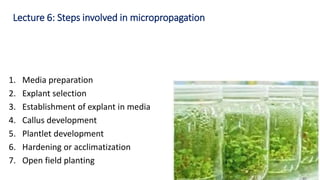
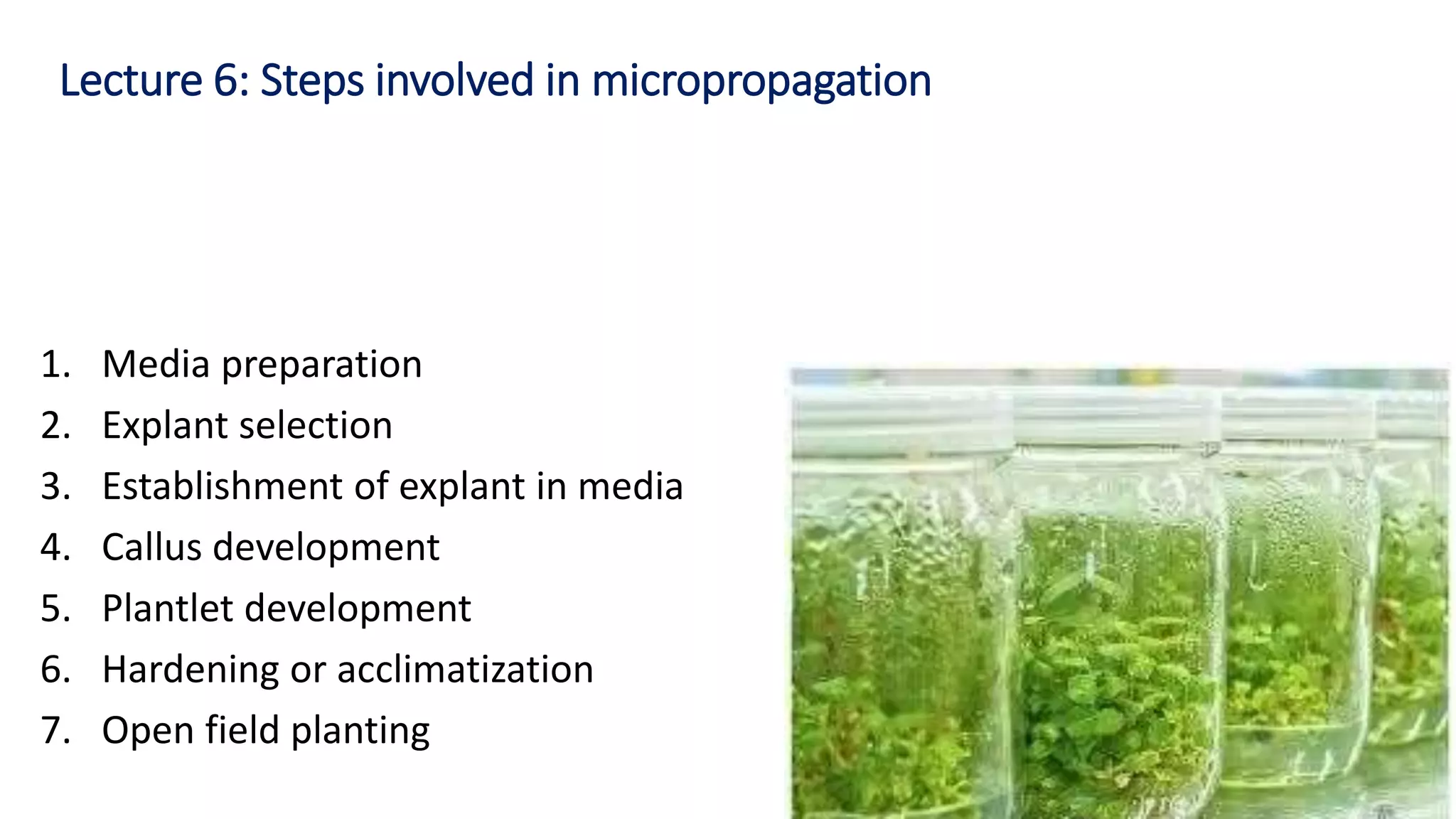
1. Media preparation
2. Explant selection
3. Establishment of explant in media
4. Callus development
5. Plantlet development
6. Hardening or acclimatization
7. Open field planting
Lecture 6: Steps involved in micropropagation
Course Code : HRT 552
Course Title : BIOTECHNOLOGY OF
HORTICULTURAL CROPS
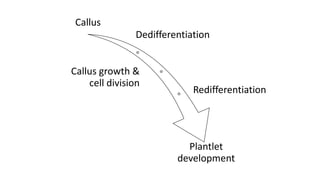
Callus
Dedifferentiation
Callus growth &
cell division
Redifferentiation
Plantlet
development
Tissue Culture
⦁ The term“ tissue culture” is commonly used in a very wide sense to
include in vitro aseptic culture of plant cells,tissue and organs.
⦁ Is the term for“ the process of growing cells artifically in the laboratory”.
⦁ Involves both plant and animal cells
⦁ Tissue culture produces clones,in which all product cells have the same
genotypes (unless affected by mutation during culture).
Plant Tissue Culture
⦁ Is a practice used to propagate clones of a plant
⦁ There are various reasons this may be done:
1) T
o create exact copies of plants that produces particularly good
flowers or fruits.
2) T
o quickly produce mature plants.
3) T
o produce multiple of plants in the absence of seeds or necessary
pollination to produce seeds.
4) Used to regenerate the whole plants from plant cells that have been
genetically modified.
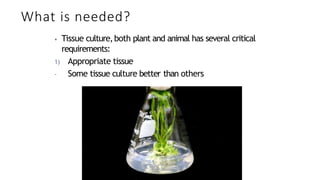
What is needed?
⦁ Tissue culture,both plant and animal has several critical
requirements:
1) Appropriate tissue
- Some tissue culture better than others
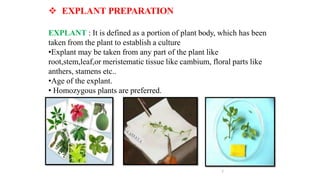
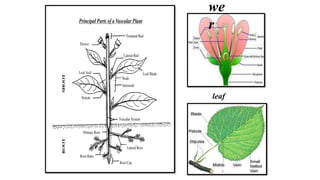
 EXPLANT PREPARATION
EXPLANT : It is defined as a portion of plant body, which has been
taken from the plant to establish a culture
•Explant may be taken from any part of the plant like
root,stem,leaf,or meristematic tissue like cambium, floral parts like
anthers, stamens etc..
•Age of the explant.
• Homozygous plants are preferred.
7
we
r
8
leaf
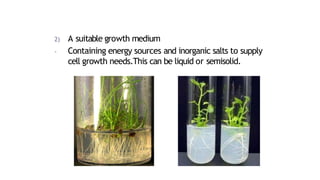
2) A suitable growth medium
- Containing energy sources and inorganic salts to supply
cell growth needs.This can be liquid or semisolid.
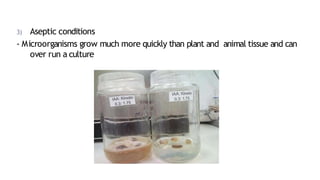
3) Aseptic conditions
- Microorganisms grow much more quickly than plant and animal tissue and can
over run a culture
4) Growth regulators
- In plants,both auxins and cytokins.
- In animal,this is not as well defined and the growth substances
are provided in serum from the cell types of interest
5) Frequent subculturing
-To ensure adequate nutrition and to avoid the build up of waste
conditions.
Aseptic Technique
⦁ Is the exclusion of invading microorganisms during experimental procedures
⦁ Using sterile instruments and culture media
⦁ Media and apparatus are sterile by autoclaving (121C for 15 minutes)
⦁ Aseptic transfer performed in a transfer chamber such as laminar flow hood which
also preferably equipped with a bunsen burner
.
⦁ Common sterilants are ethyl alcohol an clorox with an added surfactants.
Culturing (micro propagating) plant Tissue – the steps.
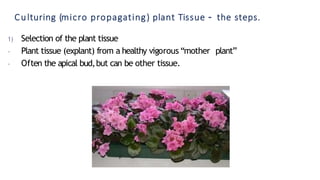
1) Selection of the plant tissue
- Plant tissue (explant) from a healthy vigorous “mother plant”
- Often the apical bud,but can be other tissue.
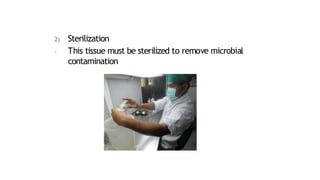
2) Sterilization
- This tissue must be sterilized to remove microbial
contamination
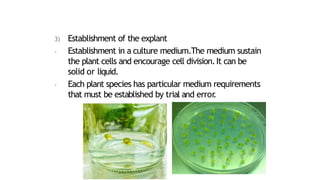
3) Establishment of the explant
- Establishment in a culture medium.The medium sustain
the plant cells and encourage cell division.It can be
solid or liquid.
- Each plant species has particular medium requirements
that must be established by trial and error
.
4) Multiplication
- The explant gives rise to acallus ( amass of loosely
arranged cells) which is manipulated by varying sugar
concentrations and the auxin (low):cytokinin (high)
ratios to form multiple shoots.
- The callus may be subdivided a number of times
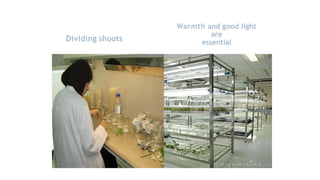
Dividing shoots
Warmth and good light
are
essential
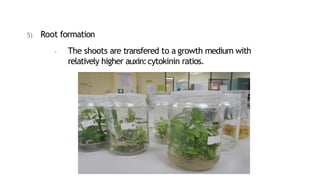
5) Root formation
- The shoots are transfered to a growth medium with
relatively higher auxin:cytokinin ratios.
Incubation of culture
● Cultures are incubated in a culture room where light, temperature
and humidity are controlled.
● For some tissues dark is essential while for some both dark and
light conditions are required.
● Humidity has also some effect.
● The cultures are incubated on culture rack at 25-28 oC constant
temperature. Culture tubes are placed at 35-40o inclined position.
● Culture to give a light intensity of 4-10 X 103 lux for 16 hrs.
Subculturing
● Transfer of cell or tissue from old culture medium to fresh culture
medium within definite time period.
● It provides sufficient space and nutrients to the growing plantlet.
● Multiplication of the callus.
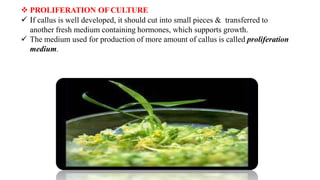
 PROLIFERATION OF CULTURE
 If callus is well developed, it should cut into small pieces & transferred to
another fresh medium containing hormones, which supports growth.
 The medium used for production of more amount of callus is called proliferation
medium.
21
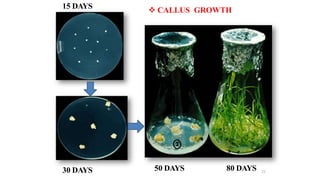
 CALLUS GROWTH
15 DAYS
30 DAYS 50 DAYS 80 DAYS 21
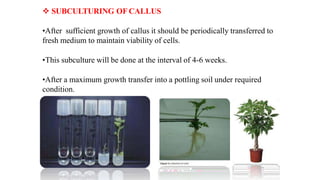
 SUBCULTURING OF CALLUS
•After sufficient growth of callus it should be periodically transferred to
fresh medium to maintain viability of cells.
•This subculture will be done at the interval of 4-6 weeks.
•After a maximum growth transfer into a pottling soil under required
condition.
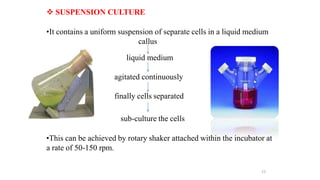
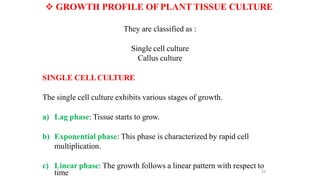
 SUSPENSION CULTURE
•It contains a uniform suspension of separate cells in a liquid medium
callus
liquid medium
agitated continuously
finally cells separated
sub-culture the cells
•This can be achieved by rotary shaker attached within the incubator at
a rate of 50-150 rpm.
23
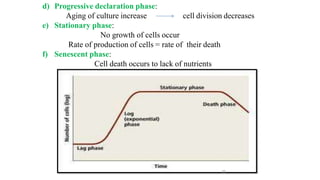
 GROWTH PROFILE OF PLANT TISSUE CULTURE
They are classified as :
Single cell culture
Callus culture
SINGLE CELLCULTURE
The single cell culture exhibits various stages of growth.
a) Lag phase: Tissue starts to grow.
b) Exponential phase: This phase is characterized by rapid cell
multiplication.
c) Linear phase: The growth follows a linear pattern with respect to
time 24
d) Progressive declaration phase:
Aging of culture increase cell division decreases
e) Stationary phase:
No growth of cells occur
Rate of production of cells = rate of their death
f) Senescent phase:
Cell death occurs to lack of nutrients
26
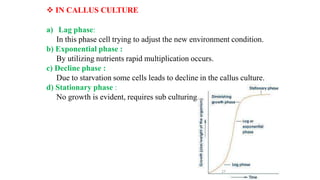
 IN CALLUS CULTURE
a) Lag phase:
In this phase cell trying to adjust the new environment condition.
b) Exponential phase :
By utilizing nutrients rapid multiplication occurs.
c) Decline phase :
Due to starvation some cells leads to decline in the callus culture.
d) Stationary phase :
No growth is evident, requires sub culturing.
27
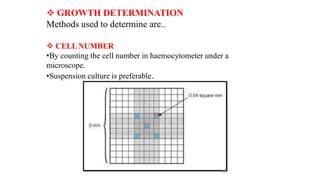
 GROWTH DETERMINATION
Methods used to determine are..
 CELLNUMBER
•By counting the cell number in haemocytometer under a
microscope.
•Suspension culture is preferable.
28
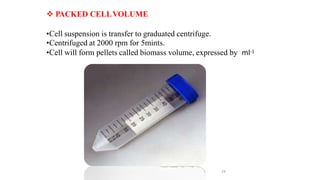
 PACKED CELLVOLUME
•Cell suspension is transfer to graduated centrifuge.
•Centrifuged at 2000 rpm for 5mints.
•Cell will form pellets called biomass volume, expressed by ml-1
29
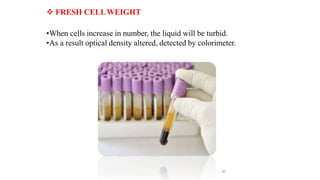
 FRESH CELLWEIGHT
•When cells increase in number, the liquid will be turbid.
•As a result optical density altered, detected by colorimeter.
30
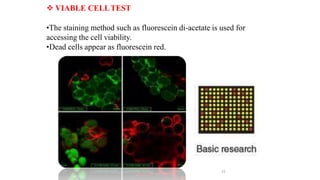
 VIABLE CELLTEST
•The staining method such as fluorescein di-acetate is used for
accessing the cell viability.
•Dead cells appear as fluorescein red.
31
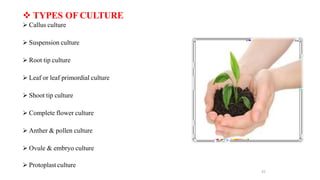
 TYPES OF CULTURE
 Callus culture
 Suspension culture
 Root tip culture
 Leaf or leaf primordial culture
 Shoot tip culture
 Complete flower culture
 Anther & pollen culture
 Ovule & embryo culture
 Protoplast culture
31
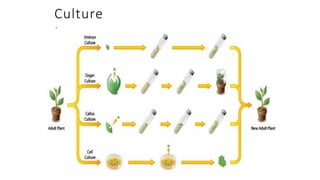
Culture
type
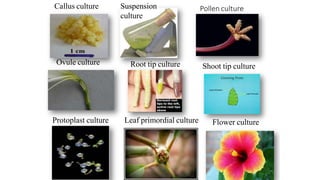
Callus culture Suspension
culture
Pollen culture
Ovule culture Root tip culture Shoot tip culture
32
Protoplast culture Leaf primordial culture Flower culture
35
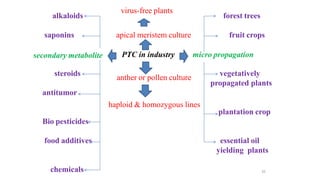
alkaloids
virus-free plants
forest trees
saponins
secondary metabolite
apical meristem culture fruit crops
PTC in industry micro propagation
steroids
anther or pollen culture
vegetatively
propagated plants
antitumor
haploid & homozygous lines
plantation crop
Bio pesticides
food additives essential oil
yielding plants
chemicals
36
REFERENCES :
• Trease and evans pharmacognosy.
W.C evans-page num :72,73,74.
•Atextbook of industrial pharmacognosy byA.N Kalia.
Page num-105 to 114.
•Atextbook of pharmacognosy by M.K Gupta & P.K
Sharma. Page num-171 to 185.
•Pharmacognosy and photochemistry-part 2 by Vinod
D Rangari. Page num-51 to 56.
• Internet source.
37
38
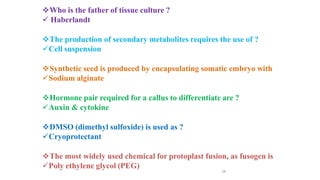
Who is the father of tissue culture ?
 Haberlandt
The production of secondary metabolites requires the use of ?
Cell suspension
Synthetic seed is produced by encapsulating somatic embryo with
Sodium alginate
Hormone pair required for a callus to differentiate are ?
Auxin & cytokine
DMSO (dimethyl sulfoxide) is used as ?
Cryoprotectant
The most widely used chemical for protoplast fusion, as fusogen is
Poly ethylene glycol (PEG)
39
Callus is ?
Unorganized actively dividing mass of cell, maintained in culture
Which of the plant cell will show totipotency ?
Meristem
To obtain haploid plant, we culture ?
Entire anther
Growth hormone produce apical dominance ?
Auxin
The vector mostly used in crop improvement ?
Agro bacterium
Amedia which contains chemically defined compound is called ?
Synthetic medium
Rooting
● It is the induction and development of adventitious roots on the
proliferated shoots.
● Root formation is induced in a medium with high auxin and low
cytokinins concentrations.
● Shoot tip or single node explant is used.
● Culture medium is maintained in a green house/mist chamber.
● Activated charcoal is frequently added to absorb root-inhibiting
agents.
Application of tissue culture
●
●
Rapid propagation.
Minimum growing space is required.
● Multiplication of medicinal plants.
●
●
●
Pathogen free plants -meristem culture.
It is useful in the plants like papaya, coconut, etc.
Large number of plants can be stored in the small
space.
Contd.
● Problems with seed and vegetative propagation overcome.
● Artificial seeds - do not under go seed dormancy.
● Uniformity of characters.
● Seedless fruit propagated easily.
● In vitro cloning enables genetic manipulation,
● Hybrids with desired traits can be obtained by this method.
● Transgenic plants produced by tissue culture technique.
● Rare and endangered plants.
● Early flowering can be induced by tissue culture technique e.g.
bamboo.
● There is potential danger of spreading of plants diseases through
a diseased material in a large number of plants.
● It is not feasible for some tress, especially for some
gymnosperms.
● In some cases multiple shooting takes place but rooting is
difficult.
● Contamination in the culture room is a serious problem.
● In some cases shoots show decline in the rate of growth and
plant die called vertrification.
Benefits of plant tissue culture
⦁ In plantsprone to virus diseases,virus freeexplants(new meristemtissueisusuallyvirusfree)
canbecultivatedto providevirus freeplants.
⦁ Plant“tissuebanks”canbefrozen,theregeneratedthroughtissueculture.
⦁ Plantculture inapproved mediaare easier to export thanare soil-grown plants,astheyare
pathogen freeandtake uplittlespace(most currentplantexportis now done in this
manner)
⦁ Tissuecultureallows fastselections for crop improvement- explants arechosen from
superior plants, thencloned.
Thank you 

Steps involved in micropropagation

  • 1.
    1. Media preparation 2.Explant selection 3. Establishment of explant in media 4. Callus development 5. Plantlet development 6. Hardening or acclimatization 7. Open field planting Lecture 6: Steps involved in micropropagation
  • 2.
    Course Code :HRT 552 Course Title : BIOTECHNOLOGY OF HORTICULTURAL CROPS
  • 3.
    Callus Dedifferentiation Callus growth & celldivision Redifferentiation Plantlet development
  • 4.
    Tissue Culture ⦁ Theterm“ tissue culture” is commonly used in a very wide sense to include in vitro aseptic culture of plant cells,tissue and organs. ⦁ Is the term for“ the process of growing cells artifically in the laboratory”. ⦁ Involves both plant and animal cells ⦁ Tissue culture produces clones,in which all product cells have the same genotypes (unless affected by mutation during culture).
  • 5.
    Plant Tissue Culture ⦁Is a practice used to propagate clones of a plant ⦁ There are various reasons this may be done: 1) T o create exact copies of plants that produces particularly good flowers or fruits. 2) T o quickly produce mature plants. 3) T o produce multiple of plants in the absence of seeds or necessary pollination to produce seeds. 4) Used to regenerate the whole plants from plant cells that have been genetically modified.
  • 6.
    What is needed? ⦁Tissue culture,both plant and animal has several critical requirements: 1) Appropriate tissue - Some tissue culture better than others
  • 7.
     EXPLANT PREPARATION EXPLANT: It is defined as a portion of plant body, which has been taken from the plant to establish a culture •Explant may be taken from any part of the plant like root,stem,leaf,or meristematic tissue like cambium, floral parts like anthers, stamens etc.. •Age of the explant. • Homozygous plants are preferred. 7
  • 8.
  • 9.
    2) A suitablegrowth medium - Containing energy sources and inorganic salts to supply cell growth needs.This can be liquid or semisolid.
  • 10.
    3) Aseptic conditions -Microorganisms grow much more quickly than plant and animal tissue and can over run a culture
  • 11.
    4) Growth regulators -In plants,both auxins and cytokins. - In animal,this is not as well defined and the growth substances are provided in serum from the cell types of interest 5) Frequent subculturing -To ensure adequate nutrition and to avoid the build up of waste conditions.
  • 12.
    Aseptic Technique ⦁ Isthe exclusion of invading microorganisms during experimental procedures ⦁ Using sterile instruments and culture media ⦁ Media and apparatus are sterile by autoclaving (121C for 15 minutes) ⦁ Aseptic transfer performed in a transfer chamber such as laminar flow hood which also preferably equipped with a bunsen burner . ⦁ Common sterilants are ethyl alcohol an clorox with an added surfactants.
  • 13.
    Culturing (micro propagating)plant Tissue – the steps. 1) Selection of the plant tissue - Plant tissue (explant) from a healthy vigorous “mother plant” - Often the apical bud,but can be other tissue.
  • 14.
    2) Sterilization - Thistissue must be sterilized to remove microbial contamination
  • 15.
    3) Establishment ofthe explant - Establishment in a culture medium.The medium sustain the plant cells and encourage cell division.It can be solid or liquid. - Each plant species has particular medium requirements that must be established by trial and error .
  • 16.
    4) Multiplication - Theexplant gives rise to acallus ( amass of loosely arranged cells) which is manipulated by varying sugar concentrations and the auxin (low):cytokinin (high) ratios to form multiple shoots. - The callus may be subdivided a number of times
  • 17.
    Dividing shoots Warmth andgood light are essential
  • 18.
    5) Root formation -The shoots are transfered to a growth medium with relatively higher auxin:cytokinin ratios.
  • 19.
    Incubation of culture ●Cultures are incubated in a culture room where light, temperature and humidity are controlled. ● For some tissues dark is essential while for some both dark and light conditions are required. ● Humidity has also some effect. ● The cultures are incubated on culture rack at 25-28 oC constant temperature. Culture tubes are placed at 35-40o inclined position. ● Culture to give a light intensity of 4-10 X 103 lux for 16 hrs.
  • 20.
    Subculturing ● Transfer ofcell or tissue from old culture medium to fresh culture medium within definite time period. ● It provides sufficient space and nutrients to the growing plantlet. ● Multiplication of the callus.
  • 21.
     PROLIFERATION OFCULTURE  If callus is well developed, it should cut into small pieces & transferred to another fresh medium containing hormones, which supports growth.  The medium used for production of more amount of callus is called proliferation medium. 21
  • 22.
     CALLUS GROWTH 15DAYS 30 DAYS 50 DAYS 80 DAYS 21
  • 23.
     SUBCULTURING OFCALLUS •After sufficient growth of callus it should be periodically transferred to fresh medium to maintain viability of cells. •This subculture will be done at the interval of 4-6 weeks. •After a maximum growth transfer into a pottling soil under required condition.
  • 24.
     SUSPENSION CULTURE •Itcontains a uniform suspension of separate cells in a liquid medium callus liquid medium agitated continuously finally cells separated sub-culture the cells •This can be achieved by rotary shaker attached within the incubator at a rate of 50-150 rpm. 23
  • 25.
     GROWTH PROFILEOF PLANT TISSUE CULTURE They are classified as : Single cell culture Callus culture SINGLE CELLCULTURE The single cell culture exhibits various stages of growth. a) Lag phase: Tissue starts to grow. b) Exponential phase: This phase is characterized by rapid cell multiplication. c) Linear phase: The growth follows a linear pattern with respect to time 24
  • 26.
    d) Progressive declarationphase: Aging of culture increase cell division decreases e) Stationary phase: No growth of cells occur Rate of production of cells = rate of their death f) Senescent phase: Cell death occurs to lack of nutrients 26
  • 27.
     IN CALLUSCULTURE a) Lag phase: In this phase cell trying to adjust the new environment condition. b) Exponential phase : By utilizing nutrients rapid multiplication occurs. c) Decline phase : Due to starvation some cells leads to decline in the callus culture. d) Stationary phase : No growth is evident, requires sub culturing. 27
  • 28.
     GROWTH DETERMINATION Methodsused to determine are..  CELLNUMBER •By counting the cell number in haemocytometer under a microscope. •Suspension culture is preferable. 28
  • 29.
     PACKED CELLVOLUME •Cellsuspension is transfer to graduated centrifuge. •Centrifuged at 2000 rpm for 5mints. •Cell will form pellets called biomass volume, expressed by ml-1 29
  • 30.
     FRESH CELLWEIGHT •Whencells increase in number, the liquid will be turbid. •As a result optical density altered, detected by colorimeter. 30
  • 31.
     VIABLE CELLTEST •Thestaining method such as fluorescein di-acetate is used for accessing the cell viability. •Dead cells appear as fluorescein red. 31
  • 32.
     TYPES OFCULTURE  Callus culture  Suspension culture  Root tip culture  Leaf or leaf primordial culture  Shoot tip culture  Complete flower culture  Anther & pollen culture  Ovule & embryo culture  Protoplast culture 31
  • 33.
  • 34.
    Callus culture Suspension culture Pollenculture Ovule culture Root tip culture Shoot tip culture 32 Protoplast culture Leaf primordial culture Flower culture
  • 35.
    35 alkaloids virus-free plants forest trees saponins secondarymetabolite apical meristem culture fruit crops PTC in industry micro propagation steroids anther or pollen culture vegetatively propagated plants antitumor haploid & homozygous lines plantation crop Bio pesticides food additives essential oil yielding plants chemicals
  • 36.
    36 REFERENCES : • Treaseand evans pharmacognosy. W.C evans-page num :72,73,74. •Atextbook of industrial pharmacognosy byA.N Kalia. Page num-105 to 114. •Atextbook of pharmacognosy by M.K Gupta & P.K Sharma. Page num-171 to 185. •Pharmacognosy and photochemistry-part 2 by Vinod D Rangari. Page num-51 to 56. • Internet source.
  • 37.
  • 38.
    38 Who is thefather of tissue culture ?  Haberlandt The production of secondary metabolites requires the use of ? Cell suspension Synthetic seed is produced by encapsulating somatic embryo with Sodium alginate Hormone pair required for a callus to differentiate are ? Auxin & cytokine DMSO (dimethyl sulfoxide) is used as ? Cryoprotectant The most widely used chemical for protoplast fusion, as fusogen is Poly ethylene glycol (PEG)
  • 39.
    39 Callus is ? Unorganizedactively dividing mass of cell, maintained in culture Which of the plant cell will show totipotency ? Meristem To obtain haploid plant, we culture ? Entire anther Growth hormone produce apical dominance ? Auxin The vector mostly used in crop improvement ? Agro bacterium Amedia which contains chemically defined compound is called ? Synthetic medium
  • 40.
    Rooting ● It isthe induction and development of adventitious roots on the proliferated shoots. ● Root formation is induced in a medium with high auxin and low cytokinins concentrations. ● Shoot tip or single node explant is used. ● Culture medium is maintained in a green house/mist chamber. ● Activated charcoal is frequently added to absorb root-inhibiting agents.
  • 42.
    Application of tissueculture ● ● Rapid propagation. Minimum growing space is required. ● Multiplication of medicinal plants. ● ● ● Pathogen free plants -meristem culture. It is useful in the plants like papaya, coconut, etc. Large number of plants can be stored in the small space.
  • 43.
    Contd. ● Problems withseed and vegetative propagation overcome. ● Artificial seeds - do not under go seed dormancy. ● Uniformity of characters. ● Seedless fruit propagated easily. ● In vitro cloning enables genetic manipulation, ● Hybrids with desired traits can be obtained by this method. ● Transgenic plants produced by tissue culture technique. ● Rare and endangered plants. ● Early flowering can be induced by tissue culture technique e.g. bamboo.

  • 44.
    ● There ispotential danger of spreading of plants diseases through a diseased material in a large number of plants. ● It is not feasible for some tress, especially for some gymnosperms. ● In some cases multiple shooting takes place but rooting is difficult. ● Contamination in the culture room is a serious problem. ● In some cases shoots show decline in the rate of growth and plant die called vertrification.
  • 45.
    Benefits of planttissue culture ⦁ In plantsprone to virus diseases,virus freeexplants(new meristemtissueisusuallyvirusfree) canbecultivatedto providevirus freeplants. ⦁ Plant“tissuebanks”canbefrozen,theregeneratedthroughtissueculture. ⦁ Plantculture inapproved mediaare easier to export thanare soil-grown plants,astheyare pathogen freeandtake uplittlespace(most currentplantexportis now done in this manner) ⦁ Tissuecultureallows fastselections for crop improvement- explants arechosen from superior plants, thencloned.
  • 46.