A Paradigm for Consistent Success in Sustainable Business Opportunity Green Saturday, November 8th Stephanie Ryan  360-929-0073
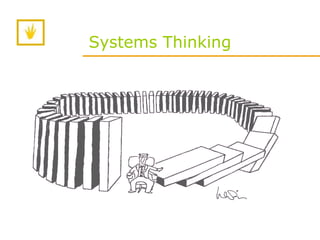
Systems Thinking
Systems Thinking A process for collective inquiry, which  uncovers & helps people to see: Wholes rather than parts Interrelationships rather than things Interdependencies (circular causality) rather than linear cause & effect chains Processes of change (patterns) rather than snapshots
Value of  Systems Thinking Surface assumptions which drive our actions.  Learn about the consequences of our actions both intended and unintended over time. Increase our capacity for holding apparent opposites. Discover critical interfaces & leverage  Builds shared understanding of complex issues which is critical for commitment and collaboration.
When to Apply Systems Thinking Systems Thinking and Systems Sensing are useful when:   Complex issues arise Multiple points of view (typically different) need to be understood Collaboration across traditional boundaries is desired Desire exists to understand critical factors that lead to sustainable growth Repeated attempts have been made to solve an issue and it defies solution (chronic)
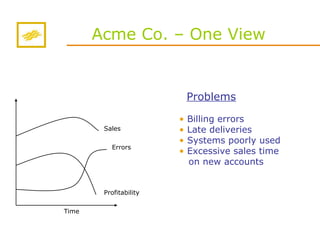
Acme Co. – One View A Sales Errors Profitability Time Problems Billing errors Late deliveries Systems poorly used Excessive sales time  on new accounts
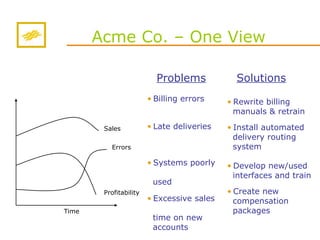
Acme Co. – One View A Sales Errors Profitability Time Problems Billing errors Late deliveries Systems poorly  used Excessive sales  time on new accounts Solutions Rewrite billing manuals & retrain Install automated  delivery routing system Develop new/used interfaces and train Create new compensation  packages
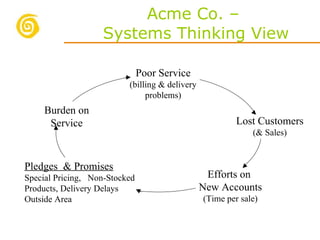
Acme Co. –  Systems Thinking View A Poor Service (billing & delivery problems) Lost Customers (& Sales) Efforts on  New Accounts (Time per sale) Burden on Service Pledges  & Promises   Special Pricing,  Non-Stocked Products, Delivery Delays Outside Area
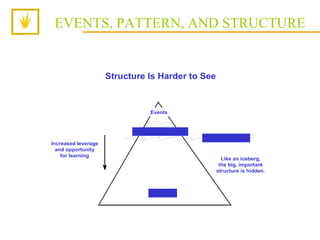
EVENTS, PATTERN, AND STRUCTURE
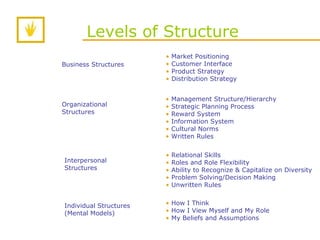
Business Structures Levels of Structure Organizational Structures Interpersonal Structures Individual Structures (Mental Models) Market Positioning Customer Interface Product Strategy Distribution Strategy Management Structure/Hierarchy Strategic Planning Process Reward System Information System Cultural Norms Written Rules Relational Skills Roles and Role Flexibility Ability to Recognize & Capitalize on Diversity Problem Solving/Decision Making Unwritten Rules How I Think How I View Myself and My Role My Beliefs and Assumptions
 
What’s a B Corporation? A new type of corporation  that uses the power of business  to create public benefit B Corporations: Meet high performance and legal standards Build collective voice for ‘good companies’ 130+ B Corps; $1 Billion+ market; 30+ industries
 
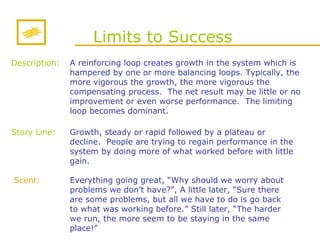
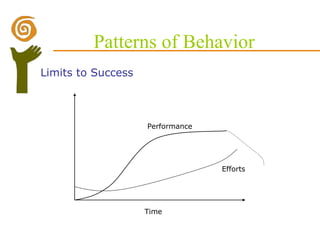
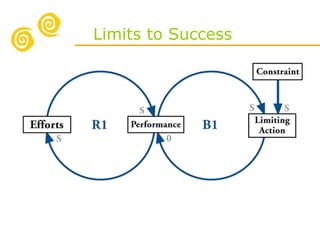
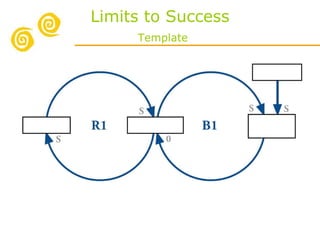
Limits to Success Story Line: A reinforcing loop creates growth in the system which is hampered by one or more balancing loops.  Typically, the more vigorous the growth, the more vigorous the compensating process.  The net result may be little or no improvement or even worse performance.  The limiting loop becomes dominant. Everything going great, “Why should we worry about problems we don’t have?”, A little later, “Sure there are some problems, but all we have to do is go back to what was working before.” Still later, “The harder we run, the more seem to be staying in the same place!” Scent: Description: Growth, steady or rapid followed by a plateau or decline.  People are trying to regain performance in the system by doing more of what worked before with little gain.
Patterns of Behavior Limits to Success Time Performance Efforts
Limits to Success
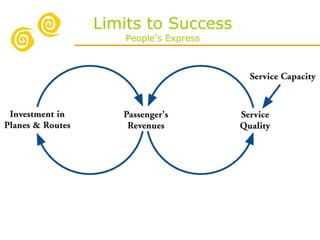
Limits to Success People’s Express
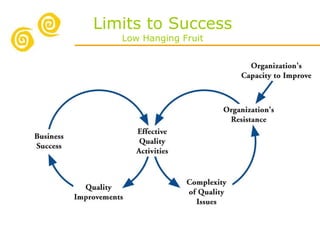
Limits to Success Low Hanging Fruit
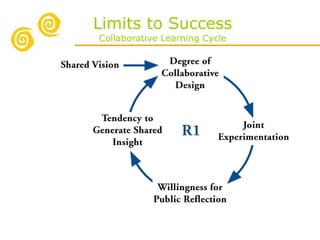
Limits to Success Collaborative Learning Cycle
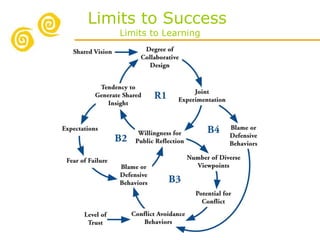
Limits to Success  Limits to Learning
Limits to Success Implications: An LTS process grows and then growth slows.  It can peak and crash/collapse. Nothing grows forever – who manages limits? Anticipate limiting forces that may not yet be apparent. Beware of doing more of what worked in the past; pushing harder on the success loop will result in a harder fall. Focus on reducing the limiting forces or constraints. Areas of Leverage: Instead of putting more energy and resources in what worked before, look to remove constraints or limits of success (attention to Balancing Loop) Expand capacity before it's needed Anticipate time delays of bringing additional capacity on line Typical constraints you can expect to encounter and need to anticipate:  Physical/hard: design of building, equipment, information flows, resources & time Abstract/soft: people's perceptions, ability to deal with resistance, diversity, people's capacity to manage
Limits to Success Quiver of Questions: What explains our success in the past, what was our engine of growth?  What barriers have we encountered to our success? To what extent are these barriers self inflicted? How are these barriers born out of our success? How can we remove these barriers or lessen their effect? What constraints would have to be altered to support the systems growth?
Limits to Success   Template
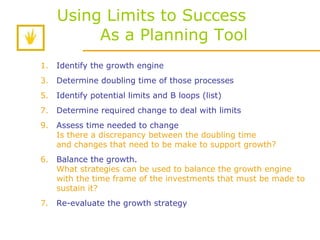
Using Limits to Success    As a Planning Tool Identify the growth engine Determine doubling time of those processes Identify potential limits and B loops (list) Determine required change to deal with limits Assess time needed to change Is there a discrepancy between the doubling time and changes that need to be make to support growth? 6.   Balance the growth.  What strategies can be used to balance the growth engine with the time frame of the investments that must be made to sustain it?  7. Re-evaluate the growth strategy
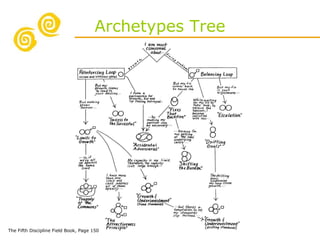
Archetypes Tree The Fifth Discipline Field Book, Page 150
Quotes David Bohm said… “ For fragmentation is now very widespread, Not only throughout society, but also in each individual; and this is leading  to a kind of general confusion of the mind, which creates an endless series of problems and interferes with our clarity of perception so seriously as to prevent us from being able to solve most of them… The notion that all these fragments are separately existent is evidently an illusion, and this illusion cannot do other than lead to endless conflict and confusion.”
Resources Pegasus Communications:  www.pegasuscom.com Archetypes Booklets, Books, CD’s.. Newsletter & Conferences B Lab-  www.bcorporation.net The Necessary Revolution : “How Individuals and Organizations Are Working Together to Create a Sustainable World” by Joe Laur, Sara Schley, Peter Senge… The Fifth Discipline & Fifth Discipline Field Book  by Peter Senge

Stephanie Ryan

  • 1.
    A Paradigm forConsistent Success in Sustainable Business Opportunity Green Saturday, November 8th Stephanie Ryan 360-929-0073
  • 2.
  • 3.
    Systems Thinking Aprocess for collective inquiry, which uncovers & helps people to see: Wholes rather than parts Interrelationships rather than things Interdependencies (circular causality) rather than linear cause & effect chains Processes of change (patterns) rather than snapshots
  • 4.
    Value of Systems Thinking Surface assumptions which drive our actions. Learn about the consequences of our actions both intended and unintended over time. Increase our capacity for holding apparent opposites. Discover critical interfaces & leverage Builds shared understanding of complex issues which is critical for commitment and collaboration.
  • 5.
    When to ApplySystems Thinking Systems Thinking and Systems Sensing are useful when: Complex issues arise Multiple points of view (typically different) need to be understood Collaboration across traditional boundaries is desired Desire exists to understand critical factors that lead to sustainable growth Repeated attempts have been made to solve an issue and it defies solution (chronic)
  • 6.
    Acme Co. –One View A Sales Errors Profitability Time Problems Billing errors Late deliveries Systems poorly used Excessive sales time on new accounts
  • 7.
    Acme Co. –One View A Sales Errors Profitability Time Problems Billing errors Late deliveries Systems poorly used Excessive sales time on new accounts Solutions Rewrite billing manuals & retrain Install automated delivery routing system Develop new/used interfaces and train Create new compensation packages
  • 8.
    Acme Co. – Systems Thinking View A Poor Service (billing & delivery problems) Lost Customers (& Sales) Efforts on New Accounts (Time per sale) Burden on Service Pledges & Promises Special Pricing, Non-Stocked Products, Delivery Delays Outside Area
  • 9.
  • 10.
    Business Structures Levelsof Structure Organizational Structures Interpersonal Structures Individual Structures (Mental Models) Market Positioning Customer Interface Product Strategy Distribution Strategy Management Structure/Hierarchy Strategic Planning Process Reward System Information System Cultural Norms Written Rules Relational Skills Roles and Role Flexibility Ability to Recognize & Capitalize on Diversity Problem Solving/Decision Making Unwritten Rules How I Think How I View Myself and My Role My Beliefs and Assumptions
  • 11.
  • 12.
    What’s a BCorporation? A new type of corporation that uses the power of business to create public benefit B Corporations: Meet high performance and legal standards Build collective voice for ‘good companies’ 130+ B Corps; $1 Billion+ market; 30+ industries
  • 13.
  • 14.
    Limits to SuccessStory Line: A reinforcing loop creates growth in the system which is hampered by one or more balancing loops. Typically, the more vigorous the growth, the more vigorous the compensating process. The net result may be little or no improvement or even worse performance. The limiting loop becomes dominant. Everything going great, “Why should we worry about problems we don’t have?”, A little later, “Sure there are some problems, but all we have to do is go back to what was working before.” Still later, “The harder we run, the more seem to be staying in the same place!” Scent: Description: Growth, steady or rapid followed by a plateau or decline. People are trying to regain performance in the system by doing more of what worked before with little gain.
  • 15.
    Patterns of BehaviorLimits to Success Time Performance Efforts
  • 16.
  • 17.
    Limits to SuccessPeople’s Express
  • 18.
    Limits to SuccessLow Hanging Fruit
  • 19.
    Limits to SuccessCollaborative Learning Cycle
  • 20.
    Limits to Success Limits to Learning
  • 21.
    Limits to SuccessImplications: An LTS process grows and then growth slows. It can peak and crash/collapse. Nothing grows forever – who manages limits? Anticipate limiting forces that may not yet be apparent. Beware of doing more of what worked in the past; pushing harder on the success loop will result in a harder fall. Focus on reducing the limiting forces or constraints. Areas of Leverage: Instead of putting more energy and resources in what worked before, look to remove constraints or limits of success (attention to Balancing Loop) Expand capacity before it's needed Anticipate time delays of bringing additional capacity on line Typical constraints you can expect to encounter and need to anticipate: Physical/hard: design of building, equipment, information flows, resources & time Abstract/soft: people's perceptions, ability to deal with resistance, diversity, people's capacity to manage
  • 22.
    Limits to SuccessQuiver of Questions: What explains our success in the past, what was our engine of growth? What barriers have we encountered to our success? To what extent are these barriers self inflicted? How are these barriers born out of our success? How can we remove these barriers or lessen their effect? What constraints would have to be altered to support the systems growth?
  • 23.
  • 24.
    Using Limits toSuccess As a Planning Tool Identify the growth engine Determine doubling time of those processes Identify potential limits and B loops (list) Determine required change to deal with limits Assess time needed to change Is there a discrepancy between the doubling time and changes that need to be make to support growth? 6. Balance the growth. What strategies can be used to balance the growth engine with the time frame of the investments that must be made to sustain it? 7. Re-evaluate the growth strategy
  • 25.
    Archetypes Tree TheFifth Discipline Field Book, Page 150
  • 26.
    Quotes David Bohmsaid… “ For fragmentation is now very widespread, Not only throughout society, but also in each individual; and this is leading to a kind of general confusion of the mind, which creates an endless series of problems and interferes with our clarity of perception so seriously as to prevent us from being able to solve most of them… The notion that all these fragments are separately existent is evidently an illusion, and this illusion cannot do other than lead to endless conflict and confusion.”
  • 27.
    Resources Pegasus Communications: www.pegasuscom.com Archetypes Booklets, Books, CD’s.. Newsletter & Conferences B Lab- www.bcorporation.net The Necessary Revolution : “How Individuals and Organizations Are Working Together to Create a Sustainable World” by Joe Laur, Sara Schley, Peter Senge… The Fifth Discipline & Fifth Discipline Field Book by Peter Senge