ACCELERATE (XLR8)

YOUR [AGILE]
TRANSFORMATIONS
PAVIA, 19 NOVEMBRE 2015
Italian_Agile_Days_2016
@EmilianoSoldi
QUESTIONI DI FRAMEWORK?
TRANSFORMING ORGANIZATIONS.
WHAT INGREDIENTS DO WE NEED?
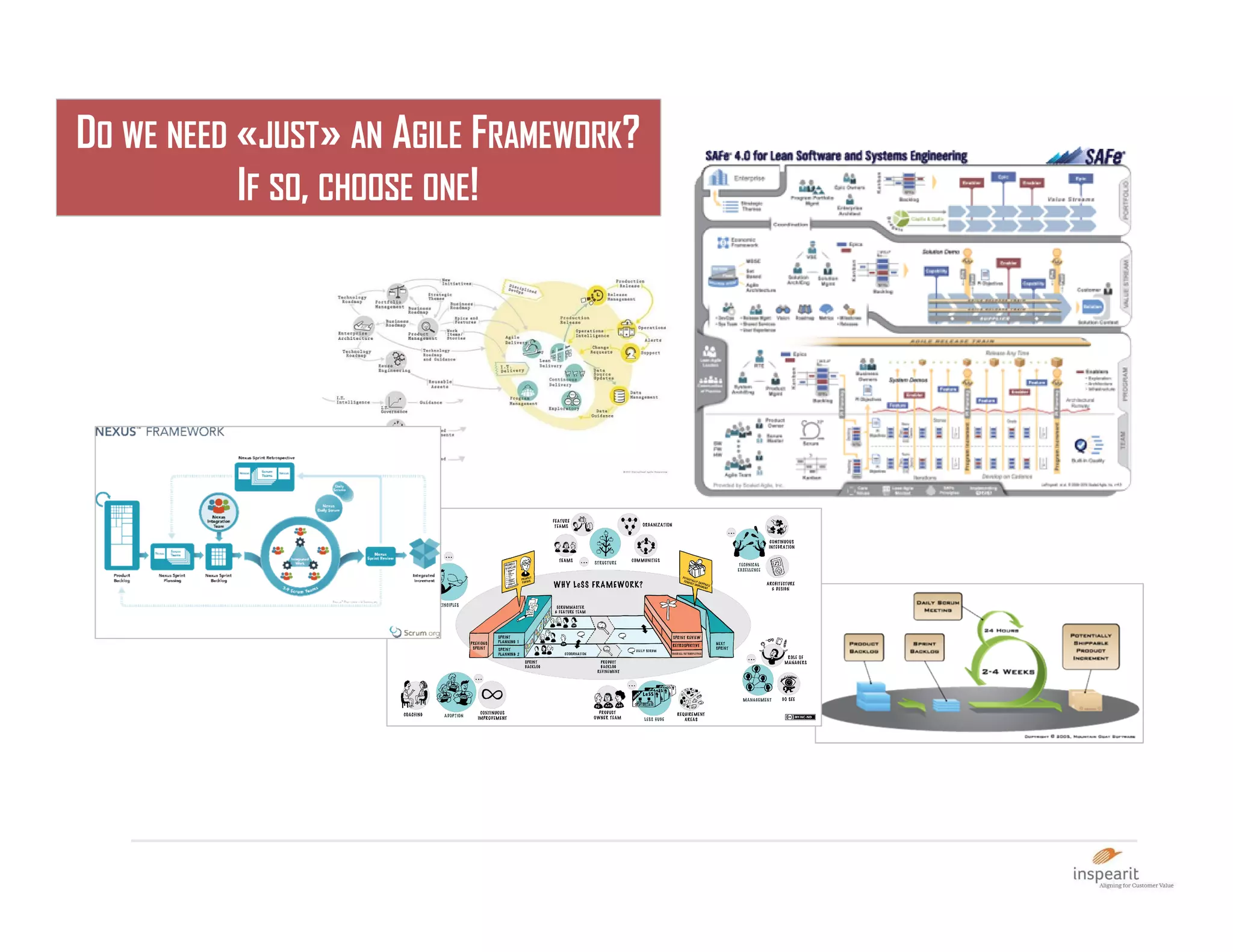
DO WE NEED «JUST» AN AGILE FRAMEWORK?
IF SO, CHOOSE ONE!
TODAY’S GREATER CHALLENGE FOR ORGANIZATION?
Stay competitive and change
amid constant turbulence and disruption
The hierarchical structures and organizational processes
organizations used for decades, are no longer up to the
task of winning in this faster-moving world.
The tension between needing to stay ahead
of increasingly fierce competition and
needing to deliver this year’s results,
can be overwhelming.
INNOVATION CANNOT BE REACHED
VIA HIERARCHIES
Innovation requires creativity, risks,
people thinking out of their boxes,
out of their silos.
Management-driven hierarchies’
mandate is to minimize risks, keep
people doing the usual things and
give silos “a long life”.
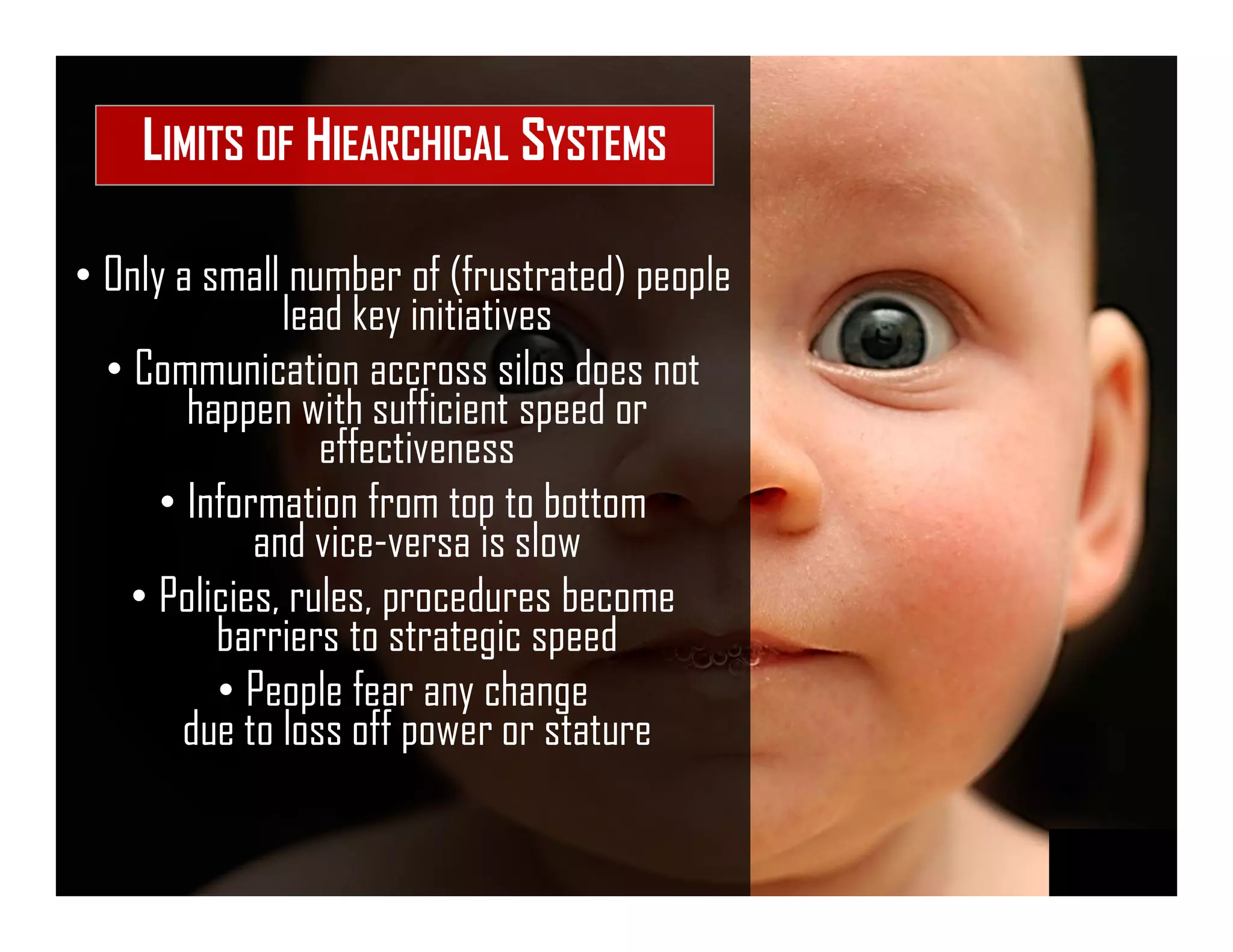
• Only a small number of (frustrated) people
lead key initiatives
• Communication accross silos does not
happen with sufficient speed or
effectiveness
• Information from top to bottom
and vice-versa is slow
• Policies, rules, procedures become
barriers to strategic speed
• People fear any change
due to loss off power or stature
LIMITS OF HIEARCHICAL SYSTEMS
BUT, ARE WE REALLY SUPPOSED TO GET RID
OF THESE MANAGEMENT-DRIVEN HIERACHIES?
…OR WE RISK TO THROW THE BABY
OUT WITH THE BATH WATER ?
Hierarchical functional organizations can effectively guide
and coordinate the actions of employees, even thousands,
spread around the globe. Such an “operating system” lets
people do what they know how to do, exceptionally well!
AND YOU KNOW WHAT’S THE TRUTH?
Management-driven hierarchies, which most part
of enterprises use, have been one of the successful
innovations of the twentieth century.
And very ofter they are still necessary
to make many organizations continue to work successfully.
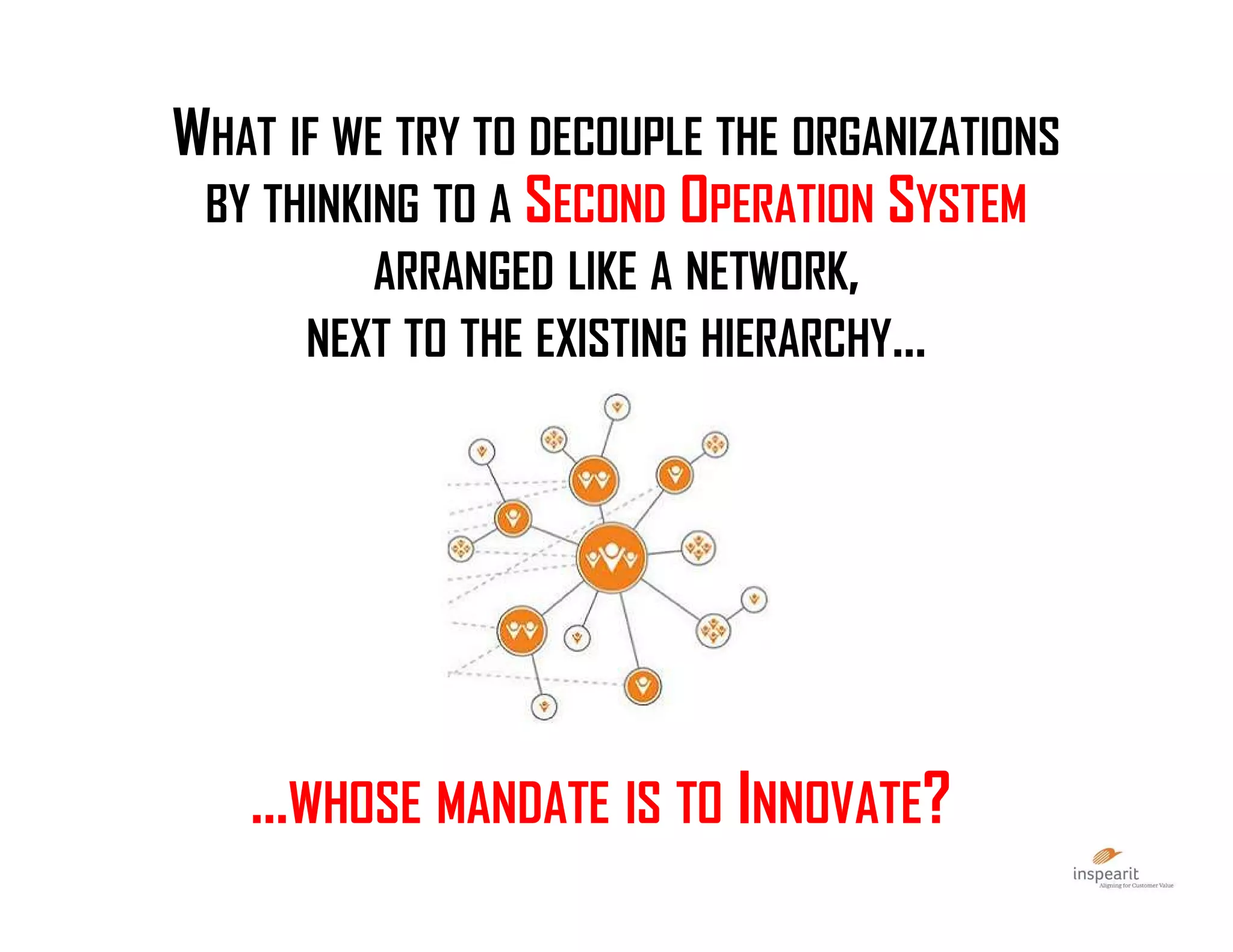
WHAT IF WE TRY TO DECOUPLE THE ORGANIZATIONS
BY THINKING TO A SECOND OPERATION SYSTEM
ARRANGED LIKE A NETWORK,
NEXT TO THE EXISTING HIERARCHY…
…WHOSE MANDATE IS TO INNOVATE?
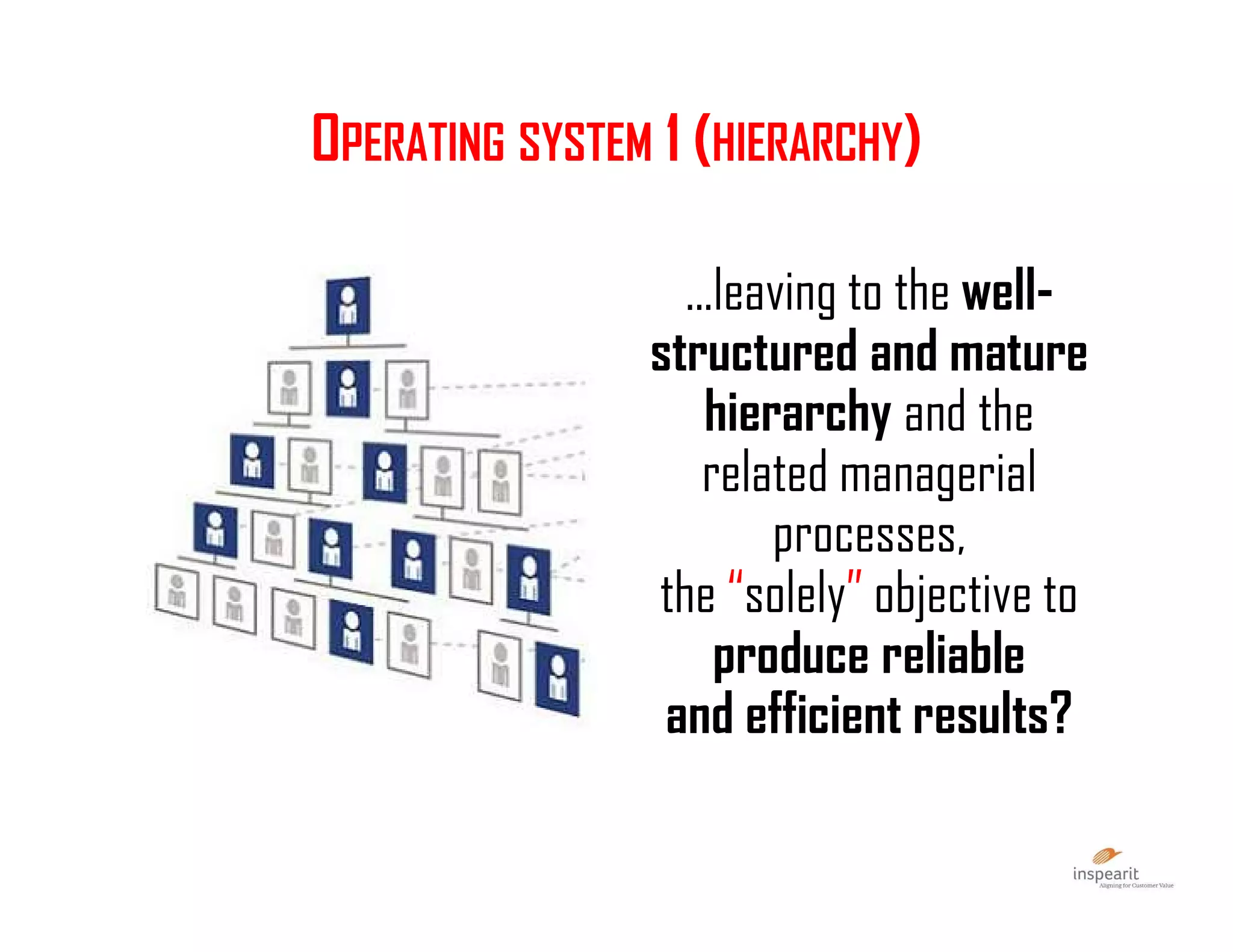
OPERATING SYSTEM 1 (HIERARCHY)
...leaving to the well-
structured and mature
hierarchy and the
related managerial
processes,
the “solely” objective to
produce reliable
and efficient results?
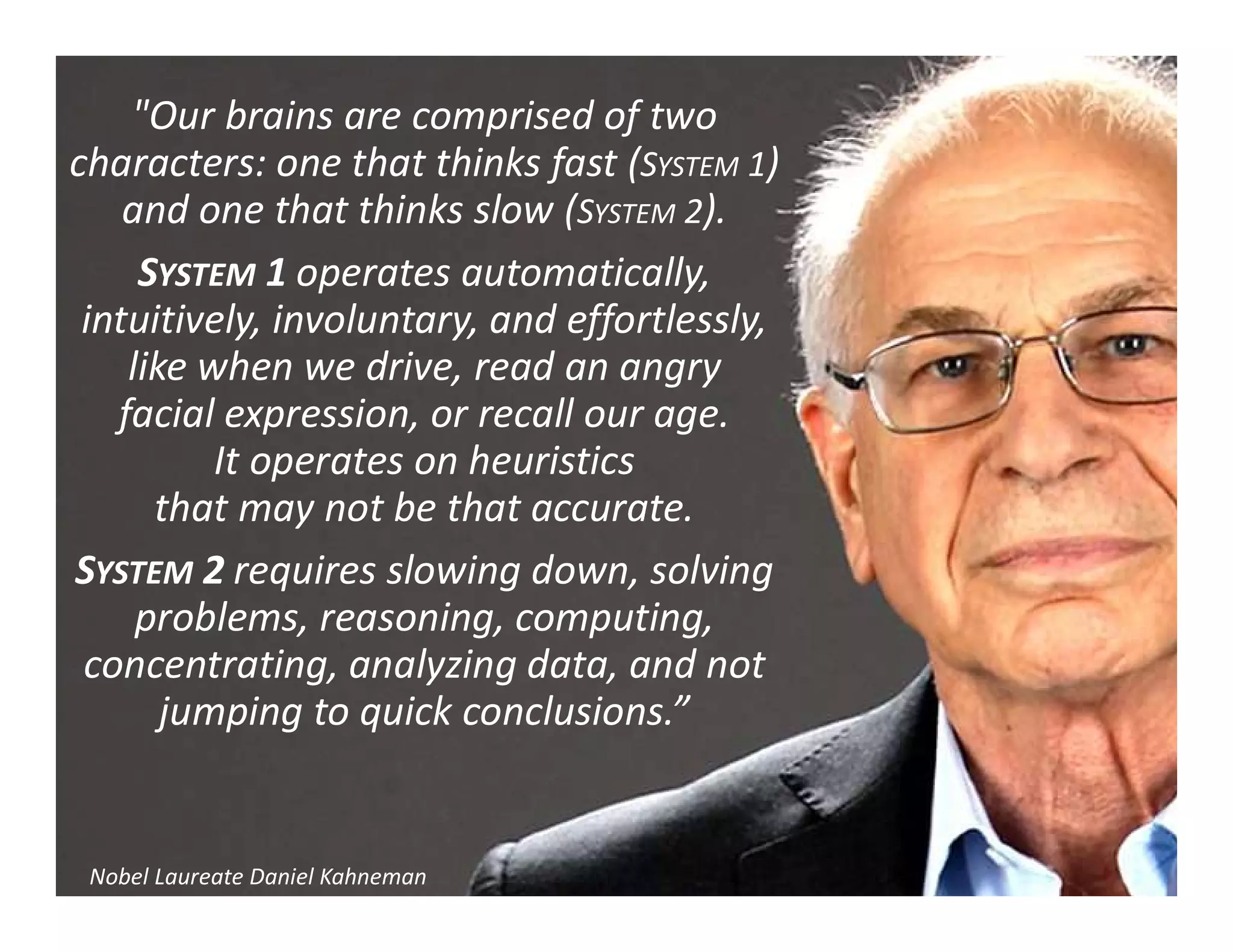
"Our brains are comprised of two
characters: one that thinks fast (SYSTEM 1)
and one that thinks slow (SYSTEM 2).
SYSTEM 1 operates automatically,
intuitively, involuntary, and effortlessly,
like when we drive, read an angry
facial expression, or recall our age.
It operates on heuristics
that may not be that accurate.
SYSTEM 2 requires slowing down, solving
problems, reasoning, computing,
concentrating, analyzing data, and not
jumping to quick conclusions.”
Nobel Laureate Daniel Kahneman
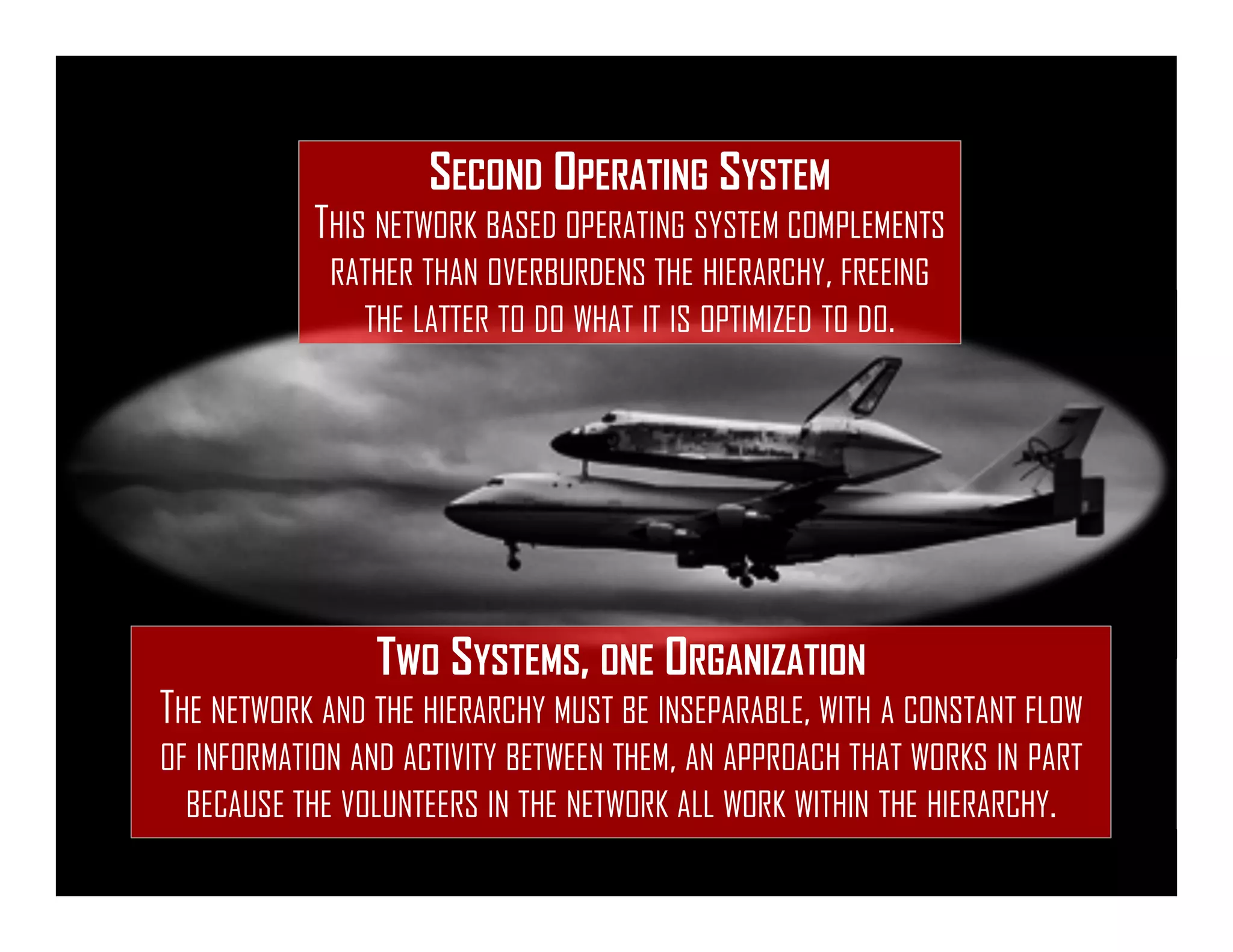
SECOND OPERATING SYSTEM
THIS NETWORK BASED OPERATING SYSTEM COMPLEMENTS
RATHER THAN OVERBURDENS THE HIERARCHY, FREEING
THE LATTER TO DO WHAT IT IS OPTIMIZED TO DO.
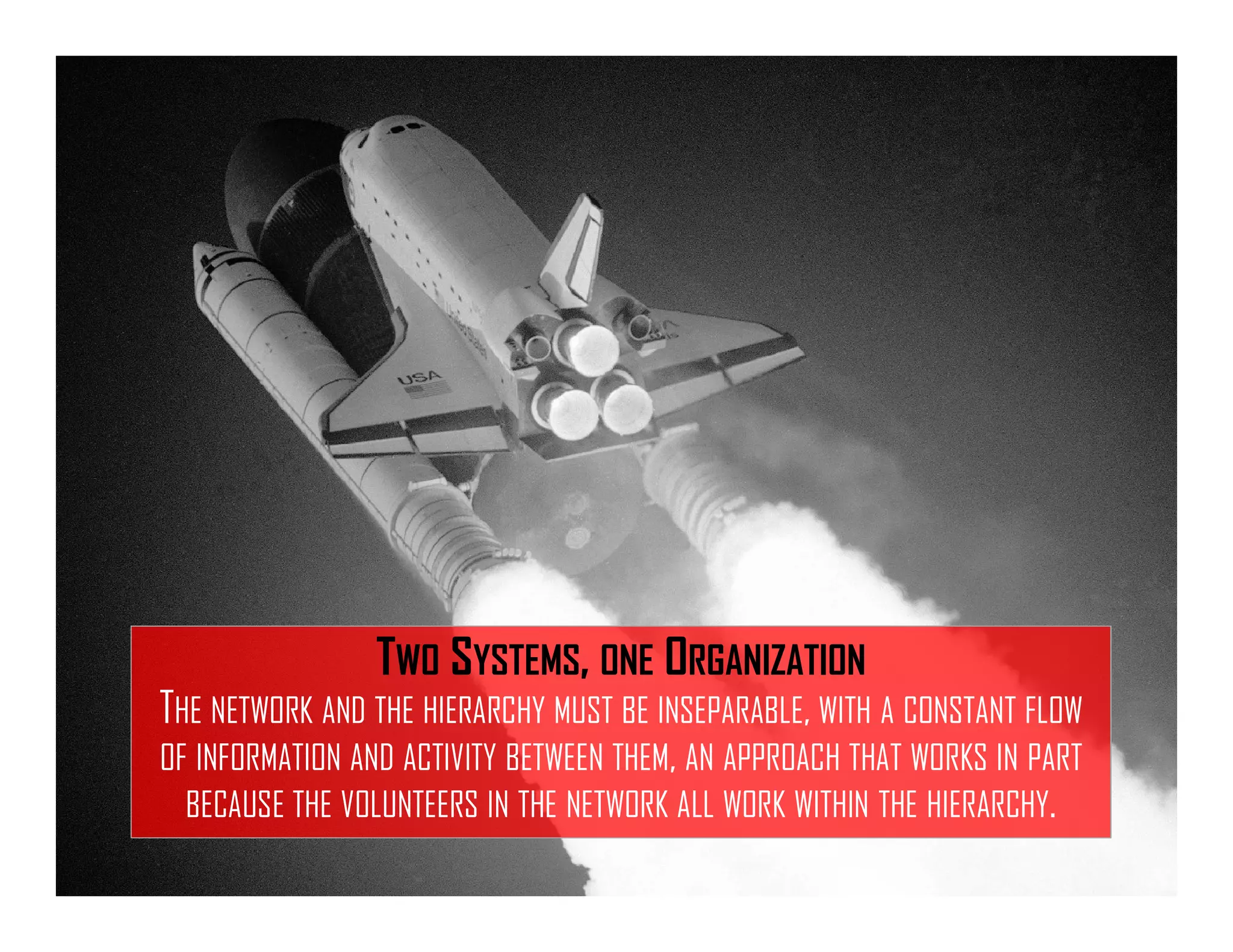
TWO SYSTEMS, ONE ORGANIZATION
THE NETWORK AND THE HIERARCHY MUST BE INSEPARABLE, WITH A CONSTANT FLOW
OF INFORMATION AND ACTIVITY BETWEEN THEM, AN APPROACH THAT WORKS IN PART
BECAUSE THE VOLUNTEERS IN THE NETWORK ALL WORK WITHIN THE HIERARCHY.
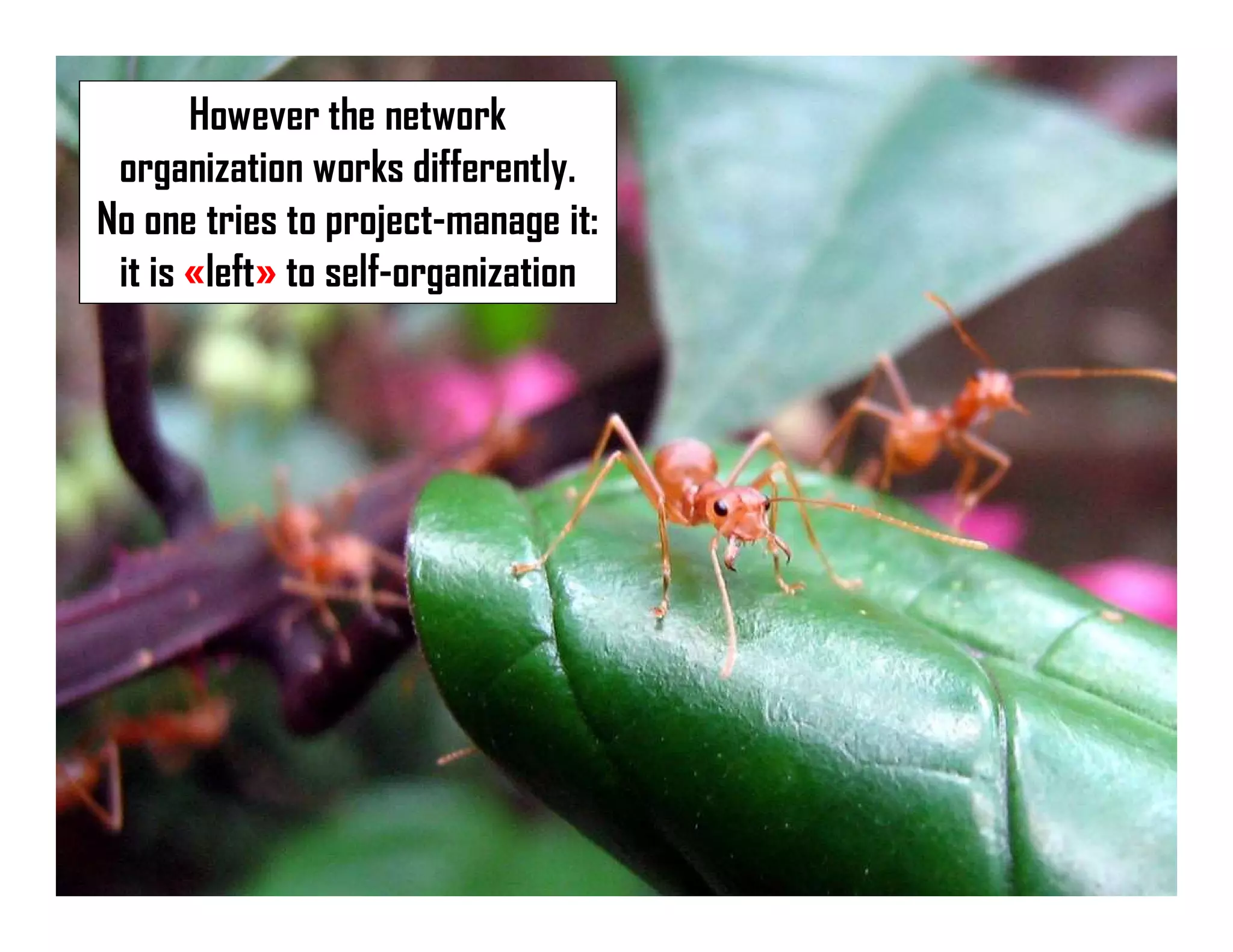
However the network
organization works differently.
No one tries to project-manage it:
it is «left» to self-organization
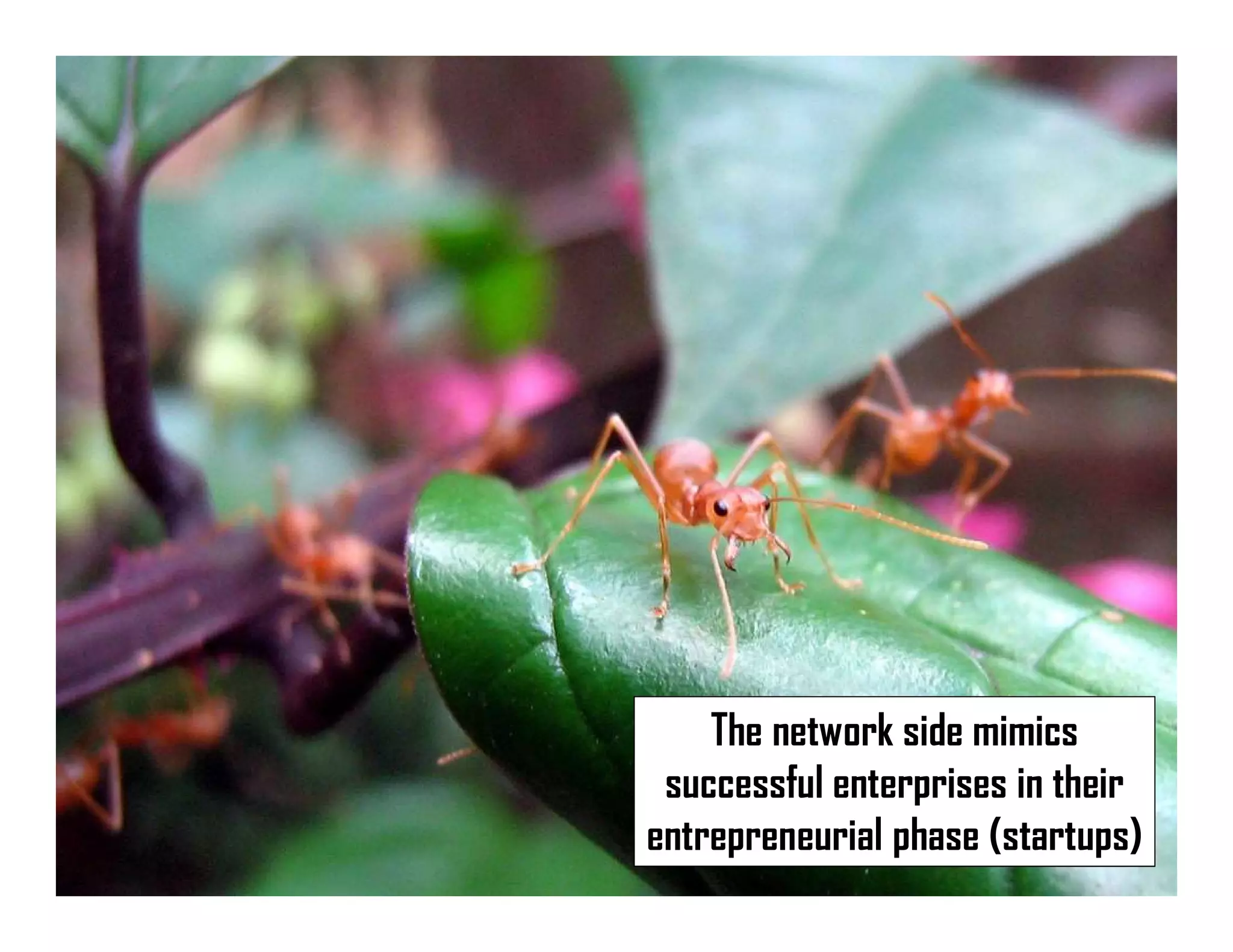
The network side mimics
successful enterprises in their
entrepreneurial phase (startups)
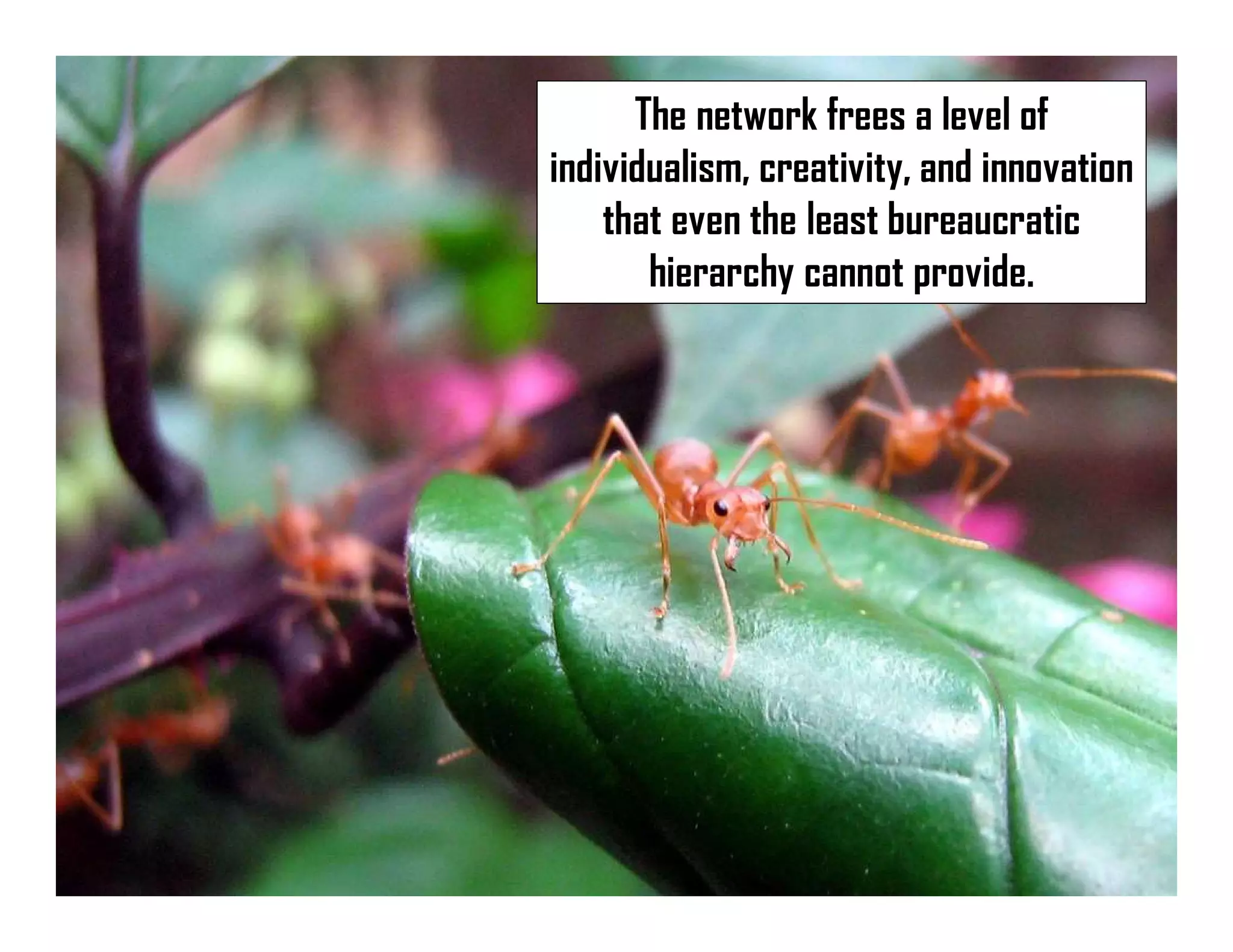
The network frees a level of
individualism, creativity, and innovation
that even the least bureaucratic
hierarchy cannot provide.
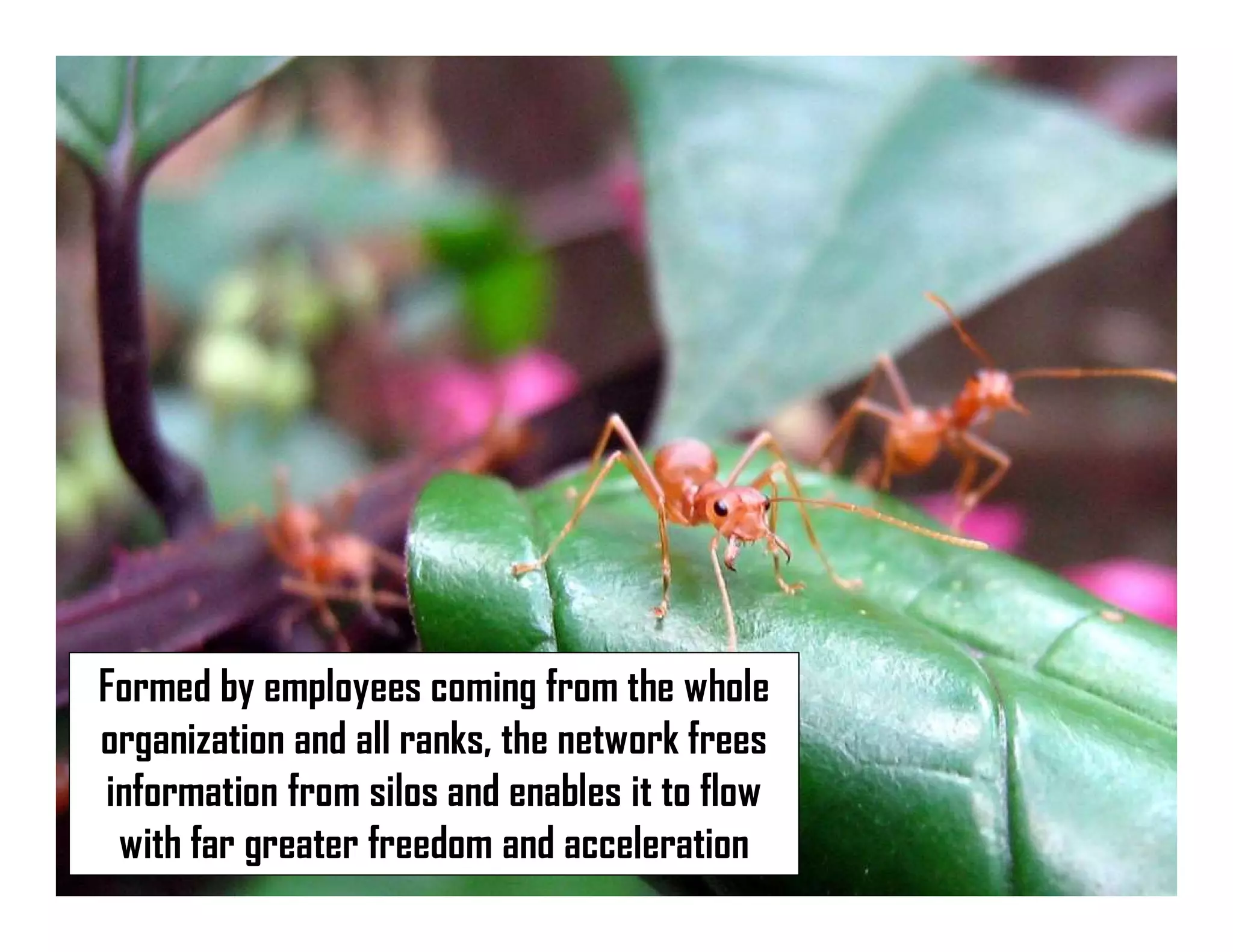
Formed by employees coming from the whole
organization and all ranks, the network frees
information from silos and enables it to flow
with far greater freedom and acceleration
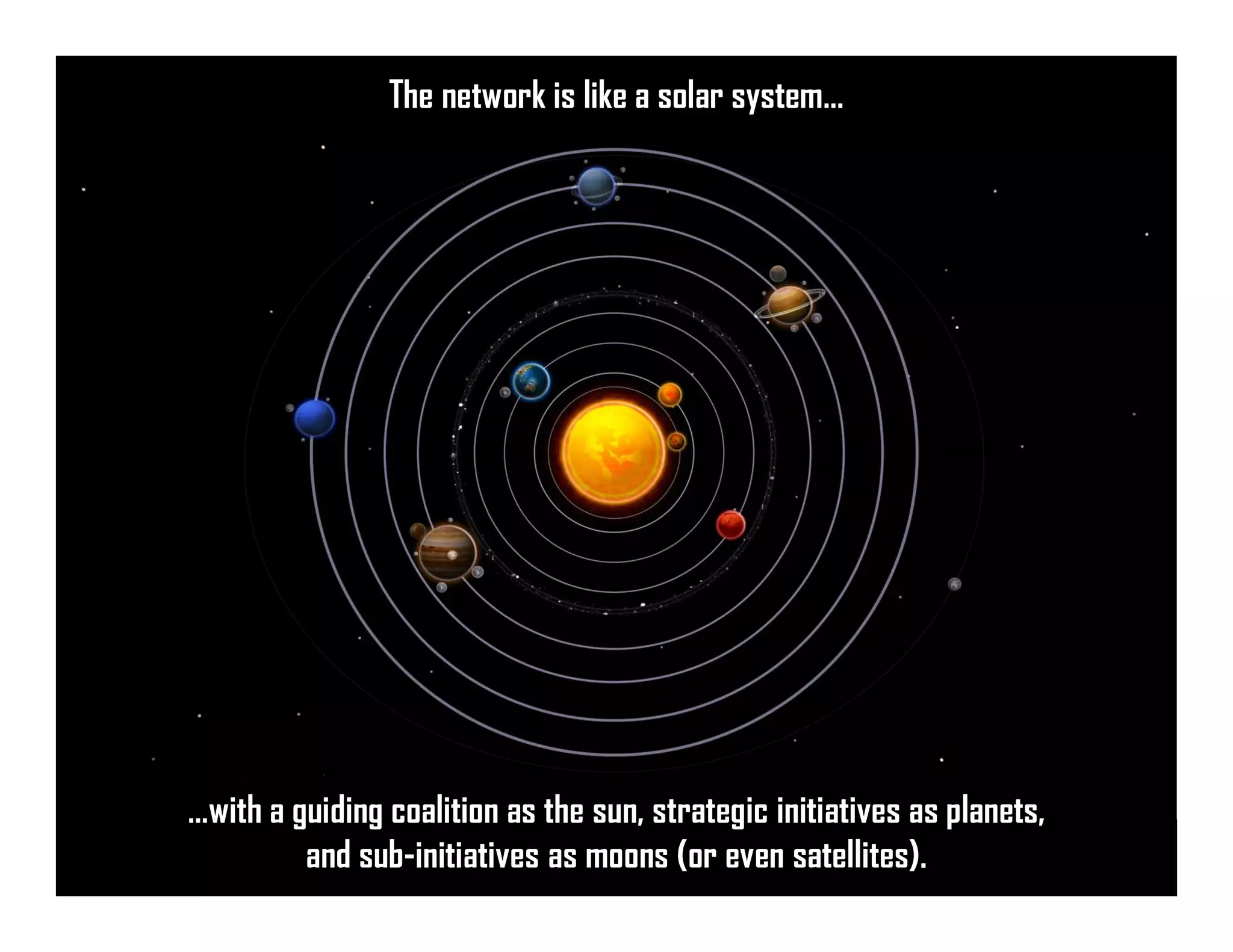
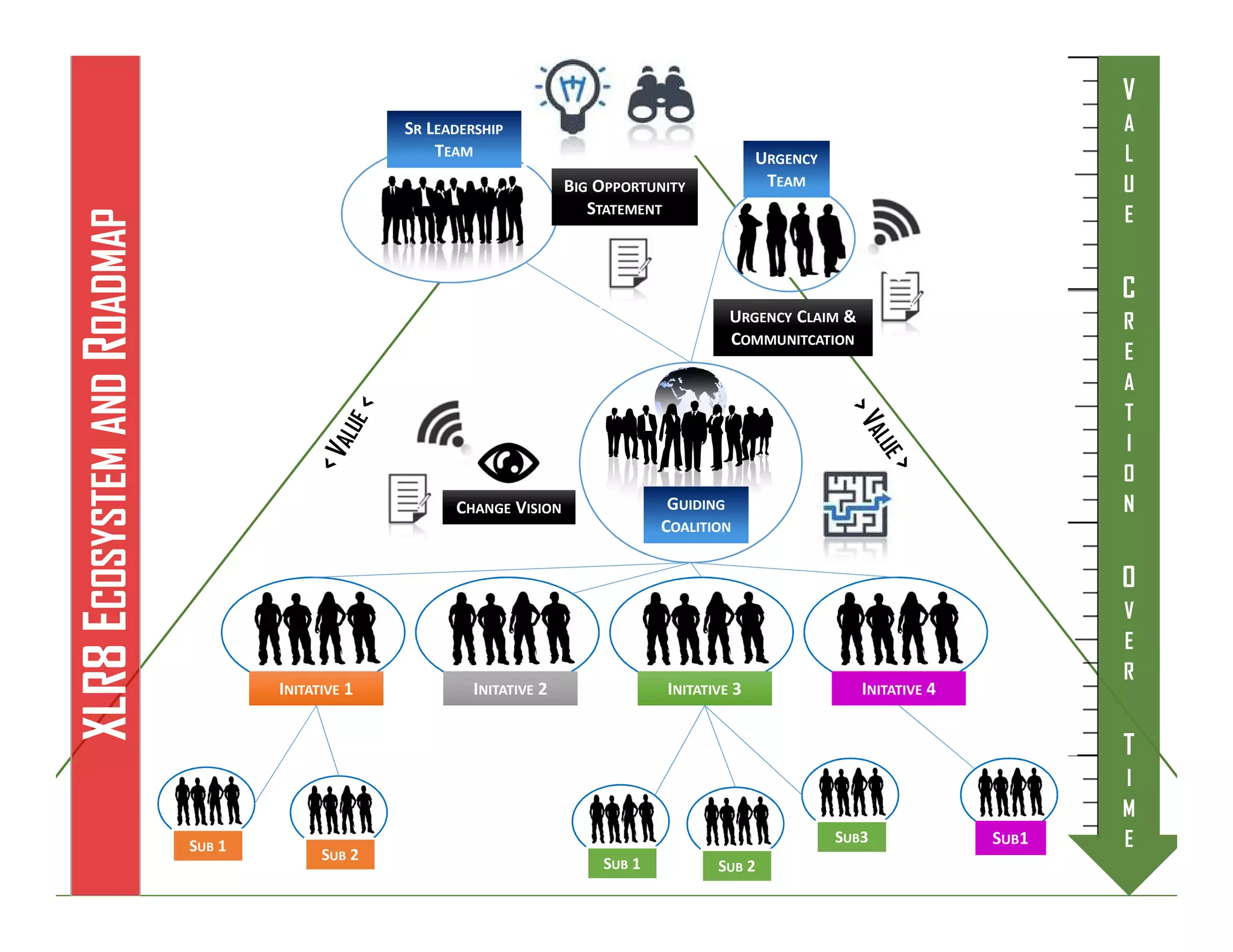
…with a guiding coalition as the sun, strategic initiatives as planets,
and sub-initiatives as moons (or even satellites).
The network is like a solar system…
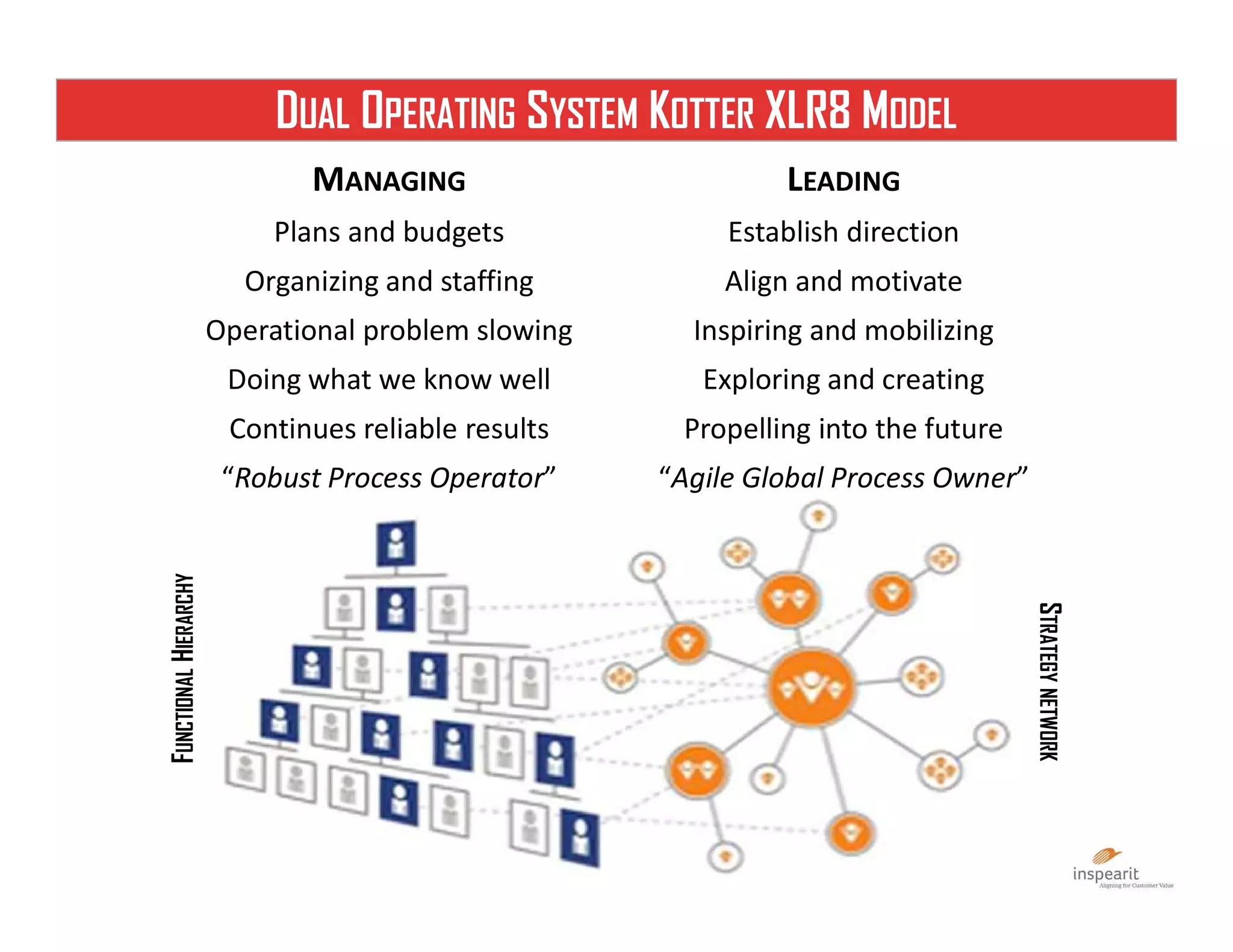
DUAL OPERATING SYSTEM KOTTER XLR8 MODEL
MANAGING
Plans and budgets
Organizing and staffing
Operational problem slowing
Doing what we know well
Continues reliable results
“Robust Process Operator”
LEADING
Establish direction
Align and motivate
Inspiring and mobilizing
Exploring and creating
Propelling into the future
“Agile Global Process Owner”
FUNCTIONALHIERARCHY
STRATEGYNETWORK
SO, WHAT WE NEEED IS
STRONG PRINCIPLES,
A BIG OPPORTUNITY TO PURSUE,
A BIT OF A PROCESS AND LOTS OF
MOTIVATION AND LEADERSHIP
DUAL OPERATING SYSTEM
KOTTER’S FIVE PRINCIPLES
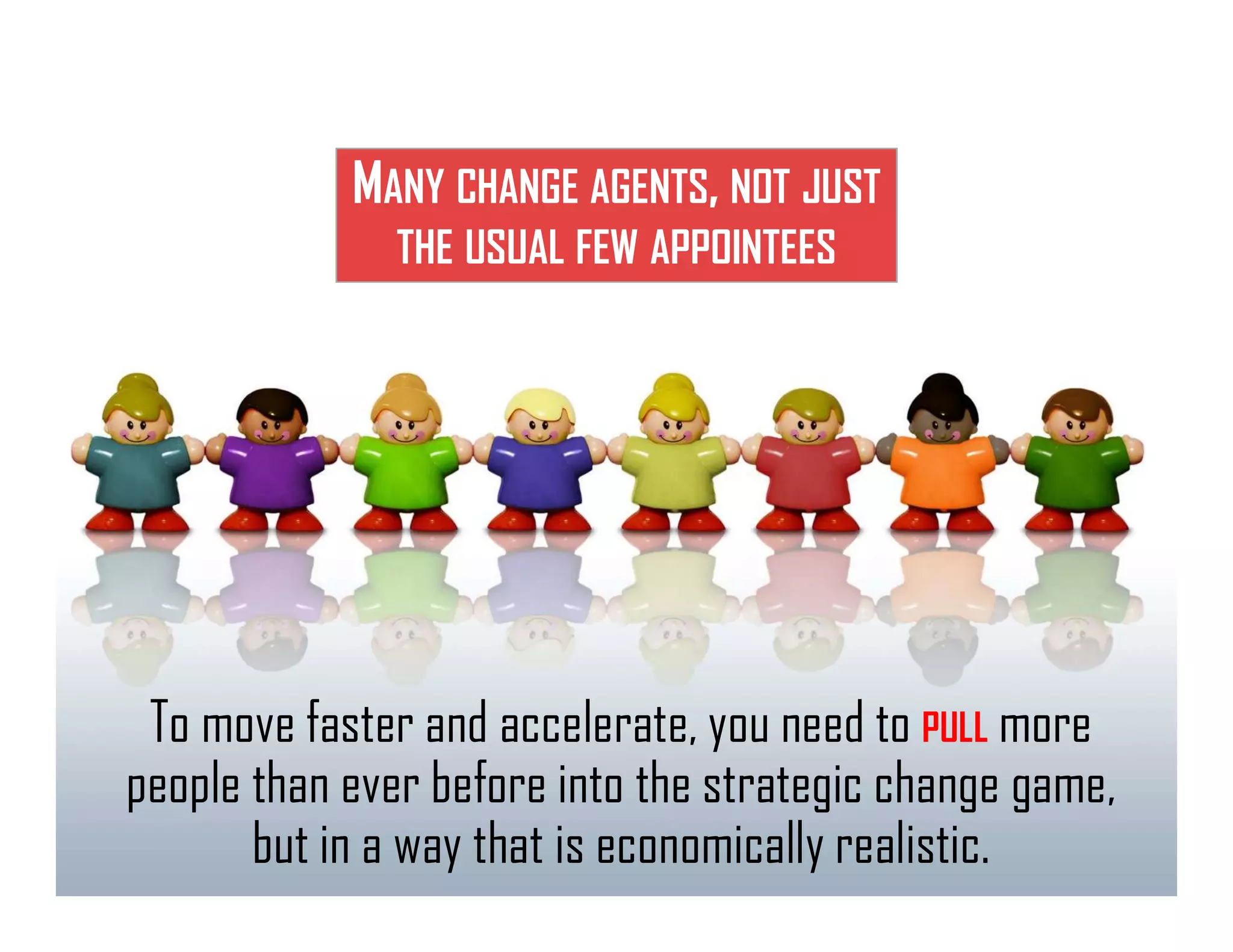
To move faster and accelerate, you need to PULL more
people than ever before into the strategic change game,
but in a way that is economically realistic.
MANY CHANGE AGENTS, NOT JUST
THE USUAL FEW APPOINTEES
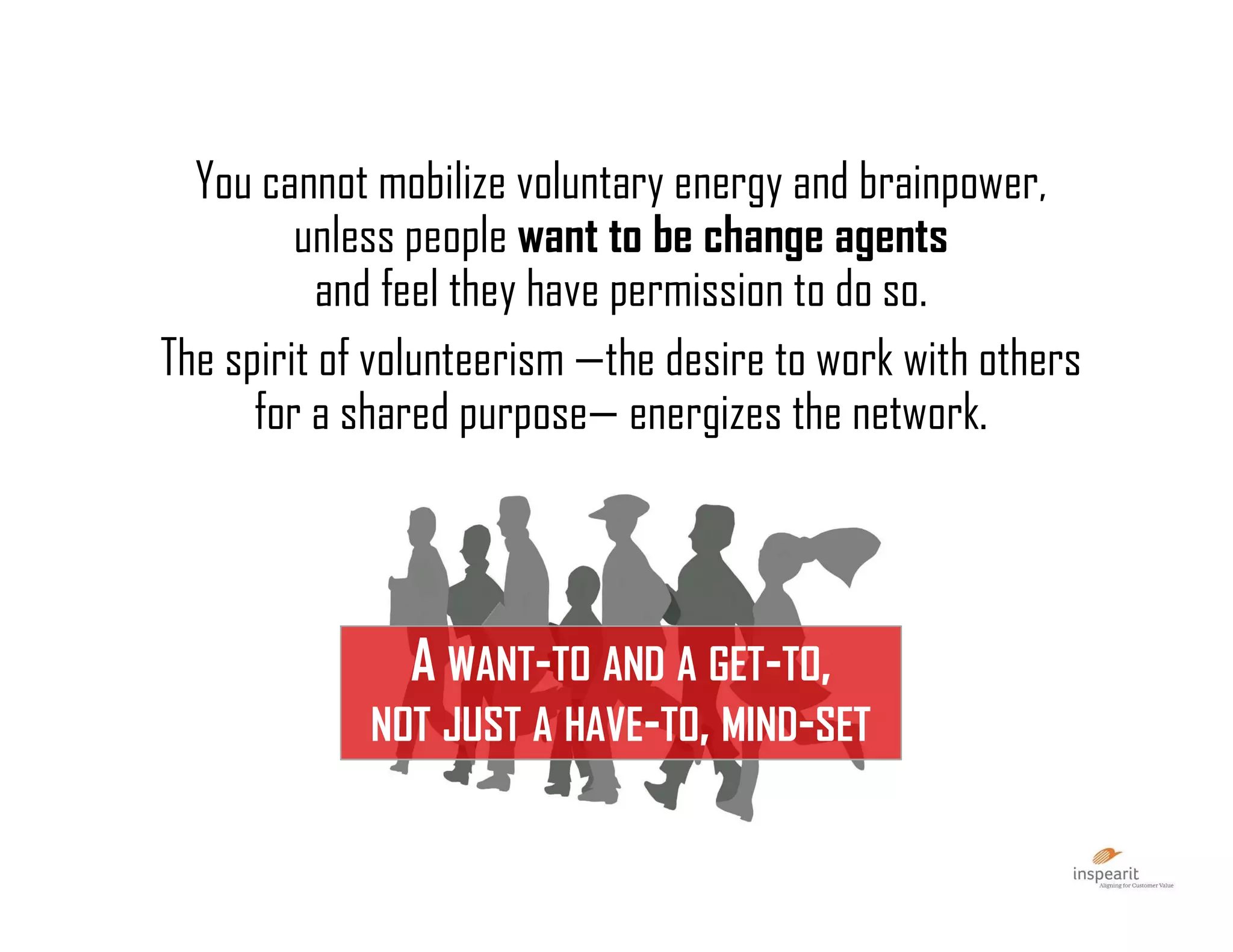
You cannot mobilize voluntary energy and brainpower,
unless people want to be change agents
and feel they have permission to do so.
The spirit of volunteerism —the desire to work with others
for a shared purpose— energizes the network.
A WANT-TO AND A GET-TO,
NOT JUST A HAVE-TO, MIND-SET
People won’t want to do a day job
in the hierarchy and a “night” job
in the network (which is essentially
how a dual operating system works)
if you rely only to logic,
with numbers and business cases
You must appeal to their emotions, too.
You must speak to their genuine desire
to contribute to positive change
and to take an enterprise in smart ways
into a better future, giving greater meaning
and purpose to their work.
HEAD AND HEART, NOT JUST HEAD.
A strategy network needs lots of leadership.
The game is all about vision, opportunity, agility,
inspired action, and celebration.
Not project management, budget reviews, reporting
relationships, compensation, and accountability to a plan.
MUCH MORE LEADERSHIP,
NOT JUST MORE MANAGEMENT.
TWO SYSTEMS, ONE ORGANIZATION
THE NETWORK AND THE HIERARCHY MUST BE INSEPARABLE, WITH A CONSTANT FLOW
OF INFORMATION AND ACTIVITY BETWEEN THEM, AN APPROACH THAT WORKS IN PART
BECAUSE THE VOLUNTEERS IN THE NETWORK ALL WORK WITHIN THE HIERARCHY.
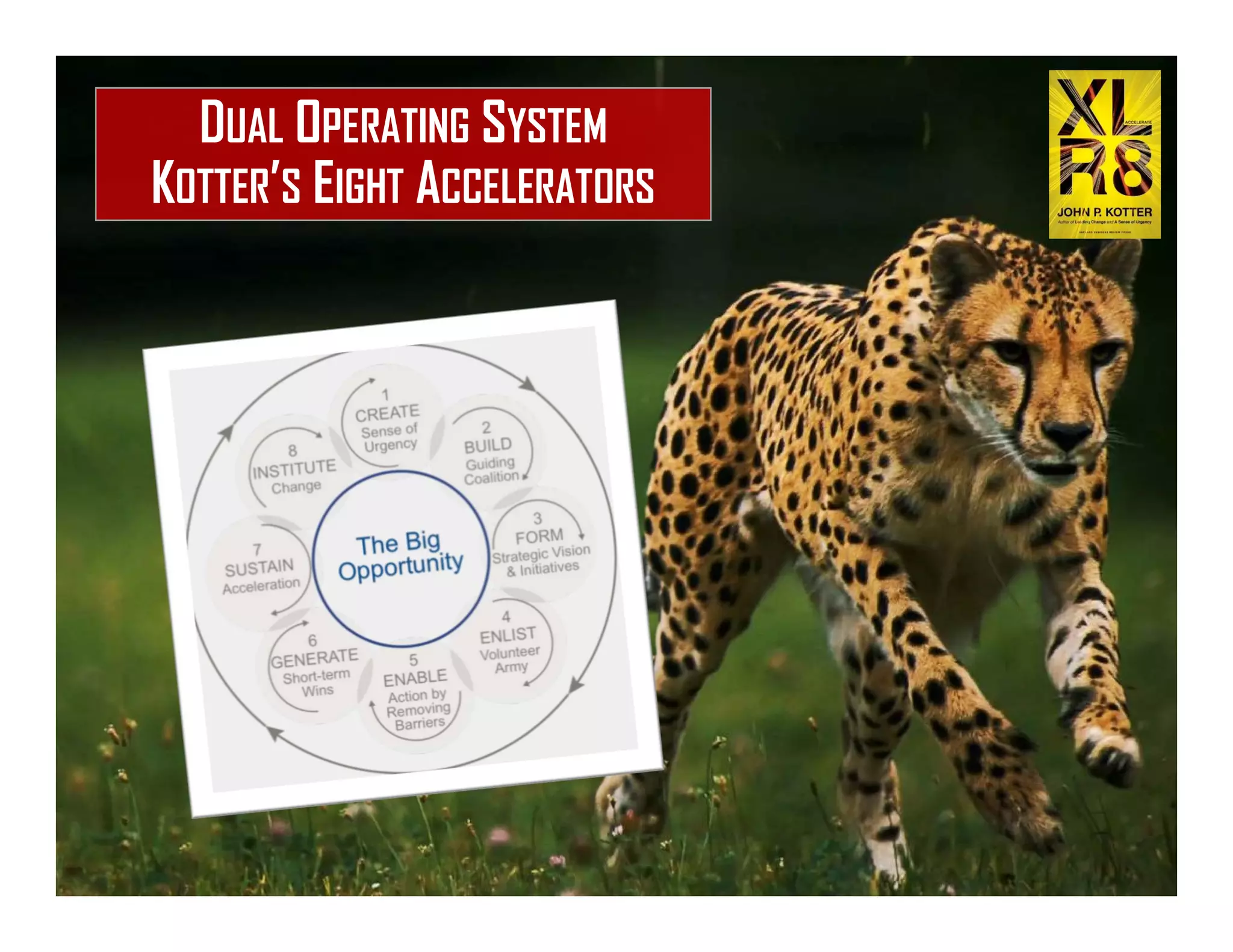
DUAL OPERATING SYSTEM
KOTTER’S EIGHT ACCELERATORS
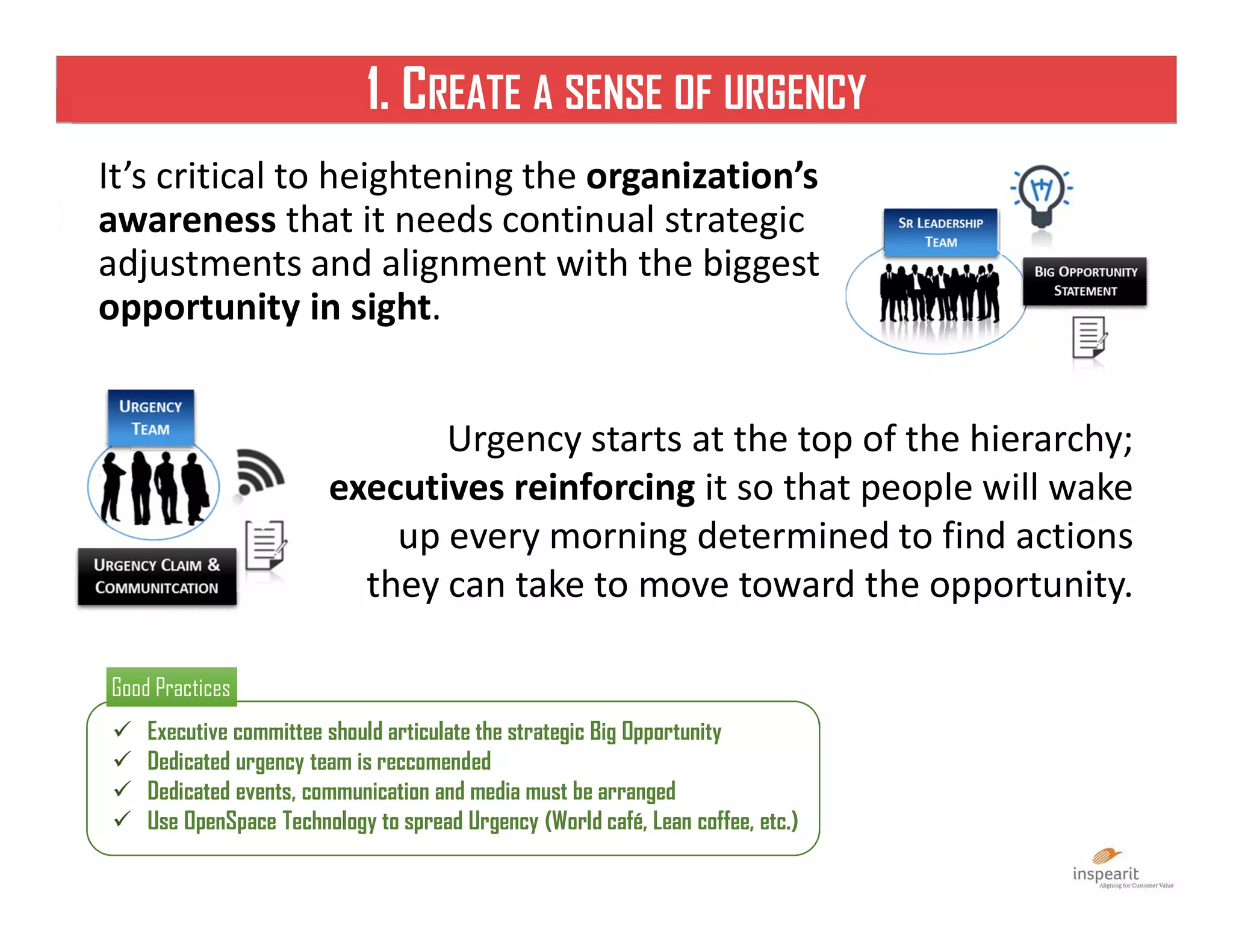
1. CREATE A SENSE OF URGENCY
It’s critical to heightening the organization’s
awareness that it needs continual strategic
adjustments and alignment with the biggest
opportunity in sight.
 Executive committee should articulate the strategic Big Opportunity
 Dedicated urgency team is reccomended
 Dedicated events, communication and media must be arranged
 Use OpenSpace Technology to spread Urgency (World café, Lean coffee, etc.)
Good PracticesGood Practices
Urgency starts at the top of the hierarchy;
executives reinforcing it so that people will wake
up every morning determined to find actions
they can take to move toward the opportunity.
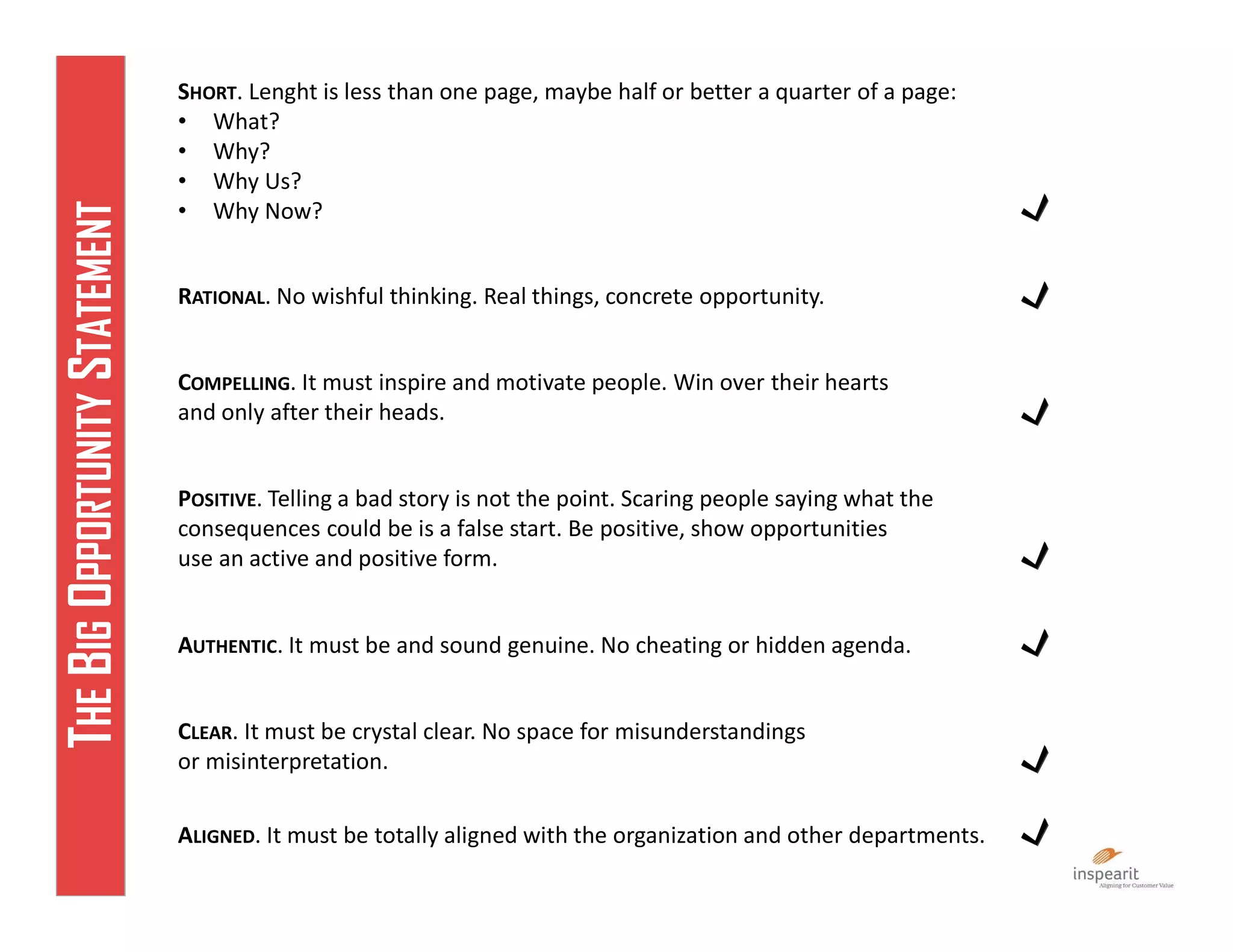
SHORT. Lenght is less than one page, maybe half or better a quarter of a page:
• What?
• Why?
• Why Us?
• Why Now?
RATIONAL. No wishful thinking. Real things, concrete opportunity.
COMPELLING. It must inspire and motivate people. Win over their hearts
and only after their heads.
POSITIVE. Telling a bad story is not the point. Scaring people saying what the
consequences could be is a false start. Be positive, show opportunities
use an active and positive form.
AUTHENTIC. It must be and sound genuine. No cheating or hidden agenda.
CLEAR. It must be crystal clear. No space for misunderstandings
or misinterpretation.
ALIGNED. It must be totally aligned with the organization and other departments.
THEBIGOPPORTUNITYSTATEMENT
2. BUILD A GUIDING COALITION
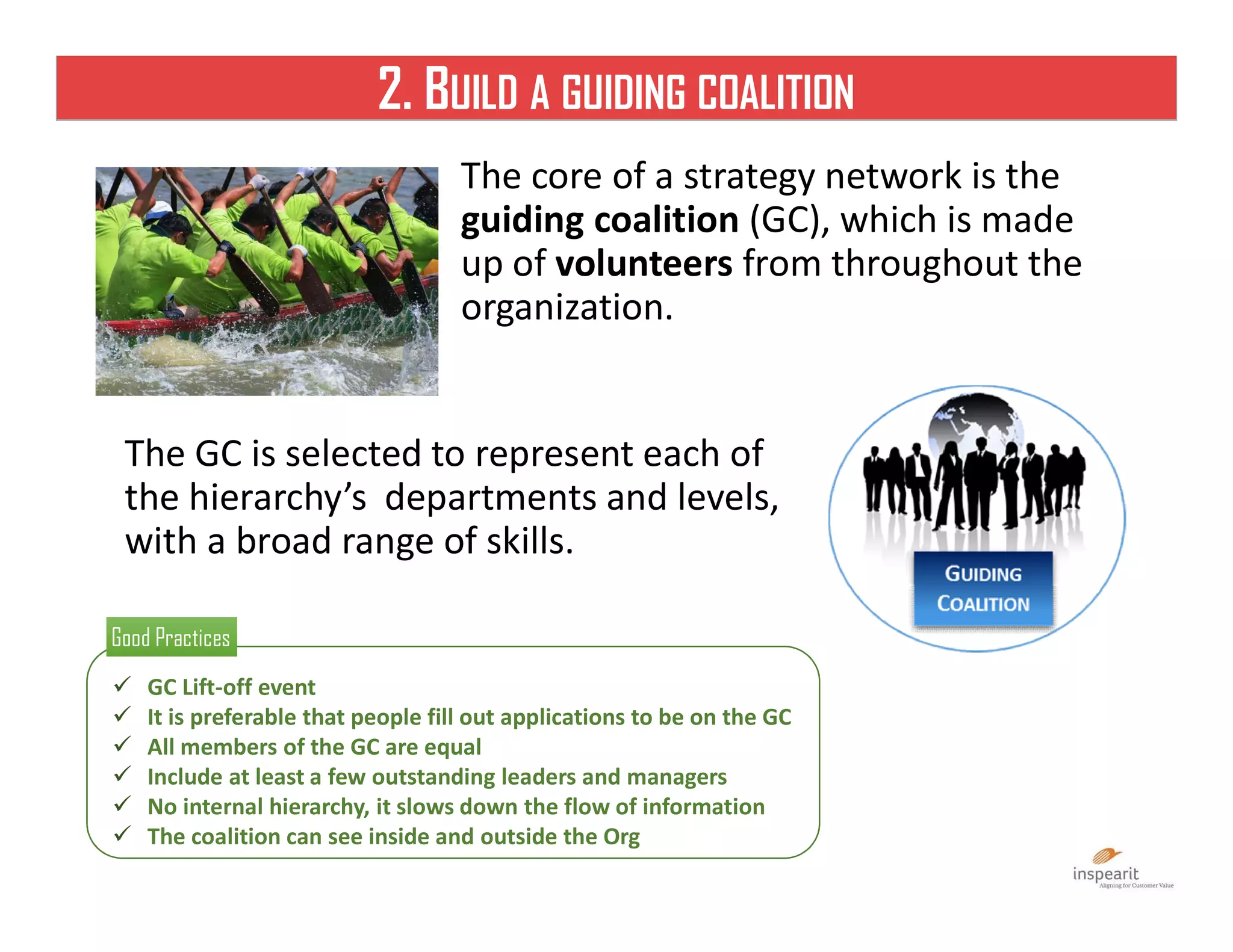
The core of a strategy network is the
guiding coalition (GC), which is made
up of volunteers from throughout the
organization.
The GC is selected to represent each of
the hierarchy’s departments and levels,
with a broad range of skills.
 GC Lift-off event
 It is preferable that people fill out applications to be on the GC
 All members of the GC are equal
 Include at least a few outstanding leaders and managers
 No internal hierarchy, it slows down the flow of information
 The coalition can see inside and outside the Org
Good PracticesGood Practices
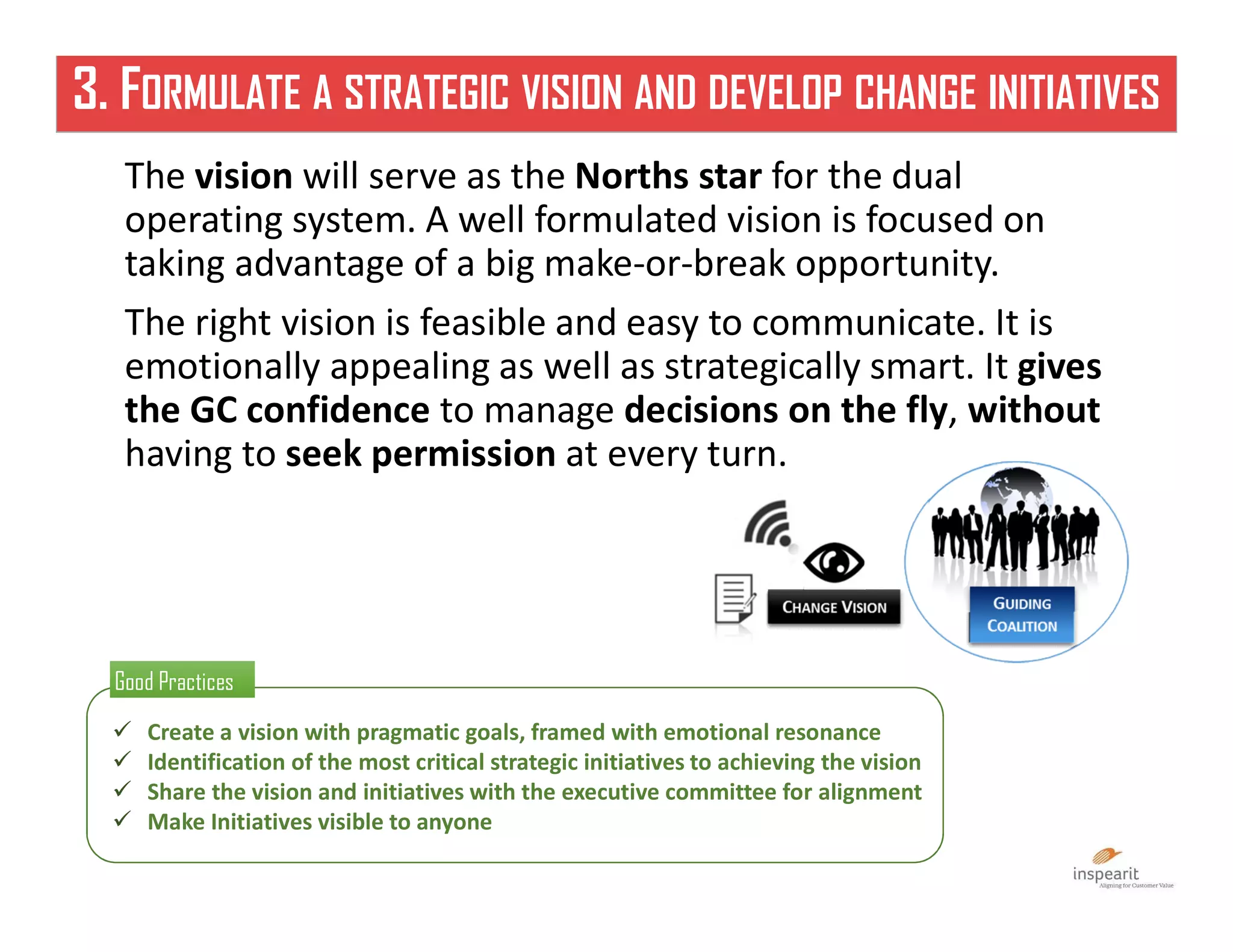
3. FORMULATE A STRATEGIC VISION AND DEVELOP CHANGE INITIATIVES
The vision will serve as the Norths star for the dual
operating system. A well formulated vision is focused on
taking advantage of a big make-or-break opportunity.
The right vision is feasible and easy to communicate. It is
emotionally appealing as well as strategically smart. It gives
the GC confidence to manage decisions on the fly, without
having to seek permission at every turn.
 Create a vision with pragmatic goals, framed with emotional resonance
 Identification of the most critical strategic initiatives to achieving the vision
 Share the vision and initiatives with the executive committee for alignment
 Make Initiatives visible to anyone
Good PracticesGood Practices
4. ENLIST A VOLUNTEER ARMY
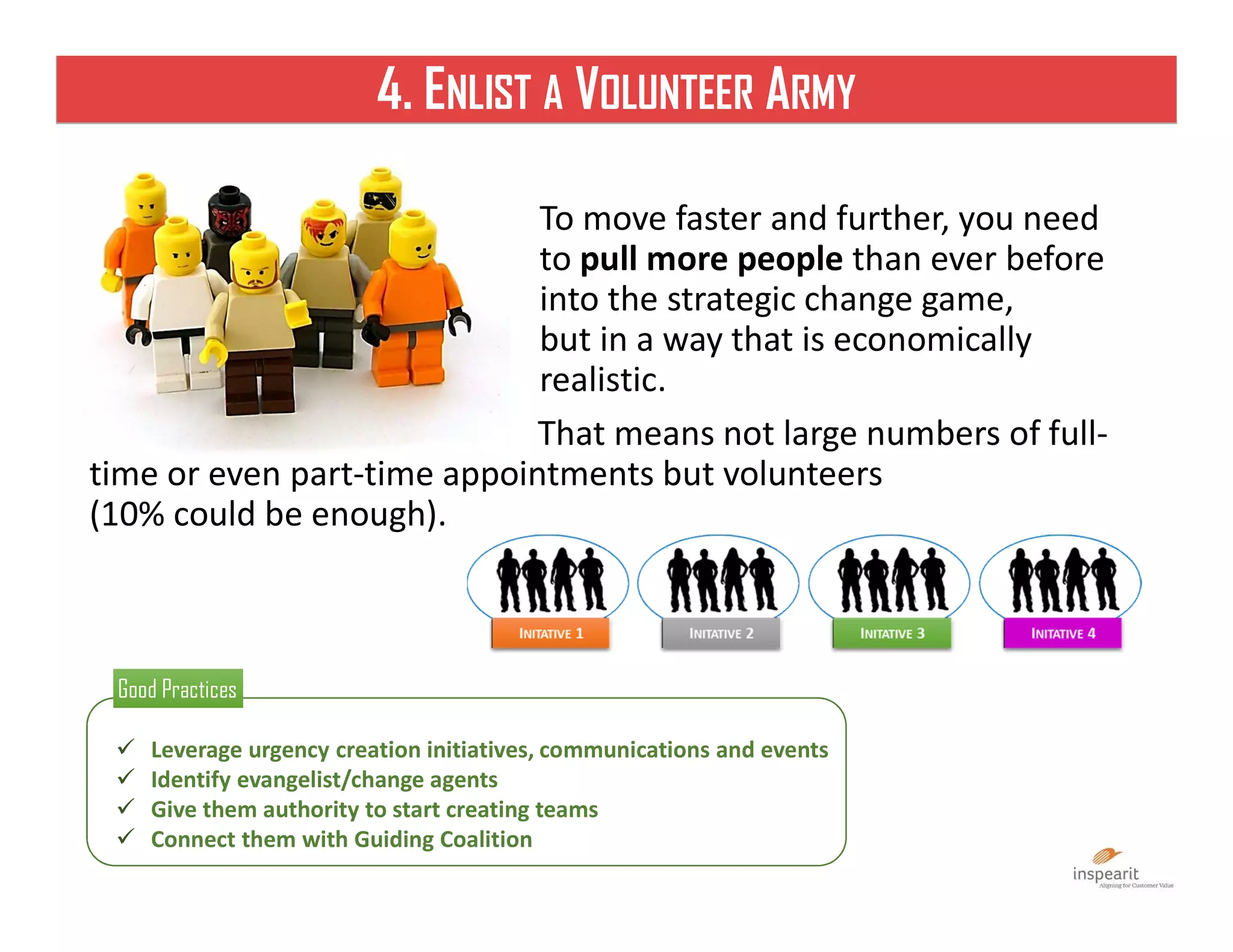
To move faster and further, you need
to pull more people than ever before
into the strategic change game,
but in a way that is economically
realistic.
 Leverage urgency creation initiatives, communications and events
 Identify evangelist/change agents
 Give them authority to start creating teams
 Connect them with Guiding Coalition
Good PracticesGood Practices
That means not large numbers of full-
time or even part-time appointments but volunteers
(10% could be enough).
5. ACCELERATE MOVEMENT REMOVES BARRIERS
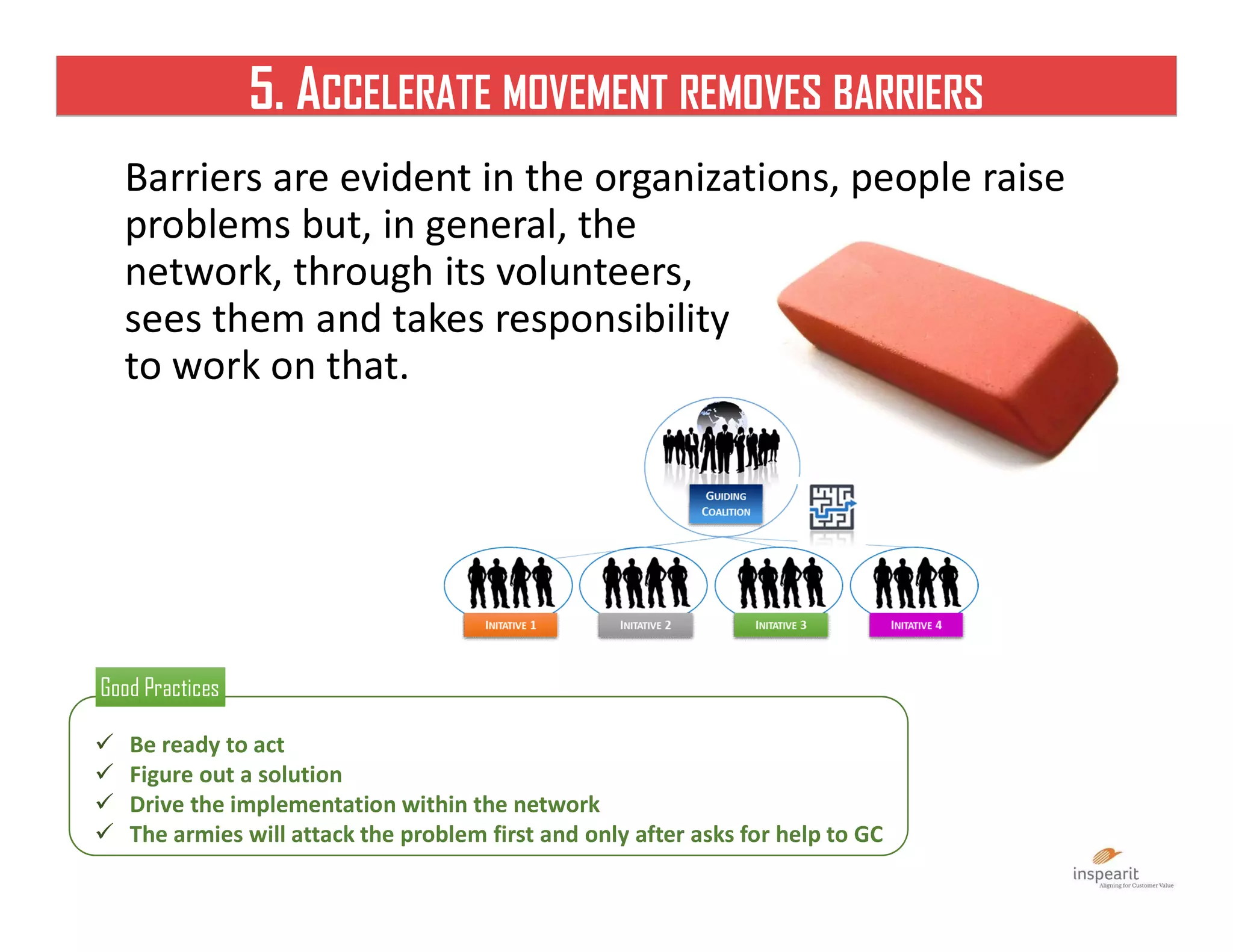
Barriers are evident in the organizations, people raise
problems but, in general, the
network, through its volunteers,
sees them and takes responsibility
to work on that.
 Be ready to act
 Figure out a solution
 Drive the implementation within the network
 The armies will attack the problem first and only after asks for help to GC
Good PracticesGood Practices
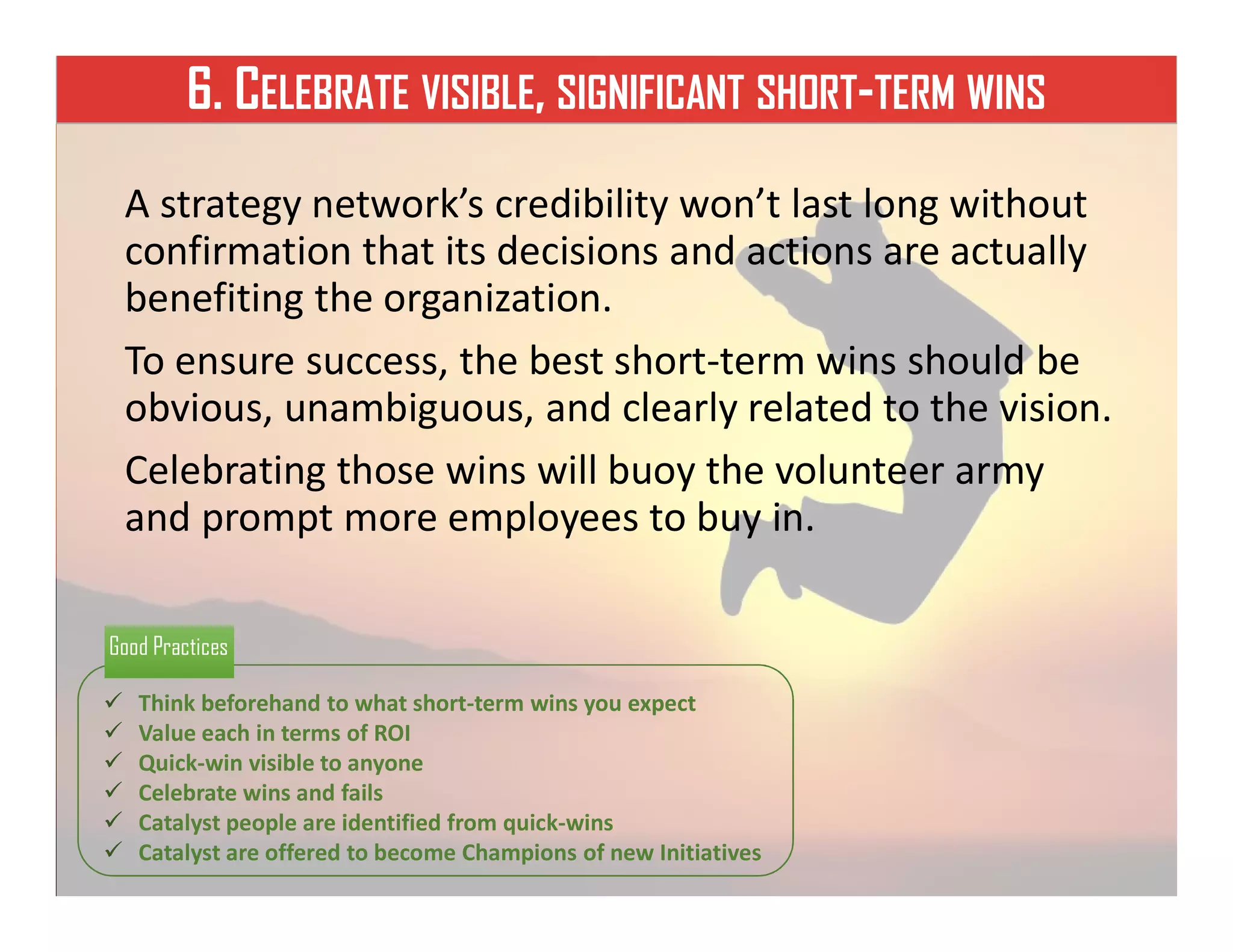
6. CELEBRATE VISIBLE, SIGNIFICANT SHORT-TERM WINS
A strategy network’s credibility won’t last long without
confirmation that its decisions and actions are actually
benefiting the organization.
To ensure success, the best short-term wins should be
obvious, unambiguous, and clearly related to the vision.
Celebrating those wins will buoy the volunteer army
and prompt more employees to buy in.
 Think beforehand to what short-term wins you expect
 Value each in terms of ROI
 Quick-win visible to anyone
 Celebrate wins and fails
 Catalyst people are identified from quick-wins
 Catalyst are offered to become Champions of new Initiatives
Good PracticesGood Practices
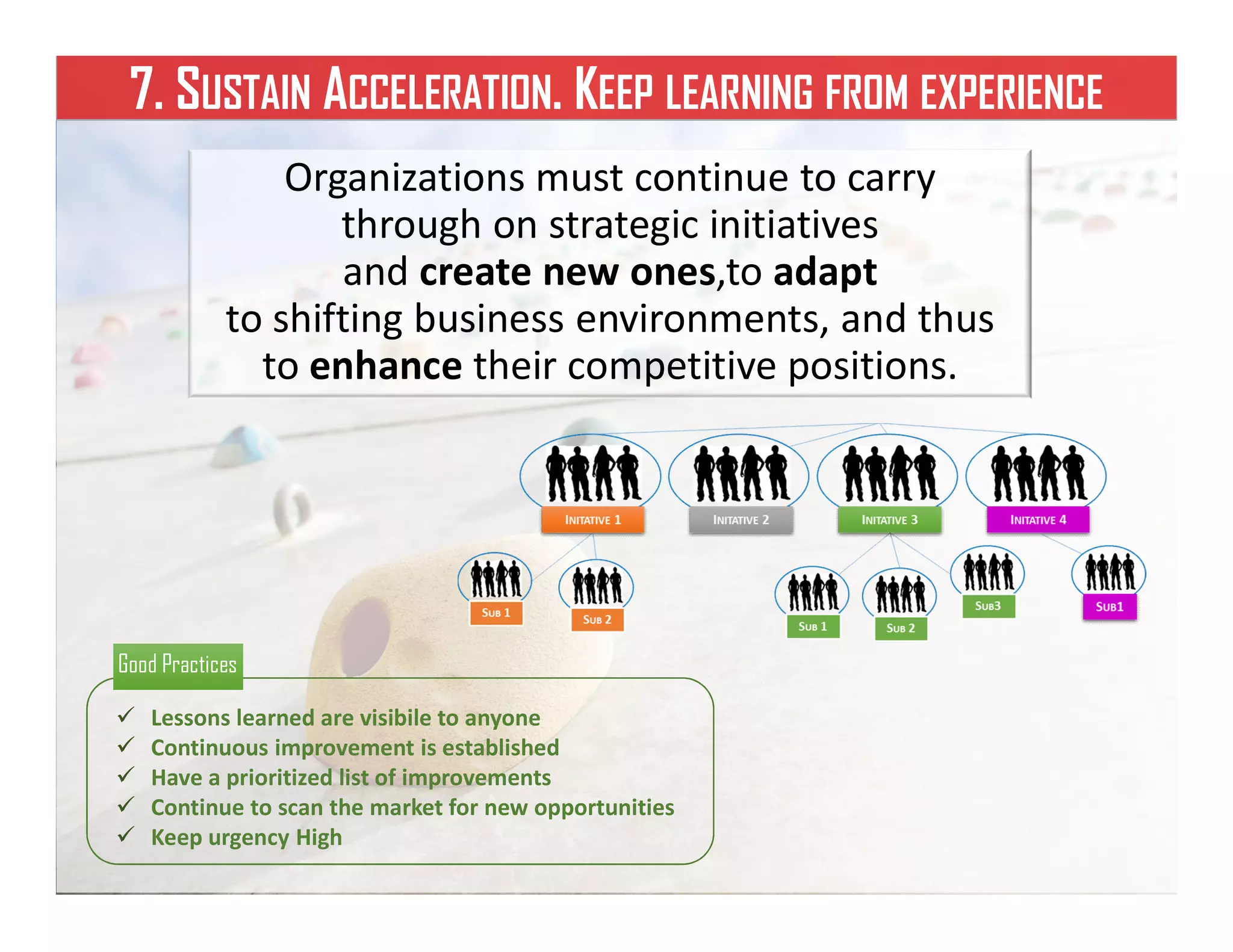
7. SUSTAIN ACCELERATION. KEEP LEARNING FROM EXPERIENCE
Organizations must continue to carry
through on strategic initiatives
and create new ones,to adapt
to shifting business environments, and thus
to enhance their competitive positions.
 Lessons learned are visibile to anyone
 Continuous improvement is established
 Have a prioritized list of improvements
 Continue to scan the market for new opportunities
 Keep urgency High
Good PracticesGood Practices
8. INSTITUTIONALIZE STRATEGIC CHANGES IN THE CULTURE
No strategic initiative, big or small, is complete until
it has been incorporated into day-to-day
activities.
New behaviors must sink into the culture of
the enterprise if the initiatives produce
visible results and sends your organization
into a strategically better future.
 Champions of finished initiatives are asked to enter the GC
 New standards and Policies are defined through lessons learned
 Expected behaviors are included in the appraisal process
 Expected behaviors are included in the hiring process
 New behaviors, methods and approaches become New Capabilities
Good PracticesGood Practices
SR LEADERSHIP
TEAM
SR LEADERSHIP
TEAM
URGENCY
TEAM
URGENCY
TEAM
INITATIVE 1INITATIVE 1 INITATIVE 2INITATIVE 2 INITATIVE 4INITATIVE 4
SUB 1
SUB 2
SUB 1 SUB 2
SUB3
GUIDING
COALITION
GUIDING
COALITION
SUB1SUB1
BIG OPPORTUNITY
STATEMENT
BIG OPPORTUNITY
STATEMENT
CHANGE VISIONCHANGE VISION
INITATIVE 3INITATIVE 3
XLR8ECOSYSTEMANDROADMAP
V
A
L
U
E
C
R
E
A
T
I
O
N
O
V
E
R
T
I
M
E
V
A
L
U
E
C
R
E
A
T
I
O
N
O
V
E
R
T
I
M
E
URGENCY CLAIM &
COMMUNITCATION
URGENCY CLAIM &
COMMUNITCATION
What are the most important
ingredients to realize all this?
SO, WHAT DO YOU THINK?!
Hard work without Motivation become stress.
Hard work with high involvement
and enthusiasm, become Passion.
emiliano.soldi at inspearit.com
https://it.linkedin.com/in/emilianosoldi
http://www.inspearit.com
@EmilianoSoldi

Accelerate [XLR8] your agile transformation

  • 1.
    ACCELERATE (XLR8) YOUR [AGILE] TRANSFORMATIONS PAVIA,19 NOVEMBRE 2015 Italian_Agile_Days_2016 @EmilianoSoldi
  • 2.
    QUESTIONI DI FRAMEWORK? TRANSFORMINGORGANIZATIONS. WHAT INGREDIENTS DO WE NEED?
  • 3.
    DO WE NEED«JUST» AN AGILE FRAMEWORK? IF SO, CHOOSE ONE!
  • 4.
    TODAY’S GREATER CHALLENGEFOR ORGANIZATION? Stay competitive and change amid constant turbulence and disruption The hierarchical structures and organizational processes organizations used for decades, are no longer up to the task of winning in this faster-moving world. The tension between needing to stay ahead of increasingly fierce competition and needing to deliver this year’s results, can be overwhelming.
  • 5.
    INNOVATION CANNOT BEREACHED VIA HIERARCHIES Innovation requires creativity, risks, people thinking out of their boxes, out of their silos. Management-driven hierarchies’ mandate is to minimize risks, keep people doing the usual things and give silos “a long life”.
  • 6.
    • Only asmall number of (frustrated) people lead key initiatives • Communication accross silos does not happen with sufficient speed or effectiveness • Information from top to bottom and vice-versa is slow • Policies, rules, procedures become barriers to strategic speed • People fear any change due to loss off power or stature LIMITS OF HIEARCHICAL SYSTEMS
  • 7.
    BUT, ARE WEREALLY SUPPOSED TO GET RID OF THESE MANAGEMENT-DRIVEN HIERACHIES? …OR WE RISK TO THROW THE BABY OUT WITH THE BATH WATER ?
  • 8.
    Hierarchical functional organizationscan effectively guide and coordinate the actions of employees, even thousands, spread around the globe. Such an “operating system” lets people do what they know how to do, exceptionally well! AND YOU KNOW WHAT’S THE TRUTH? Management-driven hierarchies, which most part of enterprises use, have been one of the successful innovations of the twentieth century. And very ofter they are still necessary to make many organizations continue to work successfully.
  • 9.
    WHAT IF WETRY TO DECOUPLE THE ORGANIZATIONS BY THINKING TO A SECOND OPERATION SYSTEM ARRANGED LIKE A NETWORK, NEXT TO THE EXISTING HIERARCHY… …WHOSE MANDATE IS TO INNOVATE?
  • 10.
    OPERATING SYSTEM 1(HIERARCHY) ...leaving to the well- structured and mature hierarchy and the related managerial processes, the “solely” objective to produce reliable and efficient results?
  • 11.
    "Our brains arecomprised of two characters: one that thinks fast (SYSTEM 1) and one that thinks slow (SYSTEM 2). SYSTEM 1 operates automatically, intuitively, involuntary, and effortlessly, like when we drive, read an angry facial expression, or recall our age. It operates on heuristics that may not be that accurate. SYSTEM 2 requires slowing down, solving problems, reasoning, computing, concentrating, analyzing data, and not jumping to quick conclusions.” Nobel Laureate Daniel Kahneman
  • 12.
    SECOND OPERATING SYSTEM THISNETWORK BASED OPERATING SYSTEM COMPLEMENTS RATHER THAN OVERBURDENS THE HIERARCHY, FREEING THE LATTER TO DO WHAT IT IS OPTIMIZED TO DO. TWO SYSTEMS, ONE ORGANIZATION THE NETWORK AND THE HIERARCHY MUST BE INSEPARABLE, WITH A CONSTANT FLOW OF INFORMATION AND ACTIVITY BETWEEN THEM, AN APPROACH THAT WORKS IN PART BECAUSE THE VOLUNTEERS IN THE NETWORK ALL WORK WITHIN THE HIERARCHY.
  • 13.
    However the network organizationworks differently. No one tries to project-manage it: it is «left» to self-organization
  • 14.
    The network sidemimics successful enterprises in their entrepreneurial phase (startups)
  • 15.
    The network freesa level of individualism, creativity, and innovation that even the least bureaucratic hierarchy cannot provide.
  • 16.
    Formed by employeescoming from the whole organization and all ranks, the network frees information from silos and enables it to flow with far greater freedom and acceleration
  • 17.
    …with a guidingcoalition as the sun, strategic initiatives as planets, and sub-initiatives as moons (or even satellites). The network is like a solar system…
  • 18.
    DUAL OPERATING SYSTEMKOTTER XLR8 MODEL MANAGING Plans and budgets Organizing and staffing Operational problem slowing Doing what we know well Continues reliable results “Robust Process Operator” LEADING Establish direction Align and motivate Inspiring and mobilizing Exploring and creating Propelling into the future “Agile Global Process Owner” FUNCTIONALHIERARCHY STRATEGYNETWORK
  • 19.
    SO, WHAT WENEEED IS STRONG PRINCIPLES, A BIG OPPORTUNITY TO PURSUE, A BIT OF A PROCESS AND LOTS OF MOTIVATION AND LEADERSHIP
  • 20.
  • 21.
    To move fasterand accelerate, you need to PULL more people than ever before into the strategic change game, but in a way that is economically realistic. MANY CHANGE AGENTS, NOT JUST THE USUAL FEW APPOINTEES
  • 22.
    You cannot mobilizevoluntary energy and brainpower, unless people want to be change agents and feel they have permission to do so. The spirit of volunteerism —the desire to work with others for a shared purpose— energizes the network. A WANT-TO AND A GET-TO, NOT JUST A HAVE-TO, MIND-SET
  • 23.
    People won’t wantto do a day job in the hierarchy and a “night” job in the network (which is essentially how a dual operating system works) if you rely only to logic, with numbers and business cases
  • 24.
    You must appealto their emotions, too. You must speak to their genuine desire to contribute to positive change and to take an enterprise in smart ways into a better future, giving greater meaning and purpose to their work. HEAD AND HEART, NOT JUST HEAD.
  • 25.
    A strategy networkneeds lots of leadership. The game is all about vision, opportunity, agility, inspired action, and celebration. Not project management, budget reviews, reporting relationships, compensation, and accountability to a plan. MUCH MORE LEADERSHIP, NOT JUST MORE MANAGEMENT.
  • 26.
    TWO SYSTEMS, ONEORGANIZATION THE NETWORK AND THE HIERARCHY MUST BE INSEPARABLE, WITH A CONSTANT FLOW OF INFORMATION AND ACTIVITY BETWEEN THEM, AN APPROACH THAT WORKS IN PART BECAUSE THE VOLUNTEERS IN THE NETWORK ALL WORK WITHIN THE HIERARCHY.
  • 27.
  • 28.
    1. CREATE ASENSE OF URGENCY It’s critical to heightening the organization’s awareness that it needs continual strategic adjustments and alignment with the biggest opportunity in sight.  Executive committee should articulate the strategic Big Opportunity  Dedicated urgency team is reccomended  Dedicated events, communication and media must be arranged  Use OpenSpace Technology to spread Urgency (World café, Lean coffee, etc.) Good PracticesGood Practices Urgency starts at the top of the hierarchy; executives reinforcing it so that people will wake up every morning determined to find actions they can take to move toward the opportunity.
  • 29.
    SHORT. Lenght isless than one page, maybe half or better a quarter of a page: • What? • Why? • Why Us? • Why Now? RATIONAL. No wishful thinking. Real things, concrete opportunity. COMPELLING. It must inspire and motivate people. Win over their hearts and only after their heads. POSITIVE. Telling a bad story is not the point. Scaring people saying what the consequences could be is a false start. Be positive, show opportunities use an active and positive form. AUTHENTIC. It must be and sound genuine. No cheating or hidden agenda. CLEAR. It must be crystal clear. No space for misunderstandings or misinterpretation. ALIGNED. It must be totally aligned with the organization and other departments. THEBIGOPPORTUNITYSTATEMENT
  • 30.
    2. BUILD AGUIDING COALITION The core of a strategy network is the guiding coalition (GC), which is made up of volunteers from throughout the organization. The GC is selected to represent each of the hierarchy’s departments and levels, with a broad range of skills.  GC Lift-off event  It is preferable that people fill out applications to be on the GC  All members of the GC are equal  Include at least a few outstanding leaders and managers  No internal hierarchy, it slows down the flow of information  The coalition can see inside and outside the Org Good PracticesGood Practices
  • 31.
    3. FORMULATE ASTRATEGIC VISION AND DEVELOP CHANGE INITIATIVES The vision will serve as the Norths star for the dual operating system. A well formulated vision is focused on taking advantage of a big make-or-break opportunity. The right vision is feasible and easy to communicate. It is emotionally appealing as well as strategically smart. It gives the GC confidence to manage decisions on the fly, without having to seek permission at every turn.  Create a vision with pragmatic goals, framed with emotional resonance  Identification of the most critical strategic initiatives to achieving the vision  Share the vision and initiatives with the executive committee for alignment  Make Initiatives visible to anyone Good PracticesGood Practices
  • 32.
    4. ENLIST AVOLUNTEER ARMY To move faster and further, you need to pull more people than ever before into the strategic change game, but in a way that is economically realistic.  Leverage urgency creation initiatives, communications and events  Identify evangelist/change agents  Give them authority to start creating teams  Connect them with Guiding Coalition Good PracticesGood Practices That means not large numbers of full- time or even part-time appointments but volunteers (10% could be enough).
  • 33.
    5. ACCELERATE MOVEMENTREMOVES BARRIERS Barriers are evident in the organizations, people raise problems but, in general, the network, through its volunteers, sees them and takes responsibility to work on that.  Be ready to act  Figure out a solution  Drive the implementation within the network  The armies will attack the problem first and only after asks for help to GC Good PracticesGood Practices
  • 34.
    6. CELEBRATE VISIBLE,SIGNIFICANT SHORT-TERM WINS A strategy network’s credibility won’t last long without confirmation that its decisions and actions are actually benefiting the organization. To ensure success, the best short-term wins should be obvious, unambiguous, and clearly related to the vision. Celebrating those wins will buoy the volunteer army and prompt more employees to buy in.  Think beforehand to what short-term wins you expect  Value each in terms of ROI  Quick-win visible to anyone  Celebrate wins and fails  Catalyst people are identified from quick-wins  Catalyst are offered to become Champions of new Initiatives Good PracticesGood Practices
  • 35.
    7. SUSTAIN ACCELERATION.KEEP LEARNING FROM EXPERIENCE Organizations must continue to carry through on strategic initiatives and create new ones,to adapt to shifting business environments, and thus to enhance their competitive positions.  Lessons learned are visibile to anyone  Continuous improvement is established  Have a prioritized list of improvements  Continue to scan the market for new opportunities  Keep urgency High Good PracticesGood Practices
  • 36.
    8. INSTITUTIONALIZE STRATEGICCHANGES IN THE CULTURE No strategic initiative, big or small, is complete until it has been incorporated into day-to-day activities. New behaviors must sink into the culture of the enterprise if the initiatives produce visible results and sends your organization into a strategically better future.  Champions of finished initiatives are asked to enter the GC  New standards and Policies are defined through lessons learned  Expected behaviors are included in the appraisal process  Expected behaviors are included in the hiring process  New behaviors, methods and approaches become New Capabilities Good PracticesGood Practices
  • 37.
    SR LEADERSHIP TEAM SR LEADERSHIP TEAM URGENCY TEAM URGENCY TEAM INITATIVE1INITATIVE 1 INITATIVE 2INITATIVE 2 INITATIVE 4INITATIVE 4 SUB 1 SUB 2 SUB 1 SUB 2 SUB3 GUIDING COALITION GUIDING COALITION SUB1SUB1 BIG OPPORTUNITY STATEMENT BIG OPPORTUNITY STATEMENT CHANGE VISIONCHANGE VISION INITATIVE 3INITATIVE 3 XLR8ECOSYSTEMANDROADMAP V A L U E C R E A T I O N O V E R T I M E V A L U E C R E A T I O N O V E R T I M E URGENCY CLAIM & COMMUNITCATION URGENCY CLAIM & COMMUNITCATION
  • 38.
    What are themost important ingredients to realize all this? SO, WHAT DO YOU THINK?!
  • 39.
    Hard work withoutMotivation become stress. Hard work with high involvement and enthusiasm, become Passion.
  • 40.