

THE POWER OF COLLABORATIVE INTELLIGENCE
The Architectural Systems Thinking in Corporate Transitions
Lili Gulbert created for
KÜRT Academy
www.kurt-akademia.hu
2017.03.30.
WELCOME TO MY JOURNEY!
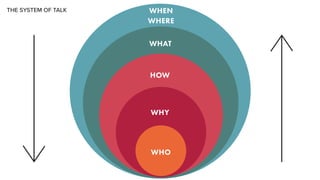
THE SYSTEM OF TALK WHEN
WHERE
WHO
WHY
HOW
WHAT
OPEN THE WINDOW
OF YOUR MIND!
“You can’t build anything meaningful
if you don’t understand the context in depth.”
Daniel Libeskind
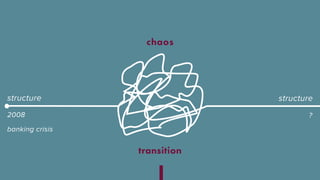
structurestructure
chaos
2008
banking crisis
?
transition
“From the point of view of economics clearly
we can make a globalization that works.
The challenge is our politics.
A neccessary condition I think to make that
politics work is reform of our systems of
global economic governance.
Democracy tempered the market economy. ”
Joseph Stiglitz
Digitalism created the super-connected
democratic environment, in what the
experimental new-economical models could
evolve which started to crack the world’s
outdated economical structures.
What are the democratic neweconomy
fenomena’s patterns:
- transparency
- openness
- collaboration
TRUST
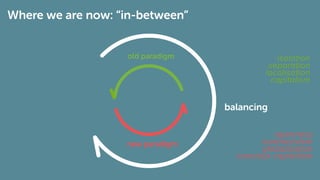
Where we are now: “in-between”
isolation
separation
localisation
capitalism
openness
connectivism
globalization
concious capitalism
old paradigm
new paradigm
balancing
The ongoing global transition in our world:
-transforms the economical, political and social systems
- is unpredictable
- is a complex progress
- challenges our deep assumptions
- breaks our trust
- knocks down structures and blurs the linear boundaries
- creates complex phenomena which include
the possibilities of the future
Uncertainity drives us to step out from our outdated
belief systems and explore, understand and modell
these possibilities through experiencing, and the joint
evolution of these possibilities is going to form
future’s new structures.
A part of this in-between state is to explore through
deep understanding who are the real architects
of the meanings of new phenomena,
who restructure our world.
Challenging your deep assumptions will surprise you!
A paradigm shift is happening in organizations too.
Their traditional operation is increasingly
being challenged by the connectivist paradigm.
Complexity and evolution play
a foundational role in the new economy.
Viewing the economy and organizations as
a complex evolving system has an
impact on how we work with change.
Explore, Design and Build Organizations as
COMPLEX ADAPTIVE SYSTEMS
Roy J. Eidelson: Complex Adaptive Systems in the Behavioral and Social Sciences, Review of General Psychology 1997
COMPLEX
conveys many attributes, the clearest of which may be the
nonlinear nature of the world around us.
According to complexity theory, small events can have dramatic effect, and
seemingly large events can have no discernible impact at all.
Roy J. Eidelson: Complex Adaptive Systems in the Behavioral and Social Sciences, Review of General Psychology 1997
ADAPTIVE
reflects the perspective’s focus on the change and evolution
that characterize individuals, groups, and societies.
They’re repeatedly disrupted by both internal phenomena and
external influences.
Roy J. Eidelson: Complex Adaptive Systems in the Behavioral and Social Sciences, Review of General Psychology 1997
SYSTEM
emphasizes interconnections.
It can be readily apparent or shrouded and concealed. As a result of the
dynamical interactions among the component parts of the system,
collective behavior emerges and often catches people by suprise-
no matter how well we understand the individual elements separately.
Roy J. Eidelson: Complex Adaptive Systems in the Behavioral and Social Sciences, Review of General Psychology 1997
The transition of complex system is
an experiential co-evolution of the living
human-systems, in which everybody is a leader.
“Capitalism needs to evolve, and that requires
different types of leaders from what
we’ve had before. Not better leaders, because
every period has its own challenges, but leaders
who are able to cope with today’s challenges.”
Paul Polman
CEO, Unilever
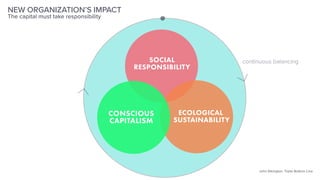
continuous balancingSOCIAL
RESPONSIBILITY
ECOLOGICAL
SUSTAINABILITY
CONSCIOUS
CAPITALISM
NEW ORGANIZATION’S IMPACT
The capital must take responsibility
John Elkington: Triple Bottom Line
“Recognizing that the environment of business
is continously changing is a dangerously
powerful insight.”
BECOME THE LEADER OF CONTINUOUS CHANGE
Systemic Leadership actively integrates and
practices the new patterns of creating change:
Reinventing. Relating. Reflecting. Influence.
The new competencies of leadership:
1. Understanding the connection of systems
2. Experiencing insightful change
3. Recognizing and understanding patterns
4. Expressing emotional maturity
5. Building and making meaning
6. Gaining diverse mindset
7. Being actively engaged
8. Collaborating
9. Achieve stability in the instability
If only one fully understands the dynamics associated
with continous change, they can:
- make better choices to build systemic change
- make conscious decisions to create diverse
professional meaning
- focus to enhance collective leadership
- think about business strategy as collaborative strategy
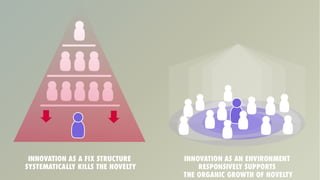
- lead innovation as an open system
- read in the environment of impact
Architects are essentially problem solvers.
They design complex systems in order to solve problems.
Architects are innovative system-disruptors
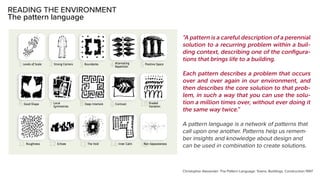
READING THE ENVIRONMENT
The pattern language
“A pattern is a careful description of a perennial
solution to a recurring problem within a buil-
ding context, describing one of the configura-
tions that brings life to a building.
Each pattern describes a problem that occurs
over and over again in our environment, and
then describes the core solution to that prob-
lem, in such a way that you can use the solu-
tion a million times over, without ever doing it
the same way twice.”
A pattern language is a network of patterns that
call upon one another. Patterns help us remem-
ber insights and knowledge about design and
can be used in combination to create solutions.
Christopher Alexander: The Pattern Language: Towns, Buildings, Construction 1997
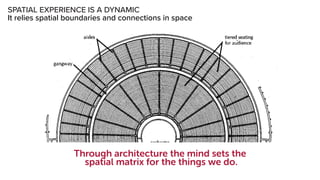
Through architecture the mind sets the
spatial matrix for the things we do.
SPATIAL EXPERIENCE IS A DYNAMIC
It relies spatial boundaries and connections in space
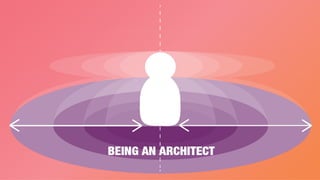
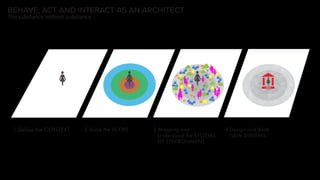
BEHAVE, ACT AND INTERACT AS AN ARCHITECT
The substance without substance
1.Define the CONTEXT 2.Scale the SCOPE 3.Mapping and
Understand the SYSTEMS
OF ENVIRONMENT
4.Design and Build
NEW SYSTEMS
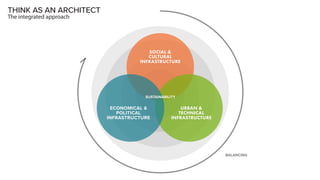
SOCIAL &
CULTURAL
INFRASTRUCTURE
URBAN &
TECHNICAL
INFRASTRUCTURE
ECONOMICAL &
POLITICAL
INFRASTRUCTURE
THINK AS AN ARCHITECT
The integrated approach
SUSTAINABILITY
BALANCING
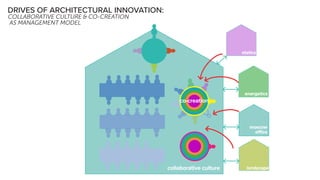
moscow
office
statics
energetics
co-creation
landscapecollaborative culture
DRIVES OF ARCHITECTURAL INNOVATION:
COLLABORATIVE CULTURE & CO-CREATION
AS MANAGEMENT MODEL
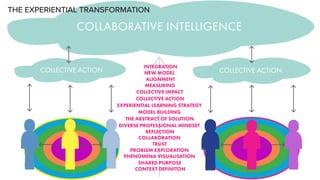
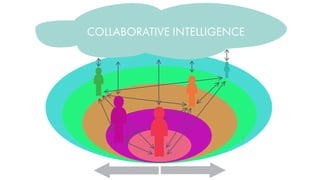
COLLABORATIVE INTELLIGENCE
COLLECTIVE ACTION COLLECTIVE ACTION
SHARED PURPOSE
TRUST
REFLECTION
COLLABORATION
PROBLEM EXPLORATION
THE ABSTRACT OF SOLUTION
EXPERIENTIAL LEARNING STRATEGY
MEASURING
CONTEXT DEFINITON
COLLECTIVE ACTION
ALIGNMENT
INTEGRATION
THE EXPERIENTIAL TRANSFORMATION
PHENOMENA VISUALISATION
DIVERSE PROFESSIONAL MINDSET
NEW MODEL
MODEL BUILDING
COLLECTIVE IMPACT
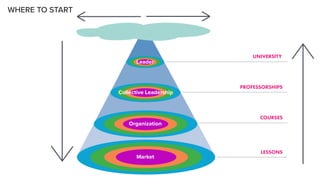
UNIVERSITY
PROFESSORSHIPS
COURSES
LESSONS
Leader
Collective Leadership
Organization
Market
WHERE TO START
“Individual behaviours are deeply embedded in
social and institutional context. We are guided
as much by what others around us say and do, and
by the ‘rules of the game’ as we are personal choice.
We often find ourselves ‘locked in’ to unsustainable
behaviours in spite of our own best intentions.”
Timothy Jackson : Motivating Sustainable Consumption, A Review of Evidence on Consumer Behaviour and Behavioural Change
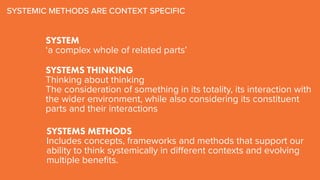
SYSTEM
‘a complex whole of related parts’
SYSTEMS METHODS
Includes concepts, frameworks and methods that support our
ability to think systemically in different contexts and evolving
multiple benefits.
SYSTEMIC METHODS ARE CONTEXT SPECIFIC
SYSTEMS THINKING
Thinking about thinking
The consideration of something in its totality, its interaction with
the wider environment, while also considering its constituent
parts and their interactions
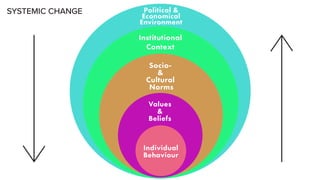
SYSTEMIC CHANGE Political &
Economical
Environment
Individual
Behaviour
Values
&
Beliefs
Socio-
&
Cultural
Norms
Institutional
Context
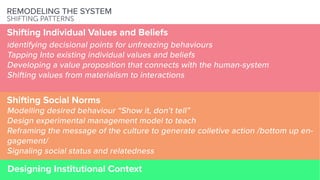
Shifting Social Norms
Modelling desired behaviour “Show it, don’t tell”
Design experimental management model to teach
Reframing the message of the culture to generate colletive action /bottom up en-
gagement/
Signaling social status and relatedness
Designing Institutional Context
REMODELING THE SYSTEM
SHIFTING PATTERNS
Shifting Individual Values and Beliefs
Identifying decisional points for unfreezing behaviours
Tapping Into existing individual values and beliefs
Developing a value proposition that connects with the human-system
Shifting values from materialism to interactions
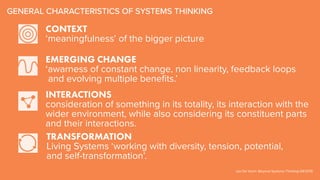
EMERGING CHANGE
‘awarness of constant change, non linearity, feedback loops
and evolving multiple benefits.’
CONTEXT
‘meaningfulness’ of the bigger picture
TRANSFORMATION
Living Systems ‘working with diversity, tension, potential,
and self-transformation’.
GENERAL CHARACTERISTICS OF SYSTEMS THINKING
Jan De Visch: Beyond Systems Thinking DIF2015
INTERACTIONS
consideration of something in its totality, its interaction with the
wider environment, while also considering its constituent parts
and their interactions.
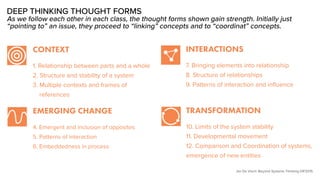
DEEP THINKING THOUGHT FORMS
As we follow each other in each class, the thought forms shown gain strength. Initially just
“pointing to” an issue, they proceed to “linking” concepts and to “coordinat” concepts.
CONTEXT
1. Relationship between parts and a whole
2. Structure and stability of a system
3. Multiple contexts and frames of
references
EMERGING CHANGE
4. Emergent and inclusion of opposites
5. Patterns of interaction
6. Embeddedness in process
INTERACTIONS
7. Bringing elements into relationship
8. Structure of relationships
9. Patterns of interaction and influence
TRANSFORMATION
10. Limits of the system stability
11. Developmental movement
12. Comparison and Coordination of systems,
emergence of new entities
Jan De Visch: Beyond Systems Thinking DIF2015
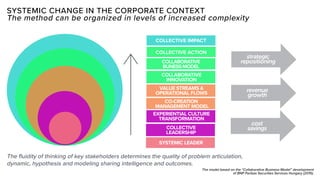
SYSTEMIC CHANGE IN THE CORPORATE CONTEXT
The method can be organized in levels of increased complexity
The fluidity of thinking of key stakeholders determines the quality of problem articulation,
dynamic, hypothesis and modeling sharing intelligence and outcomes.
COLLECTIVE IMPACT
COLLECTIVE ACTION
COLLABORATIVE
BUNESS MODEL
COLLABORATIVE
INNOVATION
VALUE STREAMS &
OPERATIONAL FLOWS
CO-CREATION
MANAGEMENT MODEL
EXPERIENTIAL CULTURE
TRANSFORMATION
COLLECTIVE
LEADERSHIP
SYSTEMIC LEADER
strategic
repositioning
revenue
growth
cost
savings
The model based on the “Collaborative Business Model” development
of BNP Paribas Securities Services Hungary (2015).
COLLABORATIVE INTELLIGENCE
ARE YOU READY?
It’s time to take the first step to change.
Email info@liligulbert.com to tell Lili what you need.
www.systemicleadershipjourney.com
THANK YOU!

The Power of Collaborative Intelligence

  • 1.
    THE POWER OFCOLLABORATIVE INTELLIGENCE The Architectural Systems Thinking in Corporate Transitions Lili Gulbert created for KÜRT Academy www.kurt-akademia.hu 2017.03.30.
  • 2.
    WELCOME TO MYJOURNEY!
  • 3.
    THE SYSTEM OFTALK WHEN WHERE WHO WHY HOW WHAT
  • 4.
  • 5.
    “You can’t buildanything meaningful if you don’t understand the context in depth.” Daniel Libeskind
  • 6.
  • 7.
    “From the pointof view of economics clearly we can make a globalization that works. The challenge is our politics. A neccessary condition I think to make that politics work is reform of our systems of global economic governance. Democracy tempered the market economy. ” Joseph Stiglitz
  • 8.
    Digitalism created thesuper-connected democratic environment, in what the experimental new-economical models could evolve which started to crack the world’s outdated economical structures.
  • 9.
    What are thedemocratic neweconomy fenomena’s patterns: - transparency - openness - collaboration TRUST
  • 10.
    Where we arenow: “in-between” isolation separation localisation capitalism openness connectivism globalization concious capitalism old paradigm new paradigm balancing
  • 11.
    The ongoing globaltransition in our world: -transforms the economical, political and social systems - is unpredictable - is a complex progress - challenges our deep assumptions - breaks our trust - knocks down structures and blurs the linear boundaries - creates complex phenomena which include the possibilities of the future
  • 12.
    Uncertainity drives usto step out from our outdated belief systems and explore, understand and modell these possibilities through experiencing, and the joint evolution of these possibilities is going to form future’s new structures. A part of this in-between state is to explore through deep understanding who are the real architects of the meanings of new phenomena, who restructure our world.
  • 13.
    Challenging your deepassumptions will surprise you!
  • 14.
    A paradigm shiftis happening in organizations too. Their traditional operation is increasingly being challenged by the connectivist paradigm.
  • 15.
    Complexity and evolutionplay a foundational role in the new economy.
  • 16.
    Viewing the economyand organizations as a complex evolving system has an impact on how we work with change.
  • 17.
    Explore, Design andBuild Organizations as COMPLEX ADAPTIVE SYSTEMS Roy J. Eidelson: Complex Adaptive Systems in the Behavioral and Social Sciences, Review of General Psychology 1997
  • 18.
    COMPLEX conveys many attributes,the clearest of which may be the nonlinear nature of the world around us. According to complexity theory, small events can have dramatic effect, and seemingly large events can have no discernible impact at all. Roy J. Eidelson: Complex Adaptive Systems in the Behavioral and Social Sciences, Review of General Psychology 1997
  • 19.
    ADAPTIVE reflects the perspective’sfocus on the change and evolution that characterize individuals, groups, and societies. They’re repeatedly disrupted by both internal phenomena and external influences. Roy J. Eidelson: Complex Adaptive Systems in the Behavioral and Social Sciences, Review of General Psychology 1997
  • 20.
    SYSTEM emphasizes interconnections. It canbe readily apparent or shrouded and concealed. As a result of the dynamical interactions among the component parts of the system, collective behavior emerges and often catches people by suprise- no matter how well we understand the individual elements separately. Roy J. Eidelson: Complex Adaptive Systems in the Behavioral and Social Sciences, Review of General Psychology 1997
  • 21.
    The transition ofcomplex system is an experiential co-evolution of the living human-systems, in which everybody is a leader.
  • 22.
    “Capitalism needs toevolve, and that requires different types of leaders from what we’ve had before. Not better leaders, because every period has its own challenges, but leaders who are able to cope with today’s challenges.” Paul Polman CEO, Unilever
  • 23.
    continuous balancingSOCIAL RESPONSIBILITY ECOLOGICAL SUSTAINABILITY CONSCIOUS CAPITALISM NEW ORGANIZATION’SIMPACT The capital must take responsibility John Elkington: Triple Bottom Line
  • 24.
    “Recognizing that theenvironment of business is continously changing is a dangerously powerful insight.” BECOME THE LEADER OF CONTINUOUS CHANGE
  • 25.
    Systemic Leadership activelyintegrates and practices the new patterns of creating change: Reinventing. Relating. Reflecting. Influence.
  • 26.
    The new competenciesof leadership: 1. Understanding the connection of systems 2. Experiencing insightful change 3. Recognizing and understanding patterns 4. Expressing emotional maturity 5. Building and making meaning 6. Gaining diverse mindset 7. Being actively engaged 8. Collaborating 9. Achieve stability in the instability
  • 27.
    If only onefully understands the dynamics associated with continous change, they can: - make better choices to build systemic change - make conscious decisions to create diverse professional meaning - focus to enhance collective leadership - think about business strategy as collaborative strategy - lead innovation as an open system - read in the environment of impact
  • 29.
    Architects are essentiallyproblem solvers. They design complex systems in order to solve problems. Architects are innovative system-disruptors
  • 30.
    READING THE ENVIRONMENT Thepattern language “A pattern is a careful description of a perennial solution to a recurring problem within a buil- ding context, describing one of the configura- tions that brings life to a building. Each pattern describes a problem that occurs over and over again in our environment, and then describes the core solution to that prob- lem, in such a way that you can use the solu- tion a million times over, without ever doing it the same way twice.” A pattern language is a network of patterns that call upon one another. Patterns help us remem- ber insights and knowledge about design and can be used in combination to create solutions. Christopher Alexander: The Pattern Language: Towns, Buildings, Construction 1997
  • 31.
    Through architecture themind sets the spatial matrix for the things we do. SPATIAL EXPERIENCE IS A DYNAMIC It relies spatial boundaries and connections in space
  • 32.
    BEHAVE, ACT ANDINTERACT AS AN ARCHITECT The substance without substance 1.Define the CONTEXT 2.Scale the SCOPE 3.Mapping and Understand the SYSTEMS OF ENVIRONMENT 4.Design and Build NEW SYSTEMS
  • 33.
    SOCIAL & CULTURAL INFRASTRUCTURE URBAN & TECHNICAL INFRASTRUCTURE ECONOMICAL& POLITICAL INFRASTRUCTURE THINK AS AN ARCHITECT The integrated approach SUSTAINABILITY BALANCING
  • 35.
    moscow office statics energetics co-creation landscapecollaborative culture DRIVES OFARCHITECTURAL INNOVATION: COLLABORATIVE CULTURE & CO-CREATION AS MANAGEMENT MODEL
  • 36.
    COLLABORATIVE INTELLIGENCE COLLECTIVE ACTIONCOLLECTIVE ACTION SHARED PURPOSE TRUST REFLECTION COLLABORATION PROBLEM EXPLORATION THE ABSTRACT OF SOLUTION EXPERIENTIAL LEARNING STRATEGY MEASURING CONTEXT DEFINITON COLLECTIVE ACTION ALIGNMENT INTEGRATION THE EXPERIENTIAL TRANSFORMATION PHENOMENA VISUALISATION DIVERSE PROFESSIONAL MINDSET NEW MODEL MODEL BUILDING COLLECTIVE IMPACT
  • 37.
  • 38.
    “Individual behaviours aredeeply embedded in social and institutional context. We are guided as much by what others around us say and do, and by the ‘rules of the game’ as we are personal choice. We often find ourselves ‘locked in’ to unsustainable behaviours in spite of our own best intentions.” Timothy Jackson : Motivating Sustainable Consumption, A Review of Evidence on Consumer Behaviour and Behavioural Change
  • 39.
    SYSTEM ‘a complex wholeof related parts’ SYSTEMS METHODS Includes concepts, frameworks and methods that support our ability to think systemically in different contexts and evolving multiple benefits. SYSTEMIC METHODS ARE CONTEXT SPECIFIC SYSTEMS THINKING Thinking about thinking The consideration of something in its totality, its interaction with the wider environment, while also considering its constituent parts and their interactions
  • 40.
    SYSTEMIC CHANGE Political& Economical Environment Individual Behaviour Values & Beliefs Socio- & Cultural Norms Institutional Context
  • 41.
    Shifting Social Norms Modellingdesired behaviour “Show it, don’t tell” Design experimental management model to teach Reframing the message of the culture to generate colletive action /bottom up en- gagement/ Signaling social status and relatedness Designing Institutional Context REMODELING THE SYSTEM SHIFTING PATTERNS Shifting Individual Values and Beliefs Identifying decisional points for unfreezing behaviours Tapping Into existing individual values and beliefs Developing a value proposition that connects with the human-system Shifting values from materialism to interactions
  • 42.
    EMERGING CHANGE ‘awarness ofconstant change, non linearity, feedback loops and evolving multiple benefits.’ CONTEXT ‘meaningfulness’ of the bigger picture TRANSFORMATION Living Systems ‘working with diversity, tension, potential, and self-transformation’. GENERAL CHARACTERISTICS OF SYSTEMS THINKING Jan De Visch: Beyond Systems Thinking DIF2015 INTERACTIONS consideration of something in its totality, its interaction with the wider environment, while also considering its constituent parts and their interactions.
  • 43.
    DEEP THINKING THOUGHTFORMS As we follow each other in each class, the thought forms shown gain strength. Initially just “pointing to” an issue, they proceed to “linking” concepts and to “coordinat” concepts. CONTEXT 1. Relationship between parts and a whole 2. Structure and stability of a system 3. Multiple contexts and frames of references EMERGING CHANGE 4. Emergent and inclusion of opposites 5. Patterns of interaction 6. Embeddedness in process INTERACTIONS 7. Bringing elements into relationship 8. Structure of relationships 9. Patterns of interaction and influence TRANSFORMATION 10. Limits of the system stability 11. Developmental movement 12. Comparison and Coordination of systems, emergence of new entities Jan De Visch: Beyond Systems Thinking DIF2015
  • 44.
    SYSTEMIC CHANGE INTHE CORPORATE CONTEXT The method can be organized in levels of increased complexity The fluidity of thinking of key stakeholders determines the quality of problem articulation, dynamic, hypothesis and modeling sharing intelligence and outcomes. COLLECTIVE IMPACT COLLECTIVE ACTION COLLABORATIVE BUNESS MODEL COLLABORATIVE INNOVATION VALUE STREAMS & OPERATIONAL FLOWS CO-CREATION MANAGEMENT MODEL EXPERIENTIAL CULTURE TRANSFORMATION COLLECTIVE LEADERSHIP SYSTEMIC LEADER strategic repositioning revenue growth cost savings The model based on the “Collaborative Business Model” development of BNP Paribas Securities Services Hungary (2015).
  • 45.
  • 46.
    ARE YOU READY? It’stime to take the first step to change. Email info@liligulbert.com to tell Lili what you need. www.systemicleadershipjourney.com THANK YOU!