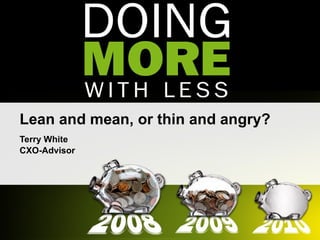
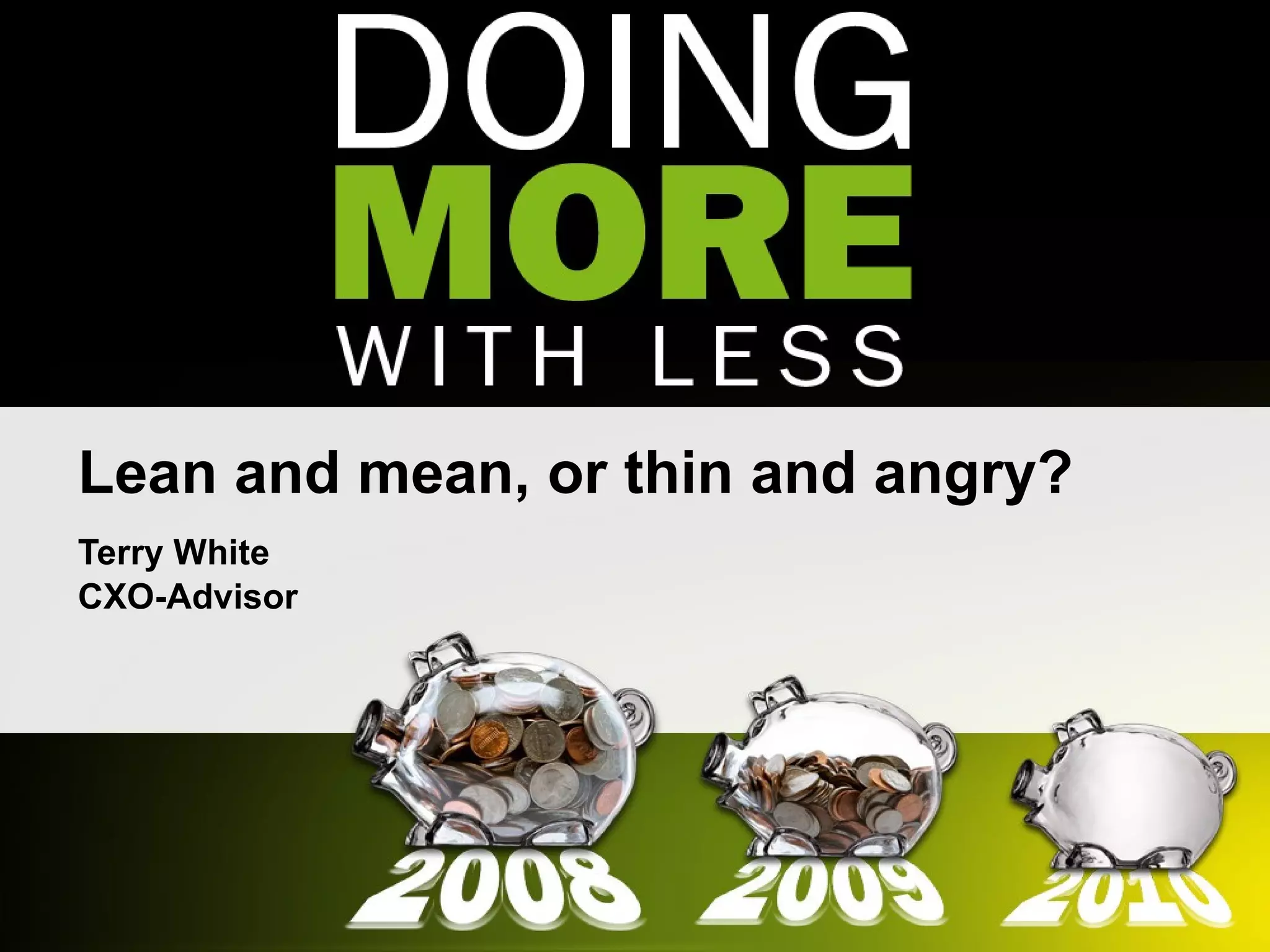
Lean and mean, or thin and angry? Terry White CXO-Advisor
Agenda Lean and mean, or thin and angry? The dilemma of do more with less and the unintended consequences Decide what few things you’ll do well and fund them fully Stop doing everything badly – it leads to random failure Thoughtful cost management There’s no such thing as a cost centre Cut the outputs not the inputs
The dilemma of do more with less Do people expect more of IT than it has resources to deliver? Rob Peter to pay Paul Everything comes in late You are seen as unreliable You don’t sleep well Cut corners on quality and take unadvisable risks Reputation for shoddy work You don’t sleep well Demand more from your staff Your best people leave You don’t sleep well Divert from training, innovation and process improvements Skills, infrastructure and products no longer competitive You don’t sleep well Mid-year unfunded mandate comes along Take it out of your budget You don’t sleep well
Doing more with less If you have a reasonably tight organisation... People can’t do more with less They do less with less Less input Less output Less quality Less training Less time Less judgement and common sense
Doing more with less Cut by 10% across the board Who thinks this can work? Putting the judgement of “what not to do” on individuals –  they make better decisions in isolation? Reconfigures priorities –  Strategies go out the window? Assumes  everything  is equal (ROI, Effort, Input) –  This is communism without the central control – anarchy? Denies dependencies –  No dependencies – no value input? Failure becomes random
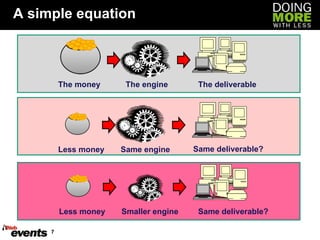
A simple equation The money The engine The deliverable Less money Same engine Same deliverable? Less money Smaller engine Same deliverable?
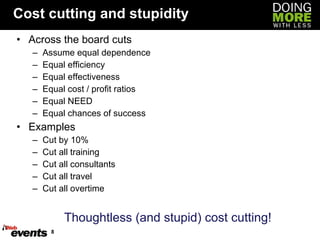
Cost cutting and stupidity Across the board cuts Assume equal dependence Equal efficiency Equal effectiveness Equal cost / profit ratios Equal NEED Equal chances of success Examples Cut by 10% Cut all training Cut all consultants Cut all travel Cut all overtime Thoughtless (and stupid) cost cutting!
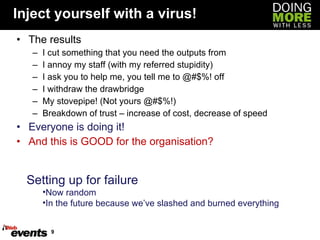
Inject yourself with a virus! The results I cut something that you need the outputs from I annoy my staff (with my referred stupidity) I ask you to help me, you tell me to @#$%! off I withdraw the drawbridge My stovepipe! (Not yours @#$%!) Breakdown of trust – increase of cost, decrease of speed Everyone is doing it! And this is GOOD for the organisation? Setting up for failure Now random In the future because we’ve slashed and burned everything
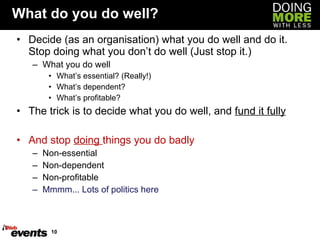
What do you do well? Decide (as an organisation) what you do well and do it. Stop doing what you don’t do well (Just stop it.) What you do well What’s essential? (Really!) What’s dependent? What’s profitable? The trick is to decide what you do well, and  fund it fully And stop  doing  things you do badly Non-essential Non-dependent Non-profitable Mmmm... Lots of politics here
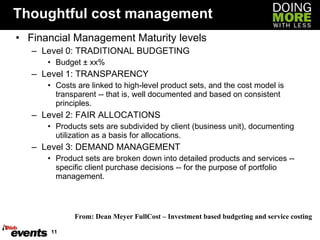
Thoughtful cost management Financial Management Maturity levels Level 0: TRADITIONAL BUDGETING Budget ± xx% Level 1: TRANSPARENCY Costs are linked to high-level product sets, and the cost model is transparent -- that is, well documented and based on consistent principles.  Level 2: FAIR ALLOCATIONS Products sets are subdivided by client (business unit), documenting utilization as a basis for allocations.  Level 3: DEMAND MANAGEMENT Product sets are broken down into detailed products and services -- specific client purchase decisions -- for the purpose of portfolio management.  From: Dean Meyer FullCost – Investment based budgeting and service costing
Thoughtful cost management  ...cont. Level 4: ACCURACY All indirect costs are amortized to just the right products and services, and accuracy is improved.  Level 5: RATES Costs are portrayed in total for products and services, and unit prices (rates) are extracted from the same data.  From: Dean Meyer FullCost – Investment based budgeting and service costing
What technologies? Know what things cost Service level costing, chargeback, and GL Continuous improvement Process, technology, trends, risk Outsource? Caveats. The usual suspects Virtualisation Open Source SAAS Optimisation Automation Standardisation Now is the time to turn the screws – but be prepared to be screwed back
No such thing as a cost centre The IT budget is not there to cover IT costs The budget is there for IT to supply existing products and services and fund new products and services View your budget as a pre-paid account There are xxx funds available to specific business units Business draws down on their pre-paid account Business decides what to use and when to use it If business demands more than you can supply “ How do you plan to pay for it? “ Cut costs” What do you intend not to buy from us?
Cut the outputs not the inputs In summary People do less with less Across the board cuts set the organisation up for random failure Decide what you do well and do it. Stop doing what you don’t do well Exercise  thoughtful  cost management Know what “services” cost and where they contribute Your budget is a pre-paid account [email_address]
Thank You Questions? terryw@ cxo-advisor.co.za

Terry White

  • 1.
    Lean and mean,or thin and angry? Terry White CXO-Advisor
  • 2.
    Agenda Lean andmean, or thin and angry? The dilemma of do more with less and the unintended consequences Decide what few things you’ll do well and fund them fully Stop doing everything badly – it leads to random failure Thoughtful cost management There’s no such thing as a cost centre Cut the outputs not the inputs
  • 3.
    Agenda Lean andmean, or thin and angry? The dilemma of do more with less and the unintended consequences Decide what few things you’ll do well and fund them fully Stop doing everything badly – it leads to random failure Thoughtful cost management There’s no such thing as a cost centre Cut the outputs not the inputs
  • 4.
    The dilemma ofdo more with less Do people expect more of IT than it has resources to deliver? Rob Peter to pay Paul Everything comes in late You are seen as unreliable You don’t sleep well Cut corners on quality and take unadvisable risks Reputation for shoddy work You don’t sleep well Demand more from your staff Your best people leave You don’t sleep well Divert from training, innovation and process improvements Skills, infrastructure and products no longer competitive You don’t sleep well Mid-year unfunded mandate comes along Take it out of your budget You don’t sleep well
  • 5.
    Doing more withless If you have a reasonably tight organisation... People can’t do more with less They do less with less Less input Less output Less quality Less training Less time Less judgement and common sense
  • 6.
    Doing more withless Cut by 10% across the board Who thinks this can work? Putting the judgement of “what not to do” on individuals – they make better decisions in isolation? Reconfigures priorities – Strategies go out the window? Assumes everything is equal (ROI, Effort, Input) – This is communism without the central control – anarchy? Denies dependencies – No dependencies – no value input? Failure becomes random
  • 7.
    A simple equationThe money The engine The deliverable Less money Same engine Same deliverable? Less money Smaller engine Same deliverable?
  • 8.
    Cost cutting andstupidity Across the board cuts Assume equal dependence Equal efficiency Equal effectiveness Equal cost / profit ratios Equal NEED Equal chances of success Examples Cut by 10% Cut all training Cut all consultants Cut all travel Cut all overtime Thoughtless (and stupid) cost cutting!
  • 9.
    Inject yourself witha virus! The results I cut something that you need the outputs from I annoy my staff (with my referred stupidity) I ask you to help me, you tell me to @#$%! off I withdraw the drawbridge My stovepipe! (Not yours @#$%!) Breakdown of trust – increase of cost, decrease of speed Everyone is doing it! And this is GOOD for the organisation? Setting up for failure Now random In the future because we’ve slashed and burned everything
  • 10.
    What do youdo well? Decide (as an organisation) what you do well and do it. Stop doing what you don’t do well (Just stop it.) What you do well What’s essential? (Really!) What’s dependent? What’s profitable? The trick is to decide what you do well, and fund it fully And stop doing things you do badly Non-essential Non-dependent Non-profitable Mmmm... Lots of politics here
  • 11.
    Thoughtful cost managementFinancial Management Maturity levels Level 0: TRADITIONAL BUDGETING Budget ± xx% Level 1: TRANSPARENCY Costs are linked to high-level product sets, and the cost model is transparent -- that is, well documented and based on consistent principles. Level 2: FAIR ALLOCATIONS Products sets are subdivided by client (business unit), documenting utilization as a basis for allocations. Level 3: DEMAND MANAGEMENT Product sets are broken down into detailed products and services -- specific client purchase decisions -- for the purpose of portfolio management. From: Dean Meyer FullCost – Investment based budgeting and service costing
  • 12.
    Thoughtful cost management ...cont. Level 4: ACCURACY All indirect costs are amortized to just the right products and services, and accuracy is improved. Level 5: RATES Costs are portrayed in total for products and services, and unit prices (rates) are extracted from the same data. From: Dean Meyer FullCost – Investment based budgeting and service costing
  • 13.
    What technologies? Knowwhat things cost Service level costing, chargeback, and GL Continuous improvement Process, technology, trends, risk Outsource? Caveats. The usual suspects Virtualisation Open Source SAAS Optimisation Automation Standardisation Now is the time to turn the screws – but be prepared to be screwed back
  • 14.
    No such thingas a cost centre The IT budget is not there to cover IT costs The budget is there for IT to supply existing products and services and fund new products and services View your budget as a pre-paid account There are xxx funds available to specific business units Business draws down on their pre-paid account Business decides what to use and when to use it If business demands more than you can supply “ How do you plan to pay for it? “ Cut costs” What do you intend not to buy from us?
  • 15.
    Cut the outputsnot the inputs In summary People do less with less Across the board cuts set the organisation up for random failure Decide what you do well and do it. Stop doing what you don’t do well Exercise thoughtful cost management Know what “services” cost and where they contribute Your budget is a pre-paid account [email_address]
  • 16.
    Thank You Questions?terryw@ cxo-advisor.co.za