Holignment™
                                                                              Organisation Maturity Model
                                                                               Diagnosis – Index - Report


                                      Holignment Organisation Maturity Indices
                                      The complexity demanded of the modern organizations is way beyond any current model of
                                      organization development. A complete re-think of the approach to learning in human systems was
There are 13 Dynamics and 15          called for and the research outcomes have delivered a new progressive approach
phases of development.
However, most organizations will
not be systemically functioning
                                      The basic premise is that if an organization is a human system, its model of learning must reflect
below Learning Levels, so             human learning patterns and be valid for all human systems whether it is an individual, team, or
developmental programs will not       organisation
need more than 6 phases to
achieve top functioning.              The model was devised by re-examining theories of learning from different strands and eras of the
However, there are always holes       behavioural sciences into discovering that they could be organized into hierarchical levels of learning
that need to be filled and this       complexity and then measuring the activities or dimensions of an organization against these levels.
approach graphically shows
where these are, and the effects
                                      Insofar as these dimensions are sources of discrete learning, they are called Dynamics. The result is a
that they have on the entirety of
the human system, but thankfully
                                      matrix with learning stages increasing upwards in increasing complexity and the Dynamics moving
also show in a human-friendly         outwards in increasing complexity from the most basic which is the use of physical resources to the
way how to grow out of those          most complex integrating macro issues from political governance to global citizenship, environmental
situations in a systemically          footprint, etc.
sustainable way.
                                       The model offers a diagnostic framework where these dimensions can be measured for their level of
                                      functioning and it provides a developmental rationale whereby interventions are introduced at the
 Sustainability is built into the     prevailing level so that they achieve traction. They are then guided from level to level so that the
model so that as in the case in
                                      whole system grows together resulting in systemically sustainable growth, while the higher levels
relation to loss of physiological
function, in the event of setback,
                                      define responsiveness, innovation and ultimately leadership. The model will take any dimension
the degradation is simply to the      through phased development from the lowest level where it is a drain on resources to the highest
stage immediately below the           where it is re-enforcing systemic leadership.
stage where the setback occurred.
This is called graceful degradation
and is found in all natural
systems. On the other hand,
organizations or any human
system that has not functionally
grown in an integrative fashion
will degrade catastrophically.


               Document Name & Version 2-1                       Holignment©                                       Date Oct 2011
Holignment™
                                                                                    Organisation Maturity Model
                                                                                     Diagnosis – Index - Report


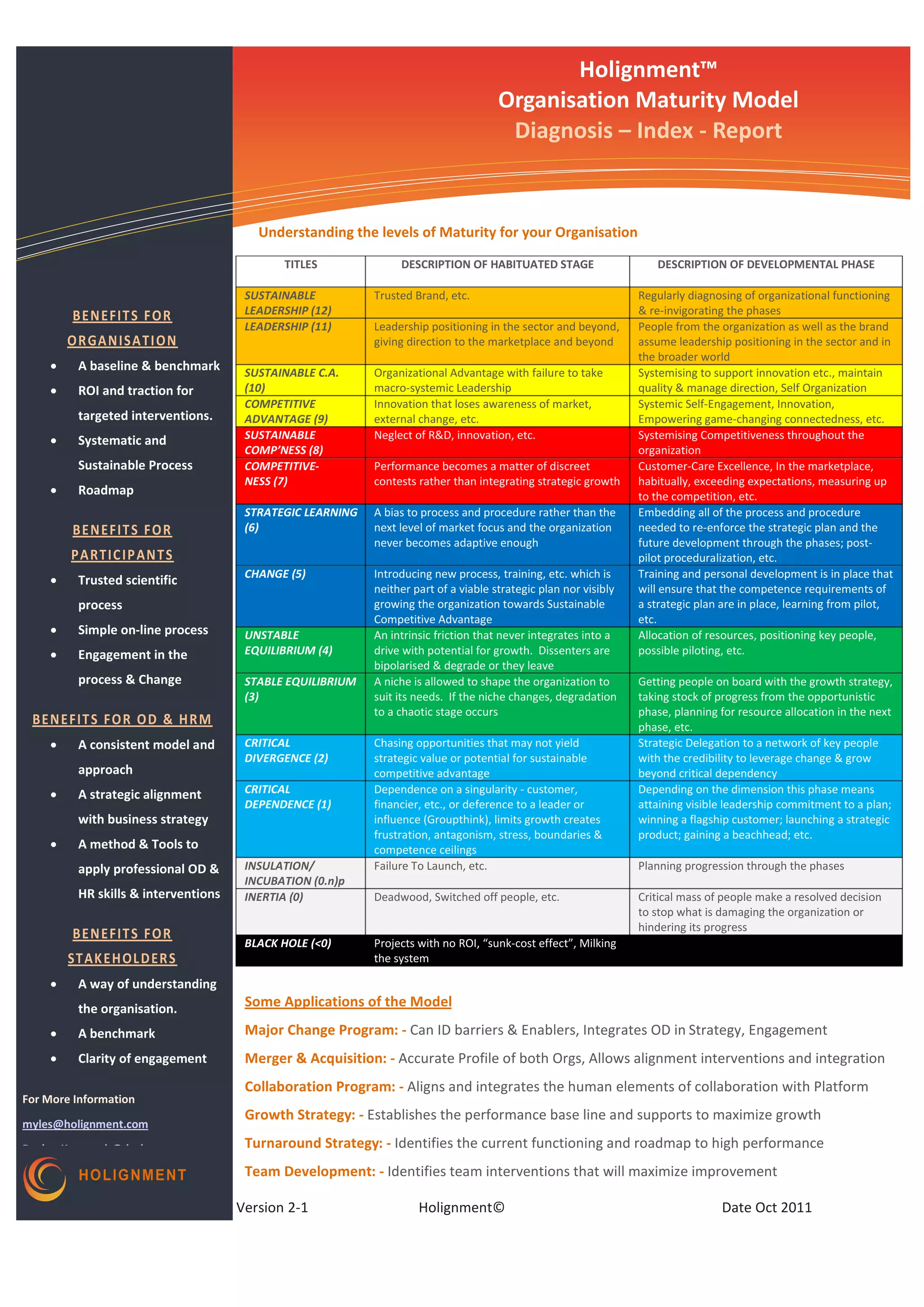
                                       Understanding the levels of Maturity for your Organisation

                                           TITLES              DESCRIPTION OF HABITUATED STAGE                     DESCRIPTION OF DEVELOPMENTAL PHASE

                                     SUSTAINABLE          Trusted Brand, etc.                                   Regularly diagnosing of organizational functioning
                                     LEADERSHIP (12)                                                            & re-invigorating the phases
                                     LEADERSHIP (11)      Leadership positioning in the sector and beyond,      People from the organization as well as the brand
                                                          giving direction to the marketplace and beyond        assume leadership positioning in the sector and in
                                                                                                                the broader world
        A baseline & benchmark      SUSTAINABLE C.A.     Organizational Advantage with failure to take         Systemising to support innovation etc., maintain
        ROI and traction for        (10)                 macro-systemic Leadership                             quality & manage direction, Self Organization
                                     COMPETITIVE          Innovation that loses awareness of market,            Systemic Self-Engagement, Innovation,
         targeted interventions.     ADVANTAGE (9)        external change, etc.                                 Empowering game-changing connectedness, etc.
        Systematic and              SUSTAINABLE          Neglect of R&D, innovation, etc.                      Systemising Competitiveness throughout the
                                     COMP’NESS (8)                                                              organization
         Sustainable Process         COMPETITIVE-         Performance becomes a matter of discreet              Customer-Care Excellence, In the marketplace,
                                     NESS (7)             contests rather than integrating strategic growth     habitually, exceeding expectations, measuring up
        Roadmap                                                                                                to the competition, etc.
                                     STRATEGIC LEARNING   A bias to process and procedure rather than the       Embedding all of the process and procedure
                                     (6)                  next level of market focus and the organization       needed to re-enforce the strategic plan and the
                                                          never becomes adaptive enough                         future development through the phases; post-
                                                                                                                pilot proceduralization, etc.
                                     CHANGE (5)           Introducing new process, training, etc. which is      Training and personal development is in place that
        Trusted scientific
                                                          neither part of a viable strategic plan nor visibly   will ensure that the competence requirements of
         process                                          growing the organization towards Sustainable          a strategic plan are in place, learning from pilot,
                                                          Competitive Advantage                                 etc.
        Simple on-line process      UNSTABLE             An intrinsic friction that never integrates into a    Allocation of resources, positioning key people,
        Engagement in the           EQUILIBRIUM (4)      drive with potential for growth. Dissenters are       possible piloting, etc.
                                                          bipolarised & degrade or they leave
         process & Change            STABLE EQUILIBRIUM   A niche is allowed to shape the organization to       Getting people on board with the growth strategy,
                                     (3)                  suit its needs. If the niche changes, degradation     taking stock of progress from the opportunistic
                                                          to a chaotic stage occurs                             phase, planning for resource allocation in the next
                                                                                                                phase, etc.
        A consistent model and      CRITICAL             Chasing opportunities that may not yield              Strategic Delegation to a network of key people
                                     DIVERGENCE (2)       strategic value or potential for sustainable          with the credibility to leverage change & grow
         approach                                         competitive advantage                                 beyond critical dependency
        A strategic alignment       CRITICAL             Dependence on a singularity - customer,               Depending on the dimension this phase means
                                     DEPENDENCE (1)       financier, etc., or deference to a leader or          attaining visible leadership commitment to a plan;
         with business strategy                           influence (Groupthink), limits growth creates         winning a flagship customer; launching a strategic
                                                          frustration, antagonism, stress, boundaries &         product; gaining a beachhead; etc.
        A method & Tools to                              competence ceilings
         apply professional OD &     INSULATION/          Failure To Launch, etc.                               Planning progression through the phases
                                     INCUBATION (0.n)p
         HR skills & interventions   INERTIA (0)          Deadwood, Switched off people, etc.                   Critical mass of people make a resolved decision
                                                                                                                to stop what is damaging the organization or
                                                                                                                hindering its progress
                                     BLACK HOLE (<0)      Projects with no ROI, “sunk-cost effect”, Milking
                                                          the system

        A way of understanding
         the organisation.           Some Applications of the Model

        A benchmark                 Major Change Program: - Can ID barriers & Enablers, Integrates OD in Strategy, Engagement
        Clarity of engagement       Merger & Acquisition: - Accurate Profile of both Orgs, Allows alignment interventions and integration
                                     Collaboration Program: - Aligns and integrates the human elements of collaboration with Platform
For More Information
                                     Growth Strategy: - Establishes the performance base line and supports to maximize growth
myles@holignment.com
Declan.Kavanagh@deckav.com           Turnaround Strategy: - Identifies the current functioning and roadmap to high performance
                                     Team Development: - Identifies team interventions that will maximize improvement

               Document Name & Version 2-1                         Holignment©                                                  Date Oct 2011

Homi diagnosis & roadmap

  • 1.
    Holignment™ Organisation Maturity Model Diagnosis – Index - Report Holignment Organisation Maturity Indices The complexity demanded of the modern organizations is way beyond any current model of organization development. A complete re-think of the approach to learning in human systems was There are 13 Dynamics and 15 called for and the research outcomes have delivered a new progressive approach phases of development. However, most organizations will not be systemically functioning The basic premise is that if an organization is a human system, its model of learning must reflect below Learning Levels, so human learning patterns and be valid for all human systems whether it is an individual, team, or developmental programs will not organisation need more than 6 phases to achieve top functioning. The model was devised by re-examining theories of learning from different strands and eras of the However, there are always holes behavioural sciences into discovering that they could be organized into hierarchical levels of learning that need to be filled and this complexity and then measuring the activities or dimensions of an organization against these levels. approach graphically shows where these are, and the effects Insofar as these dimensions are sources of discrete learning, they are called Dynamics. The result is a that they have on the entirety of the human system, but thankfully matrix with learning stages increasing upwards in increasing complexity and the Dynamics moving also show in a human-friendly outwards in increasing complexity from the most basic which is the use of physical resources to the way how to grow out of those most complex integrating macro issues from political governance to global citizenship, environmental situations in a systemically footprint, etc. sustainable way. The model offers a diagnostic framework where these dimensions can be measured for their level of functioning and it provides a developmental rationale whereby interventions are introduced at the Sustainability is built into the prevailing level so that they achieve traction. They are then guided from level to level so that the model so that as in the case in whole system grows together resulting in systemically sustainable growth, while the higher levels relation to loss of physiological function, in the event of setback, define responsiveness, innovation and ultimately leadership. The model will take any dimension the degradation is simply to the through phased development from the lowest level where it is a drain on resources to the highest stage immediately below the where it is re-enforcing systemic leadership. stage where the setback occurred. This is called graceful degradation and is found in all natural systems. On the other hand, organizations or any human system that has not functionally grown in an integrative fashion will degrade catastrophically. Document Name & Version 2-1 Holignment© Date Oct 2011
  • 2.
    Holignment™ Organisation Maturity Model Diagnosis – Index - Report Understanding the levels of Maturity for your Organisation TITLES DESCRIPTION OF HABITUATED STAGE DESCRIPTION OF DEVELOPMENTAL PHASE SUSTAINABLE Trusted Brand, etc. Regularly diagnosing of organizational functioning LEADERSHIP (12) & re-invigorating the phases LEADERSHIP (11) Leadership positioning in the sector and beyond, People from the organization as well as the brand giving direction to the marketplace and beyond assume leadership positioning in the sector and in the broader world  A baseline & benchmark SUSTAINABLE C.A. Organizational Advantage with failure to take Systemising to support innovation etc., maintain  ROI and traction for (10) macro-systemic Leadership quality & manage direction, Self Organization COMPETITIVE Innovation that loses awareness of market, Systemic Self-Engagement, Innovation, targeted interventions. ADVANTAGE (9) external change, etc. Empowering game-changing connectedness, etc.  Systematic and SUSTAINABLE Neglect of R&D, innovation, etc. Systemising Competitiveness throughout the COMP’NESS (8) organization Sustainable Process COMPETITIVE- Performance becomes a matter of discreet Customer-Care Excellence, In the marketplace, NESS (7) contests rather than integrating strategic growth habitually, exceeding expectations, measuring up  Roadmap to the competition, etc. STRATEGIC LEARNING A bias to process and procedure rather than the Embedding all of the process and procedure (6) next level of market focus and the organization needed to re-enforce the strategic plan and the never becomes adaptive enough future development through the phases; post- pilot proceduralization, etc. CHANGE (5) Introducing new process, training, etc. which is Training and personal development is in place that  Trusted scientific neither part of a viable strategic plan nor visibly will ensure that the competence requirements of process growing the organization towards Sustainable a strategic plan are in place, learning from pilot, Competitive Advantage etc.  Simple on-line process UNSTABLE An intrinsic friction that never integrates into a Allocation of resources, positioning key people,  Engagement in the EQUILIBRIUM (4) drive with potential for growth. Dissenters are possible piloting, etc. bipolarised & degrade or they leave process & Change STABLE EQUILIBRIUM A niche is allowed to shape the organization to Getting people on board with the growth strategy, (3) suit its needs. If the niche changes, degradation taking stock of progress from the opportunistic to a chaotic stage occurs phase, planning for resource allocation in the next phase, etc.  A consistent model and CRITICAL Chasing opportunities that may not yield Strategic Delegation to a network of key people DIVERGENCE (2) strategic value or potential for sustainable with the credibility to leverage change & grow approach competitive advantage beyond critical dependency  A strategic alignment CRITICAL Dependence on a singularity - customer, Depending on the dimension this phase means DEPENDENCE (1) financier, etc., or deference to a leader or attaining visible leadership commitment to a plan; with business strategy influence (Groupthink), limits growth creates winning a flagship customer; launching a strategic frustration, antagonism, stress, boundaries & product; gaining a beachhead; etc.  A method & Tools to competence ceilings apply professional OD & INSULATION/ Failure To Launch, etc. Planning progression through the phases INCUBATION (0.n)p HR skills & interventions INERTIA (0) Deadwood, Switched off people, etc. Critical mass of people make a resolved decision to stop what is damaging the organization or hindering its progress BLACK HOLE (<0) Projects with no ROI, “sunk-cost effect”, Milking the system  A way of understanding the organisation. Some Applications of the Model  A benchmark Major Change Program: - Can ID barriers & Enablers, Integrates OD in Strategy, Engagement  Clarity of engagement Merger & Acquisition: - Accurate Profile of both Orgs, Allows alignment interventions and integration Collaboration Program: - Aligns and integrates the human elements of collaboration with Platform For More Information Growth Strategy: - Establishes the performance base line and supports to maximize growth myles@holignment.com Declan.Kavanagh@deckav.com Turnaround Strategy: - Identifies the current functioning and roadmap to high performance Team Development: - Identifies team interventions that will maximize improvement Document Name & Version 2-1 Holignment© Date Oct 2011