ACUTE STEMI vs PERICARDITIS
ECG DILEMMA
Dr. Syed Haseeb Raza
FCPS Cardiology, Clinical Cardiac Electrophysiologist
Author of ECG Book and Researcher
National Institute of Cardiovascular Diseases, Karachi, Pakistan.
• .
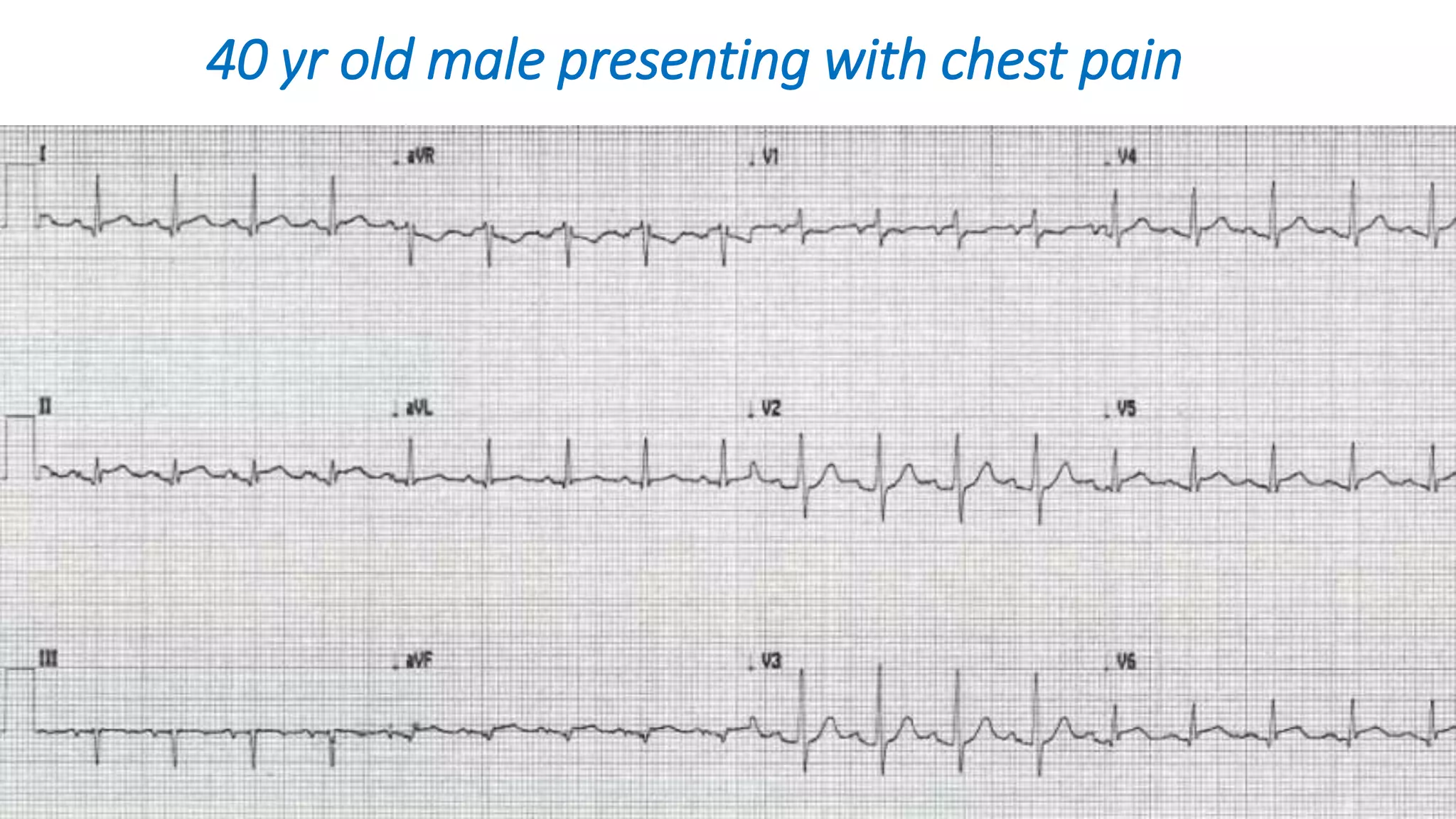
40 yr old male presenting with chest pain
What is your ECG
diagnosis?
•.
Answer will be disclosed at the end of presentation
Classical Teachings about Pericarditis
• Diffuse ST elevation in all leads
• ST elevation is concave upwards
• PR segment depression with PR elevation in lead aVR
..
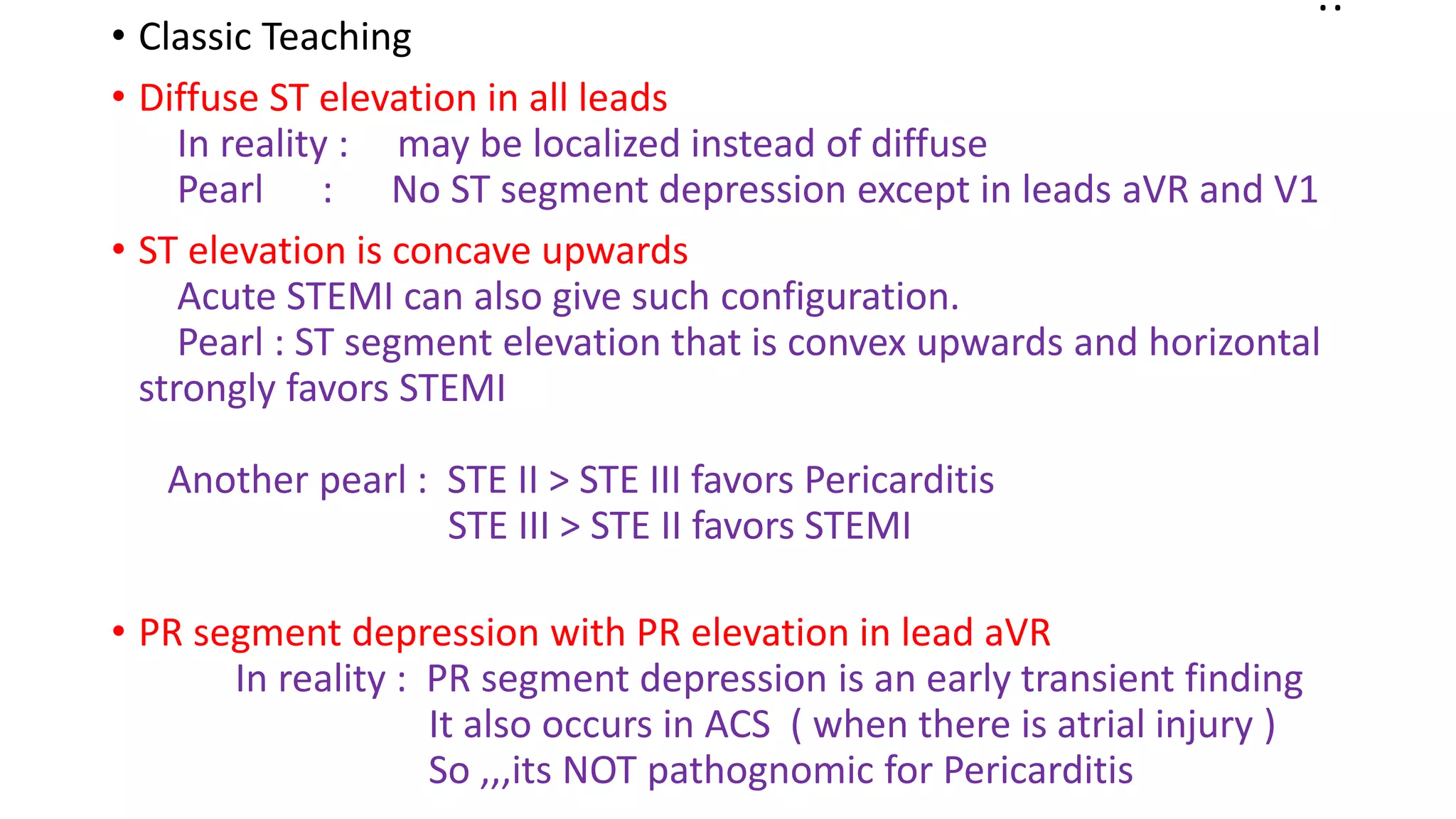
• Classic Teaching
• Diffuse ST elevation in all leads
In reality : may be localized instead of diffuse
Pearl : No ST segment depression except in leads aVR and V1
• ST elevation is concave upwards
Acute STEMI can also give such configuration.
Pearl : ST segment elevation that is convex upwards and horizontal
strongly favors STEMI
Another pearl : STE II > STE III favors Pericarditis
STE III > STE II favors STEMI
• PR segment depression with PR elevation in lead aVR
In reality : PR segment depression is an early transient finding
It also occurs in ACS ( when there is atrial injury )
So ,,,its NOT pathognomic for Pericarditis
,
Factors strongly Favoring STEMI
• ST segment depression beyond aVR and V1
• ST segment elevation convex upwards or horizontal
• STE III > STE II
Factors strongly Favoring STEMI
• ST segment depression beyond aVR and V1
• ST segment elevation convex upwards or horizontal
• STE III > STE II
Factors strongly favoring Pericarditis
• Pronounced PR depression in multiple leads
Pericarditis vs STEMI
When indoubt get “serial ECGs”
• .
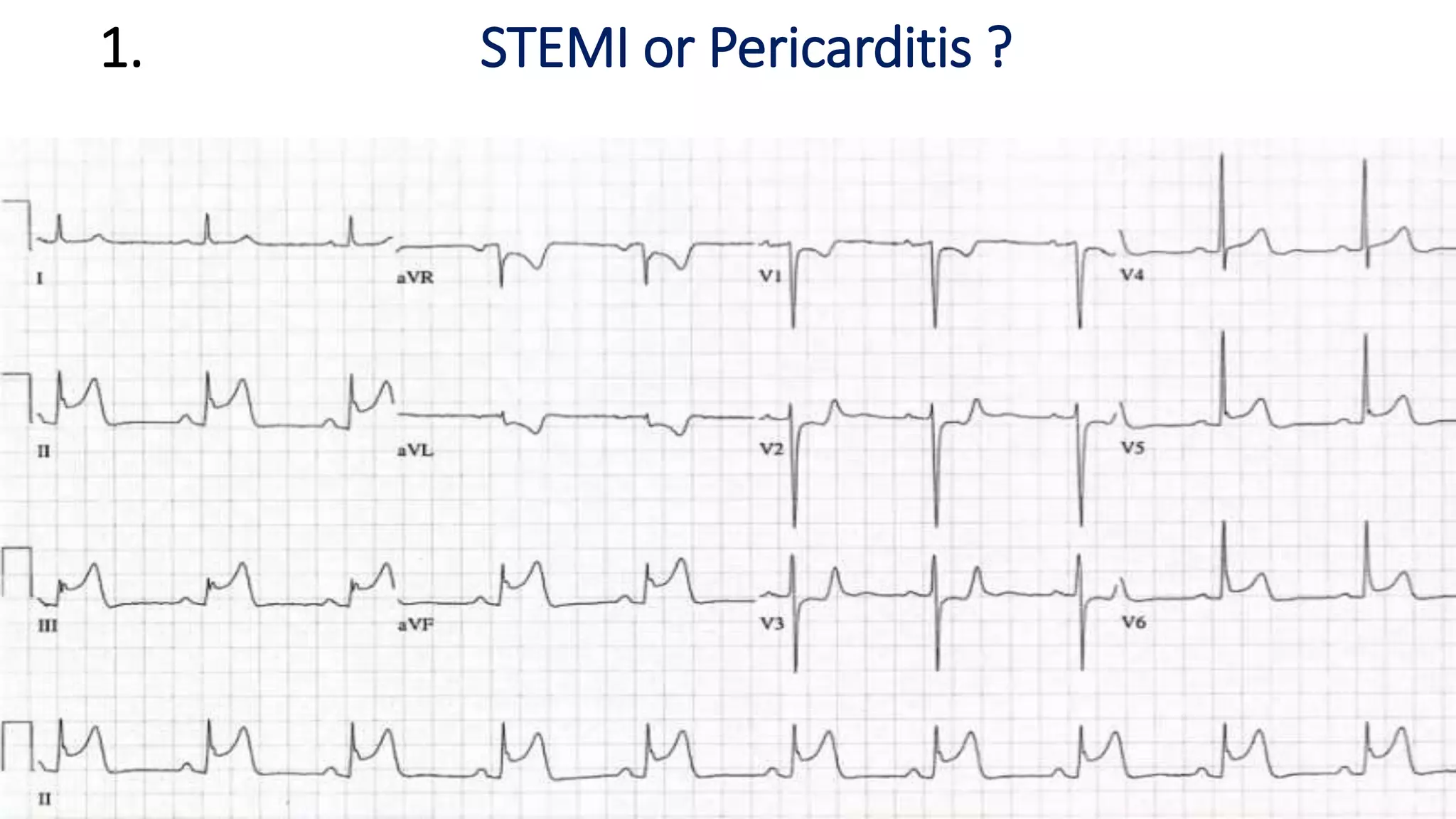
1. STEMI or Pericarditis ?
Its infero lateral STEMI
• .
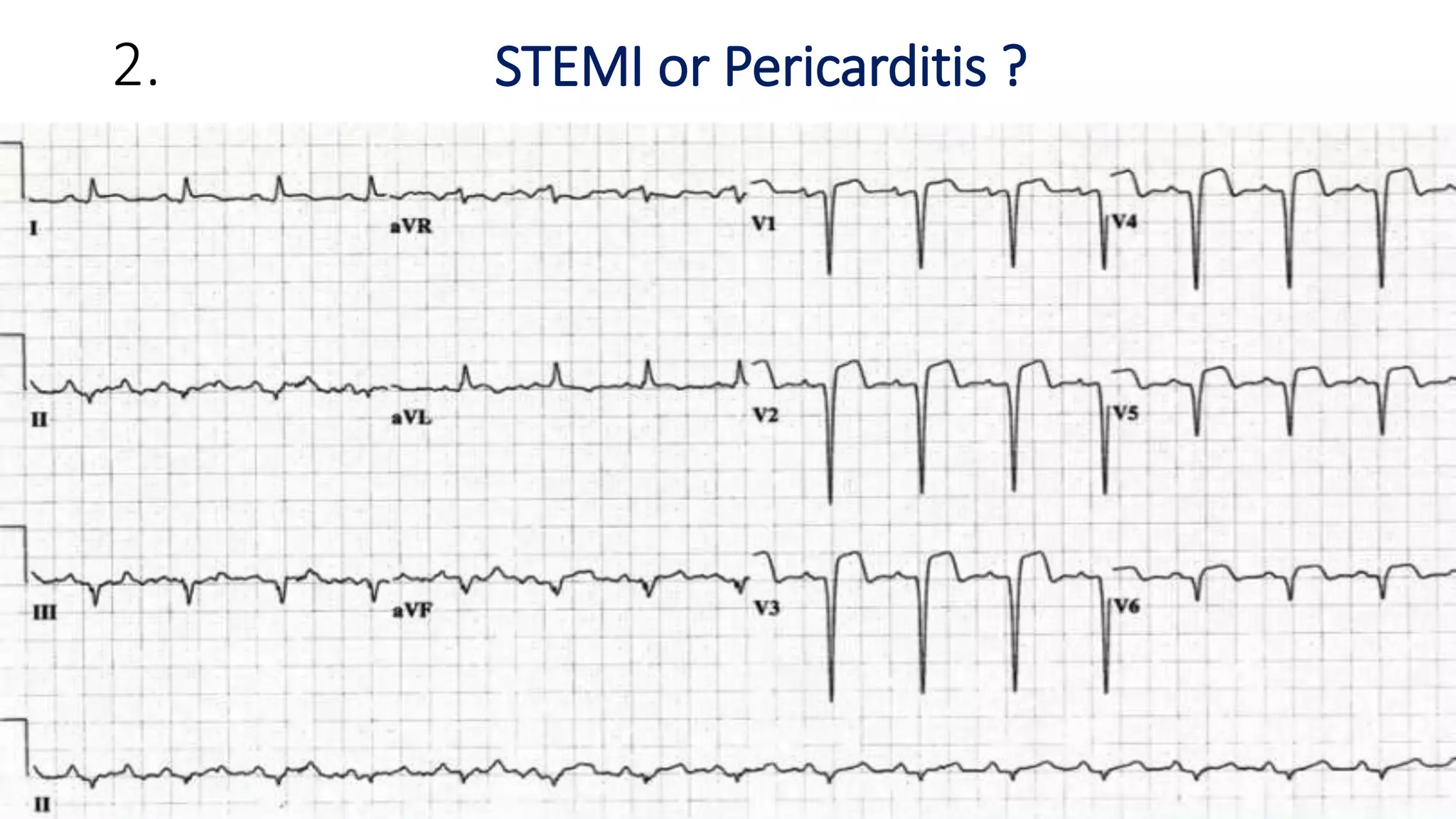
2. STEMI or Pericarditis ?
Its anterolateral STEMI
• .
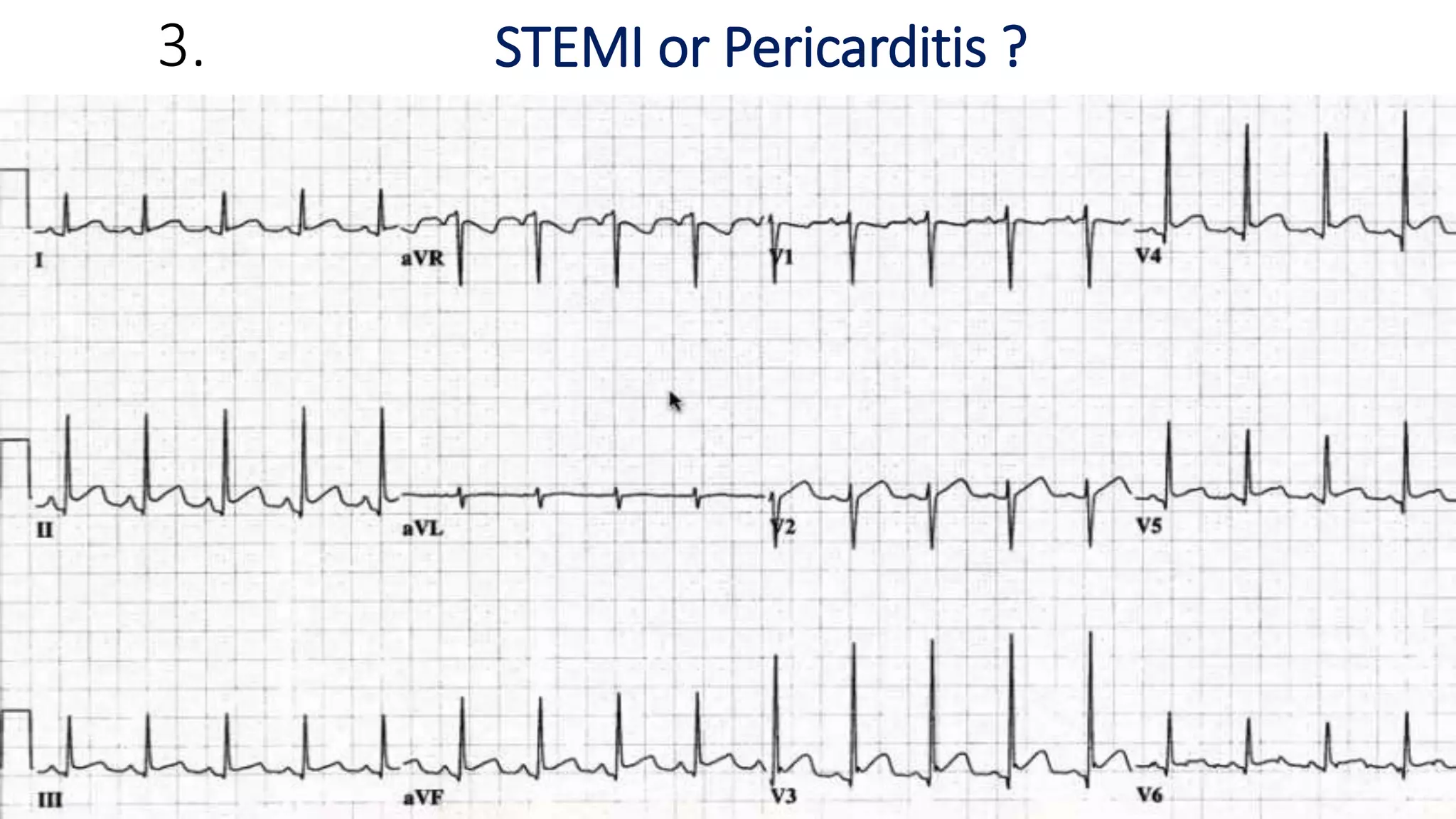
3. STEMI or Pericarditis ?
Its PERICARDITIS
• .
4. STEMI or Pericarditis ?
Note PR segment elevation in lead aVR
yet its STEMI ( ST elevation in anterolateral leads
, reciprocal ST depression in leads III , aVF)
• .
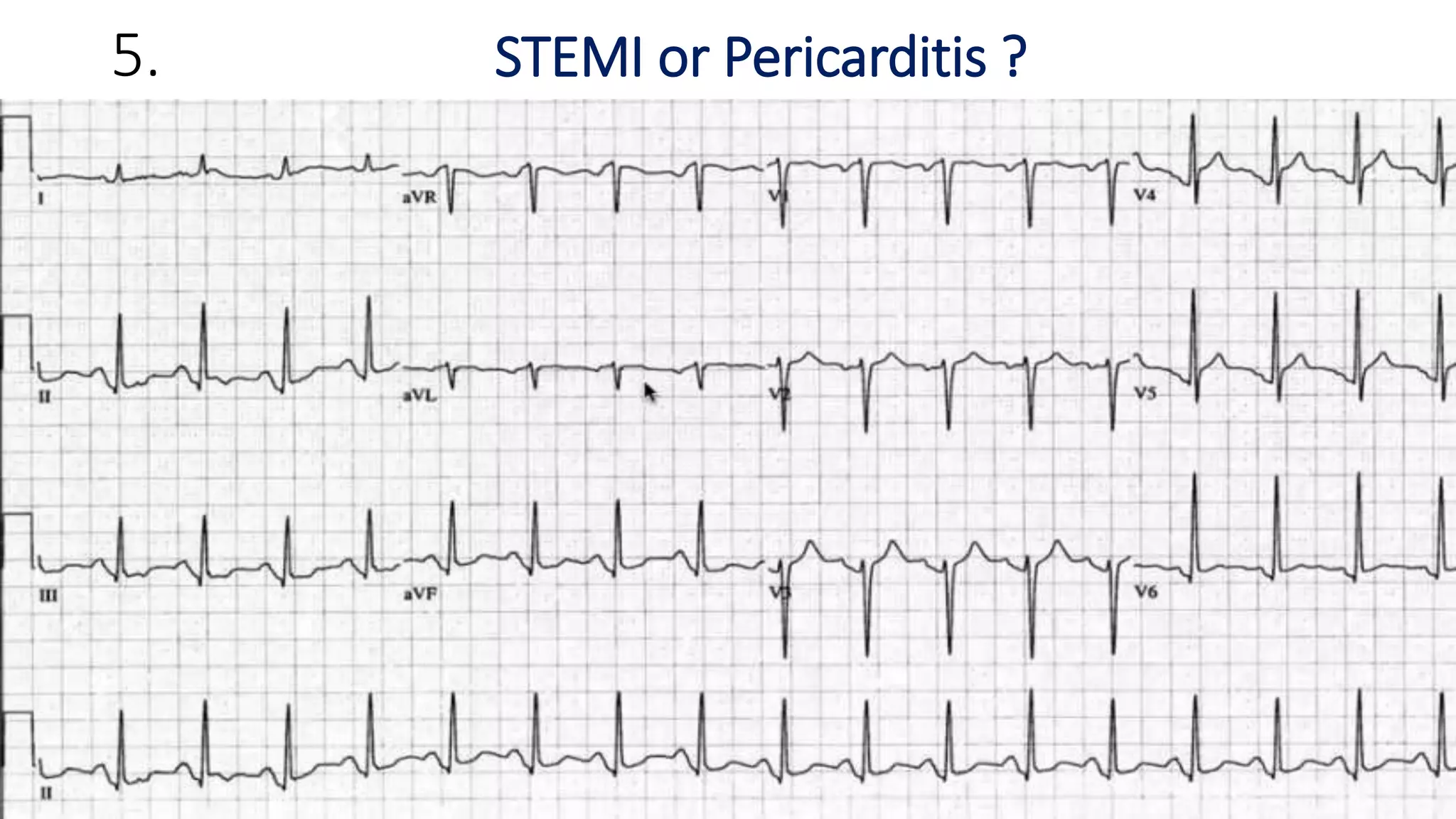
5. STEMI or Pericarditis ?
The most marked finding in this ECG is PR depression in multiple leads
BUT question is
What is the reference for ST elevation or depression in the presence of PR
depression ???
“Its T-P segment”
So taking T-P segment as standard what is happening in lead III and V6 ??
• .
.
So its ACS ,,,,,,
why PR segment depression ?
Do not forget “ATRIAL INJURY”
• ,
Coming back to the first slide of presentation.
STEMI or Pericarditis ?
.
This patient had triple vessel disease
• .
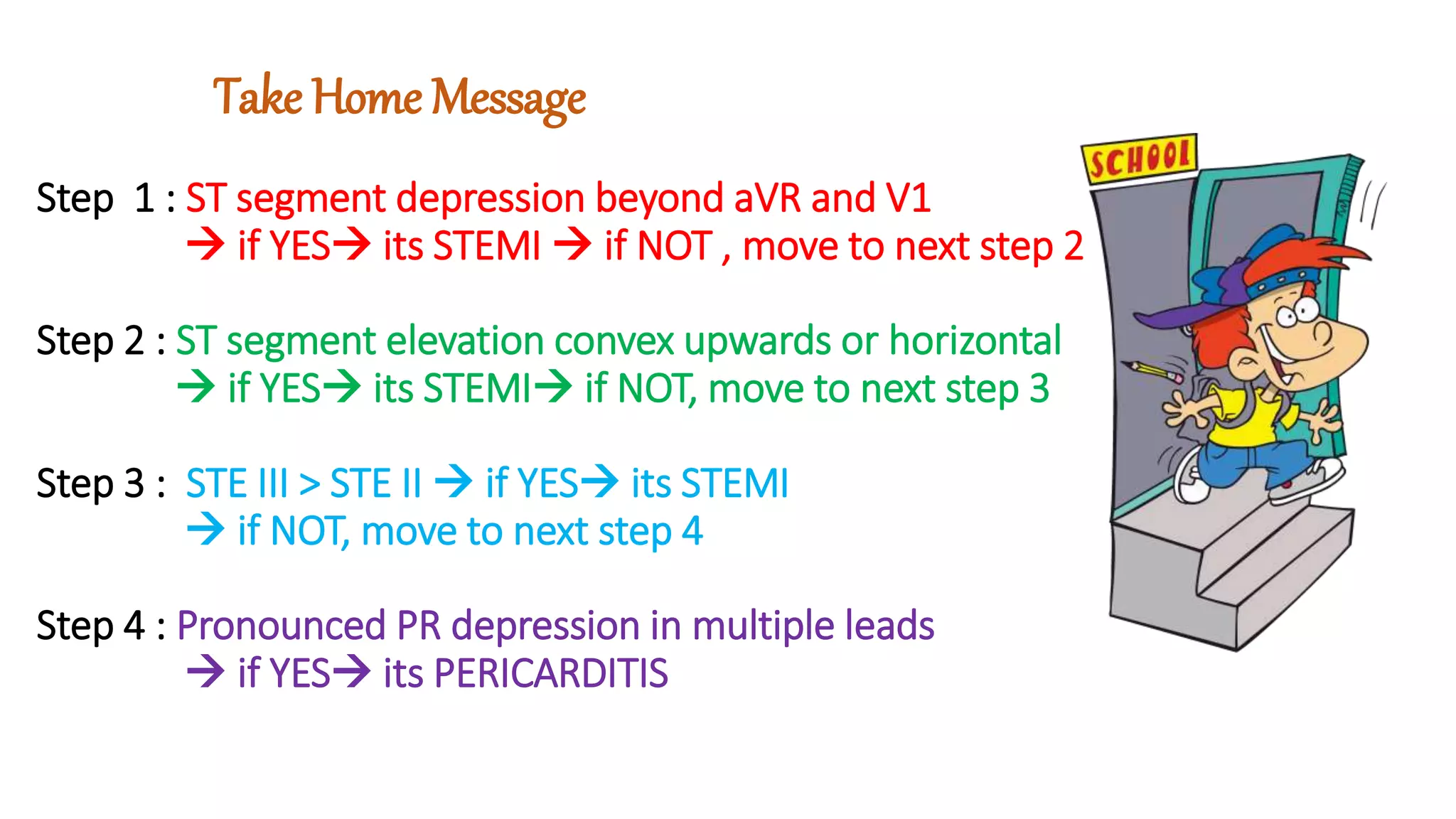
Take Home Message
Step 1 : ST segment depression beyond aVR and V1
 if YES its STEMI  if NOT , move to next step 2
Step 2 : ST segment elevation convex upwards or horizontal
 if YES its STEMI if NOT, move to next step 3
Step 3 : STE III > STE II  if YES its STEMI
 if NOT, move to next step 4
Step 4 : Pronounced PR depression in multiple leads
 if YES its PERICARDITIS
STEMI vs Pericarditis
When indoubt get serial ECGs
• .
THANKYOU
• ,

Stemi vs pericarditis ECG diagnosis

  • 1.
    ACUTE STEMI vsPERICARDITIS ECG DILEMMA Dr. Syed Haseeb Raza FCPS Cardiology, Clinical Cardiac Electrophysiologist Author of ECG Book and Researcher National Institute of Cardiovascular Diseases, Karachi, Pakistan. • .
  • 2.
    40 yr oldmale presenting with chest pain
  • 3.
    What is yourECG diagnosis? •.
  • 4.
    Answer will bedisclosed at the end of presentation
  • 5.
    Classical Teachings aboutPericarditis • Diffuse ST elevation in all leads • ST elevation is concave upwards • PR segment depression with PR elevation in lead aVR
  • 6.
    .. • Classic Teaching •Diffuse ST elevation in all leads In reality : may be localized instead of diffuse Pearl : No ST segment depression except in leads aVR and V1 • ST elevation is concave upwards Acute STEMI can also give such configuration. Pearl : ST segment elevation that is convex upwards and horizontal strongly favors STEMI Another pearl : STE II > STE III favors Pericarditis STE III > STE II favors STEMI • PR segment depression with PR elevation in lead aVR In reality : PR segment depression is an early transient finding It also occurs in ACS ( when there is atrial injury ) So ,,,its NOT pathognomic for Pericarditis
  • 7.
  • 8.
    Factors strongly FavoringSTEMI • ST segment depression beyond aVR and V1 • ST segment elevation convex upwards or horizontal • STE III > STE II
  • 9.
    Factors strongly FavoringSTEMI • ST segment depression beyond aVR and V1 • ST segment elevation convex upwards or horizontal • STE III > STE II Factors strongly favoring Pericarditis • Pronounced PR depression in multiple leads
  • 10.
    Pericarditis vs STEMI Whenindoubt get “serial ECGs” • .
  • 11.
    1. STEMI orPericarditis ?
  • 12.
    Its infero lateralSTEMI • .
  • 13.
    2. STEMI orPericarditis ?
  • 14.
  • 15.
    3. STEMI orPericarditis ?
  • 16.
  • 17.
    4. STEMI orPericarditis ?
  • 18.
    Note PR segmentelevation in lead aVR yet its STEMI ( ST elevation in anterolateral leads , reciprocal ST depression in leads III , aVF) • .
  • 19.
    5. STEMI orPericarditis ?
  • 20.
    The most markedfinding in this ECG is PR depression in multiple leads BUT question is What is the reference for ST elevation or depression in the presence of PR depression ??? “Its T-P segment” So taking T-P segment as standard what is happening in lead III and V6 ?? • .
  • 21.
  • 22.
    So its ACS,,,,,, why PR segment depression ? Do not forget “ATRIAL INJURY” • ,
  • 23.
    Coming back tothe first slide of presentation. STEMI or Pericarditis ?
  • 24.
  • 25.
    This patient hadtriple vessel disease • .
  • 26.
    Take Home Message Step1 : ST segment depression beyond aVR and V1  if YES its STEMI  if NOT , move to next step 2 Step 2 : ST segment elevation convex upwards or horizontal  if YES its STEMI if NOT, move to next step 3 Step 3 : STE III > STE II  if YES its STEMI  if NOT, move to next step 4 Step 4 : Pronounced PR depression in multiple leads  if YES its PERICARDITIS
  • 27.
    STEMI vs Pericarditis Whenindoubt get serial ECGs • .
  • 28.