 
Nancy Button
Governors State University
 Analyzes how society
applies a [negative]
definition to the label
“criminal”
 Howard Becker is thought
to be most influential
individual in formulating
the labeling theory
Howard S. Becker
 Little to no morals
 Poor character
 Likely to continue committing crime
 Less important than law abiding citizens
 Bad influence
 Loss of previous friends
o Leaves offender to turn to other offenders for friendship, a
potential negative influence
 Negative view from society
o Possibility of offender accepting “criminal” label as being true, thus
him or her basing their actions around the label
 Difficulty finding good employment opportunities
o Individual may then turn to crime as a source of money
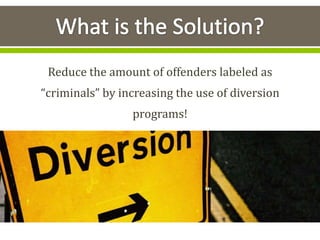
Reduce the amount of offenders labeled as
“criminals” by increasing the use of diversion
programs!
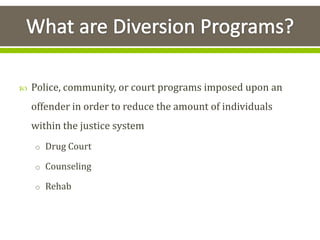
 Police, community, or court programs imposed upon an
offender in order to reduce the amount of individuals
within the justice system
o Drug Court
o Counseling
o Rehab
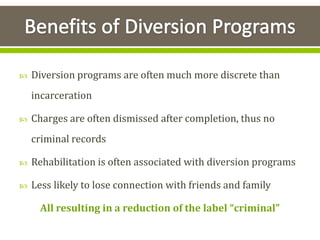
 Diversion programs are often much more discrete than
incarceration
 Charges are often dismissed after completion, thus no
criminal records
 Rehabilitation is often associated with diversion programs
 Less likely to lose connection with friends and family
All resulting in a reduction of the label “criminal”
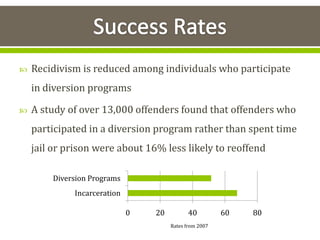
 Recidivism is reduced among individuals who participate
in diversion programs
 A study of over 13,000 offenders found that offenders who
participated in a diversion program rather than spent time
jail or prison were about 16% less likely to reoffend
0 20 40 60 80
Incarceration
Diversion Programs
Rates from 2007
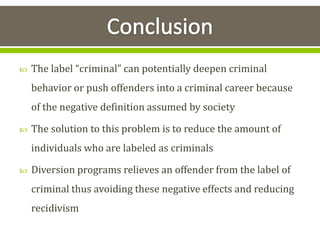
 The label “criminal” can potentially deepen criminal
behavior or push offenders into a criminal career because
of the negative definition assumed by society
 The solution to this problem is to reduce the amount of
individuals who are labeled as criminals
 Diversion programs relieves an offender from the label of
criminal thus avoiding these negative effects and reducing
recidivism
 Allen, H. E., Latessa, E. J., & Ponder, B. S. (2013). Corrections in
America An Introduction. Upper Saddle River: Pearson
Education, Inc.
 Latessa, E. J. (2006). What Works in Reducing Recidivism?
University of St. Thomas Law Journal, 521-534.
 Lilly, J. R., Cullen, F. T., & Ball, R. A. (2011). Criminological Theory
Context and Consequences. Thousand Oaks: Sage
Publications, Inc.
 Ritzer, G. (2005). Encyclopedia of Social Theory. SAGE
Publications, Inc.

Labeling theory - Nancy Button

  • 1.
  • 2.
     Analyzes howsociety applies a [negative] definition to the label “criminal”  Howard Becker is thought to be most influential individual in formulating the labeling theory Howard S. Becker
  • 3.
     Little tono morals  Poor character  Likely to continue committing crime  Less important than law abiding citizens  Bad influence
  • 4.
     Loss ofprevious friends o Leaves offender to turn to other offenders for friendship, a potential negative influence  Negative view from society o Possibility of offender accepting “criminal” label as being true, thus him or her basing their actions around the label  Difficulty finding good employment opportunities o Individual may then turn to crime as a source of money
  • 5.
    Reduce the amountof offenders labeled as “criminals” by increasing the use of diversion programs!
  • 6.
     Police, community,or court programs imposed upon an offender in order to reduce the amount of individuals within the justice system o Drug Court o Counseling o Rehab
  • 7.
     Diversion programsare often much more discrete than incarceration  Charges are often dismissed after completion, thus no criminal records  Rehabilitation is often associated with diversion programs  Less likely to lose connection with friends and family All resulting in a reduction of the label “criminal”
  • 8.
     Recidivism isreduced among individuals who participate in diversion programs  A study of over 13,000 offenders found that offenders who participated in a diversion program rather than spent time jail or prison were about 16% less likely to reoffend 0 20 40 60 80 Incarceration Diversion Programs Rates from 2007
  • 9.
     The label“criminal” can potentially deepen criminal behavior or push offenders into a criminal career because of the negative definition assumed by society  The solution to this problem is to reduce the amount of individuals who are labeled as criminals  Diversion programs relieves an offender from the label of criminal thus avoiding these negative effects and reducing recidivism
  • 10.
     Allen, H.E., Latessa, E. J., & Ponder, B. S. (2013). Corrections in America An Introduction. Upper Saddle River: Pearson Education, Inc.  Latessa, E. J. (2006). What Works in Reducing Recidivism? University of St. Thomas Law Journal, 521-534.  Lilly, J. R., Cullen, F. T., & Ball, R. A. (2011). Criminological Theory Context and Consequences. Thousand Oaks: Sage Publications, Inc.  Ritzer, G. (2005). Encyclopedia of Social Theory. SAGE Publications, Inc.