SELF STUDY SEMINAR
Steganography
By
ABTRACT
 To learn and understand what Steganography is and
about its importance.
 How Steganography works.
 Steganographic Methodologies to achieve Covert
Communications.
 Techniques to detect the use of Steganography.
 Comparison with other famous methodology of securing
data like Cryptology.
INTRODUCTION
 What exactly is Steganography?
“Steganography” “Covered or Hidden Writing”
 The art &science of communicating in a way which
hides the existence of the communication.
 Boosts the Concept of Information hiding without altering
or recasting the Information.
 Practiced in data hiding in digital files like document
files, multimedia files and even protocols.
Importance:
 Primary Goal is to hide messages inside other harmless messages.
 Doesn’t allow any other person to detect a secrete message is
being passed.
 Required by an individual as well as Governments and
organizations.
 Protects Intellectual Property Rights of Copyright Owners done via
Watermarking.
The Basic Steganographic Model
Any Steganographic
Methodology will follow the same
model using following :
 Carrier Media
 Encoding
process/Steganographic
Algorithm
 Payload
 Unique Key
 Stego-Media
 The Recovering Process
Steganography In Text Files
Text Steganography is the trickiest due to the deficiency of
redundant information . However the are some methods to achieve it:
 Line Shift Coding
 Vertical shifting of text line position to hide data.
 Word Shift Coding
 Horizontal shifting of words
 Feature Coding
 Alteration of one or more features of the text.
Steganography in Audio Files
 Changing of Individual bits that make up the digital
Audio file.
 A precise control allows the changes to be made to the
binary sequence which are not discernible to human
ears.
 Some of pre-established and effective methods are:
Steganography in Audio Files
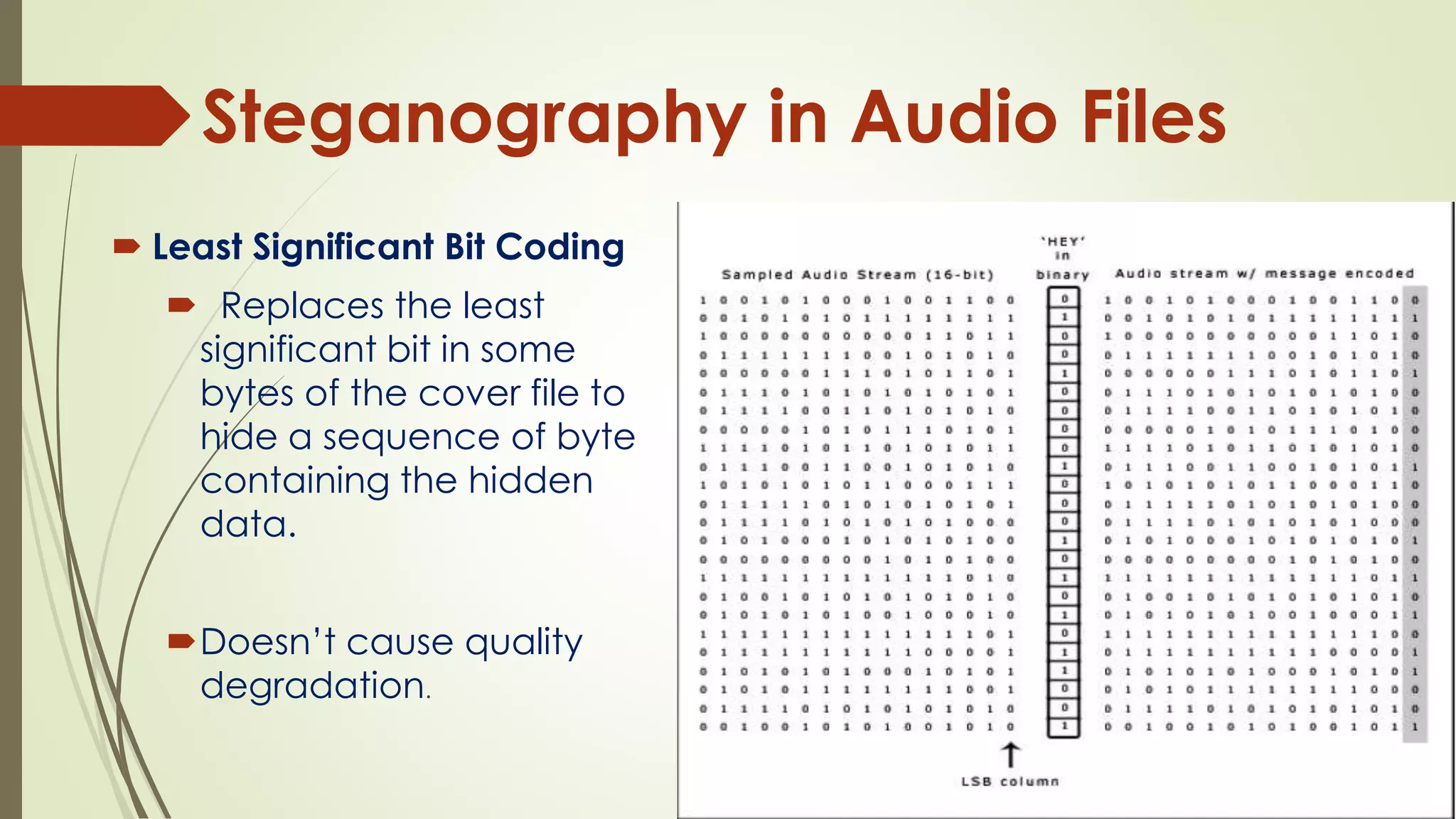
 Least Significant Bit Coding
 Replaces the least
significant bit in some
bytes of the cover file to
hide a sequence of byte
containing the hidden
data.
Doesn’t cause quality
degradation.
Steganography in Audio Files
 Least Significant Bit Coding
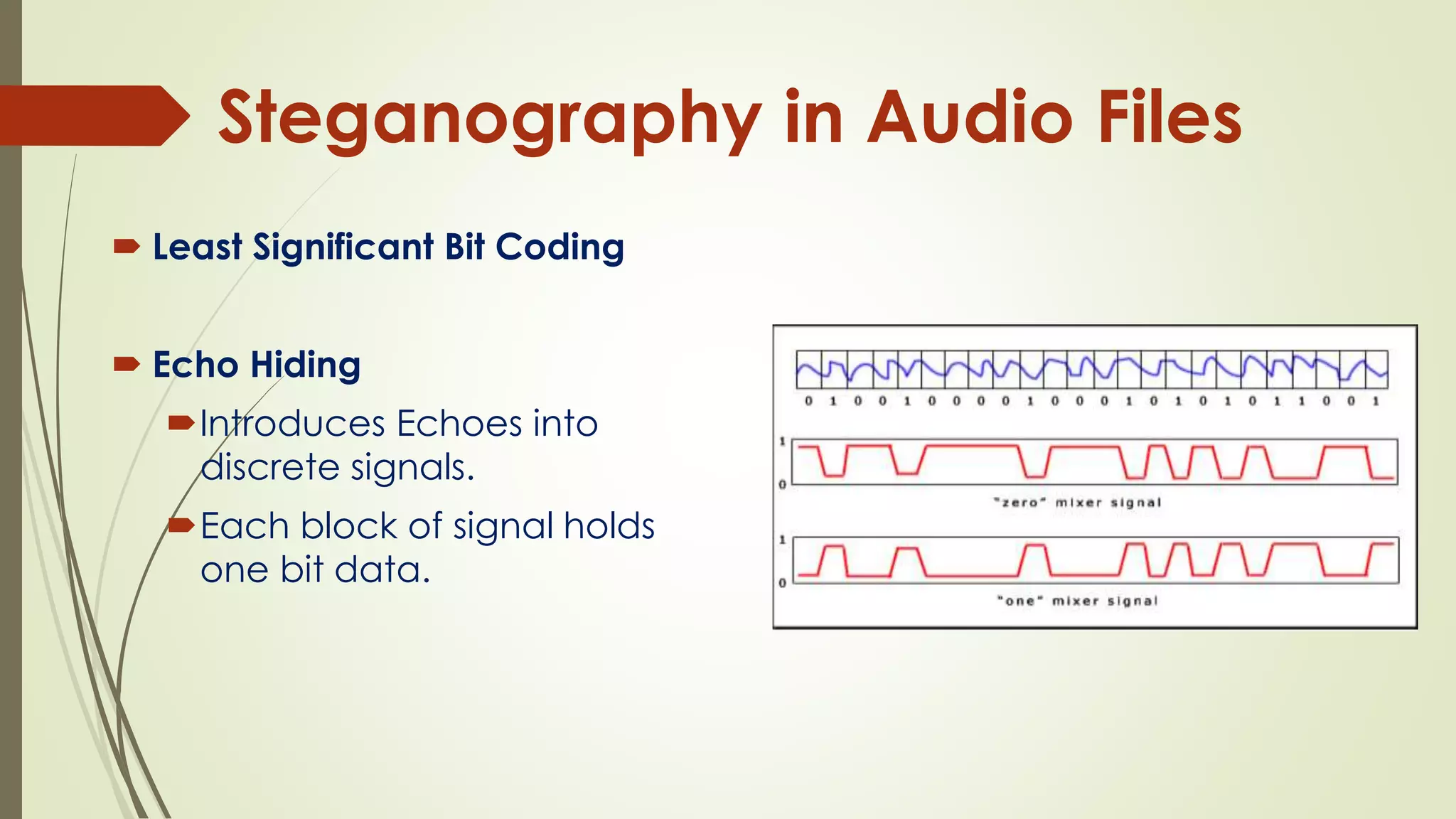
 Echo Hiding
Introduces Echoes into
discrete signals.
Each block of signal holds
one bit data.
Steganography in Audio Files
 Least Significant Bit Coding
 Echo Coding
 Phase Coding
Replacing the phase of an initial audio segment with
a reference phase to represent data.
Steganography in Images
 8-bit or higher color mages are more preferable than other images.
 In these images each pixel is represented as a single byte, with
pixel value of 0-255.
 Recommended Images are ones using 256 shades of grey as
Palette.
 Shades change very gradually between pixel value.
 Images having large area of solid color should be avoided.
Steganography in Images
 Insertion Technique
The LSB of the cover image are altered.
Pixels: (00100111 11101001 11001000)
(00100111 11001000 11101001)
(11001000 00100111 11101001)
The Code for letter ‘A’ which is to be hidden: 10000001
After the Insertion technique:
Resultant Pixels: (00100111 11101000 11001000)
(00100110 11001000 11101000)
(11001000 00100111 11101001)
Steganography over Networks
Methods to implement Steganography over a network are:
 Hiding in an attachment
 Hiding in a Transmission
 Hiding in Overt Protocol
Data Camouflaging
 You take data, put it in normal network traffic, and
modify the data in such a way it looks like a overt
protocol.
Making a text file like a HTML file.
Covert Channels
 Communications paths not designed for transferring
information.
 But these are used for covert communications.
 TCP/IP Headers.
 In IP header, the IP identification number field can be
changed as the protocols keeps working properly.
 In the TCP headers, the sequence and
acknowledgement number fields are used to hide data.
Steganalysis
 Steganography also poses threat.
 Misuse by anti-social elements to send messages without
being detected.
 There is a need to Detect Stego-Media.
 Steganalysis is the study of detecting messages hidden
using steganography.
 The goal of Steganalysis is to identify suspected
packages, determine whether or not they have a
payload encoded into them, and, if possible, recover
that payload.
Steganalysis
 Correlation Technique:
 A set of unmodified files from same source are inspected with
message file for various statistics.
 The unmodified carrier and the message files are compared in
respect of these statistics.
 If the message file is indeed a Stego-File, the differences will be
seen in the statistics as payload encoded into the file causes
these differences.
 However not every time the unmodified carrier is available.
Steganalysis
 Randomness Technique:
 Using concept of randomness.
 A unmodified carrier will have
no randomness, so its histogram
shows peaks & valleys
 A stego-file will have
randomness and its histogram
shows flatness.
 There is no need for a
unmodified carrier to detect
stego-files.
Applications of Steganography
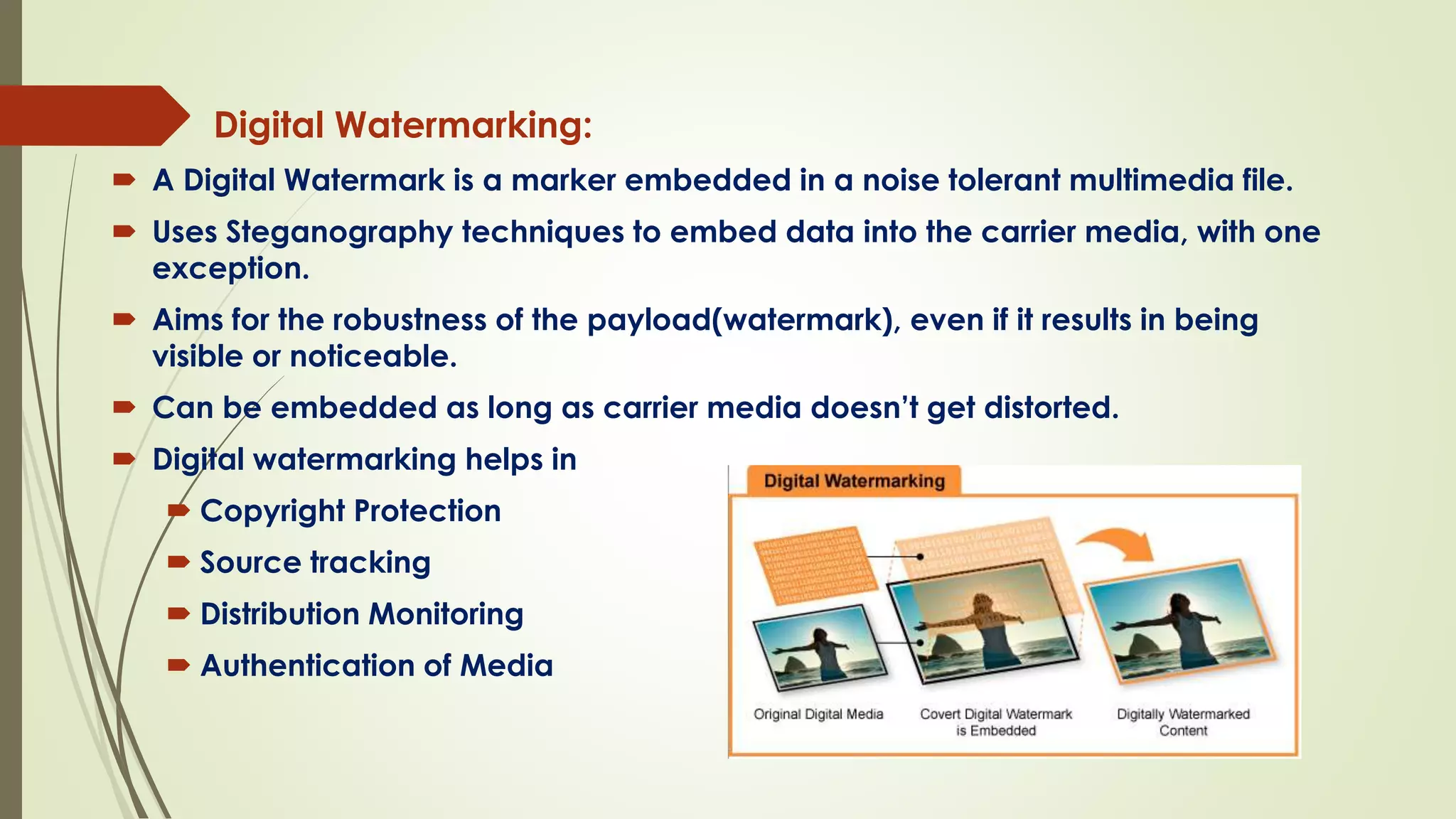
Digital Watermarking:
 A Digital Watermark is a marker embedded in a noise tolerant multimedia file.
 Uses Steganography techniques to embed data into the carrier media, with one
exception.
 Aims for the robustness of the payload(watermark), even if it results in being
visible or noticeable.
 Can be embedded as long as carrier media doesn’t get distorted.
 Digital watermarking helps in
 Copyright Protection
 Source tracking
 Distribution Monitoring
 Authentication of Media
Tamper Proofing
 To counter the risk of a files being transmitted to be tampered or altered to false
information.
 Just like a Watermark, data can be embedded onto the carrier as a check for
tampering.
 If the file undergoes some tampering, the embedded data will reflect the
changes also.
 Removal of the embedded data is also not a option as the removal will result in
the destruction of the carrier file itself.
In Modern Printers:
 Printers use Steganographic
techniques to embed information
about the document being printed
in every print.
In Biometrics:
 Avoid unauthorized use of
genetically engineered material.
 Hiding secrete messages in DNA
sequences for identification.
Steganography
Only Sender & Receiver knows
the existence of the message.
Prevents Discovery of the very
existence of Communications.
Does not Alter the structure &
content of the message.
Cryptography
The Existence of Message is
Known to all..
Prevents Unauthorized party to
discover the contents of
Communications.
Alters the structure of the
Message.
Steganography is more Advantageous!
vs.
Future of Steganography
 Improved Resistance to Analysis
 Presently, Stego-Media are more prone to be detected.
 Once detected, it will be easy to extract the hidden message.
 Making Stegos undetectable, irretrievable for those not intended
to.
 Higher Encoding Density
 Ability to hide more amount of data.
 Presently encoding density is limited without degrading the
carrier.
CONCLUSION
 Steganography is interesting subject, different than Cryptology and
System Administration.
 Based on the dilemma “YOU NEVER KNOW IF A MESSAGE IS HIDDEN”.
 Not only limited to Data Hiding, but can be put to a more Versatile use.
 Both Steganography and Cryptography together can achieve Data
Hiding.
 Expectation of more advancement in technology & efficiency
 While keeping a check on its illicit use by others.
 Steganoghraphy

Steganoghraphy

  • 1.
  • 2.
    ABTRACT  To learnand understand what Steganography is and about its importance.  How Steganography works.  Steganographic Methodologies to achieve Covert Communications.  Techniques to detect the use of Steganography.  Comparison with other famous methodology of securing data like Cryptology.
  • 3.
    INTRODUCTION  What exactlyis Steganography? “Steganography” “Covered or Hidden Writing”  The art &science of communicating in a way which hides the existence of the communication.  Boosts the Concept of Information hiding without altering or recasting the Information.  Practiced in data hiding in digital files like document files, multimedia files and even protocols.
  • 4.
    Importance:  Primary Goalis to hide messages inside other harmless messages.  Doesn’t allow any other person to detect a secrete message is being passed.  Required by an individual as well as Governments and organizations.  Protects Intellectual Property Rights of Copyright Owners done via Watermarking.
  • 5.
    The Basic SteganographicModel Any Steganographic Methodology will follow the same model using following :  Carrier Media  Encoding process/Steganographic Algorithm  Payload  Unique Key  Stego-Media  The Recovering Process
  • 6.
    Steganography In TextFiles Text Steganography is the trickiest due to the deficiency of redundant information . However the are some methods to achieve it:  Line Shift Coding  Vertical shifting of text line position to hide data.  Word Shift Coding  Horizontal shifting of words  Feature Coding  Alteration of one or more features of the text.
  • 7.
    Steganography in AudioFiles  Changing of Individual bits that make up the digital Audio file.  A precise control allows the changes to be made to the binary sequence which are not discernible to human ears.  Some of pre-established and effective methods are:
  • 8.
    Steganography in AudioFiles  Least Significant Bit Coding  Replaces the least significant bit in some bytes of the cover file to hide a sequence of byte containing the hidden data. Doesn’t cause quality degradation.
  • 9.
    Steganography in AudioFiles  Least Significant Bit Coding  Echo Hiding Introduces Echoes into discrete signals. Each block of signal holds one bit data.
  • 10.
    Steganography in AudioFiles  Least Significant Bit Coding  Echo Coding  Phase Coding Replacing the phase of an initial audio segment with a reference phase to represent data.
  • 11.
    Steganography in Images 8-bit or higher color mages are more preferable than other images.  In these images each pixel is represented as a single byte, with pixel value of 0-255.  Recommended Images are ones using 256 shades of grey as Palette.  Shades change very gradually between pixel value.  Images having large area of solid color should be avoided.
  • 12.
    Steganography in Images Insertion Technique The LSB of the cover image are altered. Pixels: (00100111 11101001 11001000) (00100111 11001000 11101001) (11001000 00100111 11101001) The Code for letter ‘A’ which is to be hidden: 10000001 After the Insertion technique: Resultant Pixels: (00100111 11101000 11001000) (00100110 11001000 11101000) (11001000 00100111 11101001)
  • 13.
    Steganography over Networks Methodsto implement Steganography over a network are:  Hiding in an attachment  Hiding in a Transmission  Hiding in Overt Protocol Data Camouflaging  You take data, put it in normal network traffic, and modify the data in such a way it looks like a overt protocol. Making a text file like a HTML file.
  • 14.
    Covert Channels  Communicationspaths not designed for transferring information.  But these are used for covert communications.  TCP/IP Headers.  In IP header, the IP identification number field can be changed as the protocols keeps working properly.  In the TCP headers, the sequence and acknowledgement number fields are used to hide data.
  • 15.
    Steganalysis  Steganography alsoposes threat.  Misuse by anti-social elements to send messages without being detected.  There is a need to Detect Stego-Media.  Steganalysis is the study of detecting messages hidden using steganography.  The goal of Steganalysis is to identify suspected packages, determine whether or not they have a payload encoded into them, and, if possible, recover that payload.
  • 16.
    Steganalysis  Correlation Technique: A set of unmodified files from same source are inspected with message file for various statistics.  The unmodified carrier and the message files are compared in respect of these statistics.  If the message file is indeed a Stego-File, the differences will be seen in the statistics as payload encoded into the file causes these differences.  However not every time the unmodified carrier is available.
  • 17.
    Steganalysis  Randomness Technique: Using concept of randomness.  A unmodified carrier will have no randomness, so its histogram shows peaks & valleys  A stego-file will have randomness and its histogram shows flatness.  There is no need for a unmodified carrier to detect stego-files.
  • 18.
  • 19.
    Digital Watermarking:  ADigital Watermark is a marker embedded in a noise tolerant multimedia file.  Uses Steganography techniques to embed data into the carrier media, with one exception.  Aims for the robustness of the payload(watermark), even if it results in being visible or noticeable.  Can be embedded as long as carrier media doesn’t get distorted.  Digital watermarking helps in  Copyright Protection  Source tracking  Distribution Monitoring  Authentication of Media
  • 20.
    Tamper Proofing  Tocounter the risk of a files being transmitted to be tampered or altered to false information.  Just like a Watermark, data can be embedded onto the carrier as a check for tampering.  If the file undergoes some tampering, the embedded data will reflect the changes also.  Removal of the embedded data is also not a option as the removal will result in the destruction of the carrier file itself.
  • 21.
    In Modern Printers: Printers use Steganographic techniques to embed information about the document being printed in every print. In Biometrics:  Avoid unauthorized use of genetically engineered material.  Hiding secrete messages in DNA sequences for identification.
  • 22.
    Steganography Only Sender &Receiver knows the existence of the message. Prevents Discovery of the very existence of Communications. Does not Alter the structure & content of the message. Cryptography The Existence of Message is Known to all.. Prevents Unauthorized party to discover the contents of Communications. Alters the structure of the Message. Steganography is more Advantageous! vs.
  • 23.
    Future of Steganography Improved Resistance to Analysis  Presently, Stego-Media are more prone to be detected.  Once detected, it will be easy to extract the hidden message.  Making Stegos undetectable, irretrievable for those not intended to.  Higher Encoding Density  Ability to hide more amount of data.  Presently encoding density is limited without degrading the carrier.
  • 24.
    CONCLUSION  Steganography isinteresting subject, different than Cryptology and System Administration.  Based on the dilemma “YOU NEVER KNOW IF A MESSAGE IS HIDDEN”.  Not only limited to Data Hiding, but can be put to a more Versatile use.  Both Steganography and Cryptography together can achieve Data Hiding.  Expectation of more advancement in technology & efficiency  While keeping a check on its illicit use by others.