Book Review
Vice and Virtue in an Age of Moral Confusion
by Os Guiness
• Until about 1800AD the most important
course in a student’s college career was moral
philosophy, or what today we call ethics.
• The course was taken as the crowning unit in
the senior year, usually taught by the college
president himself
• Resurgence – fashionable but transient
• Preventive in Approach – “avoid being caught”
• Tends to be more in a social context than with an individual’s quest
for personal virtuosity
• It is taught presuming man is inherently good not prone to wrong.
Individual hypocrisy, selfishness, cruelty and envy are merely
glanced at or ignored.
• Paradox: Education has sought a value neutral world eradicating
terms of right and wrong as judgmental lest someone be offended.
 We Seek to Address Symptoms not Causes
 The founders had a consensus of convictions evil was real.
Checks and balances were necessary in life.
 Senator Moynihan “Americans have “defined deviancy down”
 Dostoyevsky “If God is dead, and there is no future life
nothing would be immoral any longer, everything would be
permitted”
 Traditional definitions of “virtues and vices” that address the
unique value of every individual yet the conscious effort to
resist the heavy gravity of the presence and power of evil have
faded away from the conscious of the culture.
VIRTUES
 An awkward word filled with
connotations of stiff self
righteousness or
judgmentalism
 Suffers the danger of legalism
and moralism
 Start somewhere with
definitions to roll back the
confusion and fog! – tradition
can help
VICES
 An awkward word out of date
only mentioned of the Police
Vice Squad – gambling,
prostitution etc.
 A word really meant to
address the loss of self control
 Example of all types of
“anonymous” recovery groups
 Greek & Roman
Philosophers
▪ “virtue was that excellence
which causes something to
perform its purpose well” –
“virtue of a horse or a sharp
blade”
▪ Example: “vice” was a
matter of excess or deficit –
to face death too much fear
a coward (deficit) too little
fear (excess) reckless –
right amount - courage
 Old and New Testament
– out of which came 7
deadly sins – after
centuries of reflection
▪ Pride
▪ Envy
▪ Anger
▪ Sloth
▪ Avarice
▪ Gluttony
▪ Lust
▪ Pride: Self-absorption
▪ Envy: Wanting what others have with resentment
▪ Anger: Willing of harm and destruction of others verbally
or physically
▪ Sloth: lethargy towards God, the good, the ideal
▪ Avarice: Grasping on to earthly possessions
▪ Gluttony: to consume too much of anything
▪ Lust: the desire for every attractive body
 Avoid confusing pride with self respect or justified self
confidence
 Pride over does it with self esteem or positive self image
building
 Conceit, superiority, egotistical, presumptuous, vane,
boastful, self centered, arrogance, Narcissist – lover of
self
 Group pride – nationalism, tribalism, racism
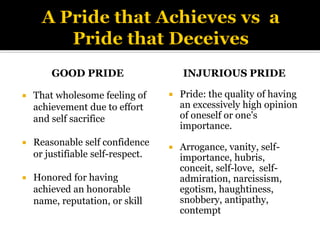
GOOD PRIDE
 That wholesome feeling of
achievement due to effort
and self sacrifice
 Reasonable self confidence
or justifiable self-respect.
 Honored for having
achieved an honorable
name, reputation, or skill
INJURIOUS PRIDE
 Pride: the quality of having
an excessively high opinion
of oneself or one's
importance.
 Arrogance, vanity, self-
importance, hubris,
conceit, self-love, self-
admiration, narcissism,
egotism, haughtiness,
snobbery, antipathy,
contempt
 “Poor in Spirit” – word for destitute or bankrupt
 False humility
▪ Avoid passive doormat mentality
▪ It is not a masked resentment – passive aggressive
behavior – begging to be pitied
 The Ideal
▪ Example – Franz Joseph Emperor of Austria – door
closed to church at his funeral when announced with
all his exalted titles – door opened when stated “a
poor sinner humbly begging God’s mercy”
▪ A Steward not an Owner of one’s skills, position, and
property
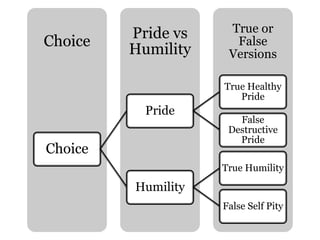
True or
False
Versions
Pride vs
Humility
Choice
Choice
Pride
True Healthy
Pride
False
Destructive
Pride
Humility
True Humility
False Self Pity
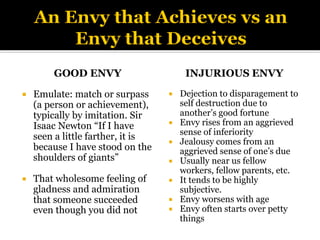
GOOD ENVY
 Emulate: match or surpass
(a person or achievement),
typically by imitation. Sir
Isaac Newton “If I have
seen a little farther, it is
because I have stood on the
shoulders of giants”
 That wholesome feeling of
gladness and admiration
that someone succeeded
even though you did not
INJURIOUS ENVY
 Dejection to disparagement to
self destruction due to
another’s good fortune
 Envy rises from an aggrieved
sense of inferiority
 Jealousy comes from an
aggrieved sense of one’s due
 Usually near us fellow
workers, fellow parents, etc.
 It tends to be highly
subjective.
 Envy worsens with age
 Envy often starts over petty
things
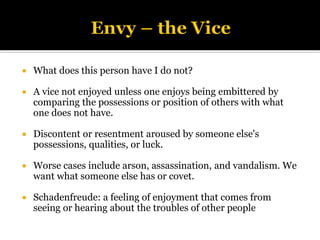
 What does this person have I do not?
 A vice not enjoyed unless one enjoys being embittered by
comparing the possessions or position of others with what
one does not have.
 Discontent or resentment aroused by someone else's
possessions, qualities, or luck.
 Worse cases include arson, assassination, and vandalism. We
want what someone else has or covet.
 Schadenfreude: a feeling of enjoyment that comes from
seeing or hearing about the troubles of other people
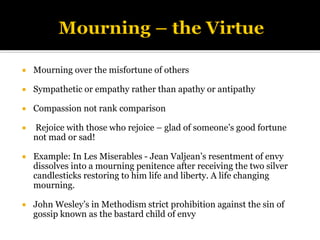
 Mourning over the misfortune of others
 Sympathetic or empathy rather than apathy or antipathy
 Compassion not rank comparison
 Rejoice with those who rejoice – glad of someone’s good fortune
not mad or sad!
 Example: In Les Miserables - Jean Valjean’s resentment of envy
dissolves into a mourning penitence after receiving the two silver
candlesticks restoring to him life and liberty. A life changing
mourning.
 John Wesley’s in Methodism strict prohibition against the sin of
gossip known as the bastard child of envy
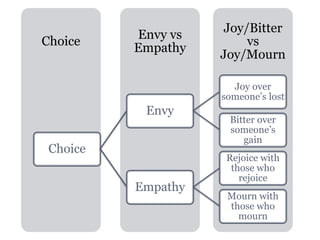
Joy/Bitter
vs
Joy/Mourn
Envy vs
Empathy
Choice
Choice
Envy
Joy over
someone’s lost
Bitter over
someone’s
gain
Empathy
Rejoice with
those who
rejoice
Mourn with
those who
mourn
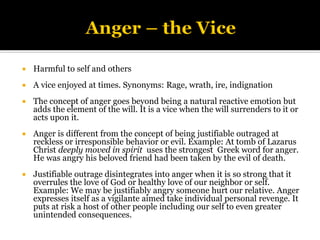
 Harmful to self and others
 A vice enjoyed at times. Synonyms: Rage, wrath, ire, indignation
 The concept of anger goes beyond being a natural reactive emotion but
adds the element of the will. It is a vice when the will surrenders to it or
acts upon it.
 Anger is different from the concept of being justifiable outraged at
reckless or irresponsible behavior or evil. Example: At tomb of Lazarus
Christ deeply moved in spirit uses the strongest Greek word for anger.
He was angry his beloved friend had been taken by the evil of death.
 Justifiable outrage disintegrates into anger when it is so strong that it
overrules the love of God or healthy love of our neighbor or self.
Example: We may be justifiably angry someone hurt our relative. Anger
expresses itself as a vigilante aimed take individual personal revenge. It
puts at risk a host of other people including our self to even greater
unintended consequences.
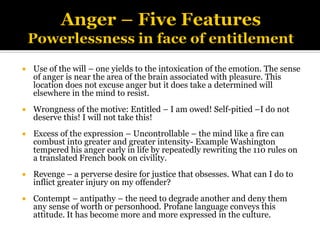
 Use of the will – one yields to the intoxication of the emotion. The sense
of anger is near the area of the brain associated with pleasure. This
location does not excuse anger but it does take a determined will
elsewhere in the mind to resist.
 Wrongness of the motive: Entitled – I am owed! Self-pitied –I do not
deserve this! I will not take this!
 Excess of the expression – Uncontrollable – the mind like a fire can
combust into greater and greater intensity- Example Washington
tempered his anger early in life by repeatedly rewriting the 110 rules on
a translated French book on civility.
 Revenge – a perverse desire for justice that obsesses. What can I do to
inflict greater injury on my offender?
 Contempt – antipathy – the need to degrade another and deny them
any sense of worth or personhood. Profane language conveys this
attitude. It has become more and more expressed in the culture.
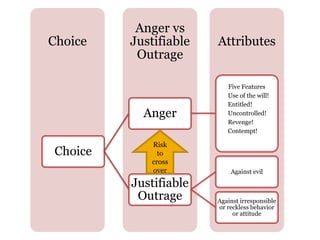
Attributes
Anger vs
Justifiable
Outrage
Choice
Choice
Anger
Five Features
Use of the will!
Entitled!
Uncontrolled!
Revenge!
Contempt!
Justifiable
Outrage
Against evil
Against irresponsible
or reckless behavior
or attitude
Risk
to
cross
over
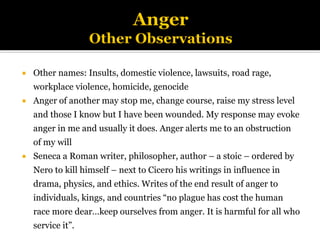
 Other names: Insults, domestic violence, lawsuits, road rage,
workplace violence, homicide, genocide
 Anger of another may stop me, change course, raise my stress level
and those I know but I have been wounded. My response may evoke
anger in me and usually it does. Anger alerts me to an obstruction
of my will
 Seneca a Roman writer, philosopher, author – a stoic – ordered by
Nero to kill himself – next to Cicero his writings in influence in
drama, physics, and ethics. Writes of the end result of anger to
individuals, kings, and countries “no plague has cost the human
race more dear…keep ourselves from anger. It is harmful for all who
service it”.
 Meekness is not weakness. Being a peacemaker does not mean being a pacifist or being passive.
 These two attributes have incalculable strengths
 Meekness has no sense of inferiority to try to pacify. Neither is it powerless to try to expose a
proved wrong.
 Meekness and peacemaking move beyond the negative (anger) to the positive (gentleness,
forbearance, and reconciliation).
 C.S. Lewis’s essay on forgiveness. Martin Luther King Jr essay on love.
 Love: An attitude as a noun (the will) , the verb love (puts forth visible effort as a result of the
will), and the noun love (an emotion or feeling that usually follows but does not usually preceded
except in the case of compassion). The initiator who loves and the receiver who benefits.
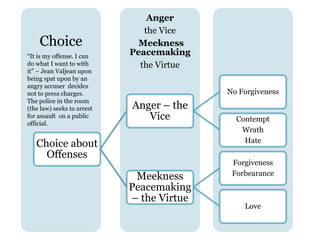
Anger
the Vice
Meekness
Peacemaking
the Virtue
Choice
Choice about
Offenses
Anger – the
Vice
No Forgiveness
Contempt
Wrath
Hate
Meekness
Peacemaking
– the Virtue
Forgiveness
Forbearance
Love
“It is my offense. I can
do what I want to with
it” – Jean Valjean upon
being spat upon by an
angry accuser decides
not to press charges.
The police in the room
(the law) seeks to arrest
for assault on a public
official.
 Book Review
 Vice andVirtue in an Age of Moral Confusion
 by Os Guiness - Chapters 4 to 7
▪ Sloth: lethargy towardsGod, the good, the ideal
▪ Avarice: Grasping on to earthly possessions
▪ Gluttony: to consume too much of anything
▪ Lust: the desire for every attractive body
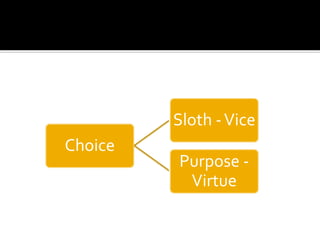
Choice
Sloth -Vice
Purpose -
Virtue
▪ Sin of the Spirit Like Pride, Envy, and Anger,
▪ It is a Sin of Omission
▪ Absence of Positive Behavior
▪ Not Roman or Greek Uniquely Christian
▪ More than insolence
▪ More than physical laziness
▪ More than lethargy
▪ More than carefree lingering with family or friends
▪ Conscious effort to give up on the pursuit of God, the spiritual,
the true, the good, the transcendent, and the beautiful.
▪ Above are considered dull, boring, mundane, worthless for self
▪ Hatred of all things spiritual that require effort
 Listlessness of life
 Despondency over meaning
 Moral burnout
 Directionless wandering
 Paralysis of the will
 Blasé boredom
 Endure no hardship
 Example: Jews who refused to conquer the promise land
 Ultimate despair and sense of futility
 Sloth the climate of the modern age – Solzhenitsyn “ US difficulties not
imprisonment, hard labor, death, government harassment, and censorship but
cupidity, boredom, sloppiness, indifference. Not the acts of a mighty, all
pervading, repressive government but the failure of a listless public to make use
of the freedom that is its birthright”
 Popular music – aloof, indifference to real joy or real tragedy – “whatever” a
continued effort to find meaning from its own meaningless
 Lack of a sense of purpose, meaning, passion, and mission in life
 Socrates:The unexamined life is not worth living
 Pascal 1623-62 – “Pensees” – a mandate of sense of mission in life of purpose to be discovered
especially in light of eternity
 Soren Kierkegaard 1813-1855 – “On the Wickedness of the Age” –The need to have passion –
passion for passion. Men's thoughts tend to be shallow.The need to experience life – thus
movement into existentialism. Died at 42 yet had tremendous influence.
 Dorothy L Sayers 1893-1957 – sloth a sin that believes in nothing, cares for nothing, seeks to know
nothing, interferes with nothing, enjoys nothing, loves nothing, hates nothing, loves for nothing.
It remains alive because there is nothing it would die for.
 Steve Covey - 7 Habits of Highly Effective People – starts with the end in mind where one
imagines their funeral. How does one wish to be remembered?
 Vaclav Havel – 1936 – “the temptation of nothingness is enormous and omnipresent”
 Napoleon – “I may lose battles; but no one will ever see me lose minutes, either by over
confidence or sloth”
 “Blessed are those who hunger for righteousness for they shall be
satisfied” – “first seek the kingdom of God”
 Mission such as ask, seek, knock indicates finding is on the horizon and is
a determined life that seeks answers and thus overcomes sloth.
 Hunger is an instinct especially when fulfilled rightfully and appropriate.
 Such pursuit implies no time to get bogged down in materialism, drug
fixes, sex, or other vain excesses. Socially approved ambition.
 WinstonChurchill – “What is our aim?Victory!”
 After pride avarice is ranked second among the 7 deadly sins.
 Synonyms: greed, covetousness
 Avarice attempts to get what we do not have and keep what we do have.
 Things are good in themselves it is when they the desire for temporal possessions becomes
inordinate, excessive, unwarranted, unreasonable, disproportionate
 Stinginess and waste are the same - avarice
 Money is hard to get, hard to keep, mourned when lost, does not live up to its expected reward
 The person practicing avarice – he may not last or the wealth may not last due to some epic
catastrophe
 Possession is thus an illusion. Even Alexander the Great had his hands show outside his coffin to
show even he could not take his wealth with him
 Avarice invites a sober judgment – one is own by his possessions – for Dante the seven daughters
of Avarice – treachery, restlessness, fraud, perjury, deceit, inhumanity, and violence.
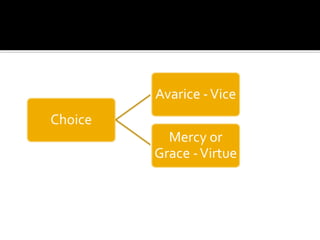
Choice
Avarice -Vice
Mercy or
Grace -Virtue
 John Bunyan’s Pilgrim Progress: Pilgrim goes to a town called Love-Gain and
meets men such as Mr. Hold theWorld, Mr. Money-Love, and Mr. Save-All.
 Chaucer: Story of “The Pardoner’s Prologue” – one who sold indulgences.
Preaching against greed while his own motivation is avarice.
 Tolstoy: “How Much Land Does a Man Need?” – how the desire to have more and
more land led to his untimely death – the only land he ended up achieving was 6
feet for his grave site.
 Langdon Brown Gilkey – On his interment inWWII Japanese camp along with Eric
Liddell hero of Chariots of Fire. “Shantung Compound”. Avarice among the
different nationalities at the camp that meant everyone suffered deprivation.
 The movieWall-Street : Mr Geko’s asserts “Greed is Good!”
 Mercy goes beyond reason, justice, and natural expectation
 Mercy’s answer to avarice’s “get what I do not have” – be content with what you
have
 Mercy’s answer to avarice’s “keep what you have” – practice instead proactive
generosity
 Avarice triggers further sins – fraud, treachery, violence – a culture of injury
 Mercy quenches further sins – a culture of mending injuries rather than inflicting
one
 Mercy loves both friend and foe. It does good to both.
 Grace is a special aspect of mercy in that mercy is utterly unmerited and
undeserved. It bestows an unexpected unmerited generosity
 Shakespeare’s “The Merchant ofVenice” – Portia’s classic response to Shylock who demands
justice of a pound of flesh. “The quality of mercy is not strained”
 History: Unlike the Germans or Japanese ofWWII the Allied prisoners of war were treated
humanely with adequate food, shelter, and medical care – a practice seldom practiced by
opposing armies in wars
 Victor Hugo – Les Miserables – JeanValjean who had stolen the night before the church’s silver is
presented by the arresting officer to confirm the matter. “Its all a mistake..Messierurs” says the
priest and the gendarmes leave.To the thief he states “Jean Valjean my friend before you go
away, here are your candlesticks you left; take them too…Jean Valjean is speechless…Jean
Valjean experiences grace. Instead of returning to a dreaded jail for the rest of his life as he
deserved he is experiences freedom and liberty from the loving priest who he had treated so
badly. It transforms him to abandon his former life of being a taker but an imitator of the loving
priest in thought and deed.
 Self-Indulgence initially considering food but can be
broadened to a form of hedonism
 Epicurean – let us eat, drink, and be merry for
tomorrow we may die
 Gluttony abuses something essential for human
survival that has physical penalties.
 Considered the least serious sin
 In Medieval way five ways gluttony displayed
▪ Eating & drinking too soon
▪ Eating & drinking to expensively
▪ Eating & drinking too eagerly
▪ Eating & drinking too much
▪ Eating and drinking with too much fuss or uproar
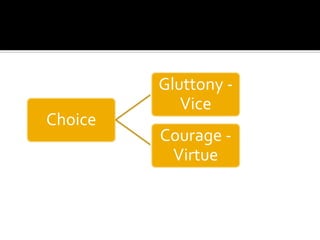
Choice
Gluttony -
Vice
Courage -
Virtue
 Petronius – Latin writer died 66AD – describes gluttony in the court of
Nero
 C.S. Lewis – Screwtape Letters
 Henry Fairlie – “The Gluttony of Our age” – A food obsessed indulgent
culture – over gratification and attention where the mind is preoccupied
about eating too much, too little, the right stuff or the wrong stuff
 Fredrick Buechner – “The Dwarves in the Stable”
 Courage under suffering and persecution – blessed are those who are
persecuted for righteousness sake
 Courage is doing that which is difficult or risky
 Instead of self indulgence there is self-denial and self sacrifice
 Gluttony seeks to consume yet in the end loses
 Courage seeks to put at risk and deny consumption yet in the end wins
 Courage requires dedication, discipline, patience, and hardship.Gluttony
does not ask any of these forms of self denial.
 Deferred gratification or prudence
 Thomas a Kempis – “Of Patient Suffering of Injuries andWrongs andWho
isTruly Patient” – be ready for battle if you would have victory – without
battle you cannot be crowned – if you desire to be crowned, resist
strongly and suffer patiently – without battle no man can come to victory
 John the Cross – 1542- 1591 – “On the Divine Light” – for refusing to
abandon his convictions he under went severe suffering – imprisonment,
banishment, and resulting illnesses.A bit of a mystic he was canonized
by the RomanChurch in 1726.
Winston Churchill
 Sure I am of this, that you have only to endure to conquer
 Never, never, never give up
 Courage is rightly esteemed the first of human qualities... because it is
the quality which guarantees all others
 This is no time for ease and comfort. It is time to dare and endure
 Success is not final, failure is not fatal: it is the courage to continue that
counts
 You have enemies? Good.That means you've stood up for something,
sometime in your life
`
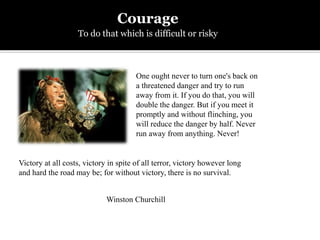
Courage
Victory at all costs, victory in spite of all terror, victory however long
and hard the road may be; for without victory, there is no survival.
One ought never to turn one's back on
a threatened danger and try to run
away from it. If you do that, you will
double the danger. But if you meet it
promptly and without flinching, you
will reduce the danger by half. Never
run away from anything. Never!
Courage
To do that which is difficult or risky
Winston Churchill
 Lust gets dissected into components as promiscuity, pornography, adultery,
fornication, incest, seduction, prostitution, and rape.
 Unethical and unrestrained expression of sexual fulfilment
 The origins is just not a matter of reaction of the body but the thoughts of the
heart and mind
 Wholesome in its original design and use sex achieves procreation and intimacy.
Outside of marriage it can prove to be a raging fire that ultimately consumes and
undermines its original design
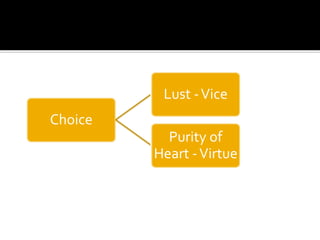
Choice
Lust -Vice
Purity of
Heart -Virtue
 Moliere 1622-1673 – a comic and artist – denied holy burial
for his banned plays – wrote Don Juan a obsessive and
unscrupulous pursuer of women
 D H Lawrence – 1885-1930 – believed a sexual
permissiveness was a cure for human maladjustment –
involved in famous censorship cases (Lady Chatterly’s Lover -
1928) and prosecuted for obscenity.
 Blessed are the pure of heart…
 Lust is unethical and unrestrained. Purity of heart is the ethical and discipline
devotion of the heart
 Lust binds and dissipates purity of heart is clear sighted and concentrated
focusing of strength
 Pure means true, authentic, simple
 Falling from the pure ideal one has available grace and forgiveness with
restoration to one who fails.
 Aristotle – there is no such thing as committing adultery with the right woman, at
the right time, and in the right way for it is simply wrong
 Augustine – 354-430AD – Confessions –
 William F May – 1927 – “False Worship: Impurity of Heart”
I. Remember the place of discipline – training ourselves to do
what we cannot ordinarily do
II. Remember deception – our utility sin that assists all other
sinning
III. Remember the danger of moralism – our ugly counterfeit of
virtue
IV.Remember that differences make a difference – our
unwelcomed insistence in a day of pluralism
V. Remember demonstration – virtue embodied in action

Steering through chaos 1 to 7

  • 1.
    Book Review Vice andVirtue in an Age of Moral Confusion by Os Guiness
  • 2.
    • Until about1800AD the most important course in a student’s college career was moral philosophy, or what today we call ethics. • The course was taken as the crowning unit in the senior year, usually taught by the college president himself
  • 3.
    • Resurgence –fashionable but transient • Preventive in Approach – “avoid being caught” • Tends to be more in a social context than with an individual’s quest for personal virtuosity • It is taught presuming man is inherently good not prone to wrong. Individual hypocrisy, selfishness, cruelty and envy are merely glanced at or ignored. • Paradox: Education has sought a value neutral world eradicating terms of right and wrong as judgmental lest someone be offended.
  • 4.
     We Seekto Address Symptoms not Causes  The founders had a consensus of convictions evil was real. Checks and balances were necessary in life.  Senator Moynihan “Americans have “defined deviancy down”  Dostoyevsky “If God is dead, and there is no future life nothing would be immoral any longer, everything would be permitted”  Traditional definitions of “virtues and vices” that address the unique value of every individual yet the conscious effort to resist the heavy gravity of the presence and power of evil have faded away from the conscious of the culture.
  • 5.
    VIRTUES  An awkwardword filled with connotations of stiff self righteousness or judgmentalism  Suffers the danger of legalism and moralism  Start somewhere with definitions to roll back the confusion and fog! – tradition can help VICES  An awkward word out of date only mentioned of the Police Vice Squad – gambling, prostitution etc.  A word really meant to address the loss of self control  Example of all types of “anonymous” recovery groups
  • 6.
     Greek &Roman Philosophers ▪ “virtue was that excellence which causes something to perform its purpose well” – “virtue of a horse or a sharp blade” ▪ Example: “vice” was a matter of excess or deficit – to face death too much fear a coward (deficit) too little fear (excess) reckless – right amount - courage  Old and New Testament – out of which came 7 deadly sins – after centuries of reflection ▪ Pride ▪ Envy ▪ Anger ▪ Sloth ▪ Avarice ▪ Gluttony ▪ Lust
  • 7.
    ▪ Pride: Self-absorption ▪Envy: Wanting what others have with resentment ▪ Anger: Willing of harm and destruction of others verbally or physically ▪ Sloth: lethargy towards God, the good, the ideal ▪ Avarice: Grasping on to earthly possessions ▪ Gluttony: to consume too much of anything ▪ Lust: the desire for every attractive body
  • 8.
     Avoid confusingpride with self respect or justified self confidence  Pride over does it with self esteem or positive self image building  Conceit, superiority, egotistical, presumptuous, vane, boastful, self centered, arrogance, Narcissist – lover of self  Group pride – nationalism, tribalism, racism
  • 9.
    GOOD PRIDE  Thatwholesome feeling of achievement due to effort and self sacrifice  Reasonable self confidence or justifiable self-respect.  Honored for having achieved an honorable name, reputation, or skill INJURIOUS PRIDE  Pride: the quality of having an excessively high opinion of oneself or one's importance.  Arrogance, vanity, self- importance, hubris, conceit, self-love, self- admiration, narcissism, egotism, haughtiness, snobbery, antipathy, contempt
  • 10.
     “Poor inSpirit” – word for destitute or bankrupt  False humility ▪ Avoid passive doormat mentality ▪ It is not a masked resentment – passive aggressive behavior – begging to be pitied  The Ideal ▪ Example – Franz Joseph Emperor of Austria – door closed to church at his funeral when announced with all his exalted titles – door opened when stated “a poor sinner humbly begging God’s mercy” ▪ A Steward not an Owner of one’s skills, position, and property
  • 11.
    True or False Versions Pride vs Humility Choice Choice Pride TrueHealthy Pride False Destructive Pride Humility True Humility False Self Pity
  • 12.
    GOOD ENVY  Emulate:match or surpass (a person or achievement), typically by imitation. Sir Isaac Newton “If I have seen a little farther, it is because I have stood on the shoulders of giants”  That wholesome feeling of gladness and admiration that someone succeeded even though you did not INJURIOUS ENVY  Dejection to disparagement to self destruction due to another’s good fortune  Envy rises from an aggrieved sense of inferiority  Jealousy comes from an aggrieved sense of one’s due  Usually near us fellow workers, fellow parents, etc.  It tends to be highly subjective.  Envy worsens with age  Envy often starts over petty things
  • 13.
     What doesthis person have I do not?  A vice not enjoyed unless one enjoys being embittered by comparing the possessions or position of others with what one does not have.  Discontent or resentment aroused by someone else's possessions, qualities, or luck.  Worse cases include arson, assassination, and vandalism. We want what someone else has or covet.  Schadenfreude: a feeling of enjoyment that comes from seeing or hearing about the troubles of other people
  • 14.
     Mourning overthe misfortune of others  Sympathetic or empathy rather than apathy or antipathy  Compassion not rank comparison  Rejoice with those who rejoice – glad of someone’s good fortune not mad or sad!  Example: In Les Miserables - Jean Valjean’s resentment of envy dissolves into a mourning penitence after receiving the two silver candlesticks restoring to him life and liberty. A life changing mourning.  John Wesley’s in Methodism strict prohibition against the sin of gossip known as the bastard child of envy
  • 15.
    Joy/Bitter vs Joy/Mourn Envy vs Empathy Choice Choice Envy Joy over someone’slost Bitter over someone’s gain Empathy Rejoice with those who rejoice Mourn with those who mourn
  • 16.
     Harmful toself and others  A vice enjoyed at times. Synonyms: Rage, wrath, ire, indignation  The concept of anger goes beyond being a natural reactive emotion but adds the element of the will. It is a vice when the will surrenders to it or acts upon it.  Anger is different from the concept of being justifiable outraged at reckless or irresponsible behavior or evil. Example: At tomb of Lazarus Christ deeply moved in spirit uses the strongest Greek word for anger. He was angry his beloved friend had been taken by the evil of death.  Justifiable outrage disintegrates into anger when it is so strong that it overrules the love of God or healthy love of our neighbor or self. Example: We may be justifiably angry someone hurt our relative. Anger expresses itself as a vigilante aimed take individual personal revenge. It puts at risk a host of other people including our self to even greater unintended consequences.
  • 17.
     Use ofthe will – one yields to the intoxication of the emotion. The sense of anger is near the area of the brain associated with pleasure. This location does not excuse anger but it does take a determined will elsewhere in the mind to resist.  Wrongness of the motive: Entitled – I am owed! Self-pitied –I do not deserve this! I will not take this!  Excess of the expression – Uncontrollable – the mind like a fire can combust into greater and greater intensity- Example Washington tempered his anger early in life by repeatedly rewriting the 110 rules on a translated French book on civility.  Revenge – a perverse desire for justice that obsesses. What can I do to inflict greater injury on my offender?  Contempt – antipathy – the need to degrade another and deny them any sense of worth or personhood. Profane language conveys this attitude. It has become more and more expressed in the culture.
  • 18.
    Attributes Anger vs Justifiable Outrage Choice Choice Anger Five Features Useof the will! Entitled! Uncontrolled! Revenge! Contempt! Justifiable Outrage Against evil Against irresponsible or reckless behavior or attitude Risk to cross over
  • 19.
     Other names:Insults, domestic violence, lawsuits, road rage, workplace violence, homicide, genocide  Anger of another may stop me, change course, raise my stress level and those I know but I have been wounded. My response may evoke anger in me and usually it does. Anger alerts me to an obstruction of my will  Seneca a Roman writer, philosopher, author – a stoic – ordered by Nero to kill himself – next to Cicero his writings in influence in drama, physics, and ethics. Writes of the end result of anger to individuals, kings, and countries “no plague has cost the human race more dear…keep ourselves from anger. It is harmful for all who service it”.
  • 20.
     Meekness isnot weakness. Being a peacemaker does not mean being a pacifist or being passive.  These two attributes have incalculable strengths  Meekness has no sense of inferiority to try to pacify. Neither is it powerless to try to expose a proved wrong.  Meekness and peacemaking move beyond the negative (anger) to the positive (gentleness, forbearance, and reconciliation).  C.S. Lewis’s essay on forgiveness. Martin Luther King Jr essay on love.  Love: An attitude as a noun (the will) , the verb love (puts forth visible effort as a result of the will), and the noun love (an emotion or feeling that usually follows but does not usually preceded except in the case of compassion). The initiator who loves and the receiver who benefits.
  • 21.
    Anger the Vice Meekness Peacemaking the Virtue Choice Choiceabout Offenses Anger – the Vice No Forgiveness Contempt Wrath Hate Meekness Peacemaking – the Virtue Forgiveness Forbearance Love “It is my offense. I can do what I want to with it” – Jean Valjean upon being spat upon by an angry accuser decides not to press charges. The police in the room (the law) seeks to arrest for assault on a public official.
  • 22.
     Book Review Vice andVirtue in an Age of Moral Confusion  by Os Guiness - Chapters 4 to 7 ▪ Sloth: lethargy towardsGod, the good, the ideal ▪ Avarice: Grasping on to earthly possessions ▪ Gluttony: to consume too much of anything ▪ Lust: the desire for every attractive body
  • 23.
  • 24.
    ▪ Sin ofthe Spirit Like Pride, Envy, and Anger, ▪ It is a Sin of Omission ▪ Absence of Positive Behavior ▪ Not Roman or Greek Uniquely Christian ▪ More than insolence ▪ More than physical laziness ▪ More than lethargy ▪ More than carefree lingering with family or friends ▪ Conscious effort to give up on the pursuit of God, the spiritual, the true, the good, the transcendent, and the beautiful. ▪ Above are considered dull, boring, mundane, worthless for self ▪ Hatred of all things spiritual that require effort
  • 25.
     Listlessness oflife  Despondency over meaning  Moral burnout  Directionless wandering  Paralysis of the will  Blasé boredom  Endure no hardship  Example: Jews who refused to conquer the promise land  Ultimate despair and sense of futility
  • 26.
     Sloth theclimate of the modern age – Solzhenitsyn “ US difficulties not imprisonment, hard labor, death, government harassment, and censorship but cupidity, boredom, sloppiness, indifference. Not the acts of a mighty, all pervading, repressive government but the failure of a listless public to make use of the freedom that is its birthright”  Popular music – aloof, indifference to real joy or real tragedy – “whatever” a continued effort to find meaning from its own meaningless  Lack of a sense of purpose, meaning, passion, and mission in life
  • 27.
     Socrates:The unexaminedlife is not worth living  Pascal 1623-62 – “Pensees” – a mandate of sense of mission in life of purpose to be discovered especially in light of eternity  Soren Kierkegaard 1813-1855 – “On the Wickedness of the Age” –The need to have passion – passion for passion. Men's thoughts tend to be shallow.The need to experience life – thus movement into existentialism. Died at 42 yet had tremendous influence.  Dorothy L Sayers 1893-1957 – sloth a sin that believes in nothing, cares for nothing, seeks to know nothing, interferes with nothing, enjoys nothing, loves nothing, hates nothing, loves for nothing. It remains alive because there is nothing it would die for.  Steve Covey - 7 Habits of Highly Effective People – starts with the end in mind where one imagines their funeral. How does one wish to be remembered?  Vaclav Havel – 1936 – “the temptation of nothingness is enormous and omnipresent”  Napoleon – “I may lose battles; but no one will ever see me lose minutes, either by over confidence or sloth”
  • 28.
     “Blessed arethose who hunger for righteousness for they shall be satisfied” – “first seek the kingdom of God”  Mission such as ask, seek, knock indicates finding is on the horizon and is a determined life that seeks answers and thus overcomes sloth.  Hunger is an instinct especially when fulfilled rightfully and appropriate.  Such pursuit implies no time to get bogged down in materialism, drug fixes, sex, or other vain excesses. Socially approved ambition.  WinstonChurchill – “What is our aim?Victory!”
  • 29.
     After prideavarice is ranked second among the 7 deadly sins.  Synonyms: greed, covetousness  Avarice attempts to get what we do not have and keep what we do have.  Things are good in themselves it is when they the desire for temporal possessions becomes inordinate, excessive, unwarranted, unreasonable, disproportionate  Stinginess and waste are the same - avarice  Money is hard to get, hard to keep, mourned when lost, does not live up to its expected reward  The person practicing avarice – he may not last or the wealth may not last due to some epic catastrophe  Possession is thus an illusion. Even Alexander the Great had his hands show outside his coffin to show even he could not take his wealth with him  Avarice invites a sober judgment – one is own by his possessions – for Dante the seven daughters of Avarice – treachery, restlessness, fraud, perjury, deceit, inhumanity, and violence.
  • 30.
  • 31.
     John Bunyan’sPilgrim Progress: Pilgrim goes to a town called Love-Gain and meets men such as Mr. Hold theWorld, Mr. Money-Love, and Mr. Save-All.  Chaucer: Story of “The Pardoner’s Prologue” – one who sold indulgences. Preaching against greed while his own motivation is avarice.  Tolstoy: “How Much Land Does a Man Need?” – how the desire to have more and more land led to his untimely death – the only land he ended up achieving was 6 feet for his grave site.  Langdon Brown Gilkey – On his interment inWWII Japanese camp along with Eric Liddell hero of Chariots of Fire. “Shantung Compound”. Avarice among the different nationalities at the camp that meant everyone suffered deprivation.  The movieWall-Street : Mr Geko’s asserts “Greed is Good!”
  • 32.
     Mercy goesbeyond reason, justice, and natural expectation  Mercy’s answer to avarice’s “get what I do not have” – be content with what you have  Mercy’s answer to avarice’s “keep what you have” – practice instead proactive generosity  Avarice triggers further sins – fraud, treachery, violence – a culture of injury  Mercy quenches further sins – a culture of mending injuries rather than inflicting one  Mercy loves both friend and foe. It does good to both.  Grace is a special aspect of mercy in that mercy is utterly unmerited and undeserved. It bestows an unexpected unmerited generosity
  • 33.
     Shakespeare’s “TheMerchant ofVenice” – Portia’s classic response to Shylock who demands justice of a pound of flesh. “The quality of mercy is not strained”  History: Unlike the Germans or Japanese ofWWII the Allied prisoners of war were treated humanely with adequate food, shelter, and medical care – a practice seldom practiced by opposing armies in wars  Victor Hugo – Les Miserables – JeanValjean who had stolen the night before the church’s silver is presented by the arresting officer to confirm the matter. “Its all a mistake..Messierurs” says the priest and the gendarmes leave.To the thief he states “Jean Valjean my friend before you go away, here are your candlesticks you left; take them too…Jean Valjean is speechless…Jean Valjean experiences grace. Instead of returning to a dreaded jail for the rest of his life as he deserved he is experiences freedom and liberty from the loving priest who he had treated so badly. It transforms him to abandon his former life of being a taker but an imitator of the loving priest in thought and deed.
  • 34.
     Self-Indulgence initiallyconsidering food but can be broadened to a form of hedonism  Epicurean – let us eat, drink, and be merry for tomorrow we may die  Gluttony abuses something essential for human survival that has physical penalties.  Considered the least serious sin  In Medieval way five ways gluttony displayed ▪ Eating & drinking too soon ▪ Eating & drinking to expensively ▪ Eating & drinking too eagerly ▪ Eating & drinking too much ▪ Eating and drinking with too much fuss or uproar
  • 35.
  • 36.
     Petronius –Latin writer died 66AD – describes gluttony in the court of Nero  C.S. Lewis – Screwtape Letters  Henry Fairlie – “The Gluttony of Our age” – A food obsessed indulgent culture – over gratification and attention where the mind is preoccupied about eating too much, too little, the right stuff or the wrong stuff  Fredrick Buechner – “The Dwarves in the Stable”
  • 37.
     Courage undersuffering and persecution – blessed are those who are persecuted for righteousness sake  Courage is doing that which is difficult or risky  Instead of self indulgence there is self-denial and self sacrifice  Gluttony seeks to consume yet in the end loses  Courage seeks to put at risk and deny consumption yet in the end wins  Courage requires dedication, discipline, patience, and hardship.Gluttony does not ask any of these forms of self denial.  Deferred gratification or prudence
  • 38.
     Thomas aKempis – “Of Patient Suffering of Injuries andWrongs andWho isTruly Patient” – be ready for battle if you would have victory – without battle you cannot be crowned – if you desire to be crowned, resist strongly and suffer patiently – without battle no man can come to victory  John the Cross – 1542- 1591 – “On the Divine Light” – for refusing to abandon his convictions he under went severe suffering – imprisonment, banishment, and resulting illnesses.A bit of a mystic he was canonized by the RomanChurch in 1726.
  • 39.
    Winston Churchill  SureI am of this, that you have only to endure to conquer  Never, never, never give up  Courage is rightly esteemed the first of human qualities... because it is the quality which guarantees all others  This is no time for ease and comfort. It is time to dare and endure  Success is not final, failure is not fatal: it is the courage to continue that counts  You have enemies? Good.That means you've stood up for something, sometime in your life ` Courage
  • 40.
    Victory at allcosts, victory in spite of all terror, victory however long and hard the road may be; for without victory, there is no survival. One ought never to turn one's back on a threatened danger and try to run away from it. If you do that, you will double the danger. But if you meet it promptly and without flinching, you will reduce the danger by half. Never run away from anything. Never! Courage To do that which is difficult or risky Winston Churchill
  • 41.
     Lust getsdissected into components as promiscuity, pornography, adultery, fornication, incest, seduction, prostitution, and rape.  Unethical and unrestrained expression of sexual fulfilment  The origins is just not a matter of reaction of the body but the thoughts of the heart and mind  Wholesome in its original design and use sex achieves procreation and intimacy. Outside of marriage it can prove to be a raging fire that ultimately consumes and undermines its original design
  • 42.
  • 43.
     Moliere 1622-1673– a comic and artist – denied holy burial for his banned plays – wrote Don Juan a obsessive and unscrupulous pursuer of women  D H Lawrence – 1885-1930 – believed a sexual permissiveness was a cure for human maladjustment – involved in famous censorship cases (Lady Chatterly’s Lover - 1928) and prosecuted for obscenity.
  • 44.
     Blessed arethe pure of heart…  Lust is unethical and unrestrained. Purity of heart is the ethical and discipline devotion of the heart  Lust binds and dissipates purity of heart is clear sighted and concentrated focusing of strength  Pure means true, authentic, simple  Falling from the pure ideal one has available grace and forgiveness with restoration to one who fails.
  • 45.
     Aristotle –there is no such thing as committing adultery with the right woman, at the right time, and in the right way for it is simply wrong  Augustine – 354-430AD – Confessions –  William F May – 1927 – “False Worship: Impurity of Heart”
  • 46.
    I. Remember theplace of discipline – training ourselves to do what we cannot ordinarily do II. Remember deception – our utility sin that assists all other sinning III. Remember the danger of moralism – our ugly counterfeit of virtue IV.Remember that differences make a difference – our unwelcomed insistence in a day of pluralism V. Remember demonstration – virtue embodied in action