Prof. Dr. Zahid Ahmad Siddiqi
ANALYSIS AND DESIGN OF BEAMS
INTRODUCTION
A beam is a structural member in which the
major deformation is bending.
The bending moment is primarily generated due
to transverse loads.
This member carries the loads throughout its
span and transfers it to its ends with or without
accompanying moment.
Prof. Dr. Zahid Ahmad Siddiqi
Beam is a combination of a compression member
on one side of neutral axis and a tension member
on the other side, joined together through a shear
element.
Following terms are used for various types of
beams according to their use:
Girder: The primary beams that are frequently
used at wide spacing supporting the smaller
beams and other structural components are called
girders.
Prof. Dr. Zahid Ahmad Siddiqi
Frequently, girders are made of built-up sections
and carry heavier loads over larger spans.
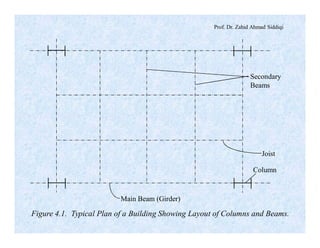
These are supported directly on columns (Figure
4.1).
Secondary Beam: These are relatively smaller
beams resting on primary beams/girders carrying
load of lesser part of roof and having smaller
span lengths (Figure 4.1).
Prof. Dr. Zahid Ahmad Siddiqi
Secondary
Beams
Joist
Main Beam (Girder)
Column
Figure 4.1. Typical Plan of a Building Showing Layout of Columns and Beams.
Prof. Dr. Zahid Ahmad Siddiqi
Joists: Joists are less important beams that
are closely spaced and are frequently having
truss-type webs.
These are closely spaced smaller beams resting
on secondary beams in majority of the cases.
With the presence of joists, the strength
requirements of the roof sheathing or slab are
greatly reduced (Figure 4.1).
Prof. Dr. Zahid Ahmad Siddiqi
Purlins: These are roof beams spanning
between trusses.
Roof sheathing is connected with purlins, which
is in turn are connected to panel points of the
truss, with no direct connection between the
roof and the truss top chord.
Uniformly distributed roof load is carried by the
purlins and is converted into point loads acting
at panel points of the truss.
Because of inclination of the load with the
centroidal axes of the section and application of
load on top chord, these beams are subjected to
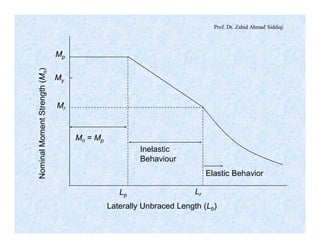
biaxial bending along with torsion.
Prof. Dr. Zahid Ahmad Siddiqi
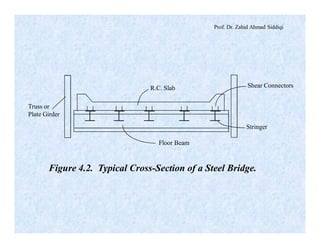
Stringers: Longitudinal bridge beams spanning
between floor beams and placed parallel to
roadway are called stringers (Figure 4.2).
Floor Beams: Floor beams are main girders of
the bridge spanning between trusses or plate
girders and running perpendicular to the roadway
of the bridge (Figure 4.2).
Girts: Horizontal wall beams used to resist
horizontal bending due to wind acting on the side
of an industrial building are referred to as girts.
Prof. Dr. Zahid Ahmad Siddiqi
Shear Connectors
Stringer
Floor Beam
Truss or
Plate Girder
R.C. Slab
Figure 4.2. Typical Cross-Section of a Steel Bridge.
Prof. Dr. Zahid Ahmad Siddiqi
Lintels: Lintels are members supporting a wall
over window or door openings.
Spandrels: In case of high-rise buildings, the
masonry walls are usually not able to withstand
their self-weight and the slab weight.
In such cases, beams are provided in exterior walls
at each floor level to support the wall load and
perhaps some roof load also.
These beams are termed as spandrels.
Prof. Dr. Zahid Ahmad Siddiqi
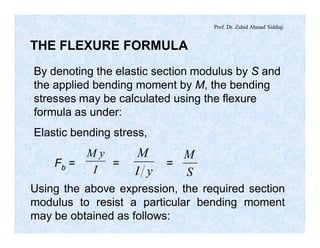
THE FLEXURE FORMULA
By denoting the elastic section modulus by S and
the applied bending moment by M, the bending
stresses may be calculated using the flexure
formula as under:
Elastic bending stress,
I
yM
yI
M
S
M
Fb = = =
Using the above expression, the required section
modulus to resist a particular bending moment
may be obtained as follows:
Prof. Dr. Zahid Ahmad Siddiqi
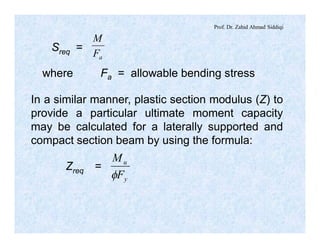
Sreq =
aF
M
where Fa = allowable bending stress
In a similar manner, plastic section modulus (Z) to
provide a particular ultimate moment capacity
may be calculated for a laterally supported and
compact section beam by using the formula:
Zreq =
y
u
F
M
f
Prof. Dr. Zahid Ahmad Siddiqi
STABILITY OF BEAM SECTIONS
Local Stability
If width over thickness ratio of the compression
flange is greater than a certain limit, flange can
buckle locally.
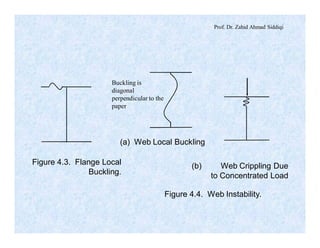
The phenomenon is called flange local buckling
(FLB) and is shown in Figure 4.3.
Similarly, if depth over thickness ratio is greater
for the web, it can locally buckle or cripple under
compression (Figure 4.4).
This phenomenon is called as web local buckling
(WLB).
Prof. Dr. Zahid Ahmad Siddiqi
Buckling is
diagonal
perpendicular to the
paper
Figure 4.3. Flange Local
Buckling.
(a) Web Local Buckling
(b) Web Crippling Due
to Concentrated Load
Figure 4.4. Web Instability.
Prof. Dr. Zahid Ahmad Siddiqi
Web local buckling usually occurs in a diagonal
position and is produced by the diagonal
compression existing in the web due to shear.
On the other hand, web crippling occurs due to
local compression transferred by the flange to
the connecting portion of web.
Lateral Stability
Due to lateral buckling of the compression zone,
the section is twisted as a whole due to the fact
that tension zone remains stable and tries to retain
its position.
Prof. Dr. Zahid Ahmad Siddiqi
This combined twisting and buckling of beam in a
lateral direction is called lateral torsional buckling
(LTB).
It depends upon the laterally unsupported length
besides the loading and the sectional
dimensions.
Unbraced or unsupported length
of beam (Lb)
It is defined as the length of beam within its two
sections whose compression flange is laterally
supported or braced against twist of the cross
section by perpendicular beams, slab or by some
other means.
Prof. Dr. Zahid Ahmad Siddiqi
In other words, it is the distance between two
points braced against lateral displacement of
the compression flange denoted by Lb.
The sections braced to prevent twist of the
member are considered better for the bracing
against the lateral torsional buckling.
Lateral stability against LTB
AISC-F2 deals with doubly symmetric compact I-
shaped members and channels bent about their
major axis.
Prof. Dr. Zahid Ahmad Siddiqi
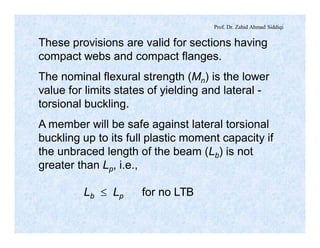
These provisions are valid for sections having
compact webs and compact flanges.
The nominal flexural strength (Mn) is the lower
value for limits states of yielding and lateral -
torsional buckling.
A member will be safe against lateral torsional
buckling up to its full plastic moment capacity if
the unbraced length of the beam (Lb) is not
greater than Lp, i.e.,
Lb £ Lp for no LTB
Prof. Dr. Zahid Ahmad Siddiqi
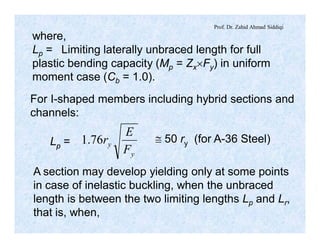
where,
Lp = Limiting laterally unbraced length for full
plastic bending capacity (Mp = Zx´Fy) in uniform
moment case (Cb = 1.0).
For I-shaped members including hybrid sections and
channels:
Lp =
y
y
F
E
r76.1 @ 50 ry (for A-36 Steel)
A section may develop yielding only at some points
in case of inelastic buckling, when the unbraced
length is between the two limiting lengths Lp and Lr,
that is, when,
Prof. Dr. Zahid Ahmad Siddiqi
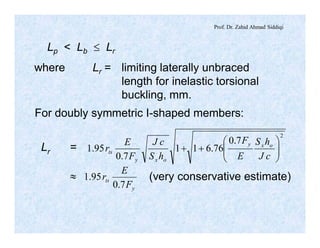
Lp < Lb £ Lr
where Lr = limiting laterally unbraced
length for inelastic torsional
buckling, mm.
For doubly symmetric I-shaped members:
Lr =
2
7.0
76.611
7.0
95.1 ÷÷
ø
ö
çç
è
æ
++
cJ
hS
E
F
hS
cJ
F
E
r oxy
oxy
ts
»
y
ts
F
E
r
7.0
95.1 (very conservative estimate)
Prof. Dr. Zahid Ahmad Siddiqi
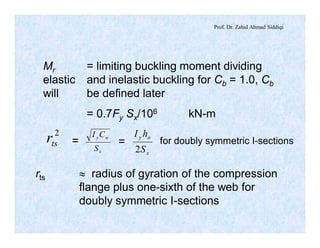
Mr = limiting buckling moment dividing
elastic and inelastic buckling for Cb = 1.0, Cb
will be defined later
= 0.7Fy Sx/106 kN-m
2
tsr
x
wy
S
CI
x
oy
S
hI
2
= for doubly symmetric I-sections=
rts » radius of gyration of the compression
flange plus one-sixth of the web for
doubly symmetric I-sections
Prof. Dr. Zahid Ahmad Siddiqi
÷
÷
ø
ö
ç
ç
è
æ
+
ff
w
f
tb
th
b
6
1
112
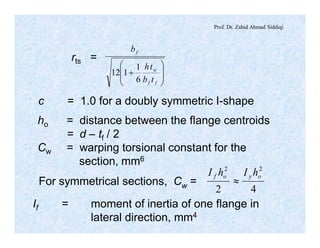
rts =
c = 1.0 for a doubly symmetric I-shape
ho = distance between the flange centroids
= d – tf / 2
Cw = warping torsional constant for the
section, mm6
For symmetrical sections, Cw =
42
22
oyof hIhI
»
If = moment of inertia of one flange in
lateral direction, mm4
Prof. Dr. Zahid Ahmad Siddiqi
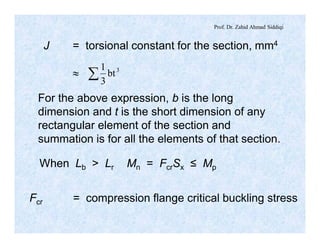
J = torsional constant for the section, mm4
» å 3
bt
3
1
For the above expression, b is the long
dimension and t is the short dimension of any
rectangular element of the section and
summation is for all the elements of that section.
When Lb > Lr Mn = FcrSx ≤ Mp
Fcr = compression flange critical buckling stress
Prof. Dr. Zahid Ahmad Siddiqi
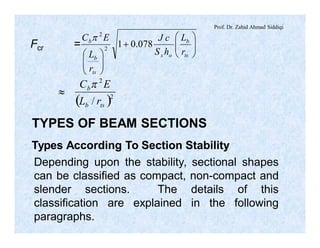
Fcr = ÷÷
ø
ö
çç
è
æ
+
÷÷
ø
ö
çç
è
æ ts
b
ox
ts
b
b
r
L
hS
cJ
r
L
EC
078.012
2
p
»
( )2
2
/ tsb
b
rL
EC p
TYPES OF BEAM SECTIONS
Types According To Section Stability
Depending upon the stability, sectional shapes
can be classified as compact, non-compact and
slender sections. The details of this
classification are explained in the following
paragraphs.
Prof. Dr. Zahid Ahmad Siddiqi
Compact section
A compact section is the one that is capable of
developing its full plastic moment capacity
before any local buckling occurs.
In order to qualify under this category, a member
must meet the following requirements (Table
B4.1 of AISC Specification):
1. Web is continuously connected with the flange.
2. Flange local stability criterion is satisfied.
3. Web local buckling criterion is satisfied.
4. Lateral torsional buckling is absent.
Prof. Dr. Zahid Ahmad Siddiqi
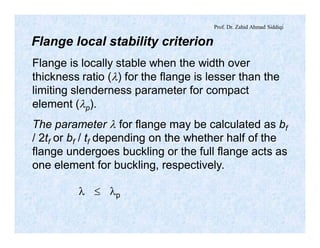
Flange local stability criterion
Flange is locally stable when the width over
thickness ratio (l) for the flange is lesser than the
limiting slenderness parameter for compact
element (lp).
The parameter l for flange may be calculated as bf
/ 2tf or bf / tf depending on the whether half of the
flange undergoes buckling or the full flange acts as
one element for buckling, respectively.
l £ lp
Prof. Dr. Zahid Ahmad Siddiqi
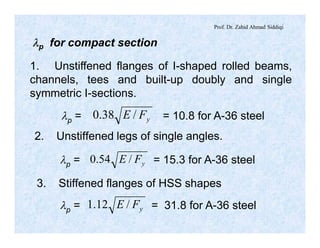
lp for compact section
1. Unstiffened flanges of I-shaped rolled beams,
channels, tees and built-up doubly and single
symmetric I-sections.
lp = = 10.8 for A-36 steelyFE /38.0
2. Unstiffened legs of single angles.
yFE /54.0lp = = 15.3 for A-36 steel
3. Stiffened flanges of HSS shapes
yFE /12.1lp = = 31.8 for A-36 steel
Prof. Dr. Zahid Ahmad Siddiqi
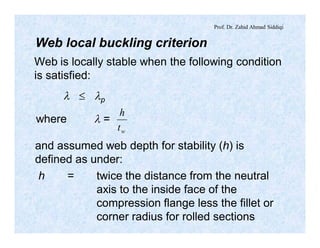
Web local buckling criterion
Web is locally stable when the following condition
is satisfied:
l £ lp
where l =
wt
h
and assumed web depth for stability (h) is
defined as under:
h = twice the distance from the neutral
axis to the inside face of the
compression flange less the fillet or
corner radius for rolled sections
Prof. Dr. Zahid Ahmad Siddiqi
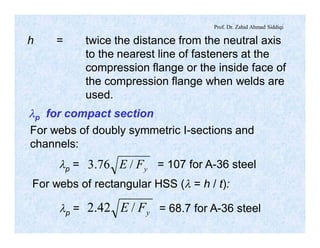
h = twice the distance from the neutral axis
to the nearest line of fasteners at the
compression flange or the inside face of
the compression flange when welds are
used.
lp for compact section
For webs of doubly symmetric I-sections and
channels:
lp = = 107 for A-36 steelyFE /76.3
For webs of rectangular HSS (l = h / t):
lp = = 68.7 for A-36 steelyFE /42.2
Prof. Dr. Zahid Ahmad Siddiqi
Lateral torsional buckling
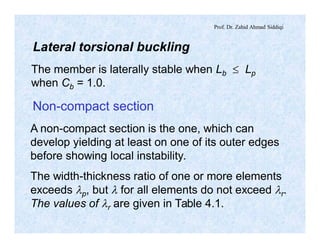
The member is laterally stable when Lb £ Lp
when Cb = 1.0.
Non-compact section
A non-compact section is the one, which can
develop yielding at least on one of its outer edges
before showing local instability.
The width-thickness ratio of one or more elements
exceeds lp, but l for all elements do not exceed lr.
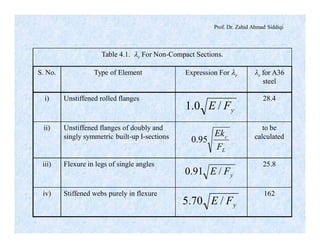
The values of lr are given in Table 4.1.
Prof. Dr. Zahid Ahmad Siddiqi
yFE /0.1
L
c
F
Ek
95.0
yFE /91.0
yFE /70.5
Table 4.1. lr For Non-Compact Sections.
S. No. Type of Element Expression For lr lr for A36
steel
i) Unstiffened rolled flanges 28.4
ii) Unstiffened flanges of doubly and
singly symmetric built-up I-sections
to be
calculated
iii) Flexure in legs of single angles 25.8
iv) Stiffened webs purely in flexure 162
Prof. Dr. Zahid Ahmad Siddiqi
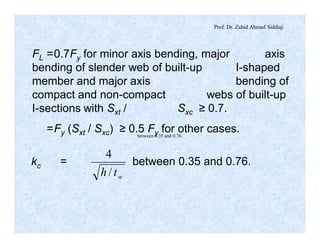
FL =0.7Fy for minor axis bending, major axis
bending of slender web of built-up I-shaped
member and major axis bending of
compact and non-compact webs of built-up
I-sections with Sxt / Sxc ≥ 0.7.
=Fy (Sxt / Sxc) ≥ 0.5 Fy for other cases.
kc = between 0.35 and 0.76.
wth /
4
between 0.35 and 0.76.
Prof. Dr. Zahid Ahmad Siddiqi
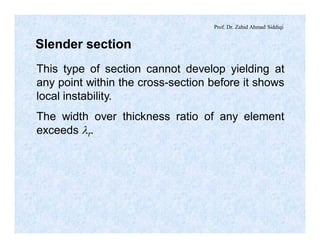
Slender section
This type of section cannot develop yielding at
any point within the cross-section before it shows
local instability.
The width over thickness ratio of any element
exceeds lr.
Prof. Dr. Zahid Ahmad Siddiqi
TYPES OF BEAMS
Depending on various aspects, the beams
may be categorized as under:
Position
Central beams.
End beams.
End Conditions
Simple beams. The simple beams, girders
and trusses have an effective length equal to
the distance between centres of gravity of the
members on which they rest.
Prof. Dr. Zahid Ahmad Siddiqi
Cantilever beams.
Continuous beams.
Fixed ended beams.
Propped cantilever beams.
Fabrication
(a) Rolled steel sections
W-sections are most economic and widely used
shapes as beams.
However, beams may also be of S or M shapes.
Angle and channel sections are used for smaller
beams.
Prof. Dr. Zahid Ahmad Siddiqi
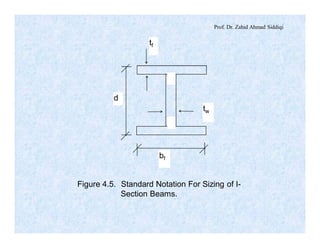
tw
bf
d
tf
Figure 4.5. Standard Notation For Sizing of I-
Section Beams.
Prof. Dr. Zahid Ahmad Siddiqi
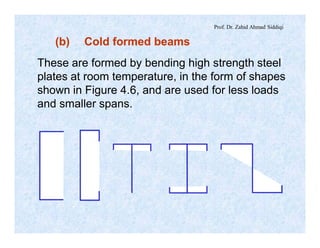
(b) Cold formed beams
These are formed by bending high strength steel
plates at room temperature, in the form of shapes
shown in Figure 4.6, and are used for less loads
and smaller spans.
Prof. Dr. Zahid Ahmad Siddiqi
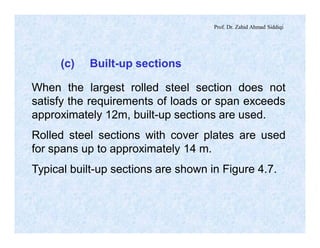
(c) Built-up sections
When the largest rolled steel section does not
satisfy the requirements of loads or span exceeds
approximately 12m, built-up sections are used.
Rolled steel sections with cover plates are used
for spans up to approximately 14 m.
Typical built-up sections are shown in Figure 4.7.
Prof. Dr. Zahid Ahmad Siddiqi
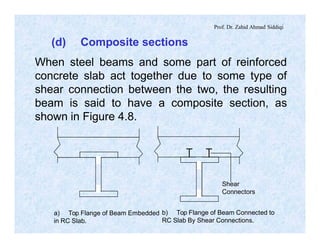
(d) Composite sections
When steel beams and some part of reinforced
concrete slab act together due to some type of
shear connection between the two, the resulting
beam is said to have a composite section, as
shown in Figure 4.8.
a) Top Flange of Beam Embedded
in RC Slab.
b) Top Flange of Beam Connected to
RC Slab By Shear Connections.
Shear
Connectors
Prof. Dr. Zahid Ahmad Siddiqi
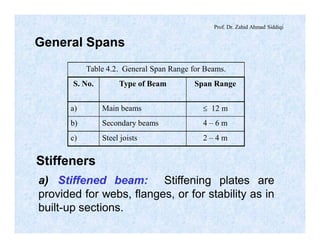
General Spans
Table 4.2. General Span Range for Beams.
S. No. Type of Beam Span Range
a) Main beams £ 12 m
b) Secondary beams 4 – 6 m
c) Steel joists 2 – 4 m
Stiffeners
a) Stiffened beam: Stiffening plates are
provided for webs, flanges, or for stability as in
built-up sections.
Prof. Dr. Zahid Ahmad Siddiqi
b) Unstiffened beam: Beams without any
additional stiffeners such as rolled steel sections
alone are called unstiffened beams.
Stability Of Section
The beams may consist of compact, non-compact
and slender sections depending on the braced
length and the loading.
The flexural capacity and economy of the beam
greatly depends on the stability of the section
used.
Prof. Dr. Zahid Ahmad Siddiqi
Lateral Support
In case of a beam, lateral support is generally
required to be provided for the compression
flange to prevent lateral torsional buckling.
However, a full support preventing the rotation of
the section is considered preferable.
The lateral support can be of the following types:
(a) Continuous lateral support
In this case, compression flange is braced
laterally along its entire span.
Prof. Dr. Zahid Ahmad Siddiqi
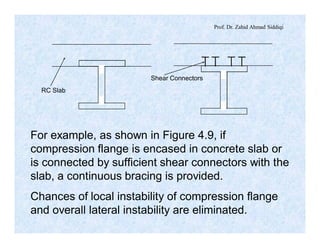
RC Slab
Shear Connectors
For example, as shown in Figure 4.9, if
compression flange is encased in concrete slab or
is connected by sufficient shear connectors with the
slab, a continuous bracing is provided.
Chances of local instability of compression flange
and overall lateral instability are eliminated.
Prof. Dr. Zahid Ahmad Siddiqi
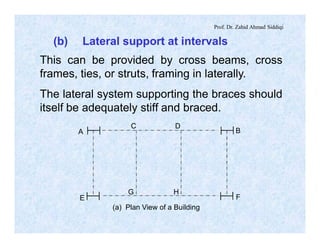
A
C D
B
E F
G H
(a) Plan View of a Building
(b) Lateral support at intervals
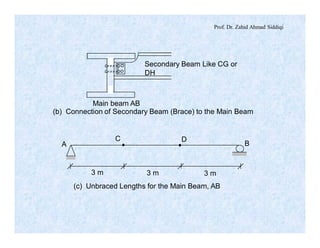
This can be provided by cross beams, cross
frames, ties, or struts, framing in laterally.
The lateral system supporting the braces should
itself be adequately stiff and braced.
Prof. Dr. Zahid Ahmad Siddiqi
Secondary Beam Like CG or
DH
Main beam AB
3 m 3 m 3 m
A
C D
B
(b) Connection of Secondary Beam (Brace) to the Main Beam
(c) Unbraced Lengths for the Main Beam, AB
Prof. Dr. Zahid Ahmad Siddiqi
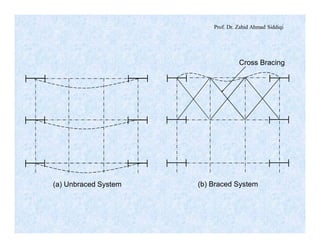
While providing lateral support at intervals, it is
necessary to make sure that the supporting structure
itself does not buckle simultaneously.
Figure 4.11(a) represents a case in which all the
main beams can buckle as a whole with unbraced
length equal to their full span even if cross beams
are present.
However, cross bracing is provided in Figure 4.11(b),
which makes the lateral bracing effective.
The system of cross bracing provided in one of the
bays will act as sufficient lateral support for the
beams of several bays.
Prof. Dr. Zahid Ahmad Siddiqi
(a) Unbraced System (b) Braced System
Cross Bracing
Prof. Dr. Zahid Ahmad Siddiqi
FLEXURAL BEHAVIOR OF
COMPACT BEAMS
When beams have adequate lateral stability of the
compression flange, the only stability limit state that
might limit moment strength is local buckling in
compression flange and/or web plate elements
making up the cross-section.
For an internally compact section, even these types
of instabilities do not occur and the section may
reach the limit state of yielding throughout the
depth of the cross section.
Prof. Dr. Zahid Ahmad Siddiqi
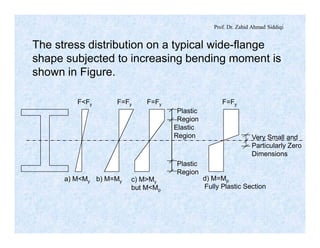
The stress distribution on a typical wide-flange
shape subjected to increasing bending moment is
shown in Figure.
F<Fy
a) M<My
F=Fy
b) M=My
F=Fy
Plastic
Region
Elastic
Region
Plastic
Region
c) M>My
but M<Mp
F=Fy
Fully Plastic Section
d) M=Mp
Very Small and
Particularly Zero
Dimensions
Prof. Dr. Zahid Ahmad Siddiqi
When the yield stress is reached at the extreme
fibre, the nominal moment strength Mn is referred
to as the yield moment My and is computed as
Mn = My = Sx Fy
When the condition of part (d) is reached, every
fibre has a strain equal to or greater than ey = Fy /
Es and is in the plastic range.
The nominal moment strength Mn in this case is,
therefore, referred to as the plastic moment
(Mp), which is computed as follows:
Prof. Dr. Zahid Ahmad Siddiqi
Mp = Fy y dA = Fy Zxò A
Where Zx, equal to ò ydA, is first moment of all
the area about an axis that equally divides the
area (equal area axis) and is called plastic
section modulus.
It is observed that the ratio Mp / My is a property of
the cross-sectional shape and is independent of
the material properties.
It tells how much the moment at a section can be
increased beyond first yield moment.
This ratio is referred to as the shape factor
denoted by the letter f.
Prof. Dr. Zahid Ahmad Siddiqi
x
x
y
p
S
Z
M
M
f ==
Once the plastic moment strength Mp has been
reached, the section can offer no additional
resistance to rotation, behaving as a fictitious
hinge but with constant resistive moment Mp, a
condition known as a plastic hinge.
Plastic hinge acts just like a real hinge in
producing instability of the structure.
In general, any combination of three hinges, real
or plastic, in a span will result in an unstable
condition known as a collapse mechanism.
Prof. Dr. Zahid Ahmad Siddiqi
Mp
My
Mr
Mn = Mp
Inelastic
Behaviour
Elastic Behavior
LrLp
Laterally Unbraced Length (Lb)
NominalMomentStrength(Mn)
Prof. Dr. Zahid Ahmad Siddiqi
Further, the nominal flexural strength, Mn, of a
beam is the lowest value obtained for the
following limit states:
a) yielding,
b) lateral-torsional buckling,
c) flange local buckling, and
d) web local buckling.
Prof. Dr. Zahid Ahmad Siddiqi
LTB BUCKLING MODIFICATION
FACTOR (Cb)
According to AISC, Cb is the lateral-torsional
buckling modification factor for non-uniform moment
diagrams when both ends of the unsupported
segment are braced.
The factor Cb accounts for the moment gradient or
the shape of the bending moment diagram.
Effect of the maximum moment present throughout
the beam segment is much more severe and Cb =
1.0 for this case.
Greater values of Cb indicate more flexural strength.
Prof. Dr. Zahid Ahmad Siddiqi
If bending moment is lesser within the span
than the ends, Cb can be taken greater than
one.
Similarly, in addition to above, if reverse
curvature is present, the situation becomes still
less severe and value of Cb may further be
increased.
1. Cb = 1.0 for cantilevers or overhangs with
unbraced free ends.
Value of Cb
Prof. Dr. Zahid Ahmad Siddiqi
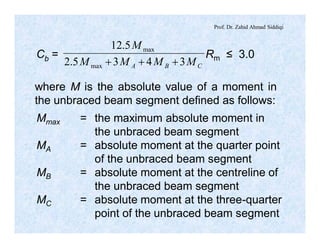
Cb = Rm ≤ 3.0
CBA MMMM
M
3435.2
5.12
max
max
+++
where M is the absolute value of a moment in
the unbraced beam segment defined as follows:
Mmax = the maximum absolute moment in
the unbraced beam segment
MA = absolute moment at the quarter point
of the unbraced beam segment
MB = absolute moment at the centreline of
the unbraced beam segment
MC = absolute moment at the three-quarter
point of the unbraced beam segment
Prof. Dr. Zahid Ahmad Siddiqi
Rm = cross section mono-symmetry parameter
= 1.0 for doubly symmetric member
Unbraced Length And Cb For Cantilever Beams
If no lateral brace is provided in the cantilever
length, Lb = actual length and Cb = 1.0.
If lateral brace is provided at free end, Lb = actual
length and Cb is calculated by the formula.
Prof. Dr. Zahid Ahmad Siddiqi
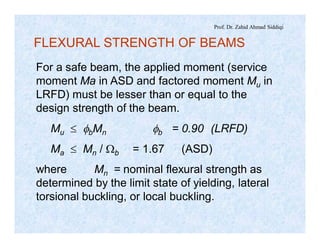
FLEXURAL STRENGTH OF BEAMS
For a safe beam, the applied moment (service
moment Ma in ASD and factored moment Mu in
LRFD) must be lesser than or equal to the
design strength of the beam.
Mu £ fbMn fb = 0.90 (LRFD)
Ma £ Mn / Wb = 1.67 (ASD)
where Mn = nominal flexural strength as
determined by the limit state of yielding, lateral
torsional buckling, or local buckling.
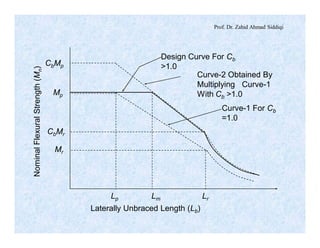
Prof. Dr. Zahid Ahmad Siddiqi
To graphically show the effect of a value of Cb
greater than one on the design flexural strength of
a beam, the curve of Figure 4.13 is multiplied with
Cb = 1.0 and is reproduced in Figure 4.14 as
Curve-1.
The flexural capacity is increased by multiplying
with Cb (greater than one) and is presented as
Curve-2.
However, the flexural capacity of any section
cannot be greater than the full plastic moment
capacity.
Prof. Dr. Zahid Ahmad Siddiqi
Applying this condition, Curve-2 is changed into
the applicable curve shown by solid line in the
figure.
A new value of limiting unbraced length denoted
by Lm is to be defined in place of Lp as follows:
Lm = limiting unbraced length for full
plastic bending capacity when
Cb>1.0 which is between the lengths
Lp and Lr.
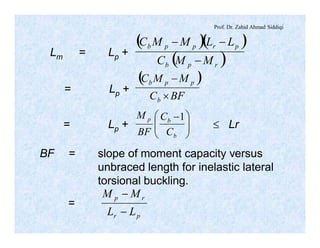
This length may be calculated by using the
following expression:
Prof. Dr. Zahid Ahmad Siddiqi
CbMp
Mp
CbMr
Mr
Lp Lm Lr
Curve-1 For Cb
=1.0
Curve-2 Obtained By
Multiplying Curve-1
With Cb >1.0
Design Curve For Cb
>1.0
Laterally Unbraced Length (Lb)
NominalFlexuralStrength(Mn)
Prof. Dr. Zahid Ahmad Siddiqi
Lm = Lp +
( )( )
( )rpb
prppb
MMC
LLMMC
-
--
= Lp +
( )
BFC
MMC
b
ppb
´
-
= Lp + £ Lr÷÷
ø
ö
çç
è
æ -
b
bp
C
C
BF
M 1
BF = slope of moment capacity versus
unbraced length for inelastic lateral
torsional buckling.
=
pr
rp
LL
MM
-
-
Prof. Dr. Zahid Ahmad Siddiqi
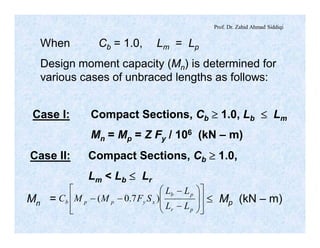
When Cb = 1.0, Lm = Lp
Design moment capacity (Mn) is determined for
various cases of unbraced lengths as follows:
Case I: Compact Sections, Cb ³ 1.0, Lb £ Lm
Mn = Mp = Z Fy / 106 (kN – m)
Case II: Compact Sections, Cb ³ 1.0,
Lm < Lb £ Lr
Mn = £ Mp (kN – m)
ú
ú
û
ù
ê
ê
ë
é
÷
÷
ø
ö
ç
ç
è
æ
-
-
--
pr
pb
xyppb
LL
LL
SFMMC )7.0(
Prof. Dr. Zahid Ahmad Siddiqi
Mn = Cb [Mp – BF(Lb – Lp)] £ Mp (kN – m)
Case III: Compact Sections, Cb ³ 1.0,
Lb > Lr
For doubly symmetric I-shaped and channel
section members:
Mn = CbFcrSx £ Mp
where Fcr =
2
2
2
078.01 ÷÷
ø
ö
çç
è
æ
+
÷÷
ø
ö
çç
è
æ ts
b
ox
ts
b
b
r
L
hS
cJ
r
L
EC p
The variables rts and others are as defined earlier.
Prof. Dr. Zahid Ahmad Siddiqi
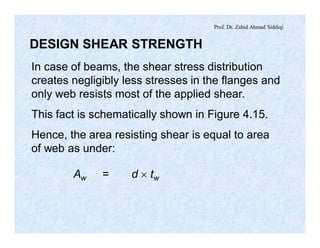
DESIGN SHEAR STRENGTH
In case of beams, the shear stress distribution
creates negligibly less stresses in the flanges and
only web resists most of the applied shear.
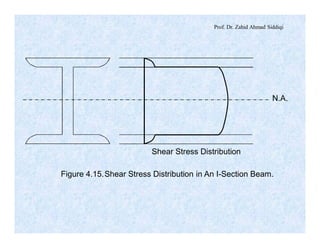
This fact is schematically shown in Figure 4.15.
Hence, the area resisting shear is equal to area
of web as under:
Aw = d ´ tw
Prof. Dr. Zahid Ahmad Siddiqi
Shear Stress Distribution
N.A.
Figure 4.15.Shear Stress Distribution in An I-Section Beam.
Prof. Dr. Zahid Ahmad Siddiqi
The stable web of a beam may reach its limit by
web yielding, in which yielding in shear takes
place when the applied shear stress (t)
becomes equal to shear yield stress (ty).
For ductile materials, shear yield stress is
approximately equal to 60 percent of the
tension yield stress (0.6 Fy).
The factor 0.6 is not a factor of safety but is a
factor to approximately change principal tensile
stress into shear stress at maximum shear
stress plane or vice versa.
Prof. Dr. Zahid Ahmad Siddiqi
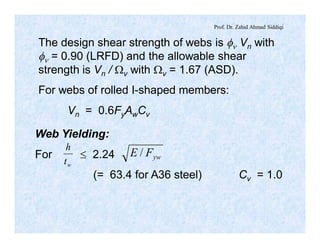
The design shear strength of webs is fn Vn with
fn = 0.90 (LRFD) and the allowable shear
strength is Vn / Wv with Wv = 1.67 (ASD).
For webs of rolled I-shaped members:
Vn = 0.6FyAwCv
wt
h
ywFE /
Web Yielding:
For £ 2.24
(= 63.4 for A36 steel) Cv = 1.0
Prof. Dr. Zahid Ahmad Siddiqi
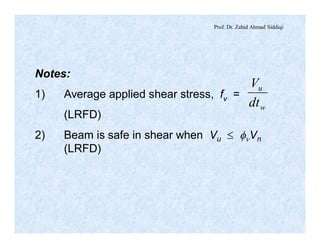
Notes:
1) Average applied shear stress, fv =
(LRFD)
2) Beam is safe in shear when Vu £ fnVn
(LRFD)
w
u
dt
V
Prof. Dr. Zahid Ahmad Siddiqi
DEFLECTIONS
Deflection check is a serviceability limit state
check and hence it is applied using the service
loads and not the factored loads.
Further, for steel structures, this check is usually
applied only using the service live load and the
deflection due to dead loads are not considered.
The reason for not including the dead load in the
calculation of deflections is that the structure is
given a negative camber during construction to
balance the dead load deflections.
Prof. Dr. Zahid Ahmad Siddiqi
There are several justifications for limiting service
live load deflections, some of which are as under:
1. The deflections produced should not be
visible to the people.
It is important to remember that some
deflection always occur which can be
measured by instruments.
Common people may consider a structure
that is completely safe from strength point of
view unsafe and dangerous if the deflections
are larger.
Prof. Dr. Zahid Ahmad Siddiqi
2. The appearance of structures may be
damaged by excessive deflections such as the
plaster may crack and other surface finishes
may be disturbed.
3. Excessive deflections in a member may
damage other members attached to it.
For example, deflections produced in a main
beam may cause high extra stresses in the
secondary beams and roofing resting on it.
4. In case the structure is supporting any type
of machinery, the deflection of one part may
disturb the alignment of the machinery shafts.
Prof. Dr. Zahid Ahmad Siddiqi
5. Sometimes, it may be required that different
parts of structure deflect by same amount when
symmetric loads are applied on them.

Steel strucure lec # (9)

  • 1.
    Prof. Dr. ZahidAhmad Siddiqi ANALYSIS AND DESIGN OF BEAMS INTRODUCTION A beam is a structural member in which the major deformation is bending. The bending moment is primarily generated due to transverse loads. This member carries the loads throughout its span and transfers it to its ends with or without accompanying moment.
  • 2.
    Prof. Dr. ZahidAhmad Siddiqi Beam is a combination of a compression member on one side of neutral axis and a tension member on the other side, joined together through a shear element. Following terms are used for various types of beams according to their use: Girder: The primary beams that are frequently used at wide spacing supporting the smaller beams and other structural components are called girders.
  • 3.
    Prof. Dr. ZahidAhmad Siddiqi Frequently, girders are made of built-up sections and carry heavier loads over larger spans. These are supported directly on columns (Figure 4.1). Secondary Beam: These are relatively smaller beams resting on primary beams/girders carrying load of lesser part of roof and having smaller span lengths (Figure 4.1).
  • 4.
    Prof. Dr. ZahidAhmad Siddiqi Secondary Beams Joist Main Beam (Girder) Column Figure 4.1. Typical Plan of a Building Showing Layout of Columns and Beams.
  • 5.
    Prof. Dr. ZahidAhmad Siddiqi Joists: Joists are less important beams that are closely spaced and are frequently having truss-type webs. These are closely spaced smaller beams resting on secondary beams in majority of the cases. With the presence of joists, the strength requirements of the roof sheathing or slab are greatly reduced (Figure 4.1).
  • 6.
    Prof. Dr. ZahidAhmad Siddiqi Purlins: These are roof beams spanning between trusses. Roof sheathing is connected with purlins, which is in turn are connected to panel points of the truss, with no direct connection between the roof and the truss top chord. Uniformly distributed roof load is carried by the purlins and is converted into point loads acting at panel points of the truss. Because of inclination of the load with the centroidal axes of the section and application of load on top chord, these beams are subjected to biaxial bending along with torsion.
  • 7.
    Prof. Dr. ZahidAhmad Siddiqi Stringers: Longitudinal bridge beams spanning between floor beams and placed parallel to roadway are called stringers (Figure 4.2). Floor Beams: Floor beams are main girders of the bridge spanning between trusses or plate girders and running perpendicular to the roadway of the bridge (Figure 4.2). Girts: Horizontal wall beams used to resist horizontal bending due to wind acting on the side of an industrial building are referred to as girts.
  • 8.
    Prof. Dr. ZahidAhmad Siddiqi Shear Connectors Stringer Floor Beam Truss or Plate Girder R.C. Slab Figure 4.2. Typical Cross-Section of a Steel Bridge.
  • 9.
    Prof. Dr. ZahidAhmad Siddiqi Lintels: Lintels are members supporting a wall over window or door openings. Spandrels: In case of high-rise buildings, the masonry walls are usually not able to withstand their self-weight and the slab weight. In such cases, beams are provided in exterior walls at each floor level to support the wall load and perhaps some roof load also. These beams are termed as spandrels.
  • 10.
    Prof. Dr. ZahidAhmad Siddiqi THE FLEXURE FORMULA By denoting the elastic section modulus by S and the applied bending moment by M, the bending stresses may be calculated using the flexure formula as under: Elastic bending stress, I yM yI M S M Fb = = = Using the above expression, the required section modulus to resist a particular bending moment may be obtained as follows:
  • 11.
    Prof. Dr. ZahidAhmad Siddiqi Sreq = aF M where Fa = allowable bending stress In a similar manner, plastic section modulus (Z) to provide a particular ultimate moment capacity may be calculated for a laterally supported and compact section beam by using the formula: Zreq = y u F M f
  • 12.
    Prof. Dr. ZahidAhmad Siddiqi STABILITY OF BEAM SECTIONS Local Stability If width over thickness ratio of the compression flange is greater than a certain limit, flange can buckle locally. The phenomenon is called flange local buckling (FLB) and is shown in Figure 4.3. Similarly, if depth over thickness ratio is greater for the web, it can locally buckle or cripple under compression (Figure 4.4). This phenomenon is called as web local buckling (WLB).
  • 13.
    Prof. Dr. ZahidAhmad Siddiqi Buckling is diagonal perpendicular to the paper Figure 4.3. Flange Local Buckling. (a) Web Local Buckling (b) Web Crippling Due to Concentrated Load Figure 4.4. Web Instability.
  • 14.
    Prof. Dr. ZahidAhmad Siddiqi Web local buckling usually occurs in a diagonal position and is produced by the diagonal compression existing in the web due to shear. On the other hand, web crippling occurs due to local compression transferred by the flange to the connecting portion of web. Lateral Stability Due to lateral buckling of the compression zone, the section is twisted as a whole due to the fact that tension zone remains stable and tries to retain its position.
  • 15.
    Prof. Dr. ZahidAhmad Siddiqi This combined twisting and buckling of beam in a lateral direction is called lateral torsional buckling (LTB). It depends upon the laterally unsupported length besides the loading and the sectional dimensions. Unbraced or unsupported length of beam (Lb) It is defined as the length of beam within its two sections whose compression flange is laterally supported or braced against twist of the cross section by perpendicular beams, slab or by some other means.
  • 16.
    Prof. Dr. ZahidAhmad Siddiqi In other words, it is the distance between two points braced against lateral displacement of the compression flange denoted by Lb. The sections braced to prevent twist of the member are considered better for the bracing against the lateral torsional buckling. Lateral stability against LTB AISC-F2 deals with doubly symmetric compact I- shaped members and channels bent about their major axis.
  • 17.
    Prof. Dr. ZahidAhmad Siddiqi These provisions are valid for sections having compact webs and compact flanges. The nominal flexural strength (Mn) is the lower value for limits states of yielding and lateral - torsional buckling. A member will be safe against lateral torsional buckling up to its full plastic moment capacity if the unbraced length of the beam (Lb) is not greater than Lp, i.e., Lb £ Lp for no LTB
  • 18.
    Prof. Dr. ZahidAhmad Siddiqi where, Lp = Limiting laterally unbraced length for full plastic bending capacity (Mp = Zx´Fy) in uniform moment case (Cb = 1.0). For I-shaped members including hybrid sections and channels: Lp = y y F E r76.1 @ 50 ry (for A-36 Steel) A section may develop yielding only at some points in case of inelastic buckling, when the unbraced length is between the two limiting lengths Lp and Lr, that is, when,
  • 19.
    Prof. Dr. ZahidAhmad Siddiqi Lp < Lb £ Lr where Lr = limiting laterally unbraced length for inelastic torsional buckling, mm. For doubly symmetric I-shaped members: Lr = 2 7.0 76.611 7.0 95.1 ÷÷ ø ö çç è æ ++ cJ hS E F hS cJ F E r oxy oxy ts » y ts F E r 7.0 95.1 (very conservative estimate)
  • 20.
    Prof. Dr. ZahidAhmad Siddiqi Mr = limiting buckling moment dividing elastic and inelastic buckling for Cb = 1.0, Cb will be defined later = 0.7Fy Sx/106 kN-m 2 tsr x wy S CI x oy S hI 2 = for doubly symmetric I-sections= rts » radius of gyration of the compression flange plus one-sixth of the web for doubly symmetric I-sections
  • 21.
    Prof. Dr. ZahidAhmad Siddiqi ÷ ÷ ø ö ç ç è æ + ff w f tb th b 6 1 112 rts = c = 1.0 for a doubly symmetric I-shape ho = distance between the flange centroids = d – tf / 2 Cw = warping torsional constant for the section, mm6 For symmetrical sections, Cw = 42 22 oyof hIhI » If = moment of inertia of one flange in lateral direction, mm4
  • 22.
    Prof. Dr. ZahidAhmad Siddiqi J = torsional constant for the section, mm4 » å 3 bt 3 1 For the above expression, b is the long dimension and t is the short dimension of any rectangular element of the section and summation is for all the elements of that section. When Lb > Lr Mn = FcrSx ≤ Mp Fcr = compression flange critical buckling stress
  • 23.
    Prof. Dr. ZahidAhmad Siddiqi Fcr = ÷÷ ø ö çç è æ + ÷÷ ø ö çç è æ ts b ox ts b b r L hS cJ r L EC 078.012 2 p » ( )2 2 / tsb b rL EC p TYPES OF BEAM SECTIONS Types According To Section Stability Depending upon the stability, sectional shapes can be classified as compact, non-compact and slender sections. The details of this classification are explained in the following paragraphs.
  • 24.
    Prof. Dr. ZahidAhmad Siddiqi Compact section A compact section is the one that is capable of developing its full plastic moment capacity before any local buckling occurs. In order to qualify under this category, a member must meet the following requirements (Table B4.1 of AISC Specification): 1. Web is continuously connected with the flange. 2. Flange local stability criterion is satisfied. 3. Web local buckling criterion is satisfied. 4. Lateral torsional buckling is absent.
  • 25.
    Prof. Dr. ZahidAhmad Siddiqi Flange local stability criterion Flange is locally stable when the width over thickness ratio (l) for the flange is lesser than the limiting slenderness parameter for compact element (lp). The parameter l for flange may be calculated as bf / 2tf or bf / tf depending on the whether half of the flange undergoes buckling or the full flange acts as one element for buckling, respectively. l £ lp
  • 26.
    Prof. Dr. ZahidAhmad Siddiqi lp for compact section 1. Unstiffened flanges of I-shaped rolled beams, channels, tees and built-up doubly and single symmetric I-sections. lp = = 10.8 for A-36 steelyFE /38.0 2. Unstiffened legs of single angles. yFE /54.0lp = = 15.3 for A-36 steel 3. Stiffened flanges of HSS shapes yFE /12.1lp = = 31.8 for A-36 steel
  • 27.
    Prof. Dr. ZahidAhmad Siddiqi Web local buckling criterion Web is locally stable when the following condition is satisfied: l £ lp where l = wt h and assumed web depth for stability (h) is defined as under: h = twice the distance from the neutral axis to the inside face of the compression flange less the fillet or corner radius for rolled sections
  • 28.
    Prof. Dr. ZahidAhmad Siddiqi h = twice the distance from the neutral axis to the nearest line of fasteners at the compression flange or the inside face of the compression flange when welds are used. lp for compact section For webs of doubly symmetric I-sections and channels: lp = = 107 for A-36 steelyFE /76.3 For webs of rectangular HSS (l = h / t): lp = = 68.7 for A-36 steelyFE /42.2
  • 29.
    Prof. Dr. ZahidAhmad Siddiqi Lateral torsional buckling The member is laterally stable when Lb £ Lp when Cb = 1.0. Non-compact section A non-compact section is the one, which can develop yielding at least on one of its outer edges before showing local instability. The width-thickness ratio of one or more elements exceeds lp, but l for all elements do not exceed lr. The values of lr are given in Table 4.1.
  • 30.
    Prof. Dr. ZahidAhmad Siddiqi yFE /0.1 L c F Ek 95.0 yFE /91.0 yFE /70.5 Table 4.1. lr For Non-Compact Sections. S. No. Type of Element Expression For lr lr for A36 steel i) Unstiffened rolled flanges 28.4 ii) Unstiffened flanges of doubly and singly symmetric built-up I-sections to be calculated iii) Flexure in legs of single angles 25.8 iv) Stiffened webs purely in flexure 162
  • 31.
    Prof. Dr. ZahidAhmad Siddiqi FL =0.7Fy for minor axis bending, major axis bending of slender web of built-up I-shaped member and major axis bending of compact and non-compact webs of built-up I-sections with Sxt / Sxc ≥ 0.7. =Fy (Sxt / Sxc) ≥ 0.5 Fy for other cases. kc = between 0.35 and 0.76. wth / 4 between 0.35 and 0.76.
  • 32.
    Prof. Dr. ZahidAhmad Siddiqi Slender section This type of section cannot develop yielding at any point within the cross-section before it shows local instability. The width over thickness ratio of any element exceeds lr.
  • 33.
    Prof. Dr. ZahidAhmad Siddiqi TYPES OF BEAMS Depending on various aspects, the beams may be categorized as under: Position Central beams. End beams. End Conditions Simple beams. The simple beams, girders and trusses have an effective length equal to the distance between centres of gravity of the members on which they rest.
  • 34.
    Prof. Dr. ZahidAhmad Siddiqi Cantilever beams. Continuous beams. Fixed ended beams. Propped cantilever beams. Fabrication (a) Rolled steel sections W-sections are most economic and widely used shapes as beams. However, beams may also be of S or M shapes. Angle and channel sections are used for smaller beams.
  • 35.
    Prof. Dr. ZahidAhmad Siddiqi tw bf d tf Figure 4.5. Standard Notation For Sizing of I- Section Beams.
  • 36.
    Prof. Dr. ZahidAhmad Siddiqi (b) Cold formed beams These are formed by bending high strength steel plates at room temperature, in the form of shapes shown in Figure 4.6, and are used for less loads and smaller spans.
  • 37.
    Prof. Dr. ZahidAhmad Siddiqi (c) Built-up sections When the largest rolled steel section does not satisfy the requirements of loads or span exceeds approximately 12m, built-up sections are used. Rolled steel sections with cover plates are used for spans up to approximately 14 m. Typical built-up sections are shown in Figure 4.7.
  • 38.
    Prof. Dr. ZahidAhmad Siddiqi (d) Composite sections When steel beams and some part of reinforced concrete slab act together due to some type of shear connection between the two, the resulting beam is said to have a composite section, as shown in Figure 4.8. a) Top Flange of Beam Embedded in RC Slab. b) Top Flange of Beam Connected to RC Slab By Shear Connections. Shear Connectors
  • 39.
    Prof. Dr. ZahidAhmad Siddiqi General Spans Table 4.2. General Span Range for Beams. S. No. Type of Beam Span Range a) Main beams £ 12 m b) Secondary beams 4 – 6 m c) Steel joists 2 – 4 m Stiffeners a) Stiffened beam: Stiffening plates are provided for webs, flanges, or for stability as in built-up sections.
  • 40.
    Prof. Dr. ZahidAhmad Siddiqi b) Unstiffened beam: Beams without any additional stiffeners such as rolled steel sections alone are called unstiffened beams. Stability Of Section The beams may consist of compact, non-compact and slender sections depending on the braced length and the loading. The flexural capacity and economy of the beam greatly depends on the stability of the section used.
  • 41.
    Prof. Dr. ZahidAhmad Siddiqi Lateral Support In case of a beam, lateral support is generally required to be provided for the compression flange to prevent lateral torsional buckling. However, a full support preventing the rotation of the section is considered preferable. The lateral support can be of the following types: (a) Continuous lateral support In this case, compression flange is braced laterally along its entire span.
  • 42.
    Prof. Dr. ZahidAhmad Siddiqi RC Slab Shear Connectors For example, as shown in Figure 4.9, if compression flange is encased in concrete slab or is connected by sufficient shear connectors with the slab, a continuous bracing is provided. Chances of local instability of compression flange and overall lateral instability are eliminated.
  • 43.
    Prof. Dr. ZahidAhmad Siddiqi A C D B E F G H (a) Plan View of a Building (b) Lateral support at intervals This can be provided by cross beams, cross frames, ties, or struts, framing in laterally. The lateral system supporting the braces should itself be adequately stiff and braced.
  • 44.
    Prof. Dr. ZahidAhmad Siddiqi Secondary Beam Like CG or DH Main beam AB 3 m 3 m 3 m A C D B (b) Connection of Secondary Beam (Brace) to the Main Beam (c) Unbraced Lengths for the Main Beam, AB
  • 45.
    Prof. Dr. ZahidAhmad Siddiqi While providing lateral support at intervals, it is necessary to make sure that the supporting structure itself does not buckle simultaneously. Figure 4.11(a) represents a case in which all the main beams can buckle as a whole with unbraced length equal to their full span even if cross beams are present. However, cross bracing is provided in Figure 4.11(b), which makes the lateral bracing effective. The system of cross bracing provided in one of the bays will act as sufficient lateral support for the beams of several bays.
  • 46.
    Prof. Dr. ZahidAhmad Siddiqi (a) Unbraced System (b) Braced System Cross Bracing
  • 47.
    Prof. Dr. ZahidAhmad Siddiqi FLEXURAL BEHAVIOR OF COMPACT BEAMS When beams have adequate lateral stability of the compression flange, the only stability limit state that might limit moment strength is local buckling in compression flange and/or web plate elements making up the cross-section. For an internally compact section, even these types of instabilities do not occur and the section may reach the limit state of yielding throughout the depth of the cross section.
  • 48.
    Prof. Dr. ZahidAhmad Siddiqi The stress distribution on a typical wide-flange shape subjected to increasing bending moment is shown in Figure. F<Fy a) M<My F=Fy b) M=My F=Fy Plastic Region Elastic Region Plastic Region c) M>My but M<Mp F=Fy Fully Plastic Section d) M=Mp Very Small and Particularly Zero Dimensions
  • 49.
    Prof. Dr. ZahidAhmad Siddiqi When the yield stress is reached at the extreme fibre, the nominal moment strength Mn is referred to as the yield moment My and is computed as Mn = My = Sx Fy When the condition of part (d) is reached, every fibre has a strain equal to or greater than ey = Fy / Es and is in the plastic range. The nominal moment strength Mn in this case is, therefore, referred to as the plastic moment (Mp), which is computed as follows:
  • 50.
    Prof. Dr. ZahidAhmad Siddiqi Mp = Fy y dA = Fy Zxò A Where Zx, equal to ò ydA, is first moment of all the area about an axis that equally divides the area (equal area axis) and is called plastic section modulus. It is observed that the ratio Mp / My is a property of the cross-sectional shape and is independent of the material properties. It tells how much the moment at a section can be increased beyond first yield moment. This ratio is referred to as the shape factor denoted by the letter f.
  • 51.
    Prof. Dr. ZahidAhmad Siddiqi x x y p S Z M M f == Once the plastic moment strength Mp has been reached, the section can offer no additional resistance to rotation, behaving as a fictitious hinge but with constant resistive moment Mp, a condition known as a plastic hinge. Plastic hinge acts just like a real hinge in producing instability of the structure. In general, any combination of three hinges, real or plastic, in a span will result in an unstable condition known as a collapse mechanism.
  • 52.
    Prof. Dr. ZahidAhmad Siddiqi Mp My Mr Mn = Mp Inelastic Behaviour Elastic Behavior LrLp Laterally Unbraced Length (Lb) NominalMomentStrength(Mn)
  • 53.
    Prof. Dr. ZahidAhmad Siddiqi Further, the nominal flexural strength, Mn, of a beam is the lowest value obtained for the following limit states: a) yielding, b) lateral-torsional buckling, c) flange local buckling, and d) web local buckling.
  • 54.
    Prof. Dr. ZahidAhmad Siddiqi LTB BUCKLING MODIFICATION FACTOR (Cb) According to AISC, Cb is the lateral-torsional buckling modification factor for non-uniform moment diagrams when both ends of the unsupported segment are braced. The factor Cb accounts for the moment gradient or the shape of the bending moment diagram. Effect of the maximum moment present throughout the beam segment is much more severe and Cb = 1.0 for this case. Greater values of Cb indicate more flexural strength.
  • 55.
    Prof. Dr. ZahidAhmad Siddiqi If bending moment is lesser within the span than the ends, Cb can be taken greater than one. Similarly, in addition to above, if reverse curvature is present, the situation becomes still less severe and value of Cb may further be increased. 1. Cb = 1.0 for cantilevers or overhangs with unbraced free ends. Value of Cb
  • 56.
    Prof. Dr. ZahidAhmad Siddiqi Cb = Rm ≤ 3.0 CBA MMMM M 3435.2 5.12 max max +++ where M is the absolute value of a moment in the unbraced beam segment defined as follows: Mmax = the maximum absolute moment in the unbraced beam segment MA = absolute moment at the quarter point of the unbraced beam segment MB = absolute moment at the centreline of the unbraced beam segment MC = absolute moment at the three-quarter point of the unbraced beam segment
  • 57.
    Prof. Dr. ZahidAhmad Siddiqi Rm = cross section mono-symmetry parameter = 1.0 for doubly symmetric member Unbraced Length And Cb For Cantilever Beams If no lateral brace is provided in the cantilever length, Lb = actual length and Cb = 1.0. If lateral brace is provided at free end, Lb = actual length and Cb is calculated by the formula.
  • 58.
    Prof. Dr. ZahidAhmad Siddiqi FLEXURAL STRENGTH OF BEAMS For a safe beam, the applied moment (service moment Ma in ASD and factored moment Mu in LRFD) must be lesser than or equal to the design strength of the beam. Mu £ fbMn fb = 0.90 (LRFD) Ma £ Mn / Wb = 1.67 (ASD) where Mn = nominal flexural strength as determined by the limit state of yielding, lateral torsional buckling, or local buckling.
  • 59.
    Prof. Dr. ZahidAhmad Siddiqi To graphically show the effect of a value of Cb greater than one on the design flexural strength of a beam, the curve of Figure 4.13 is multiplied with Cb = 1.0 and is reproduced in Figure 4.14 as Curve-1. The flexural capacity is increased by multiplying with Cb (greater than one) and is presented as Curve-2. However, the flexural capacity of any section cannot be greater than the full plastic moment capacity.
  • 60.
    Prof. Dr. ZahidAhmad Siddiqi Applying this condition, Curve-2 is changed into the applicable curve shown by solid line in the figure. A new value of limiting unbraced length denoted by Lm is to be defined in place of Lp as follows: Lm = limiting unbraced length for full plastic bending capacity when Cb>1.0 which is between the lengths Lp and Lr. This length may be calculated by using the following expression:
  • 61.
    Prof. Dr. ZahidAhmad Siddiqi CbMp Mp CbMr Mr Lp Lm Lr Curve-1 For Cb =1.0 Curve-2 Obtained By Multiplying Curve-1 With Cb >1.0 Design Curve For Cb >1.0 Laterally Unbraced Length (Lb) NominalFlexuralStrength(Mn)
  • 62.
    Prof. Dr. ZahidAhmad Siddiqi Lm = Lp + ( )( ) ( )rpb prppb MMC LLMMC - -- = Lp + ( ) BFC MMC b ppb ´ - = Lp + £ Lr÷÷ ø ö çç è æ - b bp C C BF M 1 BF = slope of moment capacity versus unbraced length for inelastic lateral torsional buckling. = pr rp LL MM - -
  • 63.
    Prof. Dr. ZahidAhmad Siddiqi When Cb = 1.0, Lm = Lp Design moment capacity (Mn) is determined for various cases of unbraced lengths as follows: Case I: Compact Sections, Cb ³ 1.0, Lb £ Lm Mn = Mp = Z Fy / 106 (kN – m) Case II: Compact Sections, Cb ³ 1.0, Lm < Lb £ Lr Mn = £ Mp (kN – m) ú ú û ù ê ê ë é ÷ ÷ ø ö ç ç è æ - - -- pr pb xyppb LL LL SFMMC )7.0(
  • 64.
    Prof. Dr. ZahidAhmad Siddiqi Mn = Cb [Mp – BF(Lb – Lp)] £ Mp (kN – m) Case III: Compact Sections, Cb ³ 1.0, Lb > Lr For doubly symmetric I-shaped and channel section members: Mn = CbFcrSx £ Mp where Fcr = 2 2 2 078.01 ÷÷ ø ö çç è æ + ÷÷ ø ö çç è æ ts b ox ts b b r L hS cJ r L EC p The variables rts and others are as defined earlier.
  • 65.
    Prof. Dr. ZahidAhmad Siddiqi DESIGN SHEAR STRENGTH In case of beams, the shear stress distribution creates negligibly less stresses in the flanges and only web resists most of the applied shear. This fact is schematically shown in Figure 4.15. Hence, the area resisting shear is equal to area of web as under: Aw = d ´ tw
  • 66.
    Prof. Dr. ZahidAhmad Siddiqi Shear Stress Distribution N.A. Figure 4.15.Shear Stress Distribution in An I-Section Beam.
  • 67.
    Prof. Dr. ZahidAhmad Siddiqi The stable web of a beam may reach its limit by web yielding, in which yielding in shear takes place when the applied shear stress (t) becomes equal to shear yield stress (ty). For ductile materials, shear yield stress is approximately equal to 60 percent of the tension yield stress (0.6 Fy). The factor 0.6 is not a factor of safety but is a factor to approximately change principal tensile stress into shear stress at maximum shear stress plane or vice versa.
  • 68.
    Prof. Dr. ZahidAhmad Siddiqi The design shear strength of webs is fn Vn with fn = 0.90 (LRFD) and the allowable shear strength is Vn / Wv with Wv = 1.67 (ASD). For webs of rolled I-shaped members: Vn = 0.6FyAwCv wt h ywFE / Web Yielding: For £ 2.24 (= 63.4 for A36 steel) Cv = 1.0
  • 69.
    Prof. Dr. ZahidAhmad Siddiqi Notes: 1) Average applied shear stress, fv = (LRFD) 2) Beam is safe in shear when Vu £ fnVn (LRFD) w u dt V
  • 70.
    Prof. Dr. ZahidAhmad Siddiqi DEFLECTIONS Deflection check is a serviceability limit state check and hence it is applied using the service loads and not the factored loads. Further, for steel structures, this check is usually applied only using the service live load and the deflection due to dead loads are not considered. The reason for not including the dead load in the calculation of deflections is that the structure is given a negative camber during construction to balance the dead load deflections.
  • 71.
    Prof. Dr. ZahidAhmad Siddiqi There are several justifications for limiting service live load deflections, some of which are as under: 1. The deflections produced should not be visible to the people. It is important to remember that some deflection always occur which can be measured by instruments. Common people may consider a structure that is completely safe from strength point of view unsafe and dangerous if the deflections are larger.
  • 72.
    Prof. Dr. ZahidAhmad Siddiqi 2. The appearance of structures may be damaged by excessive deflections such as the plaster may crack and other surface finishes may be disturbed. 3. Excessive deflections in a member may damage other members attached to it. For example, deflections produced in a main beam may cause high extra stresses in the secondary beams and roofing resting on it. 4. In case the structure is supporting any type of machinery, the deflection of one part may disturb the alignment of the machinery shafts.
  • 73.
    Prof. Dr. ZahidAhmad Siddiqi 5. Sometimes, it may be required that different parts of structure deflect by same amount when symmetric loads are applied on them.