Topic : TESTING OF HYPOTHESIS ABOUT LINEAR REGRESSION
Presented by: Atif Muhammad & Tuahira Raheem
16 17
BS Environmental science 2nd semester
Presented To : Ms. Bushra
Date 18 / 04 / 2018
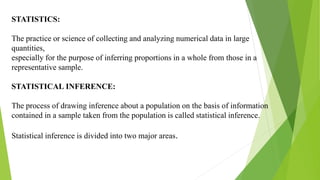
STATISTICS:
The practice or science of collecting and analyzing numerical data in large
quantities,
especially for the purpose of inferring proportions in a whole from those in a
representative sample.
STATISTICAL INFERENCE:
The process of drawing inference about a population on the basis of information
contained in a sample taken from the population is called statistical inference.
Statistical inference is divided into two major areas.
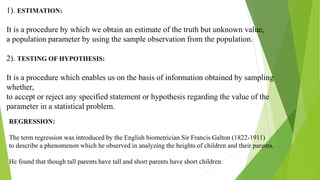
1). ESTIMATION:
It is a procedure by which we obtain an estimate of the truth but unknown value,
a population parameter by using the sample observation from the population.
2). TESTING OF HYPOTHESIS:
It is a procedure which enables us on the basis of information obtained by sampling
whether,
to accept or reject any specified statement or hypothesis regarding the value of the
parameter in a statistical problem.
REGRESSION:
The term regression was introduced by the English biometrician Sir Francis Galton (1822-1911)
to describe a phenomenon which he observed in analyzing the heights of children and their parents.
He found that though tall parents have tall and short parents have short children.
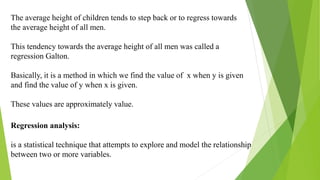
The average height of children tends to step back or to regress towards
the average height of all men.
This tendency towards the average height of all men was called a
regression Galton.
Basically, it is a method in which we find the value of x when y is given
and find the value of y when x is given.
These values are approximately value.
Regression analysis:
is a statistical technique that attempts to explore and model the relationship
between two or more variables.
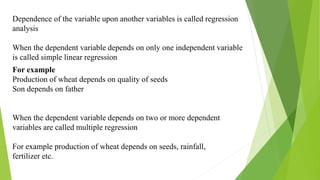
For example
Production of wheat depends on quality of seeds
Son depends on father
When the dependent variable depends on two or more dependent
variables are called multiple regression
For example production of wheat depends on seeds, rainfall,
fertilizer etc.
Dependence of the variable upon another variables is called regression
analysis
When the dependent variable depends on only one independent variable
is called simple linear regression
Example
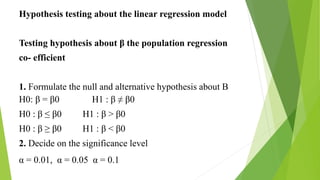
Hypothesis testing about the linear regression model
Testing hypothesis about β the population regression
co- efficient
1. Formulate the null and alternative hypothesis about B
H β = β0 H1 : β ≠ β0
H0 : β ≤ β H1 : β ˃ β0
H0 : β ≥ β0 H1 : β ˂ β0
2. Decide on the significance level
α = 0.01, α = 0.05 α = 0.1
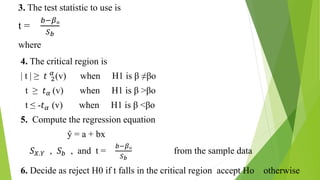
3. The test statistic to use is
t =
𝑏−𝛽ₒ
𝑆 𝑏
where
4. The critical region is
| t | ≥ 𝑡 2
𝛼
(v) when H1 is β ≠βo
t ≥ 𝑡 𝛼 (v) when H1 is β >βo
t ≤ -𝑡 𝛼 (v) when H1 is β <βo
5. Compute the regression equation
ŷ = a + bx
𝑆 𝑋.𝑌 , 𝑆 𝑏 , and t =
𝑏−𝛽ₒ
𝑆 𝑏
from the sample data
6. Decide as reject H0 if t falls in the critical region accept Ho otherwise
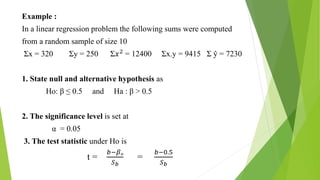
Example :
In a linear regression problem the following sums were computed
from a random sample of size 10
Ʃx = 320 Ʃy = 250 Ʃ𝑥2 = 12400 Ʃx.y = 9415 Ʃ ŷ = 7230
1. State null and alternative hypothesis as
Ho: β ≤ 0.5 and Ha : β ˃ 0.5
2. The significance level is set at
α = 0.05
3. The test statistic under Ho is
t =
𝑏−𝛽ₒ
𝑆 𝑏
=
𝑏−0.5
𝑆 𝑏
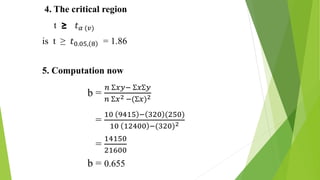
4. The critical region
t ≥ 𝑡 𝛼 (𝑣)
is t ≥ 𝑡0.05, 8 = 1.86
5. Computation now
b =
𝑛 Ʃ𝑥𝑦− Ʃ𝑥Ʃ𝑦
𝑛 Ʃ𝑥2 −(Ʃ𝑥)2
=
10 9415 − 320 (250)
10 12400 −(320)2
=
14150
21600
b = 0.655
a = Ȳ - bx̅
𝑠 𝑦𝑥
2 =
Ʃ(𝑦−ŷ)2
𝑛−2
=
Ʃ𝑌2 −𝑎Ʃ𝑌−𝑏Ʃ𝑋𝑌
𝑛−2
=
7230− 4.04 250 −(0.655)(9415)
10−2
=
53.175
8
𝑆 𝑦𝑥
2 = 6.647
so that 𝑆 𝑦𝑥 = 6.647
= 2.578
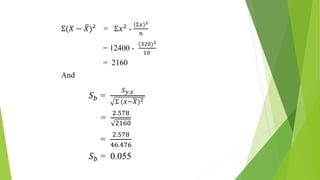
Ʃ(𝑋 − 𝛸)2
= Ʃ𝑥2
-
(Ʃ𝑥)2
𝑛
= 12400 -
(320)2
10
= 2160
And
𝑆 𝑏 =
𝑆 𝑦.𝑥
Ʃ (𝑥− 𝛸)2
=
2.578
2160
=
2.578
46.476
𝑆 𝑏 = 0.055
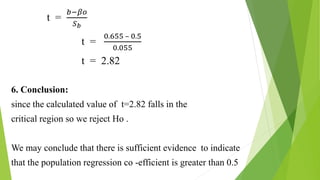
6. Conclusion:
since the calculated value of t=2.82 falls in the
critical region so we reject Ho .
We may conclude that there is sufficient evidence to indicate
that the population regression co -efficient is greater than 0.5
t =
𝑏−𝛽𝑜
𝑆 𝑏
t =
0.655 – 0.5
0.055
t = 2.82
THANK YOU

statistics linear progression

  • 1.
    Topic : TESTINGOF HYPOTHESIS ABOUT LINEAR REGRESSION Presented by: Atif Muhammad & Tuahira Raheem 16 17 BS Environmental science 2nd semester Presented To : Ms. Bushra Date 18 / 04 / 2018
  • 2.
    STATISTICS: The practice orscience of collecting and analyzing numerical data in large quantities, especially for the purpose of inferring proportions in a whole from those in a representative sample. STATISTICAL INFERENCE: The process of drawing inference about a population on the basis of information contained in a sample taken from the population is called statistical inference. Statistical inference is divided into two major areas.
  • 3.
    1). ESTIMATION: It isa procedure by which we obtain an estimate of the truth but unknown value, a population parameter by using the sample observation from the population. 2). TESTING OF HYPOTHESIS: It is a procedure which enables us on the basis of information obtained by sampling whether, to accept or reject any specified statement or hypothesis regarding the value of the parameter in a statistical problem. REGRESSION: The term regression was introduced by the English biometrician Sir Francis Galton (1822-1911) to describe a phenomenon which he observed in analyzing the heights of children and their parents. He found that though tall parents have tall and short parents have short children.
  • 4.
    The average heightof children tends to step back or to regress towards the average height of all men. This tendency towards the average height of all men was called a regression Galton. Basically, it is a method in which we find the value of x when y is given and find the value of y when x is given. These values are approximately value. Regression analysis: is a statistical technique that attempts to explore and model the relationship between two or more variables.
  • 5.
    For example Production ofwheat depends on quality of seeds Son depends on father When the dependent variable depends on two or more dependent variables are called multiple regression For example production of wheat depends on seeds, rainfall, fertilizer etc. Dependence of the variable upon another variables is called regression analysis When the dependent variable depends on only one independent variable is called simple linear regression
  • 6.
  • 8.
    Hypothesis testing aboutthe linear regression model Testing hypothesis about β the population regression co- efficient 1. Formulate the null and alternative hypothesis about B H β = β0 H1 : β ≠ β0 H0 : β ≤ β H1 : β ˃ β0 H0 : β ≥ β0 H1 : β ˂ β0 2. Decide on the significance level α = 0.01, α = 0.05 α = 0.1
  • 9.
    3. The teststatistic to use is t = 𝑏−𝛽ₒ 𝑆 𝑏 where 4. The critical region is | t | ≥ 𝑡 2 𝛼 (v) when H1 is β ≠βo t ≥ 𝑡 𝛼 (v) when H1 is β >βo t ≤ -𝑡 𝛼 (v) when H1 is β <βo 5. Compute the regression equation ŷ = a + bx 𝑆 𝑋.𝑌 , 𝑆 𝑏 , and t = 𝑏−𝛽ₒ 𝑆 𝑏 from the sample data 6. Decide as reject H0 if t falls in the critical region accept Ho otherwise
  • 10.
    Example : In alinear regression problem the following sums were computed from a random sample of size 10 Ʃx = 320 Ʃy = 250 Ʃ𝑥2 = 12400 Ʃx.y = 9415 Ʃ ŷ = 7230 1. State null and alternative hypothesis as Ho: β ≤ 0.5 and Ha : β ˃ 0.5 2. The significance level is set at α = 0.05 3. The test statistic under Ho is t = 𝑏−𝛽ₒ 𝑆 𝑏 = 𝑏−0.5 𝑆 𝑏
  • 11.
    4. The criticalregion t ≥ 𝑡 𝛼 (𝑣) is t ≥ 𝑡0.05, 8 = 1.86 5. Computation now b = 𝑛 Ʃ𝑥𝑦− Ʃ𝑥Ʃ𝑦 𝑛 Ʃ𝑥2 −(Ʃ𝑥)2 = 10 9415 − 320 (250) 10 12400 −(320)2 = 14150 21600 b = 0.655
  • 12.
    a = Ȳ- bx̅ 𝑠 𝑦𝑥 2 = Ʃ(𝑦−ŷ)2 𝑛−2 = Ʃ𝑌2 −𝑎Ʃ𝑌−𝑏Ʃ𝑋𝑌 𝑛−2 = 7230− 4.04 250 −(0.655)(9415) 10−2 = 53.175 8 𝑆 𝑦𝑥 2 = 6.647 so that 𝑆 𝑦𝑥 = 6.647 = 2.578
  • 13.
    Ʃ(𝑋 − 𝛸)2 =Ʃ𝑥2 - (Ʃ𝑥)2 𝑛 = 12400 - (320)2 10 = 2160 And 𝑆 𝑏 = 𝑆 𝑦.𝑥 Ʃ (𝑥− 𝛸)2 = 2.578 2160 = 2.578 46.476 𝑆 𝑏 = 0.055
  • 14.
    6. Conclusion: since thecalculated value of t=2.82 falls in the critical region so we reject Ho . We may conclude that there is sufficient evidence to indicate that the population regression co -efficient is greater than 0.5 t = 𝑏−𝛽𝑜 𝑆 𝑏 t = 0.655 – 0.5 0.055 t = 2.82
  • 15.