SKEWNESS AND KURTOSIS
Mrs.P.Kalaiselvi M.Sc.,M.A.
Miss.S.Swathi Sundari M.Sc.M.Phil.
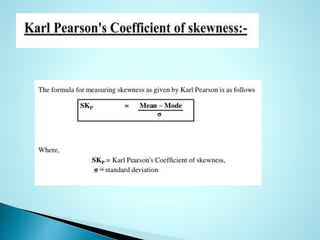
What Is Skewness?
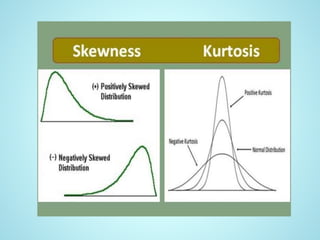
 Skewness refers to distortion or asymmetry in a
symmetrical bell curve, or normal distribution, in a
set of data. If the curve is shifted to the left or to the
right, it is said to be skewed.
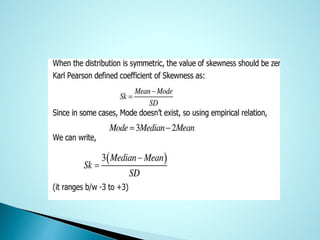
 Skewness can be quantified as a representation of
the extent to which a given distribution varies from a
normal distribution. A normal distribution has a skew
of zero.
 The three probability distributions depicted below are
positively-skewed (or right-skewed) to an increasing
degree. Negatively-skewed distributions are also
known as left-skewed distributions.
DEFINITION of Kurtosis
 Like skewness, kurtosis is a statistical measure
that is used to describe the distribution. Whereas
skewness differentiates extreme values in one
versus the other tail, kurtosis measures extreme
values in either tail.
 Kurtosis is a measure that describes the shape of
a distribution's tails in relation to its overall
shape. A distribution can be infinitely peaked
with low kurtosis, and a distribution can be
perfectly flat-topped with infinite kurtosis. Thus,
kurtosis measures “tailedness,” not “peakedness.”
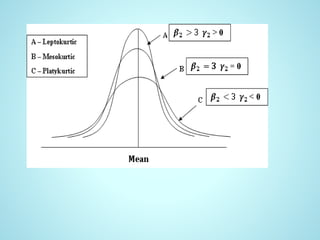
 There are three categories of kurtosis that can be
displayed by a set of data. All measures of kurtosis are
compared against a standard normal distribution, or bell
curve.
 The first category of kurtosis is a mesokurtic distribution.
This distribution has kurtosis statistic similar to that of the
normal distribution, meaning that the extreme value
characteristic of the distribution is similar to that of a
normal distribution.
 The second category is a leptokurtic distribution. Any
distribution that is leptokurtic displays greater kurtosis
than a mesokurtic distribution.
 The final type of distribution is a platykurtic distribution.
These types of distributions have short tails .The prefix of
"platy-" means "broad," and it is meant to describe a short
and broad-looking peak.
 THANK YOU

Statistics

  • 1.
    SKEWNESS AND KURTOSIS Mrs.P.KalaiselviM.Sc.,M.A. Miss.S.Swathi Sundari M.Sc.M.Phil.
  • 6.
    What Is Skewness? Skewness refers to distortion or asymmetry in a symmetrical bell curve, or normal distribution, in a set of data. If the curve is shifted to the left or to the right, it is said to be skewed.  Skewness can be quantified as a representation of the extent to which a given distribution varies from a normal distribution. A normal distribution has a skew of zero.  The three probability distributions depicted below are positively-skewed (or right-skewed) to an increasing degree. Negatively-skewed distributions are also known as left-skewed distributions.
  • 9.
    DEFINITION of Kurtosis Like skewness, kurtosis is a statistical measure that is used to describe the distribution. Whereas skewness differentiates extreme values in one versus the other tail, kurtosis measures extreme values in either tail.  Kurtosis is a measure that describes the shape of a distribution's tails in relation to its overall shape. A distribution can be infinitely peaked with low kurtosis, and a distribution can be perfectly flat-topped with infinite kurtosis. Thus, kurtosis measures “tailedness,” not “peakedness.”
  • 10.
     There arethree categories of kurtosis that can be displayed by a set of data. All measures of kurtosis are compared against a standard normal distribution, or bell curve.  The first category of kurtosis is a mesokurtic distribution. This distribution has kurtosis statistic similar to that of the normal distribution, meaning that the extreme value characteristic of the distribution is similar to that of a normal distribution.  The second category is a leptokurtic distribution. Any distribution that is leptokurtic displays greater kurtosis than a mesokurtic distribution.  The final type of distribution is a platykurtic distribution. These types of distributions have short tails .The prefix of "platy-" means "broad," and it is meant to describe a short and broad-looking peak.
  • 14.