Skewness & Kurtosis
Dr. S. Doss
Measures of Shape
• Symmetrical – the right half is a mirror image
of the left half
• Skewed – shows that the distribution lacks
symmetry; Absence of symmetry
– Extreme values or “tail” in one side of a distribution
– Positively- or right-skewed vs. negatively- or left-
skewed
Coefficient of Skewness
 

 d
M
Sk


3
• Coefficient of Skewness (Sk)- compares the mean
and median in light of the magnitude to the
standard deviation; Md is the median; Sk is
coefficient of skewness; σ is the Std Dev
Coefficient of Skewness
• Summary measure for skewness
• If Sk < 0, the distribution is negatively skewed (skewed to
the left).
• If Sk = 0, the distribution is symmetric (not skewed). If Sk
is close to 0, it’s almost symmetric
• If Sk > 0, the distribution is positively skewed (skewed to
the right).
 

 d
k
M
S


3
• Symmetric Left tail is the mirror image of the
right tail. Example: heights and weights of
people
Histogram
Relative
Frequency
.05
.10
.15
.20
.25
.30
.35
0
• Moderately Skewed Left
– A longer tail to the left Example: Exam scores
Relative
Frequency
.05
.10
.15
.20
.25
.30
.35
0
Skewness (Continued)
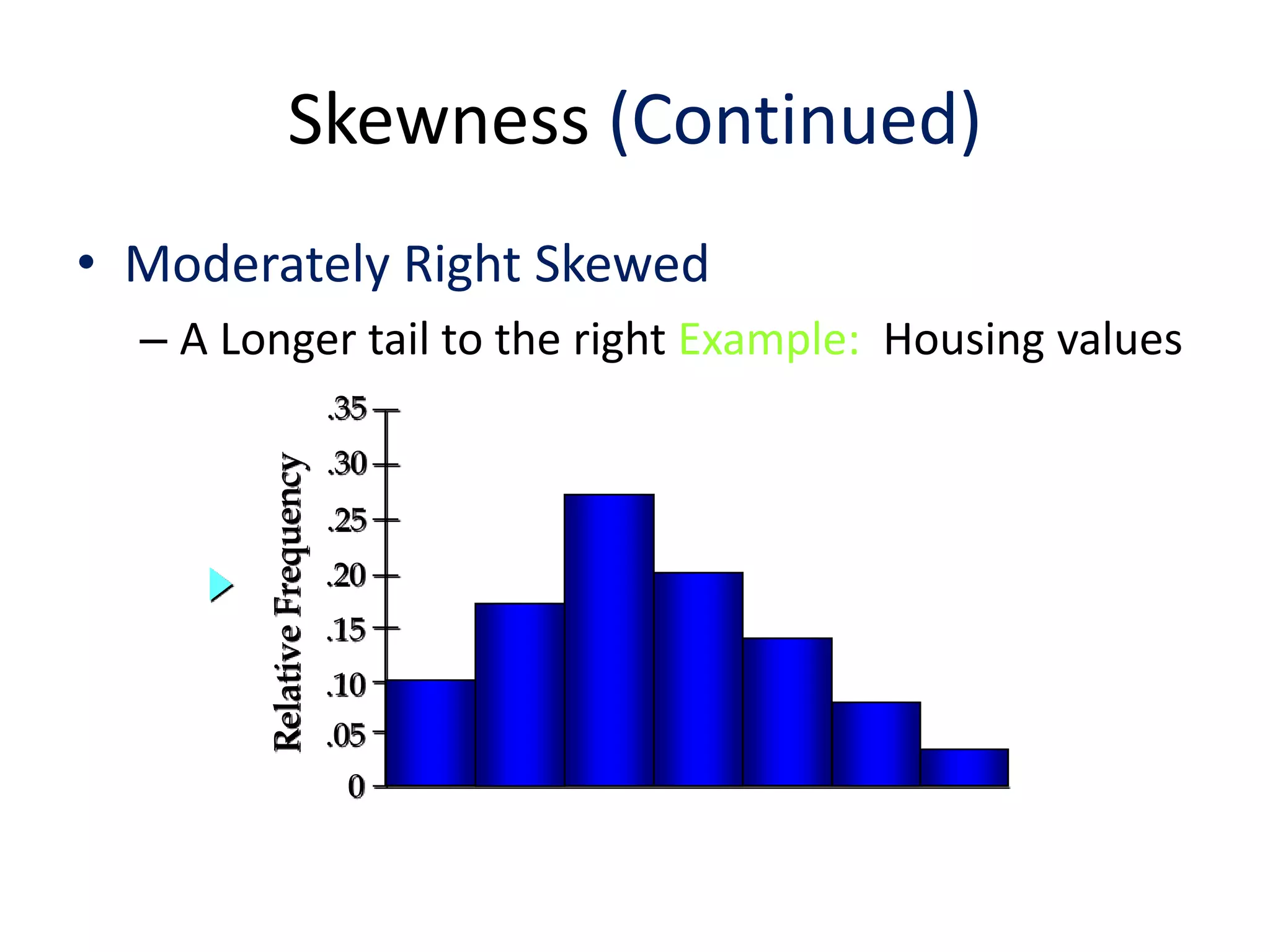
• Moderately Right Skewed
– A Longer tail to the right Example: Housing values
Relative
Frequency
.05
.10
.15
.20
.25
.30
.35
0
Skewness (Continued)
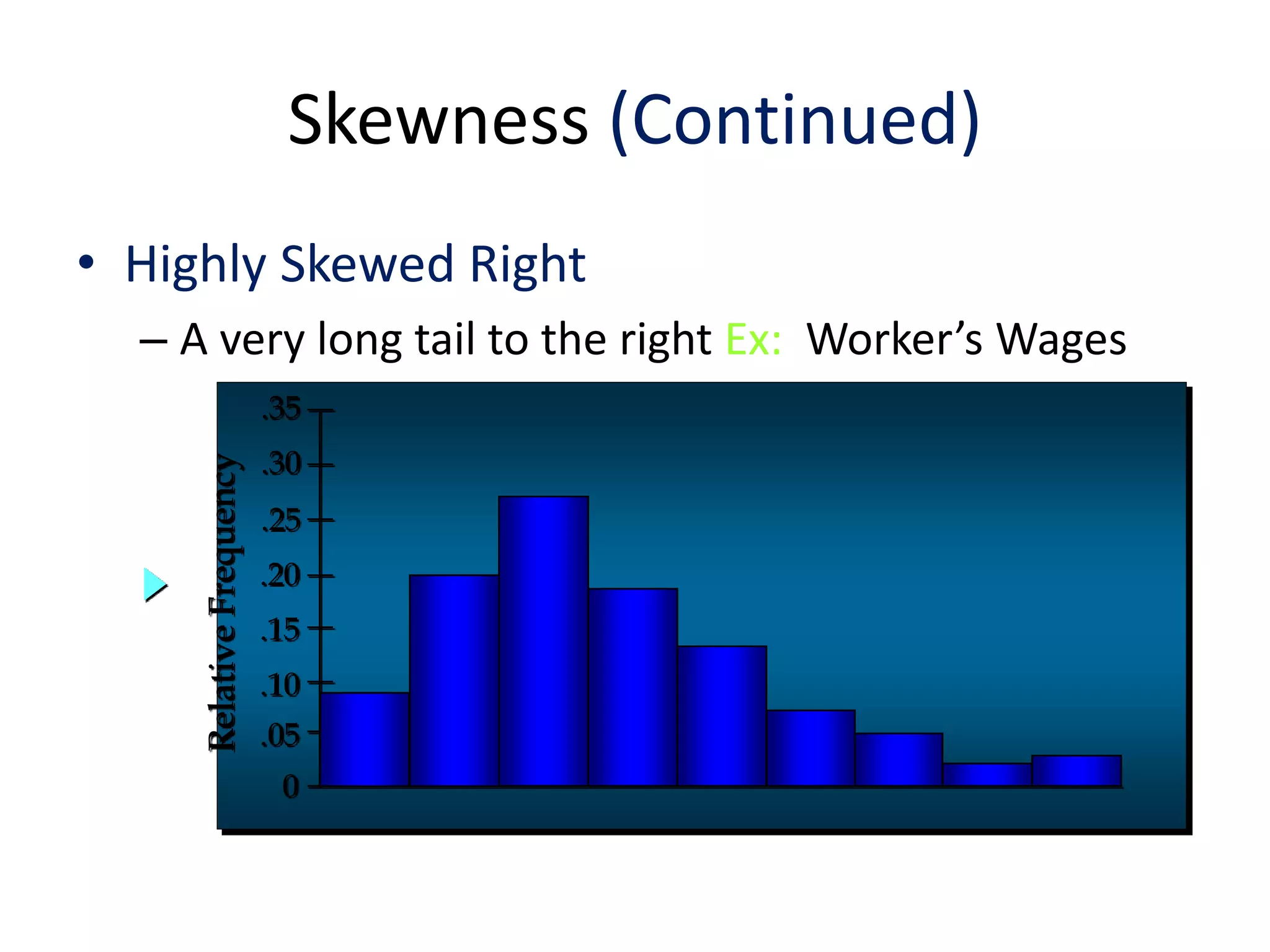
• Highly Skewed Right
– A very long tail to the right Ex: Worker’s Wages
Relative
Frequency
.05
.10
.15
.20
.25
.30
.35
0
Skewness (Continued)
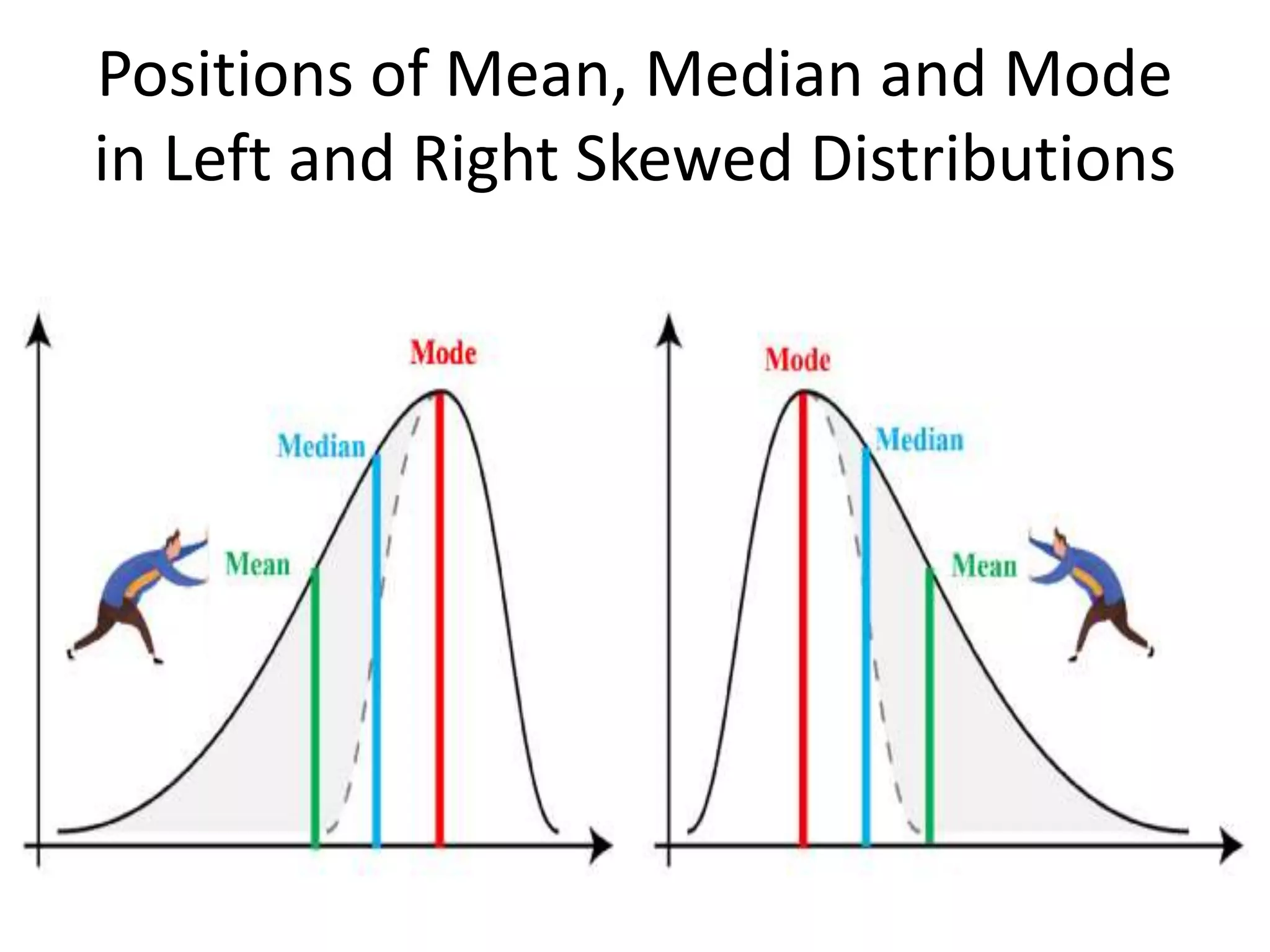
Positions of Mean, Median and Mode
in Left and Right Skewed Distributions
Applications of Skewness
• No of wealthy people in USA
• Economically poor people in Somalia (Africa)
• Cricket Scores by top batsman (80:20)
• Movie Ticket sales of popular Actor
• Skewness in model building
• It helps in identifying the outliers
• Mode > Median > Mean – Identify distribution
• Mean > Median > Mode – Identify distribution
• The positive excess value will have peaked curve
(Leptokurtic)
• The negative excess value will have a flat curve
(Platykurtic)
• The normal distribution will have an excess k value
of ‘0’ (K-3 = 0) or kurtosis value of 3 (k=3).
Leptokurtic Distribution
• Leptokurtic distribution will have high values of K or Excess positive
values of K (B2 -3 = 6).
• It will have high frequency of moderate values and also
comparatively large values as compared to normal distribution.
• The tail of the distribution will be comparatively thicker.
Platykurtic Distribution
• Platykurtic distribution will have lower values of K or Excess negative
values of K (B2 -3 = -1).
• It will have larger values of small and moderate values with wider
volatility as the standard deviation is expected to be comparatively
larger.
• The tail of the distribution will be comparatively lighter.
Applications of Kurtosis
• Leptokurtic distribution in General Insurance
– High Frequency claims with moderate severity – Motor
Insurance accident claims in rainy season, Crop Insurance
in drought, Health Insurance during pandemic.
• Mesokurtic distribution
– Property claims of householders, marine cargo claims, Fire
Claims, etc.
• Platykurtic distribution
– Property claims of shopkeepers, textile, machinery,
fertilizer sectors.
– TP claims of commercial vehicles
– Motor accident claims of private cars including luxury
vehicles
– Flood claims
Applications of Kurtosis
• Helpful to decide the normality of distribution
• Measures the peak as well as thickness of the
tail.
• Higher value indicates larger the risk as the tail
is thicker.
• Thicker the tail indicates extreme values or
losses.
• Lower the kurtosis value indicates lesser freq
of high value losses.

Skewness _ Kurtosis New.pptx

  • 1.
  • 2.
    Measures of Shape •Symmetrical – the right half is a mirror image of the left half • Skewed – shows that the distribution lacks symmetry; Absence of symmetry – Extreme values or “tail” in one side of a distribution – Positively- or right-skewed vs. negatively- or left- skewed
  • 3.
    Coefficient of Skewness    d M Sk   3 • Coefficient of Skewness (Sk)- compares the mean and median in light of the magnitude to the standard deviation; Md is the median; Sk is coefficient of skewness; σ is the Std Dev
  • 4.
    Coefficient of Skewness •Summary measure for skewness • If Sk < 0, the distribution is negatively skewed (skewed to the left). • If Sk = 0, the distribution is symmetric (not skewed). If Sk is close to 0, it’s almost symmetric • If Sk > 0, the distribution is positively skewed (skewed to the right).     d k M S   3
  • 5.
    • Symmetric Lefttail is the mirror image of the right tail. Example: heights and weights of people Histogram Relative Frequency .05 .10 .15 .20 .25 .30 .35 0
  • 6.
    • Moderately SkewedLeft – A longer tail to the left Example: Exam scores Relative Frequency .05 .10 .15 .20 .25 .30 .35 0 Skewness (Continued)
  • 7.
    • Moderately RightSkewed – A Longer tail to the right Example: Housing values Relative Frequency .05 .10 .15 .20 .25 .30 .35 0 Skewness (Continued)
  • 8.
    • Highly SkewedRight – A very long tail to the right Ex: Worker’s Wages Relative Frequency .05 .10 .15 .20 .25 .30 .35 0 Skewness (Continued)
  • 9.
    Positions of Mean,Median and Mode in Left and Right Skewed Distributions
  • 10.
    Applications of Skewness •No of wealthy people in USA • Economically poor people in Somalia (Africa) • Cricket Scores by top batsman (80:20) • Movie Ticket sales of popular Actor • Skewness in model building • It helps in identifying the outliers • Mode > Median > Mean – Identify distribution • Mean > Median > Mode – Identify distribution
  • 11.
    • The positiveexcess value will have peaked curve (Leptokurtic) • The negative excess value will have a flat curve (Platykurtic) • The normal distribution will have an excess k value of ‘0’ (K-3 = 0) or kurtosis value of 3 (k=3).
  • 12.
    Leptokurtic Distribution • Leptokurticdistribution will have high values of K or Excess positive values of K (B2 -3 = 6). • It will have high frequency of moderate values and also comparatively large values as compared to normal distribution. • The tail of the distribution will be comparatively thicker.
  • 13.
    Platykurtic Distribution • Platykurticdistribution will have lower values of K or Excess negative values of K (B2 -3 = -1). • It will have larger values of small and moderate values with wider volatility as the standard deviation is expected to be comparatively larger. • The tail of the distribution will be comparatively lighter.
  • 14.
    Applications of Kurtosis •Leptokurtic distribution in General Insurance – High Frequency claims with moderate severity – Motor Insurance accident claims in rainy season, Crop Insurance in drought, Health Insurance during pandemic. • Mesokurtic distribution – Property claims of householders, marine cargo claims, Fire Claims, etc. • Platykurtic distribution – Property claims of shopkeepers, textile, machinery, fertilizer sectors. – TP claims of commercial vehicles – Motor accident claims of private cars including luxury vehicles – Flood claims
  • 15.
    Applications of Kurtosis •Helpful to decide the normality of distribution • Measures the peak as well as thickness of the tail. • Higher value indicates larger the risk as the tail is thicker. • Thicker the tail indicates extreme values or losses. • Lower the kurtosis value indicates lesser freq of high value losses.

Editor's Notes