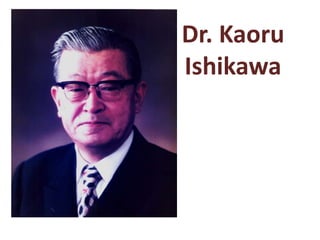
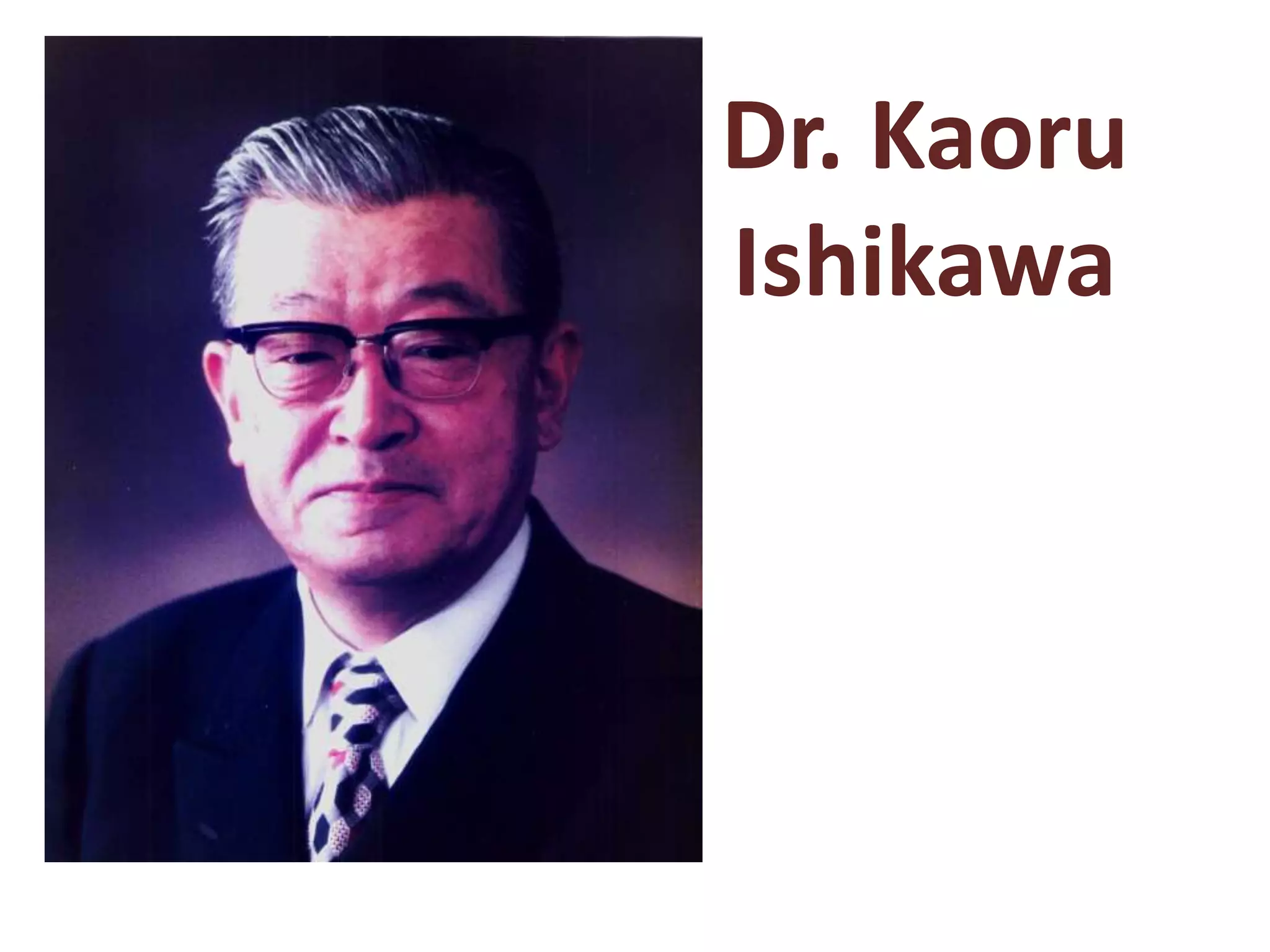
Dr. Kaoru
Ishikawa
• Born in Tokyo on July 13, 1915
• In 1939, graduated from in Engg. In Applied Chemistry
• 1939-41: worked as a naval officer ; 1941-47 worked at Nissan Liquid fuel
company
• In 1947, became associate professor in University of Tokyo
• In 1949, Ishikawa joined the Japanese Union of Scientists and Engineers (JUSE)
quality control research group
• His skill at mobilizing large groups of people towards a specific common goal was
largely responsible for Japan's quality-improvement initiatives.
• He translated, integrated and expanded the management concepts of W.
Edwards Deming and Joseph M. Juran into the Japanese system.
• Died on April 16, 1989
Continued
customer
service
Cause and
Effect
diagram
Quality
circles
His Contributions
Internal
Customer
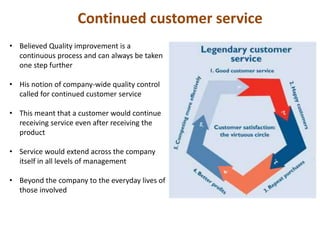
Continued customer service
• Believed Quality improvement is a
continuous process and can always be taken
one step further
• His notion of company-wide quality control
called for continued customer service
• This meant that a customer would continue
receiving service even after receiving the
product
• Service would extend across the company
itself in all levels of management
• Beyond the company to the everyday lives of
those involved
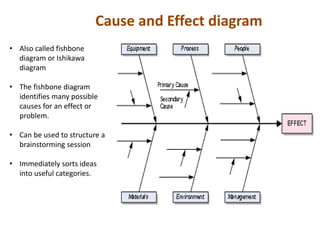
Cause and Effect diagram
• Also called fishbone
diagram or Ishikawa
diagram
• The fishbone diagram
identifies many possible
causes for an effect or
problem.
• Can be used to structure a
brainstorming session
• Immediately sorts ideas
into useful categories.
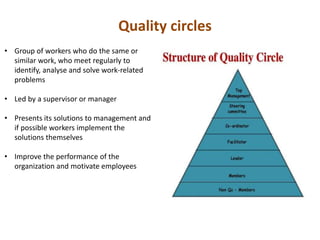
Quality circles
• Group of workers who do the same or
similar work, who meet regularly to
identify, analyse and solve work-related
problems
• Led by a supervisor or manager
• Presents its solutions to management and
if possible workers implement the
solutions themselves
• Improve the performance of the
organization and motivate employees
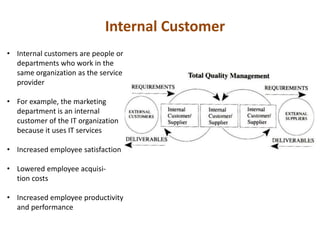
Internal Customer
• Internal customers are people or
departments who work in the
same organization as the service
provider
• For example, the marketing
department is an internal
customer of the IT organization
because it uses IT services
• Increased employee satisfaction
• Lowered employee acquisi-
tion costs
• Increased employee productivity
and performance
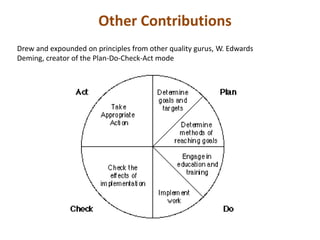
Drew and expounded on principles from other quality gurus, W. Edwards
Deming, creator of the Plan-Do-Check-Act mode
Other Contributions
THANK
YOU

Dr. Kaoru Ishikawa

  • 1.
  • 2.
    • Born inTokyo on July 13, 1915 • In 1939, graduated from in Engg. In Applied Chemistry • 1939-41: worked as a naval officer ; 1941-47 worked at Nissan Liquid fuel company • In 1947, became associate professor in University of Tokyo • In 1949, Ishikawa joined the Japanese Union of Scientists and Engineers (JUSE) quality control research group • His skill at mobilizing large groups of people towards a specific common goal was largely responsible for Japan's quality-improvement initiatives. • He translated, integrated and expanded the management concepts of W. Edwards Deming and Joseph M. Juran into the Japanese system. • Died on April 16, 1989
  • 3.
  • 4.
    Continued customer service •Believed Quality improvement is a continuous process and can always be taken one step further • His notion of company-wide quality control called for continued customer service • This meant that a customer would continue receiving service even after receiving the product • Service would extend across the company itself in all levels of management • Beyond the company to the everyday lives of those involved
  • 5.
    Cause and Effectdiagram • Also called fishbone diagram or Ishikawa diagram • The fishbone diagram identifies many possible causes for an effect or problem. • Can be used to structure a brainstorming session • Immediately sorts ideas into useful categories.
  • 6.
    Quality circles • Groupof workers who do the same or similar work, who meet regularly to identify, analyse and solve work-related problems • Led by a supervisor or manager • Presents its solutions to management and if possible workers implement the solutions themselves • Improve the performance of the organization and motivate employees
  • 7.
    Internal Customer • Internalcustomers are people or departments who work in the same organization as the service provider • For example, the marketing department is an internal customer of the IT organization because it uses IT services • Increased employee satisfaction • Lowered employee acquisi- tion costs • Increased employee productivity and performance
  • 8.
    Drew and expoundedon principles from other quality gurus, W. Edwards Deming, creator of the Plan-Do-Check-Act mode Other Contributions
  • 9.