
STATINS
Cornerstone in lipid
management
Dr Awadhesh Sharma,DM,FACC,FSCAI
Assistant professor
LPS Institute of Cardiology,Kanpur
The Story of 2 Wonder Drugs
What penicillin did to infections , Statins did to
Atherogenic dyslipidemias
Penicillin producing fungi gave us statins
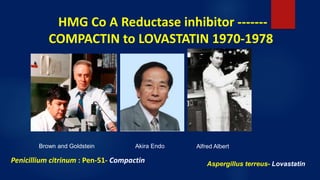
HMG Co A Reductase inhibitor -------
COMPACTIN to LOVASTATIN 1970-1978
Brown and Goldstein Akira Endo Alfred Albert
Aspergillus terreus- LovastatinPenicillium citrinum : Pen-51- Compactin
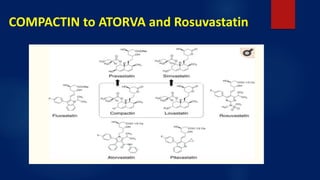
COMPACTIN to ATORVA and Rosuvastatin
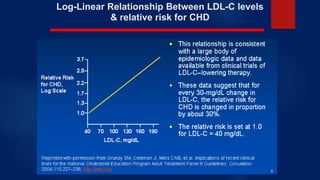
Log-Linear Relationship Between LDL-C levels
& relative risk for CHD
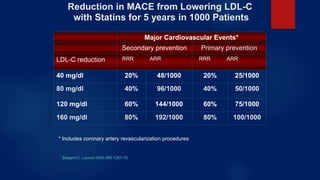
Reduction in MACE from Lowering LDL-C
with Statins for 5 years in 1000 Patients
Major Cardiovascular Events*
Secondary prevention Primary prevention
LDL-C reduction RRR ARR RRR ARR
40 mg/dl 20% 48/1000 20% 25/1000
80 mg/dl 40% 96/1000 40% 50/1000
120 mg/dl 60% 144/1000 60% 75/1000
160 mg/dl 80% 192/1000 80% 100/1000
Baigent C. Lancet 2005;366:1267-78.
* Includes coronary artery revascularization procedures
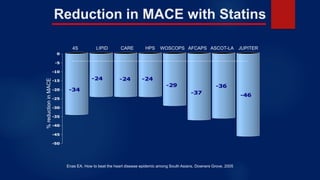
-34
-24 -24 -24
-29
-37
-36
-46
-50
-45
-40
-35
-30
-25
-20
-15
-10
-5
0
%reductioninMACE
Reduction in MACE with Statins
Enas EA. How to beat the heart disease epidemic among South Asians. Downers Grove, 2005
4S LIPID CARE HPS WOSCOPS AFCAPS ASCOT-LA JUPITER
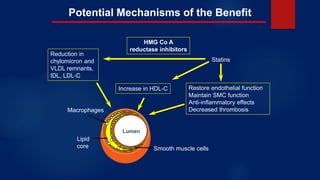
Potential Mechanisms of the Benefit
Statins
Increase in HDL-C
Reduction in
chylomicron and
VLDL remnants,
IDL, LDL-C
Restore endothelial function
Maintain SMC function
Anti-inflammatory effects
Decreased thrombosis
Lumen
Lipid
core
Macrophages
Smooth muscle cells
HMG Co A
reductase inhibitors
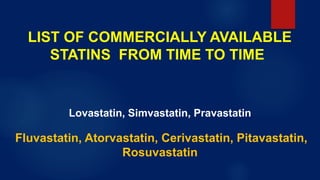
LIST OF COMMERCIALLY AVAILABLE
STATINS FROM TIME TO TIME
Lovastatin, Simvastatin, Pravastatin
Fluvastatin, Atorvastatin, Cerivastatin, Pitavastatin,
Rosuvastatin
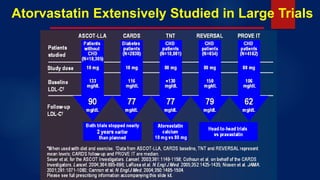
Atorvastatin Extensively Studied in Large Trials
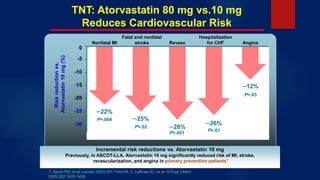
Incremental risk reductions vs. Atorvastatin 10 mg
Previously, in ASCOT-LLA, Atorvastatin 10 mg significantly reduced risk of MI, stroke,
revascularization, and angina in primary prevention patients1
-30
-25
-20
-15
-10
-5
0
─12%
Angina
─22%
Nonfatal MI
─28%
Revasc
─25%
Fatal and nonfatal
stroke
─26%
Hospitalization
for CHF
Riskreductionvs.
Atorvastatin10mg(%)
TNT: Atorvastatin 80 mg vs.10 mg
Reduces Cardiovascular Risk
1. Sever PS, et al. Lancet. 2003;361:1149-58. 2. LaRosa JC, et al. N Engl J Med.
2005;352:1425-1435.
P=.004
P=.02
P<.001
P=.01
P=.03
0 1 2 3 4 5 6
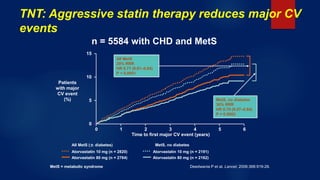
TNT: Aggressive statin therapy reduces major CV
events
Deedwania P et al. Lancet. 2006;368:919-28.
Patients
with major
CV event
(%)
Time to first major CV event (years)
n = 5584 with CHD and MetS
Atorvastatin 10 mg (n = 2820)
Atorvastatin 80 mg (n = 2764)
Atorvastatin 10 mg (n = 2191)
Atorvastatin 80 mg (n = 2162)
All MetS (± diabetes) MetS, no diabetes
MetS = metabolic syndrome
15
10
5
0
MetS, no diabetes
30% RRR
HR 0.70 (0.57–0.84)
P = 0.0002
All MetS
29% RRR
HR 0.71 (0.61–0.84)
P < 0.0001
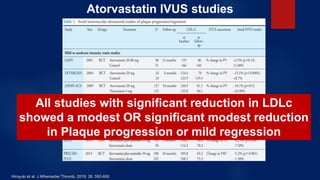
Atorvastatin IVUS studies
Hiroyuki et al. J Atheroscler Thromb, 2019; 26: 592-600
All studies with significant reduction in LDLc
showed a modest OR significant modest reduction
in Plaque progression or mild regression
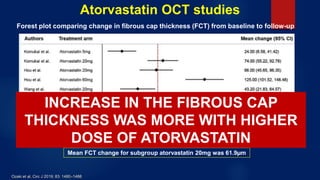
Atorvastatin OCT studies
Ozaki et al, Circ J 2019; 83: 1480–1488
Mean FCT change for subgroup atorvastatin 5mg was 27.8µm
Mean FCT change for subgroup atorvastatin 20mg was 61.9µm
Forest plot comparing change in fibrous cap thickness (FCT) from baseline to follow-up
INCREASE IN THE FIBROUS CAP
THICKNESS WAS MORE WITH HIGHER
DOSE OF ATORVASTATIN
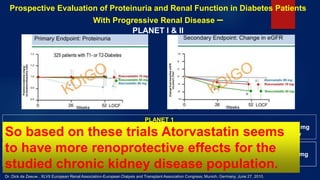
Prospective Evaluation of Proteinuria and Renal Function in Diabetes Patients
With Progressive Renal Disease –
PLANET I & II
Dr. Dick de Zeeuw , XLVII European Renal Association-European Dialysis and Transplant Association Congress; Munich, Germany, June 27, 2010.
PLANET 1
Δ UPC ratio decreased by 12.6% with atorvastatin 80 mg(p = 0.033) and <5% with rosuvastatin 40 & 10 mg
Δ eGFR:No change in atorvastatin group; -7.29 & -3.70 ml/min with rosuvastatin 10 & 40 mg respectively
PLANET 2
UPC ratio decreased by 24.1% with atorvastatin 80 mg(p = 0.033) and <10% with rosuvastatin 40 & 10 mg
Δ eGFR:No change with atorvastatin & rosuvastatin 10 mg ; -3.3 ml/min with rosuvastatin 40 mg
respectively
So based on these trials Atorvastatin seems
to have more renoprotective effects for the
studied chronic kidney disease population.
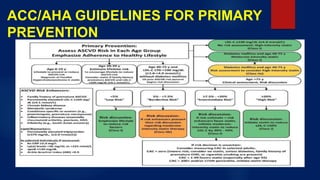
ACC/AHA GUIDELINES FOR PRIMARY
PREVENTION
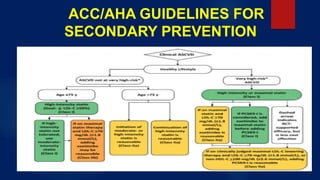
ACC/AHA GUIDELINES FOR
SECONDARY PREVENTION
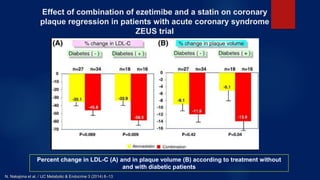
Effect of combination of ezetimibe and a statin on coronary
plaque regression in patients with acute coronary syndrome
ZEUS trial
Percent change in LDL-C (A) and in plaque volume (B) according to treatment without
and with diabetic patients
N. Nakajima et al. / IJC Metabolic & Endocrine 3 (2014) 8–13
FAQ’S Regarding High Dose Atorvastatin
Do We Indians Tolerate High Dose Statins
Well ?
Are we using High Dose statins in high risk
patients optimally?
Indian Experience with High dose
atorvastatin in ACS: CURE ACS
 A total of 236 patients with diagnosed ACS (with TIMI Risk
score≥ 3) within preceding 10 days were randomized to
receive either atorvastatin 80 mg or atorvastatin 40 mg once
daily in a randomized study
 Follow up: 12 weeks.
 The end points of the trial were % change in LDL-C and hs
CRP from baseline.
Kaul. U et al JAPI 2013:61: 11-15
Indian Experience with High dose
atorvastatin in ACS: CURE ACS
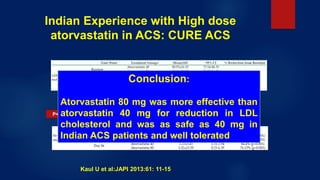
P=0.024 for LDL-C reductionand hs CRP reduction (Atorvastatin 40 Vs 80 mg)
Kaul U et al:JAPI 2013:61: 11-15
Conclusion:
Atorvastatin 80 mg was more effective than
atorvastatin 40 mg for reduction in LDL
cholesterol and was as safe as 40 mg in
Indian ACS patients and well tolerated
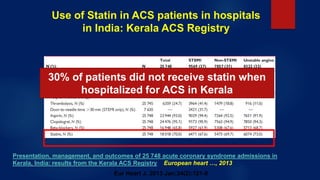
Use of Statin in ACS patients in hospitals
in India: Kerala ACS Registry
Eur Heart J. 2013 Jan;34(2):121-9
30% of patients did not receive statin when
hospitalized for ACS in Kerala
Presentation, management, and outcomes of 25 748 acute coronary syndrome admissions in
Kerala, India: results from the Kerala ACS Registry European heart …, 2013
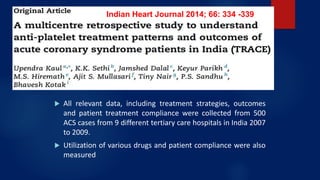
TRACE Study: use of statin in ACS in India in
2014
 All relevant data, including treatment strategies, outcomes
and patient treatment compliance were collected from 500
ACS cases from 9 different tertiary care hospitals in India 2007
to 2009.
 Utilization of various drugs and patient compliance were also
measured
Indian Heart Journal 2014; 66: 334 -339
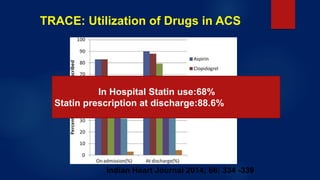
TRACE: Utilization of Drugs in ACS
In Hospital Statin use:68%
Statin prescription at discharge:88.6%
Indian Heart Journal 2014; 66: 334 -339
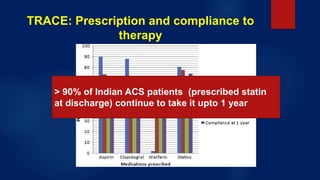
TRACE: Prescription and compliance to
therapy
> 90% of Indian ACS patients (prescribed statin
at discharge) continue to take it upto 1 year
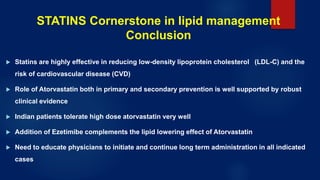
STATINS Cornerstone in lipid management
Conclusion
 Statins are highly effective in reducing low-density lipoprotein cholesterol (LDL-C) and the
risk of cardiovascular disease (CVD)
 Role of Atorvastatin both in primary and secondary prevention is well supported by robust
clinical evidence
 Indian patients tolerate high dose atorvastatin very well
 Addition of Ezetimibe complements the lipid lowering effect of Atorvastatin
 Need to educate physicians to initiate and continue long term administration in all indicated
cases
THANK YOU

Statins-cornerstone in lipid management

  • 1.
    STATINS Cornerstone in lipid management DrAwadhesh Sharma,DM,FACC,FSCAI Assistant professor LPS Institute of Cardiology,Kanpur
  • 2.
    The Story of2 Wonder Drugs What penicillin did to infections , Statins did to Atherogenic dyslipidemias Penicillin producing fungi gave us statins
  • 3.
    HMG Co AReductase inhibitor ------- COMPACTIN to LOVASTATIN 1970-1978 Brown and Goldstein Akira Endo Alfred Albert Aspergillus terreus- LovastatinPenicillium citrinum : Pen-51- Compactin
  • 4.
    COMPACTIN to ATORVAand Rosuvastatin
  • 5.
    Log-Linear Relationship BetweenLDL-C levels & relative risk for CHD
  • 6.
    Reduction in MACEfrom Lowering LDL-C with Statins for 5 years in 1000 Patients Major Cardiovascular Events* Secondary prevention Primary prevention LDL-C reduction RRR ARR RRR ARR 40 mg/dl 20% 48/1000 20% 25/1000 80 mg/dl 40% 96/1000 40% 50/1000 120 mg/dl 60% 144/1000 60% 75/1000 160 mg/dl 80% 192/1000 80% 100/1000 Baigent C. Lancet 2005;366:1267-78. * Includes coronary artery revascularization procedures
  • 7.
    -34 -24 -24 -24 -29 -37 -36 -46 -50 -45 -40 -35 -30 -25 -20 -15 -10 -5 0 %reductioninMACE Reductionin MACE with Statins Enas EA. How to beat the heart disease epidemic among South Asians. Downers Grove, 2005 4S LIPID CARE HPS WOSCOPS AFCAPS ASCOT-LA JUPITER
  • 8.
    Potential Mechanisms ofthe Benefit Statins Increase in HDL-C Reduction in chylomicron and VLDL remnants, IDL, LDL-C Restore endothelial function Maintain SMC function Anti-inflammatory effects Decreased thrombosis Lumen Lipid core Macrophages Smooth muscle cells HMG Co A reductase inhibitors
  • 9.
    LIST OF COMMERCIALLYAVAILABLE STATINS FROM TIME TO TIME Lovastatin, Simvastatin, Pravastatin Fluvastatin, Atorvastatin, Cerivastatin, Pitavastatin, Rosuvastatin
  • 10.
  • 11.
    Incremental risk reductionsvs. Atorvastatin 10 mg Previously, in ASCOT-LLA, Atorvastatin 10 mg significantly reduced risk of MI, stroke, revascularization, and angina in primary prevention patients1 -30 -25 -20 -15 -10 -5 0 ─12% Angina ─22% Nonfatal MI ─28% Revasc ─25% Fatal and nonfatal stroke ─26% Hospitalization for CHF Riskreductionvs. Atorvastatin10mg(%) TNT: Atorvastatin 80 mg vs.10 mg Reduces Cardiovascular Risk 1. Sever PS, et al. Lancet. 2003;361:1149-58. 2. LaRosa JC, et al. N Engl J Med. 2005;352:1425-1435. P=.004 P=.02 P<.001 P=.01 P=.03
  • 12.
    0 1 23 4 5 6 TNT: Aggressive statin therapy reduces major CV events Deedwania P et al. Lancet. 2006;368:919-28. Patients with major CV event (%) Time to first major CV event (years) n = 5584 with CHD and MetS Atorvastatin 10 mg (n = 2820) Atorvastatin 80 mg (n = 2764) Atorvastatin 10 mg (n = 2191) Atorvastatin 80 mg (n = 2162) All MetS (± diabetes) MetS, no diabetes MetS = metabolic syndrome 15 10 5 0 MetS, no diabetes 30% RRR HR 0.70 (0.57–0.84) P = 0.0002 All MetS 29% RRR HR 0.71 (0.61–0.84) P < 0.0001
  • 13.
    Atorvastatin IVUS studies Hiroyukiet al. J Atheroscler Thromb, 2019; 26: 592-600 All studies with significant reduction in LDLc showed a modest OR significant modest reduction in Plaque progression or mild regression
  • 14.
    Atorvastatin OCT studies Ozakiet al, Circ J 2019; 83: 1480–1488 Mean FCT change for subgroup atorvastatin 5mg was 27.8µm Mean FCT change for subgroup atorvastatin 20mg was 61.9µm Forest plot comparing change in fibrous cap thickness (FCT) from baseline to follow-up INCREASE IN THE FIBROUS CAP THICKNESS WAS MORE WITH HIGHER DOSE OF ATORVASTATIN
  • 15.
    Prospective Evaluation ofProteinuria and Renal Function in Diabetes Patients With Progressive Renal Disease – PLANET I & II Dr. Dick de Zeeuw , XLVII European Renal Association-European Dialysis and Transplant Association Congress; Munich, Germany, June 27, 2010. PLANET 1 Δ UPC ratio decreased by 12.6% with atorvastatin 80 mg(p = 0.033) and <5% with rosuvastatin 40 & 10 mg Δ eGFR:No change in atorvastatin group; -7.29 & -3.70 ml/min with rosuvastatin 10 & 40 mg respectively PLANET 2 UPC ratio decreased by 24.1% with atorvastatin 80 mg(p = 0.033) and <10% with rosuvastatin 40 & 10 mg Δ eGFR:No change with atorvastatin & rosuvastatin 10 mg ; -3.3 ml/min with rosuvastatin 40 mg respectively So based on these trials Atorvastatin seems to have more renoprotective effects for the studied chronic kidney disease population.
  • 16.
    ACC/AHA GUIDELINES FORPRIMARY PREVENTION
  • 17.
  • 18.
    Effect of combinationof ezetimibe and a statin on coronary plaque regression in patients with acute coronary syndrome ZEUS trial Percent change in LDL-C (A) and in plaque volume (B) according to treatment without and with diabetic patients N. Nakajima et al. / IJC Metabolic & Endocrine 3 (2014) 8–13
  • 19.
    FAQ’S Regarding HighDose Atorvastatin Do We Indians Tolerate High Dose Statins Well ? Are we using High Dose statins in high risk patients optimally?
  • 20.
    Indian Experience withHigh dose atorvastatin in ACS: CURE ACS  A total of 236 patients with diagnosed ACS (with TIMI Risk score≥ 3) within preceding 10 days were randomized to receive either atorvastatin 80 mg or atorvastatin 40 mg once daily in a randomized study  Follow up: 12 weeks.  The end points of the trial were % change in LDL-C and hs CRP from baseline. Kaul. U et al JAPI 2013:61: 11-15
  • 21.
    Indian Experience withHigh dose atorvastatin in ACS: CURE ACS P=0.024 for LDL-C reductionand hs CRP reduction (Atorvastatin 40 Vs 80 mg) Kaul U et al:JAPI 2013:61: 11-15 Conclusion: Atorvastatin 80 mg was more effective than atorvastatin 40 mg for reduction in LDL cholesterol and was as safe as 40 mg in Indian ACS patients and well tolerated
  • 22.
    Use of Statinin ACS patients in hospitals in India: Kerala ACS Registry Eur Heart J. 2013 Jan;34(2):121-9 30% of patients did not receive statin when hospitalized for ACS in Kerala Presentation, management, and outcomes of 25 748 acute coronary syndrome admissions in Kerala, India: results from the Kerala ACS Registry European heart …, 2013
  • 23.
    TRACE Study: useof statin in ACS in India in 2014  All relevant data, including treatment strategies, outcomes and patient treatment compliance were collected from 500 ACS cases from 9 different tertiary care hospitals in India 2007 to 2009.  Utilization of various drugs and patient compliance were also measured Indian Heart Journal 2014; 66: 334 -339
  • 24.
    TRACE: Utilization ofDrugs in ACS In Hospital Statin use:68% Statin prescription at discharge:88.6% Indian Heart Journal 2014; 66: 334 -339
  • 25.
    TRACE: Prescription andcompliance to therapy > 90% of Indian ACS patients (prescribed statin at discharge) continue to take it upto 1 year
  • 26.
    STATINS Cornerstone inlipid management Conclusion  Statins are highly effective in reducing low-density lipoprotein cholesterol (LDL-C) and the risk of cardiovascular disease (CVD)  Role of Atorvastatin both in primary and secondary prevention is well supported by robust clinical evidence  Indian patients tolerate high dose atorvastatin very well  Addition of Ezetimibe complements the lipid lowering effect of Atorvastatin  Need to educate physicians to initiate and continue long term administration in all indicated cases
  • 27.