DR. DEBABRATA HALDER
NICVD, DHAKA
RANOLAZINE
Introduction
 Ranolazine, a piperazine derivative, represents a
second-line antianginal drug in the management of
chronic stable angina pectoris(CSAP), was approved in
the United States(2006) and Europe(2008).
Pharmacodynamics
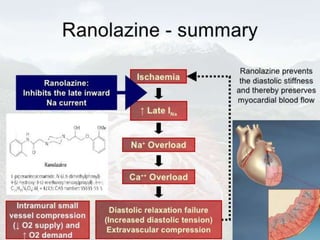
 In the ischaemic myocardium, late inward Na+ currents
occur.
 This contributes to an increase in intracellular Na+,
 This leads to an increase in intracellular Ca++(through
sodium-calcium exchanger)
 Calcium overload in ischaemic cells leads to impaired left
ventricular diastolic relaxation(called diastolic stiffness).
 Elevated left ventricular diastolic wall tension
compromises coronary blood flow even further.
 Additionally, calcium overload has adverse effects on
myocardial electrical activity predisposing to
ventricular tachycardia.
 Ranolazine inhibits the late phase of the inward
sodium current during cardiac repolarization .Thus
- Decreasing the calcium overload,thus
- Reducing diastolic stiffness, and
- Improving myocardial perfusion.
summery
Metabolic Properties
 Myocardial ischemia is associated with sudden
increase in fatty acid levels resulting in enhanced
oxidation of LCFA.
 LCFA oxidation needs more ATPs & also an increased
O2 demand for their breakdown than glucose
oxidation.
 Moreover this may lead to accumulation of FFAs &
lactic acid increasing the acidosis & affecting heart
performance.
 This is prevented by Ranolazine(partial inhibitor of
fatty acid oxidation-pFOX ) which shifts metabolism
from fatty acid beta oxidation to glucose oxidation.
 Ranolazine also inhibits the delayed rectifier
potassium current (IKr) at clinically therapeutic level,
which prolongs the ventricular action potential
duration (prolongation of QTc by 2 to 6 ms).
Pharmacokinetics
 Route : Oral
 Onset of Action : 2 to 6 hours and steady state within 3
days of twice-daily dosing.
 Plasma Half Life(t ½ ): about 7 hours
 Metabolism : Liver
 Excretion : Kidney(75%)
Tolerability
 Extended-release ranolazine has been well tolerated.
 The most frequent adverse events- dizziness (11.8%),
constipation (10.9%), and peripheral edema (8.3%).
 Plasma levels increase up to 50% to 60% in patients with
moderate hepatic or renal impairment. Therefore, caution
in these groups.
 Contraindication: creatinine clearance of ≤30 mL/min,
renal dialysis, cirrhosis of liver.
Interaction/Precaution
 Ranolazine undergoes hepatic metabolism by CYP3A4.
 Ranolazine is contraindicated with potent inhibitors of the
CYP3A4 pathway including
- antifungals (ketoconazole and other azole),
- antibiotics (macrolides, clarithromycin),
- HIV protease inhibitors,
- Diltiazem,
- Grapefruit juice.
Interaction/Precaution
 Although ranolazine prolongs QT interval, in a recent
large trial no proarrhythmic effects were noted.
 However, it should still be avoided in those with prior
QT prolongation, or with other drugs that prolong QT
interval.
 It is recommended that an ECG be performed 1 to 2
weeks after initiation.
Dose
Extended release tablet : 500mg & 1000mg.
 Starting dose: 500mg BID
 Maximum dose: 1000mg BID
2012 ACCF/AHA/ACP/AATS/PCNA/SCAI Guideline
for the Diagnosis and Management of Patients
With Stable Ischemic Heart Disease
 Ranolazine can be useful as a substitute for beta blockers if
initial treatment with beta blockers leads to unacceptable
side effects or is ineffective or if initial treatment with beta
blockers is contraindicated. (LOE: B)
 Ranolazine in combination with beta blockers can be
useful when initial treatment with betablockers is not
successful . (LOE: A)
2013 ESC guidelines on the management of
stable coronary artery disease
Second line antianginal drug(COR-IIa, LOE-B).
Ref:Ranolazine:A contemporary Review;J AM Heart Asso.march 15,2016
 MARISA study
 CARISA study
 ERICA study
-Provide the clinical basis for use of ranolazine as
an antianginal therapy in chronic stable angina.
Acute Coronary Syndrome
 MERLIN-TIMI 36 randomized trial : Effects of
ranolazine in acute non-ST-elevation acute coronary
syndromes
 Study population & period : 6560 ; 348 days
 Study result: No benefit overall on its primary
outcome.
Ref:morrow et al; JAMA,2007
Trimetazidine & Ranolazine
 Both drugs stimulate glucose metabolism from beta
oxidation .
 But, ranolazine has one additional benefit by
inhibiting the late phase of inward sodium current
during cardiac repolarization.
 In this way, ranolazine provides better efficacy.
Ivabradine & Ranolazine
 Study Name: Comparison of the efficacy and
tolerability of ivabradine and ranolazine in patients of
chronic stable angina pectoris.
 Study popualtion & period: 30; 08 weeks
 Study result: Both appeared equiactive. However,
ranolazine had a better safety and tolerability profile
than ivabradine .
Ref: chaturvedi et al;2013
Microvascular Coronary Dysfunction
 Study Name: Ranolazine improves angina in women
with evidence of myocardial ischemia but no
obstructive coronary artery disease.
 Study Type:Pilot randomized,double blind, placebo
controlled trial
 Study popualtion & period: 20; 04 weeks
 Study result: Ranolazine improves angina.
Ref:mehta et al;JACC cardiovasc Imaging.2011
 Study Name: Effects of ivabradine and ranolazine in
patients of MVA.
 Study popualtion & period: 46 ;04 weeks
 Study result: significantly improved in both groups
with ranolazine more than ivabradine.
Ref: villano et al.Am J cardiol.2013
New onset & Paroxysmal AF
 Study Name: Ranolazine enhances the efficacy of
amiodarone for conversion of recent-onset atrial
fibrillation(<48 hours).
 Study Type: Randomized,prospective,single-blind trial
 Study popualtion : 121
• Study result: A significantly higher conversion rate at 24
hours and at 12 hours in the ranolazine plus amiodarone.
Ref: koskinas et al;Europace.2014
Postoperative Cardiac Surgery AF
 Study Name: Efficacy of ranolazine in preventing AF
following cardiac surgery
 Study Type: Meta-analysis(04 studies)
 Study popualtion : 663
• Study result: A significant reduction in POAF with
ranolazine plus standard therapy.
Ref: Chintan trivedi et al,december 5,2016
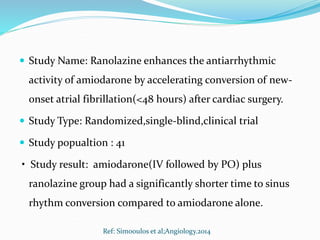
 Study Name: Ranolazine enhances the antiarrhythmic
activity of amiodarone by accelerating conversion of new-
onset atrial fibrillation(<48 hours) after cardiac surgery.
 Study Type: Randomized,single-blind,clinical trial
 Study popualtion : 41
• Study result: amiodarone(IV followed by PO) plus
ranolazine group had a significantly shorter time to sinus
rhythm conversion compared to amiodarone alone.
Ref: Simooulos et al;Angiology.2014
Chronic AF
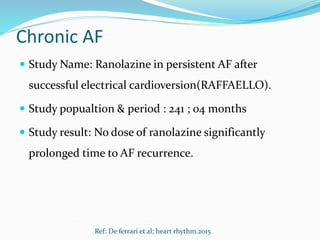
 Study Name: Ranolazine in persistent AF after
successful electrical cardioversion(RAFFAELLO).
 Study popualtion & period : 241 ; 04 months
 Study result: No dose of ranolazine significantly
prolonged time to AF recurrence.
Ref: De ferrari et al; heart rhythm.2015
Glycometabolic Effect
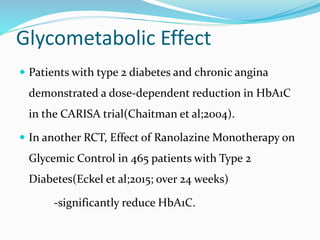
 Patients with type 2 diabetes and chronic angina
demonstrated a dose-dependent reduction in HbA1C
in the CARISA trial(Chaitman et al;2004).
 In another RCT, Effect of Ranolazine Monotherapy on
Glycemic Control in 465 patients with Type 2
Diabetes(Eckel et al;2015; over 24 weeks)
-significantly reduce HbA1C.
Incomplete Revascularization After PCI
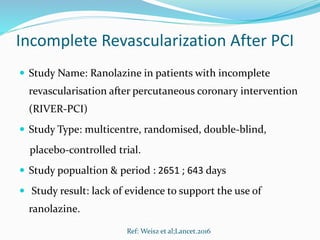
 Study Name: Ranolazine in patients with incomplete
revascularisation after percutaneous coronary intervention
(RIVER-PCI)
 Study Type: multicentre, randomised, double-blind,
placebo-controlled trial.
 Study popualtion & period : 2651 ; 643 days
 Study result: lack of evidence to support the use of
ranolazine.
Ref: Weisz et al;Lancet.2016
Take Home Massage
 Ranolazine does not affect heart rate & blood pressure.
 Ranolazine is a second-line agent in refractory angina.
 Ranolazine shows potential role in MCD, post-CABG
AF, and type 2 diabetes.
 Ranolazine has limited evidence in ACS, incomplete
revascularization post-PCI, and chronic AF.
Ranolazine

Ranolazine

  • 1.
  • 2.
    Introduction  Ranolazine, apiperazine derivative, represents a second-line antianginal drug in the management of chronic stable angina pectoris(CSAP), was approved in the United States(2006) and Europe(2008).
  • 3.
    Pharmacodynamics  In theischaemic myocardium, late inward Na+ currents occur.  This contributes to an increase in intracellular Na+,  This leads to an increase in intracellular Ca++(through sodium-calcium exchanger)  Calcium overload in ischaemic cells leads to impaired left ventricular diastolic relaxation(called diastolic stiffness).
  • 4.
     Elevated leftventricular diastolic wall tension compromises coronary blood flow even further.  Additionally, calcium overload has adverse effects on myocardial electrical activity predisposing to ventricular tachycardia.
  • 5.
     Ranolazine inhibitsthe late phase of the inward sodium current during cardiac repolarization .Thus - Decreasing the calcium overload,thus - Reducing diastolic stiffness, and - Improving myocardial perfusion.
  • 6.
  • 7.
    Metabolic Properties  Myocardialischemia is associated with sudden increase in fatty acid levels resulting in enhanced oxidation of LCFA.  LCFA oxidation needs more ATPs & also an increased O2 demand for their breakdown than glucose oxidation.
  • 8.
     Moreover thismay lead to accumulation of FFAs & lactic acid increasing the acidosis & affecting heart performance.  This is prevented by Ranolazine(partial inhibitor of fatty acid oxidation-pFOX ) which shifts metabolism from fatty acid beta oxidation to glucose oxidation.
  • 9.
     Ranolazine alsoinhibits the delayed rectifier potassium current (IKr) at clinically therapeutic level, which prolongs the ventricular action potential duration (prolongation of QTc by 2 to 6 ms).
  • 10.
    Pharmacokinetics  Route :Oral  Onset of Action : 2 to 6 hours and steady state within 3 days of twice-daily dosing.  Plasma Half Life(t ½ ): about 7 hours  Metabolism : Liver  Excretion : Kidney(75%)
  • 11.
    Tolerability  Extended-release ranolazinehas been well tolerated.  The most frequent adverse events- dizziness (11.8%), constipation (10.9%), and peripheral edema (8.3%).  Plasma levels increase up to 50% to 60% in patients with moderate hepatic or renal impairment. Therefore, caution in these groups.  Contraindication: creatinine clearance of ≤30 mL/min, renal dialysis, cirrhosis of liver.
  • 12.
    Interaction/Precaution  Ranolazine undergoeshepatic metabolism by CYP3A4.  Ranolazine is contraindicated with potent inhibitors of the CYP3A4 pathway including - antifungals (ketoconazole and other azole), - antibiotics (macrolides, clarithromycin), - HIV protease inhibitors, - Diltiazem, - Grapefruit juice.
  • 13.
    Interaction/Precaution  Although ranolazineprolongs QT interval, in a recent large trial no proarrhythmic effects were noted.  However, it should still be avoided in those with prior QT prolongation, or with other drugs that prolong QT interval.  It is recommended that an ECG be performed 1 to 2 weeks after initiation.
  • 14.
    Dose Extended release tablet: 500mg & 1000mg.  Starting dose: 500mg BID  Maximum dose: 1000mg BID
  • 15.
    2012 ACCF/AHA/ACP/AATS/PCNA/SCAI Guideline forthe Diagnosis and Management of Patients With Stable Ischemic Heart Disease  Ranolazine can be useful as a substitute for beta blockers if initial treatment with beta blockers leads to unacceptable side effects or is ineffective or if initial treatment with beta blockers is contraindicated. (LOE: B)  Ranolazine in combination with beta blockers can be useful when initial treatment with betablockers is not successful . (LOE: A)
  • 16.
    2013 ESC guidelineson the management of stable coronary artery disease Second line antianginal drug(COR-IIa, LOE-B). Ref:Ranolazine:A contemporary Review;J AM Heart Asso.march 15,2016
  • 17.
     MARISA study CARISA study  ERICA study -Provide the clinical basis for use of ranolazine as an antianginal therapy in chronic stable angina.
  • 18.
    Acute Coronary Syndrome MERLIN-TIMI 36 randomized trial : Effects of ranolazine in acute non-ST-elevation acute coronary syndromes  Study population & period : 6560 ; 348 days  Study result: No benefit overall on its primary outcome. Ref:morrow et al; JAMA,2007
  • 19.
    Trimetazidine & Ranolazine Both drugs stimulate glucose metabolism from beta oxidation .  But, ranolazine has one additional benefit by inhibiting the late phase of inward sodium current during cardiac repolarization.  In this way, ranolazine provides better efficacy.
  • 20.
    Ivabradine & Ranolazine Study Name: Comparison of the efficacy and tolerability of ivabradine and ranolazine in patients of chronic stable angina pectoris.  Study popualtion & period: 30; 08 weeks  Study result: Both appeared equiactive. However, ranolazine had a better safety and tolerability profile than ivabradine . Ref: chaturvedi et al;2013
  • 21.
    Microvascular Coronary Dysfunction Study Name: Ranolazine improves angina in women with evidence of myocardial ischemia but no obstructive coronary artery disease.  Study Type:Pilot randomized,double blind, placebo controlled trial  Study popualtion & period: 20; 04 weeks  Study result: Ranolazine improves angina. Ref:mehta et al;JACC cardiovasc Imaging.2011
  • 22.
     Study Name:Effects of ivabradine and ranolazine in patients of MVA.  Study popualtion & period: 46 ;04 weeks  Study result: significantly improved in both groups with ranolazine more than ivabradine. Ref: villano et al.Am J cardiol.2013
  • 23.
    New onset &Paroxysmal AF  Study Name: Ranolazine enhances the efficacy of amiodarone for conversion of recent-onset atrial fibrillation(<48 hours).  Study Type: Randomized,prospective,single-blind trial  Study popualtion : 121 • Study result: A significantly higher conversion rate at 24 hours and at 12 hours in the ranolazine plus amiodarone. Ref: koskinas et al;Europace.2014
  • 24.
    Postoperative Cardiac SurgeryAF  Study Name: Efficacy of ranolazine in preventing AF following cardiac surgery  Study Type: Meta-analysis(04 studies)  Study popualtion : 663 • Study result: A significant reduction in POAF with ranolazine plus standard therapy. Ref: Chintan trivedi et al,december 5,2016
  • 25.
     Study Name:Ranolazine enhances the antiarrhythmic activity of amiodarone by accelerating conversion of new- onset atrial fibrillation(<48 hours) after cardiac surgery.  Study Type: Randomized,single-blind,clinical trial  Study popualtion : 41 • Study result: amiodarone(IV followed by PO) plus ranolazine group had a significantly shorter time to sinus rhythm conversion compared to amiodarone alone. Ref: Simooulos et al;Angiology.2014
  • 26.
    Chronic AF  StudyName: Ranolazine in persistent AF after successful electrical cardioversion(RAFFAELLO).  Study popualtion & period : 241 ; 04 months  Study result: No dose of ranolazine significantly prolonged time to AF recurrence. Ref: De ferrari et al; heart rhythm.2015
  • 27.
    Glycometabolic Effect  Patientswith type 2 diabetes and chronic angina demonstrated a dose-dependent reduction in HbA1C in the CARISA trial(Chaitman et al;2004).  In another RCT, Effect of Ranolazine Monotherapy on Glycemic Control in 465 patients with Type 2 Diabetes(Eckel et al;2015; over 24 weeks) -significantly reduce HbA1C.
  • 28.
    Incomplete Revascularization AfterPCI  Study Name: Ranolazine in patients with incomplete revascularisation after percutaneous coronary intervention (RIVER-PCI)  Study Type: multicentre, randomised, double-blind, placebo-controlled trial.  Study popualtion & period : 2651 ; 643 days  Study result: lack of evidence to support the use of ranolazine. Ref: Weisz et al;Lancet.2016
  • 29.
    Take Home Massage Ranolazine does not affect heart rate & blood pressure.  Ranolazine is a second-line agent in refractory angina.  Ranolazine shows potential role in MCD, post-CABG AF, and type 2 diabetes.  Ranolazine has limited evidence in ACS, incomplete revascularization post-PCI, and chronic AF.