Concepts of memory by D V Nagarjana Devi is licensed under a Creative Commons Attribution-ShareAlike 4.0
International License.
Basic Concepts of
Memory
 Stored Program concept-Von Neumann
 Memory is broadly classified into two categories
-Internal : Used by CPU to perform a task
-External : Used to store bulk information
Memory Hierarchy
 Register: reside in the CPU and stores the information brought from memory
into CPU
 Cache memory: Cache memory is a storage device placed in between CPU
and Main memory
 Main memory : provides storage and relatively slower memory than cache
memory.
 Magnetic disk: bulk storage device
 Removable media(Magnetic tape, CD,DVD etc): storing data which is not
currently used.
Types of ROM
 PROM– Programmable Read Only Memory: It can be programmed once as per
user requirements.
 EPROM-Erasable Programmable Read Only Memory: Contents of the memory
can be erased and store new data into memory.
 EEPROM-Electrically Erasable Programmable Read Only Memory: Contents of
particular location can be changed without effecting the contents of other
location.
 Memory Access Time: The time that elapses between the initiation of an
operation and the completion of the operation.
 Memory Cycle time: The minimum time delay between the initiation of two
independent memory operations.
 Memory cycle time is slightly larger than Memory Access time.
Tpyes of RAM
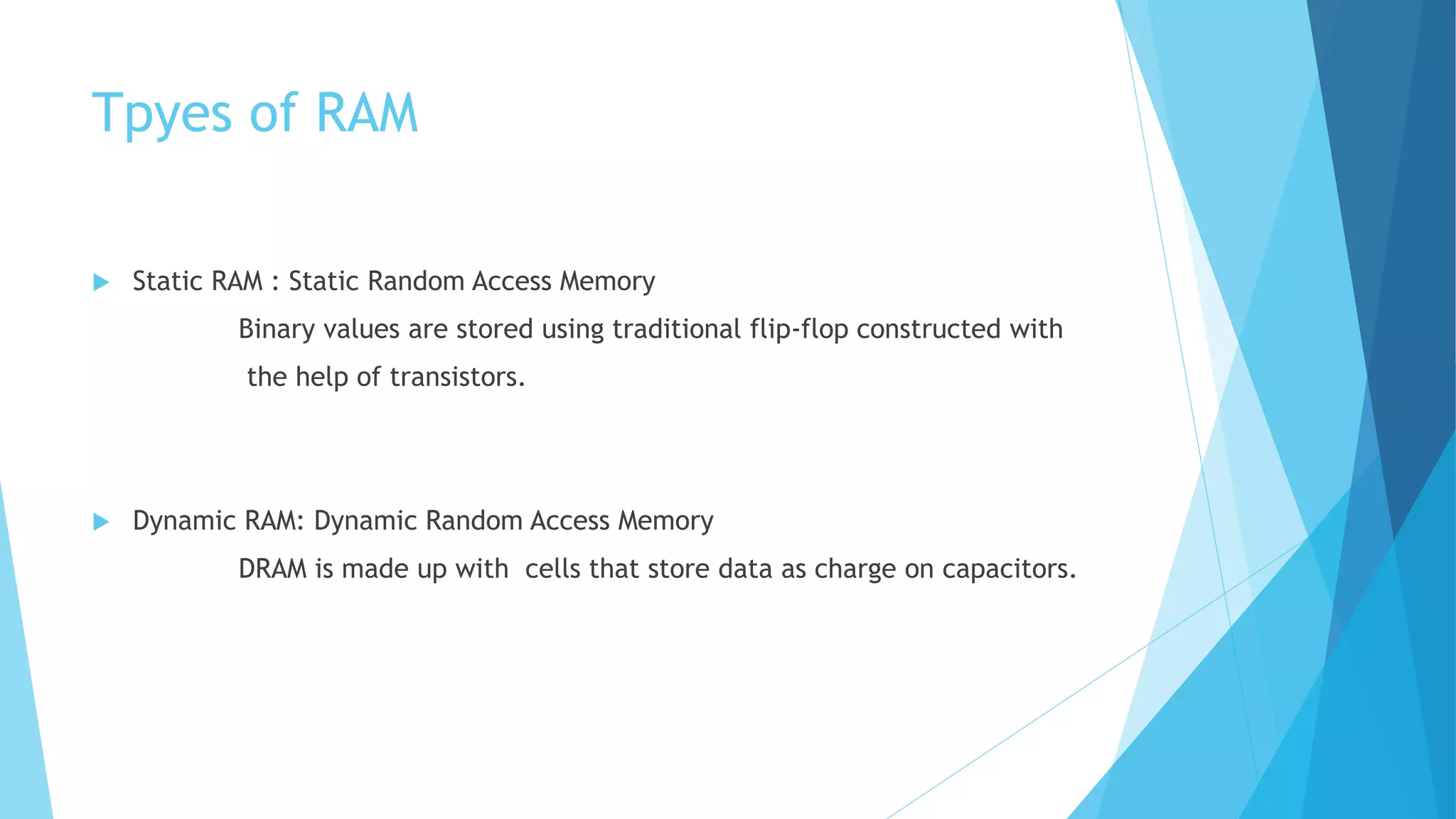
 Static RAM : Static Random Access Memory
Binary values are stored using traditional flip-flop constructed with
the help of transistors.
 Dynamic RAM: Dynamic Random Access Memory
DRAM is made up with cells that store data as charge on capacitors.
SRAM vs DRAM
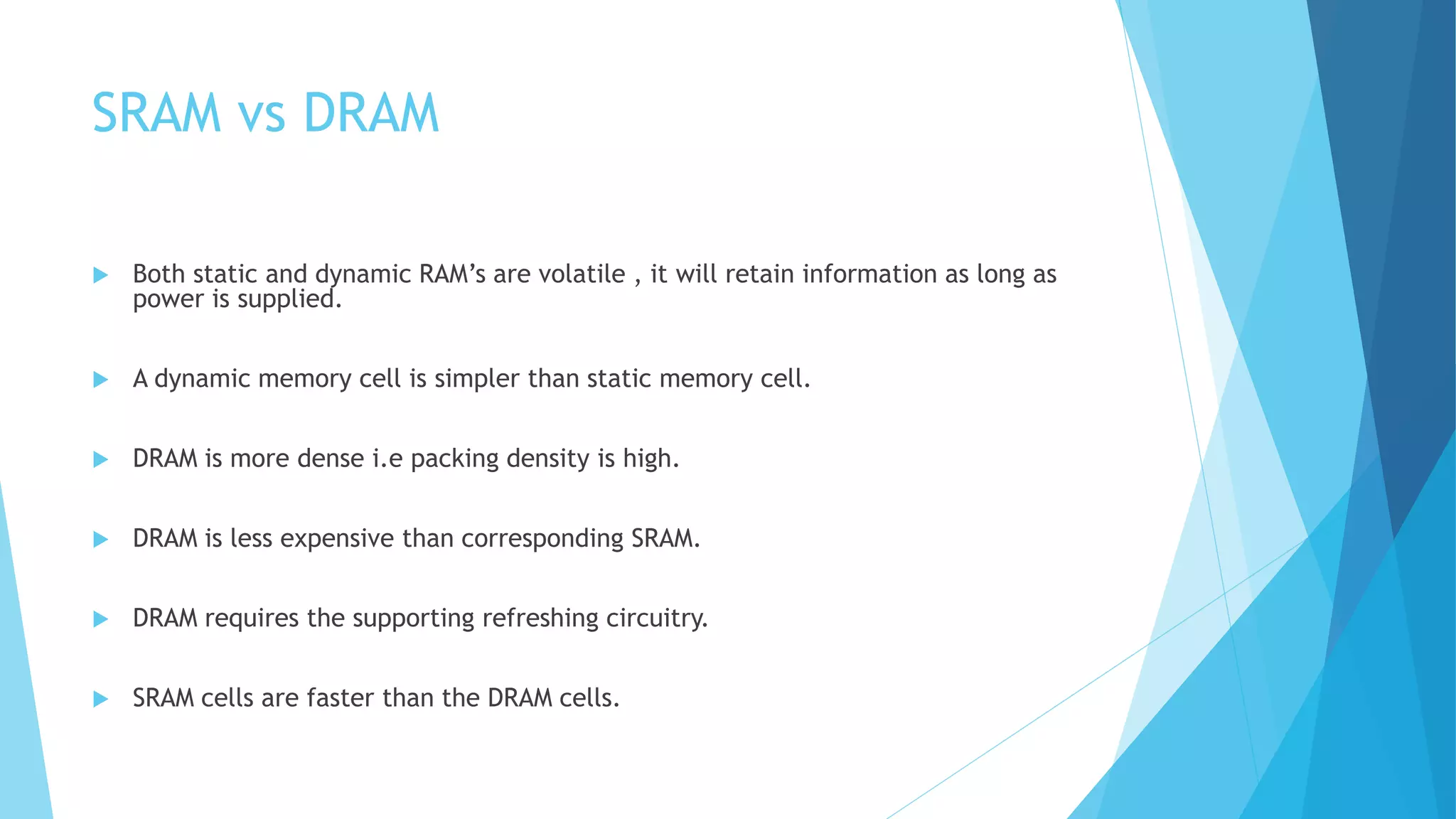
 Both static and dynamic RAM’s are volatile , it will retain information as long as
power is supplied.
 A dynamic memory cell is simpler than static memory cell.
 DRAM is more dense i.e packing density is high.
 DRAM is less expensive than corresponding SRAM.
 DRAM requires the supporting refreshing circuitry.
 SRAM cells are faster than the DRAM cells.

Basic concepts of memory

  • 1.
    Concepts of memoryby D V Nagarjana Devi is licensed under a Creative Commons Attribution-ShareAlike 4.0 International License.
  • 2.
  • 3.
     Stored Programconcept-Von Neumann  Memory is broadly classified into two categories -Internal : Used by CPU to perform a task -External : Used to store bulk information
  • 4.
    Memory Hierarchy  Register:reside in the CPU and stores the information brought from memory into CPU  Cache memory: Cache memory is a storage device placed in between CPU and Main memory  Main memory : provides storage and relatively slower memory than cache memory.  Magnetic disk: bulk storage device  Removable media(Magnetic tape, CD,DVD etc): storing data which is not currently used.
  • 5.
    Types of ROM PROM– Programmable Read Only Memory: It can be programmed once as per user requirements.  EPROM-Erasable Programmable Read Only Memory: Contents of the memory can be erased and store new data into memory.  EEPROM-Electrically Erasable Programmable Read Only Memory: Contents of particular location can be changed without effecting the contents of other location.
  • 6.
     Memory AccessTime: The time that elapses between the initiation of an operation and the completion of the operation.  Memory Cycle time: The minimum time delay between the initiation of two independent memory operations.  Memory cycle time is slightly larger than Memory Access time.
  • 7.
    Tpyes of RAM Static RAM : Static Random Access Memory Binary values are stored using traditional flip-flop constructed with the help of transistors.  Dynamic RAM: Dynamic Random Access Memory DRAM is made up with cells that store data as charge on capacitors.
  • 8.
    SRAM vs DRAM Both static and dynamic RAM’s are volatile , it will retain information as long as power is supplied.  A dynamic memory cell is simpler than static memory cell.  DRAM is more dense i.e packing density is high.  DRAM is less expensive than corresponding SRAM.  DRAM requires the supporting refreshing circuitry.  SRAM cells are faster than the DRAM cells.