OUTLINE 
SAMPLING. 
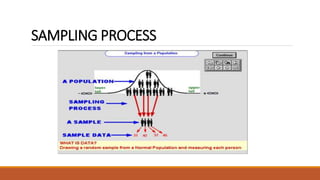
 SAMPLING PROCESS. 
 SAMPLING TYPES. 
 SAMPLING ERROR. 
SAMPLE SIZE
SAMPLING 
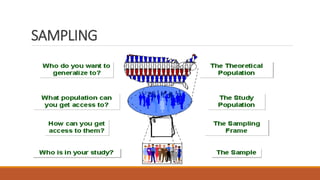
The process of obtaining information from a sample of a larger group 
(population). 
 A sample is “a smaller (but hopefully representative) collection of units from a 
population used to determine truths about that population”.
SAMPLING
Characteristics of Good Samples 
Representative 
Accessible 
Low cost
SAMPLING PROCESS 
1. Define the population : 
The Element ..... individuals 
families 
seminar groups 
Sampling Unit…. individuals over 20 
families with 2 kids 
seminar groups at ”new” university 
Extent ............ individuals who have bought “one” 
families who eat fast food 
seminar groups doing MR 
Timing ......... bought over the last seven days
SAMPLING PROCESS 
2. Identify the sampling frame : 
Select “sample units” 
 Individuals 
 Household 
 Streets 
 Telephone numbers 
 Companies
SAMPLING PROCESS 
1. Select a sampling design or procedure : 
 PROBABILITY 
 NON- PROBABILITY 
2. Determine the sample size. 
3. Draw the sample.
SAMPLING PROCESS
SAMPLING TYPES 
Probability sampling - equal chance of being included in the sample (random) 
◦ -simple random sampling 
◦ -systematic sampling 
◦ -stratified sampling 
◦ -cluster sampling 
Non-probability sampling - unequal chance of being included in the sample (non-random) 
◦ -convenience sampling 
◦ -judgment sampling 
◦ -snowball sampling 
◦ -quota sampling
Probability sampling
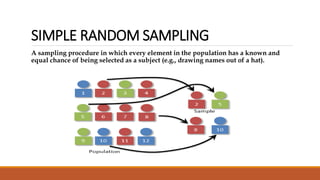
SIMPLE RANDOM SAMPLING 
A sampling procedure in which every element in the population has a known and 
equal chance of being selected as a subject (e.g., drawing names out of a hat).
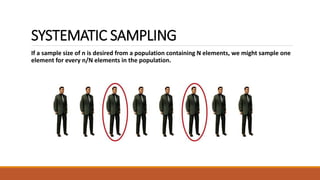
SYSTEMATIC SAMPLING 
If a sample size of n is desired from a population containing N elements, we might sample one 
element for every n/N elements in the population.
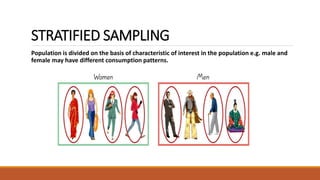
STRATIFIED SAMPLING 
Population is divided on the basis of characteristic of interest in the population e.g. male and 
female may have different consumption patterns.
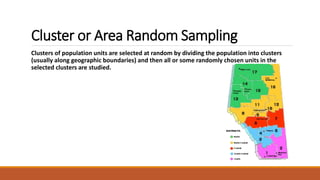
Cluster or Area Random Sampling 
Clusters of population units are selected at random by dividing the population into clusters 
(usually along geographic boundaries) and then all or some randomly chosen units in the 
selected clusters are studied.
Non-probability 
sampling
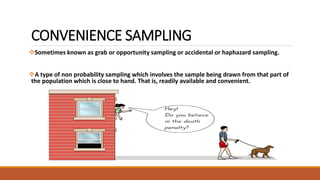
CONVENIENCE SAMPLING 
Sometimes known as grab or opportunity sampling or accidental or haphazard sampling. 
A type of non probability sampling which involves the sample being drawn from that part of 
the population which is close to hand. That is, readily available and convenient.
JUDGMENTAL SAMPLING 
 The researcher chooses the sample based on who they think would be appropriate for the 
study. 
 This is used primarily when there is a limited number of people that have expertise in the 
area being researched.
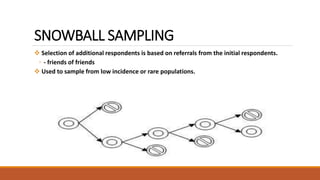
SNOWBALL SAMPLING 
 Selection of additional respondents is based on referrals from the initial respondents. 
◦ - friends of friends 
 Used to sample from low incidence or rare populations.
QUOTA SAMPLING 
Quota sampling is a method for selecting survey participants. 
In quota sampling, a population is first segmented into mutually exclusive sub-groups, just as in 
stratified sampling. 
Then judgment is used to select the subjects or units from each segment based on a specified 
proportion. 
For example, an interviewer may be told to sample 200 females and 300 males between the age 
of 45 and 60. 
This means that individuals can put a demand on who they want to sample (targeting).
SAMPLING ERROR
Random Sampling Error 
 Random error- the sample selected is not representative of the population due to chance. 
 The level of it is controlled by sample size. 
 A larger sample size leads to a smaller sampling error.
Non-sampling Error 
Systematic Error 
◦ 
 The level of it is not controlled by sample size.
The basic types of non-sampling error 
A non-response error occurs when units selected as part of the sampling procedure do not 
respond in whole or in part . 
A response or data error is any systematic bias that occurs during data collection, analysis or 
interpretation, like: 
◦ Respondent error (e.g., lying, forgetting, etc.). 
◦ Interviewer bias. 
◦ Recording errors. 
◦ Poorly designed questionnaires
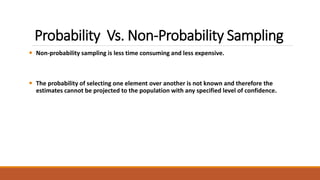
Probability Vs. Non-Probability Sampling 
 Non-probability sampling is less time consuming and less expensive. 
 The probability of selecting one element over another is not known and therefore the 
estimates cannot be projected to the population with any specified level of confidence.
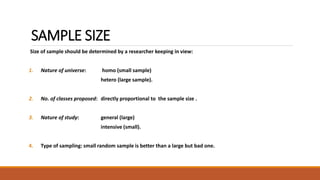
SAMPLE SIZE 
Size of sample should be determined by a researcher keeping in view: 
1. Nature of universe: homo (small sample) 
hetero (large sample). 
2. No. of classes proposed: directly proportional to the sample size . 
3. Nature of study: general (large) 
intensive (small). 
4. Type of sampling: small random sample is better than a large but bad one.
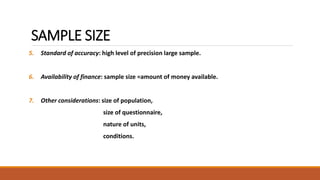
SAMPLE SIZE 
5. Standard of accuracy: high level of precision large sample. 
6. Availability of finance: sample size =amount of money available. 
7. Other considerations: size of population, 
size of questionnaire, 
nature of units, 
conditions.
Stat (2)

Stat (2)

  • 1.
    OUTLINE SAMPLING. SAMPLING PROCESS.  SAMPLING TYPES.  SAMPLING ERROR. SAMPLE SIZE
  • 2.
    SAMPLING The processof obtaining information from a sample of a larger group (population).  A sample is “a smaller (but hopefully representative) collection of units from a population used to determine truths about that population”.
  • 3.
  • 4.
    Characteristics of GoodSamples Representative Accessible Low cost
  • 5.
    SAMPLING PROCESS 1.Define the population : The Element ..... individuals families seminar groups Sampling Unit…. individuals over 20 families with 2 kids seminar groups at ”new” university Extent ............ individuals who have bought “one” families who eat fast food seminar groups doing MR Timing ......... bought over the last seven days
  • 6.
    SAMPLING PROCESS 2.Identify the sampling frame : Select “sample units”  Individuals  Household  Streets  Telephone numbers  Companies
  • 7.
    SAMPLING PROCESS 1.Select a sampling design or procedure :  PROBABILITY  NON- PROBABILITY 2. Determine the sample size. 3. Draw the sample.
  • 8.
  • 9.
    SAMPLING TYPES Probabilitysampling - equal chance of being included in the sample (random) ◦ -simple random sampling ◦ -systematic sampling ◦ -stratified sampling ◦ -cluster sampling Non-probability sampling - unequal chance of being included in the sample (non-random) ◦ -convenience sampling ◦ -judgment sampling ◦ -snowball sampling ◦ -quota sampling
  • 10.
  • 11.
    SIMPLE RANDOM SAMPLING A sampling procedure in which every element in the population has a known and equal chance of being selected as a subject (e.g., drawing names out of a hat).
  • 12.
    SYSTEMATIC SAMPLING Ifa sample size of n is desired from a population containing N elements, we might sample one element for every n/N elements in the population.
  • 13.
    STRATIFIED SAMPLING Populationis divided on the basis of characteristic of interest in the population e.g. male and female may have different consumption patterns.
  • 14.
    Cluster or AreaRandom Sampling Clusters of population units are selected at random by dividing the population into clusters (usually along geographic boundaries) and then all or some randomly chosen units in the selected clusters are studied.
  • 15.
  • 16.
    CONVENIENCE SAMPLING Sometimesknown as grab or opportunity sampling or accidental or haphazard sampling. A type of non probability sampling which involves the sample being drawn from that part of the population which is close to hand. That is, readily available and convenient.
  • 17.
    JUDGMENTAL SAMPLING The researcher chooses the sample based on who they think would be appropriate for the study.  This is used primarily when there is a limited number of people that have expertise in the area being researched.
  • 18.
    SNOWBALL SAMPLING Selection of additional respondents is based on referrals from the initial respondents. ◦ - friends of friends  Used to sample from low incidence or rare populations.
  • 19.
    QUOTA SAMPLING Quotasampling is a method for selecting survey participants. In quota sampling, a population is first segmented into mutually exclusive sub-groups, just as in stratified sampling. Then judgment is used to select the subjects or units from each segment based on a specified proportion. For example, an interviewer may be told to sample 200 females and 300 males between the age of 45 and 60. This means that individuals can put a demand on who they want to sample (targeting).
  • 20.
  • 21.
    Random Sampling Error  Random error- the sample selected is not representative of the population due to chance.  The level of it is controlled by sample size.  A larger sample size leads to a smaller sampling error.
  • 22.
    Non-sampling Error SystematicError ◦  The level of it is not controlled by sample size.
  • 23.
    The basic typesof non-sampling error A non-response error occurs when units selected as part of the sampling procedure do not respond in whole or in part . A response or data error is any systematic bias that occurs during data collection, analysis or interpretation, like: ◦ Respondent error (e.g., lying, forgetting, etc.). ◦ Interviewer bias. ◦ Recording errors. ◦ Poorly designed questionnaires
  • 24.
    Probability Vs. Non-ProbabilitySampling  Non-probability sampling is less time consuming and less expensive.  The probability of selecting one element over another is not known and therefore the estimates cannot be projected to the population with any specified level of confidence.
  • 25.
    SAMPLE SIZE Sizeof sample should be determined by a researcher keeping in view: 1. Nature of universe: homo (small sample) hetero (large sample). 2. No. of classes proposed: directly proportional to the sample size . 3. Nature of study: general (large) intensive (small). 4. Type of sampling: small random sample is better than a large but bad one.
  • 26.
    SAMPLE SIZE 5.Standard of accuracy: high level of precision large sample. 6. Availability of finance: sample size =amount of money available. 7. Other considerations: size of population, size of questionnaire, nature of units, conditions.