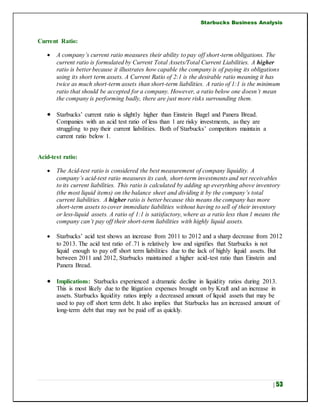
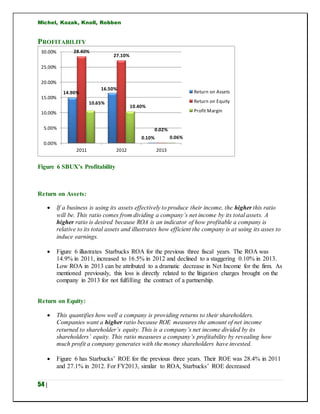
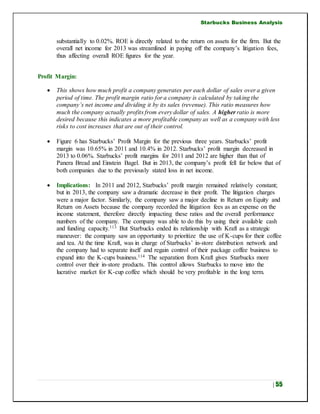
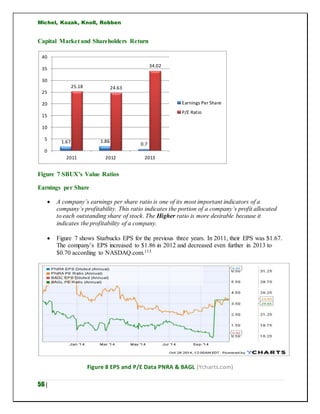
Michel, Kozak, Knoll, Robben
2 |
Table of Contents
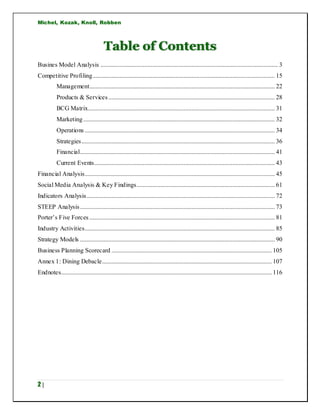
Busines Model Analysis ................................................................................................................. 3
Competitive Profiling.................................................................................................................... 15
Management...................................................................................................................... 22
Products & Services.......................................................................................................... 28
BCG Matrix....................................................................................................................... 31
Marketing.......................................................................................................................... 32
Operations ......................................................................................................................... 34
Strategies........................................................................................................................... 36
Financial............................................................................................................................ 41
Current Events................................................................................................................... 43
Financial Analysis......................................................................................................................... 45
Social Media Analysis & Key Findings........................................................................................ 61
Indicators Analysis........................................................................................................................ 72
STEEP Analysis............................................................................................................................ 73
Porter’s Five Forces ...................................................................................................................... 81
Industry Activities......................................................................................................................... 85
Strategy Models ............................................................................................................................ 90
Business Planning Scorecard ...................................................................................................... 105
Annex 1: Dining Debacle............................................................................................................ 107
Endnotes...................................................................................................................................... 116
Starbucks Business Analysis
| 3
Business Model Analysis
STEP 1:ARTICULATE THE VALUE PROPOSITION
Starbucks’ value proposition is focused on the company’s strong brand image and quality
products. Offering high quality products and friendly, reliable customer service creates a strong
brand image and customer loyalty. The customer service not only creates the rich coffee culture
atmosphere within each location but can be found online as well. Starbucks commitment to
social media outlets as a customer service avenue further illustrates its dedication to consumers
as well as advancing technology. The company actively maintains Twitter and Facebook
accounts which serve as a place where customer issues may be resolved and new products are
advertised. On Twitter, Starbucks social media team maintains its personal touch by responding
to almost every tweet posted about
the company. This is part of the
company’s goal to create meaningful
interactions and personalization with
its customers.
Starbucks’ quality products
and elite image create a strong brand
loyalty, as its products are often
perceived as an elite status symbol.
This loyalty and elitist image are a
result of the coffee culture and
atmosphere that are found at
Starbucks. Store layouts are inspired
by local culture and art and serve as
the third place consumers can go between home and work. Starbucks focus on corporate social
responsibility also contribute to their elitist image. According to a survey conducted by Lab42,
84% of consumers would pay more for products by companies that participate in forms of
corporate social responsibility. Starbucks is currently committed to buy all of its coffee from
sources which utilize coffee and farmer equity (C.A.F.E) practices by the year 2015. Last year
95% of its coffee came from these C.A.F.E sources.
The quality of Starbucks products are a result of strategic acquisitions which allows for
product diversification and reliable sources of coffee and other goods. Through acquisitions,
Starbucks maintains superior control of its supply chain as it collects coffee beans from more
than 30 countries. The company has acquired ten companies within the last ten years, and
continues to seek new opportunities for growth within the organic food industry. In addition to
acquiring food and beverage companies, Starbucks partners with technology companies such as
Square and Apple in order to enhance its iPhone app and adopt Apple Pay.
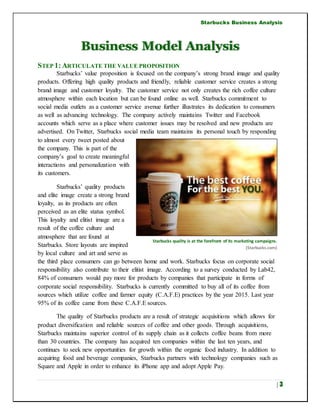
Starbucks quality is at the forefront of its marketing campaigns.
(Starbucks.com)
Michel, Kozak, Knoll, Robben
4 |
STEP 2:SPECIFYTHE TARGET SEGMENT
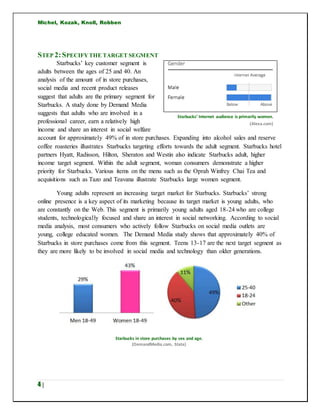
Starbucks’ key customer segment is
adults between the ages of 25 and 40. An
analysis of the amount of in store purchases,
social media and recent product releases
suggest that adults are the primary segment for
Starbucks. A study done by Demand Media
suggests that adults who are involved in a
professional career, earn a relatively high
income and share an interest in social welfare
account for approximately 49% of in store purchases. Expanding into alcohol sales and reserve
coffee roasteries illustrates Starbucks targeting efforts towards the adult segment. Starbucks hotel
partners Hyatt, Radisson, Hilton, Sheraton and Westin also indicate Starbucks adult, higher
income target segment. Within the adult segment, woman consumers demonstrate a higher
priority for Starbucks. Various items on the menu such as the Oprah Winfrey Chai Tea and
acquisitions such as Tazo and Teavana illustrate Starbucks large women segment.
Young adults represent an increasing target market for Starbucks. Starbucks’ strong
online presence is a key aspect of its marketing because its target market is young adults, who
are constantly on the Web. This segment is primarily young adults aged 18-24 who are college
students, technologically focused and share an interest in social networking. According to social
media analysis, most consumers who actively follow Starbucks on social media outlets are
young, college educated women. The Demand Media study shows that approximately 40% of
Starbucks in store purchases come from this segment. Teens 13-17 are the next target segment as
they are more likely to be involved in social media and technology than older generations.
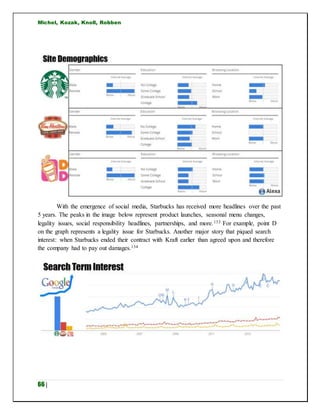
Starbucks’ Internet audience is primarily women.
(Alexa.com)
Starbucks in store purchases by sex and age.
(DemandMedia.com, Stata)
Starbucks Business Analysis
| 5
STEP 3:DETERMINE COMPETITORS
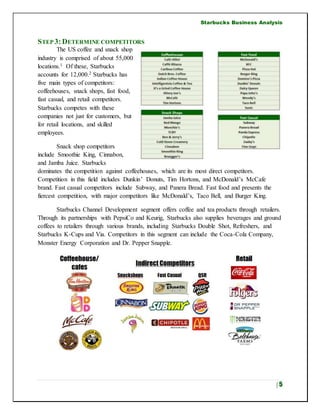
The US coffee and snack shop
industry is comprised of about 55,000
locations.1 Of these, Starbucks
accounts for 12,000.2 Starbucks has
five main types of competitors:
coffeehouses, snack shops, fast food,
fast casual, and retail competitors.
Starbucks competes with these
companies not just for customers, but
for retail locations, and skilled
employees.
Snack shop competitors
include Smoothie King, Cinnabon,
and Jamba Juice. Starbucks
dominates the competition against coffeehouses, which are its most direct competitors.
Competition in this field includes Dunkin’ Donuts, Tim Hortons, and McDonald’s McCafe
brand. Fast casual competitors include Subway, and Panera Bread. Fast food and presents the
fiercest competition, with major competitors like McDonald’s, Taco Bell, and Burger King.
Starbucks Channel Development segment offers coffee and tea products through retailers.
Through its partnerships with PepsiCo and Keurig, Starbucks also supplies beverages and ground
coffees to retailers through various brands, including Starbucks Double Shot, Refreshers, and
Starbucks K-Cups and Via. Competitors in this segment can include the Coca-Cola Company,
Monster Energy Corporation and Dr. Pepper Snapple.
Michel, Kozak, Knoll, Robben
6 |
STEP 4:EVALUATE THE VALUE CHAIN AND COST MODEL
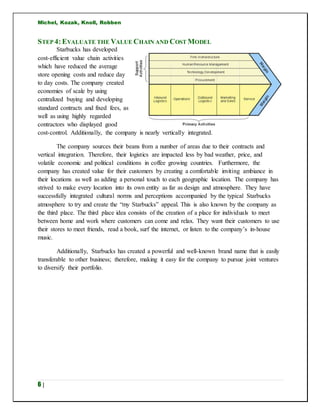
Starbucks has developed
cost-efficient value chain activities
which have reduced the average
store opening costs and reduce day
to day costs. The company created
economies of scale by using
centralized buying and developing
standard contracts and fixed fees, as
well as using highly regarded
contractors who displayed good
cost-control. Additionally, the company is nearly vertically integrated.
The company sources their beans from a number of areas due to their contracts and
vertical integration. Therefore, their logistics are impacted less by bad weather, price, and
volatile economic and political conditions in coffee growing countries. Furthermore, the
company has created value for their customers by creating a comfortable inviting ambiance in
their locations as well as adding a personal touch to each geographic location. The company has
strived to make every location into its own entity as far as design and atmosphere. They have
successfully integrated cultural norms and perceptions accompanied by the typical Starbucks
atmosphere to try and create the “my Starbucks” appeal. This is also known by the company as
the third place. The third place idea consists of the creation of a place for individuals to meet
between home and work where customers can come and relax. They want their customers to use
their stores to meet friends, read a book, surf the internet, or listen to the company’s in-house
music.
Additionally, Starbucks has created a powerful and well-known brand name that is easily
transferable to other business; therefore, making it easy for the company to pursue joint ventures
to diversify their portfolio.
Starbucks Business Analysis
| 7
STEP 5:DETERMINE THE REVENUE MODEL FOR THEFIRM
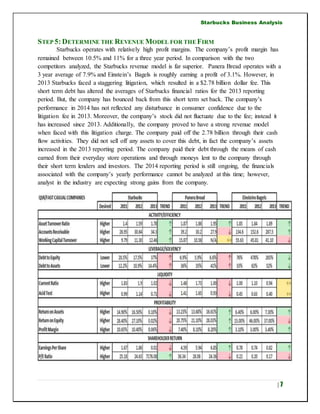
Starbucks operates with relatively high profit margins. The company’s profit margin has
remained between 10.5% and 11% for a three year period. In comparison with the two
competitors analyzed, the Starbucks revenue model is far superior. Panera Bread operates with a
3 year average of 7.9% and Einstein’s Bagels is roughly earning a profit of 3.1%. However, in
2013 Starbucks faced a staggering litigation, which resulted in a $2.78 billion dollar fee. This
short term debt has altered the averages of Starbucks financial ratios for the 2013 reporting
period. But, the company has bounced back from this short term set back. The company’s
performance in 2014 has not reflected any disturbance in consumer confidence due to the
litigation fee in 2013. Moreover, the company’s stock did not fluctuate due to the fee; instead it
has increased since 2013. Additionally, the company proved to have a strong revenue model
when faced with this litigation charge. The company paid off the 2.78 billion through their cash
flow activities. They did not sell off any assets to cover this debt, in fact the company’s assets
increased in the 2013 reporting period. The company paid their debt through the means of cash
earned from their everyday store operations and through moneys lent to the company through
their short term lenders and investors. The 2014 reporting period is still ongoing, the financials
associated with the company’s yearly performance cannot be analyzed at this time; however,
analyst in the industry are expecting strong gains from the company.
Michel, Kozak, Knoll, Robben
8 |
STEP 6:DETERMINE THE STRATEGYFOR STARBUCKS
Starbucks became the country’s #1 coffeehouse through a differentiation strategy
emphasizing quality products at premium prices. The restaurant industry and retail soft drink
industries are both highly competitive. Starbucks has achieved great success in these markets
through its commitments to corporate social responsibility, product quality, local culture and
store atmosphere, global expansion, and providing strong employee benefits, which, in turn, pays
off in customer service. Its success has allowed it to grow exponentially since 1982.
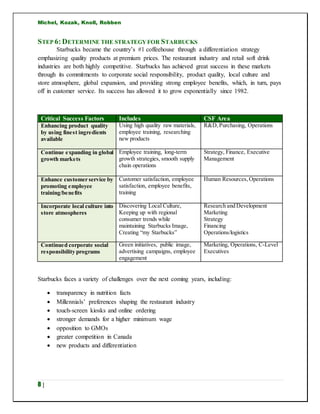
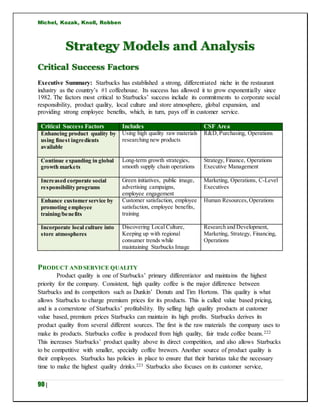
Critical Success Factors Includes CSF Area
Enhancing product quality
by using finest ingredients
available
Using high quality raw materials,
employee training, researching
new products
R&D, Purchasing, Operations
Continue expanding in global
growth markets
Employee training, long-term
growth strategies, smooth supply
chain operations
Strategy, Finance, Executive
Management
Enhance customer service by
promoting employee
training/benefits
Customer satisfaction, employee
satisfaction, employee benefits,
training
Human Resources,Operations
Incorporate local culture into
store atmospheres
Discovering Local Culture,
Keeping up with regional
consumer trends while
maintaining Starbucks Image,
Creating “my Starbucks”
Research and Development
Marketing
Strategy
Financing
Operations/logistics
Continued corporate social
responsibility programs
Green initiatives, public image,
advertising campaigns, employee
engagement
Marketing, Operations, C-Level
Executives
Starbucks faces a variety of challenges over the next coming years, including:
 transparency in nutrition facts
 Millennials’ preferences shaping the restaurant industry
 touch-screen kiosks and online ordering
 stronger demands for a higher minimum wage
 opposition to GMOs
 greater competition in Canada
 new products and differentiation
Starbucks Business Analysis
| 9
Starbucks is already well-positioned to handle these threats. Its continued growth strategy
includes opening more stores, expanding its current day parts, and opening more drive-thrus.
Starbucks will use its strong brand name combined with foreign partnerships and acquisitions to
fuel foreign expansion. It can deal with other coming controversies and challenges by
emphasizing healthier products, including introducing GMO-free products to its Starbucks
stores, and expanding its Teavana, and Evolution Fresh brands to satisfy customers looking for
healthy options at grocery retailers. Expanding these product lines, along with the Fizzio and
Keurig Cold product lines, would also reduce Starbucks’ reliance on the saturated coffee market.
Michel, Kozak, Knoll, Robben
10 |
STEP 7:BUSINESS MODEL ANALYSIS GRID
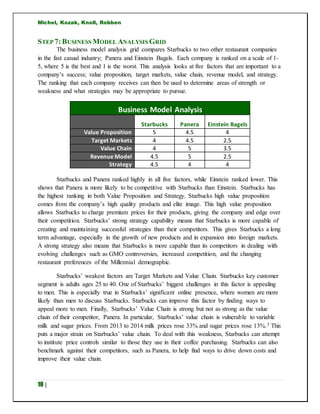
The business model analysis grid compares Starbucks to two other restaurant companies
in the fast casual industry; Panera and Einstein Bagels. Each company is ranked on a scale of 1-
5, where 5 is the best and 1 is the worst. This analysis looks at five factors that are important to a
company’s success; value proposition, target markets, value chain, revenue model, and strategy.
The ranking that each company receives can then be used to determine areas of strength or
weakness and what strategies may be appropriate to pursue.
Business Model Analysis
Starbucks Panera Einstein Bagels
Value Proposition 5 4.5 4
Target Markets 4 4.5 2.5
Value Chain 4 5 3.5
Revenue Model 4.5 5 2.5
Strategy 4.5 4 4
Starbucks and Panera ranked highly in all five factors, while Einstein ranked lower. This
shows that Panera is more likely to be competitive with Starbucks than Einstein. Starbucks has
the highest ranking in both Value Proposition and Strategy. Starbucks high value proposition
comes from the company’s high quality products and elite image. This high value proposition
allows Starbucks to charge premium prices for their products, giving the company and edge over
their competition. Starbucks’ strong strategy capability means that Starbucks is more capable of
creating and maintaining successful strategies than their competitors. This gives Starbucks a long
term advantage, especially in the growth of new products and in expansion into foreign markets.
A strong strategy also means that Starbucks is more capable than its competitors in dealing with
evolving challenges such as GMO controversies, increased competition, and the changing
restaurant preferences of the Millennial demographic.
Starbucks’ weakest factors are Target Markets and Value Chain. Starbucks key customer
segment is adults ages 25 to 40. One of Starbucks’ biggest challenges in this factor is appealing
to men. This is especially true in Starbucks’ significant online presence, where women are more
likely than men to discuss Starbucks. Starbucks can improve this factor by finding ways to
appeal more to men. Finally, Starbucks’ Value Chain is strong but not as strong as the value
chain of their competitor, Panera. In particular, Starbucks’ value chain is vulnerable to variable
milk and sugar prices. From 2013 to 2014 milk prices rose 33% and sugar prices rose 13%.3 This
puts a major strain on Starbucks’ value chain. To deal with this weakness, Starbucks can attempt
to institute price controls similar to those they use in their coffee purchasing. Starbucks can also
benchmark against their competitors, such as Panera, to help find ways to drive down costs and
improve their value chain.
Starbucks Business Analysis
| 11
Michel, Kozak, Knoll, Robben
12 |
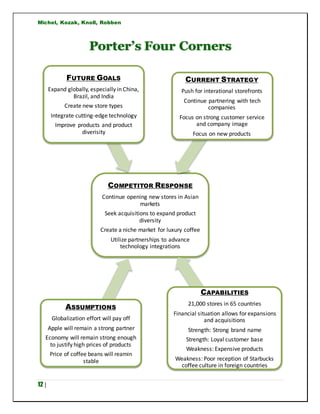
Porter’s Four Corners
COMPETITOR RESPONSE
Continue opening new stores in Asian
markets
Seek acquisitions to expand product
diversity
Create a niche market for luxury coffee
Utilize partnerships to advance
technology integrations
FUTURE GOALS
Expand globally, especially in China,
Brazil, and India
Create new store types
Integrate cutting-edge technology
Improve products and product
diverisity
CURRENT STRATEGY
Push for interational storefronts
Continue partnering with tech
companies
Focus on strong customer service
and company image
Focus on new products
ASSUMPTIONS
Globalization effort will pay off
Apple will remain a strong partner
Economy will remain strong enough
to justify high prices of products
Price of coffee beans will reamin
stable
CAPABILITIES
21,000 stores in 65 countries
Financial situation allows for expansions
and acquisitions
Strength: Strong brand name
Strength: Loyal customer base
Weakness: Expensive products
Weakness: Poor reception of Starbucks
coffee culture in foreign countries
Starbucks Business Analysis
| 13
COMPETITOR RESPONSE PROFILE
Starbucks is likely to increase financial gains over the next five years through continuing
growth in Asia, integrating advanced technology and creating a niche market for luxury coffee.
As Starbucks continues to expand throughout Asia, corporate partnerships and acquisitions will
allow them to diversify their product offerings. Starbucks’ partnership with Tata Global
Beverages in India is one example of this. The addition of the reserve coffee roaster stories to the
market is also likely to create a niche for gourmet coffee which will increase profits and drive
demand for luxury coffee. In addition to creating a luxurious appeal for coffee, the use of
partnerships to integrate technology will also benefit Starbucks in the long run.
FUTURE GOALS
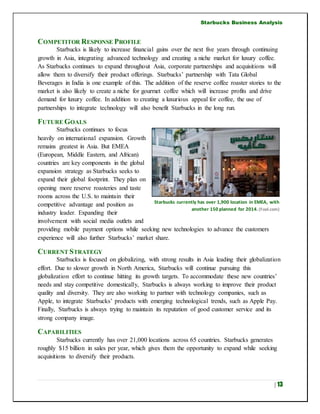
Starbucks continues to focus
heavily on international expansion. Growth
remains greatest in Asia. But EMEA
(European, Middle Eastern, and African)
countries are key components in the global
expansion strategy as Starbucks seeks to
expand their global footprint. They plan on
opening more reserve roasteries and taste
rooms across the U.S. to maintain their
competitive advantage and position as
industry leader. Expanding their
involvement with social media outlets and
providing mobile payment options while seeking new technologies to advance the customers
experience will also further Starbucks’ market share.
CURRENT STRATEGY
Starbucks is focused on globalizing, with strong results in Asia leading their globalization
effort. Due to slower growth in North America, Starbucks will continue pursuing this
globalization effort to continue hitting its growth targets. To accommodate these new countries’
needs and stay competitive domestically, Starbucks is always working to improve their product
quality and diversity. They are also working to partner with technology companies, such as
Apple, to integrate Starbucks’ products with emerging technological trends, such as Apple Pay.
Finally, Starbucks is always trying to maintain its reputation of good customer service and its
strong company image.
CAPABILITIES
Starbucks currently has over 21,000 locations across 65 countries. Starbucks generates
roughly $15 billion in sales per year, which gives them the opportunity to expand while seeking
acquisitions to diversify their products.
Starbucks currently has over 1,900 location in EMEA, with
another 150 planned for 2014.(Fool.com)
Michel, Kozak, Knoll, Robben
14 |
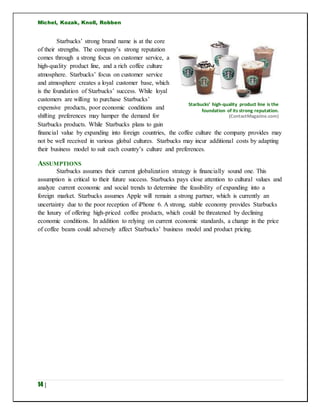
Starbucks’ strong brand name is at the core
of their strengths. The company’s strong reputation
comes through a strong focus on customer service, a
high-quality product line, and a rich coffee culture
atmosphere. Starbucks’ focus on customer service
and atmosphere creates a loyal customer base, which
is the foundation of Starbucks’ success. While loyal
customers are willing to purchase Starbucks’
expensive products, poor economic conditions and
shifting preferences may hamper the demand for
Starbucks products. While Starbucks plans to gain
financial value by expanding into foreign countries, the coffee culture the company provides may
not be well received in various global cultures. Starbucks may incur additional costs by adapting
their business model to suit each country’s culture and preferences.
ASSUMPTIONS
Starbucks assumes their current globalization strategy is financially sound one. This
assumption is critical to their future success. Starbucks pays close attention to cultural values and
analyze current economic and social trends to determine the feasibility of expanding into a
foreign market. Starbucks assumes Apple will remain a strong partner, which is currently an
uncertainty due to the poor reception of iPhone 6. A strong, stable economy provides Starbucks
the luxury of offering high-priced coffee products, which could be threatened by declining
economic conditions. In addition to relying on current economic standards, a change in the price
of coffee beans could adversely affect Starbucks’ business model and product pricing.
Starbucks’ high-quality product line is the
foundation of its strong reputation.
(ContactMagazine.com)
Starbucks Business Analysis
| 15
The History of Starbucks
Executive Summary: Starbucks Corporation was founded in 1972 with a far different vision
than it has today. Starbucks’ history demonstrates how powerful Howard Schultz’s impact was
on the company’s success. He altered Starbucks’ course, changing it from a slow-growing
company that sold coffee grounds to an exponentially-growing company that brews coffee
drinks. Starbucks today is based on the coffeehouse culture he witnessed during a vacation in
Italy. It currently features about 22,000 stores worldwide, and an extensive line of retail
beverages, and opens another two to three daily. It has expanded its market share through
partnerships, joint ventures and strategic acquisitions, such as Teavana.
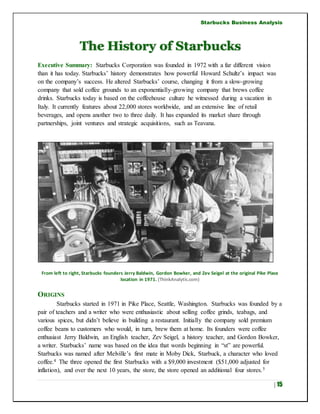
From left to right, Starbucks founders Jerry Baldwin, Gordon Bowker, and Zev Seigel at the original Pike Place
location in 1971. (ThinkAnalytic.com)
ORIGINS
Starbucks started in 1971 in Pike Place, Seattle, Washington. Starbucks was founded by a
pair of teachers and a writer who were enthusiastic about selling coffee grinds, teabags, and
various spices, but didn’t believe in building a restaurant. Initially the company sold premium
coffee beans to customers who would, in turn, brew them at home. Its founders were coffee
enthusiast Jerry Baldwin, an English teacher, Zev Seigel, a history teacher, and Gordon Bowker,
a writer. Starbucks’ name was based on the idea that words beginning in “st” are powerful.
Starbucks was named after Melville’s first mate in Moby Dick, Starbuck, a character who loved
coffee.4 The three opened the first Starbucks with a $9,000 investment ($51,000 adjusted for
inflation), and over the next 10 years, the store, the store opened an additional four stores.5
Michel, Kozak, Knoll, Robben
16 |
Before joining Starbucks, Schultz worked for a Swedish coffee distributor that sold
coffee beans to Starbucks. Howard Schultz visited Starbucks because he was curious that they
were buying so many drip coffee makers. Schultz went to Pike Place in Seattle and was
immediately impressed with the ambiance, aroma, and the enthusiasm of the company’s
employees.6 Schultz met Bowker and Baldwin in 1981. He impressed them with his energy, his
marketing skill and his business sense. Baldwin and Bowker at the time lacked the deep business
background that Schultz had and saw his potential value to Starbucks.7 In 1982, Howard Schultz
joined Starbucks as its head of marketing and retail. The founders of Starbucks initially thought
hiring him was risky, but Schultz was passionate and persistent.
Following a trip to Italy in 1983, Schultz was
full of new ideas for the company to create an
American version of the Italian espresso bar culture.
He believed the company should sell brewed drinks in
addition to coffee beans. . He wanted Starbucks to be
an experience, one that captures the company’s
ambiance, comfortable atmosphere, friendly
employees, and then brew quality coffee. But the
owners of Starbucks did not want the company to
leave the retail business behind and take the risk of
entering a new market. In 1985, Schultz left the
company to found Il Giornale, based on his vision of
importing Italy’s coffeehouse culture.8
Coincidentally, Bower and Baldwin decided to sell the business in 1986. Shultz acquired
Starbucks in 1987 with the help of Seattle investors.9 Under his leadership, Starbucks began
pursuing the brewed coffee market using a differentiation strategy based on high quality products
and premium pricing. This new coffee shop experience created new demand. Starbucks drew
customers in because the quality and ambiance were unlike their competitors.
EXPANSION
After successfully expanding Starbucks throughout Seattle, Schultz boldly opened a store
in Vancouver, Canada, to test the market and determine how well his business model worked
internationally and outside the West Coast.10 Starbucks expanded to Chicago and Vancouver in
1987,11 Portland, and Los Angeles. The move to Chicago and Los Angeles were both strategic
maneuvers. Chicago was a testing ground for eastward expansion and Los Angeles has been
known as a trendsetting city. The Los Angeles Times named Starbucks the best coffee in America
before the store opened.
Continued expansion of the company became increasingly difficult. To control the
quality and character of its products, Starbucks chose to avoid franchising and maintain only
company-owned stores. Expanding into new markets requires an increase in venture capital, so
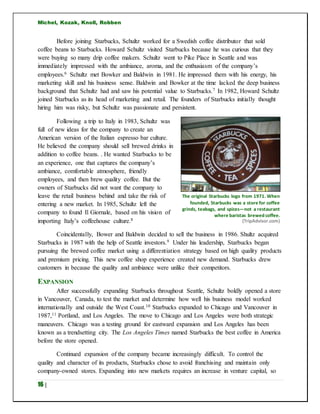
The original Starbucks logo from 1971. When
founded, Starbucks was a store for coffee
grinds, teabags, and spices—not a restaurant
where baristas brewed coffee.
(TripAdvisor.com)
Starbucks Business Analysis
| 17
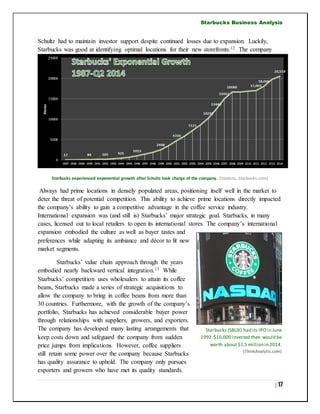
Schultz had to maintain investor support despite continued losses due to expansion. Luckily,
Starbucks was good at identifying optimal locations for their new storefronts.12 The company
Starbucks experienced exponential growth after Schultz took charge of the company. (Statista, Starbucks.com)
Always had prime locations in densely populated areas, positioning itself well in the market to
deter the threat of potential competition. This ability to achieve prime locations directly impacted
the company’s ability to gain a competitive advantage in the coffee service industry.
International expansion was (and still is) Starbucks’ major strategic goal. Starbucks, in many
cases, licensed out to local retailers to open its international stores. The company’s international
expansion embodied the culture as well as buyer tastes and
preferences while adapting its ambiance and décor to fit new
market segments.
Starbucks’ value chain approach through the years
embodied nearly backward vertical integration.13 While
Starbucks’ competition uses wholesalers to attain its coffee
beans, Starbucks made a series of strategic acquisitions to
allow the company to bring in coffee beans from more than
30 countries. Furthermore, with the growth of the company’s
portfolio, Starbucks has achieved considerable buyer power
through relationships with suppliers, growers, and exporters.
The company has developed many lasting arrangements that
keep costs down and safeguard the company from sudden
price jumps from implications. However, coffee suppliers
still retain some power over the company because Starbucks
has quality assurance to uphold. The company only pursues
exporters and growers who have met its quality standards.
Starbucks (SBUX) had its IPO in June
1992.$10,000 invested then would be
worth about $1.5 million in 2014.
(ThinkAnalytic.com)
Michel, Kozak, Knoll, Robben
18 |
Under Schultz’s management, Starbucks attempted many strategies to improve the image
of the company and develop brand recognition and loyalty. It approached many avenues to
promote its product. For example, the company increased marketing through new market
segments while innovating and diversifying its product line. The company partnered with airlines
such as United and Horizon to serve its coffee in flight. It also approached hotels by entering
agreements with Hyatt, Radisson, Hilton, Sheraton, and Westin to offer its coffee in hotel
rooms.14 Additionally, the company worked with food distributors such as Sysco Corporation,
Kraft Foods Inc., and U.S. Food service to have its coffee distributed in restaurants, offices,
grocery stores and institutions like hospitals and universities.
GROWTH AND DIVERSIFICATION
The Company has also pursed a number of joint ventures to achieve further portfolio
diversification. The primary objective was to make its product more accessible to current
customers while also reaching new ones. The company entered a joint venture with PepsiCo in
1994,15 and created a product line of ready-to-drink coffees which PepsiCo distributed through
its channels. In 1999, Starbucks acquired Tazo tea, which PepsiCo also incorporated into its
distribution channel. Starbucks also partnered with Dreyer’s Grand Ice Cream in 1995 and began
supplying extract for coffee-flavored ice cream. Their coffee ice cream became the number one
selling super premium coffee ice cream in that segment. Furthermore, the company entered into a
partnership with Unilever, whose brands include Ben and Jerry’s, Breyers, and Good Humor.
Starbucks was successful in pursing new markets because it pursued ventures in closely related
markets and avoided unreasonable costs.
In 2005, Starbucks acquired Ethos Water, further expanding the company’s product line.
This acquisition was important due to the social responsibility attached to this acquisition. Ethos
Water was known for donating $0.05 of every bottle the company sold to a charitable
organization which funded development and clean drinking water for countries in Africa and
Asia.
Starbucks has maintained a good stance on the changing technology and product
innovations by implementing a reloadable card in 2001. This card ultimately became a mobile
app now comparable to Apple iPay. Furthermore, the company has kept up with the trends of the
decade; it continued to focus on social responsibility by launching the industry’s first paper
beverage cups containing recycled fiber in 2006. The following year, the company eliminated all
artificial trans-fat from its drinks and made milk the new standard for espresso beverages.16
In 2009, emerging from financial losses, the company employed a wide-scale marketing
strategy, putting up posters in six major cities, and a national ad campaign that used TV ads, a
Webisode series, and taste tests across the country to convince customers were unable to
distinguish between Via and Starbucks regular coffee to promote the instant coffee Via.
Starbucks produced Via to combat McDonald’s and the company’s McCafe, in response to
Starbucks Business Analysis
| 19
McDonald’s heavy advertisements of its McCafe. Starbucks spent over $25 million of its $94
million marketing budget on promoting Via.17 Likewise, the company further innovated in
October 2012 when it came out with its Verismo System. The Verismo was created to compete
with further home coffee makers such as Keurig, Tassimo, etc. This machine allowed users to
make a single-serve Starbucks latte, espresso, and filter coffee at home. This was the only home
machine with this capability. The company promoted Verismo as the perfect gift for the
holidays.18 The campaign included primetime TV spots, presence on Univision and Telemundo,
print ads, social media and digital marketing. Moreover, in 2011, Starbucks launched K-Cup
portion packs and later in 2012 announced the expansion of Green Mountain partnership for the
purpose of Keurig implementation.19 Starbucks acquired Teavana in 2012 to transform the tea
category.
Starbucks has often been the innovator in popular
business trends. It has been the forerunner in the coffee
industry to tap these new markets. Similar to previous
maneuvers, Starbucks entered an agreement with Danone
in 2013 to expand their portfolio.20 In 2014, it announced
collaboration with Oprah Winfrey to co-create Teavana
Oprah Chia tea. The company then partnered with
Square in 2014, enhancing its iPhone app and reloadable card.21 More recently, the company
adopted Apples iPay and developed three different storefront models to use in different markets.
Starbucks is evolving annually, allowing it to remain current with economic trends. The
company has undergone a serious transformation since inception in 1971 while remaining true to
its core values.
Michel, Kozak, Knoll, Robben
20 |
Strategic Acquisitions
1995-1999
•1998: Acquired Seattle Coffee Company in the U.K.
•1999: Acquired Hear music and Tazo LLC
2000-2004
•2003: Acquired Seattle Coffee Company
2005-2009
•2005: Acquired Ethos Water Company
•2006: Acquired Coffee Partners Hawaii & Cafe del Caribe
•2008: Company’s subsidiary,Starbucks CoffeeCanada,Inc.entered agreement
to acquireall assets fromCoffee Vision,Inc.and Coffee Vision Atlantic,Inc.
•2009: Company acquired full ownership of Starbucks Coffee FranceSAS
2010-2014
•2010: Acquired Cafes Sereia do Brasil Participacoes S.A
•2011: Company acquired the remaining30% ownership of its business in
southern China
•2011: Acquired Evolution Fresh, Inc.
•2012: Acquired Bay Bread, LLC and its La Boulangebakery brand
•2012: Acquired Teavana HoldingInc.
Starbucks Business Analysis
| 21
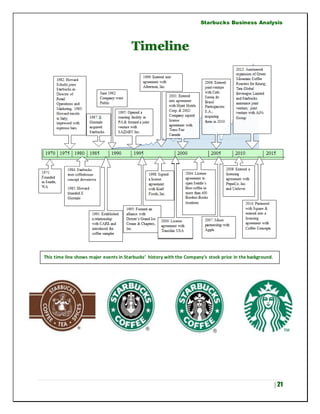
Timeline
This time line shows major events in Starbucks’ history with the Company’s stock price in the background.
Michel, Kozak, Knoll, Robben
22 |
Management
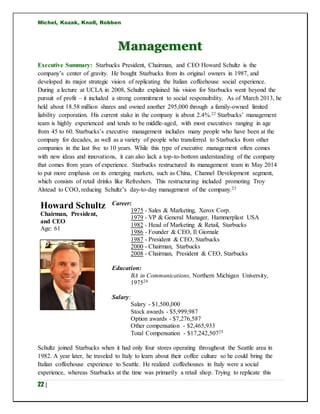
Executive Summary: Starbucks President, Chairman, and CEO Howard Schultz is the
company’s center of gravity. He bought Starbucks from its original owners in 1987, and
developed its major strategic vision of replicating the Italian coffeehouse social experience.
During a lecture at UCLA in 2008, Schultz explained his vision for Starbucks went beyond the
pursuit of profit – it included a strong commitment to social responsibility. As of March 2013, he
held about 18.58 million shares and owned another 295,000 through a family-owned limited
liability corporation. His current stake in the company is about 2.4%.22 Starbucks’ management
team is highly experienced and tends to be middle-aged, with most executives ranging in age
from 45 to 60. Starbucks’s executive management includes many people who have been at the
company for decades, as well as a variety of people who transferred to Starbucks from other
companies in the last five to 10 years. While this type of executive management often comes
with new ideas and innovations, it can also lack a top-to-bottom understanding of the company
that comes from years of experience. Starbucks restructured its management team in May 2014
to put more emphasis on its emerging markets, such as China, Channel Development segment,
which consists of retail drinks like Refreshers. This restructuring included promoting Troy
Alstead to COO, reducing Schultz’s day-to-day management of the company.23
Howard Schultz
Chairman, President,
and CEO
Age: 61
Career:
1975 - Sales & Marketing, Xerox Corp.
1979 - VP & General Manager, Hammerplast USA
1982 - Head of Marketing & Retail, Starbucks
1986 - Founder & CEO, Il Giornale
1987 - President & CEO, Starbucks
2000 - Chairman, Starbucks
2008 - Chairman, President & CEO, Starbucks
Education:
BA in Communications, Northern Michigan University,
197524
Salary:
Salary - $1,500,000
Stock awards - $5,999,987
Option awards - $7,276,587
Other compensation - $2,465,933
Total Compensation - $17,242,50725
Schultz joined Starbucks when it had only four stores operating throughout the Seattle area in
1982. A year later, he traveled to Italy to learn about their coffee culture so he could bring the
Italian coffeehouse experience to Seattle. He realized coffeehouses in Italy were a social
experience, whereas Starbucks at the time was primarily a retail shop. Trying to replicate this
Starbucks Business Analysis
| 23
experience, he talked to the then-owners of Starbucks, Gerald Baldwin and Gordon Bowker,
about shifting their business model. They said no. Taking matters into his own hands, Schultz
left the coffee company and founded his own, Il Giornale (“The Daily”), seeking to replicate the
Italian coffee social experience. A year later, in 1987, the owners of Starbucks put the company
up for sale. He bought it with the help of local Seattle investors, merged it with Il Giornale, and
reshaped the company in the image of Italian coffeehouses. He continued managing it for the
next 13 years, aiding its exponential growth into the business it is today. In 2000, he resigned as
CEO and assumed the role of chairman. The company continued its aggressive expansion
throughout the 2000s, to the point where Starbucks said it had lost sight of its original vision. In
January 2008, with sales in decline and the company beginning to feel the effects of the
economic downturn, he returned to the role of president and CEO. Schultz has provided the
strategic vision of Starbucks, helping it grow into the global corporation it is today, running over
21,000 stores in 65 countries.26
Clifford
Burrows
Group President,
Americas
Age: 55
Career:
1982 - Habitat Design Limited
2001 - Managing Director, UK, Starbucks
APR 06 - MAR 08 - President, Starbucks Europe, Middle
East, and Africa
MAR 08 - OCT 11 - President, Starbucks Coffee U.S.
Operations
OCT 11 - MAY 13 - President, Starbucks Coffee Americas
Operations
MAY 13 - Group President, Starbucks27
Education:
Left college after one term28
Salary:
Salary - $733,838
Stock Awards - $874,976
Option Awards - $751,631
Other Compensation - $1,186,089
Total Compensation - $3,546,53429
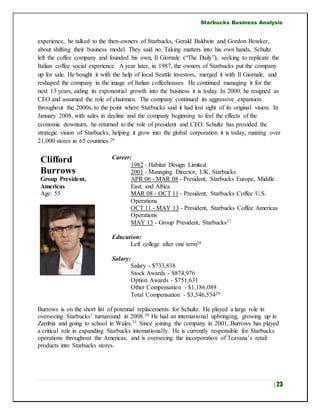
Burrows is on the short list of potential replacements for Schultz. He played a large role in
overseeing Starbucks’ turnaround in 2008.30 He had an international upbringing, growing up in
Zambia and going to school in Wales.31 Since joining the company in 2001, Burrows has played
a critical role in expanding Starbucks internationally. He is currently responsible for Starbucks
operations throughout the Americas, and is overseeing the incorporation of Teavana’s retail
products into Starbucks stores.
Michel, Kozak, Knoll, Robben
24 |
Troy Alstead
Chief Operating Officer
Age: 51
Career:
1992 - Joined Starbucks
SEP 04 - AUG 07 - Senior Vice President, Corporate
Finance
AUG 07 - APR 08 - Senior Vice President, Global Finance
and Business Operations
APR - OCT 08 - Chief Operating Officer, Starbucks
Greater China
NOV 08 - SEP 2013 - CFO & Chief Administrative
Officer, Starbucks32
Education:
BBA in Finance, University of Washington, 1985
Salary:
Salary: $741,058
Total Compensation: $3,022,29833
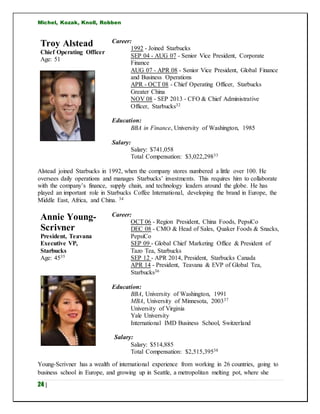
Alstead joined Starbucks in 1992, when the company stores numbered a little over 100. He
oversees daily operations and manages Starbucks’ investments. This requires him to collaborate
with the company’s finance, supply chain, and technology leaders around the globe. He has
played an important role in Starbucks Coffee International, developing the brand in Europe, the
Middle East, Africa, and China. 34
Annie Young-
Scrivner
President, Teavana
Executive VP,
Starbucks
Age: 4535
Career:
OCT 06 - Region President, China Foods, PepsiCo
DEC 08 - CMO & Head of Sales, Quaker Foods & Snacks,
PepsiCo
SEP 09 - Global Chief Marketing Office & President of
Tazo Tea, Starbucks
SEP 12 - APR 2014, President, Starbucks Canada
APR 14 - President, Teavana & EVP of Global Tea,
Starbucks36
Education:
BBA, University of Washington, 1991
MBA, University of Minnesota, 200337
University of Virginia
Yale University
International IMD Business School, Switzerland
Salary:
Salary: $514,885
Total Compensation: $2,515,39538
Young-Scrivner has a wealth of international experience from working in 26 countries, going to
business school in Europe, and growing up in Seattle, a metropolitan melting pot, where she
Starbucks Business Analysis
| 25
currently lives today. One of her main areas of focus is developing markets, she explained in an
interview, “where our footprint is small, where we’re beginning to create the third-place
experience for our customers.”39
Adam Brotman
Chief Digital Officer
Age: 45
Career:
AUG 95 - FEB 97 - Attorney; Heller, Ehrman, White, &
McAuliffe
OCT 96 - FEB 06 - CEO & Co-Founder, PlayNetwork
JUL 06 - SEP 08 - SVP, Corbis Corp.
OCT 08 - JAN 09 - CEO, Barefoot Yoga Company
APR 09 - Chief Digital Officer, Starbucks40
Education:
BA, Classical Civilizations, Business Administration,
University of California Los Angeles, 1991
JD, University of Washington, 1987
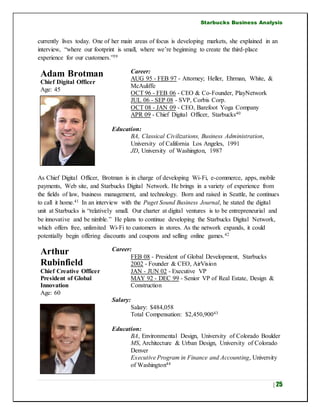
As Chief Digital Officer, Brotman is in charge of developing Wi-Fi, e-commerce, apps, mobile
payments, Web site, and Starbucks Digital Network. He brings in a variety of experience from
the fields of law, business management, and technology. Born and raised in Seattle, he continues
to call it home.41 In an interview with the Puget Sound Business Journal, he stated the digital
unit at Starbucks is “relatively small. Our charter at digital ventures is to be entrepreneurial and
be innovative and be nimble.” He plans to continue developing the Starbucks Digital Network,
which offers free, unlimited Wi-Fi to customers in stores. As the network expands, it could
potentially begin offering discounts and coupons and selling online games.42
Arthur
Rubinfield
Chief Creative Officer
President of Global
Innovation
Age: 60
Career:
FEB 08 - President of Global Development, Starbucks
2002 - Founder & CEO, AirVision
JAN - JUN 02 - Executive VP
MAY 92 - DEC 99 - Senior VP of Real Estate, Design &
Construction
Salary:
Salary: $484,058
Total Compensation: $2,450,90043
Education:
BA, Environmental Design, University of Colorado Boulder
MS, Architecture & Urban Design, University of Colorado
Denver
Executive Program in Finance and Accounting, University
of Washington44
Michel, Kozak, Knoll, Robben
26 |
A registered and accredited architect, Rubinfield leads Starbucks’ store design strategy. His
design strategies include reducing environmental impacts through green initiatives, and
incorporating the local culture of each Starbucks location’s surrounding city and neighborhood.
He helped define the ambiance of Starbucks as the chain grew from just over 100 stores to 4,000
worldwide from 1992 to 2002. After leaving in 2002 to found the advisory firm AirVision, he
returned to Starbucks in 2008 at Schultz’s request.45
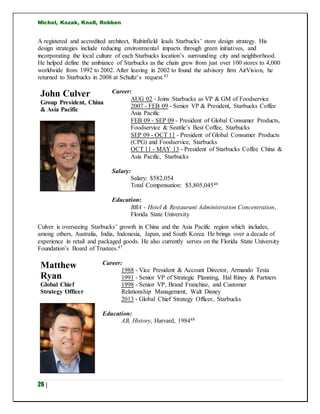
John Culver
Group President, China
& Asia Pacific
Career:
AUG 02 - Joins Starbucks as VP & GM of Foodservice
2007 - FEB 09 - Senior VP & President, Starbucks Coffee
Asia Pacific
FEB 09 - SEP 09 - President of Global Consumer Products,
Foodservice & Seattle’s Best Coffee, Starbucks
SEP 09 - OCT 11 - President of Global Consumer Products
(CPG) and Foodservice, Starbucks
OCT 11 - MAY 13 - President of Starbucks Coffee China &
Asia Pacific, Starbucks
Salary:
Salary: $582,054
Total Compensation: $3,805,04546
Education:
BBA - Hotel & Restaurant Administration Concentration,
Florida State University
Culver is overseeing Starbucks’ growth in China and the Asia Pacific region which includes,
among others, Australia, India, Indonesia, Japan, and South Korea. He brings over a decade of
experience in retail and packaged goods. He also currently serves on the Florida State University
Foundation’s Board of Trustees.47
Matthew
Ryan
Global Chief
Strategy Officer
Career:
1988 - Vice President & Account Director, Armando Testa
1991 - Senior VP of Strategic Planning, Hal Riney & Partners
1998 - Senior VP, Brand Franchise, and Customer
Relationship Management, Walt Disney
2013 - Global Chief Strategy Officer, Starbucks
Education:
AB, History, Harvard, 198448
Starbucks Business Analysis
| 27
Ryan’s roles include overseeing Starbucks’ long-term planning, streamlining its monetization
process, and enhancing its customer loyalty and relationship management.49 Before coming to
Starbucks, he worked for Disney in areas including the Disney Rewards Visa card, character
franchise development, and long-term strategic planning.50
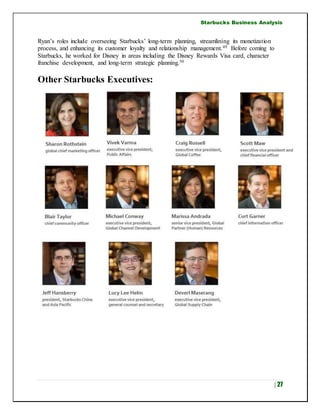
Other Starbucks Executives:
Michel, Kozak, Knoll, Robben
28 |
Products & Services
Executive Summary: Starbucks products include coffee, tea, bakery items, juices, and pre-
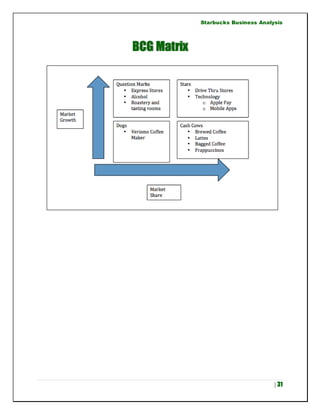
packaged drinks. Starbucks’ best cash cow is its basic coffee, while Starbucks’ primary dog is its
Verismo coffee maker. Currently, Starbucks’ biggest question mark is adding alcohol to their
menu. The primary differentiator of Starbucks’ products is their high quality. Starbucks has six
different brands which are all related to coffee, tea, bakery items, or pre-packaged drinks. The
company attains coffee through high quality growers and utilizes approximately thirty sources to
ensure the quality of its product. In addition to the quality coffee, Starbucks offers several other
quality products from tea and juices to bakery items and snacks. Through strategic acquisitions
such as Teavana, Tazo and Evolution Fresh, the company is able to diversify its products and
attract more consumers. Starbucks commitment to quality is also demonstrated in the level of
customer service which adds significant value to company. The stores chic layouts, friendly
customer service and vibrant atmosphere encompass the company’s tradition of quality products
and services as well.
PRODUCT QUALITY & VARIETY
The quality and variety in Starbucks’ products allows the company to stay ahead of the
competition. Starbucks boasts six brands which offer unique food and beverage additions to their
coffee culture model.51 Product diversification is important not only to the company’s business
model, but to the value and application of services.
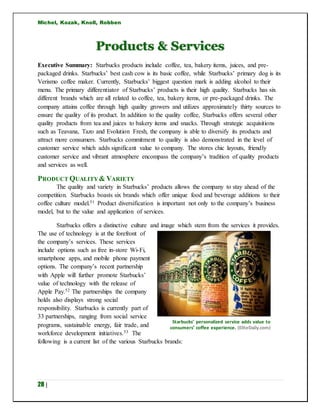
Starbucks offers a distinctive culture and image which stem from the services it provides.
The use of technology is at the forefront of
the company’s services. These services
include options such as free in-store Wi-Fi,
smartphone apps, and mobile phone payment
options. The company’s recent partnership
with Apple will further promote Starbucks’
value of technology with the release of
Apple Pay.52 The partnerships the company
holds also displays strong social
responsibility. Starbucks is currently part of
33 partnerships, ranging from social service
programs, sustainable energy, fair trade, and
workforce development initiatives.53 The
following is a current list of the various Starbucks brands:
Starbucks’ personalized service adds value to
consumers’ coffee experience. (EliteDaily.com)
Starbucks Business Analysis
| 29
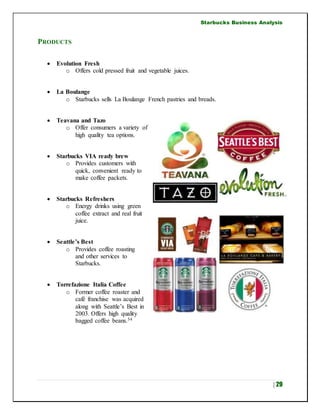
PRODUCTS
 Evolution Fresh
o Offers cold pressed fruit and vegetable juices.
 La Boulange
o Starbucks sells La Boulange French pastries and breads.
 Teavana and Tazo
o Offer consumers a variety of
high quality tea options.
 Starbucks VIA ready brew
o Provides customers with
quick, convenient ready to
make coffee packets.
 Starbucks Refreshers
o Energy drinks using green
coffee extract and real fruit
juice.
 Seattle’s Best
o Provides coffee roasting
and other services to
Starbucks.
 Torrefazione Italia Coffee
o Former coffee roaster and
café franchise was acquired
along with Seattle’s Best in
2003. Offers high quality
bagged coffee beans.54
Michel, Kozak, Knoll, Robben
30 |
SERVICES
 Customer Service
o Personalized service
o Reserve coffee tasting rooms
 Technology
o Apple pay
o Mobile apps
o Wi-Fi
 Convenience
o Drive-thru
o Express stores
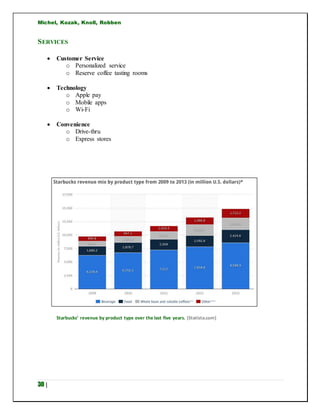
Starbucks’ revenue by product type over the last five years. (Statista.com)
Starbucks Business Analysis
| 31
BCG Matrix
Michel, Kozak, Knoll, Robben
32 |
Marketing
Executive Summary: Starbucks’ success can be attributed to its marketing and elite image.
Marketing is the activity, set of institutions, and processes for creating, capturing,
communicating, delivering, and exchanging offerings that have value for customers, clients,
partners, and society at large.55 Just like its products, Starbucks’ marketing focuses on quality.
This is because part of Starbucks’ value proposition, and the reason Starbucks can charge
premium prices, is the company’s image. Starbucks creates this image with its marketing.
Starbucks relies heavily on social media marketing and a generally strong online presence to
promote its brand.
QUALITYAND SERVICE
Starbucks’ goal is to create value through its goods and services while structuring an
atmosphere to satisfy customer needs. Starbucks structures its brand image and marketing to
exemplify
quality and
service. Its
2009 marketing
remade its
image: “If it’s
still not perfect,
you must not be
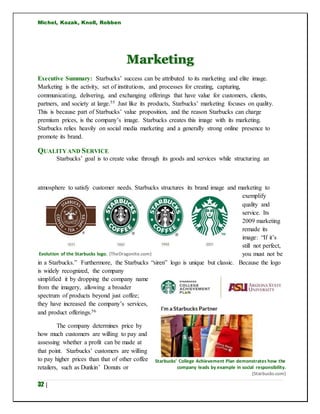
in a Starbucks.” Furthermore, the Starbucks “siren” logo is unique but classic. Because the logo
is widely recognized, the company
simplified it by dropping the company name
from the imagery, allowing a broader
spectrum of products beyond just coffee;
they have increased the company’s services,
and product offerings.56
The company determines price by
how much customers are willing to pay and
assessing whether a profit can be made at
that point. Starbucks’ customers are willing
to pay higher prices than that of other coffee
retailers, such as Dunkin’ Donuts or
Starbucks’ College Achievement Plan demonstrates how the
company leads by example in social responsibility.
(Starbucks.com)
Evolution of the Starbucks logo. (TheDragonite.com)
Starbucks Business Analysis
| 33
McDonald’s, in part because of the company’s elite image that is created in Starbucks’
advertisements. In addition, Starbucks practices corporate social responsibility, and many
customers see value in that and want to support efforts to help the environment, and the
community, as well as ethical business practices.
Starbucks successfully uses and integrates its social media to engage customers.57
Starbucks has over 6.68 million followers on Twitter58 and over 37.5 million likes on
Facebook.59 Starbucks uses these sites to answer customer questions, promote events, and
increase brand loyalty by re-tweeting what people are saying about the brand.60 The company
also uses its YouTube channel to show commercials, educate consumers on different blends and
their origins, and emphasize the company’s social responsibility through charity work videos.
Furthermore, the company offers free in-house Wi-Fi service to customers. This service has
helped with consumer retention and increased the overall brand image of the company.
Starbucks’ strong online presence is a key aspect of its marketing because its target market is
young adults, who are constantly on the Web. Consequently, Starbucks lets customers know the
company cares about customers’ wants and needs, while also creating a Starbucks community
online.61 Finally, the company has a rich history of social responsibility to the community as well
as a benefits program for the company’s part time and full time workers. Starbucks exemplifies
service and ethical frameworks as they continue to give back to the community and to the
company’s employees.62
More recently, however,
Starbucks has employed new store
layouts and targeting key segments to
branch out and achieve more market
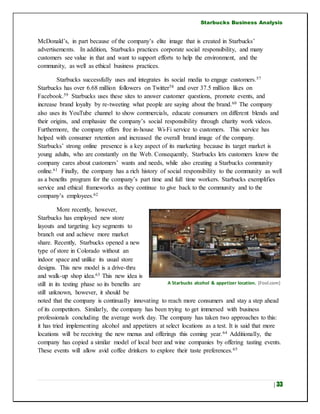
share. Recently, Starbucks opened a new
type of store in Colorado without an
indoor space and unlike its usual store
designs. This new model is a drive-thru
and walk-up shop idea.63 This new idea is
still in its testing phase so its benefits are
still unknown, however, it should be
noted that the company is continually innovating to reach more consumers and stay a step ahead
of its competitors. Similarly, the company has been trying to get immersed with business
professionals concluding the average work day. The company has taken two approaches to this:
it has tried implementing alcohol and appetizers at select locations as a test. It is said that more
locations will be receiving the new menus and offerings this coming year.64 Additionally, the
company has copied a similar model of local beer and wine companies by offering tasting events.
These events will allow avid coffee drinkers to explore their taste preferences.65
A Starbucks alcohol & appetizer location. (Fool.com)
Michel, Kozak, Knoll, Robben
34 |
Operations
Executive Summary: Starbucks conducts its operations through five different operating
segments: the Americas, EMEA (Europe, Middle East, and Africa), China/Asia Pacific (CAP),
Channel, and Other. The most important of these is the Americas segment, which produces 74%
of the company’s revenue and features 68% of Starbucks stores. It operates eight major
manufacturing centers, all of which are located in the U.S., and 60 other smaller distribution
centers. It currently has 182,000 employees worldwide and made Fortune’s list of the 100 Best
Companies to Work For in 2012 and 2013. Starbucks has made two major acquisitions in the last
two years: Bay Bread LLC, a bakery company that holds the popular La Boulange brand, and
Teavana Holdings Inc., an artisanal tea company. Both acquisitions show Starbucks’ desire to
expand its product lines beyond coffee.
OPERATING SEGMENTS
Starbucks’ five operating segments are divided mainly along geographic lines.66 The
Americas, EMEA, and CAP segments are company-operated stores and licensed stores. Channel
is the company’s whole bean and ground coffees, single serve products, and ready-to-drink
beverages, including Tazo teas and Starbucks Refreshers. The other segment categories include
Starbucks’ Teavana, Seattle’s Best Coffee, Evolution Fresh brands, and the company’s Digital
Ventures business. The Americas makes up the largest percent of Starbucks’ total net revenue,
with 74% while EMEA, CAP, and Channel make up 8%, 6%, and 10% of Starbucks’ total net
revenue respectively. The Other Segments makes up the smallest percent, with only 3%.
LOCATIONS
Starbucks was founded in Seattle, Washington and this is where the corporation’s
headquarters continues to be located. As of
the end of Q3 FY14, the company operated
20,863 stores across 64 countries. 52% of
these stores are company-operated and 48%
are licensed. The Americas has the majority
of Starbucks locations, with 68% of all
stores.67 Starbucks is currently focused on
globalizing the company. Explosive growth
in China has led this globalization effort.68
Starbucks expects China to overtake Canada
as its second largest market by the end of 2014. Starbucks operates eight major manufacturing,
roasting, and distribution plants where Starbucks roasts all of its coffee and manufactures its
various packaged products.69 These plants are all located in the U.S. Five are on the West coast,
and the other three are on the East. Alongside these major plants, Starbucks operates 60 other
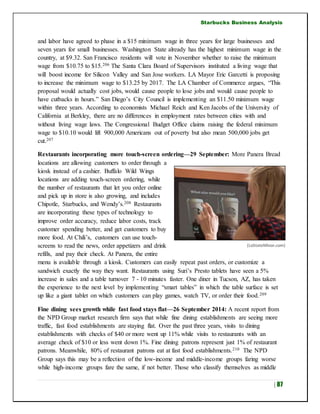
Starbucks’ eight manufacturing and distribution plants.
(Starbucks.com)
Starbucks Business Analysis
| 35
distribution centers across the world. It has placed a major emphasis on these centers in the last
few years after some supply issues surfaced in 2008 in response to the company’s rapid
expansion.70 In 2010, these distribution centers made over 2.7 million deliveries to Starbucks
stores.
Starbucks “partners” at an event in Los Angeles. (Starbucks.com)
EMPLOYEES
As of September 2013, Starbucks’ employs approximately 182,000 people worldwide. Of
these, about 137,000 work in the U.S. and 45,000 work outside of the US. There is currently no
significant union presence among Starbucks workers. Starbucks’ appears to have a strong
relationship with its employees, with a GlassDoor rating of 3.7 stars and 75% of employees
saying they would recommend the job to a friend.71
MERGERS AND ACQUISITIONS
Starbucks made two major acquisitions in 2012. The first was Bay Bread LLC, a bakery
company that owns the popular La Boulange bakery brand.72 Starbucks completed this
acquisition in July 2012 for $100 million. Bay Bread allows Starbucks to centralize its product
line and offer a wider range of higher quality pastries in the U.S. market. The other major
acquisition Starbucks made was of Teavana Holdings Inc.73 Starbucks completed this acquisition
in December 2012 for $598 million. Teavana produces artisanal teas and tea-related
paraphernalia. This acquisition has been very profitable for Starbucks. Analysts credit Teavana
as an important part of Starbucks’ improving revenue numbers in 2014.74 Both acquisitions show
Starbucks commitment to expanding its product line beyond coffee.
Michel, Kozak, Knoll, Robben
36 |
Strategies
Executive Summary: In its 2013 annual report, Starbucks stated its growth strategy is to open
new stores, and increase sales in current stores, while fostering its strong image and its
relationships with employees and customers. Thus, Starbucks’ long-term strategy has three main
pillars:
 US expansion through adding new stores and boosting individual store sales
 Opening new stores internationally
 Maintaining a strong image through corporate responsibility.
U.S. EXPANSION
In April 2014, CEO Howard
Schultz stated the company is
“significantly under-stored in many
markets, including North America.”
Part of this U.S. expansion strategy
goes hand-in-hand with the
company’s plan to expand its day
parts by offering more lunch and
dinner options, such as wine, beer,
and soda, essentially turning
Starbucks into an all-day
destination. 75 Currently, its stores’
peak business hours are during the
early morning. Schultz stated the
company’s expansion will not
mirror its earlier, far more
aggressive expansion strategies
from the ‘00s, when the company
expanded from 3,501 stores to 16,858.76 “This is not 2007 when we were going to grow the
company in an undisciplined way.”77 Echoing this sentiment, Starbucks specifically uses the
word “disciplined” in reference to the company’s strategy for expanding global market share.
In a 2013 interview with The Motley Fool, CFO Troy Alstead said, “we are a long ways
from saturation” and that “we have years and years and years of growth left in the U.S.” The
company plans to roll out 1,500 stores worldwide, including 600 in North America, by year’s
end. Part of this strategy includes opening more drive-thru stores: while about 40% of its stores
now feature drive-thrus, among new stores opening, about 60% will have a drive-thru. The
Despite common jokes about Starbucks’ market saturation, as seen
here in a 1998 episode of The Simpsons, CEO Howard Schultz says
the company has more growth potential in the US. (Flickr.com)
Starbucks Business Analysis
| 37
company is also looking to boost sales at current stores by adding drive-thrus when and where
they can. Compared to the rest of the world, the US, Alstead said, “Is more of a mature drive-
thru market.”78
INTERNATIONAL GROWTH
Starbucks’ global footprint as of October 2013. (Washington Post)
With the U.S. market becoming more crowded, Starbucks is looking toward strong
expansion opportunities internationally. Company executives specifically highlight China,
Brazil, India, and Russia for their strong growth potential.
In China, Starbucks opened
its 1,000th store in fall 2013 and it’s
currently on track to reach 1,500 by
2015. Starbucks’ footprint in China
is expected to surpass its footprint in
Canada sometime this year,
becoming Starbucks’ second-largest
market.79 Starbucks stores have a
more open design and more
comfortable furniture in the
People’s Republic, with an
architectural style that blends East
and West. Some stores will be
almost 3,800 feet, compared to about 2,200 for the average American Starbucks.80 The company
is also experimenting with new products to appeal to Chinese consumers, like the Thai-style
prawn wrap or the Hainan chicken and rice wrap.81
To draw more customers to its stores in China, Starbucks has
launched a variety of discounts and promotions, including a
discount for inviting a friend to Starbucks. (Examiner.com)
Michel, Kozak, Knoll, Robben
38 |
Potential barriers to market growth include the fact that the average person in China earns
only $500 a month, and the coffee costs 10-20% more in China than it does in the states.
Furthermore, the average Chinese man drinks only three cups of coffee per year. Customers in
China are more likely to use Starbucks as their third place whereas in the U.S., they are more
likely to grab a cup on their way to school or work.82 The recent revelations about tainted meat at
the Shanghai Husi may also hinder Starbucks’ growth. The company used the plant for meat in
its Chicken Apple Sauce Paninis.83
In Brazil, Starbucks’ growth has been less rapid than in other countries – opening about
60 stores in eight years – perhaps because the country already has a strong coffee culture. As one
analyst put it, “An American Corporation trying to sell coffee to Brazilians is almost as
ambitious as trying to sell sand in Sahara.”84 The South American country is the world’s top
coffee bean producer, and already features a number of coffeehouse franchises. Thus, Brazilians
generally see coffee as a cheap, easily available drink, not a $4 luxury. Consequently, Starbucks
drinks are priced more cheaply in Brazil. The country’s average price for a cup of espresso is
$0.68. Starbucks sells theirs for $1.27. Local menu items include Brazilian cheese bread, and
muffins with mozzarella, arugula, and tomato, while Starbucks cappuccinos feature doce de leite,
a cream popular in Brazil.85
In India, Starbucks has only
been operating since 2012, but is
already seeing rapid growth. As of
April 2014, the coffee giant had
established 43 stores in India, which
included seven opened in just the prior
six weeks. Cafes in India generally
function like bars in the US, where
customers hang out for hours instead
of employing the frequent grab and go
habits of Americans. The idea of cafes
as a third place is already well-
established in India. Hence, the stores
have to be more lavish than those
found in the US. Starbucks is
expanding throughout India in collaboration with Tata Global Beverages, a company
headquartered in West Bengal, India, and culturally influential throughout the region.86
GLOBAL RESPONSIBILITY
In its 2013 10-K filing, Starbucks cited corporate responsibility as a vital part of its global
strategy. “Global responsibility strategy and commitments are integral to our overall business
strategy. As a result, we believe we deliver benefits to our stakeholders, including employees,
Howard Schultz with Tata chairman Ratana Tata, at the first
Starbucks in India, Oct. 19, 2012. (India Express)
Starbucks Business Analysis
| 39
business partners, customers, suppliers, shareholders, community members and others.” In
addition to its annual 10-K, Starbucks also puts out a Global Responsibility Report every year
informing investors of how it gives back. As part of its commitment to social responsibility, the
company cites ethical sourcing, environmental impact, and community improvement. 87
Ethical sourcing is one reason Starbucks’
coffee is more expensive than its competitors. As of
2013, the company ethically sourced 95% of its
coffee, and its goal is to reach 100% by 2015.88 Over
the last 40 years, the company has invested $70
million in collaborative farming programs, loans, and
support centers. Starbucks says its goal is to improve
farmer livelihood while maintaining a long-term
supply chain. The company maintains a farming
R&D center in Costa Rica where agronomists test out different growing practices in hopes of
making research discoveries and developing best practices.89
Starbucks is addressing environmental challenges by building greener stores, employing
water conservation, supporting renewable energy, encouraging recycling, and reducing cup and
packaging waste.90 Starbucks offers customers a $0.10
discount on their order for bringing in a reusable cup,
reducing environmental impact. Since the cups cost $1,
they pay for themselves after 10 orders. It hopes to have
5% of customers bringing in reusable cups by 2015,
down from its earlier, more optimistic assessments of
25%.91 The company is also addressing environmental
challenges by building greener stores, employing water conservation,
supporting renewable energy, encouraging recycling, and reducing cup and packaging waste.
Starbucks’ community improvement plans include local
volunteering and generous health care benefits for employees. Starbucks’
employee benefits include health care for part-time and full-time
employees, and tuition reimbursement plans. This commitment requires
the company to spend more on health care than on coffee beans.92 In
2010, Schultz says he told one shareholder who advocated Starbucks
cutting health care benefits, “I could cut $300 million out of a lot of
things, but do you want to kill the company, and kill the trust in what this
company stands for? There is no way I will do it, and if that is what you want
to do, you should sell your stock.”93 As part of its commitment to its workers, Starbucks calls its
employees “partners” just as Walmart calls its employees “associates.” One of the company’s
goals is to increase community service globally to one million hours. It encourages community
(Starbucks.com)
(Starbucks.com)
(Starbucks.com)
Michel, Kozak, Knoll, Robben
40 |
members to sign up for projects through its Web site, which includes food donations, school
improvement projects, rebuilding after disasters, gardening, and neighborhood cleanup.94
According to business analyst Simon Sinek,
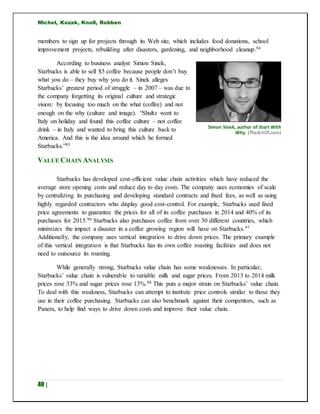
Starbucks is able to sell $5 coffee because people don’t buy
what you do – they buy why you do it. Sinek alleges
Starbucks’ greatest period of struggle – in 2007 – was due to
the company forgetting its original culture and strategic
vision: by focusing too much on the what (coffee) and not
enough on the why (culture and image). “Shultz went to
Italy on holiday and found this coffee culture – not coffee
drink – in Italy and wanted to bring this culture back to
America. And this is the idea around which he formed
Starbucks.”95
VALUE CHAIN ANALYSIS
Starbucks has developed cost-efficient value chain activities which have reduced the
average store opening costs and reduce day to day costs. The company uses economies of scale
by centralizing its purchasing and developing standard contracts and fixed fees, as well as using
highly regarded contractors who display good cost-control. For example, Starbucks used fixed
price agreements to guarantee the prices for all of its coffee purchases in 2014 and 40% of its
purchases for 2015.96 Starbucks also purchases coffee from over 30 different countries, which
minimizes the impact a disaster in a coffee growing region will have on Starbucks.97
Additionally, the company uses vertical integration to drive down prices. The primary example
of this vertical integration is that Starbucks has its own coffee roasting facilities and does not
need to outsource its roasting.
While generally strong, Starbucks value chain has some weaknesses. In particular,
Starbucks’ value chain is vulnerable to variable milk and sugar prices. From 2013 to 2014 milk
prices rose 33% and sugar prices rose 13%.98 This puts a major strain on Starbucks’ value chain.
To deal with this weakness, Starbucks can attempt to institute price controls similar to those they
use in their coffee purchasing. Starbucks can also benchmark against their competitors, such as
Panera, to help find ways to drive down costs and improve their value chain.
Simon Sinek, author of Start With
Why. (TheArtOf.com)
Starbucks Business Analysis
| 41
Financial
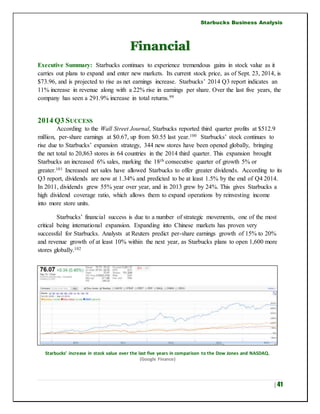
Executive Summary: Starbucks continues to experience tremendous gains in stock value as it
carries out plans to expand and enter new markets. Its current stock price, as of Sept. 23, 2014, is
$73.96, and is projected to rise as net earnings increase. Starbucks’ 2014 Q3 report indicates an
11% increase in revenue along with a 22% rise in earnings per share. Over the last five years, the
company has seen a 291.9% increase in total returns.99
2014 Q3 SUCCESS
According to the Wall Street Journal, Starbucks reported third quarter profits at $512.9
million, per-share earnings at $0.67, up from $0.55 last year.100 Starbucks’ stock continues to
rise due to Starbucks’ expansion strategy, 344 new stores have been opened globally, bringing
the net total to 20,863 stores in 64 countries in the 2014 third quarter. This expansion brought
Starbucks an increased 6% sales, marking the 18th consecutive quarter of growth 5% or
greater.101 Increased net sales have allowed Starbucks to offer greater dividends. According to its
Q3 report, dividends are now at 1.34% and predicted to be at least 1.5% by the end of Q4 2014.
In 2011, dividends grew 55% year over year, and in 2013 grew by 24%. This gives Starbucks a
high dividend coverage ratio, which allows them to expand operations by reinvesting income
into more store units.
Starbucks’ financial success is due to a number of strategic movements, one of the most
critical being international expansion. Expanding into Chinese markets has proven very
successful for Starbucks. Analysts at Reuters predict per-share earnings growth of 15% to 20%
and revenue growth of at least 10% within the next year, as Starbucks plans to open 1,600 more
stores globally.102
Starbucks’ increase in stock value over the last five years in comparison to the Dow Jones and NASDAQ.
(Google Finance)
Michel, Kozak, Knoll, Robben
42 |
Starbucks also reported capital expenditures growth of 3.46% for the Q3 2014.103 Capital
expenditures were $1.2 billion, roughly 8% of the company’s revenue in 2013. This is a 4%
increase from the previous year, most likely due to continued store growth and advances in
technology. Although Starbucks has seen growth in revenues and capital expenditures, it
incurred a large loss because of a recent lawsuit from shareholders over a breach of contract with
Kraft Foods. Last November, Starbucks was ordered to pay Kraft $2.75 billion due to a
distribution issue of its packaged coffee to grocery stores.104 Despite the loss from the lawsuit,
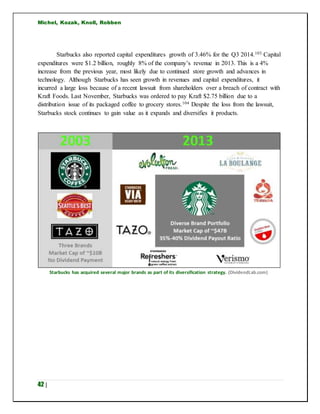
Starbucks stock continues to gain value as it expands and diversifies it products.
Starbucks has acquired several major brands as part of its diversification strategy. (DividendLab.com)
Starbucks Business Analysis
| 43
Current Events
Executive Summary: Starbucks’ current events show two major trends; a focus on marketing to
the millennial generation and a focus on globalization. The company’s focus on millennials can
be seen in its focus on adopting the newest technological trends, such as Apple Pay, and in its
recent review of the company’s conservative dress policy to possibly allow visible tattoos. Both
of these moves are initiatives that resonate with the millennial generation. Starbucks’ focus on
globalization can be seen in the many news stories about the company coming out of Asia.
Starbucks is growing rapidly in China, and by the end of 2014, there will be more Starbucks
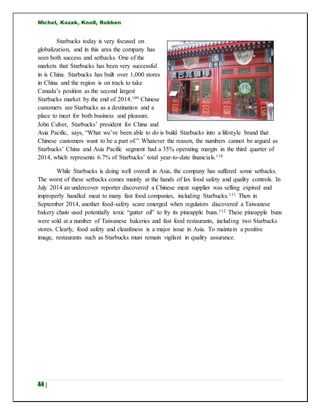
stores in China than there are in Canada. However, this globalization is not without issues as
food safety issues in Asia continue to damage the company’s reputation.
MILLENNIALS & THE ASIAN MARKET
One story that shows Starbucks’ continued
desire to appeal to the millennial market is the
company’s adoption of Apple Pay, a phone-based
payment platform that allows users to make
purchases using their phone instead of cash or card.
Starbucks plans to roll out its use of the product in
October, along with a number of other restaurants
such as McDonald’s and Subway. Starbucks already
has experience with this sort of technology, as the
company’s current smartphone app allows users to
pay from a gift card loaded onto their phone.105 In
fact, 11% of Starbucks’ sales is processed through
this mobile app. The adoption of this kind of new
technology may prove popular with the tech-driven millennial generation.
Another event that shows Starbucks’ focus on the millennial generation is its current
reevaluation and potential revision of its dress code. This will include a review of current
policies against workers having visible tattoos. It went into motion partly due to an online
petition that gathered about 23,000 signatures asking the company to change its tattoo policy.106
Allowing visible tattoos is very much in line with millennial thinking, as over a third of the
generation has tattoos.107 Reversing the current policy would not only appeal to Starbucks’
customers; many of the company’s employees are millennials themselves and would welcome
the change. Starbucks recognizes this. A spokesman for the company said, “We know the dress
code and tattoo policy is important to them, so we are taking a fresh look at it.”108
Starbucks is an early adopter when it comes
to mobile payment methods.
(BusinessInsider.com)
Michel, Kozak, Knoll, Robben
44 |
Starbucks today is very focused on
globalization, and in this area the company has
seen both success and setbacks. One of the
markets that Starbucks has been very successful
in is China. Starbucks has built over 1,000 stores
in China and the region is on track to take
Canada’s position as the second largest
Starbucks market by the end of 2014.109 Chinese
customers see Starbucks as a destination and a
place to meet for both business and pleasure.
John Culver, Starbucks’ president for China and
Asia Pacific, says, “What we’ve been able to do is build Starbucks into a lifestyle brand that
Chinese customers want to be a part of.” Whatever the reason, the numbers cannot be argued as
Starbucks’ China and Asia Pacific segment had a 35% operating margin in the third quarter of
2014, which represents 6.7% of Starbucks’ total year-to-date financials.110
While Starbucks is doing well overall in Asia, the company has suffered some setbacks.
The worst of these setbacks comes mainly at the hands of lax food safety and quality controls. In
July 2014 an undercover reporter discovered a Chinese meat supplier was selling expired and
improperly handled meat to many fast food companies, including Starbucks.111 Then in
September 2014, another food-safety scare emerged when regulators discovered a Taiwanese
bakery chain used potentially toxic “gutter oil” to fry its pineapple buns.112 These pineapple buns
were sold at a number of Taiwanese bakeries and fast food restaurants, including two Starbucks
stores. Clearly, food safety and cleanliness is a major issue in Asia. To maintain a positive
image, restaurants such as Starbucks must remain vigilant in quality assurance.
Financial Analysis
STARBUCKS’COMPETITOR COMPARISON
Figure 1 compares financial ratios between Starbucks, Panera Bread and Einstein Noah
Restaurant. This assessment looks at 2011-2013 for the three companies.
Activity/Efficiency Ratios
 Starbucks’ Asset Turnover Ratio is 1.78, up from 1.59 in the
previous year. Both their sales and total assets have been
increasing over the past three years. While Panera and Einstein
have higher Asset Turnover Ratios than Starbucks, the ratio
does not take into account the possibility of the competitors’
sales decreasing or the company having to sell off assets.
 Starbucks’ Working Capital Ratio has steadily increased over
the past three years and is 12.46. But Einstein’s has an
advantage over Starbucks with their working capital slowly
decreasing from 55.63 in 2011 to 41.1 in 2013, while both
companies have an advantage over Panera, who decreased in
2011 to 2012 from 15.87 to 10.58. Similarly, the company
provided no measure to calculate their working capital ratio for
2013 but based on the prior drop in performance, it’s likely no
higher than that of 2012’s performance.
 The Accounts Receivable ratio in which Starbucks has seen a steady increase since 2011.
Their ratio grew from 26.95 in 2011 to 34.3 in 2013. However, Einstein Noah Group still
maintains an advantage over Starbucks in the growth of their accounts receivable from
134.6 in 2011 to 287.5 in 2013. This shows a drastic increase in sales for the firm.
Additionally, Panera is the underdog in this category. Panera’s accounts receivable
decreased from 39.2 in 2011 to 27.9 in 2013.
Leverage/Solvency Ratios
 For debt to equity, Starbucks is at 37% for 2013 compared to 6.6% at Panera and 265%
for Einstein. Starbucks’ debt to equity increased to 37% in 2013 from 17.5% in 2012. An
increase in debt to equity is not desirable. Starbucks and Panera both saw increases in
their debt to equity from 2012 to 2013 while Einstein saw a decrease from 478% in 2012
to 265% in 2013. Despite Einstein being the only company out of the three to see a
decrease in their debt to equity ratio, Starbucks and Panera have more favorable ratios.
Panera has a competitive advantage over Starbucks and Einstein with its debt to equity
ratio of 6.6%.
 Starbucks debt-to-assets ratio is at 14.4% compared to Panera’s 41% and Einstein’s 52%.
Similar to the debt to equity ratios, Einstein was the only company to see a decrease in
their ratio from 2012 to 2013. A decrease in the debt to assets ratio is more favorable. But
(Wikipedia.org)
Starbucks Business Analysis
| 47
Starbucks maintains the advantage with their debt to assets here because the smaller the
number the better the outcome. This can be attributed to Starbucks’ vast asset base which
continues to increase year after year.
Liquidity Ratios
 Starbucks’ current ratio is 1.02 for 2013 compared to 1 for Panera and 0.94 for Einstein.
Starbucks and Panera both see negative trends for their acid test ratio. Starbucks fell from
1.83 in 2011 to 1.02 in 2013, whereas Panera fell from 1.48 in 2011 to 1 in 2013.
Einstein’s current ratio remained relatively constant from 2011 to 2013. Their current
ratio was 1 in 2011 and fell by .06 to reach a value of 0.94 for 2013. But Starbucks
maintains the advantage with its current ratio being higher than the two competitors. A
higher current ratio is more favorable and a ratio or minimum acceptance is 1:1. A 1:1
ratio suggests there are potential risks with the firm.
 Starbucks’ acid test ratio is 0.71 in 2013 compared to 0.93 for Panera and 0.43 for
Einstein. Both Panera and Starbucks saw a negative trend for their Acid-test ratio with
Panera falling from 1.65 in 2012 to 0.93 in 2013 and Starbucks falling from 1.14 in 2012
to 0.71 in 2013. Einstein Noah Group remained relatively constant from 2011 to 2013,
their acid test was 0.45 in 2011 and decreased by 0.05 to reach a value of 0.40 in 2013.
Having a higher acid-test ratio is seen as a favorable trait, therefore Panera has an
advantage with their acid-test ratio of 0.93. However, a 1:1 ratio is seen as a satisfactory
figure and all three companies are operating below the minimum average.
Profitability Ratios
 For 2013 Starbucks showed a severe disadvantage in profitability ratios compared to both
Panera and Einstein. The company saw a serious decline in all their ratios from 2012 to
2013. Starbucks’ Return on Assets dropped from 16.5% in 2012 to 0.1% in 2013. Both
Panera and Einstein saw an increase in their return on assets from 2012 to 2013. Panera
increased from 13.68% in 2012 to 16.61% in 2013 and Einstein saw an increase from 6%
in 2012 to 7.3% in 2013.
 Starbucks’ Return on equity was 0.02% in 2013. Panera saw a return on equity of 28.03%
for 2013 and Einstein has a return on equity of 37% in 2013. Panera was the only
company to see a positive trend for their return on equity increasing from 21.1% in 2012
to 28.03% in 2013. However, Einstein has the advantage with the highest percentage for
2013 despite it having a negative trend falling from 46% in 2012 to 37% in 2013.
Starbucks fell from 27.1% in 2012 to 0.02% in 2013.
 Starbucks’ Profit Margin was 0.06% for 2013 falling from 10.4% in 2012. Starbucks was
the only company out of the three to see a negative trend for the profit margin. Panera
increased from 8.1% in 2012 to 8.2% in 2013 and Einstein increased from 3% in 2012 to
3.4% in 2013. Panera seeing the highest percentage of profit margins for 2013 have the
advantage.
Michel, Kozak, Knoll, Robben
48 |
Starbucks has a slight advantage over Einstein overall when comparing the ratios, but as
of 2013, Panera has the overwhelming advantage. The drastic decline in Starbucks’ ratios from
2012 to 2013 lead to the competitive advantage Panera appears to have. But these ratios are not
the test of the company’s overall standing and performance. In 2013 Starbucks was involved in
legal proceedings with their partner at the time Kraft. Kraft and Starbucks had a partnership with
Starbucks coffee distribution and packaging segment. In order to pursue k-cups for the
company’s new products and stream line future growth Starbucks was forced to end their
partnership with Kraft. The company was forced to do so simply because they wanted to have
control of their distribution and packaging of coffee and tea for destitution amongst other coffee
and tea locations such as grocery stores and wholesale centers like Costco. As a result of these
legal proceedings, Starbucks had to pay $2.79 billion to Kraft for breaking their contract.
ACTIVITY AND EFFICIENCY
Figure 2 Activity/Efficiency Ratios SBUX
Asset turnover ratio
 This shows how efficient a company is using their assets to induce new sales revenue. The
formula for this ratio is Sales (Revenue)/Average Total Assets. A higher ratio is better
because that means the company is producing new sales from their existing assets. The
company is efficiently generating more dollars from what they already own, instead of
having to invest in more assets to continue produce sales.
 Starbucks’ current asset turnover ratio illustrates the company’s global expansion
strategy, as they continue to increase property, plant and equipment. By increasing their
assets, they can produce more sales from those additional assets, which increase their
asset turnover ratio. The asset turnover ratio starts at 1.4 in 2011and increases to 1.78 by
1.4 1.59 1.78
26.95
30.64
34.3
9.79
11.30 12.46
0
5
10
15
20
25
30
35
40
2011 2012 2013
Activity/Efficiency
Assset Turnover Ratio Accounts Receivable Working Capital Turnover
Starbucks Business Analysis
| 49
2013. Panera and Einstein Bagel are more successful at producing sales from their current
assets. Their asset turnover ratios grow from the 1.8 to 1.9 range.
Accounts receivable ratio
 This ratio measures the sales for which the payment has yet to be received by the
company. This ratio is calculated using the formula Sales (Revenue)/Average Accounts
Receivable. A higher ratio is desired because it illustrates that a company is strictly
operating on a cash basis. Or for most companies, the higher ratio illustrates their ability
to efficiently and effectively extend credit and collect their accounts receivable.
 Starbucks maintains a relatively low accounts receivable ratio when compared to
competitors Panera Bread and Einstein Bagel. Though lower than its competitors, this
ratio indicates Starbucks does not rely on cash operations nearly as much as Einstein
Bagel or Panera Bread. The increasing ratio also indicates positive financial growth.
Starbucks continues to operate more heavily on cash as they grow economically.
Working Capital Turnover Ratio
 A company’s working capital turnover ratio compares the depletion of working capital
(current assets – current liabilities) to the generation of sales which depicts how
efficiently and effectively a company is using its working capital to drive sales. The
working capital turnover ratio is calculated by Sales (revenue)/ Average Working
Capital. A higher ratio is more desirable because it illustrates how well a company is
generating sales from the money used to fund sales. This ratio highlights the relationship
between the money used to fund the operations and the sales stemming from those
operations.
 Starbucks’ working capital turnover ratio displays steady growth between 2011 and 2013.
This illustrates that Starbucks is effectively using its working capital to increase sales. An
overall increase in capital is likely to cause this ratio to increase as well.
 Implications: Starbucks’ increasing working capital turnover, accounts receivable and
asset turnover ratios imply Starbucks will continue to experience financial gains over the
next few years. By increasing the number of stores and using existing capital to increase
sales, Starbucks will maintain steady financial gains. Their expansion strategy includes
international growth, as well as opening new stores and drive-thrus in the US with new
day parts. The general activity and efficiency ratios support Starbucks strategy of
expansion and utilizing existing capital.
Michel, Kozak, Knoll, Robben
50 |
LEVERAGE AND SOLVENCY
Figure 3 Leverage/Solvency Ratios SBUX
Debt to equity
 This ratio measures the funds provided by the creditors compared to the funds provided
by the owners. A rising Debt to Equity indicates the company has increased their debt.
This ratio is calculated using the following formula: Total Debt (Long Term + Short
Term)/Total Stockholder’s equity. The more debt a company has, the higher the
company’s debt to equity ratio. For this reason, investors prefer lower ratios when it
comes to a company’s debt to equity ratios. Higher ratios indicate a company is
expanding aggressively which typically means a greater investment risk.
 Starbucks’ debt to equity decreased from 20.5% to 17.5% from 2011 to 2012 but took a
sharp increase to 37% in 2013. This indicates that Starbucks used more money from
creditors to fund new projects and also incurred a substantial amount of debt between
2012 and 2013.
Debt to assets:
 This ratio shows the percentage of the company’s assets that are financed by creditors
compared to the assets financed by the owners at any given time. Debt to Assets is
calculated by using the following formula: Total Debt (Long Term + Short Term)/Total
Assets. For Companies, a lower ratio is desired because it indicates that the company
owns most of their assets and doesn’t have to pay interest to creditors on them.
 Starbucks’ debt to assets ratio decreased slightly from 2011 to 2012, from 12.2% to
10.9%. But from 2012 to 2013, it increased to 14.4%. This indicates that as Starbucks
expanded during 2012, they incurred more long-term debt from acquiring new
storefronts. The increase is also due to litigation charges Kraft brought against Starbucks.
20.5%
17.5%
37%
12.2% 10.9%
14.4%
0.0%
5.0%
10.0%
15.0%
20.0%
25.0%
30.0%
35.0%
40.0%
2011 2012 2013
Leverage/Solvency
Debt to Equity Debt to Assets
Starbucks Business Analysis
| 51
Although Starbucks showed an increase in the amount of assets that are financed by
creditors, they are much lower than the ratios of their competitors. In 2013, Einstein
Bagel maintained a debt to asset ratio of 52%, while Panera held 41%.
 Implications: From 2011 to 2012, Starbucks experienced a decline in their debt to equity
and debt to assets ratio. But in 2013, the company’s leverage and solvency ratios spiked,
implying several key indicators. Starbucks began to incur more long-term debt, most
notably in the form of expenses due to the Kraft litigation. Along with litigation
expenses, Starbucks secured funding to acquire more property and equipment to increase
assets and generate more sales. Due to the higher debt to assets ratio, Starbucks must
have utilized funding from creditors to purchase assets.
Michel, Kozak, Knoll, Robben
52 |
Liquidity
Figure 4 Liquidity Ratios SBUX
Starbucks’ liquidity showed a slight increase from 2011 to 2012, but decreased dramatically
from 2012 to 2013. This is the result of more assets or liabilities. In Starbucks’ case, the
aforementioned litigation charges likely damaged the liquidity of the company, in conjunction
with a strategy of rapid expansion and technological improvements.
1.83 1.9
1.020.99
1.14
0.71
0
0.2
0.4
0.6
0.8
1
1.2
1.4
1.6
1.8
2
2011 2012 2013
Liquidity
Current Ratio Acid Test
Figure 5 Current Ratio of SBUX, BAGL, and PNRA (ycharts)
Starbucks Business Analysis
| 53
Current Ratio:
 A company’s current ratio measures their ability to pay off short-term obligations. The
current ratio is formulated by Current Total Assets/Total Current Liabilities. A higher
ratio is better because it illustrates how capable the company is of paying its obligations
using its short term assets. A Current Ratio of 2:1 is the desirable ratio meaning it has
twice as much short-term assets than short-term liabilities. A ratio of 1:1 is the minimum
ratio that should be accepted for a company. However, a ratio below one doesn’t mean
the company is performing badly, there are just more risks surrounding them.
 Starbucks’ current ratio is slightly higher than Einstein Bagel and Panera Bread.
Companies with an acid test ratio of less than 1 are risky investments, as they are
struggling to pay their current liabilities. Both of Starbucks’ competitors maintain a
current ratio below 1.
Acid-test ratio:
 The Acid-test ratio is considered the best measurement of company liquidity. A
company’s acid-test ratio measures its cash, short-term investments and net receivables
to its current liabilities. This ratio is calculated by adding up everything above inventory
(the most liquid items) on the balance sheet and dividing it by the company’s total
current liabilities. A higher ratio is better because this means the company has more
short-term assets to cover immediate liabilities without having to sell of their inventory
or less-liquid assets. A ratio of 1:1 is satisfactory, where as a ratio less than 1 means the
company can’t pay off their short-term liabilities with highly liquid assets.
 Starbucks’ acid test shows an increase from 2011 to 2012 and a sharp decrease from 2012
to 2013. The acid test ratio of .71 is relatively low and signifies that Starbucks is not
liquid enough to pay off short term liabilities due to the lack of highly liquid assets. But
between 2011 and 2012, Starbucks maintained a higher acid-test ratio than Einstein and
Panera Bread.
 Implications: Starbucks experienced a dramatic decline in liquidity ratios during 2013.
This is most likely due to the litigation expenses brought on by Kraft and an increase in
assets. Starbucks liquidity ratios imply a decreased amount of liquid assets that may be
used to pay off short term debt. It also implies that Starbucks has an increased amount of
long-term debt that may not be paid off as quickly.
Michel, Kozak, Knoll, Robben
54 |
PROFITABILITY
Figure 6 SBUX’s Profitability
Return on Assets:
 If a business is using its assets effectively to produce their income, the higher this ratio
will be. This ratio comes from dividing a company’s net income by its total assets. A
higher ratio is desired because ROA is an indicator of how profitable a company is
relative to its total assets and illustrates how efficient the company is at using its asses to
induce earnings.
 Figure 6 illustrates Starbucks ROA for the previous three fiscal years. The ROA was
14.9% in 2011, increased to 16.5% in 2012 and declined to a staggering 0.10% in 2013.
Low ROA in 2013 can be attributed to a dramatic decrease in Net Income for the firm. As
mentioned previously, this loss is directly related to the litigation charges brought on the
company in 2013 for not fulfilling the contract of a partnership.
Return on Equity:
 This quantifies how well a company is providing returns to their shareholders.
Companies want a higher ratio because ROE measures the amount of net income
returned to shareholder’s equity. This is a company’s net income divided by its
shareholders’ equity. This ratio measures a company’s profitability by revealing how
much profit a company generates with the money shareholders have invested.
 Figure 6 has Starbucks’ ROE for the previous three years. Their ROE was 28.4% in 2011
and 27.1% in 2012. For FY2013, similar to ROA, Starbucks’ ROE decreased
14.90%
16.50%
0.10%
28.40%
27.10%
0.02%
10.65%
10.40%
0.06%
0.00%
5.00%
10.00%
15.00%
20.00%
25.00%
30.00%
2011 2012 2013
Return on Assets
Return on Equity
Profit Margin
Starbucks Business Analysis
| 55
substantially to 0.02%. ROE is directly related to the return on assets for the firm. But the
overall net income for 2013 was streamlined in paying off the company’s litigation fees,
thus affecting overall ROE figures for the year.
Profit Margin:
 This shows how much profit a company generates per each dollar of sales over a given
period of time. The profit margin ratio for a company is calculated by taking the
company’s net income and dividing it by its sales (revenue). This ratio measures how
much the company actually profits from every dollar of sales. A higher ratio is more
desired because this indicates a more profitable company as well as a company with less
risks to cost increases that are out of their control.
 Figure 6 has Starbucks’ Profit Margin for the previous three years. Starbucks’ profit
margin was 10.65% in 2011 and 10.4% in 2012. Starbucks’ profit margin decreased in
2013 to 0.06%. Starbucks’ profit margins for 2011 and 2012 are higher than that of
Panera Bread and Einstein Bagel. But in 2013, the company’s profit fell far below that of
both companies due to the previously stated loss in net income.
 Implications: In 2011 and 2012, Starbucks’ profit margin remained relatively constant;
but in 2013, the company saw a dramatic decrease in their profit. The litigation charges
were a major factor. Similarly, the company saw a major decline in Return on Equity and
Return on Assets because the company recorded the litigation fees as an expense on the
income statement, therefore directly impacting these ratios and the overall performance
numbers of the company. The company was able to do this by using their available cash
and funding capacity.113 But Starbucks ended its relationship with Kraft as a strategic
maneuver: the company saw an opportunity to prioritize the use of K-cups for their coffee
and tea. At the time Kraft, was in charge of Starbucks’ in-store distribution network and
the company had to separate itself and regain control of their package coffee business to
expand into the K-cups business.114 The separation from Kraft gives Starbucks more
control over their in-store products. This control allows Starbucks to move into the
lucrative market for K-cup coffee which should be very profitable in the long term.
Michel, Kozak, Knoll, Robben
56 |
Capital Market and Shareholders Return
Figure 7 SBUX’s Value Ratios
Earnings per Share
 A company’s earnings per share ratio is one of its most important indicators of a
company’s profitability. This ratio indicates the portion of a company’s profit allocated
to each outstanding share of stock. The Higher ratio is more desirable because it
indicates the profitability of a company.
 Figure 7 shows Starbucks EPS for the previous three years. In 2011, their EPS was $1.67.
The company’s EPS increased to $1.86 in 2012 and decreased even further in 2013 to
$0.70 according to NASDAQ.com.115
Figure 8 EPS and P/E Data PNRA & BAGL (Ycharts.com)
1.67 1.86
0.7
25.18 24.63
34.02
0
5
10
15
20
25
30
35
40
2011 2012 2013
Earnings Per Share
P/E Ratio
Starbucks Business Analysis
| 57
P/E Ratio
 The price to earnings ratio indicates the market price per each $1 of earnings the
company generates. A higher P/E ratio is better because the company has a higher
projected earnings. This ratio is calculated by dividing the EPS by the current market
value per share.
 Figure 7 shows Starbucks’ P/E Ratio over the past three years. Their P/E ratio for 2011
was 25.18. It decreased to 24.63 in FY2012 but increased to 34.04 in FY2013 according
to NASDAQ.com.116 As shown in figure 8, Panera Bread and Einstein Bagels operate
with relatively similar P/E ratios to that of Starbucks prior to 2013.
 Implications: As shown in figure 7, Starbucks operates with a similar P/E ratio to Panera
Bread and Einstein Noah Restaurant, considering the P/E ratio provided by
NASDAQ.com. The three restaurants have P/E ratios between 20 and 30. But the P/E
ratio and EPS provided for Starbucks by NASDAQ.com does not reflect the actual
figures for the company. When computing the ratio from the company’s income
statement and balance sheet, the value for 2013’s EPS was $0.01 and their P/E ratio was
7,176.08 (seen in figure’s 9 & 10 below). As mentioned previously, this is due to the
litigation charges the company paid in 2013.117 In 2013 Starbucks ended their partnership
with Kraft before the expiration of their agreement. The company was taken to arbitration
and lost with a heavy penalty of $2,784.1 (million). Therefore, the company’s net income
was impacted severely. Their net income went from $1,383.8 (million) in 2012 to $8.3
(million) in 2013. Given the actual P/E ratio for the company being incredibly high
despite the lower EPS value one would think investors would be more attracted to the
stock. The higher the P/E ratio for a company means the company has a higher the
projected earnings.
Figure 9 SBUX’s Actual EPS and P/E Ratio
0.01
7176.08
0
1000
2000
3000
4000
5000
6000
7000
8000
Earnings Per Share P/E Ratio
2013 Anomaly
This is by no means a
typical P/E Ratio. This
anomaly occurred
because of the Kraft
Litigation Charge.
Starbucks generally
operates with a P/E
Ratio of 23-26
Michel, Kozak, Knoll, Robben
58 |
Figure 10 SBUX Actual PE Ratio relative to PNRA & BAGL (2014) (ycharts.com)
Cash Flow Analysis
Figure 11 SBUX’s Cash Flow Analysis
Free Cash Flow:
 Is a measure of financial performance calculated as operating cash flow minus capital
expenditures. Free cash flow (FCF) represents the cash that a company is able to
generate after laying out the money required to maintain or expand its asset base.
 Starbuck saw an increase in their free cash flow from 2010 to 2013. A firm’s ability to
generate cash from its operations is important because it allows a company to pursue
opportunities that enhance the company’s portfolio and shareholder value. Without cash,
Starbucks Business Analysis
| 59
a company is limited to borrowing funds for the development of new products,
acquisitions, and stock dividends.
Cash Flow to Revenue:
 This ratio, which is expressed as a percentage, compares a company’s operating cash
flow to its net sales or revenues, which gives investors an idea of the company’s ability to
turn sales into cash.
 Starbucks saw a decrease in their cash flow to revenue in 2013. This can be attributed to
the Kraft litigation fees in 2013. This figure is important because it represents the ability
of a company to make the most of its operating activities. It shows the ability to move its
product and turn it into cash via revenues.
Cash Return on Assets:
 The cash return on assets ratio is used to compare a business’s performance among other
industry members. The ratio can be used internally by the company’s analysts, or by
potential and current investors. The ratio does not however include any future
commitments regarding assets, nor does it include the cost of replacing older ones.
 Starbucks saw a relatively natural trend in Cash Return on Assets. This ratio is useful for
comparing the company to similar companies. It shows the overall return the company
sees on the use of its assets.
Cash to Income:
 Cash to Income ratio measures the amount of cash generated by a company’s normal
business operations. Operating cash flow is important because it indicates whether a
company is able to generate sufficient positive cash flow to maintain and grow its
operations, or whether it may require external financing.
 Starbucks’ Cash to Income saw a drastic decline from 2012 to 2013, also due to the Kraft
litigation fees. This figure is important to note because it shows the overall cash
generated by the company’s overall business practices for the period. Starbucks has a
negative number in this category because the company had to use all its cash and use
other financing means to pay Kraft in 2013.
Debt Coverage:
 The Debt Coverage ratio compares a company’s operating cash flow to its total debt.
This ratio provides indication of a company’s ability to cover total debt with its yearly
cash flow from operations.
Michel, Kozak, Knoll, Robben
60 |
 Starbucks’ Debt Coverage increased from 2012 to 2013. This is significant because it
shows the company is operating effectively. This ratio provides indications of a
company’s ability to cover total debt with its yearly cash flow operations. The higher the
percentage, the better the company’s ability to pay its debt.
Interest Coverage:
 The interest coverage ratio is used to determine how easily a company can pay interest
expenses on outstanding debt. The ratio is calculated by dividing EBIT by the company’s
interest expenses for the same period. The lower the ratio, the more the company is
burdened by debt expense.
 Starbucks’ Interest Coverage has seen continual negative numbers for this category of the
Cash flow ratios. This means the ability of the company to meet interest expenses may be
questionable.
 Implications: Starbucks’ ability to generate cash from their activities help increase
shareholder value. The company has cash on hand to make strategic acquisitions, pay
debts, expand, and create new products. The cash flow activities for the company proved
beneficial in 2013 when they were forced to pay Kraft $2.76 billion.
Starbucks Business Analysis
| 61
Social Media Analysis & Key Findings
Key Findings: Starbucks is the 9th-most prominent brand on Facebook, and the 2nd-most
prominent restaurant brand, ranking behind only McDonald’s. Starbucks’ social success is due to
a social media strategy that emphasizes being proactive and innovative. The company was doing
Facebook promotions before most companies had even established a Facebook page. The coffee
company is also well-established across all major social media brands, including Twitter,
Pinterest, Google+, and Instagram. Its search volume far exceeds that of competitors, and brand
analysis shows that it enjoys its greatest popularity among college-educated women.
STARBUCKS’SOCIAL SUCCESS
Whereas other companies might emphasize gaining new
customers, Starbucks emphasizes fostering strong relationships
with its current customers. During the 2008 recession, Howard
Schultz’s greatest fear was losing core customers during the
recession. “The issue at hand ... is the cost of losing your core
customer,” he said. “It’s very hard to get them back.”118 Starbucks
uses its social media to foster these relationships. When Starbucks
chooses to share a photo, they don’t just put it one site: they tweet
it, they share it on Instagram, the pin it on Pinterest, and they post
it on Facebook.119 On Twitter, Starbucks social media team
maintains its personal touch by responding to almost every tweet
posted about the company. This is part of the company’s goal to
create meaningful interactions and personalization with its
customers. But they also strive to avoid cluttering
up their customers’ feeds, often posting less than
one update per day.120
Starbucks features a robust
Facebook page that includes
job listings, hundreds of
photos, an extensive
company timeline running
from 1982 to the present,
locations listings throughout
the world, videos, Pinterest,
and links to international Starbucks pages, such as
Starbucks Argentina and Starbucks Indonesia.
Starbucks also maintains dozes of pages for its
Michel, Kozak, Knoll, Robben
62 |
various brands and products, including Frappuccino, Tazo Teas, and Evolution Fresh.
Starbucks’ site says, “It’s rare for a company to encourage employees to publically
connect through social media. Starbucks does. Even more unusual, Starbucks wanted to be a
part of the conversation, not acting as the watchful company but more like a friend at work.”
Toward that effort, it maintains a team of five young social media gurus to engage with social
media, called the Partner Communications & Engagement team.121
Starbucks Chief Digital officer Adam Brotman says part of the company’s success comes
through intentional innovation: he wants the company to be a leader, not a follower. “We will
take an area like payment or ordering or our ability to engage and connect with customers
through mobile and social platforms,” Brotman told MIT Sloan Management Review, “and we’ll
look at what we think are some of the most innovative things that are out there and just really get
ourselves warmed up around what’s possible. We’re sort of brainstorming at the edges of what
we think is possible, and then we’ll come back to, for us, what is the most magical or innovative
thing we can do?”122
Starbucks has also proved
unusually adept at avoiding
any social media campaigns
backfiring and turning into
huge embarrassments, as,
for example, the
McDStories hashtag did for
McDonald’s.
McDonald’s had
to learn the hard
way how social
media
promotions can
backfire horribly
on the company.
Starbucks Business Analysis
| 63
Competitors
Executive Summary: Starbucks has a far greater online presence than their competitors, Tim
Hortons and Dunkin’ Donuts. Web users search for Starbucks more often, visit Starbucks’ site
more often, and tweet about Starbucks more often. Starbucks is so prolific online that the
company is mentioned in social media an average of once every ten seconds. Tim Hortons and
Dunkin’ Donuts have Starbucks beat in only a few areas. For example, the average user spends
less time on Starbucks’ site, only 2 minutes and 27 seconds, than they do on Starbucks’
competitors’ sites. Starbucks’ positive-to-negative mentions ratio is also lower than Tim
Hortons’, but Starbucks’ sheer volume of messages greatly mitigates this disadvantage.
COMPETITIVE METRICS
One of the strongest indicators of a company’s online presence is how often Internet
users search each company’s name in Google. Google Trends displays this information. Google
Trends shows that the search term “Starbucks” is much more popular than “Tim Hortons” or
“Dunkin’ Donuts.” Starbucks also has far more international popularity. Starbucks’ has
significant search popularity in the US, Singapore, and Canada.123 Tim Hortons only has strong
search popularity in Canada, and Dunkin’ Donuts only has strong search popularity in the US.
Common related searches for all three companies include nutrition and calorie information,
menu, and locations.
Related to this search information is the traffic going to a company’s Web site. A
company’s site traffic indicates how popular the company is online. In this metric again,
Starbucks far outpaces its competition. Alexa places Starbucks.com as the 2,298 most popular
site on the internet. In comparison, DunkinDonuts.com is ranked 18,499 and TimHortons.com is
ranked 37,761.124 While Starbucks has the most trafficked site, individual users spend less time
on Starbucks.com than on DunkinDonuts.com or TimHortons.com. The average visitor to
Starbucks.com spends 2 minutes and 27 seconds (2:27) on the site, compared to 2:56 and 2:39 on
DunkinDonuts.com and TimHortons.com respectively.
Twitter and Facebook are two of the strongest indicators of a company’s social media
presence. The site TweetReach.com also analyses Twitter postings. This site takes a 50-tweet
snapshot of Twitter mentions, in this case a company name, and then provides an analysis on
how many people those tweets reached. Topsy’s analysis shows that while Starbucks
has more tweets, each tweet mentioning Starbucks reaches fewer people
than tweets mentioning Dunkin’ Donuts. 50 tweets mentioning
Starbucks reached 38,563 accounts.125 50 tweets mentioning Dunkin’
Donuts reached 44,964 accounts.126 And 50 tweets mentioning Tim Hortons reached only 35,507
accounts.127 However, the raw number of tweets Starbucks has mitigates this disadvantage.
Michel, Kozak, Knoll, Robben
64 |
This chart shows the tweets per day that mention Starbucks, Time Hortons, and Dunkin’ Donuts from Sept. 13 to Oct. 13.
Topsy.com analyzes Twitter mentions. From September 13th to October 13th, Twitter users mentioned Starbucks 1,507,300
times, which is over eight times more mentions than Tim Hortons and Dunkin’ Donuts received combined. Tim Hortons had
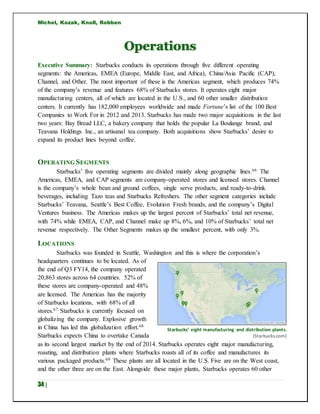
52,902 mentions and Dunkin’ Donuts had 118, 261 mentions.
There are many other social media sites aside
from Twitter. SocialMention.com aggregates and
analyzes information from over 80 social media sites.128
Starbucks is mentioned every 10 seconds, Dunkin’
Donuts is mentioned every 31 seconds, and Tim Hortons,
every 4 minutes.129 The majority of blog posts about
Starbucks maintain a neutral sentiment towards
Starbucks. While the majority is neutral, a small group of
consumers give positive feedback while very few give
negative feedback. People mention Starbucks in a blog
every nine minutes on average. Current hot topics include
new Apple Pay mobile payment system, new store
locations, and seasonal products.130 According to Board
Reader, employment opportunities seem to be a hot topic at Starbucks as well. Bloggers continue
to discuss the positive benefits of employment at Starbucks, including higher education
opportunities and lack of discrimination. The majority of the posts are positive in nature and
describe new products such as the Pumpkin Spice Latte. Generally, the majority bloggers and
users who comment online are females and appear to be 14 and 30.131
Starbucks Business Analysis
| 65
Quantitative
Executive Summary: Starbucks’ global social media rank is currently 2,298. This is up 286
places since 3 months prior. The majority of visitors to the Starbucks Web site are college-
educated women who are browsing from home. Compared to competitors, Starbucks maintains
the majority of traffic on its social media sites and apps.
BRAND PROMINENCE
Starbucks far outranks
Dunkin’ Donuts and Tim
Hortons in social media traffic
volume. Starbucks has an
audience of 51,513,808
individuals across their major
forms of social media as
indicated by the image to the right (a breakdown of this source can be found in the appendix).132
The likely driver of Starbucks’ social media traffic is its strong brand image built through
corporate social responsibility, and quality products. However, the company is ranked second in
terms of social media growth. Starbucks, Dunkin’ Donuts and Tim Hortons all had no
performance on YouTube in the month of October.
All three coffee companies have seen their sites’ popularity
improve over the last three months. In addition, comparing the
demographics of those browsing these companies’ sites will likely
give indication to their consumer base. Starbucks demographic Web
traffic can be seen on the next page.
All three sites have seen traffic growth, and consequently, global rankings, improve over the last six months. For Dunkin’
Donuts, this growth is likely due to its ad campaign, and for Tim Hortons, the announcement of Burger King’s acquisition in
September.
Michel, Kozak, Knoll, Robben
66 |
With the emergence of social media, Starbucks has received more headlines over the past
5 years. The peaks in the image below represent product launches, seasonal menu changes,
legality issues, social responsibility headlines, partnerships, and more.133 For example, point D
on the graph represents a legality issue for Starbucks. Another major story that piqued search
interest: when Starbucks ended their contract with Kraft earlier than agreed upon and therefore
the company had to pay out damages.134
Starbucks Business Analysis
| 67
Alexa’s metrics illustrate Starbucks’ success across a variety of social platforms.
The metrics above illustrate that Starbucks’ site is far larger and more valuable than those of its competitors.
Michel, Kozak, Knoll, Robben
68 |
Qualitative
Executive Summary: Starbucks maintains major social networking presences on Facebook,
Twitter, YouTube, Instagram and My Starbucks Ideas. Although some store locations have
individual Facebook accounts, Starbucks maintains a community page for consumers worldwide.
The use of Twitter, Facebook and Instagram allows Starbucks to transfer the high level of
customer service found in stores into cyber space. It also allows consumers to bring issues to
light via Facebook and Twitter for fast, effective results. The company’s YouTube channel
further promotes brand image through videos displaying corporate social responsibility and an
emphasis on community.
YOUTUBE
Starbucks’ YouTube page hosts a variety of videos and
channels. Starbucks’ YouTube channel has 47,000 subscribers,
compared to 4,800 for Tim Hortons and 9,200 for Dunkin’ Donuts.
Through YouTube, Starbucks can effectively promote new products, socially responsible
events and strong brand image. The Discussion section allows customers to address various
issues and ask questions related to products and services. The current top posts are associated
with new products and the Meet Me at Starbucks video. The video displays a typical day at
Starbucks shot between 28 countries and emphasizes the focus on community. The dedication
to community is at the forefront of Starbucks’ values and further strengthens their brand
image.135
FACEBOOK
Starbucks’ Facebook page is well-maintained and
appears to be updated frequently. Like the YouTube page,
their Facebook site also promotes new products and events
to strengthen brand image.136 Starbucks keeps followers
up to speed on new menu items and also keeps them
engaged by following a photographic series entitled
#HowWeMet. The series captures photos of friends,
family, coworkers and significant others meeting at
Starbucks and shares stories of how they met. The series
has a large following and continues to receive positive
feedback across Facebook and Twitter. Starbucks’
Facebook post introducing the HowWeMet series received
17,000 Likes while Starbucks’ overall Facebook page has 37.9 million Likes.
Starbucks Business Analysis
| 69
According to Ice Rocket, topics of discussion among Starbucks’ Facebook users
include posts about the seasonal school and Pumpkin Spice Latte. This identifies the
Generation X and Millennial segments that Starbucks targets. Although most posts are
positive, the Pumpkin Spice Latte did receive negative feedback throughout Facebook as some
consumers complained about the taste and the artificial sweetener.
TWITTER
Starbucks’ Twitter account is
also well-maintained and is likely to
be the hub for customer service
issues. Starbucks raises awareness
for charities, community events and
new products through Twitter. In
the fall, Starbucks heavily promotes
the Pumpkin Spice Latte. The
majority of posts on Twitter are
positive comments on making new
friends, bringing the community
together and enjoying good coffee.
The tweets and replies section
includes feedback about negative experiences and serves as a place for customer service.
Starbucks’ responses are very personal and custom to each individual’s problem as they seek to
resolve any issue.
According to Ice Rocket, current Twitter posts primarily address which store location the
user is at, and what drinks they enjoy. Some users refer to Starbucks as a religious cult for
white, upper middle class families while others joke about the addiction they have to the
coffee.137
INSTAGRAM
Starbucks Instagram allows users to follow the “How We
Met” photographic series and also promotes new products and
ideas. Starbucks currently has a following of over three million
people and has made 561 posts.138 The “How We Met” series
displays people of all sorts at Starbucks and offers snapshots into
peoples’ lives. The Instagram page is also synced to Facebook,
allowing Facebook users without Instagram to actively
follow the series as well.
Starbucks’ Twitter page focuses heavily on community and bringing
people together. (Twitter.com)
Starbucks promotes community by taking
snapshots into peoples’ lives with “How
We Met.” (Instagram)
Michel, Kozak, Knoll, Robben
70 |
MY STARBUCKS IDEA
My Starbucks Idea is a social gathering place
for Starbucks consumers to brainstorm and share new
ideas. While part of the corporate site, it engages
consumers and keeps them actively involved in the
decision making process. The site offers Starbucks drinkers a chance to come up with new ideas
in three categories: product, experience and involvement. As users share ideas, a real time news
feed displays new ideas so others may vote or comment on
them. Top voters and commenters are put on a leaderboard and
some of the best ideas are put to action. A recent idea that is
being put in action is the return of Kind bars to the stores.139
Other ideas in action include mini Frappuccino’s, custom coffee
tumbler designs and new K-cup flavors mocha and cinnamon
dolce. Top recent ideas include alternatives to dairy and soy
milk, buy ten get one free rewards program and free coffee on your birthday.
(StarbucksFallEssentials.com)
Starbucks Business Analysis
| 71
Strategies
Starbucks has proven itself remarkably adept at staying innovative and dealing with STEEP
trends and Porter’s Five Forces before they become a major issue. Minimum wage demands are not a
major concern for Starbucks since entry-level employees already start out working above the
minimum wage. Schultz has applauded President Obama for his calls for a higher minimum wage.
Nor is the Affordable Care Act (“Obamacare”) an issue, since the company already provides more
health coverage than Obamacare requires. The Latin American drought is not a major issue for
Starbucks since the majority of its coffee beans are price-protected through 2015 and Starbucks’
well-established value chain allows it to attain coffee beans from over 20 countries. Corporate social
responsibility is a relatively minor issue since the company emphasizes that front so much it’s even
in Starbucks’ mission statement. And the company has performed well even despite the ups and
downs of the stock market. Hence, there are only a few areas in which Starbucks can innovate.
One, is providing customers with the nutrition facts of its products through its
Starbucks app. More health-conscious customers will want this information more easily available,
and Obamacare is mandating more nutrition facts incorporated into restaurant’s menu boards. This
may be a precursor to more and more nutrition facts becoming readily available to consumers. By
jumping ahead of the trend instead of waiting for it to become law, Starbucks will gain first-mover
advantage and improve its image.
Two, the company can better adapt to trends in organic foods and GMO regulations by
testing organic coffee in select markets, using organic coffee beans and milk from organic-
certified cows. More health-conscious cities such as Seattle, Portland, Eugene and San Francisco,
would be ideal for test launching these products and gauging consumer interest. This would give
Starbucks a first-mover advantage in selling organic coffee at coffeehouses.
Three, the company can expand its appeal to Chinese consumers by increasing its
scrutiny of its Chinese suppliers. Customers in China often favor foreign brands, given the series of
food scandals that China is notorious for. Starbucks currently has an image as a safe, Western food
restaurant that it should protect. Starbucks could tighten its supplier accreditation process and hire
contractors to continuously oversee food supply.
Fourth, active global portfolio management, which requires preparing for sales in Canada
to dip, given increasing competition in Canada from Tim Hortons and McDonald’s. As the Canadian
market becomes more saturated, Starbucks may find better opportunities for expansion in Latin
America, Europe, and Asia. China recently surpassed Canada as Starbucks’ #2 market and shows the
strongest growth potential.
Fifth, Starbucks must continue to remain diligent about stock performance. The
company has weathered recessions well for the most part, but saw sluggish stock performance
during the fiscal crisis of 2008, largely as a result of trying to expand too quickly without
ensuring quality.
Michel, Kozak, Knoll, Robben
72 |
Indicators Analysis
Starbucks Business Analysis
| 73
STEEP Analysis
SOCIAL
HEALTH AND WELLNESS
Health and wellness is an important
trend in society that Starbucks needs to
accommodate. 38% of adults agree that if
healthy menu items sound appetizing, they are
more likely to order that item. But a stigma still
exists that any food from the QSR industry is
inherently unhealthy. This has led to a wide
variety of methods that consumers use to
determine if a food item is healthy or not. For
instance, 37% of consumers polled believe that
an item with a low calorie count is a healthy
option, while 39% believe an item with more
fruits and vegetables is healthier.140 Katrina Fajardo, foodservice analyst at Mintel, says that
restaurant operators should continue to offer their traditional menu items while also adding items
that are low calorie, locally grown, or health customized versions of their main meals. Fajardo
says this will “boost consumers’ perceptions of health on the menu without needing a full menu
overhaul.”141
TRANSPARENCY IN NUTRITION FACTS
Transparency is an issue that has come to the fore in consumers’ minds. Consumers are
becoming more concerned with what is in their food and how it is prepared, and they expect
restaurants to provide this information. Over 100,000 consumers search for food allergy
information every month in Google, and between 2.4 and 3.4 million, search for information
Salads are a popular addition to QSR and fast casual
menus. (BlissTree.com)
Michel, Kozak, Knoll, Robben
74 |
concerning GMO and gluten-free foods. Consumers have become very interested in the source of
their food, with a preference for GMO free and locally sourced foods. Government policies also
follow this trend, with new menu regulations mandating health information and regulators
introducing for the first time food allergy regulations into the 2013 food code.142 To stay
competitive, restaurants will have to follow this trend by providing more information about their
products to consumers and using GMO free and locally sourced food when possible.
MILLENNIALS AFFECT RESTAURANT LANDSCAPE
Millennials are the up and coming generation, comprised
of adults ages 18 to 34, and the restaurant industry has begun to
feel the effect of this generation’s preferences. Overall,
Millennials have decreased their visits to restaurants by 21%,
choosing to focus on food quality over quantity. Millennials also
often prefer a wider variety of foods, searching for food items
they can’t get elsewhere. “The appeal is in the difference,” writes
Lillia Callum-Penso in an article for GreenvilleOnline.143
Millennials also have less money to spend on food, and so are
more price conscious than previous generations. These
preferences have led to Millennials avoiding casual chains such as Olive Garden and Chili’s and
frequenting independently owned restaurants and fast casual restaurants such as Chipotle and
Starbucks. As the baby boomer generation fades and Millennials take the primary spending role,
restaurants will have to adapt to these preferences in order to survive.
TECHNOLOGICAL
APPLE PAYIMPLEMENTATION
More than 500 financial institutions have begun
implementing Apply Pay, an alternative to Google Wallet which
allows customers to make purchases with their smartphones
instead of using plastic cards.144 Starbucks is taking a cautious
approach to Apple Pay, implementing it in their Starbucks app,
but likely waiting to see how it fares before implementing
widespread integration throughout its 11,000+ US stores.
Starbucks still isn’t using the near-field communication (NFC) technology needed that enables
consumers to easily make a purchase by tapping their phone against a payment kiosk. Starbucks
will be using Apple Pay, but only as a payment option for reloading their Starbucks card app. If
Apple Pay proves popular, they can proceed to widespread implementation.145 The hardware for
NFC technology would cost anywhere from $15 to $50 per checkout lane.146
Apple is emphasizing convenience
to get customers to adopt Apple
Pay. (IBTimes.co.uk)
Millennials are the new customer
base for restaurants.
(GreenvilleOnline.com)
Starbucks Business Analysis
| 75
INCORPORATION OF TOUCH-SCREEN KIOSKS ANDONLINE ORDERING
More Panera Bread locations are
allowing customers to order through kiosks
instead of a cashier. Buffalo Wild Wings
locations are adding touch-screen ordering,
while the number of restaurants that let you
order online and pick up in store is also
growing, and includes Chipotle, Starbucks,
and Wendy’s. Restaurants are incorporating
these types of technology to improve order
accuracy, reduce labor costs, track customer
spending better, and get customers to buy
more food. Restaurants using Suri’s Presto tablets have seen a 5% increase in sales and a table
turnover 7 - 10 minutes faster.147 At Chili’s, customers can use touch-screens to read the news,
order appetizers and drink refills, and pay their check. At Panera, the entire menu is available
through a kiosk. Customers can easily repeat past orders, or customize a sandwich exactly how
they want. One diner in Tucson, AZ, has taken the experience to the next level by implementing
“smart tables” in which the entire table surface is spill-proof touch-screen on which customers
can play games, watch TV, or order food.148 While Starbucks has implemented online mobile
app pre-ordering, the company may be reluctant to add touch-screen kiosks to its locations
because it prefers the personalization that comes from having customers interact with baristas.
CYBER-ATTACKS ARE UP, BUT CYBER SECURITYSPENDING IS DOWN
While cyber-attacks are increasing, security spending by firms is actually decreasing,
according to Price Waterhouse Cooper’s Global State of Information Security Survey 2015.
Cyberattacks have been affecting banks, retailers, and restaurants, among
other businesses.149 JPMorgan Chase and nine other financial institutions
were recently hit by a cyberattack that affected 76 million customers, and
targeted the firm’s core infrastructure.150 216 Jimmy John’s stores and 108
other restaurants were hit in a major data breach against their payment
system, built by Signature Systems. The company uses remote
management tools that allow it to fix computer problems without sending a
technician to the store.151 These same tools create a security vulnerability that allowed hackers to
gain access to credit card names, numbers, expiration dates, and verification codes. Cards used
starting in mid-June are at risk. The company realized it had a malware problem on July 30, but
it took a week to remove the majority of it, and until mid-September to remove every trace.152
Panera Bread is among the most innovative companies when it
comes to touch-screen ordering. (Consumerist.com)
Michel, Kozak, Knoll, Robben
76 |
ECONOMIC
EFFECTS OF LATIN AMERICANDROUGHT TO BE FELT IN US
Meteorologists are predicting
low rainfall in Brazil for the next
two months, which will only
exacerbate the country’s drought
problem. The consequences could be
felt in the US through coffee and
sugar prices. While El Salvador,
Panama, Guatemala and the
Honduras also face drought prospects, Brazil is the world’s largest coffee producer.153
Consequently, Arabica coffee prices are rising, and could by 2015 exceed the historic high of $3
per pound set at the end of 2010.154 Starbucks is better insulated from rising coffee prices than
other companies – with 60% of its coffee supply price-protected through 2015 – but the other
40% could pose an extra cost that may cut into Starbucks’ profit margins if it isn’t passed on to
customers.155
EMPLOYEES DEMANDING HIGHERMINIMUM WAGE
83% of restaurant patrons support a
minimum wage hike, according to an
online survey from Technomic, Inc.
“Consumers clearly believe the economic
benefits of a minimum wage increase far
outweigh the negatives,” said a
representative from Technomic. The
National Restaurant Association and the
International Franchise Association,
which both represent fast food giants like
McDonald’s, have strongly opposed a
minimum wage hike. 13 states and six
cities have raised their own minimum
wages.156 West Coast cities are leading
the way in raising the minimum wage. In
Starbucks’ hometown of Seattle, business
and labor have agreed to phase in a $15
minimum wage in three years for large businesses and seven years for small businesses.
Washington State already has the highest minimum wage in the country, at $9.32. San Francisco
residents will vote in November whether to raise the minimum wage from $10.75 to $15. The
The South
American drought
has major world
implications for
coffee and sugar
prices. (Sydney
Morning Herald)
Restaurant and retail workers across the nation have been staging
mass protests for a higher minimum wage. (Wikipedia)
Starbucks Business Analysis
| 77
Santa Clara Board of Supervisors instituted a living wage that will boost income for Silicon
Valley and San Jose workers. LA Mayor Eric Garcetti is proposing to increase the minimum
wage to $13.25 by 2017. The LA Chamber of Commerce argues, “This proposal would actually
cost jobs, would cause people to lose jobs and would cause people to have cutbacks in hours.”
San Diego’s City Council is implementing an $11.50 minimum wage within three years.
According to economists Michael Reich and Ken Jacobs of the University of California at
Berkley, there are no differences in employment rates between cities with and without living
wage laws. The Congressional Budget Office claims raising the federal minimum wage to
$10.10, as Obama has proposed, would lift 900,000 Americans out of poverty but also mean
500,000 jobs get cut.157
POOR STOCK MARKET PERFORMANCE
While the stock market has seen bullish growth over the last year,
mid-October saw poor growth, including the worst three-day market slide
since 2011.158 Many analysts have called it a simple “correction period,”
and have concluded the correction period is over.159 With Grey Thursday
(a.k.a. Thanksgiving) and Black Friday only a month away, retailers are
expecting to see strong growth over the next couple months, especially with
the holiday shopping season gearing up.160 Despite the market correction,
Starbucks stock has been performing well over the past five years but has
been relatively stagnant over the last 12 months.
Starbucks’ stock
ratings are holding
strong, with 14 Strong
Buys, 2 Buys, and 3
Holds. (Nasdq.com)
Michel, Kozak, Knoll, Robben
78 |
ENVIRONMENTAL
OPPOSITION TO GMOS BECOMING MORE WIDESPREAD
About 70% of processed foods in grocery stores are genetically
modified. Voters in Colorado161 and Oregon162 will decide on
Proposition 105 and Measure 92, respectively, to determine
whether these foods have to be labeled. The issue is only likely
to become more controversial in the coming months, and if these
ballot measures pass, it would likely fuel similar ballot initiatives
in other states and push corporations to use fewer GMOs.
Starbucks is already feeling the pressure from the fight, as
150,000 consumers have signed a petition urging Starbucks to switch to organic milk and stop
sourcing milk from cows fed genetically modified organisms. GMO Inside, an anti-GMO group,
urged social media activism and launched #OrganicMilkNext on Twitter to push Starbucks to
make the change.163
GROWING CONCERN FORCORPORATE SOCIAL RESPONSIBILITY
A poll of 30,000
consumers across the world
indicates that 55% are willing to
pay more for goods and services
provided by companies
practicing corporate social
responsibility, and committed to
positive social and
environmental impacts. The
Nielsen Global Survey on
Corporate Social Responsibility showed Millennials are more responsive to sustainability actions
than other groups, such as Generation X and the Baby Boomers.164 Another survey, conducted
by Lab42 in August 2014, placed a higher emphasis on corporate social responsibility than
Nielsen’s polling, showing that 84% would pay more. While Nielsen surveyed consumers across
the entire globe, Lab42 focused on only U.S. consumers. And while the Nielsen survey focused
on sustainability, the Lab42 survey shifted emphases to companies having strong reputations,
putting out high-quality products, and treating employees well. Their survey also revealed that
33% of consumers don’t know how to define social responsibility.165 Starbucks has always put a
strong emphasis on social responsibility, providing tuition reimbursement and health care for
employees, as well as ethically sourcing its coffee bean growth. If consumers become more
socially conscious about their purchases, it bodes well for Starbucks’ growth potential.166
GMO Inside is leading the push to get
milk from GMO-fed cows out of
Starbucks’ drinks. (GMOInside.org)
Since its founding in Seattle in 1971, Starbucks has placed a heavy emphasis
on corporate social responsibility. (Starbucks.com)
Starbucks Business Analysis
| 79
DEMAND FOR ORGANICFOODS GROWING
The demand for organic foods is growing faster than the supply. Organic food sales
soared from $3 billion in 1997167 to $28 billion in 2012, totaling about 4% of total grocery food
sales. Production acreage and facilities aren’t growing nearly as rapidly. From 2008 to 2011,
organic acreage grew only 12% per year, while the number of certified organic livestock grew
only 3%. To qualify as organic in accordance with USDA standards, land used to produce
organic crops can’t be treated with chemicals for at least three years, and livestock have to be
raised organically from conception. While specialty stores like Whole Foods used to be the main
source of organic foods, major retailers including Walmart, have been looking to expand their
organic food supply.168 Organic crops take longer to grow and produce lower yields, so despite
consumer interest in organic foods (91% of Walmart customers said they would buy organic),
companies are not as quick to take advantage of the trend. Organic represents risks and
opportunities for restaurants and retailers alike.169 McDonald’s and Chipotle are among the
restaurant companies who have expressed an interest in expanding their organic offerings.170
POLITICAL
BUSINESSES CAUGHT UP IN OPEN-CARRYCONTROVERSY
Starbucks found itself at the center of the open-carry
controversy in 2014, when several customers chose to enter the store
with rifles. CEO Howard Schultz issued a letter requesting
customers to leave their weapons at home, without issuing an
outright ban on firearms.171 The decision was controversial among
open-carry supporters, with some accusing others of harming the
cause172 and others attempting to organize protest events at
Starbucks. Starbucks isn’t alone in asking open carriers to leave their
weapons at home: Chipotle, Target, and Sonic have done the same,
likely because having people openly carrying arms in a store will drive more customers away
than it would attract.173 With gun laws becoming less strict in
America, this issue is not likely to go away anytime soon.
INDUSTRYSAFETYREGULATIONS IN CHINA
China is set to add new regulations to its food safety laws over the coming months. These
regulations will introduce harsher penalties for those who violate the laws, and give more
authority to regulators. These changes come in light of a rash of food production complaints.174
51.7% of food inspections in Q2 2014 failed, and several high-profile scandals emerged.175 In
July 2014, an undercover reporter in China found a supplier selling expired meat to various fast
Starbucks, Chipotle and Jack in the
Box are among businesses that have
asked customers to leave their assault
rifles at home. (MotherJones.com)
Michel, Kozak, Knoll, Robben
80 |
food companies, including Starbucks.176 In September, regulators discovered a Taiwanese bakery
chain using potentially toxic “gutter oil” to fry pineapple buns, which it then sold at a number of
Taiwanese bakeries and fast food restaurants, including two Starbucks stores.177 In October, the
Taipei District Prosecutors’ Office indicted 13 people over mixing non-edible oil with cooking
oil, a violation of China’s food safety regulations.178 Given the numerous food safety scandals in
China, many consumers in the People’s Republic prefer foreign-branded and imported food
products. While the food scandals extended to Starbucks as well, the diminishing reputation of
Chinese food safety may actually enhance the Starbucks brand in China.
AFFORDABLE CARE ACT CONTROVERSIAL WITH SMALL BUSINESSES
Some restaurants are adding an Obamacare surcharge
to their customers’ bills, despite the fact the law won’t go into
effect for small businesses until 2016, and the fact that the
surcharges are going over poorly with customers: not
necessarily for the extra cost, but more for the political
statement the restaurants are making. One Denny’s franchisee
who owns 30 restaurants in Florida was reprimanded by the
corporate CEO, who denounced his actions as a political
statement.179 Members of the Pennsylvania Restaurant and
Lodging Association, among others, have complained about
the extra costs that Obamacare would add when it goes into
effect in 2015.180Starbucks CEO Howard Schultz has called
the law a net positive for the country and added that it would
have no major effect on Starbucks’ health care plans, which are already more generous than the
law’s requirements.181 “We have been providing comprehensive health insurance to all our
employees,” he said, “including part-time people who work 20 hours a week, for over 20 years.
So our plan is actually better.”182
(HuffPost.com)
Starbucks Business Analysis
| 81
Porter’s Five Forces
RIVALRY
CANADIAN COMPETITION INTENSIFIES
McDonald’s has begun to make its McCafe ground
coffee available for purchase in Canadian grocery
stores.183 This is part of McDonald’s strategy to
expand its coffee territory in Canada. McDonald’s has
seen significant growth in its breakfast day-part in the
last five years, and is looking to make this trend
continue by moving into the home coffee market.
Meanwhile, Tim Hortons, the current leader in
Canadian coffee sales, has begun selling a new dark
roast at its stores.184 This is the first time the Canadian
coffee king has introduced a second blend in 50 years.
Companies continue to find ways to differentiate themselves, indicating that rivalry is very fierce
and each company is looking for a new product to gain an advantage.
NON-TRADITIONAL LOCATIONS
As rivalry among competitors increases, market
saturation becomes a major issue. As a result, many quick
serve and fast casual restaurants are trying to find a way to
reach a new or different group of customers. One way these
restaurants are reaching out to new customers is by locating
their restaurants in non-traditional locations, including
hospitals, universities, and casinos.185 Non-traditional
locations can be dangerous bets for restaurants as some
places, such as stadiums, are not open all year and may not
be profitable. That these companies are willing to take risks
shows the highly competitive nature of the industry.
NEW PRODUCTS AND DIFFERENTIATION
In Q2 2014, Starbucks saw 5% more growth than its competition. This growth is due
largely to Starbucks’ new products. These include Teavana Tea, Fizzio handcrafted soda, and la
Boulange pastries.186 Starbucks’ focus on differentiation through new products shows that the
industry has a high degree of rivalry. Coffee products tend to be very similar, making
differentiation a difficult strategy. Starbucks attempts to differentiate itself from its rivals with its
new products, which shows the pressure of rivalry on their coffee business is strong and they are
trying to differentiate.
McCafe brand coffee is now being sold in Canadian
grocery stores. (Investing.com)
This Starbucks, located on Stonybrook
College campus, is an example of a non-
traditional location. (Stonybrook.edu)
Michel, Kozak, Knoll, Robben
82 |
POWER OF BUYERS
INCREASING BUYER EDUCATION
Coffee tourism is on the rise, and this means
more consumers are becoming more educated about
coffee sourcing. Crimson Cup Coffee and Tea is one of
the small companies cultivating the coffee tourism
industry.187 Crimson Cup offers trips to coffee growing
regions in Central America for college students and
owners of independent coffeehouses. The trip shows
tourists the full extent of the coffee growing industry,
from the growing process to the impacts the industry
has on the local population. As this brand of tourism
continues to grow, consumers will become more
educated about the coffee industry. This will likely
work to Starbucks’ benefit, as consumers will become more socially conscious of Starbucks’
ethical sourcing, and thus, more likely to buy Starbucks coffee.
GROWING TEA INDUSTRY CREATES MORE SUBSTITUTES
Tea is a growing substitute threat to Starbucks’ coffee sales. Tea is
a fast growing industry in the US. Since 2007, tea sales have grown 32%
to a high of $15.7 billion in annual sales. Over the next two years, the tea
market is expected to expand even further, up to $18 billion in annual
sales. When substitutes are easily available and when the cost to switch to
those substitutes is low, buyer power is greatly increased. Starbucks has
recognized this threat, and is currently working to mitigate it by expanding
its Tazo tea line and acquiring Teavana Tea. While these are good steps,
the threat to Starbucks’ majority coffee based business still exists.
STARBUCKS’CUSTOMERS HAVE STRONG BRAND LOYALTY
Starbucks has exceptionally brand-loyal customers. This was seen
in 2012 and 2013 when Starbucks raised their prices. Despite the price hike, Starbucks
maintained the same number of customers per day.188 Part of this loyalty is from Starbucks’
significant online presence and prominent store locations.189 But marketing expert Priya
Raghubir claims the most important component of Starbucks’ customer loyalty is Starbucks’
position as “the quintessential coffee shop,” creating an inviting atmosphere that differs from
more snobbish small coffee shops. This strong brand loyalty helps to somewhat mitigate the
Crimson Cup Coffee President Greg Ubert at one
of the company’s tour locations in El Socorro,
Honduras. (Dispatch.com)
Starbucks acquired the
popular Teavana brand in
response to the growing
market for tea products.
(Teavana.com)
Starbucks Business Analysis
| 83
otherwise strong power that buyers have over Starbucks by reducing the customers’ price
sensitivity.
SUPPLIERS
C.A.F.E. POLICYMAYLIMIT SUPPLIERS
Starbucks is committed to sourcing
all of its coffee from farms that meet their
Coffee and Farmer Equity (C.A.F.E.)
Standards. Conservational International
works with Starbucks to lay out guidelines
for Starbucks’ ethical sourcing policy. The
C.A.F.E. standards include guidelines about
ecologically friendly growing, fair trade and fair
labor practices.190 Starbucks has made a public
commitment to buy all of its coffee from C.A.F.E. suppliers by 2015. All signs point toward the
company making good on this commitment, as by 2013, 95% of the company’s coffee came
from C.A.F.E. suppliers.191 To keep to this standard, Starbucks will need to continuously find
new C.A.F.E. suppliers. This limits which suppliers Starbucks can use and gives the suppliers
that do follow these guidelines slightly more power.
FIXED-PRICE CONTRACTS PROTECT STARBUCKS
Coffee bean prices are a serious issue for
Starbucks, and rising prices could damage their business
and give suppliers more control over the company. In
light of this, Starbucks has done its best to put protections
in place to prevent damage to the company from suddenly
fluctuating prices. Starbucks has fixed-price agreements
for all of its coffee for 2014 and around 40% for 2015.192
These agreements prevent sudden price fluctuations from
damaging their business and allow the company to
prepare for more expensive supplies in the future.
This decreases the power that suppliers have over
Starbucks.
Shanghai Husi was discovered to be selling spoiled
meats to its restaurant customers, including
Starbucks. (ibtimes.com)
SCS Global Services is the third-party Starbucks uses
to ensure its suppliers follow C.A.F.E. standards.
(SCSGlobalServices.com)
Michel, Kozak, Knoll, Robben
84 |
SUPPLIER SCANDALS THREATEN CHINA STARBUCKS
China has become a major growth area for Starbucks, but recent issues with suppliers
have begun to threaten this growth. The most recent was in July 2014, when regulators
discovered the meat supplier Shanghai Husi Food discovered using expired meat in its products.
Some of Starbucks’ cafes were using products supplied by Husi, and the fallout from the scandal
affected Starbucks as well as a number of other companies. This food scare and others like it are
likely to continue in China in the near future.193 If Starbucks cannot trust its suppliers in China, it
will become more expensive and difficult to maintain its business there. This could prove
detrimental for Starbucks, especially since China is a major growth area.
Starbucks Business Analysis
| 85
Industry Activities
McDonald’s expanding into fast casual realm—10 December 2014:
McDonald’s plans to compete with Subway and Chipotle by implementing
a new program it calls “Create Your Taste.” This will allow customers to
customize their burgers’ bread, cheese, and toppings using touch-screen
ordering. The company will be rolling Create Your Taste out at 2,000 of
its 14,000 US locations in 2015.194
Fast food expanding healthy choices—5 November 2014: More quick-service and fast casual
restaurants are adding healthy food to their menus while many upstart chains are focusing their
product line on healthy offerings. These trends are more prominent along the West Coast. At
Lyfe Kitchen, currently in 13 locations across four states, the emphasis is that the food tastes
great, first and foremost, but it’s also healthy.195 The burger chain uses meat only from grass-fed
cows, and keeps its entrees under 600 calories. It offers kale banana smoothies but markets the
product’s taste above the flavor. While these kinds of foods cost more than McDonald’s, the
millennial generation is willing to pay more for tastier, healthier food.196
McDonald’s to bring back the McRib—5 November 2014: McDonald’s plans to reintroduce
the McRib in about 75% of its stores. This move comes as McDonald’s sales are falling in the
US and the company is looking to stop this trend. Sales have fallen 3.3% in the third quarter, the
fourth straight quarterly decline for the restaurant company. The McRib is a cult classic and is
expected to help improve McDonald’s sales in the short term. Using limited time offering
products, such as the McRib, is a good way to raise sales in short term because customers don’t
want to “miss out” on the limited offering. However it isn’t a long term solution that
McDonald’s can rely on to continue to raise sales.197
Starbucks delivery latest in a series of new products and services—10 October 2014:
Always looking for new ways to expand, Starbucks has announced it will begin offering delivery
in late 2015 in select markets. Starbucks CEO
Howard Schultz envisions giving the customers
the ability to “create a standing order of
Starbucks delivered hot to your desk daily.”
Customers will place orders through the
Starbucks mobile app. This will make Starbucks
coffee more convenient for customers, eliminate
the hassle of waiting in line in the store or at the
drive-thru, and make it easy to place large orders
without any worries about how to get a dozen
cups of coffee into the office.198 Some of Starbucks’ major challenges in implementing this
program will be keeping the coffee warm when it arrives. While sales are up 10% for the quarter,
(Starbucks.com)
Michel, Kozak, Knoll, Robben
86 |
the company’s outlook is poorer than expected. This is the latest strategy among a long series
that Starbucks has used to boost sales. Other recent additions to Starbucks’ products and services
include new lines of single-origin coffee aimed at customers who demand ethical sourcing. The
company also plans to open 100 stores that sell only small Reserve-brand coffee, and is
expanding its coffee product line.199
Chipotle the most successful company in food industry—21 October 2014: Chipotle’s same-
store sales are up almost 20% over last quarter, making it, as Business
Insider put it, “the most successful company in the food industry right
now.” Chipotle may be cannibalizing sales from other fast food
restaurants; McDonald’s, for example, reported sales were down 3.3%.
Part of Chipotle’s success is the result of consumers shifting away from
QSR in favor of more fast casual fare.200 Chipotle founder Steve Ells
attributed his company’s success to fast casual, saying, “The companies
that have lost the most customers over the last decade are traditional fast-
food chains, while the biggest gains go to fast casual restaurants.” McDonald’s, at one time, had
majority control in Chipotle. But the two have different business models. Whereas Chipotle
investors might see its rapid growth as the stock’s main value, McDonald’s investors appreciate
the frequent dividend payouts.201
Frozen meals have better nutrition than QSR—21 October 2014: An analysis of frozen food
and fast food at a recent conference on nutrition showed that frozen meal consumers, compared
to QSR consumers eat 253 fewer calories per day, 2.6g less saturated fat per day, 3.9g more
dietary fiber, 511mg more potassium, and 135mg more calcium, and 8.5g more protein.202 The
analysis compared frozen food to QSR, but not fast casual or casual dining, which tend to serve
healthier food than QSR.203
Gas prices and unemployment are down, but discretionary spending isn’t up—15 October
2014: Gas prices have fallen 15% since late June, but while economists have expected
discretionary in other areas -- such as clothing retail and fast food -- to rise, those gains haven’t
shown up so far.204 Retail sales fell 0.3% overall in September, with drops in auto departments,
gas, food services, and building materials. NRF Chief Economist Jack Kleinhenz said the retail
dip came “despite increasing consumer confidence, an uptick in employment, lower gas prices,
and with inflation in check, consumers still slowed spending.”205
Restaurant patrons support minimum wage hike—30 September 2014: 83% of restaurant
patrons support minimum wage hike, according to an online survey from Technomic, Inc.
“Consumers clearly believe the economic benefits of a minimum wage increase far outweigh the
negatives,” said a representative from Technomic. The National Restaurant Association and the
International Franchise Association, which both represent fast food giants like McDonald’s, have
strongly opposed a minimum wage hike. 13 states and six cities have raised their own minimum
wages. West Coast cities are leading the way in raising the minimum wage. In Seattle, business
Starbucks Business Analysis
| 87
and labor have agreed to phase in a $15 minimum wage in three years for large businesses and
seven years for small businesses. Washington State already has the highest minimum wage in the
country, at $9.32. San Francisco residents will vote in November whether to raise the minimum
wage from $10.75 to $15.206 The Santa Clara Board of Supervisors instituted a living wage that
will boost income for Silicon Valley and San Jose workers. LA Mayor Eric Garcetti is proposing
to increase the minimum wage to $13.25 by 2017. The LA Chamber of Commerce argues, “This
proposal would actually cost jobs, would cause people to lose jobs and would cause people to
have cutbacks in hours.” San Diego’s City Council is implementing an $11.50 minimum wage
within three years. According to economists Michael Reich and Ken Jacobs of the University of
California at Berkley, there are no differences in employment rates between cities with and
without living wage laws. The Congressional Budget Office claims raising the federal minimum
wage to $10.10 would lift 900,000 Americans out of poverty but also mean 500,000 jobs get
cut.207
Restaurants incorporating more touch-screen ordering—29 September: More Panera Bread
locations are allowing customers to order through a
kiosk instead of a cashier. Buffalo Wild Wings
locations are adding touch-screen ordering, while
the number of restaurants that let you order online
and pick up in store is also growing, and includes
Chipotle, Starbucks, and Wendy’s.208 Restaurants
are incorporating these types of technology to
improve order accuracy, reduce labor costs, track
customer spending better, and get customers to buy
more food. At Chili’s, customers can use touch-
screens to read the news, order appetizers and drink
refills, and pay their check. At Panera, the entire
menu is available through a kiosk. Customers can easily repeat past orders, or customize a
sandwich exactly the way they want. Restaurants using Suri’s Presto tablets have seen a 5%
increase in sales and a table turnover 7 - 10 minutes faster. One diner in Tucson, AZ, has taken
the experience to the next level by implementing “smart tables” in which the table surface is set
up like a giant tablet on which customers can play games, watch TV, or order their food.209
Fine dining sees growth while fast food stays flat—26 September 2014: A recent report from
the NPD Group market research firm says that while fine dining establishments are seeing more
traffic, fast food establishments are staying flat. Over the past three years, visits to dining
establishments with checks of $40 or more went up 11% while visits to restaurants with an
average check of $10 or less went down 1%. Fine dining patrons represent just 1% of restaurant
patrons. Meanwhile, 80% of restaurant patrons eat at fast food establishments.210 The NPD
Group says this may be a reflection of the low-income and middle-income groups faring worse
while high-income groups fare the same, if not better. Those who classify themselves as middle
(LoStateMinor.com)
Michel, Kozak, Knoll, Robben
88 |
class shrank from 53% in 2008 to 44% in 2014. Meanwhile, those who classify themselves as
lower- or lower-middle-class rose from 25% in 2008 to 40% in 2014. “This is the type of thing
that keeps restaurant executives up at night,” said Bonnie Riggs of the NPD Group. “The middle
class is shrinking.” Households with incomes of $100,000 or more account for 36% of total fast
food spending.211
Jimmy John’s cardholders hit in major data breach—26 September 2014: 216 Jimmy
John’s stores and 108 other restaurants were hit in a major data breach
against their payment system, built by Signature Systems. The company
uses remote management tools that allow it to fix computer problems
without sending a technician to the store.212 These same tools create a
security vulnerability that allowed hackers to gain access to credit card
names, numbers, expiration dates, and verification codes. Cards used
starting in mid-June are at risk. The company realized it had a malware
problem on July 30, but it took a week to remove the majority of it, and until mid-September to
remove every trace.213
Fast Casual Sales Out-Pace QSR Sales in Canada—24 September 2014: US tech companies
may delay their scheduled IPO’s until they see how Alibaba’s stock performs following its
record-breaking performance this past week. Tech companies considering an IPO this fall
include Hub spot, LendingClub.com, GoDaddy.com and Box, among others. More importantly,
if demand for Alibaba’s stock holds then holding companies will likely begin selling off stock in
other investments to purchase more from Alibaba. Negative implications would be similar to that
of Facebooks IPO in 2012, which may happen simply due to corporate governance in china or
lack of confidence in decision-making policies by the owners. Furthermore, Alibaba has
purchased a US based company called 11Main who will directly compete with eBay. With the
capital achieved through their recent IPO, Alibaba will likely approach more markets and
directly compete with US companies within the US itself.214
Johnny Rockets launch a drive-thru model—18 September: Shows the brand becoming more
aggressive and trying to tap into the QSR market even further. Also, exploring their more retro
footing by embracing the 50’s drive in mentality such as Sonic has been doing recently. This
may lead to Johnny Rockets gaining more market segment and effectively allowing them to steal
market segment from Starbucks during the lunch hour rush. The Brand has a more diverse menu
that fits to lunch and dinner and may appeal to consumers more with the drive through
capabilities.215
More higher-income household’s good news for restaurants – 17 September: While the
median income of households has remained steady, there has been steady growth in the number
of higher income households (households with annual income above $75,000). This is significant
to the restaurant industry as most of the industry’s income is from the higher income
demographic.216
Starbucks Business Analysis
| 89
Yum Brands bringing Pizza Hut to Africa—17 September: Sources indicate that Africa has
the fastest young growing population.217 This is significant for two reasons. The continual
emergence of companies into South Africa displays the current markets companies operate in are
saturated. Also, it shows that there is room for serious market potential in South Africa.
Starbucks should consider other markets besides the US and Europe.218
Starbucks may lift workers’ visible tattoo ban—10 September: Starbucks has begun the
process of reviewing its dress code, including its ban on visible tattoos. The tattoo ban has
recently been a subject of controversy in the social media space. Starbucks is expected to
announce its updates in the next few weeks. This decision follows a recent online petition on
social media to end Starbucks’ ban on visible tattoos. This again shows how important it is to
Starbucks brand to respond to social media and maintain its important Millennials clientele.219
McDonalds faces allegations of franchise wage violations—29 July: If law is passed or if
McDonalds is held accountable for their franchises treatment of their workers further
implications may fall on all companies that have a franchise structure. Starbucks has many
Franchise locations and therefore may be subject to any decision on this finding.220 Being held
accountable as a joint employer of franchise employee’s aids intense pressure to pay employees
better salaries and offer benefits.221
Michel, Kozak, Knoll, Robben
90 |
Strategy Models and Analysis
Critical Success Factors
Executive Summary: Starbucks has established a strong, differentiated niche in the restaurant
industry as the country’s #1 coffeehouse. Its success has allowed it to grow exponentially since
1982. The factors most critical to Starbucks’ success include its commitments to corporate social
responsibility, product quality, local culture and store atmosphere, global expansion, and
providing strong employee benefits, which, in turn, pays off in customer service.
Critical Success Factors Includes CSF Area
Enhancing product quality by
using finest ingredients
available
Using high quality raw materials
researching new products
R&D, Purchasing, Operations
Continue expanding in global
growth markets
Long-term growth strategies,
smooth supply chain operations
Strategy, Finance, Operations
Executive Management
Increased corporate social
responsibility programs
Green initiatives, public image,
advertising campaigns,
employee engagement
Marketing, Operations, C-Level
Executives
Enhance customer service by
promoting employee
training/benefits
Customer satisfaction, employee
satisfaction, employee benefits,
training
Human Resources, Operations
Incorporate local culture into
store atmospheres
Discovering Local Culture,
Keeping up with regional
consumer trends while
maintaining Starbucks Image
Research and Development,
Marketing, Strategy, Financing,
Operations
PRODUCT ANDSERVICE QUALITY
Product quality is one of Starbucks’ primary differentiator and maintains the highest
priority for the company. Consistent, high quality coffee is the major difference between
Starbucks and its competitors such as Dunkin’ Donuts and Tim Hortons. This quality is what
allows Starbucks to charge premium prices for its products. This is called value based pricing,
and is a cornerstone of Starbucks’ profitability. By selling high quality products at customer
value based, premium prices Starbucks can maintain its high profits. Starbucks derives its
product quality from several different sources. The first is the raw materials the company uses to
make its products. Starbucks coffee is produced from high quality, fair trade coffee beans.222
This increases Starbucks’ product quality above its direct competition, and also allows Starbucks
to be competitive with smaller, specialty coffee brewers. Another source of product quality is
their employees. Starbucks has policies in place to ensure that their baristas take the necessary
time to make the highest quality drinks.223 Starbucks also focuses on its customer service,
Starbucks Business Analysis
| 91
ensuring each customer has a high quality experience.224 The departments that are most engaged
with this critical success factor are operations, research and development, and purchasing or
procurement. Operations and Human Resources can ensure that Starbucks’ employees are
following company policy, research and development can produce new, higher quality products
and sourcing can ensure that the company’s stores are using high quality raw materials.
GLOBAL EXPANSION
Starbucks global growth initiative is a key critical success factor held by Starbucks and
therefore considered its second priority. Due to the market saturation within the US, Starbucks
must expand to increase profitability and global market share. This is confirmed in Starbucks’
2013 10k report, where the company describes its dependence on Europe and Asia for growth as
a risk factor.225 The expansion process is likely to be carried out by virtually all aspects of the
company. The strategy department must make adequate plans to move into new countries. This
division will need to oversee any regulatory, cultural and operational issues that may arise during
the expansion process. The company must also be financially prepared for the continued
expansion. Starbucks finance departments will be responsible for handling currency issues and
making sure the company is financially stable during the expansion process as well. HR must
properly account for employee training on an international level, and each country must receive
tailored training to promote store effectiveness. Starbucks Global Operations divisions will
ensure smooth supply chain operations and distribution to each added location. It is also
important for Starbucks Marketing department to conduct thorough market research in order to
identify prospective locations in the global marketplace. Overall, it is important that Starbucks
continue to reach these markets. In 2013, Starbucks’ China and Asia Pacific revenue grew
27%.226 This growth is critical Starbucks’ current and future success.
CORPORATE SOCIAL RESPONSIBILITY
Corporate social responsibility (CSR) is a differentiator for Starbucks and is an important
source of competitive advantage. Therefore, it is considered the next priority in terms of critical
success factors for the company. By actively engaging in CSR, Starbucks is attempting to put
itself above its competition in the minds of consumers. Many of Starbucks’ competitors, such as
McDonald’s and Dunkin’ Donuts, do not have a public image as a socially responsible company.
This gives Starbucks a major image advantage over them. CSR can also benefit Starbucks in
other ways. Financially, green packaging is cheaper to make and energy efficient stores are
cheaper to operate.227 Focusing on finding a way to reduce water usage in stores may drive the
innovation of new, disruptive technologies. CSR is also a strong advertising technique. By
focusing on the social good of CSR, it is easier for Starbucks’ advertisements to be engaging
with the public. Finally, CSR can help promote employee engagement and a positive corporate
culture with CSR events such as volunteer days.
Starbucks is currently engaged in a wide variety of CSR projects. The most important is
their C.A.F.E. buying approach. A C.A.F.E. certification means that a coffee bean farm is
operating in an ecological, economical, socially responsible manner. Starbucks has made a
Michel, Kozak, Knoll, Robben
92 |
public commitment to buy all of its coffee from C.A.F.E. certified farms by 2015.228 Starbucks is
also engaged in a variety of other CSR projects, such as reducing waste from their disposable
cups and reducing the energy requirements of their stores. Starbucks outlines all of these projects
and their related progress in a yearly report called the Starbucks Global Responsibility Report.229
Many of Starbucks’ departments are engaged in the company’s CSR effort. However, the most
important departments are marketing, the C-level executives, and procurement. Marketing
ensures that all of the company’s CSR is well known and well received by the public, the C-level
executives’ endorsements are important to the CSR’s success, and procurement is critical to
meeting the C.A.F.E. goal that is Starbucks’ most important CSR program.
STRONG CUSTOMER SERVICE THROUGH
SATISFIED EMPLOYEES
In 2012, Starbucks ranked 73rd among the
Fortune 100 Best Companies to Work For.230 Superior
customer service is critical because without it,
Starbucks couldn’t justify its high prices. Starbucks’
employee satisfaction is key to its strong customer
service. Due to the high importance of continued
emphasis on satisfying employees, it is the next
priority in terms of critical success factors. GlassDoor
shows CEO Howard Schultz has an 87% approval
rating, compared to only 67% for Dunkin’ Donuts’
CEO. 79% of Starbucks employees would recommend the company to a friend, while only 63%
of Dunkin’ Donuts employees would say the same. Starbucks is able to maintain happy
employees through generous health care benefits, stock options, and education benefits.231 Happy
employees, in turn, provide solid customer service. Starbucks’ customer satisfaction rating,
according to the American Customer Satisfaction Index, ranks at 76%. Dunkin’ Donuts customer
satisfaction is at 75%.232 Therefore, by promoting employee satisfaction and happiness Starbucks
simultaneously increases its customer satisfaction.
LOCAL CULTURE AND STORE ATMOSPHERE
Starbucks store atmosphere is critical in the success
and image of the company, however does not maintain a
priority as high as the mentioned factors when it comes to the
success of the company. Before the return of Howard Shultz,
Starbucks was expanding exponentially. The company was
saturating the market and inherently diluting the company
image, and store atmosphere. In 1995, the company had
created four themes for their locations based off of the four
basic elements of air, earth, fire, and water. The company
filtered these themes through the coffee jargon of aroma,
Highly Customizable low-traffic location
(fastcodesign.com)
Starbucks’ satisfied employees contribute to
each store’s positive atmosphere, and in turn,
helps maintain strong customer satisfaction.
(Fortune.com)
Starbucks Business Analysis
| 93
harvest, roast, and brew. However, this was a very simplified way to mass produce its locations.
With the company expanding out of control the four themes became standardized and often times
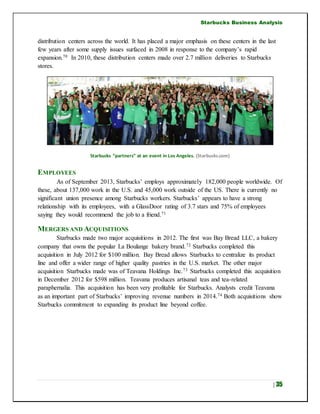
the shipments associated with opening a store would contain contents of a separate theme. This
was a clear indication of how the quality control began to slip away from the grasp of the
company.
Today, Starbucks has evolved their image. The
company has put a focus on creating the “my”
statement associated with their stores. The company
wishes to expand more on the experience associated
with going to a Starbucks. To do so, the company has
invested considerable time and resources in carefully
designing its global store locations. Each global
location has design genesis’s that are responsible for
tying in the Starbucks feel to the specific
neighborhood and culture. The company experimented
with this concept in 2007 with their introduction of
their Roy’s location in Seattle. This location is by no
means a typical Starbucks, however it has the unique and relatable feeling for a set cliental,
therefore leading to the “my” feeling. This concept has also inspired the design of Starbucks
flagship locations. These locations gain considerable attention for how unique they actually are.
Starbucks’ overall goal is to take the company’s 23,000 stores and make at least 21,500 unique
locations.233 The company receives considerable foot traffic and attention for their local coffee
house feel. By accurately tying in the local atmosphere and keeping up with technology trends
and fashion appeal, Starbucks can maintain high foot traffic and sales in each of its locations.
FlagshipStore Amsterdam (fastcodesign.com)
Michel, Kozak, Knoll, Robben
94 |
SWOT Analysis
SWOT
Strategies and
Analysis
Strengths:
• Strong market positions
in the US
• Global brand recognition
• High-quality coffee and
pastry products
• Strong customer loyalty
Weaknesses:
• Kraft contract issue
• GMO controversies
• Premium pricing
• US overdependence
• Market saturation
Opportunities:
• Expansion into emerging
markets in China, Brazil,
India and Russia
• Expanding product lines
to non-brewed coffee
products such as energy
drinks, lunch items,
alcohol, and single serve
at home brewing items
like K-Cups
• Take advantage of
technological advances
such as Apple Pay,
smartphone apps and
touch screen kiosks
• Expand into the lunch
day part
• Positive growth
projections for the
single-serve market
• Utilize global brand
recognition in order to
fuel expansion efforts
into foreign markets.
• Expand into organic and
natural food and
beverage market with
items such as sodas,
home brewing, and lunch
menu items.
• Support advancing
technological trends by
implementing new phone
apps and phone based
payment methods.
• Partner with well
established, ethical,
quality brands in foreign
markets to make
international expansion
easier and alleviate
Starbucks’ dependence
on the US market.
• To help deal with GMO
controversies,
Starbucks can expand
Teavana and other
organic company labels
across single-serve
markets and into the
workplace.
• Expand beverage lines
such as Fizzio,
Evolution Fresh,
Starbucks Refreshers
and other beverages
into Keurig Cold so
reduce Starbucks’
reliance on the
saturated coffee
market.
Starbucks Business Analysis
| 95
Threats:
• Coffee culture doesn’t
always export well
• Increased competition
from traditional
competitors such as
McDonald’s, Dunkin’
Donuts, and Tim Hortons
• Growing demand for
healthy products
• Coffee price volatility
• Carefully tailor each
country’s Starbucks
stores to its region and
culture.
• Leverage brand
recognition and market
leadership to emphasize
healthy products through
ad campaigns.
• Maintain current strategy
of differentiation for
dealing with increased
competition.
• Switch to a GMO free
product line and
emphasize increased
health of products.
• Pursue high quality
research on potential
foreign markets to
determine how to adapt
Starbucks coffee
culture and
successfully expand in
foreign markets.
• Acquire coffee house
companies in foreign
markets.
Michel, Kozak, Knoll, Robben
96 |
Executive Summary: There are a wide variety of strategies that Starbucks can pursue based on
a SWOT analysis of the company. Overall, Starbucks should focus its efforts on expanding its
product line into more health conscious foods and ingredients. From the company’s strengths and
weaknesses, the most important strategy for Starbucks to pursue is to expand into the organic and
natural food and beverage markets. The most important strategy for Starbucks to pursue from the
company’s weaknesses and opportunities is to expand the Teavana and other organic company
labels across single-serve markets and into the workplace. The most important strategy for
Starbucks to pursue from the company’s strengths and threats is carefully tailoring each
country’s Starbucks stores to the local region and culture. Finally, the most important strategy for
Starbucks to pursue from the company’s weaknesses and threats is to switch to a GMO free
product line and emphasize the health of these GMO free products.
STRENGTHS/OPPORTUNITIES
Starbucks maintains a variety of strengths and opportunities which can effectively fuel
growth and expansion. The company’s strong global brand recognition eases their expansion into
the global marketplace. In conjunction with an equally strong brand image, Starbucks expansion
efforts will be maximized. Moving into the organic and natural foods market will keep Starbucks
ahead of the organic food movement. Starbucks current product line Evolution Fresh is at the
forefront of customer wellness trends and illustrates the importance of expansion into organic,
natural foods. The juice is created from all natural raw fruits and vegetables. According to
Starbucks, the super-premium green juice is greatly outpacing the growth of the $1.6 billion
super-premium juice category as a whole.234 The further expansion of organic product lines will
allow Starbucks to broaden their current market
targets and facilitate long term financial growth.
The organic food market as a whole is also
increasing in the US, with a compound annual
growth rate of 14% expected through 2018.235
This growth rate, along with the estimated $35
billion size of the market in 2014, shows that
the organic food market is one that Starbucks
should enter.236
Starbucks technological advances are
also at the forefront of the company’s success
and further implementing the newest technologies
will facilitate growth. An example of a rapidly
evolving trend is the smartphone. As of mid-2013,
over half of the US adult population owned a smartphone.237 Starbucks has been attempting to
take advantage of this trend. According to computerworld.com, 10% of Starbucks transactions in
the U.S. are made with a phone. Starbucks’s loyalty cards in North America booked 30% year-
over-year growth in dollars loaded. Starbucks is currently installing wireless charging mats in
Starbucks’ technological implementations allows
them to maintain a competitive advantage.
(boston.com)
Starbucks Business Analysis
| 97
more stores, illustrating the necessity to maintain a competitive edge by utilizing the newest
technologies.238 Other technology trends include touch-screen kiosks and online ordering.239
WEAKNESS/OPPORTUNITIES
Expansion into international markets has many barriers. The company must
adhere to language barriers, cultural barriers, legal barriers, etc.240 Therefore, to expand
internationally, it is in the best interest of the company to locate a well-established supplier and
retailer within the market. Starbucks has been successful with locating quality suppliers of their
coffee beans and has used this approach with segments of the company’s international expansion
to date. However, to maintain the company image it is vitally important to seek out partnerships
with companies that are ethically sound and provide quality products. The company cannot risk
tarnishing their image like that of McDonalds due to their international expansion campaigns.241
Other markets the company must consider are the single-serve market and the office
workplace market. The single-serve or notably called Ready to Drink (RTD) market was
forecasted to grow to 125 billion by 2017; therefore, growing at a Compound Annual Growth
Rate (CAGR) of 10.9%.242 Additionally, tea is the second most consumed beverage worldwide
behind water. More recently, the US market has had a surge of consumption of tea via a wellness
spring.243 Therefore, Starbucks should leverage their current 5 year partnership with Keurig
Green Mountain to produce and sell Teavana, other organic K-Cups in retail locations, and
provide them to business operations through the company’s office coffee and vending service.244
Considering the information mentioned previously
such as the wellness trend, growth projections for the
single-serve market, and the known saturation of the US
market; the company must consider expansion of their
alternative beverages such as Fizzio, Evolution Fresh,
Starbucks Refreshers, and their other bottled alternatives
with that of the Keurig Cold, which is set to reach the
market in 2015. The company’s current partnership with
the company would allow for easy transition of this new
product line and enable the company to reach their
consumers in the convenience of their home, and
workplace. According to Tom Novik, 15 percent of US
households have one thing in common; they own a Keurig coffee brewer.245
The Keurig Cold is a great opportunity for
continual expansion into the beverage
industry. (www.shoffeeblog.com)
Michel, Kozak, Knoll, Robben
98 |
STRENGTHS/THREATS
Despite Starbucks’ internal strengths, its
external threats put the company at a
disadvantage. Starbucks has strong market
positions, global brand recognition, quality
products, and customer loyalty it can use to
withstand and overcome external threats.
According to Forbes, the company is
considered one of the world’s most valuable
brand, and therefore facilitates global
expansion.246 Because its coffee culture does
not always export well to other countries,
Starbucks should become more adaptive in each
regional venue. The American model does not
succeed in every country. In some countries,
such as China, Starbucks needs to emphasize the third place aspect of its business, while in
Brazil, where coffee is already extremely cheap, Starbucks needs to find ways to reduce prices if
it hopes to attain a significant market share.247 Another threat is the growing demand for healthy
products. Many of the drinks Starbucks serves are high calorie and considered unhealthy, such as
the classic 16oz café latte with 190 calories or a 16oz Caramel Macchiato with 240 calories.248
Starbucks can overcome this obstacle by emphasizing its green teas or black teas in its ad
campaigns. Finally, one of Starbucks’ greatest obstacles is increased competition in the US and
Canadian market from retailers like McCafe and Tim Hortons. This is especially true in the
Canadian market, where McCafe has seen significant growth and Tim Hortons is working to
maintain its position as market leader with a new dark roast coffee.249 People go to these venues
because the coffee is cheaper, but if Starbucks cut its prices, that could threaten its image as the
premium, high-quality coffee company. Some customers Starbucks may have to write off. If it
reduced its prices, Starbucks would threaten its own image, so maintaining the current course
remains the best option in this case. Starbucks’ strategy is based on differentiation, not on being
a low-cost leader.
WEAKNESS/THREATS
Starbucks has a variety of threats and weaknesses that the company needs to deal with if
they are going to grow in the future. A major weakness that Starbucks has is a series of
controversies over the use of GMO ingredients in their products. For example, in November
2014 rock star Neil Young encouraged his fans to boycott Starbucks over the company’s GMO
policy.250 A major threat to Starbucks is the growing demand for healthy food products.251 To
deal with these two issues, Starbucks can investigate switching to a GMO free product line. The
advertising for this switch can focus on the increased health of GMO free products. This will
help alleviate Starbucks’ weakness to GMO controversies while also increasing the health of
their products overall. Other major weaknesses that Starbucks has are an overdependence on the
One of Starbucks’ most important challenges is
expanding into developing markets like India.
(http://blogs.ubc.ca)
Starbucks Business Analysis
| 99
US market and general market saturation in the US. As of September 2014 over 68% of
Starbucks’ stores are located in the US.252 This weakness
is compounded by the threat of coffee culture not
exporting well to foreign markets making foreign
expansion difficult. Starbucks explains this weakness at
length in their 10k, acknowledging that foreign expansion
is critical to future growth while simultaneously being
very difficult to achieve.253 In order to handle these issues,
Starbucks should increase their market research on foreign
markets in order to determine what markets are best for
Starbucks coffee culture. Without this market research,
Starbucks runs the risk wasting money building stores in
areas that aren’t profitable. Starbucks can also deal with
these issues by looking to acquire or benchmark against
coffee houses or similar businesses that are already
successful in foreign markets. For example, when moving
into India Starbucks can benchmark against the Indian café
chain Café Coffee Day, a popular chain with over 1,000 stores in India.254 By taking the habits of
these successful businesses, Starbucks can better ensure their success in foreign markets.
Anti-GMO advertisements such as these
are a major weakness for Starbucks.
(gmoinside.org)
Michel, Kozak, Knoll, Robben
100 |
Analysis of Competing Hypotheses
Executive Summary: The two hypotheses that we tested using an ACH matrix are whether it is
likely or unlikely that Starbucks will expand into the GMO free, organic and natural food and
beverage market to remain competitive. This matrix found that it is most likely in Starbucks’
favor to expand into the GMO free and organic food market. Some of the key pieces of evidence
that led to this conclusion are that Starbucks has seen success with GMO free and organic foods
in the past, the market increasingly desires GMO and organic foods, and GMO free and organic
food will be expensive to implement.
Starbucks Business Analysis
| 101
Michel, Kozak, Knoll, Robben
102 |
Strategy Map
KEY FINDINGS
Starbucks’ top priorities focus on three dynamic functions of the company: increasing
profitability, satisfying customers and selling new products. Starbucks’ profit margin is usually
between 10 and 11%. This high profit margin is fueling the company’s important moves to
expand globally. Starbucks also must maintain a high level of customer satisfaction, despite
increased competition. Lastly, it is important for Starbucks to continue developing new products
to stay competitive in a saturated market. By succeeding in these key areas, Starbucks will
increase its success and promote strong brand image and customer loyalty.
INCREASE PROFITABILITY
Increasing profitability is critical to the success of several Starbucks strategic initiatives.
The company typically has a profit margin of 10-11%, with the recent exception of 2013, where
litigation fees essentially wiped out corporate profits for the year. Increasing profitability
remains essential in supporting continued global expansion new product development.255
Starbucks will be able to maintain increased profitability by reducing overhead and product costs
while avoiding unnecessary spending. Starbucks’ profitability is fueling its current rate of global
expansion and its growing product line. After dealing with the Kraft litigation charge, Starbucks
will likely continue to focus on increasing profitability to maintain its position as industry
leader.256 Starbucks’ profit margins are higher in Asia and the company expects its overall profit
margins will grow as it expands into this market segment. It also expects higher profits through
its retail beverages. The company is also enhancing profits by expanding its operational day
parts. By 2019, the company plans to offer the Starbucks Evenings --which includes beer, wine,
and hors d’oeuvres in 20-25% of locations.257
CUSTOMER SATISFACTION
Customer satisfaction is at the core of any business in the food industry. By focusing
heavily on customer satisfaction and individual experience, Starbucks can effectively maintain
its advantage against competitors. The company can provide a unique experience for customers
with the individualized setting and ambiance of each storefront. Starbucks’s quality and
experience is responsible for increasing their profitability, strengthening their corporate image
and increasing consumer brand loyalty. Starbucks can measure customer satisfaction through
increases in sales, store foot traffic and social media analysis. Starbucks recently fell in customer
satisfaction ratings, to a ranking of 76, behind Wendy’s at 78, Little Caesar’s and Domino’s
Pizza, and Papa John’s and Pizza Hut at 82.258
Starbucks Business Analysis
| 103
NEW PRODUCTS
Starbucks’ constant focus on delivering new products is critical to its strategy of
maintaining a strong brand image and loyal customers. Focusing on new products gives
Starbucks a unique advantage over competitors by offering customers a diverse selection of
quality products. This drives customer satisfaction, which in turn increases brand loyalty and
profitability. Due to the high level of brand loyalty among Starbucks customers, new products
are highly likely to succeed, increase sales, and expand Starbucks’ customer base.259 The success
of new products allows Starbucks to increase its profitability and carry out expansion strategies
as well as investing in new products and acquisitions.260 For example, Starbucks recently
launched the Chestnut Praline Latte, a drink the R&D team started developing in late 2012. This
latte received one of Starbucks’ highest product rating scores. Starbucks’ R&D team in Seattle
searches worldwide for new recipe ideas and tests out trends, then tests them out in the lab to see
what works. When they find something that works well, the team releases it in a limited number
of Starbucks markets to test the product before rolling it out nation or worldwide.261
Business Planning Scorecard
FINANCIAL PERSPECTIVE
Goals Measures
Increased Profitability  New product releases
 Revenue
 Foreign growth
 New store openings
Decrease Overhead  Cost vs quality analysis
 Average costs of products
 Marginal costs analysis
Avoid Unnecessary Spending  Cost of legal fees
 Amount of market research
 Debt to asset ratio
CUSTOMER PERSPECTIVE
Goals Measures
Improve customer satisfaction  Foot traffic to stores
 Sales
 Customer surveys
 Social media analysis
Increase corporate social responsibility  Number of positive mentions on
social media
 Number of partnerships with CSR
groups
 Amount of money spent on CSR
footprint
Produce high-quality products  Number of awards
 Amount of sales
 Customer surveys
Create a positive in-store atmosphere  Customer time spent in store
 Customer surveys
 Amount of money spent on store
design
Michel, Kozak, Knoll, Robben
106 |
INTERNAL BUSINESS
Goals Measures
New product lines  Number of new products
 Sales of new products
 Ratio of planned vs. actual releases
Improve supply chain management  Costs of product
 Benchmarking vs. Competitors
Invest in technology  Money spent on technology products
and research
 Benchmark technology against
competitors
 Age of current equipment
LEARNING AND GROWTH PERSPECTIVE
Goals Measures
Increase workforce satisfaction  Average employee retention
 Employee Surveys
 Customer satisfaction reports
 Complaints and manager reports
Increase workforce training  Money spent on employee training
 Time spent on employee training
 Customer satisfaction reports
 Number of incorrect orders
Attract skilled employees  Wages and benefits vs. competition
 Customer satisfaction reports
 Average education level of employees
Starbucks Business Analysis
| 107
Annex 1: Dining Debacle
THE 2008 FISCAL CRISIS AND ITS EFFECTS ON THE RESTAURANT INDUSTRY
SUMMARY:THE FINANCIAL CRISES OF 2008
The year 2008 brought a myriad of problems for the restaurant
business: rising costs of food and gas, a credit crunch, and a faltering
economy, all exacerbated by a financial crisis. By summer 2008, several
small national chains had already closed down. Village Inn declared
bankruptcy on April 3. Steak and Ale and Bennigan’s both declared on July
29. In June, the Restaurant at Doneckers in Ephrata, PA, closed, followed a
month later by the Log Cabin in Warwick, PA. At 75 years old, the Log
Cabin had made it through the Great Depression, but couldn’t survive the
recession of 2008. The restaurant’s closure also meant the layoff of 47
staff.262 And then the investment bank, Lehman Brothers, declared
bankruptcy on Sept. 15, 2008, exacerbating the credit crunch and recession, bringing about a
widespread financial panic, and making it harder for businesses to obtain loans. The effects of
the financial crisis could be felt in restaurants big and small.
Effect on the small restaurant business
In San Francisco, business owners and
brothers Nathan and Brett Niebergall, said the
financial crisis was hurting patronage at their local
fine dining establishment, Frisée. On some
weeknights, business was down 50% over the
previous year. “We are one of the first things people
tend to cut out when things are tight,” they told the
San Francisco Chronicle. “Going out to dinner,
spending a lot of money on food and wine is not what
people are thinking about when the rest of the world is
screaming, ‘Hold on to everything you’ve got.’”
To save $2,500 per month, they cut ties with all vendors except their meat provider. The
other food they needed they got from shopping at farmers’ markets and wholesalers, but this
required longer hours, often including 15-hour days. One of the brothers stated, “It has got to the
point now where the margins are so thin that we have to cut everywhere.”263
Their story wasn’t uncommon among small businesses during 2008. In September, 67%
of business owners reported being affected by the credit crunch, according to the National Small
Business Association (NSBA). That figure was up from 55% in February 2008. 32% reported a
deterioration in the terms of available bank loans, up from 27% in February. According to the
Nathan and Brett Niebergall, owners of Frisée in
San Francisco. (SFGate.com)
Michel, Kozak, Knoll, Robben
108 |
NSBA, when banks have to cut credit, small businesses are the ones affected first.264 Other
assessments of the credit crisis’s effects were more optimistic. The National Federation of
Independent Business, a similar organization, reported only 10% of its members found loans
harder to come by. Community banks were less affected by the credit crunch, and still able to
give out loans to small businesses.265 One restaurant industry analyst noted that franchisees
looking for $200,000 or below could probably find such a loan at regional banks, but larger
restaurant chains would have a harder time. “It will never be as easy as it was before,” said WD
Partners’ Dennis Lombardi. “Banks will be under much more pressure to make sure they don’t
over-leverage the recipient of the loan.”266 One business owner in Vermont wanted to add a
$350,000 fine dining restaurant to his ski resort, but couldn’t get any bank financing. With the
banks not able to help him out, he approached customers about investing.267
Among the small restaurant business, the crises of 2008 hit the fine dining segment the
hardest. Some fine dining chefs, used to serving $300 entrees, turned to fast food to make up for
losses caused by the financial crisis. Among them was Paul
Bocuse, nicknamed the Pope of French cuisine. He added a fast
food restaurant serving sandwiches and hamburgers to his fine
dining chain serving lavish French meals. Guy Martin, another fine
dining celebrity chef, opened a snack food counter.268 At Rayuela
in New York, management noticed customers were sharing dishes,
ordering expensive entrees less, and skipping dessert and appetizers
more. Like others, its manager, Héctor Sanz, felt slightly safer in
the bad economic conditions because he had opened a more casual
restaurant with lower prices a few months prior. One fine dining
restaurant, Citrus at Social in Hollywood, opened in February with $40 entrees, but had to re-do
its menu for smaller portions and lower prices. This was part of a larger trend of restaurants
cutting prices to attract customers.269
The effect on restaurants wasn’t limited to the U.S. either. In Britain, 100 restaurants
closed shop in January 2009. Gordon
Ramsay Holdings was among the
businesses affected. The chain closed
two restaurants in London in 2008, and
cut business hours at other restaurants.
It had incurred a £10.5 ($17.14)
million debt with the Royal Bank of
Scotland, giving Ramsay good reason
to be upset.270
The Citrus at Social in Hollywood
had to rethink their business plan
after opening in February 2008 to a
poor market. (TBIMG)
Starbucks Business Analysis
| 109
EFFECT ON LARGER CHAINS
The effects were arguably worse for larger chains. Bank of America stopped loans to
McDonald’s that the burger chain had been using to build and market coffee bars in 14,000
locations. McDonald’s executive Cindy Fuller issued a memo to franchisees warning them that
“now is not the time to be shopping for loans based on interest rates.”271
Many large chains had to slow or stop expansion. O’Charley’s put a halt
to building any new restaurants, and postponed remodeling work on its existing
restaurants. P.F. Chang’s opened about 42 restaurants in 2008, but expected to
open about half as many in 2009. Ruby Tuesday also announced it would stop
opening new stores in 2008 as the “business sector is overbuilt and demand has
declined.” Smaller chains, like Buffalo Wild Wings and BJ’s, didn’t feel the
effects as acutely, and planned to continue opening new restaurants in 2009 at
the same pace as they had before in 2008.272 Yum Brands’ CFO also admitted
franchisees were struggling to obtain loans, and admitted the situation had “affected our
refranchising efforts.” Like McDonald’s, Yum Brands was also in the process of renovation,
adding Wing Streets to 1,700 of its 7,500 Pizza Huts. One Subway franchisee said he had to put
down 30% - 50% to get a loan, whereas before, he only had to put down 20%.273
Traffic fell at restaurants. Wait times at restaurants fell from 17 minutes on average in
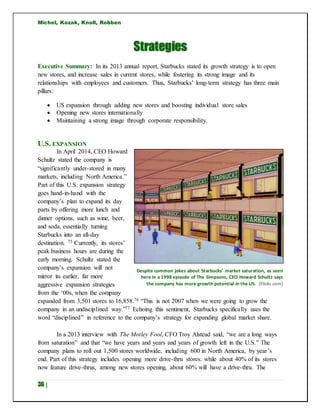
2007 to 14 minutes in 2008.274 Technomic restaurant consultancy’s figures for Q3 2008 showed
sales were down 2.6% over the previous year, based on an analysis of public companies. The
price of food also increased 9%, and declining tourism in late 2008 hurt restaurants in major
destinations like New York and Los Angeles. Restaurants typically operate on only a 4% margin.
The economic conditions
saw some customers
eschewing casual dining
for fast food or fast
casual. Full-service
restaurants expected a 5%
decline in sales.275 A
survey by the National
Restaurant Association in
October 2008 found that 53% of restaurant owners cited either rising food costs or the sluggish
economy as their primary concern.276 Another survey by Technomic, Inc., found 74% of
consumers were planning to visit restaurants less often than before and to 50% planned to spend
less when they did visit.277 A September 2008 customer survey from Booz & Company (featured
above) showed the recession would cause a major shift in consumer behavior. It showed
customers were dining out less and planned to continue curbing their restaurant consumption.278
This consumer spending survey from September 2008 predicted a sharp decline in
restaurants’ foot traffic. (Booz & Co.)
Michel, Kozak, Knoll, Robben
110 |
APPLICATION TO STARBUCKS:HOW THEY WEATHERED THE CRISIS
BEFORE THE RECESSION
Starbucks Corporation was expanding exponentially before the recession. They had
developed a cost-efficient value chain to reduce the average store opening costs and reduce day-
to-day costs. Starbucks created economies of scale by using centralized buying and developing
standard contracts and fixed fees, as well as using highly regarded contractors who displayed
good cost-control. Additionally, the company was successful in nearly becoming vertically
integrated both backward and forward.
Because Starbucks was able to source their beans from a number of areas due to their
contracts and vertical integration, the company was at less exposure to bad weather, price
fluctuations, and volatile economic and political conditions in coffee growing countries.
Similarly, the company created a means of value for their customers by providing a comfortable
ambiance that attributed to the overall experience. They sought to create a third place between
home and work where customers could relax and unwind. They wanted customers to come to
their stores to meet friends, read a book, surf the Internet, or listen to the company’s in-house
music.
Starbucks had expanded briskly across the U.S. prior to the recession. The company had
a powerful and well-known brand name that was easily transferable to other businesses, allowing
them to pursue joint ventures and diversify their portfolio. Through their joint ventures, they
made their product more accessible to both existing and new customers.
DURING THE RECESSION
Starbucks was facing a management crisis and a recession simultaneously. “For some
reason,” Howard Schultz told Harvard Business Review, by 2007, “we seemed to become the
poster child for excess. It’s easy to laugh about it now, but people said that buying a latte at
Starbucks wasn’t smart. McDonald’s put up billboards saying that four dollars for a coffee is
Starbucks Business Analysis
| 111
dumb. Gas went as high as five dollars in some places, coupled with the financial crisis—and all
of a sudden we saw a seismic change in consumer behavior.”279 In 2007, Starbucks’ customer
traffic fell for the first time ever. And from 2006 to 2008, their stock lost half its value.280 The
recession hit the Starbucks experience hard. Sources indicate that during the leadership of Jim
Donald, the company emphasized expansion and efficiency at the expense of customer service,
effectively watering down the high-quality coffee experience that customers had enjoyed about
Starbucks. In 2008, the board of directors asked Howard Schultz to return as CEO.
The board reinstated Schultz as
CEO on Jan. 8, 2008. Upon arrival Schultz
laid out his plan before the top 10
executives of the company and asked
simply “are you in or are you out?” Eight
of the 10 top executives left the
company.281 Schultz had his work cut out
for him as CEO. He had to take a long,
hard look at how other major visionaries,
such as Charles Schwab and Steve Jobs,
had turned their own companies around.
His first objective was to remake Starbucks’ image,
beginning with its mission statement. The company’s old mission
was “to establish Starbucks as the premier purveyor of the finest
coffees in the world while maintaining our uncompromising
principles as we grow.” The new statement was, “to inspire and
nurture the human spirit – One person, One cup, and One Neighborhood at a time.” This new
mission statement marketed the company as more than just a beverage seller but an avenue of
unique costumer experiences. It also emphasized Starbucks’ social responsibility: contributing to
communities and charities, running an environmentally-friendly business, and treating
employees well.
Schultz conducted an overhaul of the company from top-to-bottom. He asked Arthur
Rubinfield to return to redesign the company stores with ambiance that more closely resembled
the Italian coffeehouse feel that had inspired Schultz to begin with. He had over 7,000 stores
close early on Feb. 26, 2008, to retrain baristas on making great coffee. He consulted outsiders
on the best ways to turn the company around. The company also invested in major advertising,
including a commercial that on during Saturday Night Live during the 2008 presidential
campaign, promising customers if they vote, they get a free cup of coffee.282
Howard Schultz
(Starbucks.com)
(Wall Street Journal)
Michel, Kozak, Knoll, Robben
112 |
Schultz’s greatest fear was losing
core customers during the recession. “The
issue at hand ... is the cost of losing your
core customer,” he said. “It’s very hard to
get them back.”283 To retain core
customers, Starbucks introduced the Gold
Card, which gave customers a variety of
benefits. For $25 a year, they got free
refills, 10% off almost all purchases, two
hours of free Wi-Fi per day, and surprise
offers through e-mail.284
After changing the mission
statement, Schultz ran a situation analysis
using SWOT. A SWOT analysis evaluates
the internal and external strengths, weaknesses, opportunities and threats. Internal strengths for
Starbucks include their strong brand identity, their ability to sell diverse products and their joint
venture with PepsiCo. Their many retail locations and their joint venture allow them to leverage
their value chain relationships into a competitive advantage. But relying on a joint venture can
also be a weakness. The company also risks erosion of their values and goals if they expand too
much. This was said to be the case leading up to the recession.285 Starbucks was becoming just a
place; their coffee was often burnt and the experience was far from personal. 286
International expansion also provided a great opportunity for Starbucks. They already had
a presence in major countries such as China, India, and Japan.287 They also demonstrate social
responsibility through fair trade coffee purchases,288 their cooperation with growers to practice
environmentally friendly work habits as well as treating their employees exceptionally well.
Another venue they could approach is being “green” to attract environmentally conscious
clientele. However, threats that Starbucks is faced with include but are not limited to, a saturated
US market, fierce competition in the industry and substitute products.
Many of these factors played a role in the erosion of sales during the recession as well as
the return to profitable growth in 2010. Schultz came in and capitalized on the company’s
strengths by improving existing supply chain activities and improved on the company’s
weaknesses by closing 900 underperforming stores, trimming the workforce by roughly 6,700
employees and giving renewed attention to employee training that focused on enthusiasm for
customer service.289 He also took advantage of the company’s opportunities by expanding their
food menu, adding healthier bakery options, introducing new products such as Starbucks VIA
and investing in international markets such as China, India, and Vietnam, while keeping the
threats in mind.
In February, Starbucks closed early in 7,100 locations to retrain its
employees on how to make quality coffee. (BusinessInsider.com)
Starbucks Business Analysis
| 113
By Q2 of FY2010 the company saw net revenues increase and a net income of $217
million. The same quarter a year prior the company’s net income was $25 million. Schultz
therefore, successfully turned the company around and gained back its position in the market by
bringing in new innovation while still staying true to the principles he used to build the company
up from 1982 to 2000.
Michel, Kozak, Knoll, Robben
114 |
KEY FINDINGS & FURTHER INVESTIGATION
THE ADVANTAGE OF BEING CHEAP
Fast food and especially fast casual are well-positioned to benefit from recessions.
The recession of 2008 may have worked
to the benefit of the fast casual segment
of the industry while working to the
detriment of casual dining and, most of
all, fine dining. The chart at right, from
the Cleveland Plain Dealer, illustrates
how fast casual restaurants continued to
enjoy a decent growth rate while other
restaurant types contracted.290 In 2013,
Darden Restaurants, owners of Olive
Garden and Red Lobster, saw declining sales. Applebee’s and Chili’s slashed their revenue
projections. While fast food, casual dining, and fine dining aren’t going away, these segments
should expect their growth to slow or decline in comparison to fast casual. Many larger chains
would do well to follow Yum Brands’ model and start testing out various fast casual shops to
find one that sticks with consumers. Yum Brands is still invested in Pizza Hut, Taco Bell, and
KFC, but it’s also experimenting with several fast casual brands, including U.S. Taco Company,
Bahn Shop, and Super Chix.291 Fast food also fared well during the recession. Despite whatever
problems the credit crunch created for McDonald’s in attaining loans, the recession boosted foot
traffic and sales to McDonald’s as customers sought out healthier options. In November 2008,
McDonald’s announced their sales for October were up 8.2% over the previous year’s results.292
In the end, Chipotle, Qdoba, Starbucks, Burger King, and Panera Bread posted 2008 sales
growth of 20.7%, 17.8%, 6.9%, 6.6%, and 16.2%, respectively. But the big winner of the
recession was fast casual. And the fast casual market will only continue to grow. Of 3,000
costumers surveyed by Brand Keys consultancy group in September 2014, 32% of Baby
Boomers, 11% of Generation X, and 20% of Millennials are frequenting fast food less than they
used to. Among Millennials, 90% say they want food that’s “tastier, healthier, and more
customized” and are willing to pay more for it.293
Starbucks Business Analysis
| 115
CHANGE CAN BE FOR GOODOR ILL
Starbucks found a great business strategy under Schultz’s guidance, then lost sight
of it. Many analysts say Starbucks’ problem in 2008 is that they lost sight of their founding
vision. That’s true enough, but they lost sight of their founding vision in 1982, when Schultz
took over the company and transformed it from a coffee and spice retailer to a coffeehouse.
Change can be for good or ill. Schultz found a formula that worked and guided the company’s
expansion until 2000, but his successors lost sight of his vision despite his continued presence as
chairman.
According to analyst Simon Sinek, the biggest reason Starbucks struggled in 2007-09
isn’t even the financial crisis: it was because Schultz picked the wrong people to succeed. “The
mistake all these visionary CEOs make,” Sinek said, “is that they choose someone who is an
operator to become the visionary. So Howard Schultz picked his COO and Starbucks went into
decline. Shultz had to come back. Michael Dell picked his COO. Dell went into decline and
Michael Dell had to come back. Bill Gates picked his COO. Microsoft is in decline. Steve Jobs
made the same mistake. He picked Tim Cook. Tim Cook is described as a man able to look at
vast amounts of information and find the problems. You don’t want a man who finds problems;
you want a guy who sees opportunity.”294
Schultz faced incredible pressure in his first few months back to streamline the company
even further than his successors/predecessors did – cut employee benefits, franchise the stores –
instead, he brought it back to his original vision of offering premium coffee while maintaining a
socially responsible image.
“There was tremendous pressure in the first three or four months after my return,”
Schultz said in 2010, “to dramatically change the strategy and the business model of the
company. The marketplace was saying, ‘Starbucks needs to undo all these company-owned
stores and franchise the system.’ That would have given us a war chest of cash and significantly
increased return on capital. It’s a good argument economically. It’s a good argument for
shareholder value. But it would have fractured the culture of the company.”295
The culture was what mattered. It was what made a $4 cup of coffee seem reasonably to
customers and Schultz knew it. As soon as Schultz returned, Starbucks’ stock shot up 8%. He
successfully turned the company around, but at age 61, he won’t be there forever to run it.
Someday, Starbucks’ board will have to appoint a new CEO and if they make the same mistake
as before, Schultz might not be there to save the day again.
Michel, Kozak, Knoll, Robben
116 |
Endnotes
1 Statista.2014. ‘Number Of Coffee And Snack Shops In The U.S. 2016c’.Accessed December 11 2014.
http://www.statista.com/statistics/196590/total-number-of-snack-and-coffee-shops-in-the-us-since-2002/.
2 Statista.2014. ‘Starbucks: Number of Stores U.S. 2014’. Accessed December 11 2014.
http://www.statista.com/statistics/218360/number-of-starbucks-stores-in-the-us/.
3 Trefis,. 2014. ‘Why Starbucks Has An Edge Over Competitors Despite Rising Coffee Prices -- Trefis’. Accessed
December 11 2014. http://www.trefis.com/stock/sbux/articles/239308/marywhy-starbucks-has-an-edge-over-
competitors-despite-rising-coffee-prices/2014-05-30.
4 Allison, Melissa. 9 March 2008. ‘StarbucksCo-Founder Talks About Early Days, Launching Redhook And Seattle
Weekly, Too’. Accessed December 11 2014. http://seattletimes.com/html/businesstechnology
5 Smith, Daniel P. September 2011. ‘Starbucks CEO Has Grand Plans For Coffee Brand’. Accessed December 11
2014. http://www.qsrmagazine.com/executive-insights/over-hill-40-years-sbux.
6 Starbucks.com “StarbucksCompany Timeline.” N.p., n.d. Web. 20 Sept. 2014.
http://globalassets.starbucks.com/assets/5deaa36b7f454011a8597d271f552106.pdf
7 Entrepreneur. 10 October 2008. ‘Howard Schultz’. Accessed December 11 2014.
http://www.entrepreneur.com/article/197692.
8 Larimore, Rachael.2014. ‘Starbucks CEO Howard Schultz Got The World Hooked On Lattes. Here’S How.’. Slate
Magazine. Accessed December 11 2014.
http://www.slate.com/articles/business/when_big_businesses_were_small
9 Bio.com.”Howard SchultzBiography.” A&E Networks Television, n.d. Web. 22 Sept. 2014.
http://www.biography.com/people/howard-schultz-21166227#birth-of-the-modern-starbucks
10 REI. “Starbucks’International Operations.” N.p., n.d. Web. 22 Sept. 2014.
http://www.mi.rei.ase.ro/Site%20MI/Starbucks_EN.pdf
11 Starbucks.com“Starbucks Company Timeline.” N.p., n.d. Web. 20 Sept. 2014.
http://globalassets.starbucks.com/assets/5deaa36b7f454011a8597d271f552106.pdf
12 Geereddy, Nithin . “Strategic AnalysisOf Starbucks Corporation.”
http://scholar.harvard.edu/files/nithingeereddy/files/starbucks_case_analysis.pdf
13 Simonetti, Betsina. “Examples of Backward Vertical Integration Strategies.” N.p., n.d. Web. 22 Sept. 2014.
http://smallbusiness.chron.com/examples-backward-vertical-integration-strategies-14703.html
14 JVHero.com. “Strategic alliancesboost a business both partners.” N.p., n.d. Web. 22 Sept. 2014.
http://www.jvhero.com/strategic-alliance-examples/
15 Seattle Times. “Starbucks,Pepsi Join to Create Drinks.”Advanced.N.p., 11 Aug. 1994. Web. 22 Sept. 2014.
http://community.seattletimes.nwsource.com/archive/?date=19940811&slug=1924821
Starbucks Business Analysis
| 117
16 Seattle PI. “Starbucksand Unileverteam up over ice cream.” N.p., n.d. Web. 22 Sept. 2014.
http://www.seattlepi.com/business/article/Starbucks-and-Unilever-team-up-over-ice-cream-1285251.php
17 Glover, Katherine. “StarbucksGoes All Out in Via Instant Coffee Launch.” CBSNews. CBS Interactive, 29 Sept.
2009. Web. 22 Sept. 2014. http://www.cbsnews.com/news/starbucks-goes-all-out-in-via-instant-coffee-launch/
18 AdsoftheWorld.com,. 2014. ‘Starbucks Verismo: Impossible Until Now’. Accessed December 11 2014.
http://adsoftheworld.com/media/tv/starbucks_verismo_impossible_until_now
19 USA Today. “Starbucks,Green Mountain expand partnership.” N.p., 21 Mar. 2012. Web. 22 Sept. 2014.
http://usatoday30.usatoday.com/money/industries/food/story/2012-03-21/starbucks-green-mountain-partnership-
expands/53684378/1
20 Starbucks Newsroom. “Starbucksand Danone Announce Strategic Agreement to Create and Develop an
Exclusive Line of Evolution Fresh, Inspired by Dannon-branded Fresh Dairy Products.” N.p., 23 July 2013. Web.
22 Sept. 2014. http://news.starbucks.com/news/starbucks-and-danone-announce-strategic-agreement-to-create-and-
develop-an-
21 The Wall Street Journal. “StarbucksInvests in Square.”, n.d. Web. 22 Sept. 2014.
http://online.wsj.com/news/articles/SB10000872396390444423704577575803898185594
22 US Fed News Service. 18 May 2013. Starbucks Reports Multipled Transactions by CEO Schultz. Retrieved 10
December 2014,from http://www.highbeam.com/doc/1P3-2973171111.html
23 Gasparro,Annie. 2014.‘Starbucks Shuffles Global Management Team’. WSJ. Accessed December 11 2014.
http://www.wsj.com/articles/SB10001424127887324766604578458862109746202
24 Biography.com. 2014. Howard Schultz.Retrieved 20 September 2014, from
http://www.biography.com/people/howard-schultz-21166227#early-life-and-career
25 Mergentonline.com.ezproxy.mercyhurst.edu. 2014. Retrieved 20 September 2014, from
http://www.mergentonline.com.ezproxy.mercyhurst.edu/companyexecutives.php?pagetype=officers&compnumber=
73271&exe
26 Entrepreneur. 2014. Howard Schultz.Retrieved 20 September 2014, from
http://www.entrepreneur.com/article/197692
27 BusinessWeek. 2014. Clifford Burrows: Executive Profile & Biography.Retrieved 20 September 2014, from
http://investing.businessweek.com/research/stocks/people/person.asp?personId=10202309&ticker=SBUX
28 Allison, Ibid.
29 MergentOnline.com.ezproxy.Mercyhurst.edu. 2014. Retrieved 20 September 2014, from
http://www.mergentonline.com.ezproxy.mercyhurst.edu/companyexecutives.php?compnumber=73271&pagetype=o
fficers&execid
30 Allison, Melissa. 2014. Building Starbucks one store at a time. The Seattle Times. Retrieved 20 September 2014,
from http://seattletimes.com/html/businesstechnology/
31 Starbucks Newsroom. 2014. Cliff Burrows | Starbucks Newsroom. Retrieved 20 September 2014, from
http://news.starbucks.com/leadership/cliff-burrows
32 LeviStrauss.com. 2014. Leadership.Retrieved 20 September 2014, from http://www.levistrauss.com/who-we-
are/leadership/
Michel, Kozak, Knoll, Robben
118 |
33 Mergentonline.com.ezproxy.mercyhurst.edu. 2014. Retrieved 20 September 2014, from
http://www.mergentonline.com.ezproxy.mercyhurst.edu/companyexecutives.php?compnumber=73271&pagetype=o
fficers&execid
34 Starbucks Newsroom. 2014. Troy Alstead. Retrieved 20 September 2014, from
http://news.starbucks.com/leadership/troy-alstead
35 Businessweek.com. 2014. Annie Young-Scrivner:Executive Profile & Biography. Retrieved 20 September 2014,
from http://investing.businessweek.com/research/stocks/people/person.asp?personId=62658752&ticker=SBUX
36 Linkedin.com. 2014. Annie Young-Scrivner. Retrieved 20 September 2014, from
https://www.linkedin.com/pub/annie-young-scrivner/14/b6/b67
37 BusinessWeek.com. 2014. Annie Young-Scrivner:Executive Profile & Biography.Retrieved 20 September 2014,
from http://investing.businessweek.com/research/stocks/people/person.asp?personId=62658752&ticker=SBUX
38 MergentOnline.com.ezproxy.Mercyhurst.edu. (2014). Retrieved 20 September 2014, from
http://www.mergentonline.com.ezproxy.mercyhurst.edu/companyexecutives.php?compnumber=73271&pagetype=o
fficers&execid
39 York, E. 2010. The Global CMO Interview: Annie Young-Scrivner,Starbucks.AdAge.com. Retrieved 20
September 2014, from http://adage.com/article/cmo-interviews/global-cmo-interview-annie-young-scrivner-
starbucks/144390/
40 LinkedIn.com. 2014. Adam Brotman. Retrieved 20 September 2014, from
https://www.linkedin.com/in/adambrotman
41 Starbucks Newsroom. 2014. Adam Brotman. Retrieved 20 September 2014, from
http://news.starbucks.com/leadership/adam-brotman
42 Engleman, Eric. 2014. Q&A: Starbucks’Adam Brotman on the coffee giant’s digital push. Puget Sound Business
Journal. Retrieved 20 September 2014, from
http://www.bizjournals.com/seattle/blog/techflash/2010/09/qa_adam_brotman_on_starbucks_big_digital_push.html?
page=all
43 MergentOnline.com.ezproxy.Mercyhurst.edu. (2014). Retrieved 20 September 2014, from
http://www.mergentonline.com.ezproxy.mercyhurst.edu/companyexecutives .php?compnumber=73271&pagetype=o
fficers&execid
44 BusinessWeek.com. 2014. John Culver: Executive Profile & Biography.Retrieved 20 September 2014, from
http://investing.businessweek.com/research/stocks/people/person.asp?personId=35346233&ticker=SBUX
45 Starbucks Newsroom. 2014. Arthur Rubinfeld.Retrieved 20 September 2014, from
http://news.starbucks.com/leadership/arthur-rubinfeld
46 MergentOnline.com.ezproxy.Mercyhurst.edu. (2014). Retrieved 20 September 2014, from
http://www.mergentonline.com.ezproxy.mercyhurst.edu/companyexecutives.php?compnumber=73271&pagetype=o
fficers&execid=7269030
47 Starbucks Newsroom. 2014. John Culver. Retrieved 20 September 2014, from
http://news.starbucks.com/leadership/john-culver
48 LinkedIn.com. 2014. Matt Ryan. Retrieved 20 September 2014, from https://www.linkedin.com/pub/matt-
ryan/69/1a5/201
Starbucks Business Analysis
| 119
49 Starbucks Newsroom. 2014. Matthew Ryan. Retrieved 20 September 2014, from
http://news.starbucks.com/leadership/matthew-ryan
50 Businessweek.Com. 2014. ‘Matthew Ryan: Executive Profile & Biography’. Accessed December 11 2014.
http://investing.businessweek.com/research/stocks/people/person.asp?personId=234697375&ticker=SBUX.
51 Starbucks Coffee Company. 2014. ‘Our Brands’. Accessed September 23 2014.
http://www.starbucks.com/careers/brands.
52 Thestreet.com. 2014. Accessed September 23 2014. http://www.thestreet.com/story/12886177/1/can-apple-pay-
trump-starbucks-mobile-app-payment-success.html.
53 Starbucks Coffee Company. 2014. ‘Our Relationships’. Accessed September 23 2014.
http://www.starbucks.com/responsibility/learn-more/relationships.
54Starbucksocs.com. 2014. ‘Torrefazione Italia® Coffee | Coffee | Starbucks Office Coffee’. Accessed September 23
2014. http://starbucksocs.com/Coffee/Torrefazione.
55 American Marketing Association. “About AMA.” American Marketing Association. 2014.
https://www.ama.org/AboutAMA/Pages/Definition-of-Marketing.aspx.
56 Marketingweek.co.uk. 2014. ‘Starbucks Marketing Strategy & Marketing Campaigns | Marketing Week’.
Accessed September 23 2014. http://www.marketingweek.co.uk/brands/starbucks/.
57 Ruiz, Joseph.2011. ‘6 Reasons Starbucks Marketing Communications Strategy Is So Effective | Strategic Driven’.
Strategicdriven.Com. Accessed September 23 2014. http://www.strategicdriven.com/marketing-insights-blog/6-
Reasons-Starbucks-marketing-communications-strategy-is-so-effective/.
58 Twitter.com. 2014. ‘Starbucks Coffee (Starbucks) | Twitter’. Accessed September 23 2014.
https://twitter.com/Starbucks.
59 Facebook. 2014. ‘Starbucks’. Accessed September 23 2014. https://www.facebook.com/Starbucks.
60 Noff, Ayelet. 2010. ‘The Starbucks Formula For Social Media Success - The Next Web’. The Next Web.
Accessed September 23 2014. http://thenextweb.com/2010/01/11/starbucks-formula-social-media-success/.
61 Voteforus.com. 2014. ‘ Starbucks Marketing Strategy’. Accessed September 23 2014.
http://www.voteforus.com/starbucksmarketingstrategy.html.
62 Starbucks.com. 2014. ‘Responsibility’. Accessed September 23 2014. http://www.starbucks.com/responsibility.
63 Co.Design. 2012. ‘An Experimental New Starbucks Store:Tiny, Portable, And Hyper Local’. Accessed September
23 2014. http://www.fastcodesign.com/1670889/an-experimental-new-starbucks-store-tiny-portable-and-hyper-
local.
64 Brantley, Chris. 2014. ‘ What StarbucksHas To Gain By Expanding Its Alcohol Sales (SBUX) ‘. The Motley Fool.
Accessed September 23 2014. http://www.fool.com/investing/general/2014/04/21/what-starbucks-has-to-gain-by-
expanding-their-alco.aspx.
65 Bruce Horovitz. 2014. ‘StarbucksTo Try Tasting Room; Express Stores’. USAToday.com. Accessed September
23 2014. http://www.usatoday.com/story/money/2014/09/05/starbucks-fast-food-restaurants/15106295/.
66 SEC.gov. 2014. ‘SBUX - 9.29.2013 - 10K’. Accessed September 23 2014.
http://www.sec.gov/Archives/edgar/data/829224/000082922413000044/sbux-9292013x10k.htm
Michel, Kozak, Knoll, Robben
120 |
67 Ibid.
68 Violet Law, GlobalPost. 2014. ‘StarbucksPushes Major Expansion In China As Coffee Culture Emerges’. NBC
News. Accessed September 23 2014. http://www.nbcnews.com/news/asian-america/starbucks-pushes-major-
expansion-china-coffee-culture-emerges-n175141.
69 Starbucks Coffee Company. 2014. ‘Manufacturing And Distribution’. Accessed September 23 2014.
http://www.starbucks.com/careers/manufacturing-distribution.
70 DCVelocity.com. May 6, 2010. ‘Conference Reports - WERC Annual Conference 2010 - Starbucks’Supply Chain
Finds Success Through Simplicity’.Accessed September 23 2014.
http://www.dcvelocity.com/conference_reports/werc2010/20100526starbucks_supply_chain/.
71 Glassdoor. 2014. ‘Working At Starbucks’.Accessed September 23 2014.
http://www.glassdoor.com/Overview/Working-at-Starbucks-EI_IE2202.11,20.htm.
72 LexisNexis Starbucks Profile
73 LexisNexis Starbucks Profile
74 Team, Trefis. 2014. ‘StarbucksTo Enter Into New Beverage Segments With Teavana & Fizzio Brands’. Forbes.
Accessed September 23 2014. http://www.forbes.com/sites/greatspeculations/2014/09/02/starbucks-to-enter-into-
new-beverage-segments-with-teavana-fizzio-brands/.
75 Guenette, Ryan. 2014. ‘StarbucksIs Under-Stored In The U.S. -- Wait, What?’. Fool.com. Accessed September 21
2014. http://www.fool.com/investing/general/2014/07/15/starbucks-is-under-stored-in-the-us-wait-what.aspx.
76 Starbucks Newsroom. 2011. ‘StarbucksCompany Timeline.’ Accessed September 23, 2014.
http://www.starbucks.com/assets/ba6185aa2f9440379ce0857d89de8412.pdf
77 Transcripts, SA. 2014. ‘Starbucks’CEO Discusses F2Q2014 Results - Earnings Call Transcript’.
Seekingalpha.Com. Accessed September 21 2014. http://seekingalpha.com/article/2164683-starbucks-ceo-discusses-
f2q2014-results-earnings-call-transcript?part=single.
78 Gardner, T. 2014. Why Drive-Thru Locations Are So Important for Starbucks (SBUX).Fool.com. Accessed 21
September 2014. http://www.fool.com/investing/general/2013/04/09/why-drive-thru-locations-are-so-important-for-
star.aspx
79 Starbucks.com. StarbucksCoffee 2012 Biennial Investor Conference – John Culver. Accessed 20 September
2014. http://phx.corporate-
ir.net/External.File?item=UGFyZW50SUQ9NDg3NzMxfENoaWxkSUQ9NTIzOTgyfFR5cGU9MQ==&t=1
80 NetLeaseAdvisor.com. 2014. ‘StarbucksNet Lease Information’. Accessed September 21 2014.
http://www.netleaseadvisor.com/tenant.php?t=17.
81 Burkitt, Laurie. 2014. ‘StarbucksPlaysTo Local Chinese Tastes’. WSJ. Accessed September 21 2014.
http://online.wsj.com/news/articles/SB10001424127887324784404578142931427720970?mg=reno64-
wsj&url=http%3A%2F%2Fonline.wsj.com%2Farticle
82 Examiner.com. 2014. ‘StarbucksChina Launches Internet Promotion To Lure Customers’. Accessed September
21 2014. http://www.examiner.com/article/starbucks-china-launches-internet-promotion-to-lure-customers.
Starbucks Business Analysis
| 121
83 Reuters. 2014. ‘China Food Scandal Spreads,Drags In Starbucks, Burger King And Mcnuggets In Japan’.
Accessed September 21 2014. http://www.reuters.com/article/2014/07/22/us-china-food-
idUSKBN0FR07K20140722.
84 The Brazil Business.2011. ‘4 Lessons To Learn From Starbucks In Brazil’. Accessed September 21 2014.
http://thebrazilbusiness.com/article/4-lessons-to-learn-from-starbucks-in-brazil.
85 SeattleTimes.com. 2014. ‘StarbucksEnters Brazilian Coffee Market With 2 Sao Paulo Stores’. Accessed
September 21 2014. http://seattletimes.com/html/businesstechnology
86 The Economic Times. 2014. ‘Coffee Chain Starbucks Expanding Aggressively In India’. Accessed September 21
2014. http://articles.economictimes.indiatimes.com/2014-04-14/news/49126396_1_costa-coffee-cafe-coffee-day-
coffee-chain.
87 Starbucks.com. 2013. Global Responsibility Report.Accessed September 21, 2014.
http://news.starbucks.com/uploads/documents/Responsibility_Report_2013.pdf
88 Dan Ritter, Wall St. Cheat Sheet. 2014. ‘3 Reasons It’s Hard To Hate Starbucks’.USAToday.Com. Accessed
September 21 2014. http://www.usatoday.com/story/money/business/2014/07/06/why-its-hard-to-hate-
starbucks/12022699/
89 Starbucks Coffee Company. 2014. ‘Coffee Purchasing’. Accessed September 22 2014.
http://www.starbucks.com/responsibility/global-report/ethical-sourcing/coffee-purchasing.
90 Starbucks Coffee Company. 2014. ‘Building Greener Stores’. Accessed September 22 2014.
http://www.starbucks.com/responsibility/environment/green-building.
91 Ho, Erica, and Erica Ho. 2014. ‘StarbucksIntroduces Environmentally-Friendly $1 Reusable Cups’.TIME.Com.
Accessed September 21 2014. http://newsfeed.time.com/2013/01/03/starbucks-introduces-environmentally-friendly-
1-reusable-cups
92 Fortune. 2010. ‘ StarbucksSpendsMore On Health Care Than Coffee’. Accessed September 21 2014.
http://archive.fortune.com/2010/06/07/news/companies
93 The Seattle Times. 2014. ‘Howard Schultz Talks To Harvard Business Review: A Preview Of His Upcoming
Book?’Accessed September 22 2014.
http://seattletimes.com/html/coffeecity/2012378067_howard_schultz_talks_to_harvar.html.
94 Starbucks Newsroom. 2014. ‘StarbucksAccelerates Path Toward One Million Community Service Hours In 2013
Through 3Rd Annual Global Month Of Service’. Accessed September 22 2014.
http://news.starbucks.com/news/starbucks-accelerates-path-toward-one-million-community-service-hours-in-20.
95 NewStatesman.com. 2012. ‘Nothing Says ‘Have A Nice Day, Now Get Out!; Like A Paper Cup’. Accessed
September 21 2014. http://www.newstatesman.com/business/business/2012/05/simon-sinek-starbucks-steve-jobs-
lady-gaga.
96 Trefis. June 4, 2014. ‘Why Starbucks Has An Edge Over Competitors Despite Rising Coffee Prices.’ NASDAQ.com.
Accessed October 20, 2014. http://www.nasdaq.com/article/why-starbucks-has-an-edge-over-competitors-
despite-rising-coffee-prices-cm358945
97 Simonetti, Betsina.“Examples of Backward Vertical Integration Strategies.” N.p., n.d. Web. 22 Sept. 2014.
http://smallbusiness.chron.com/examples-backward-vertical-integration-strategies-14703.html
Michel, Kozak, Knoll, Robben
122 |
98 Trefis,. 2014.‘Why Starbucks Has An Edge Over Competitors Despite RisingCoffee Prices -- Trefis’. Accessed
December 11 2014. http://www.trefis.com/stock/sbux/articles/239308/marywhy-starbucks-has-an-edge-over-
competitors-despite-rising-coffee-prices/2014-05-30.
99 Starbucks InvestorRelations. 2014. ‘Quarterly Results’. Accessed September 23 2014.
http://investor.starbucks.com/phoenix.zhtml?c=99518&p=quarterlyearnings.
100 Stynes, Tess.Jul 24 2014. ‘Starbucks Posts Higher Profit, Revenue ‘. WSJ. Accessed September 23 2014.
http://online.wsj.com/articles/starbucks-posts-higher-profit-revenue-as-traffic-improves-1406232968.
101 Ibid.
102 Stynes, Ibid.
103 Csimarket.com. 2014. ‘StarbucksCapital Expenditures Growth Rates (SBUX), Current And Historic Growth -
Csimarket’. Accessed September 23 2014.
http://csimarket.com/stocks/single_growth_rates.php?code=SBUX&capx.
104 Peterson, Hayley. 2014. ‘ShareholdersSue Starbucks For $2.8 Billion Over Dispute With Kraft’. Business
Insider. Accessed September 23 2014. http://www.businessinsider.com/shareholders-sue-starbucks-over-kraft-
dispute-2014-1.
105 Golson, Jordan. 2014. ‘StarbucksHas Already Shown Us The Future Of Mobile Payments’. Techrepublic.
Accessed September 23 2014. http://www.techrepublic.com/article/starbucks-has-already-shown-us-the-future-of-
mobile-payments/.
106 The Huffington Post. 2014. ‘StarbucksBaristas Fight To Show Tattoos’. Accessed September 23 2014.
http://www.huffingtonpost.com/2014/09/12/starbucks-tattoos_n_5811888.html.
107 Pew Research Center for the People and the Press. 2007. ‘A Portrait Of “Generation Next”‘. Accessed
September 23 2014. http://www.people-press.org/2007/01/09/a-portrait-of-generation-next/.
108 The Seattle Times. 2014. ‘StarbucksMay Let Baristas Bare Their Tattoos’. Accessed September 23 2014.
http://seattletimes.com/html/businesstechnology/2024508750_starbuckstattooxml.html.
109 http://www.nbcnews.com/news/asian-america/starbucks-pushes-major-expansion-china-coffee-culture-emerges-
n175141
110 The Street. 2014. ‘Could Weaker China Economy Derail U.S. Retailer’s Plans For Asia?’. Accessed September
23 2014. http://www.thestreet.com/story/12878966/1/could-weaker-china-economy-derail-us-retailers-plans-for-
asia.html.
111 CBSnews.com. 2014. ‘McDonald’s, KFC Operations In China Affected By Food Scandal’.Accessed September
23 2014. http://www.cbsnews.com/news/mcdonalds-kfc-operations-in-china-affected-by-food-scandal/.
112 Barber, Elizabeth. 2014. ‘‘Gutter Oil’ Sparks Food Fears Once Again In Greater China’. TIME.Com. Accessed
September 23 2014. http://time.com/3300093/taiwan-gutter-oil-hong-kong-chang-guann-maxims-cakes-starbucks-7-
eleven/.
113 Burritt, Chris. 2013. ‘StarbucksTo Pay $2.79 Billion To Settle Coffee Dispute’. Bloomberg. Accessed October28
2014. http://www.bloomberg.com/news/2013-11-12/starbucks-to-pay-2-76-billion-to-settle-grocery-dispute.html.
114 Ibid.
Starbucks Business Analysis
| 123
115 NASDAQ.com,. 2014. ‘Starbucks Corporation (SBUX) PE Ratio’. Accessed October28 2014.
http://www.nasdaq.com/symbol/sbux/pe-ratio.
116 NASDAQ.com, Ibid.
117 Burritt, Ibid.
118 Adamy, Janet, and Nick Wingfield. 2014. ‘Starbucks To Present Recession Strategy’.WSJ. Accessed September
30 2014. http://online.wsj.com/articles/SB123723335325646025
119 Digital Spark Marketing. 2013. ‘Starbucks Marketing Makes Social Media A Difference Maker’. Accessed
October 15 2014. http://www.digitalsparkmarketing.com/creative-marketing/social-media/starbucks-marketing/.
120 Gembarski, Robert. 2012. ‘How Starbucks Built An Engaging Brand On Social Media - Social Media Content
Creation & Lead Generation By Branding Personality’.Social Media Content Creation & Lead Generation By
Branding Personality. Accessed October15 2014. http://www.brandingpersonality.com/how-starbucks-built-an-
engagin-brand-on-social-media/.
121 Starbucks Newsroom. 2014. ‘Sharing (Some) Secrets Of The Starbucks Partner Social Media Team’. Accessed
October 15 2014. http://news.starbucks.com/news/sharing-some-secrets-of-the-starbucks-partner-social-media-team.
122 Technology, Massachusetts.2013. ‘How Starbucks Has Gone Digital’. MIT Sloan Management Review.
Accessed October15 2014. http://sloanreview.mit.edu/article/how-starbucks-has-gone-digital/.
123 Google.com. 2014. ‘Google Trends’. Accessed October15 2014.
http://www.google.com/trends/explore#q=Starbucks
124 Alexa.com. 2014. ‘Alexa Site Overview’. Accessed October15 2014.
http://www.alexa.com/siteinfo#?sites=timhortons.com&sites=dunkindonuts.com.
125 TweetReach. 2014. ‘Twitter Reach Report Results For Starbucks’.Accessed October15 2014.
http://tweetreach.com/reports/11981395.
126 TweetReach. 2014. ‘Twitter Reach Report Results For Dunkin’Donuts’. Accessed October15 2014.
https://tweetreach.com/reports/11981401.
127 TweetReach. 2014. ‘Twitter Reach Report Results For Tim Hortons’. Accessed October15 2014.
https://tweetreach.com/reports/11981405.
128 SocialMention.com. 2014. ‘FAQ’. Accessed October15 2014. http://socialmention.com/faq.
129 SocialMention.com. 2014. ‘Loading...’. Accessed October15 2014.
http://www.socialmention.com/search?q=Starbucks&t=all&btnG=Search.
130 SocialMention.com. 2014. ‘Starbucks’.Accessed October14 2014.
http://socialmention.com/search?q=starbucks&t=blogs&btnG=Search.
131 BoardReader.com. 2014. ‘Starbucks’.Accessed October14 2014. http://boardreader.com/s/starbucks.html.
132 RivalIQ.com. 2014. ‘CompetitorAnalysis For Digital Marketers’. Accessed October14 2014.
https://www.rivaliq.com/overview.
Michel, Kozak, Knoll, Robben
124 |
133 Google.com. 2014. ‘Web Search Interest’. Accessed October14 2014.
http://www.google.com/trends/explore#q=starbucks%2C%20%2Fm%2F02ccc5%2C%20%2Fm%2F018l04&cmpt=
q.
134 Iol.co.za. 2014. ‘StarbucksMust Pay Damages To Kraft’. Accessed October14 2014.
http://www.iol.co.za/business/international/starbucks-must-pay-damages-to-kraft-1.1606300#.VDyCUvldWSo.
135 YouTube. 2014. ‘StarbucksCoffee’. Accessed October14 2014. https://www.YouTube.com/user/Starbucks.
136 Facebook. 2014. ‘Starbucks’.Accessed October14 2014. https://www.facebook.com/Starbucks.
137 IceRocket.com. 2014. ‘MeltwaterIcerocket Blog Search’. Accessed October14 2014.
http://www.icerocket.com/search?tab=blog&fr=h&q=starbucks.
138 Instagram. 2014. ‘StarbucksOn Instagram’. Accessed October14 2014. http://instagram.com/starbucks.
139 MyStarbucksIdea.force.com. 2014. ‘List of Ideas’. Accessed October14 2014.
http://mystarbucksidea.force.com/ideaList?ext=0&lsi=0&category=Atmosphere+%26+Locatio
140 August 29, 2014. ‘Report: Diners More Likely to Order Healthy,Familiar Foods.’ QSR Magazine. Accessed
October 10, 2014. http://www.qsrmagazine.com/news/report-diners-more-likely-order-healthy-familiar-foods.
141 Ibid.
142 Kelso, Alicia. October 17, 2014. ‘Industry Trends: Consumers Will Spend More for Transparency, Authenticity,
Safety.’ FastCasual.com. Accessed October18, 2014. http://www.fastcasual.com/articles/industry-trends-consumers-
will-spend-more-for-transparency-authenticity-safety/.
143 Callum-Penso, Lillia. October 19, 2014. ‘As Millennials grow up they are shaping the dining landscape.’
GreenvilleOnline. Accessed October20, 2014.
http://www.greenvilleonline.com/story/entertainment/dining/2014/10/18/millennials -grow-shaping-dining-
landscape/17502137/
144 Gerdeman, Dina. 2014. ‘Why Would Consumers Want To Adopt Apple Pay?’. Forbes. Accessed October17 2014.
http://www.forbes.com/sites/hbsworkingknowledge/2014/10/15/why-would-consumers-want-to-adopt-apple-pay/.
145 Thomas, Owen. 2014. ‘You Actually Can’t Use Apple Pay To Buy A Latte At Starbucks’.Accessed October17
2014. Readwrite.com. http://readwrite.com/2014/10/16/starbucks-apple-pay-launch.
146 Shein, Esther. 2014. ‘NFC: A Bust Already?’. Accessed October17 2014.
http://www.informationweek.com/wireless/nfc-a-bust-already/d/d-id/1106700?.
147 Nichols, Chris. 2014. ‘Restaurant Technology Isn’t Replacing Humans Yet’. Yahoo Finance. Accessed October
22 2014. http://finance.yahoo.com/news/restaurant-technology-isn-t-replacing-humans-yet-170615778.html.
148 Mediaroom.marlinfinance.com,. 2014. ‘Technology Next On The Menu For Some Restaurants | Marlin
Equipment Finance Media Room’. Accessed October22 2014. http://mediaroom.marlinfinance.com/food-service-
equipment/technology-next-on-the-menu-for-some-restaurants/.
149 Caruthers, Renee. Oct. 14, 2014. ‘JPMorgan Will Double Cybersecurity Spending But Many Other Companies
May Cut Costs’. FierceFinanceIT. Accessed October22 2014. http://www.fiercefinanceit.com/story/jpmorgan-will-
double-cybersecurity-spending-many-other-companies-may-cut-co/2014-10-14.
Starbucks Business Analysis
| 125
150 Samson, Adam. Aug.28, 2014. ‘Sophisticated Bank Cyber Attack Said To Target Core Infrastructure’. Fox
Business.Accessed October22 2014. http://www.foxbusiness.com/technology/2014/08/28/sophisticated-bank-
cyber-attack-said-to-target-core-infrastructure/.
151 Vinton, Kate. Sept. 30, 2014. ‘Data Breach Bulletin:Supervalu,Jimmy John’s, Shellshock,American Family
Care’. Forbes. Accessed October22 2014. http://www.forbes.com/sites/katevinton/2014/09/30/data-breach-bulletin-
supervalu-jimmy-johns-shellshock-american-family-care/.
152 Williams, Martyn. Sep. 26, 2014. ‘Credit Card Breach That Hit Jimmy John’s Is Larger Than Originally
Thought’. Pcworld. Accessed October22 2014. http://www.pcworld.com/article/2688452/credit-card-breach-that-
hit-jimmy-johns-is-larger-than-originally-thought.html.
153 Lee, Brianna. 2014. ‘Brazil Drought Boosts Coffee Prices, Threatens Sugar Production’.International Business
Times. Accessed October17 2014. http://www.ibtimes.com/brazil-drought-boosts-coffee-prices-threatens-sugar-
production-1704093.
154 Caldwell, Kyle. 2014. ‘Coffee Prices Are Rising - How Can You Invest?’. Telegraph.Co.Uk. Accessed October
17 2014. http://www.telegraph.co.uk/finance/personalfinance/investing/11159602/Why-the-price-of-coffee-is-
rising-and-how-to-profit-from-it.html.
155 Sozzi, Brian. 2014. ‘What Do Exploding Coffee Prices Mean For Starbucks In 2015?’. Accessed October17
2014. http://www.thestreet.com/story/12901457/1/what-do-exploding-coffee-prices-mean-for-starbucks-in-
2015.html.
156 Baertlein. Sep. 30, 2014. ‘U.S. Restaurant Patrons Support Minimum Wage Hike: Survey’. Accessed October22
2014. http://www.reuters.com/article/2014/09/30/us-usa-restaurants-wage-idUSKCN0HP2DC20140930.
157 Dreier, Peter. Oct. 1, 2014. ‘The War Over Wages, City By City’. The Huffington Post. Accessed October22
2014. http://www.huffingtonpost.com/peter-dreier/the-war-over-wages-city-
b_b_5916154.html?utm_hp_ref=politics.
158 O’Donnell, Carl. Oct. 13, 2014. ‘StocksTumble In Worst Three Day Slide Since 2011’. Forbes. Accessed October
22 2014. http://www.forbes.com/sites/carlodonnell/2014/10/13/stocks-tumble-in-worst-three-day-slide-since-2011/.
159 Tobey, John. Oct. 20, 2014. ‘‘Corrected’ Stock Market At Crossroads - How To Decide Next Direction’. Forbes.
Accessed October22 2014. http://www.forbes.com/sites/johntobey/2014/10/20/corrected-stock-market-at-
crossroads-how-to-decide-next-direction/.
160 Insana, Ron. Oct. 21, 2014. ‘Is The Stock-Market Correction Over?’.CNBC. Accessed October22 2014.
http://www.cnbc.com/id/102106829.
161 Josie Sexton. 2014. ‘As GMO Issue Heads To Ballot,Two Sides Still At Odds’. Coloradoan.com. Accessed
October 17 2014. http://www.coloradoan.com/story/news/local/2014/10/13/safety-fairness-heart-gmo-labeling-
issue/17236095/.
162 OregonLive.com. 2014. ‘GMO Labeling In Oregon: Measure 92 Turns State Into ‘Battleground For Food
Culture’’. Accessed October17 2014. http://www.oregonlive.com/politics/index.ssf/2014
163 The Daily Meal. 2014. ‘StarbucksUrged To Stop Using Milk From GMO-Fed Cows’. Accessed October17
2014. http://www.thedailymeal.com/news/starbucks-urged-stop-using-milk-gmo-fed-cows/100214.
164 Responsibility, Global. June 17, 2014. ‘ Global Consumers Are Willing To Put Their Money Where Their Heart
Is When It Comes To Goods And Services From Companies Committed To Social Responsibility ‘.Nielsen.Com.
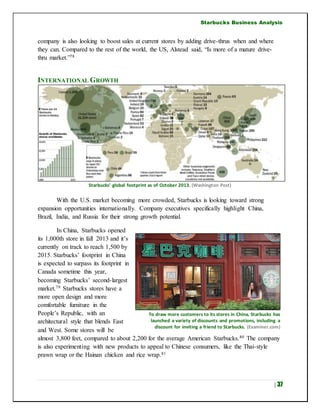
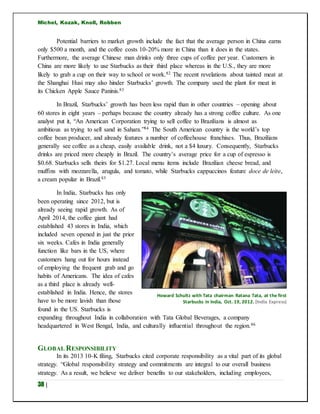
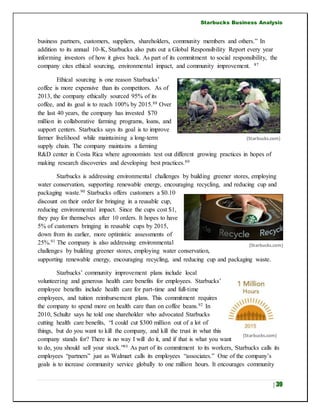
Michel, Kozak, Knoll, Robben
126 |
Accessed October22 2014. http://www.nielsen.com/content/corporate/us/en/press-room/2014/global-consumers-
are-willing-to-put-their-money-where-their-heart-is.html.
165 How, Veronica Maria. Oct. 18, 2014. ‘How Do Consumers Perceive Corporate Social Responsibility?’
MarketingProfs. Accessed October22 2014. http://www.marketingprofs.com/chirp/2014/26265/how-do-consumers-
perceive-corporate-social-responsibility-infographic.
166 Starbucks Coffee Company. 2013. ‘Global Responsibility Report Goals & Progress 2013’.Accessed October22
2014. http://www.starbucks.com/responsibility/global-report.
167 Faber, Scott. March 1, 2014. ‘Bay Journal - Article: Demand For Organic Food Growing Faster Than Domestic
Supply’.Bayjournal.com. Accessed October22 2014.
http://www.bayjournal.com/article/demand_for_organic_food_growing_faster_than_domestic_supply
168 Hopkinson, Jenny.2014. ‘Will Wal-Mart Gobble Up Organic Food Supply?’.Politico. Accessed October22
2014. http://www.politico.com/story/2014/04/walmart-organic-food-105631.html.
169 Lomax, Alyce. July 14, 2014. Supply,Demand, and Organic Industry RiskFool.com. Accessed October22 2014.
http://www.fool.com/investing/general/2014/07/14/supply-demand-and-organic-industry-risk.aspx.
170 Patton, Leslie. Oct. 21, 2014. ‘McDonald’s May Sell More Organic Foods’. Businessweek.Com. Accessed
October 22 2014. http://www.businessweek.com/news/2014-10-21/mcdonald-s-may-sell-more-organic-foods.
171 Starbucks Coffee Company. 2014. ‘An Open Letter From Howard Schultz,CEO Of Starbucks Coffee Company’.
Accessed October17 2014. http://www.starbucks.com/blog/an-open-letter-from-howard-schultz-ceo-of-starbucks-
coffee-company/1268.
172 chrishernandezauthor. 2014. ‘Please, Open Carriers, Stop “Defending My Rights”‘. Accessed October17 2014.
http://chrishernandezauthor.com/2014/07/06/please-open-carriers-stop-defending-my-rights/.
173 2acheck.com. 2014. ‘StarbucksBans Guns.’ Second Amendment Check. Accessed October17 2014.
http://www.2acheck.com/tag/starbucks-bans-guns/.
174 Jing, Wang. NortonRoseFulbright.com. September 2014. ‘Food Safety; China Set To Strengthen Food Safety
Regulations’.Accessed October22 2014.
http://www.nortonrosefulbright.com/au/knowledge/publications/120853/food-safety-china-set-to-strengthen-food-
safety-
175 Schrieber, Andrew. Oct. 9, 2014. ‘Over Half Of Food Inspections In Mainland China Failed Last Quarter’.
FoodNavigator-Asia.com. Accessed October22 2014. http://www.foodnavigator-asia.com/Policy/Over-half-of-
food-inspections-in-mainland-China-failed-last-quarter.
176 CBSnews.com. 2014. ‘McDonald’s, KFC Operations In China Affected By Food Scandal’.Accessed September
23 2014. http://www.cbsnews.com/news/mcdonalds-kfc-operations-in-china-affected-by-food-scandal
177 Barber, Elizabeth. 2014. ‘‘Gutter Oil’ Sparks Food Fears Once Again In Greater China’. TIME.Com. Accessed
September 23 2014. http://time.com/3300093/taiwan-gutter-oil-hong-kong-chang-guann-maxims-cakes-starbucks-7-
eleven/.
178 Yen, Queena. Oct. 22, 2014. ‘Wei Indicted Over Fraud, Food Safety Violations,Forgery’. The China Post.
Accessed October22 2014. http://www.chinapost.com.tw/taiwan/national/national-news/2014/10/22/420038/Wei-
indicted.htm.
Starbucks Business Analysis
| 127
179 Kaufman, Alex. Oct. 7, 2014. ‘Adding An ‘Obamacare Surcharge’To Restaurant Bills Is A Terrible Idea’. The
Huffington Post.Accessed October22 2014. http://www.huffingtonpost.com/2014/10/07/obamacare-
surcharge_n_5945732.html.
180 Staff, Washington.2014. ‘Obamacare Hurting Restaurants in Pennsylvania’.Washington Free Beacon.
Accessed October22 2014. http://freebeacon.com/issues/obamacare-hurting-restaurants-in-pennsylvania/.
181 Berman, Jillian. 2014. ‘StarbucksCEO Howard Schultz: Obamacare Is ‘A Net Positive’’. The Huffington Post.
Accessed October22 2014. http://www.huffingtonpost.com/2014/06/17/howard-schultz-
obamacare_n_5504128.html.
182 The Huffington Post. Oct. 30, 2014. ‘Starbucks CEO: Obamacare Has Gone ‘Off The Rails’’. Accessed October
22 2014. http://www.huffingtonpost.com/2013/10/30/starbucks-obamacare-off-the-rails_n_4179271.html.
183 Ho, Solarina. September 16, 2014. ‘Amid coffee rivalry, McDonald’s Canada to sell java in grocery stores.’
Investing.com. Accessed October20, 2014. http://www.investing.com/news/stock-market-news/amid-coffee-
rivalry,-mcdonald’s-canada-to-sell-java-in-grocery-stores-309664
184 Ho, Solarina. September 16, 2014. ‘Amid coffee rivalry, McDonald’s Canada to sell java in grocery stores.’
Investing.com. Accessed October20, 2014. http://www.investing.com/news/stock-market-news/amid-coffee-
rivalry,-mcdonald’s-canada-to-sell-java-in-grocery-stores-309664
185 Smith, Daniel. August 2014. ‘Uncommon Ground.’ QSR Magazine. Accessed October20, 2014.
http://www.qsrmagazine.com/competition/uncommon-ground
186 Yagalla, Mark. May 2, 2014. ‘StarbucksContinues to Blow Away the Competition. The Motley Fool. Accessed
October 20, 2014. http://www.fool.com/investing/general/2014/05/02/starbucks-continues-to-blow-away-the-
competition.aspx
187 Stephens,Steve. June 2, 2013. ‘Coffee tours help educate bean buyers and consumers.’ Dispatch. Accessed
October 20, 2014. http://www.dispatch.com/content/stories/travel/2013/06/02/1-coffee-tours-help-educate-bean-
buyers-consumers.html
188 Trefis. June 4, 2014. ‘Why StarbucksHas An Edge Over Competitors Despite Rising Coffee Prices.’
NASDAQ.com. Accessed October20, 2014. http://www.nasdaq.com/article/why-starbucks-has-an-edge-over-
competitors-despite-rising-coffee-prices-cm358945
189 Shayon, Sheila. March 8, 2013. ‘Why Starbucks’Customer Loyalty is More Lucrative Than Any Ad Campaign.’
BrandChannel. Accessed October20, 2014. http://www.brandchannel.com/home/post/Starbucks-Customer-Loyalty-
030813.aspx
190 SCS Global Services. 2014. ‘StarbucksC.A.F.E. Practices’ SCS Global Services. Accessed October20, 2014.
http://www.scsglobalservices.com/starbucks-cafe-practices
191 Starbucks. 2014. ‘Coffee.’ Starbucks. Accessed October20, 2014.
http://www.starbucks.com/responsibility/sourcing/coffee
192 Trefis. June 4, 2014. ‘Why StarbucksHas An Edge Over Competitors Despite Rising Coffee Prices.’
NASDAQ.com. Accessed October20, 2014. http://www.nasdaq.com/article/why-starbucks-has-an-edge-over-
competitors-despite-rising-coffee-prices-cm358945
Michel, Kozak, Knoll, Robben
128 |
193 Jourdan, Adam. July 22, 2014. ‘China food scandal spreads, drags in Starbucks,Burger King and McNuggetsin
Japan’ Reuters. Accessed October20, 2014. http://www.reuters.com/article/2014/07/22/us-china-food-
idUSKBN0FR07K20140722
194 ABC7 San Francisco.8 December 2014. ‘McDonalds To Expand ‘Create Your Taste’ Program’. Accessed
December 11 2014. http://abc7news.com/food/mcdonalds-to-expand-create-your-taste-program/428831/.
195 Williams, Martyn. 2014. ‘Credit Card Breach That Hit Jimmy John’s Is Larger Than Originally Thought’.
Pcworld. Accessed December 10 2014. http://www.pcworld.com/article/2688452/credit-card-breach-that-hit-jimmy-
johns-is-larger-than-originally-thought.html.
196 Li, Shan. 2 November 2014. ‘Bye-Bye, Burgers: New Fast-Food Chains Bet On Healthy Eating’.LAtimes.Com.
Accessed December 10 2014. http://www.latimes.com/business/la-fi-healthy-fast-food-20141102-
story.html#page=1.
197 Patton, Leslie. 2014. ‘McDonald’S Bringing Back Mcrib In 75% Of U.S. Restaurants’. Bloomberg. Accessed December 11 2014.
http://www.bloomberg.com/news/2014-11-05/mcdonald-s-bringing-back-mcrib-in-75-of-u-s-restaurants.html.
198 Staff, CNN. 2014. ‘Can StarbucksDelivery Deliver?’. CNN. Accessed December 10 2014.
http://www.cnn.com/2014/10/31/living/starbucks-delivery-pros-cons/.
199 Stynes, Tess.2014. StarbucksDelivery Is Coming; Sales Rise 10%. WSJ.com. Accessed December 10 2014.
http://www.wsj.com/articles/starbucks-sales-growth-disappoints-1414700141.
200 Lutz, Ashley. 21 October 2014. ‘Chipotle’s CEO Describes A Seismic Shift In American Consumers ‘. Business
Insider. Accessed December 10 2014. http://www.businessinsider.com/chipotles-ceo-comments-on-consumers-
2014-10#ixzz3Gvh9yl5S.
201 Nichols, Chris. 22 October 2014. ‘At McDonald’s Despair, At Chipotle Arrogance’.Yahoo Finance. Accessed
December 10 2014. http://finance.yahoo.com/news/at-mcdonald-s-despair--at-chipotle-arrogance-165813219.html.
202 News-Medical.Net. 21 October 2014. ‘Frozen Meals Have Better Diet Quality Than QSR Meals, Shows
Research’. Accessed December 10 2014. http://www.news-medical.net/news/20141021/Frozen-meals-have-better-
diet-quality-than-QSR-meals-shows-research.aspx.
203 Stallard, Brian. 22 October 2014. ‘Prepackaged Frozen Meals Are Healthier Than Fast Food’. Nature World
News,. Accessed December 10 2014. http://www.natureworldnews.com/articles/9787/20141022/prepackaged-
frozen-meals-healthier-fast-food.htm.
204 Reuters. 15 October 2014. ‘U.S. Retail Sales Give Cautionary Sign On Consumer Demand’. Accessed December
10 2014. http://www.reuters.com/article/2014/10/15/us-retail-sales-idUSKCN0I41EA20141015.
205 Kell, John. 2014. ‘Gas Prices Are Falling,So Why Aren’t Consumers Spending?’.Fortune. Accessed December
10 2014. http://fortune.com/2014/10/15/gasoline-retail-sales/.
206 Baertlein, Lisa. 30 September 2014. Wage Hike: Survey’. Accessed December 10 2014.
http://www.reuters.com/article/2014/09/30/us-usa-restaurants-wage-idUSKCN0HP2DC20140930.
207 Drier, Peter. 1 October 2014. ‘The War Over Wages, City By City’. Accessed December 10 2014.
http://www.huffingtonpost.com/peter-dreier/the-war-over-wages-city-b_b_5916154.html?utm_hp_ref=politics.
Starbucks Business Analysis
| 129
208 Nichols, Chris. 29 September 2014. ‘Restaurant Technology Isn’t Replacing Humans Yet’. Yahoo Finance.
Accessed December 10 2014. http://finance.yahoo.com/news/restaurant-technology-isn-t-replacing-humans-yet-
170615778.html.
209 Mediaroom.MarlinFinance.com,. 25 September 2014. ‘Technology Next On The Menu For Some Restaurants’.
Accessed December 10 2014. http://mediaroom.marlinfinance.com/food-service-equipment/technology-next-on-the-
menu-for-some-restaurants/.
210 Weisberg, Lori. 2014. ‘Fine Dining On Upswing, Fast Food Flat’. U-T San Diego. Accessed December 10 2014.
http://www.utsandiego.com/news/2014/sep/26/fine-dining-up-fast-food-restaurants-flat/.
211 Bruce Horovitz, USA Today.28 September 2014. ‘Fine-Dining Grows; Fast-Food Business Slows’.
Tennessean.Com. Accessed December 10 2014. http://www.tennessean.com/story/money/2014/09/29/fine-dining-
grows-fast-food-business-slows/16411271/.
212 Vinton, Kate. 2014. ‘Data Breach Bulletin:Supervalu,Jimmy John’s, Shellshock,American Family Care’.
Forbes. Accessed December 10 2014. http://www.forbes.com/sites/katevinton/2014/09/30/data-breach-bulletin-
supervalu-jimmy-johns-shellshock-american-family-care/.
213 Williams, Martyn. 26 September 2014. ‘Credit Card Breach That Hit Jimmy John’s Is Larger Than Originally
Thought’. Pcworld. Accessed December 10 2014. http://www.pcworld.com/article/2688452/credit-card-breach-that-
hit-jimmy-johns-is-larger-than-originally-thought.html.
214 White, Robert C. 24 September 2014. ‘Alibaba’S Record IPO – How Will It Affect U.S. Technology
Companies?’. Accessed December 11 2014. http://www.thesecuritiesedge.com/2014/09/alibabas-record-ipo-how-
will-it-affect-u-s-technology-companies/.
215 “Johnny Rockets Launches Drive-Thru Spinoff.” tamara. N.p., n.d. Web. 18 Sept. 2014.
http://www.qsrmagazine.com/news/johnny-rockets-launches-drive-thru-spinoff
216 National Restaurant Association.17 September 2014. ‘More Higher-Income Households Good News For
Restaurants’. Accessed December 11 2014. http://www.restaurant.org/News-Research/News/More-higher-income-
households-good-news-for-restau.
217 “South African President Zuma: Fast-Growing Africa Must Rethink Its Global Role.” The World Economic
Forum. N.p., n.d. Web. 17 Sept. 2014. http://www.weforum.org/news/south-african-president-zuma-fast-growing-
africa-must-rethink-its-global-role
218 Kew, Janice. “Pizza Hut Returns to South Africa With Take Out Market Focus.”Bloomberg.com. Bloomberg, 17
Sept. 2014. Web. 17 Sept. 2014. http://www.bloomberg.com/news/2014-09-17/pizza-hut-returns-to-south-africa-
with-focus-on-take-out-market.html
219 Bruce Horovitz. 10 September 2014. ‘Starbucks May Lift Workers’ Visible Tattoo Ban’. Usatoday.Com.
Accessed December 11 2014. http://www.usatoday.com/story/money/business/2014/09/10/starbucks-tattoos-dress-
codes-fast-food-restaurants/15406069/.
220 Jamieson, Dave. “House RepublicansGo To Bat For McDonald’s In Fast-Food Fight.” The Huffington Post.
TheHuffingtonPost.com, 9 Sept. 2014. Web. 18 Sept. 2014. http://www.huffingtonpost.com/2014/09/09/nlrb-
mcdonalds-house-republicans_n_5792034.html
Michel, Kozak, Knoll, Robben
130 |
221 “McDonald’s Can Be Liable For Issues At Franchise-Owned Restaurants,NLRB Rules.” The Huffington Post.
TheHuffingtonPost.com, 29 July 2014. Web.18 Sept. 2014. http://www.huffingtonpost.com/2014/07/29/mcdonalds-
nlrb-joint-employer-ruling_n_5630902.html
222 Morrison, Maureen. 2013. ‘StarbucksJumps On Food-Sourcing Trend In Upcoming Campaign’. Adage.Com.
Accessed November 5 2014. http://adage.com/article/news/starbucks-launches-campaign-focused-bean-
quality/244263/.
223 McArdle, Megan. 2010. ‘StarbucksPuts Quality Over Quantity’. The Atlantic. Accessed November 5 2014.
http://www.theatlantic.com/business/archive/2010/10/starbucks-puts-quality-over-quantity/64511/.
224 Forbes.com,. 2014. ‘Welcome To Forbes’. Accessed November 5 2014.
http://www.forbes.com/fdc/welcome_mjx.shtml.
225 SEC.gov. 2014. ‘SBUX - 9.29.2013 - 10K’. Accessed September 23 2014.
http://www.sec.gov/Archives/edgar/data/829224/000082922413000044/sbux-9292013x10k.htm
226 SEC.gov. 2014.‘SBUX - 9.29.2013 - 10K’. Accessed September 23 2014.
http://www.sec.gov/Archives/edgar/data/829224/000082922413000044/sbux-9292013x10k.htm
227 Epstein-Reeves, James. 2012. ‘Six Reasons Companies Should Embrace CSR’. Forbes. Accessed November 5
2014. http://www.forbes.com/sites/csr/2012/02/21/six-reasons-companies-should-embrace-csr/.
228 Starbucks Coffee Company,. 2014. ‘Responsibly Grown And Fair Trade Coffee’. Accessed November 5 2014.
http://www.starbucks.com/responsibility/sourcing/coffee.
229 StarbucksGlobal Responsibility Report.2013. Accessed November 5 2014.
http://globalassets.starbucks.com/assets/98e5a8e6c7b1435ab67f2368b1c7447a
230 Fortune. 2012. ‘StarbucksRanked No.73’. Accessed November 4 2014.
http://archive.fortune.com/magazines/fortune/best-companies/2012/snapshots/73.html.
231 Cooper, Ted. March 5, 2014. ‘Wall Street Won’t Tell You About Starbucks’Magic Bullet’. The Motley Fool.
Accessed November 4 2014. http://www.fool.com/investing/general/2014/03/05/starbucks-magic-bullet.aspx.
232 TheACSI.org. June 17, 2014. ‘Small Restaurant Chains Improve Customer Satisfaction,Large Chains
Deteriorate American Customer Satisfaction Index’. Accessed November 4 2014. http://www.theacsi.org/news-and-
resources/press-releases/press-2014/press-release-restaurants-2014.
233 Co.Design,. 2014. ‘Can StarbucksMake 23,000 Coffee Shops Feel Unique?’. Accessed November 4, 2014.
http://www.fastcodesign.com/3034441/starbucks-secrets-to-make-every-store-feel-unique.
234 Starbucks Newsroom. 2014. ‘Evolution Fresh At The Forefront Of Customer Wellness Trends | Starbucks
Newsroom’. Accessed November 23 2014. http://news.starbucks.com/news/evolution-fresh-at-the-forefront-of-
customer-wellness-trends.
235 Daniells, Stephen. “US Organic Food Market to Grow 14% from 2013-18.” Food Navigator USA. January 3,
2014. http://www.foodnavigator-usa.com/Markets/US-organic-food-market-to-grow-14-from-2013-18.
236 USDA. “Organic Market Overview.” United States Department of Agriculture. April 7, 2014.
http://www.ers.usda.gov/topics/natural-resources-environment/organic-agriculture/organic-market-overview.aspx.
Starbucks Business Analysis
| 131
237 Mark, Rogowsky. “More Than Half Of Us Have Smartphones, Giving Apple And Google Much To Smile
About.” Forbes. June 6, 2013. http://www.forbes.com/sites/markrogowsky/2013/06/06/more-than-half-of-us-have-
smartphones-giving-apple-and-google-much-to-smile-about/.
238 Elgan, Mike. 2014. ‘Forget Coffee, Starbucks Is A Tech Company’. Computerworld.Accessed November 23
2014. http://www.computerworld.com/article/2490746/retail-it/forget-coffee--starbucks-is-a-tech-company.html.
239 STEEP, Technology Trends, Incorporation of Touch-Screen Kiosks and Online Ordering
240 Kauffman - Test,.2014. ‘Expanding Abroad I: Strategic Issues’.Accessed November 22 2014.
http://www.entrepreneurship.org/resource-center/expanding-abroad-i-strategic-issues.aspx.
241 Yan, Alanna. 2014. ‘New China Food Scandal Hits Mcdonald’s,KFC’. Cnnmoney. Accessed November 22
2014. http://money.cnn.com/2014/07/21/news/companies/kfc-mcdonalds-china/.
242. Marketsandmarkets.com,. 2014. ‘Ready To Drink Tea Market & Ready To Drink Coffee Market Worth $125
Billion By 2017’. Accessed November 22 2014. http://www.marketsandmarkets.com/PressReleases/rtd-coffee-
tea.asp.
243 Interpack.com,. 2014. ‘Tea: Wellness In A Cup’. Accessed November 22 2014.
http://www.interpack.com/cipp/md_interpack/custom/pub/content,oid,12855/lang,2/ticket,g_u_e_s_t/~/Tea_Wellnes
s_in_a_Cup.html.
244 Starbucksocs.com,. 2014. ‘Starbucks Office Coffee’. Accessed November 22 2014. http://starbucksocs.com/.
245 Seven Days,. 2014. ‘Volunteer Tasters Test What’s New At Keurig Green Mountain’. Accessed November 22
2014. http://www.sevendaysvt.com/vermont/volunteer-tasters-test-whats-new-at-keurig-green-
mountain/Content?oid=2444787.
246 Worstall, Tim, Kelly Erb, Tim Worstall, The Muse,Ryan Mac, Ryan Mac, and Samantha Sharf et al. 2014.
'Starbucks On The Forbes World's Most Valuable Brands List'. Forbes. Accessed December 11 2014.
http://www.forbes.com/companies/starbucks/.
247 Strategies, International Growth
248 Starbucks. “Explore Our Menu.” Starbucks. January 1, 2014.
http://www.starbucks.com/menu/catalog/nutrition?drink=all#view_control=nutrition.
249 Porter’s Five Forces, Rivalry, Canadian Competition Intensifies
250 White, Adam. “Rocker Neil Young Calls for Starbucks Boycott over GMOs.” USA Today.November 18, 2014.
http://www.usatoday.com/story/news/nation/2014/11/17/singer-neil-young-takes-vermonts-side-on-gmo-
issue/19205671/.
251 STEEP, Social Trends, Health and Wellness
252 SEC.gov. 2014. ‘SBUX - 9.28.2014 - 10K’. Accessed December 6 2014.
http://www.sec.gov/Archives/edgar/data/829224/000082922414000041/sbux-9282014x10k.htm
253 Ibid
254 Bailay, Rasul. “Coffee Chain Starbucks Expanding Aggressively in India.” Economic Times. April 14, 2014.
http://articles.economictimes.indiatimes.com/2014-04-14/news/49126396_1_costa-coffee-cafe-coffee-day-coffee-
chain.
Michel, Kozak, Knoll, Robben
132 |
255 Burritt, Chris. 2013. ‘StarbucksTo Pay $2.79 Billion To Settle Coffee Dispute’. Bloomberg. Accessed October28
2014. http://www.bloomberg.com/news/2013-11-12/starbucks-to-pay-2-76-billion-to-settle-grocery-dispute.html.
256 Peterson, Kim. 2014. ‘Starbucks’Growth Strategy? Open More Starbucks’.CBS News. Accessed November 12
2014. http://www.cbsnews.com/news/starbucks-growth-strategy-open-more-starbucks/.
257 Bowman, Jeremy. 2014. ‘ StarbucksHas A Plan For World Domination (SBUX) ‘. Fool.Com. Accessed
December 11 2014. http://www.fool.com/investing/general/2014/12/09/starbucks-has-a-plan-for-world-
domination.aspx.
258 Miller, Ben. June 17, 2014. ‘StarbucksFalls In Customer Satisfaction Ratings’. Puget Sound Business Journal.
Accessed November 13 2014. http://www.bizjournals.com/seattle/morning_call/2014/06/starbucks-falls-in-
customer-satisfaction-ratings.html.
259 Team, Trefis. October 31, 2014. ‘Starbucks’Top-Line Growth In FY2014 Driven By Higher Pricing;Accelerated
Expansion In New Beverage Segments’. Forbes. Accessed November 11 2014.
http://www.forbes.com/sites/greatspeculations/2014/10/31/starbucks-top-line-growth-in-fy2014-driven-by-higher-
pricing-accelerated-expansion-in-new-beverage-segments/.
260 Team, Trefis. September 5, 2013. ‘Starbucks Has Big Plans To Diversify Beyond Coffee’. Forbes. Accessed
November 12 2014. http://www.forbes.com/sites/greatspeculations/2013/09/05/starbucks-has-big-plans-to-diversify-
beyond-coffee/.
261 McCormack, Caitlin. 25 November 2014. ‘How Does Starbucks Create A New Beverage?’. Shine From Yahoo
Canada. Accessed December 11 2014. https://ca.shine.yahoo.com/blogs/shine-on/how-does-starbucks-create-a-new-
beverage-181945004.html.
262 Beuscher, James. LancasterOnline. Dec. 29, 2008. ‘Fine Dining Adapts To Changing Economy’.Accessed
September 26 2014. http://lancasteronline.com/business/fine-dining-adapts-to-changing-economy/article_fbd6e45f-
0148-5ac6-bfe0-117a0439b624.html.
263 SFGate. 2014. ‘Brothers Cut Back To Keep Restaurant Open’. Accessed September 26 2014.
http://www.sfgate.com/business/article/Brothers-cut-back-to-keep-restaurant-open-3192709.php.
264 Money.CNN.com. 2014. ‘Credit Crunch Freezes Small Business Hiring, Expansion’.Accessed September 25
2014. http://money.cnn.com/2008/09/24/smallbusiness/small_biz_credit_freeze.smb/.
265 Bandyk, Matthew. 2008. ‘Does The Financial Crisis Mean A Credit Crisis For Small Businesses?’. US News &
World Report. Accessed September 26 2014. http://money.usnews.com/money/business-economy/small-
business/articles/2008/10/03/does-the-financial-crisis-mean-a-credit-crisis-for-small-businesses.
266 Tutor, Laura. 2014. ‘Chain RestaurantsDeal With Economic Crisis In 2009.’ QSR Magazine. Accessed
September 26 2014. http://www2.qsrmagazine.com/articles/features/122/hunker_down-1.phtml.
267 Taulli, Tom. 2008. ‘Raising Capital From Customers’. Businessweek.Com. Accessed September 26 2014.
http://www.businessweek.com/stories/2008-11-18/raising-capital-from-customersbusinessweek-business-news-
stock-market-and-financial-advice.
268 Allen, Peter. 2009. ‘Top French Chefs Turning To Fast Food Because Of Financial Crisis’. Telegraph.co.uk.
Accessed September 26 2014. http://www.telegraph.co.uk/news/worldnews/europe/france/4284514/Top-French-
chefs-turning-to-fast-food-because-of-financial-crisis.html.
Starbucks Business Analysis
| 133
269 Parsons, Russ.2014. ‘High-End Restaurants On A Tightrope Of Economic Uncertainty’. LATimes.com.
Accessed September 26 2014. http://www.latimes.com/local/la-fo-economy8-2008oct08-story.html
270 The Independent.2009. ‘Munch Crunch: Britain’s Restaurant Crisis’. Accessed September 26 2014.
http://www.independent.co.uk/life-style/food-and-drink/features/munch-crunch-britains-restaurant-crisis-
1605279.html.
271 York, Emily. 2008. ‘Credit Crunch Takes Bite Out Of McDonald’s’. AdAge.Com. Accessed September 24 2014.
http://adage.com/article/news/credit-crunch-takes-bite-mcdonald-s/131320/.
272 Singh, Shivani. Oct. 2, 2014. ‘Growth At Casual Dining Chains Hit By Credit Woes’. Reuters. Accessed
September 26 2014. http://www.reuters.com/article/2008/10/02/us-restaurants-casual-idUSTRE49175Z20081002.
273 York, Emily. Oct. 13, 2008. ‘Credit Crisis Knocks Down Domino’s Franchisees’. Adage.Com. Accessed
September 26 2014. http://adage.com/article/news/credit-crisis-knocks-domino-s-franchisees/131671/.
274 Eatmedaily.com. Dec. 31, 2008. ‘Wait Times Down At Corporate Casual Dining Chains’. Accessed September
26 2014. http://www.eatmedaily.com/2008/12/wait-times-down-at-corporate-casual-dining-chains/.
275 Pace, Gina. 2008. ‘NYC RestaurantsSlammed By Financial Crisis’. MSNBC.com. Accessed September 26 2014.
http://www.nbcnews.com/id/27106533/ns/business-local_business/t/nyc-restaurants-slammed-financial-
crisis/#.VCTKENXF-m1.
276 Caplan, Jeremy. Oct. 10, 2008. ‘Restaurants Face Lean Times in the Economic Downturn’. TIME.com. Accessed
September 26 2014. http://content.time.com/time/nation/article/0,8599,1848402,00.html
277 QSRmagazine.com. 2014. ‘Economic Crisis Hits Restaurants’.Accessed September 26 2014.
http://www.qsrmagazine.com/news/economic-crisis-hits-restaurants.
278 Leinwand, Paul; Moeller, Leslie H.; Shriram, K.B. ‘Consumer Spending in the Economic Downturn: The wide
ranging impact on consumer behavior.’ Accessed September 29, 2014. Booz & Co.
http://www.strategyand.pwc.com/media/file/Consumer-Spending-in-the-Economic-Downturn.pdf
279 Ignatius, Adi. July 2010. ‘The HBR Interview: “We Had To Own The Mistakes”‘. Harvard Business Review.
Accessed September 30 2014. http://hbr.org/2010/07/the-hbr-interview-we-had-to-own-the-mistakes/ar/1.
280 ‘Review Of “Onward: How Starbucks Fought For Its Life Without Losing Its Soul” By Howard Schultz’. 2014.
Accessed September 28 2014. http://www.richardprice.io/post/72232496547/review-of-onward-how-starbucks-
fought-for-its-life.
281 NYTimes.com. 2014. ‘Starbucks’S Chief Tries To Recapture Its Heyday’. Accessed September 28 2014.
http://www.nytimes.com/2011/03/13/business/13coffee.html?pagewanted=all.
282 Groth, Aimee. June 19, 2011. ‘19 Amazing Ways CEO Howard Schultz Saved Starbucks ‘. Business Insider.
Accessed September 30 2014. http://www.businessinsider.com/howard-schultz-turned-starbucks-around-2011-
6?op=1.
283 Adamy, Janet, and Nick Wingfield. 2014. ‘Starbucks To Present Recession Strategy’.WSJ. Accessed September
30 2014. http://online.wsj.com/articles/SB123723335325646025
284 Johnson,David. 2008. ‘Beat The Recession: Reward Loyal Customers - Epiphany Marketing’s Strategic
Marketing Blog’.Epiphany Marketing’s Strategic Marketing Blog. Accessed September 30 2014.
http://www.epiphanymarketing.com/blog/2008/11/26/beat-the-recession-reward-loyal-customers/.
Michel, Kozak, Knoll, Robben
134 |
285 The Huffington Post. 2014. ‘Starbucks CEO On Company’s Spiritual Crisis’. Accessed September 28 2014.
http://www.huffingtonpost.com/2013/12/11/howard-schultz_n_4421766.html.
286 Web.a.ebscohost.com.2014. ‘ Starbucks Corporation: Ebscohost ‘. Accessed September 28 2014.
http://web.a.ebscohost.com/ehost/pdfviewer/pdfviewer?sid=84e2034e-21ca-41bd-bfa7-
526a90186676%40sessionmgr4005&vid=2&hid=4214.
287 GoUpstate.com. 2014. ‘Recession Changed Starbucks CEO Howard Schultz’. Accessed September 28 2014.
http://www.goupstate.com/article/20110313/ZNYT01/103133003?p=8&tc=pg.
288 Organicconsumers.org. 2014. ‘Starbucks Purchasing Guidelines Miss The Mark’. Accessed September 28 2014.
http://www.organicconsumers.org/starbucks/purchasing.cfm.
289 Groth, Aimee. 2011. ‘19 Amazing Ways CEO Howard Schultz Saved Starbucks ‘. Business Insider. Accessed
September 28 2014. http://www.businessinsider.com/howard-schultz-turned-starbucks-around-2011-6?op=1.
290 Cho, Janet. March 10, 2013. ‘More Diners Choosing Fast-Casual Eateries Like Old Carolina Barbecue Over
Traditional Sit-Down Restaurants’. Cleveland.com. Accessed September 30 2014.
http://www.cleveland.com/business/index.ssf/2013/03/more_diners_choosing_fast-
casual_eateries_like_old_carolina_barbecue_over_traditional_sit-down_restaurants.html.
291 Bruce Horovitz, USA TODAY. 2014. ‘Yum Opens New Banh Shop Concept’.USAToday.Com. Accessed
September 30 2014. http://www.usatoday.com/story/money/business/2014/09/14/yum-brands-banh-shop-
shophouse-chipotle-fast-casual-restaurants/15513213/.
292 Gutierrez, Carl. November 10, 2008. ‘McDonald’s Recession-Proof Menu’. Forbes. Accessed September 30
2014. http://www.forbes.com/2008/11/10/mcdonalds-restaurants-update-markets-equity-
cx_cg_1110markets32.html.
293 QSRweb.com. 2014. ‘MillennialsWilling To Pay More For Better, More Customizable Food’. Accessed
September 30 2014. http://www.qsrweb.com/news/millennials-willing-to-pay-more-for-better-more-customizable-
food/.
294 Newstatesman.com. May 8, 2012. ‘Nothing Says “Have A Nice Day, Now Get Out!” Like A Paper Cup’.
Accessed September 30 2014. http://www.newstatesman.com/business/business/2012/05/simon-sinek-starbucks-
steve-jobs-lady-gaga.
295 Ignatius, Ibid.

Starbucks Final

  • 2.
    Michel, Kozak, Knoll,Robben 2 | Table of Contents Busines Model Analysis ................................................................................................................. 3 Competitive Profiling.................................................................................................................... 15 Management...................................................................................................................... 22 Products & Services.......................................................................................................... 28 BCG Matrix....................................................................................................................... 31 Marketing.......................................................................................................................... 32 Operations ......................................................................................................................... 34 Strategies........................................................................................................................... 36 Financial............................................................................................................................ 41 Current Events................................................................................................................... 43 Financial Analysis......................................................................................................................... 45 Social Media Analysis & Key Findings........................................................................................ 61 Indicators Analysis........................................................................................................................ 72 STEEP Analysis............................................................................................................................ 73 Porter’s Five Forces ...................................................................................................................... 81 Industry Activities......................................................................................................................... 85 Strategy Models ............................................................................................................................ 90 Business Planning Scorecard ...................................................................................................... 105 Annex 1: Dining Debacle............................................................................................................ 107 Endnotes...................................................................................................................................... 116
  • 3.
    Starbucks Business Analysis |3 Business Model Analysis STEP 1:ARTICULATE THE VALUE PROPOSITION Starbucks’ value proposition is focused on the company’s strong brand image and quality products. Offering high quality products and friendly, reliable customer service creates a strong brand image and customer loyalty. The customer service not only creates the rich coffee culture atmosphere within each location but can be found online as well. Starbucks commitment to social media outlets as a customer service avenue further illustrates its dedication to consumers as well as advancing technology. The company actively maintains Twitter and Facebook accounts which serve as a place where customer issues may be resolved and new products are advertised. On Twitter, Starbucks social media team maintains its personal touch by responding to almost every tweet posted about the company. This is part of the company’s goal to create meaningful interactions and personalization with its customers. Starbucks’ quality products and elite image create a strong brand loyalty, as its products are often perceived as an elite status symbol. This loyalty and elitist image are a result of the coffee culture and atmosphere that are found at Starbucks. Store layouts are inspired by local culture and art and serve as the third place consumers can go between home and work. Starbucks focus on corporate social responsibility also contribute to their elitist image. According to a survey conducted by Lab42, 84% of consumers would pay more for products by companies that participate in forms of corporate social responsibility. Starbucks is currently committed to buy all of its coffee from sources which utilize coffee and farmer equity (C.A.F.E) practices by the year 2015. Last year 95% of its coffee came from these C.A.F.E sources. The quality of Starbucks products are a result of strategic acquisitions which allows for product diversification and reliable sources of coffee and other goods. Through acquisitions, Starbucks maintains superior control of its supply chain as it collects coffee beans from more than 30 countries. The company has acquired ten companies within the last ten years, and continues to seek new opportunities for growth within the organic food industry. In addition to acquiring food and beverage companies, Starbucks partners with technology companies such as Square and Apple in order to enhance its iPhone app and adopt Apple Pay. Starbucks quality is at the forefront of its marketing campaigns. (Starbucks.com)
  • 4.
    Michel, Kozak, Knoll,Robben 4 | STEP 2:SPECIFYTHE TARGET SEGMENT Starbucks’ key customer segment is adults between the ages of 25 and 40. An analysis of the amount of in store purchases, social media and recent product releases suggest that adults are the primary segment for Starbucks. A study done by Demand Media suggests that adults who are involved in a professional career, earn a relatively high income and share an interest in social welfare account for approximately 49% of in store purchases. Expanding into alcohol sales and reserve coffee roasteries illustrates Starbucks targeting efforts towards the adult segment. Starbucks hotel partners Hyatt, Radisson, Hilton, Sheraton and Westin also indicate Starbucks adult, higher income target segment. Within the adult segment, woman consumers demonstrate a higher priority for Starbucks. Various items on the menu such as the Oprah Winfrey Chai Tea and acquisitions such as Tazo and Teavana illustrate Starbucks large women segment. Young adults represent an increasing target market for Starbucks. Starbucks’ strong online presence is a key aspect of its marketing because its target market is young adults, who are constantly on the Web. This segment is primarily young adults aged 18-24 who are college students, technologically focused and share an interest in social networking. According to social media analysis, most consumers who actively follow Starbucks on social media outlets are young, college educated women. The Demand Media study shows that approximately 40% of Starbucks in store purchases come from this segment. Teens 13-17 are the next target segment as they are more likely to be involved in social media and technology than older generations. Starbucks’ Internet audience is primarily women. (Alexa.com) Starbucks in store purchases by sex and age. (DemandMedia.com, Stata)
  • 5.
    Starbucks Business Analysis |5 STEP 3:DETERMINE COMPETITORS The US coffee and snack shop industry is comprised of about 55,000 locations.1 Of these, Starbucks accounts for 12,000.2 Starbucks has five main types of competitors: coffeehouses, snack shops, fast food, fast casual, and retail competitors. Starbucks competes with these companies not just for customers, but for retail locations, and skilled employees. Snack shop competitors include Smoothie King, Cinnabon, and Jamba Juice. Starbucks dominates the competition against coffeehouses, which are its most direct competitors. Competition in this field includes Dunkin’ Donuts, Tim Hortons, and McDonald’s McCafe brand. Fast casual competitors include Subway, and Panera Bread. Fast food and presents the fiercest competition, with major competitors like McDonald’s, Taco Bell, and Burger King. Starbucks Channel Development segment offers coffee and tea products through retailers. Through its partnerships with PepsiCo and Keurig, Starbucks also supplies beverages and ground coffees to retailers through various brands, including Starbucks Double Shot, Refreshers, and Starbucks K-Cups and Via. Competitors in this segment can include the Coca-Cola Company, Monster Energy Corporation and Dr. Pepper Snapple.
  • 6.
    Michel, Kozak, Knoll,Robben 6 | STEP 4:EVALUATE THE VALUE CHAIN AND COST MODEL Starbucks has developed cost-efficient value chain activities which have reduced the average store opening costs and reduce day to day costs. The company created economies of scale by using centralized buying and developing standard contracts and fixed fees, as well as using highly regarded contractors who displayed good cost-control. Additionally, the company is nearly vertically integrated. The company sources their beans from a number of areas due to their contracts and vertical integration. Therefore, their logistics are impacted less by bad weather, price, and volatile economic and political conditions in coffee growing countries. Furthermore, the company has created value for their customers by creating a comfortable inviting ambiance in their locations as well as adding a personal touch to each geographic location. The company has strived to make every location into its own entity as far as design and atmosphere. They have successfully integrated cultural norms and perceptions accompanied by the typical Starbucks atmosphere to try and create the “my Starbucks” appeal. This is also known by the company as the third place. The third place idea consists of the creation of a place for individuals to meet between home and work where customers can come and relax. They want their customers to use their stores to meet friends, read a book, surf the internet, or listen to the company’s in-house music. Additionally, Starbucks has created a powerful and well-known brand name that is easily transferable to other business; therefore, making it easy for the company to pursue joint ventures to diversify their portfolio.
  • 7.
    Starbucks Business Analysis |7 STEP 5:DETERMINE THE REVENUE MODEL FOR THEFIRM Starbucks operates with relatively high profit margins. The company’s profit margin has remained between 10.5% and 11% for a three year period. In comparison with the two competitors analyzed, the Starbucks revenue model is far superior. Panera Bread operates with a 3 year average of 7.9% and Einstein’s Bagels is roughly earning a profit of 3.1%. However, in 2013 Starbucks faced a staggering litigation, which resulted in a $2.78 billion dollar fee. This short term debt has altered the averages of Starbucks financial ratios for the 2013 reporting period. But, the company has bounced back from this short term set back. The company’s performance in 2014 has not reflected any disturbance in consumer confidence due to the litigation fee in 2013. Moreover, the company’s stock did not fluctuate due to the fee; instead it has increased since 2013. Additionally, the company proved to have a strong revenue model when faced with this litigation charge. The company paid off the 2.78 billion through their cash flow activities. They did not sell off any assets to cover this debt, in fact the company’s assets increased in the 2013 reporting period. The company paid their debt through the means of cash earned from their everyday store operations and through moneys lent to the company through their short term lenders and investors. The 2014 reporting period is still ongoing, the financials associated with the company’s yearly performance cannot be analyzed at this time; however, analyst in the industry are expecting strong gains from the company.
  • 8.
    Michel, Kozak, Knoll,Robben 8 | STEP 6:DETERMINE THE STRATEGYFOR STARBUCKS Starbucks became the country’s #1 coffeehouse through a differentiation strategy emphasizing quality products at premium prices. The restaurant industry and retail soft drink industries are both highly competitive. Starbucks has achieved great success in these markets through its commitments to corporate social responsibility, product quality, local culture and store atmosphere, global expansion, and providing strong employee benefits, which, in turn, pays off in customer service. Its success has allowed it to grow exponentially since 1982. Critical Success Factors Includes CSF Area Enhancing product quality by using finest ingredients available Using high quality raw materials, employee training, researching new products R&D, Purchasing, Operations Continue expanding in global growth markets Employee training, long-term growth strategies, smooth supply chain operations Strategy, Finance, Executive Management Enhance customer service by promoting employee training/benefits Customer satisfaction, employee satisfaction, employee benefits, training Human Resources,Operations Incorporate local culture into store atmospheres Discovering Local Culture, Keeping up with regional consumer trends while maintaining Starbucks Image, Creating “my Starbucks” Research and Development Marketing Strategy Financing Operations/logistics Continued corporate social responsibility programs Green initiatives, public image, advertising campaigns, employee engagement Marketing, Operations, C-Level Executives Starbucks faces a variety of challenges over the next coming years, including:  transparency in nutrition facts  Millennials’ preferences shaping the restaurant industry  touch-screen kiosks and online ordering  stronger demands for a higher minimum wage  opposition to GMOs  greater competition in Canada  new products and differentiation
  • 9.
    Starbucks Business Analysis |9 Starbucks is already well-positioned to handle these threats. Its continued growth strategy includes opening more stores, expanding its current day parts, and opening more drive-thrus. Starbucks will use its strong brand name combined with foreign partnerships and acquisitions to fuel foreign expansion. It can deal with other coming controversies and challenges by emphasizing healthier products, including introducing GMO-free products to its Starbucks stores, and expanding its Teavana, and Evolution Fresh brands to satisfy customers looking for healthy options at grocery retailers. Expanding these product lines, along with the Fizzio and Keurig Cold product lines, would also reduce Starbucks’ reliance on the saturated coffee market.
  • 10.
    Michel, Kozak, Knoll,Robben 10 | STEP 7:BUSINESS MODEL ANALYSIS GRID The business model analysis grid compares Starbucks to two other restaurant companies in the fast casual industry; Panera and Einstein Bagels. Each company is ranked on a scale of 1- 5, where 5 is the best and 1 is the worst. This analysis looks at five factors that are important to a company’s success; value proposition, target markets, value chain, revenue model, and strategy. The ranking that each company receives can then be used to determine areas of strength or weakness and what strategies may be appropriate to pursue. Business Model Analysis Starbucks Panera Einstein Bagels Value Proposition 5 4.5 4 Target Markets 4 4.5 2.5 Value Chain 4 5 3.5 Revenue Model 4.5 5 2.5 Strategy 4.5 4 4 Starbucks and Panera ranked highly in all five factors, while Einstein ranked lower. This shows that Panera is more likely to be competitive with Starbucks than Einstein. Starbucks has the highest ranking in both Value Proposition and Strategy. Starbucks high value proposition comes from the company’s high quality products and elite image. This high value proposition allows Starbucks to charge premium prices for their products, giving the company and edge over their competition. Starbucks’ strong strategy capability means that Starbucks is more capable of creating and maintaining successful strategies than their competitors. This gives Starbucks a long term advantage, especially in the growth of new products and in expansion into foreign markets. A strong strategy also means that Starbucks is more capable than its competitors in dealing with evolving challenges such as GMO controversies, increased competition, and the changing restaurant preferences of the Millennial demographic. Starbucks’ weakest factors are Target Markets and Value Chain. Starbucks key customer segment is adults ages 25 to 40. One of Starbucks’ biggest challenges in this factor is appealing to men. This is especially true in Starbucks’ significant online presence, where women are more likely than men to discuss Starbucks. Starbucks can improve this factor by finding ways to appeal more to men. Finally, Starbucks’ Value Chain is strong but not as strong as the value chain of their competitor, Panera. In particular, Starbucks’ value chain is vulnerable to variable milk and sugar prices. From 2013 to 2014 milk prices rose 33% and sugar prices rose 13%.3 This puts a major strain on Starbucks’ value chain. To deal with this weakness, Starbucks can attempt to institute price controls similar to those they use in their coffee purchasing. Starbucks can also benchmark against their competitors, such as Panera, to help find ways to drive down costs and improve their value chain.
  • 11.
  • 12.
    Michel, Kozak, Knoll,Robben 12 | Porter’s Four Corners COMPETITOR RESPONSE Continue opening new stores in Asian markets Seek acquisitions to expand product diversity Create a niche market for luxury coffee Utilize partnerships to advance technology integrations FUTURE GOALS Expand globally, especially in China, Brazil, and India Create new store types Integrate cutting-edge technology Improve products and product diverisity CURRENT STRATEGY Push for interational storefronts Continue partnering with tech companies Focus on strong customer service and company image Focus on new products ASSUMPTIONS Globalization effort will pay off Apple will remain a strong partner Economy will remain strong enough to justify high prices of products Price of coffee beans will reamin stable CAPABILITIES 21,000 stores in 65 countries Financial situation allows for expansions and acquisitions Strength: Strong brand name Strength: Loyal customer base Weakness: Expensive products Weakness: Poor reception of Starbucks coffee culture in foreign countries
  • 13.
    Starbucks Business Analysis |13 COMPETITOR RESPONSE PROFILE Starbucks is likely to increase financial gains over the next five years through continuing growth in Asia, integrating advanced technology and creating a niche market for luxury coffee. As Starbucks continues to expand throughout Asia, corporate partnerships and acquisitions will allow them to diversify their product offerings. Starbucks’ partnership with Tata Global Beverages in India is one example of this. The addition of the reserve coffee roaster stories to the market is also likely to create a niche for gourmet coffee which will increase profits and drive demand for luxury coffee. In addition to creating a luxurious appeal for coffee, the use of partnerships to integrate technology will also benefit Starbucks in the long run. FUTURE GOALS Starbucks continues to focus heavily on international expansion. Growth remains greatest in Asia. But EMEA (European, Middle Eastern, and African) countries are key components in the global expansion strategy as Starbucks seeks to expand their global footprint. They plan on opening more reserve roasteries and taste rooms across the U.S. to maintain their competitive advantage and position as industry leader. Expanding their involvement with social media outlets and providing mobile payment options while seeking new technologies to advance the customers experience will also further Starbucks’ market share. CURRENT STRATEGY Starbucks is focused on globalizing, with strong results in Asia leading their globalization effort. Due to slower growth in North America, Starbucks will continue pursuing this globalization effort to continue hitting its growth targets. To accommodate these new countries’ needs and stay competitive domestically, Starbucks is always working to improve their product quality and diversity. They are also working to partner with technology companies, such as Apple, to integrate Starbucks’ products with emerging technological trends, such as Apple Pay. Finally, Starbucks is always trying to maintain its reputation of good customer service and its strong company image. CAPABILITIES Starbucks currently has over 21,000 locations across 65 countries. Starbucks generates roughly $15 billion in sales per year, which gives them the opportunity to expand while seeking acquisitions to diversify their products. Starbucks currently has over 1,900 location in EMEA, with another 150 planned for 2014.(Fool.com)
  • 14.
    Michel, Kozak, Knoll,Robben 14 | Starbucks’ strong brand name is at the core of their strengths. The company’s strong reputation comes through a strong focus on customer service, a high-quality product line, and a rich coffee culture atmosphere. Starbucks’ focus on customer service and atmosphere creates a loyal customer base, which is the foundation of Starbucks’ success. While loyal customers are willing to purchase Starbucks’ expensive products, poor economic conditions and shifting preferences may hamper the demand for Starbucks products. While Starbucks plans to gain financial value by expanding into foreign countries, the coffee culture the company provides may not be well received in various global cultures. Starbucks may incur additional costs by adapting their business model to suit each country’s culture and preferences. ASSUMPTIONS Starbucks assumes their current globalization strategy is financially sound one. This assumption is critical to their future success. Starbucks pays close attention to cultural values and analyze current economic and social trends to determine the feasibility of expanding into a foreign market. Starbucks assumes Apple will remain a strong partner, which is currently an uncertainty due to the poor reception of iPhone 6. A strong, stable economy provides Starbucks the luxury of offering high-priced coffee products, which could be threatened by declining economic conditions. In addition to relying on current economic standards, a change in the price of coffee beans could adversely affect Starbucks’ business model and product pricing. Starbucks’ high-quality product line is the foundation of its strong reputation. (ContactMagazine.com)
  • 15.
    Starbucks Business Analysis |15 The History of Starbucks Executive Summary: Starbucks Corporation was founded in 1972 with a far different vision than it has today. Starbucks’ history demonstrates how powerful Howard Schultz’s impact was on the company’s success. He altered Starbucks’ course, changing it from a slow-growing company that sold coffee grounds to an exponentially-growing company that brews coffee drinks. Starbucks today is based on the coffeehouse culture he witnessed during a vacation in Italy. It currently features about 22,000 stores worldwide, and an extensive line of retail beverages, and opens another two to three daily. It has expanded its market share through partnerships, joint ventures and strategic acquisitions, such as Teavana. From left to right, Starbucks founders Jerry Baldwin, Gordon Bowker, and Zev Seigel at the original Pike Place location in 1971. (ThinkAnalytic.com) ORIGINS Starbucks started in 1971 in Pike Place, Seattle, Washington. Starbucks was founded by a pair of teachers and a writer who were enthusiastic about selling coffee grinds, teabags, and various spices, but didn’t believe in building a restaurant. Initially the company sold premium coffee beans to customers who would, in turn, brew them at home. Its founders were coffee enthusiast Jerry Baldwin, an English teacher, Zev Seigel, a history teacher, and Gordon Bowker, a writer. Starbucks’ name was based on the idea that words beginning in “st” are powerful. Starbucks was named after Melville’s first mate in Moby Dick, Starbuck, a character who loved coffee.4 The three opened the first Starbucks with a $9,000 investment ($51,000 adjusted for inflation), and over the next 10 years, the store, the store opened an additional four stores.5
  • 16.
    Michel, Kozak, Knoll,Robben 16 | Before joining Starbucks, Schultz worked for a Swedish coffee distributor that sold coffee beans to Starbucks. Howard Schultz visited Starbucks because he was curious that they were buying so many drip coffee makers. Schultz went to Pike Place in Seattle and was immediately impressed with the ambiance, aroma, and the enthusiasm of the company’s employees.6 Schultz met Bowker and Baldwin in 1981. He impressed them with his energy, his marketing skill and his business sense. Baldwin and Bowker at the time lacked the deep business background that Schultz had and saw his potential value to Starbucks.7 In 1982, Howard Schultz joined Starbucks as its head of marketing and retail. The founders of Starbucks initially thought hiring him was risky, but Schultz was passionate and persistent. Following a trip to Italy in 1983, Schultz was full of new ideas for the company to create an American version of the Italian espresso bar culture. He believed the company should sell brewed drinks in addition to coffee beans. . He wanted Starbucks to be an experience, one that captures the company’s ambiance, comfortable atmosphere, friendly employees, and then brew quality coffee. But the owners of Starbucks did not want the company to leave the retail business behind and take the risk of entering a new market. In 1985, Schultz left the company to found Il Giornale, based on his vision of importing Italy’s coffeehouse culture.8 Coincidentally, Bower and Baldwin decided to sell the business in 1986. Shultz acquired Starbucks in 1987 with the help of Seattle investors.9 Under his leadership, Starbucks began pursuing the brewed coffee market using a differentiation strategy based on high quality products and premium pricing. This new coffee shop experience created new demand. Starbucks drew customers in because the quality and ambiance were unlike their competitors. EXPANSION After successfully expanding Starbucks throughout Seattle, Schultz boldly opened a store in Vancouver, Canada, to test the market and determine how well his business model worked internationally and outside the West Coast.10 Starbucks expanded to Chicago and Vancouver in 1987,11 Portland, and Los Angeles. The move to Chicago and Los Angeles were both strategic maneuvers. Chicago was a testing ground for eastward expansion and Los Angeles has been known as a trendsetting city. The Los Angeles Times named Starbucks the best coffee in America before the store opened. Continued expansion of the company became increasingly difficult. To control the quality and character of its products, Starbucks chose to avoid franchising and maintain only company-owned stores. Expanding into new markets requires an increase in venture capital, so The original Starbucks logo from 1971. When founded, Starbucks was a store for coffee grinds, teabags, and spices—not a restaurant where baristas brewed coffee. (TripAdvisor.com)
  • 17.
    Starbucks Business Analysis |17 Schultz had to maintain investor support despite continued losses due to expansion. Luckily, Starbucks was good at identifying optimal locations for their new storefronts.12 The company Starbucks experienced exponential growth after Schultz took charge of the company. (Statista, Starbucks.com) Always had prime locations in densely populated areas, positioning itself well in the market to deter the threat of potential competition. This ability to achieve prime locations directly impacted the company’s ability to gain a competitive advantage in the coffee service industry. International expansion was (and still is) Starbucks’ major strategic goal. Starbucks, in many cases, licensed out to local retailers to open its international stores. The company’s international expansion embodied the culture as well as buyer tastes and preferences while adapting its ambiance and décor to fit new market segments. Starbucks’ value chain approach through the years embodied nearly backward vertical integration.13 While Starbucks’ competition uses wholesalers to attain its coffee beans, Starbucks made a series of strategic acquisitions to allow the company to bring in coffee beans from more than 30 countries. Furthermore, with the growth of the company’s portfolio, Starbucks has achieved considerable buyer power through relationships with suppliers, growers, and exporters. The company has developed many lasting arrangements that keep costs down and safeguard the company from sudden price jumps from implications. However, coffee suppliers still retain some power over the company because Starbucks has quality assurance to uphold. The company only pursues exporters and growers who have met its quality standards. Starbucks (SBUX) had its IPO in June 1992.$10,000 invested then would be worth about $1.5 million in 2014. (ThinkAnalytic.com)
  • 18.
    Michel, Kozak, Knoll,Robben 18 | Under Schultz’s management, Starbucks attempted many strategies to improve the image of the company and develop brand recognition and loyalty. It approached many avenues to promote its product. For example, the company increased marketing through new market segments while innovating and diversifying its product line. The company partnered with airlines such as United and Horizon to serve its coffee in flight. It also approached hotels by entering agreements with Hyatt, Radisson, Hilton, Sheraton, and Westin to offer its coffee in hotel rooms.14 Additionally, the company worked with food distributors such as Sysco Corporation, Kraft Foods Inc., and U.S. Food service to have its coffee distributed in restaurants, offices, grocery stores and institutions like hospitals and universities. GROWTH AND DIVERSIFICATION The Company has also pursed a number of joint ventures to achieve further portfolio diversification. The primary objective was to make its product more accessible to current customers while also reaching new ones. The company entered a joint venture with PepsiCo in 1994,15 and created a product line of ready-to-drink coffees which PepsiCo distributed through its channels. In 1999, Starbucks acquired Tazo tea, which PepsiCo also incorporated into its distribution channel. Starbucks also partnered with Dreyer’s Grand Ice Cream in 1995 and began supplying extract for coffee-flavored ice cream. Their coffee ice cream became the number one selling super premium coffee ice cream in that segment. Furthermore, the company entered into a partnership with Unilever, whose brands include Ben and Jerry’s, Breyers, and Good Humor. Starbucks was successful in pursing new markets because it pursued ventures in closely related markets and avoided unreasonable costs. In 2005, Starbucks acquired Ethos Water, further expanding the company’s product line. This acquisition was important due to the social responsibility attached to this acquisition. Ethos Water was known for donating $0.05 of every bottle the company sold to a charitable organization which funded development and clean drinking water for countries in Africa and Asia. Starbucks has maintained a good stance on the changing technology and product innovations by implementing a reloadable card in 2001. This card ultimately became a mobile app now comparable to Apple iPay. Furthermore, the company has kept up with the trends of the decade; it continued to focus on social responsibility by launching the industry’s first paper beverage cups containing recycled fiber in 2006. The following year, the company eliminated all artificial trans-fat from its drinks and made milk the new standard for espresso beverages.16 In 2009, emerging from financial losses, the company employed a wide-scale marketing strategy, putting up posters in six major cities, and a national ad campaign that used TV ads, a Webisode series, and taste tests across the country to convince customers were unable to distinguish between Via and Starbucks regular coffee to promote the instant coffee Via. Starbucks produced Via to combat McDonald’s and the company’s McCafe, in response to
  • 19.
    Starbucks Business Analysis |19 McDonald’s heavy advertisements of its McCafe. Starbucks spent over $25 million of its $94 million marketing budget on promoting Via.17 Likewise, the company further innovated in October 2012 when it came out with its Verismo System. The Verismo was created to compete with further home coffee makers such as Keurig, Tassimo, etc. This machine allowed users to make a single-serve Starbucks latte, espresso, and filter coffee at home. This was the only home machine with this capability. The company promoted Verismo as the perfect gift for the holidays.18 The campaign included primetime TV spots, presence on Univision and Telemundo, print ads, social media and digital marketing. Moreover, in 2011, Starbucks launched K-Cup portion packs and later in 2012 announced the expansion of Green Mountain partnership for the purpose of Keurig implementation.19 Starbucks acquired Teavana in 2012 to transform the tea category. Starbucks has often been the innovator in popular business trends. It has been the forerunner in the coffee industry to tap these new markets. Similar to previous maneuvers, Starbucks entered an agreement with Danone in 2013 to expand their portfolio.20 In 2014, it announced collaboration with Oprah Winfrey to co-create Teavana Oprah Chia tea. The company then partnered with Square in 2014, enhancing its iPhone app and reloadable card.21 More recently, the company adopted Apples iPay and developed three different storefront models to use in different markets. Starbucks is evolving annually, allowing it to remain current with economic trends. The company has undergone a serious transformation since inception in 1971 while remaining true to its core values.
  • 20.
    Michel, Kozak, Knoll,Robben 20 | Strategic Acquisitions 1995-1999 •1998: Acquired Seattle Coffee Company in the U.K. •1999: Acquired Hear music and Tazo LLC 2000-2004 •2003: Acquired Seattle Coffee Company 2005-2009 •2005: Acquired Ethos Water Company •2006: Acquired Coffee Partners Hawaii & Cafe del Caribe •2008: Company’s subsidiary,Starbucks CoffeeCanada,Inc.entered agreement to acquireall assets fromCoffee Vision,Inc.and Coffee Vision Atlantic,Inc. •2009: Company acquired full ownership of Starbucks Coffee FranceSAS 2010-2014 •2010: Acquired Cafes Sereia do Brasil Participacoes S.A •2011: Company acquired the remaining30% ownership of its business in southern China •2011: Acquired Evolution Fresh, Inc. •2012: Acquired Bay Bread, LLC and its La Boulangebakery brand •2012: Acquired Teavana HoldingInc.
  • 21.
    Starbucks Business Analysis |21 Timeline This time line shows major events in Starbucks’ history with the Company’s stock price in the background.
  • 22.
    Michel, Kozak, Knoll,Robben 22 | Management Executive Summary: Starbucks President, Chairman, and CEO Howard Schultz is the company’s center of gravity. He bought Starbucks from its original owners in 1987, and developed its major strategic vision of replicating the Italian coffeehouse social experience. During a lecture at UCLA in 2008, Schultz explained his vision for Starbucks went beyond the pursuit of profit – it included a strong commitment to social responsibility. As of March 2013, he held about 18.58 million shares and owned another 295,000 through a family-owned limited liability corporation. His current stake in the company is about 2.4%.22 Starbucks’ management team is highly experienced and tends to be middle-aged, with most executives ranging in age from 45 to 60. Starbucks’s executive management includes many people who have been at the company for decades, as well as a variety of people who transferred to Starbucks from other companies in the last five to 10 years. While this type of executive management often comes with new ideas and innovations, it can also lack a top-to-bottom understanding of the company that comes from years of experience. Starbucks restructured its management team in May 2014 to put more emphasis on its emerging markets, such as China, Channel Development segment, which consists of retail drinks like Refreshers. This restructuring included promoting Troy Alstead to COO, reducing Schultz’s day-to-day management of the company.23 Howard Schultz Chairman, President, and CEO Age: 61 Career: 1975 - Sales & Marketing, Xerox Corp. 1979 - VP & General Manager, Hammerplast USA 1982 - Head of Marketing & Retail, Starbucks 1986 - Founder & CEO, Il Giornale 1987 - President & CEO, Starbucks 2000 - Chairman, Starbucks 2008 - Chairman, President & CEO, Starbucks Education: BA in Communications, Northern Michigan University, 197524 Salary: Salary - $1,500,000 Stock awards - $5,999,987 Option awards - $7,276,587 Other compensation - $2,465,933 Total Compensation - $17,242,50725 Schultz joined Starbucks when it had only four stores operating throughout the Seattle area in 1982. A year later, he traveled to Italy to learn about their coffee culture so he could bring the Italian coffeehouse experience to Seattle. He realized coffeehouses in Italy were a social experience, whereas Starbucks at the time was primarily a retail shop. Trying to replicate this
  • 23.
    Starbucks Business Analysis |23 experience, he talked to the then-owners of Starbucks, Gerald Baldwin and Gordon Bowker, about shifting their business model. They said no. Taking matters into his own hands, Schultz left the coffee company and founded his own, Il Giornale (“The Daily”), seeking to replicate the Italian coffee social experience. A year later, in 1987, the owners of Starbucks put the company up for sale. He bought it with the help of local Seattle investors, merged it with Il Giornale, and reshaped the company in the image of Italian coffeehouses. He continued managing it for the next 13 years, aiding its exponential growth into the business it is today. In 2000, he resigned as CEO and assumed the role of chairman. The company continued its aggressive expansion throughout the 2000s, to the point where Starbucks said it had lost sight of its original vision. In January 2008, with sales in decline and the company beginning to feel the effects of the economic downturn, he returned to the role of president and CEO. Schultz has provided the strategic vision of Starbucks, helping it grow into the global corporation it is today, running over 21,000 stores in 65 countries.26 Clifford Burrows Group President, Americas Age: 55 Career: 1982 - Habitat Design Limited 2001 - Managing Director, UK, Starbucks APR 06 - MAR 08 - President, Starbucks Europe, Middle East, and Africa MAR 08 - OCT 11 - President, Starbucks Coffee U.S. Operations OCT 11 - MAY 13 - President, Starbucks Coffee Americas Operations MAY 13 - Group President, Starbucks27 Education: Left college after one term28 Salary: Salary - $733,838 Stock Awards - $874,976 Option Awards - $751,631 Other Compensation - $1,186,089 Total Compensation - $3,546,53429 Burrows is on the short list of potential replacements for Schultz. He played a large role in overseeing Starbucks’ turnaround in 2008.30 He had an international upbringing, growing up in Zambia and going to school in Wales.31 Since joining the company in 2001, Burrows has played a critical role in expanding Starbucks internationally. He is currently responsible for Starbucks operations throughout the Americas, and is overseeing the incorporation of Teavana’s retail products into Starbucks stores.
  • 24.
    Michel, Kozak, Knoll,Robben 24 | Troy Alstead Chief Operating Officer Age: 51 Career: 1992 - Joined Starbucks SEP 04 - AUG 07 - Senior Vice President, Corporate Finance AUG 07 - APR 08 - Senior Vice President, Global Finance and Business Operations APR - OCT 08 - Chief Operating Officer, Starbucks Greater China NOV 08 - SEP 2013 - CFO & Chief Administrative Officer, Starbucks32 Education: BBA in Finance, University of Washington, 1985 Salary: Salary: $741,058 Total Compensation: $3,022,29833 Alstead joined Starbucks in 1992, when the company stores numbered a little over 100. He oversees daily operations and manages Starbucks’ investments. This requires him to collaborate with the company’s finance, supply chain, and technology leaders around the globe. He has played an important role in Starbucks Coffee International, developing the brand in Europe, the Middle East, Africa, and China. 34 Annie Young- Scrivner President, Teavana Executive VP, Starbucks Age: 4535 Career: OCT 06 - Region President, China Foods, PepsiCo DEC 08 - CMO & Head of Sales, Quaker Foods & Snacks, PepsiCo SEP 09 - Global Chief Marketing Office & President of Tazo Tea, Starbucks SEP 12 - APR 2014, President, Starbucks Canada APR 14 - President, Teavana & EVP of Global Tea, Starbucks36 Education: BBA, University of Washington, 1991 MBA, University of Minnesota, 200337 University of Virginia Yale University International IMD Business School, Switzerland Salary: Salary: $514,885 Total Compensation: $2,515,39538 Young-Scrivner has a wealth of international experience from working in 26 countries, going to business school in Europe, and growing up in Seattle, a metropolitan melting pot, where she
  • 25.
    Starbucks Business Analysis |25 currently lives today. One of her main areas of focus is developing markets, she explained in an interview, “where our footprint is small, where we’re beginning to create the third-place experience for our customers.”39 Adam Brotman Chief Digital Officer Age: 45 Career: AUG 95 - FEB 97 - Attorney; Heller, Ehrman, White, & McAuliffe OCT 96 - FEB 06 - CEO & Co-Founder, PlayNetwork JUL 06 - SEP 08 - SVP, Corbis Corp. OCT 08 - JAN 09 - CEO, Barefoot Yoga Company APR 09 - Chief Digital Officer, Starbucks40 Education: BA, Classical Civilizations, Business Administration, University of California Los Angeles, 1991 JD, University of Washington, 1987 As Chief Digital Officer, Brotman is in charge of developing Wi-Fi, e-commerce, apps, mobile payments, Web site, and Starbucks Digital Network. He brings in a variety of experience from the fields of law, business management, and technology. Born and raised in Seattle, he continues to call it home.41 In an interview with the Puget Sound Business Journal, he stated the digital unit at Starbucks is “relatively small. Our charter at digital ventures is to be entrepreneurial and be innovative and be nimble.” He plans to continue developing the Starbucks Digital Network, which offers free, unlimited Wi-Fi to customers in stores. As the network expands, it could potentially begin offering discounts and coupons and selling online games.42 Arthur Rubinfield Chief Creative Officer President of Global Innovation Age: 60 Career: FEB 08 - President of Global Development, Starbucks 2002 - Founder & CEO, AirVision JAN - JUN 02 - Executive VP MAY 92 - DEC 99 - Senior VP of Real Estate, Design & Construction Salary: Salary: $484,058 Total Compensation: $2,450,90043 Education: BA, Environmental Design, University of Colorado Boulder MS, Architecture & Urban Design, University of Colorado Denver Executive Program in Finance and Accounting, University of Washington44
  • 26.
    Michel, Kozak, Knoll,Robben 26 | A registered and accredited architect, Rubinfield leads Starbucks’ store design strategy. His design strategies include reducing environmental impacts through green initiatives, and incorporating the local culture of each Starbucks location’s surrounding city and neighborhood. He helped define the ambiance of Starbucks as the chain grew from just over 100 stores to 4,000 worldwide from 1992 to 2002. After leaving in 2002 to found the advisory firm AirVision, he returned to Starbucks in 2008 at Schultz’s request.45 John Culver Group President, China & Asia Pacific Career: AUG 02 - Joins Starbucks as VP & GM of Foodservice 2007 - FEB 09 - Senior VP & President, Starbucks Coffee Asia Pacific FEB 09 - SEP 09 - President of Global Consumer Products, Foodservice & Seattle’s Best Coffee, Starbucks SEP 09 - OCT 11 - President of Global Consumer Products (CPG) and Foodservice, Starbucks OCT 11 - MAY 13 - President of Starbucks Coffee China & Asia Pacific, Starbucks Salary: Salary: $582,054 Total Compensation: $3,805,04546 Education: BBA - Hotel & Restaurant Administration Concentration, Florida State University Culver is overseeing Starbucks’ growth in China and the Asia Pacific region which includes, among others, Australia, India, Indonesia, Japan, and South Korea. He brings over a decade of experience in retail and packaged goods. He also currently serves on the Florida State University Foundation’s Board of Trustees.47 Matthew Ryan Global Chief Strategy Officer Career: 1988 - Vice President & Account Director, Armando Testa 1991 - Senior VP of Strategic Planning, Hal Riney & Partners 1998 - Senior VP, Brand Franchise, and Customer Relationship Management, Walt Disney 2013 - Global Chief Strategy Officer, Starbucks Education: AB, History, Harvard, 198448
  • 27.
    Starbucks Business Analysis |27 Ryan’s roles include overseeing Starbucks’ long-term planning, streamlining its monetization process, and enhancing its customer loyalty and relationship management.49 Before coming to Starbucks, he worked for Disney in areas including the Disney Rewards Visa card, character franchise development, and long-term strategic planning.50 Other Starbucks Executives:
  • 28.
    Michel, Kozak, Knoll,Robben 28 | Products & Services Executive Summary: Starbucks products include coffee, tea, bakery items, juices, and pre- packaged drinks. Starbucks’ best cash cow is its basic coffee, while Starbucks’ primary dog is its Verismo coffee maker. Currently, Starbucks’ biggest question mark is adding alcohol to their menu. The primary differentiator of Starbucks’ products is their high quality. Starbucks has six different brands which are all related to coffee, tea, bakery items, or pre-packaged drinks. The company attains coffee through high quality growers and utilizes approximately thirty sources to ensure the quality of its product. In addition to the quality coffee, Starbucks offers several other quality products from tea and juices to bakery items and snacks. Through strategic acquisitions such as Teavana, Tazo and Evolution Fresh, the company is able to diversify its products and attract more consumers. Starbucks commitment to quality is also demonstrated in the level of customer service which adds significant value to company. The stores chic layouts, friendly customer service and vibrant atmosphere encompass the company’s tradition of quality products and services as well. PRODUCT QUALITY & VARIETY The quality and variety in Starbucks’ products allows the company to stay ahead of the competition. Starbucks boasts six brands which offer unique food and beverage additions to their coffee culture model.51 Product diversification is important not only to the company’s business model, but to the value and application of services. Starbucks offers a distinctive culture and image which stem from the services it provides. The use of technology is at the forefront of the company’s services. These services include options such as free in-store Wi-Fi, smartphone apps, and mobile phone payment options. The company’s recent partnership with Apple will further promote Starbucks’ value of technology with the release of Apple Pay.52 The partnerships the company holds also displays strong social responsibility. Starbucks is currently part of 33 partnerships, ranging from social service programs, sustainable energy, fair trade, and workforce development initiatives.53 The following is a current list of the various Starbucks brands: Starbucks’ personalized service adds value to consumers’ coffee experience. (EliteDaily.com)
  • 29.
    Starbucks Business Analysis |29 PRODUCTS  Evolution Fresh o Offers cold pressed fruit and vegetable juices.  La Boulange o Starbucks sells La Boulange French pastries and breads.  Teavana and Tazo o Offer consumers a variety of high quality tea options.  Starbucks VIA ready brew o Provides customers with quick, convenient ready to make coffee packets.  Starbucks Refreshers o Energy drinks using green coffee extract and real fruit juice.  Seattle’s Best o Provides coffee roasting and other services to Starbucks.  Torrefazione Italia Coffee o Former coffee roaster and café franchise was acquired along with Seattle’s Best in 2003. Offers high quality bagged coffee beans.54
  • 30.
    Michel, Kozak, Knoll,Robben 30 | SERVICES  Customer Service o Personalized service o Reserve coffee tasting rooms  Technology o Apple pay o Mobile apps o Wi-Fi  Convenience o Drive-thru o Express stores Starbucks’ revenue by product type over the last five years. (Statista.com)
  • 31.
  • 32.
    Michel, Kozak, Knoll,Robben 32 | Marketing Executive Summary: Starbucks’ success can be attributed to its marketing and elite image. Marketing is the activity, set of institutions, and processes for creating, capturing, communicating, delivering, and exchanging offerings that have value for customers, clients, partners, and society at large.55 Just like its products, Starbucks’ marketing focuses on quality. This is because part of Starbucks’ value proposition, and the reason Starbucks can charge premium prices, is the company’s image. Starbucks creates this image with its marketing. Starbucks relies heavily on social media marketing and a generally strong online presence to promote its brand. QUALITYAND SERVICE Starbucks’ goal is to create value through its goods and services while structuring an atmosphere to satisfy customer needs. Starbucks structures its brand image and marketing to exemplify quality and service. Its 2009 marketing remade its image: “If it’s still not perfect, you must not be in a Starbucks.” Furthermore, the Starbucks “siren” logo is unique but classic. Because the logo is widely recognized, the company simplified it by dropping the company name from the imagery, allowing a broader spectrum of products beyond just coffee; they have increased the company’s services, and product offerings.56 The company determines price by how much customers are willing to pay and assessing whether a profit can be made at that point. Starbucks’ customers are willing to pay higher prices than that of other coffee retailers, such as Dunkin’ Donuts or Starbucks’ College Achievement Plan demonstrates how the company leads by example in social responsibility. (Starbucks.com) Evolution of the Starbucks logo. (TheDragonite.com)
  • 33.
    Starbucks Business Analysis |33 McDonald’s, in part because of the company’s elite image that is created in Starbucks’ advertisements. In addition, Starbucks practices corporate social responsibility, and many customers see value in that and want to support efforts to help the environment, and the community, as well as ethical business practices. Starbucks successfully uses and integrates its social media to engage customers.57 Starbucks has over 6.68 million followers on Twitter58 and over 37.5 million likes on Facebook.59 Starbucks uses these sites to answer customer questions, promote events, and increase brand loyalty by re-tweeting what people are saying about the brand.60 The company also uses its YouTube channel to show commercials, educate consumers on different blends and their origins, and emphasize the company’s social responsibility through charity work videos. Furthermore, the company offers free in-house Wi-Fi service to customers. This service has helped with consumer retention and increased the overall brand image of the company. Starbucks’ strong online presence is a key aspect of its marketing because its target market is young adults, who are constantly on the Web. Consequently, Starbucks lets customers know the company cares about customers’ wants and needs, while also creating a Starbucks community online.61 Finally, the company has a rich history of social responsibility to the community as well as a benefits program for the company’s part time and full time workers. Starbucks exemplifies service and ethical frameworks as they continue to give back to the community and to the company’s employees.62 More recently, however, Starbucks has employed new store layouts and targeting key segments to branch out and achieve more market share. Recently, Starbucks opened a new type of store in Colorado without an indoor space and unlike its usual store designs. This new model is a drive-thru and walk-up shop idea.63 This new idea is still in its testing phase so its benefits are still unknown, however, it should be noted that the company is continually innovating to reach more consumers and stay a step ahead of its competitors. Similarly, the company has been trying to get immersed with business professionals concluding the average work day. The company has taken two approaches to this: it has tried implementing alcohol and appetizers at select locations as a test. It is said that more locations will be receiving the new menus and offerings this coming year.64 Additionally, the company has copied a similar model of local beer and wine companies by offering tasting events. These events will allow avid coffee drinkers to explore their taste preferences.65 A Starbucks alcohol & appetizer location. (Fool.com)
  • 34.
    Michel, Kozak, Knoll,Robben 34 | Operations Executive Summary: Starbucks conducts its operations through five different operating segments: the Americas, EMEA (Europe, Middle East, and Africa), China/Asia Pacific (CAP), Channel, and Other. The most important of these is the Americas segment, which produces 74% of the company’s revenue and features 68% of Starbucks stores. It operates eight major manufacturing centers, all of which are located in the U.S., and 60 other smaller distribution centers. It currently has 182,000 employees worldwide and made Fortune’s list of the 100 Best Companies to Work For in 2012 and 2013. Starbucks has made two major acquisitions in the last two years: Bay Bread LLC, a bakery company that holds the popular La Boulange brand, and Teavana Holdings Inc., an artisanal tea company. Both acquisitions show Starbucks’ desire to expand its product lines beyond coffee. OPERATING SEGMENTS Starbucks’ five operating segments are divided mainly along geographic lines.66 The Americas, EMEA, and CAP segments are company-operated stores and licensed stores. Channel is the company’s whole bean and ground coffees, single serve products, and ready-to-drink beverages, including Tazo teas and Starbucks Refreshers. The other segment categories include Starbucks’ Teavana, Seattle’s Best Coffee, Evolution Fresh brands, and the company’s Digital Ventures business. The Americas makes up the largest percent of Starbucks’ total net revenue, with 74% while EMEA, CAP, and Channel make up 8%, 6%, and 10% of Starbucks’ total net revenue respectively. The Other Segments makes up the smallest percent, with only 3%. LOCATIONS Starbucks was founded in Seattle, Washington and this is where the corporation’s headquarters continues to be located. As of the end of Q3 FY14, the company operated 20,863 stores across 64 countries. 52% of these stores are company-operated and 48% are licensed. The Americas has the majority of Starbucks locations, with 68% of all stores.67 Starbucks is currently focused on globalizing the company. Explosive growth in China has led this globalization effort.68 Starbucks expects China to overtake Canada as its second largest market by the end of 2014. Starbucks operates eight major manufacturing, roasting, and distribution plants where Starbucks roasts all of its coffee and manufactures its various packaged products.69 These plants are all located in the U.S. Five are on the West coast, and the other three are on the East. Alongside these major plants, Starbucks operates 60 other Starbucks’ eight manufacturing and distribution plants. (Starbucks.com)
  • 35.
    Starbucks Business Analysis |35 distribution centers across the world. It has placed a major emphasis on these centers in the last few years after some supply issues surfaced in 2008 in response to the company’s rapid expansion.70 In 2010, these distribution centers made over 2.7 million deliveries to Starbucks stores. Starbucks “partners” at an event in Los Angeles. (Starbucks.com) EMPLOYEES As of September 2013, Starbucks’ employs approximately 182,000 people worldwide. Of these, about 137,000 work in the U.S. and 45,000 work outside of the US. There is currently no significant union presence among Starbucks workers. Starbucks’ appears to have a strong relationship with its employees, with a GlassDoor rating of 3.7 stars and 75% of employees saying they would recommend the job to a friend.71 MERGERS AND ACQUISITIONS Starbucks made two major acquisitions in 2012. The first was Bay Bread LLC, a bakery company that owns the popular La Boulange bakery brand.72 Starbucks completed this acquisition in July 2012 for $100 million. Bay Bread allows Starbucks to centralize its product line and offer a wider range of higher quality pastries in the U.S. market. The other major acquisition Starbucks made was of Teavana Holdings Inc.73 Starbucks completed this acquisition in December 2012 for $598 million. Teavana produces artisanal teas and tea-related paraphernalia. This acquisition has been very profitable for Starbucks. Analysts credit Teavana as an important part of Starbucks’ improving revenue numbers in 2014.74 Both acquisitions show Starbucks commitment to expanding its product line beyond coffee.
  • 36.
    Michel, Kozak, Knoll,Robben 36 | Strategies Executive Summary: In its 2013 annual report, Starbucks stated its growth strategy is to open new stores, and increase sales in current stores, while fostering its strong image and its relationships with employees and customers. Thus, Starbucks’ long-term strategy has three main pillars:  US expansion through adding new stores and boosting individual store sales  Opening new stores internationally  Maintaining a strong image through corporate responsibility. U.S. EXPANSION In April 2014, CEO Howard Schultz stated the company is “significantly under-stored in many markets, including North America.” Part of this U.S. expansion strategy goes hand-in-hand with the company’s plan to expand its day parts by offering more lunch and dinner options, such as wine, beer, and soda, essentially turning Starbucks into an all-day destination. 75 Currently, its stores’ peak business hours are during the early morning. Schultz stated the company’s expansion will not mirror its earlier, far more aggressive expansion strategies from the ‘00s, when the company expanded from 3,501 stores to 16,858.76 “This is not 2007 when we were going to grow the company in an undisciplined way.”77 Echoing this sentiment, Starbucks specifically uses the word “disciplined” in reference to the company’s strategy for expanding global market share. In a 2013 interview with The Motley Fool, CFO Troy Alstead said, “we are a long ways from saturation” and that “we have years and years and years of growth left in the U.S.” The company plans to roll out 1,500 stores worldwide, including 600 in North America, by year’s end. Part of this strategy includes opening more drive-thru stores: while about 40% of its stores now feature drive-thrus, among new stores opening, about 60% will have a drive-thru. The Despite common jokes about Starbucks’ market saturation, as seen here in a 1998 episode of The Simpsons, CEO Howard Schultz says the company has more growth potential in the US. (Flickr.com)
  • 37.
    Starbucks Business Analysis |37 company is also looking to boost sales at current stores by adding drive-thrus when and where they can. Compared to the rest of the world, the US, Alstead said, “Is more of a mature drive- thru market.”78 INTERNATIONAL GROWTH Starbucks’ global footprint as of October 2013. (Washington Post) With the U.S. market becoming more crowded, Starbucks is looking toward strong expansion opportunities internationally. Company executives specifically highlight China, Brazil, India, and Russia for their strong growth potential. In China, Starbucks opened its 1,000th store in fall 2013 and it’s currently on track to reach 1,500 by 2015. Starbucks’ footprint in China is expected to surpass its footprint in Canada sometime this year, becoming Starbucks’ second-largest market.79 Starbucks stores have a more open design and more comfortable furniture in the People’s Republic, with an architectural style that blends East and West. Some stores will be almost 3,800 feet, compared to about 2,200 for the average American Starbucks.80 The company is also experimenting with new products to appeal to Chinese consumers, like the Thai-style prawn wrap or the Hainan chicken and rice wrap.81 To draw more customers to its stores in China, Starbucks has launched a variety of discounts and promotions, including a discount for inviting a friend to Starbucks. (Examiner.com)
  • 38.
    Michel, Kozak, Knoll,Robben 38 | Potential barriers to market growth include the fact that the average person in China earns only $500 a month, and the coffee costs 10-20% more in China than it does in the states. Furthermore, the average Chinese man drinks only three cups of coffee per year. Customers in China are more likely to use Starbucks as their third place whereas in the U.S., they are more likely to grab a cup on their way to school or work.82 The recent revelations about tainted meat at the Shanghai Husi may also hinder Starbucks’ growth. The company used the plant for meat in its Chicken Apple Sauce Paninis.83 In Brazil, Starbucks’ growth has been less rapid than in other countries – opening about 60 stores in eight years – perhaps because the country already has a strong coffee culture. As one analyst put it, “An American Corporation trying to sell coffee to Brazilians is almost as ambitious as trying to sell sand in Sahara.”84 The South American country is the world’s top coffee bean producer, and already features a number of coffeehouse franchises. Thus, Brazilians generally see coffee as a cheap, easily available drink, not a $4 luxury. Consequently, Starbucks drinks are priced more cheaply in Brazil. The country’s average price for a cup of espresso is $0.68. Starbucks sells theirs for $1.27. Local menu items include Brazilian cheese bread, and muffins with mozzarella, arugula, and tomato, while Starbucks cappuccinos feature doce de leite, a cream popular in Brazil.85 In India, Starbucks has only been operating since 2012, but is already seeing rapid growth. As of April 2014, the coffee giant had established 43 stores in India, which included seven opened in just the prior six weeks. Cafes in India generally function like bars in the US, where customers hang out for hours instead of employing the frequent grab and go habits of Americans. The idea of cafes as a third place is already well- established in India. Hence, the stores have to be more lavish than those found in the US. Starbucks is expanding throughout India in collaboration with Tata Global Beverages, a company headquartered in West Bengal, India, and culturally influential throughout the region.86 GLOBAL RESPONSIBILITY In its 2013 10-K filing, Starbucks cited corporate responsibility as a vital part of its global strategy. “Global responsibility strategy and commitments are integral to our overall business strategy. As a result, we believe we deliver benefits to our stakeholders, including employees, Howard Schultz with Tata chairman Ratana Tata, at the first Starbucks in India, Oct. 19, 2012. (India Express)
  • 39.
    Starbucks Business Analysis |39 business partners, customers, suppliers, shareholders, community members and others.” In addition to its annual 10-K, Starbucks also puts out a Global Responsibility Report every year informing investors of how it gives back. As part of its commitment to social responsibility, the company cites ethical sourcing, environmental impact, and community improvement. 87 Ethical sourcing is one reason Starbucks’ coffee is more expensive than its competitors. As of 2013, the company ethically sourced 95% of its coffee, and its goal is to reach 100% by 2015.88 Over the last 40 years, the company has invested $70 million in collaborative farming programs, loans, and support centers. Starbucks says its goal is to improve farmer livelihood while maintaining a long-term supply chain. The company maintains a farming R&D center in Costa Rica where agronomists test out different growing practices in hopes of making research discoveries and developing best practices.89 Starbucks is addressing environmental challenges by building greener stores, employing water conservation, supporting renewable energy, encouraging recycling, and reducing cup and packaging waste.90 Starbucks offers customers a $0.10 discount on their order for bringing in a reusable cup, reducing environmental impact. Since the cups cost $1, they pay for themselves after 10 orders. It hopes to have 5% of customers bringing in reusable cups by 2015, down from its earlier, more optimistic assessments of 25%.91 The company is also addressing environmental challenges by building greener stores, employing water conservation, supporting renewable energy, encouraging recycling, and reducing cup and packaging waste. Starbucks’ community improvement plans include local volunteering and generous health care benefits for employees. Starbucks’ employee benefits include health care for part-time and full-time employees, and tuition reimbursement plans. This commitment requires the company to spend more on health care than on coffee beans.92 In 2010, Schultz says he told one shareholder who advocated Starbucks cutting health care benefits, “I could cut $300 million out of a lot of things, but do you want to kill the company, and kill the trust in what this company stands for? There is no way I will do it, and if that is what you want to do, you should sell your stock.”93 As part of its commitment to its workers, Starbucks calls its employees “partners” just as Walmart calls its employees “associates.” One of the company’s goals is to increase community service globally to one million hours. It encourages community (Starbucks.com) (Starbucks.com) (Starbucks.com)
  • 40.
    Michel, Kozak, Knoll,Robben 40 | members to sign up for projects through its Web site, which includes food donations, school improvement projects, rebuilding after disasters, gardening, and neighborhood cleanup.94 According to business analyst Simon Sinek, Starbucks is able to sell $5 coffee because people don’t buy what you do – they buy why you do it. Sinek alleges Starbucks’ greatest period of struggle – in 2007 – was due to the company forgetting its original culture and strategic vision: by focusing too much on the what (coffee) and not enough on the why (culture and image). “Shultz went to Italy on holiday and found this coffee culture – not coffee drink – in Italy and wanted to bring this culture back to America. And this is the idea around which he formed Starbucks.”95 VALUE CHAIN ANALYSIS Starbucks has developed cost-efficient value chain activities which have reduced the average store opening costs and reduce day to day costs. The company uses economies of scale by centralizing its purchasing and developing standard contracts and fixed fees, as well as using highly regarded contractors who display good cost-control. For example, Starbucks used fixed price agreements to guarantee the prices for all of its coffee purchases in 2014 and 40% of its purchases for 2015.96 Starbucks also purchases coffee from over 30 different countries, which minimizes the impact a disaster in a coffee growing region will have on Starbucks.97 Additionally, the company uses vertical integration to drive down prices. The primary example of this vertical integration is that Starbucks has its own coffee roasting facilities and does not need to outsource its roasting. While generally strong, Starbucks value chain has some weaknesses. In particular, Starbucks’ value chain is vulnerable to variable milk and sugar prices. From 2013 to 2014 milk prices rose 33% and sugar prices rose 13%.98 This puts a major strain on Starbucks’ value chain. To deal with this weakness, Starbucks can attempt to institute price controls similar to those they use in their coffee purchasing. Starbucks can also benchmark against their competitors, such as Panera, to help find ways to drive down costs and improve their value chain. Simon Sinek, author of Start With Why. (TheArtOf.com)
  • 41.
    Starbucks Business Analysis |41 Financial Executive Summary: Starbucks continues to experience tremendous gains in stock value as it carries out plans to expand and enter new markets. Its current stock price, as of Sept. 23, 2014, is $73.96, and is projected to rise as net earnings increase. Starbucks’ 2014 Q3 report indicates an 11% increase in revenue along with a 22% rise in earnings per share. Over the last five years, the company has seen a 291.9% increase in total returns.99 2014 Q3 SUCCESS According to the Wall Street Journal, Starbucks reported third quarter profits at $512.9 million, per-share earnings at $0.67, up from $0.55 last year.100 Starbucks’ stock continues to rise due to Starbucks’ expansion strategy, 344 new stores have been opened globally, bringing the net total to 20,863 stores in 64 countries in the 2014 third quarter. This expansion brought Starbucks an increased 6% sales, marking the 18th consecutive quarter of growth 5% or greater.101 Increased net sales have allowed Starbucks to offer greater dividends. According to its Q3 report, dividends are now at 1.34% and predicted to be at least 1.5% by the end of Q4 2014. In 2011, dividends grew 55% year over year, and in 2013 grew by 24%. This gives Starbucks a high dividend coverage ratio, which allows them to expand operations by reinvesting income into more store units. Starbucks’ financial success is due to a number of strategic movements, one of the most critical being international expansion. Expanding into Chinese markets has proven very successful for Starbucks. Analysts at Reuters predict per-share earnings growth of 15% to 20% and revenue growth of at least 10% within the next year, as Starbucks plans to open 1,600 more stores globally.102 Starbucks’ increase in stock value over the last five years in comparison to the Dow Jones and NASDAQ. (Google Finance)
  • 42.
    Michel, Kozak, Knoll,Robben 42 | Starbucks also reported capital expenditures growth of 3.46% for the Q3 2014.103 Capital expenditures were $1.2 billion, roughly 8% of the company’s revenue in 2013. This is a 4% increase from the previous year, most likely due to continued store growth and advances in technology. Although Starbucks has seen growth in revenues and capital expenditures, it incurred a large loss because of a recent lawsuit from shareholders over a breach of contract with Kraft Foods. Last November, Starbucks was ordered to pay Kraft $2.75 billion due to a distribution issue of its packaged coffee to grocery stores.104 Despite the loss from the lawsuit, Starbucks stock continues to gain value as it expands and diversifies it products. Starbucks has acquired several major brands as part of its diversification strategy. (DividendLab.com)
  • 43.
    Starbucks Business Analysis |43 Current Events Executive Summary: Starbucks’ current events show two major trends; a focus on marketing to the millennial generation and a focus on globalization. The company’s focus on millennials can be seen in its focus on adopting the newest technological trends, such as Apple Pay, and in its recent review of the company’s conservative dress policy to possibly allow visible tattoos. Both of these moves are initiatives that resonate with the millennial generation. Starbucks’ focus on globalization can be seen in the many news stories about the company coming out of Asia. Starbucks is growing rapidly in China, and by the end of 2014, there will be more Starbucks stores in China than there are in Canada. However, this globalization is not without issues as food safety issues in Asia continue to damage the company’s reputation. MILLENNIALS & THE ASIAN MARKET One story that shows Starbucks’ continued desire to appeal to the millennial market is the company’s adoption of Apple Pay, a phone-based payment platform that allows users to make purchases using their phone instead of cash or card. Starbucks plans to roll out its use of the product in October, along with a number of other restaurants such as McDonald’s and Subway. Starbucks already has experience with this sort of technology, as the company’s current smartphone app allows users to pay from a gift card loaded onto their phone.105 In fact, 11% of Starbucks’ sales is processed through this mobile app. The adoption of this kind of new technology may prove popular with the tech-driven millennial generation. Another event that shows Starbucks’ focus on the millennial generation is its current reevaluation and potential revision of its dress code. This will include a review of current policies against workers having visible tattoos. It went into motion partly due to an online petition that gathered about 23,000 signatures asking the company to change its tattoo policy.106 Allowing visible tattoos is very much in line with millennial thinking, as over a third of the generation has tattoos.107 Reversing the current policy would not only appeal to Starbucks’ customers; many of the company’s employees are millennials themselves and would welcome the change. Starbucks recognizes this. A spokesman for the company said, “We know the dress code and tattoo policy is important to them, so we are taking a fresh look at it.”108 Starbucks is an early adopter when it comes to mobile payment methods. (BusinessInsider.com)
  • 44.
    Michel, Kozak, Knoll,Robben 44 | Starbucks today is very focused on globalization, and in this area the company has seen both success and setbacks. One of the markets that Starbucks has been very successful in is China. Starbucks has built over 1,000 stores in China and the region is on track to take Canada’s position as the second largest Starbucks market by the end of 2014.109 Chinese customers see Starbucks as a destination and a place to meet for both business and pleasure. John Culver, Starbucks’ president for China and Asia Pacific, says, “What we’ve been able to do is build Starbucks into a lifestyle brand that Chinese customers want to be a part of.” Whatever the reason, the numbers cannot be argued as Starbucks’ China and Asia Pacific segment had a 35% operating margin in the third quarter of 2014, which represents 6.7% of Starbucks’ total year-to-date financials.110 While Starbucks is doing well overall in Asia, the company has suffered some setbacks. The worst of these setbacks comes mainly at the hands of lax food safety and quality controls. In July 2014 an undercover reporter discovered a Chinese meat supplier was selling expired and improperly handled meat to many fast food companies, including Starbucks.111 Then in September 2014, another food-safety scare emerged when regulators discovered a Taiwanese bakery chain used potentially toxic “gutter oil” to fry its pineapple buns.112 These pineapple buns were sold at a number of Taiwanese bakeries and fast food restaurants, including two Starbucks stores. Clearly, food safety and cleanliness is a major issue in Asia. To maintain a positive image, restaurants such as Starbucks must remain vigilant in quality assurance.
  • 45.
  • 46.
    STARBUCKS’COMPETITOR COMPARISON Figure 1compares financial ratios between Starbucks, Panera Bread and Einstein Noah Restaurant. This assessment looks at 2011-2013 for the three companies. Activity/Efficiency Ratios  Starbucks’ Asset Turnover Ratio is 1.78, up from 1.59 in the previous year. Both their sales and total assets have been increasing over the past three years. While Panera and Einstein have higher Asset Turnover Ratios than Starbucks, the ratio does not take into account the possibility of the competitors’ sales decreasing or the company having to sell off assets.  Starbucks’ Working Capital Ratio has steadily increased over the past three years and is 12.46. But Einstein’s has an advantage over Starbucks with their working capital slowly decreasing from 55.63 in 2011 to 41.1 in 2013, while both companies have an advantage over Panera, who decreased in 2011 to 2012 from 15.87 to 10.58. Similarly, the company provided no measure to calculate their working capital ratio for 2013 but based on the prior drop in performance, it’s likely no higher than that of 2012’s performance.  The Accounts Receivable ratio in which Starbucks has seen a steady increase since 2011. Their ratio grew from 26.95 in 2011 to 34.3 in 2013. However, Einstein Noah Group still maintains an advantage over Starbucks in the growth of their accounts receivable from 134.6 in 2011 to 287.5 in 2013. This shows a drastic increase in sales for the firm. Additionally, Panera is the underdog in this category. Panera’s accounts receivable decreased from 39.2 in 2011 to 27.9 in 2013. Leverage/Solvency Ratios  For debt to equity, Starbucks is at 37% for 2013 compared to 6.6% at Panera and 265% for Einstein. Starbucks’ debt to equity increased to 37% in 2013 from 17.5% in 2012. An increase in debt to equity is not desirable. Starbucks and Panera both saw increases in their debt to equity from 2012 to 2013 while Einstein saw a decrease from 478% in 2012 to 265% in 2013. Despite Einstein being the only company out of the three to see a decrease in their debt to equity ratio, Starbucks and Panera have more favorable ratios. Panera has a competitive advantage over Starbucks and Einstein with its debt to equity ratio of 6.6%.  Starbucks debt-to-assets ratio is at 14.4% compared to Panera’s 41% and Einstein’s 52%. Similar to the debt to equity ratios, Einstein was the only company to see a decrease in their ratio from 2012 to 2013. A decrease in the debt to assets ratio is more favorable. But (Wikipedia.org)
  • 47.
    Starbucks Business Analysis |47 Starbucks maintains the advantage with their debt to assets here because the smaller the number the better the outcome. This can be attributed to Starbucks’ vast asset base which continues to increase year after year. Liquidity Ratios  Starbucks’ current ratio is 1.02 for 2013 compared to 1 for Panera and 0.94 for Einstein. Starbucks and Panera both see negative trends for their acid test ratio. Starbucks fell from 1.83 in 2011 to 1.02 in 2013, whereas Panera fell from 1.48 in 2011 to 1 in 2013. Einstein’s current ratio remained relatively constant from 2011 to 2013. Their current ratio was 1 in 2011 and fell by .06 to reach a value of 0.94 for 2013. But Starbucks maintains the advantage with its current ratio being higher than the two competitors. A higher current ratio is more favorable and a ratio or minimum acceptance is 1:1. A 1:1 ratio suggests there are potential risks with the firm.  Starbucks’ acid test ratio is 0.71 in 2013 compared to 0.93 for Panera and 0.43 for Einstein. Both Panera and Starbucks saw a negative trend for their Acid-test ratio with Panera falling from 1.65 in 2012 to 0.93 in 2013 and Starbucks falling from 1.14 in 2012 to 0.71 in 2013. Einstein Noah Group remained relatively constant from 2011 to 2013, their acid test was 0.45 in 2011 and decreased by 0.05 to reach a value of 0.40 in 2013. Having a higher acid-test ratio is seen as a favorable trait, therefore Panera has an advantage with their acid-test ratio of 0.93. However, a 1:1 ratio is seen as a satisfactory figure and all three companies are operating below the minimum average. Profitability Ratios  For 2013 Starbucks showed a severe disadvantage in profitability ratios compared to both Panera and Einstein. The company saw a serious decline in all their ratios from 2012 to 2013. Starbucks’ Return on Assets dropped from 16.5% in 2012 to 0.1% in 2013. Both Panera and Einstein saw an increase in their return on assets from 2012 to 2013. Panera increased from 13.68% in 2012 to 16.61% in 2013 and Einstein saw an increase from 6% in 2012 to 7.3% in 2013.  Starbucks’ Return on equity was 0.02% in 2013. Panera saw a return on equity of 28.03% for 2013 and Einstein has a return on equity of 37% in 2013. Panera was the only company to see a positive trend for their return on equity increasing from 21.1% in 2012 to 28.03% in 2013. However, Einstein has the advantage with the highest percentage for 2013 despite it having a negative trend falling from 46% in 2012 to 37% in 2013. Starbucks fell from 27.1% in 2012 to 0.02% in 2013.  Starbucks’ Profit Margin was 0.06% for 2013 falling from 10.4% in 2012. Starbucks was the only company out of the three to see a negative trend for the profit margin. Panera increased from 8.1% in 2012 to 8.2% in 2013 and Einstein increased from 3% in 2012 to 3.4% in 2013. Panera seeing the highest percentage of profit margins for 2013 have the advantage.
  • 48.
    Michel, Kozak, Knoll,Robben 48 | Starbucks has a slight advantage over Einstein overall when comparing the ratios, but as of 2013, Panera has the overwhelming advantage. The drastic decline in Starbucks’ ratios from 2012 to 2013 lead to the competitive advantage Panera appears to have. But these ratios are not the test of the company’s overall standing and performance. In 2013 Starbucks was involved in legal proceedings with their partner at the time Kraft. Kraft and Starbucks had a partnership with Starbucks coffee distribution and packaging segment. In order to pursue k-cups for the company’s new products and stream line future growth Starbucks was forced to end their partnership with Kraft. The company was forced to do so simply because they wanted to have control of their distribution and packaging of coffee and tea for destitution amongst other coffee and tea locations such as grocery stores and wholesale centers like Costco. As a result of these legal proceedings, Starbucks had to pay $2.79 billion to Kraft for breaking their contract. ACTIVITY AND EFFICIENCY Figure 2 Activity/Efficiency Ratios SBUX Asset turnover ratio  This shows how efficient a company is using their assets to induce new sales revenue. The formula for this ratio is Sales (Revenue)/Average Total Assets. A higher ratio is better because that means the company is producing new sales from their existing assets. The company is efficiently generating more dollars from what they already own, instead of having to invest in more assets to continue produce sales.  Starbucks’ current asset turnover ratio illustrates the company’s global expansion strategy, as they continue to increase property, plant and equipment. By increasing their assets, they can produce more sales from those additional assets, which increase their asset turnover ratio. The asset turnover ratio starts at 1.4 in 2011and increases to 1.78 by 1.4 1.59 1.78 26.95 30.64 34.3 9.79 11.30 12.46 0 5 10 15 20 25 30 35 40 2011 2012 2013 Activity/Efficiency Assset Turnover Ratio Accounts Receivable Working Capital Turnover
  • 49.
    Starbucks Business Analysis |49 2013. Panera and Einstein Bagel are more successful at producing sales from their current assets. Their asset turnover ratios grow from the 1.8 to 1.9 range. Accounts receivable ratio  This ratio measures the sales for which the payment has yet to be received by the company. This ratio is calculated using the formula Sales (Revenue)/Average Accounts Receivable. A higher ratio is desired because it illustrates that a company is strictly operating on a cash basis. Or for most companies, the higher ratio illustrates their ability to efficiently and effectively extend credit and collect their accounts receivable.  Starbucks maintains a relatively low accounts receivable ratio when compared to competitors Panera Bread and Einstein Bagel. Though lower than its competitors, this ratio indicates Starbucks does not rely on cash operations nearly as much as Einstein Bagel or Panera Bread. The increasing ratio also indicates positive financial growth. Starbucks continues to operate more heavily on cash as they grow economically. Working Capital Turnover Ratio  A company’s working capital turnover ratio compares the depletion of working capital (current assets – current liabilities) to the generation of sales which depicts how efficiently and effectively a company is using its working capital to drive sales. The working capital turnover ratio is calculated by Sales (revenue)/ Average Working Capital. A higher ratio is more desirable because it illustrates how well a company is generating sales from the money used to fund sales. This ratio highlights the relationship between the money used to fund the operations and the sales stemming from those operations.  Starbucks’ working capital turnover ratio displays steady growth between 2011 and 2013. This illustrates that Starbucks is effectively using its working capital to increase sales. An overall increase in capital is likely to cause this ratio to increase as well.  Implications: Starbucks’ increasing working capital turnover, accounts receivable and asset turnover ratios imply Starbucks will continue to experience financial gains over the next few years. By increasing the number of stores and using existing capital to increase sales, Starbucks will maintain steady financial gains. Their expansion strategy includes international growth, as well as opening new stores and drive-thrus in the US with new day parts. The general activity and efficiency ratios support Starbucks strategy of expansion and utilizing existing capital.
  • 50.
    Michel, Kozak, Knoll,Robben 50 | LEVERAGE AND SOLVENCY Figure 3 Leverage/Solvency Ratios SBUX Debt to equity  This ratio measures the funds provided by the creditors compared to the funds provided by the owners. A rising Debt to Equity indicates the company has increased their debt. This ratio is calculated using the following formula: Total Debt (Long Term + Short Term)/Total Stockholder’s equity. The more debt a company has, the higher the company’s debt to equity ratio. For this reason, investors prefer lower ratios when it comes to a company’s debt to equity ratios. Higher ratios indicate a company is expanding aggressively which typically means a greater investment risk.  Starbucks’ debt to equity decreased from 20.5% to 17.5% from 2011 to 2012 but took a sharp increase to 37% in 2013. This indicates that Starbucks used more money from creditors to fund new projects and also incurred a substantial amount of debt between 2012 and 2013. Debt to assets:  This ratio shows the percentage of the company’s assets that are financed by creditors compared to the assets financed by the owners at any given time. Debt to Assets is calculated by using the following formula: Total Debt (Long Term + Short Term)/Total Assets. For Companies, a lower ratio is desired because it indicates that the company owns most of their assets and doesn’t have to pay interest to creditors on them.  Starbucks’ debt to assets ratio decreased slightly from 2011 to 2012, from 12.2% to 10.9%. But from 2012 to 2013, it increased to 14.4%. This indicates that as Starbucks expanded during 2012, they incurred more long-term debt from acquiring new storefronts. The increase is also due to litigation charges Kraft brought against Starbucks. 20.5% 17.5% 37% 12.2% 10.9% 14.4% 0.0% 5.0% 10.0% 15.0% 20.0% 25.0% 30.0% 35.0% 40.0% 2011 2012 2013 Leverage/Solvency Debt to Equity Debt to Assets
  • 51.
    Starbucks Business Analysis |51 Although Starbucks showed an increase in the amount of assets that are financed by creditors, they are much lower than the ratios of their competitors. In 2013, Einstein Bagel maintained a debt to asset ratio of 52%, while Panera held 41%.  Implications: From 2011 to 2012, Starbucks experienced a decline in their debt to equity and debt to assets ratio. But in 2013, the company’s leverage and solvency ratios spiked, implying several key indicators. Starbucks began to incur more long-term debt, most notably in the form of expenses due to the Kraft litigation. Along with litigation expenses, Starbucks secured funding to acquire more property and equipment to increase assets and generate more sales. Due to the higher debt to assets ratio, Starbucks must have utilized funding from creditors to purchase assets.
  • 52.
    Michel, Kozak, Knoll,Robben 52 | Liquidity Figure 4 Liquidity Ratios SBUX Starbucks’ liquidity showed a slight increase from 2011 to 2012, but decreased dramatically from 2012 to 2013. This is the result of more assets or liabilities. In Starbucks’ case, the aforementioned litigation charges likely damaged the liquidity of the company, in conjunction with a strategy of rapid expansion and technological improvements. 1.83 1.9 1.020.99 1.14 0.71 0 0.2 0.4 0.6 0.8 1 1.2 1.4 1.6 1.8 2 2011 2012 2013 Liquidity Current Ratio Acid Test Figure 5 Current Ratio of SBUX, BAGL, and PNRA (ycharts)
  • 53.
    Starbucks Business Analysis |53 Current Ratio:  A company’s current ratio measures their ability to pay off short-term obligations. The current ratio is formulated by Current Total Assets/Total Current Liabilities. A higher ratio is better because it illustrates how capable the company is of paying its obligations using its short term assets. A Current Ratio of 2:1 is the desirable ratio meaning it has twice as much short-term assets than short-term liabilities. A ratio of 1:1 is the minimum ratio that should be accepted for a company. However, a ratio below one doesn’t mean the company is performing badly, there are just more risks surrounding them.  Starbucks’ current ratio is slightly higher than Einstein Bagel and Panera Bread. Companies with an acid test ratio of less than 1 are risky investments, as they are struggling to pay their current liabilities. Both of Starbucks’ competitors maintain a current ratio below 1. Acid-test ratio:  The Acid-test ratio is considered the best measurement of company liquidity. A company’s acid-test ratio measures its cash, short-term investments and net receivables to its current liabilities. This ratio is calculated by adding up everything above inventory (the most liquid items) on the balance sheet and dividing it by the company’s total current liabilities. A higher ratio is better because this means the company has more short-term assets to cover immediate liabilities without having to sell of their inventory or less-liquid assets. A ratio of 1:1 is satisfactory, where as a ratio less than 1 means the company can’t pay off their short-term liabilities with highly liquid assets.  Starbucks’ acid test shows an increase from 2011 to 2012 and a sharp decrease from 2012 to 2013. The acid test ratio of .71 is relatively low and signifies that Starbucks is not liquid enough to pay off short term liabilities due to the lack of highly liquid assets. But between 2011 and 2012, Starbucks maintained a higher acid-test ratio than Einstein and Panera Bread.  Implications: Starbucks experienced a dramatic decline in liquidity ratios during 2013. This is most likely due to the litigation expenses brought on by Kraft and an increase in assets. Starbucks liquidity ratios imply a decreased amount of liquid assets that may be used to pay off short term debt. It also implies that Starbucks has an increased amount of long-term debt that may not be paid off as quickly.
  • 54.
    Michel, Kozak, Knoll,Robben 54 | PROFITABILITY Figure 6 SBUX’s Profitability Return on Assets:  If a business is using its assets effectively to produce their income, the higher this ratio will be. This ratio comes from dividing a company’s net income by its total assets. A higher ratio is desired because ROA is an indicator of how profitable a company is relative to its total assets and illustrates how efficient the company is at using its asses to induce earnings.  Figure 6 illustrates Starbucks ROA for the previous three fiscal years. The ROA was 14.9% in 2011, increased to 16.5% in 2012 and declined to a staggering 0.10% in 2013. Low ROA in 2013 can be attributed to a dramatic decrease in Net Income for the firm. As mentioned previously, this loss is directly related to the litigation charges brought on the company in 2013 for not fulfilling the contract of a partnership. Return on Equity:  This quantifies how well a company is providing returns to their shareholders. Companies want a higher ratio because ROE measures the amount of net income returned to shareholder’s equity. This is a company’s net income divided by its shareholders’ equity. This ratio measures a company’s profitability by revealing how much profit a company generates with the money shareholders have invested.  Figure 6 has Starbucks’ ROE for the previous three years. Their ROE was 28.4% in 2011 and 27.1% in 2012. For FY2013, similar to ROA, Starbucks’ ROE decreased 14.90% 16.50% 0.10% 28.40% 27.10% 0.02% 10.65% 10.40% 0.06% 0.00% 5.00% 10.00% 15.00% 20.00% 25.00% 30.00% 2011 2012 2013 Return on Assets Return on Equity Profit Margin
  • 55.
    Starbucks Business Analysis |55 substantially to 0.02%. ROE is directly related to the return on assets for the firm. But the overall net income for 2013 was streamlined in paying off the company’s litigation fees, thus affecting overall ROE figures for the year. Profit Margin:  This shows how much profit a company generates per each dollar of sales over a given period of time. The profit margin ratio for a company is calculated by taking the company’s net income and dividing it by its sales (revenue). This ratio measures how much the company actually profits from every dollar of sales. A higher ratio is more desired because this indicates a more profitable company as well as a company with less risks to cost increases that are out of their control.  Figure 6 has Starbucks’ Profit Margin for the previous three years. Starbucks’ profit margin was 10.65% in 2011 and 10.4% in 2012. Starbucks’ profit margin decreased in 2013 to 0.06%. Starbucks’ profit margins for 2011 and 2012 are higher than that of Panera Bread and Einstein Bagel. But in 2013, the company’s profit fell far below that of both companies due to the previously stated loss in net income.  Implications: In 2011 and 2012, Starbucks’ profit margin remained relatively constant; but in 2013, the company saw a dramatic decrease in their profit. The litigation charges were a major factor. Similarly, the company saw a major decline in Return on Equity and Return on Assets because the company recorded the litigation fees as an expense on the income statement, therefore directly impacting these ratios and the overall performance numbers of the company. The company was able to do this by using their available cash and funding capacity.113 But Starbucks ended its relationship with Kraft as a strategic maneuver: the company saw an opportunity to prioritize the use of K-cups for their coffee and tea. At the time Kraft, was in charge of Starbucks’ in-store distribution network and the company had to separate itself and regain control of their package coffee business to expand into the K-cups business.114 The separation from Kraft gives Starbucks more control over their in-store products. This control allows Starbucks to move into the lucrative market for K-cup coffee which should be very profitable in the long term.
  • 56.
    Michel, Kozak, Knoll,Robben 56 | Capital Market and Shareholders Return Figure 7 SBUX’s Value Ratios Earnings per Share  A company’s earnings per share ratio is one of its most important indicators of a company’s profitability. This ratio indicates the portion of a company’s profit allocated to each outstanding share of stock. The Higher ratio is more desirable because it indicates the profitability of a company.  Figure 7 shows Starbucks EPS for the previous three years. In 2011, their EPS was $1.67. The company’s EPS increased to $1.86 in 2012 and decreased even further in 2013 to $0.70 according to NASDAQ.com.115 Figure 8 EPS and P/E Data PNRA & BAGL (Ycharts.com) 1.67 1.86 0.7 25.18 24.63 34.02 0 5 10 15 20 25 30 35 40 2011 2012 2013 Earnings Per Share P/E Ratio
  • 57.
    Starbucks Business Analysis |57 P/E Ratio  The price to earnings ratio indicates the market price per each $1 of earnings the company generates. A higher P/E ratio is better because the company has a higher projected earnings. This ratio is calculated by dividing the EPS by the current market value per share.  Figure 7 shows Starbucks’ P/E Ratio over the past three years. Their P/E ratio for 2011 was 25.18. It decreased to 24.63 in FY2012 but increased to 34.04 in FY2013 according to NASDAQ.com.116 As shown in figure 8, Panera Bread and Einstein Bagels operate with relatively similar P/E ratios to that of Starbucks prior to 2013.  Implications: As shown in figure 7, Starbucks operates with a similar P/E ratio to Panera Bread and Einstein Noah Restaurant, considering the P/E ratio provided by NASDAQ.com. The three restaurants have P/E ratios between 20 and 30. But the P/E ratio and EPS provided for Starbucks by NASDAQ.com does not reflect the actual figures for the company. When computing the ratio from the company’s income statement and balance sheet, the value for 2013’s EPS was $0.01 and their P/E ratio was 7,176.08 (seen in figure’s 9 & 10 below). As mentioned previously, this is due to the litigation charges the company paid in 2013.117 In 2013 Starbucks ended their partnership with Kraft before the expiration of their agreement. The company was taken to arbitration and lost with a heavy penalty of $2,784.1 (million). Therefore, the company’s net income was impacted severely. Their net income went from $1,383.8 (million) in 2012 to $8.3 (million) in 2013. Given the actual P/E ratio for the company being incredibly high despite the lower EPS value one would think investors would be more attracted to the stock. The higher the P/E ratio for a company means the company has a higher the projected earnings. Figure 9 SBUX’s Actual EPS and P/E Ratio 0.01 7176.08 0 1000 2000 3000 4000 5000 6000 7000 8000 Earnings Per Share P/E Ratio 2013 Anomaly This is by no means a typical P/E Ratio. This anomaly occurred because of the Kraft Litigation Charge. Starbucks generally operates with a P/E Ratio of 23-26
  • 58.
    Michel, Kozak, Knoll,Robben 58 | Figure 10 SBUX Actual PE Ratio relative to PNRA & BAGL (2014) (ycharts.com) Cash Flow Analysis Figure 11 SBUX’s Cash Flow Analysis Free Cash Flow:  Is a measure of financial performance calculated as operating cash flow minus capital expenditures. Free cash flow (FCF) represents the cash that a company is able to generate after laying out the money required to maintain or expand its asset base.  Starbuck saw an increase in their free cash flow from 2010 to 2013. A firm’s ability to generate cash from its operations is important because it allows a company to pursue opportunities that enhance the company’s portfolio and shareholder value. Without cash,
  • 59.
    Starbucks Business Analysis |59 a company is limited to borrowing funds for the development of new products, acquisitions, and stock dividends. Cash Flow to Revenue:  This ratio, which is expressed as a percentage, compares a company’s operating cash flow to its net sales or revenues, which gives investors an idea of the company’s ability to turn sales into cash.  Starbucks saw a decrease in their cash flow to revenue in 2013. This can be attributed to the Kraft litigation fees in 2013. This figure is important because it represents the ability of a company to make the most of its operating activities. It shows the ability to move its product and turn it into cash via revenues. Cash Return on Assets:  The cash return on assets ratio is used to compare a business’s performance among other industry members. The ratio can be used internally by the company’s analysts, or by potential and current investors. The ratio does not however include any future commitments regarding assets, nor does it include the cost of replacing older ones.  Starbucks saw a relatively natural trend in Cash Return on Assets. This ratio is useful for comparing the company to similar companies. It shows the overall return the company sees on the use of its assets. Cash to Income:  Cash to Income ratio measures the amount of cash generated by a company’s normal business operations. Operating cash flow is important because it indicates whether a company is able to generate sufficient positive cash flow to maintain and grow its operations, or whether it may require external financing.  Starbucks’ Cash to Income saw a drastic decline from 2012 to 2013, also due to the Kraft litigation fees. This figure is important to note because it shows the overall cash generated by the company’s overall business practices for the period. Starbucks has a negative number in this category because the company had to use all its cash and use other financing means to pay Kraft in 2013. Debt Coverage:  The Debt Coverage ratio compares a company’s operating cash flow to its total debt. This ratio provides indication of a company’s ability to cover total debt with its yearly cash flow from operations.
  • 60.
    Michel, Kozak, Knoll,Robben 60 |  Starbucks’ Debt Coverage increased from 2012 to 2013. This is significant because it shows the company is operating effectively. This ratio provides indications of a company’s ability to cover total debt with its yearly cash flow operations. The higher the percentage, the better the company’s ability to pay its debt. Interest Coverage:  The interest coverage ratio is used to determine how easily a company can pay interest expenses on outstanding debt. The ratio is calculated by dividing EBIT by the company’s interest expenses for the same period. The lower the ratio, the more the company is burdened by debt expense.  Starbucks’ Interest Coverage has seen continual negative numbers for this category of the Cash flow ratios. This means the ability of the company to meet interest expenses may be questionable.  Implications: Starbucks’ ability to generate cash from their activities help increase shareholder value. The company has cash on hand to make strategic acquisitions, pay debts, expand, and create new products. The cash flow activities for the company proved beneficial in 2013 when they were forced to pay Kraft $2.76 billion.
  • 61.
    Starbucks Business Analysis |61 Social Media Analysis & Key Findings Key Findings: Starbucks is the 9th-most prominent brand on Facebook, and the 2nd-most prominent restaurant brand, ranking behind only McDonald’s. Starbucks’ social success is due to a social media strategy that emphasizes being proactive and innovative. The company was doing Facebook promotions before most companies had even established a Facebook page. The coffee company is also well-established across all major social media brands, including Twitter, Pinterest, Google+, and Instagram. Its search volume far exceeds that of competitors, and brand analysis shows that it enjoys its greatest popularity among college-educated women. STARBUCKS’SOCIAL SUCCESS Whereas other companies might emphasize gaining new customers, Starbucks emphasizes fostering strong relationships with its current customers. During the 2008 recession, Howard Schultz’s greatest fear was losing core customers during the recession. “The issue at hand ... is the cost of losing your core customer,” he said. “It’s very hard to get them back.”118 Starbucks uses its social media to foster these relationships. When Starbucks chooses to share a photo, they don’t just put it one site: they tweet it, they share it on Instagram, the pin it on Pinterest, and they post it on Facebook.119 On Twitter, Starbucks social media team maintains its personal touch by responding to almost every tweet posted about the company. This is part of the company’s goal to create meaningful interactions and personalization with its customers. But they also strive to avoid cluttering up their customers’ feeds, often posting less than one update per day.120 Starbucks features a robust Facebook page that includes job listings, hundreds of photos, an extensive company timeline running from 1982 to the present, locations listings throughout the world, videos, Pinterest, and links to international Starbucks pages, such as Starbucks Argentina and Starbucks Indonesia. Starbucks also maintains dozes of pages for its
  • 62.
    Michel, Kozak, Knoll,Robben 62 | various brands and products, including Frappuccino, Tazo Teas, and Evolution Fresh. Starbucks’ site says, “It’s rare for a company to encourage employees to publically connect through social media. Starbucks does. Even more unusual, Starbucks wanted to be a part of the conversation, not acting as the watchful company but more like a friend at work.” Toward that effort, it maintains a team of five young social media gurus to engage with social media, called the Partner Communications & Engagement team.121 Starbucks Chief Digital officer Adam Brotman says part of the company’s success comes through intentional innovation: he wants the company to be a leader, not a follower. “We will take an area like payment or ordering or our ability to engage and connect with customers through mobile and social platforms,” Brotman told MIT Sloan Management Review, “and we’ll look at what we think are some of the most innovative things that are out there and just really get ourselves warmed up around what’s possible. We’re sort of brainstorming at the edges of what we think is possible, and then we’ll come back to, for us, what is the most magical or innovative thing we can do?”122 Starbucks has also proved unusually adept at avoiding any social media campaigns backfiring and turning into huge embarrassments, as, for example, the McDStories hashtag did for McDonald’s. McDonald’s had to learn the hard way how social media promotions can backfire horribly on the company.
  • 63.
    Starbucks Business Analysis |63 Competitors Executive Summary: Starbucks has a far greater online presence than their competitors, Tim Hortons and Dunkin’ Donuts. Web users search for Starbucks more often, visit Starbucks’ site more often, and tweet about Starbucks more often. Starbucks is so prolific online that the company is mentioned in social media an average of once every ten seconds. Tim Hortons and Dunkin’ Donuts have Starbucks beat in only a few areas. For example, the average user spends less time on Starbucks’ site, only 2 minutes and 27 seconds, than they do on Starbucks’ competitors’ sites. Starbucks’ positive-to-negative mentions ratio is also lower than Tim Hortons’, but Starbucks’ sheer volume of messages greatly mitigates this disadvantage. COMPETITIVE METRICS One of the strongest indicators of a company’s online presence is how often Internet users search each company’s name in Google. Google Trends displays this information. Google Trends shows that the search term “Starbucks” is much more popular than “Tim Hortons” or “Dunkin’ Donuts.” Starbucks also has far more international popularity. Starbucks’ has significant search popularity in the US, Singapore, and Canada.123 Tim Hortons only has strong search popularity in Canada, and Dunkin’ Donuts only has strong search popularity in the US. Common related searches for all three companies include nutrition and calorie information, menu, and locations. Related to this search information is the traffic going to a company’s Web site. A company’s site traffic indicates how popular the company is online. In this metric again, Starbucks far outpaces its competition. Alexa places Starbucks.com as the 2,298 most popular site on the internet. In comparison, DunkinDonuts.com is ranked 18,499 and TimHortons.com is ranked 37,761.124 While Starbucks has the most trafficked site, individual users spend less time on Starbucks.com than on DunkinDonuts.com or TimHortons.com. The average visitor to Starbucks.com spends 2 minutes and 27 seconds (2:27) on the site, compared to 2:56 and 2:39 on DunkinDonuts.com and TimHortons.com respectively. Twitter and Facebook are two of the strongest indicators of a company’s social media presence. The site TweetReach.com also analyses Twitter postings. This site takes a 50-tweet snapshot of Twitter mentions, in this case a company name, and then provides an analysis on how many people those tweets reached. Topsy’s analysis shows that while Starbucks has more tweets, each tweet mentioning Starbucks reaches fewer people than tweets mentioning Dunkin’ Donuts. 50 tweets mentioning Starbucks reached 38,563 accounts.125 50 tweets mentioning Dunkin’ Donuts reached 44,964 accounts.126 And 50 tweets mentioning Tim Hortons reached only 35,507 accounts.127 However, the raw number of tweets Starbucks has mitigates this disadvantage.
  • 64.
    Michel, Kozak, Knoll,Robben 64 | This chart shows the tweets per day that mention Starbucks, Time Hortons, and Dunkin’ Donuts from Sept. 13 to Oct. 13. Topsy.com analyzes Twitter mentions. From September 13th to October 13th, Twitter users mentioned Starbucks 1,507,300 times, which is over eight times more mentions than Tim Hortons and Dunkin’ Donuts received combined. Tim Hortons had 52,902 mentions and Dunkin’ Donuts had 118, 261 mentions. There are many other social media sites aside from Twitter. SocialMention.com aggregates and analyzes information from over 80 social media sites.128 Starbucks is mentioned every 10 seconds, Dunkin’ Donuts is mentioned every 31 seconds, and Tim Hortons, every 4 minutes.129 The majority of blog posts about Starbucks maintain a neutral sentiment towards Starbucks. While the majority is neutral, a small group of consumers give positive feedback while very few give negative feedback. People mention Starbucks in a blog every nine minutes on average. Current hot topics include new Apple Pay mobile payment system, new store locations, and seasonal products.130 According to Board Reader, employment opportunities seem to be a hot topic at Starbucks as well. Bloggers continue to discuss the positive benefits of employment at Starbucks, including higher education opportunities and lack of discrimination. The majority of the posts are positive in nature and describe new products such as the Pumpkin Spice Latte. Generally, the majority bloggers and users who comment online are females and appear to be 14 and 30.131
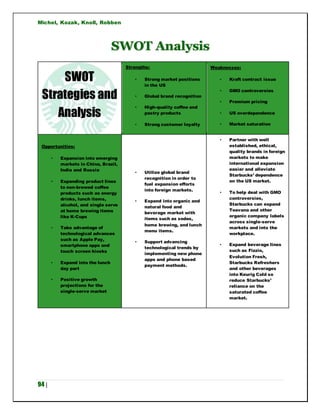
  • 65.
    Starbucks Business Analysis |65 Quantitative Executive Summary: Starbucks’ global social media rank is currently 2,298. This is up 286 places since 3 months prior. The majority of visitors to the Starbucks Web site are college- educated women who are browsing from home. Compared to competitors, Starbucks maintains the majority of traffic on its social media sites and apps. BRAND PROMINENCE Starbucks far outranks Dunkin’ Donuts and Tim Hortons in social media traffic volume. Starbucks has an audience of 51,513,808 individuals across their major forms of social media as indicated by the image to the right (a breakdown of this source can be found in the appendix).132 The likely driver of Starbucks’ social media traffic is its strong brand image built through corporate social responsibility, and quality products. However, the company is ranked second in terms of social media growth. Starbucks, Dunkin’ Donuts and Tim Hortons all had no performance on YouTube in the month of October. All three coffee companies have seen their sites’ popularity improve over the last three months. In addition, comparing the demographics of those browsing these companies’ sites will likely give indication to their consumer base. Starbucks demographic Web traffic can be seen on the next page. All three sites have seen traffic growth, and consequently, global rankings, improve over the last six months. For Dunkin’ Donuts, this growth is likely due to its ad campaign, and for Tim Hortons, the announcement of Burger King’s acquisition in September.
  • 66.
    Michel, Kozak, Knoll,Robben 66 | With the emergence of social media, Starbucks has received more headlines over the past 5 years. The peaks in the image below represent product launches, seasonal menu changes, legality issues, social responsibility headlines, partnerships, and more.133 For example, point D on the graph represents a legality issue for Starbucks. Another major story that piqued search interest: when Starbucks ended their contract with Kraft earlier than agreed upon and therefore the company had to pay out damages.134
  • 67.
    Starbucks Business Analysis |67 Alexa’s metrics illustrate Starbucks’ success across a variety of social platforms. The metrics above illustrate that Starbucks’ site is far larger and more valuable than those of its competitors.
  • 68.
    Michel, Kozak, Knoll,Robben 68 | Qualitative Executive Summary: Starbucks maintains major social networking presences on Facebook, Twitter, YouTube, Instagram and My Starbucks Ideas. Although some store locations have individual Facebook accounts, Starbucks maintains a community page for consumers worldwide. The use of Twitter, Facebook and Instagram allows Starbucks to transfer the high level of customer service found in stores into cyber space. It also allows consumers to bring issues to light via Facebook and Twitter for fast, effective results. The company’s YouTube channel further promotes brand image through videos displaying corporate social responsibility and an emphasis on community. YOUTUBE Starbucks’ YouTube page hosts a variety of videos and channels. Starbucks’ YouTube channel has 47,000 subscribers, compared to 4,800 for Tim Hortons and 9,200 for Dunkin’ Donuts. Through YouTube, Starbucks can effectively promote new products, socially responsible events and strong brand image. The Discussion section allows customers to address various issues and ask questions related to products and services. The current top posts are associated with new products and the Meet Me at Starbucks video. The video displays a typical day at Starbucks shot between 28 countries and emphasizes the focus on community. The dedication to community is at the forefront of Starbucks’ values and further strengthens their brand image.135 FACEBOOK Starbucks’ Facebook page is well-maintained and appears to be updated frequently. Like the YouTube page, their Facebook site also promotes new products and events to strengthen brand image.136 Starbucks keeps followers up to speed on new menu items and also keeps them engaged by following a photographic series entitled #HowWeMet. The series captures photos of friends, family, coworkers and significant others meeting at Starbucks and shares stories of how they met. The series has a large following and continues to receive positive feedback across Facebook and Twitter. Starbucks’ Facebook post introducing the HowWeMet series received 17,000 Likes while Starbucks’ overall Facebook page has 37.9 million Likes.
  • 69.
    Starbucks Business Analysis |69 According to Ice Rocket, topics of discussion among Starbucks’ Facebook users include posts about the seasonal school and Pumpkin Spice Latte. This identifies the Generation X and Millennial segments that Starbucks targets. Although most posts are positive, the Pumpkin Spice Latte did receive negative feedback throughout Facebook as some consumers complained about the taste and the artificial sweetener. TWITTER Starbucks’ Twitter account is also well-maintained and is likely to be the hub for customer service issues. Starbucks raises awareness for charities, community events and new products through Twitter. In the fall, Starbucks heavily promotes the Pumpkin Spice Latte. The majority of posts on Twitter are positive comments on making new friends, bringing the community together and enjoying good coffee. The tweets and replies section includes feedback about negative experiences and serves as a place for customer service. Starbucks’ responses are very personal and custom to each individual’s problem as they seek to resolve any issue. According to Ice Rocket, current Twitter posts primarily address which store location the user is at, and what drinks they enjoy. Some users refer to Starbucks as a religious cult for white, upper middle class families while others joke about the addiction they have to the coffee.137 INSTAGRAM Starbucks Instagram allows users to follow the “How We Met” photographic series and also promotes new products and ideas. Starbucks currently has a following of over three million people and has made 561 posts.138 The “How We Met” series displays people of all sorts at Starbucks and offers snapshots into peoples’ lives. The Instagram page is also synced to Facebook, allowing Facebook users without Instagram to actively follow the series as well. Starbucks’ Twitter page focuses heavily on community and bringing people together. (Twitter.com) Starbucks promotes community by taking snapshots into peoples’ lives with “How We Met.” (Instagram)
  • 70.
    Michel, Kozak, Knoll,Robben 70 | MY STARBUCKS IDEA My Starbucks Idea is a social gathering place for Starbucks consumers to brainstorm and share new ideas. While part of the corporate site, it engages consumers and keeps them actively involved in the decision making process. The site offers Starbucks drinkers a chance to come up with new ideas in three categories: product, experience and involvement. As users share ideas, a real time news feed displays new ideas so others may vote or comment on them. Top voters and commenters are put on a leaderboard and some of the best ideas are put to action. A recent idea that is being put in action is the return of Kind bars to the stores.139 Other ideas in action include mini Frappuccino’s, custom coffee tumbler designs and new K-cup flavors mocha and cinnamon dolce. Top recent ideas include alternatives to dairy and soy milk, buy ten get one free rewards program and free coffee on your birthday. (StarbucksFallEssentials.com)
  • 71.
    Starbucks Business Analysis |71 Strategies Starbucks has proven itself remarkably adept at staying innovative and dealing with STEEP trends and Porter’s Five Forces before they become a major issue. Minimum wage demands are not a major concern for Starbucks since entry-level employees already start out working above the minimum wage. Schultz has applauded President Obama for his calls for a higher minimum wage. Nor is the Affordable Care Act (“Obamacare”) an issue, since the company already provides more health coverage than Obamacare requires. The Latin American drought is not a major issue for Starbucks since the majority of its coffee beans are price-protected through 2015 and Starbucks’ well-established value chain allows it to attain coffee beans from over 20 countries. Corporate social responsibility is a relatively minor issue since the company emphasizes that front so much it’s even in Starbucks’ mission statement. And the company has performed well even despite the ups and downs of the stock market. Hence, there are only a few areas in which Starbucks can innovate. One, is providing customers with the nutrition facts of its products through its Starbucks app. More health-conscious customers will want this information more easily available, and Obamacare is mandating more nutrition facts incorporated into restaurant’s menu boards. This may be a precursor to more and more nutrition facts becoming readily available to consumers. By jumping ahead of the trend instead of waiting for it to become law, Starbucks will gain first-mover advantage and improve its image. Two, the company can better adapt to trends in organic foods and GMO regulations by testing organic coffee in select markets, using organic coffee beans and milk from organic- certified cows. More health-conscious cities such as Seattle, Portland, Eugene and San Francisco, would be ideal for test launching these products and gauging consumer interest. This would give Starbucks a first-mover advantage in selling organic coffee at coffeehouses. Three, the company can expand its appeal to Chinese consumers by increasing its scrutiny of its Chinese suppliers. Customers in China often favor foreign brands, given the series of food scandals that China is notorious for. Starbucks currently has an image as a safe, Western food restaurant that it should protect. Starbucks could tighten its supplier accreditation process and hire contractors to continuously oversee food supply. Fourth, active global portfolio management, which requires preparing for sales in Canada to dip, given increasing competition in Canada from Tim Hortons and McDonald’s. As the Canadian market becomes more saturated, Starbucks may find better opportunities for expansion in Latin America, Europe, and Asia. China recently surpassed Canada as Starbucks’ #2 market and shows the strongest growth potential. Fifth, Starbucks must continue to remain diligent about stock performance. The company has weathered recessions well for the most part, but saw sluggish stock performance during the fiscal crisis of 2008, largely as a result of trying to expand too quickly without ensuring quality.
  • 72.
    Michel, Kozak, Knoll,Robben 72 | Indicators Analysis
  • 73.
    Starbucks Business Analysis |73 STEEP Analysis SOCIAL HEALTH AND WELLNESS Health and wellness is an important trend in society that Starbucks needs to accommodate. 38% of adults agree that if healthy menu items sound appetizing, they are more likely to order that item. But a stigma still exists that any food from the QSR industry is inherently unhealthy. This has led to a wide variety of methods that consumers use to determine if a food item is healthy or not. For instance, 37% of consumers polled believe that an item with a low calorie count is a healthy option, while 39% believe an item with more fruits and vegetables is healthier.140 Katrina Fajardo, foodservice analyst at Mintel, says that restaurant operators should continue to offer their traditional menu items while also adding items that are low calorie, locally grown, or health customized versions of their main meals. Fajardo says this will “boost consumers’ perceptions of health on the menu without needing a full menu overhaul.”141 TRANSPARENCY IN NUTRITION FACTS Transparency is an issue that has come to the fore in consumers’ minds. Consumers are becoming more concerned with what is in their food and how it is prepared, and they expect restaurants to provide this information. Over 100,000 consumers search for food allergy information every month in Google, and between 2.4 and 3.4 million, search for information Salads are a popular addition to QSR and fast casual menus. (BlissTree.com)
  • 74.
    Michel, Kozak, Knoll,Robben 74 | concerning GMO and gluten-free foods. Consumers have become very interested in the source of their food, with a preference for GMO free and locally sourced foods. Government policies also follow this trend, with new menu regulations mandating health information and regulators introducing for the first time food allergy regulations into the 2013 food code.142 To stay competitive, restaurants will have to follow this trend by providing more information about their products to consumers and using GMO free and locally sourced food when possible. MILLENNIALS AFFECT RESTAURANT LANDSCAPE Millennials are the up and coming generation, comprised of adults ages 18 to 34, and the restaurant industry has begun to feel the effect of this generation’s preferences. Overall, Millennials have decreased their visits to restaurants by 21%, choosing to focus on food quality over quantity. Millennials also often prefer a wider variety of foods, searching for food items they can’t get elsewhere. “The appeal is in the difference,” writes Lillia Callum-Penso in an article for GreenvilleOnline.143 Millennials also have less money to spend on food, and so are more price conscious than previous generations. These preferences have led to Millennials avoiding casual chains such as Olive Garden and Chili’s and frequenting independently owned restaurants and fast casual restaurants such as Chipotle and Starbucks. As the baby boomer generation fades and Millennials take the primary spending role, restaurants will have to adapt to these preferences in order to survive. TECHNOLOGICAL APPLE PAYIMPLEMENTATION More than 500 financial institutions have begun implementing Apply Pay, an alternative to Google Wallet which allows customers to make purchases with their smartphones instead of using plastic cards.144 Starbucks is taking a cautious approach to Apple Pay, implementing it in their Starbucks app, but likely waiting to see how it fares before implementing widespread integration throughout its 11,000+ US stores. Starbucks still isn’t using the near-field communication (NFC) technology needed that enables consumers to easily make a purchase by tapping their phone against a payment kiosk. Starbucks will be using Apple Pay, but only as a payment option for reloading their Starbucks card app. If Apple Pay proves popular, they can proceed to widespread implementation.145 The hardware for NFC technology would cost anywhere from $15 to $50 per checkout lane.146 Apple is emphasizing convenience to get customers to adopt Apple Pay. (IBTimes.co.uk) Millennials are the new customer base for restaurants. (GreenvilleOnline.com)
  • 75.
    Starbucks Business Analysis |75 INCORPORATION OF TOUCH-SCREEN KIOSKS ANDONLINE ORDERING More Panera Bread locations are allowing customers to order through kiosks instead of a cashier. Buffalo Wild Wings locations are adding touch-screen ordering, while the number of restaurants that let you order online and pick up in store is also growing, and includes Chipotle, Starbucks, and Wendy’s. Restaurants are incorporating these types of technology to improve order accuracy, reduce labor costs, track customer spending better, and get customers to buy more food. Restaurants using Suri’s Presto tablets have seen a 5% increase in sales and a table turnover 7 - 10 minutes faster.147 At Chili’s, customers can use touch-screens to read the news, order appetizers and drink refills, and pay their check. At Panera, the entire menu is available through a kiosk. Customers can easily repeat past orders, or customize a sandwich exactly how they want. One diner in Tucson, AZ, has taken the experience to the next level by implementing “smart tables” in which the entire table surface is spill-proof touch-screen on which customers can play games, watch TV, or order food.148 While Starbucks has implemented online mobile app pre-ordering, the company may be reluctant to add touch-screen kiosks to its locations because it prefers the personalization that comes from having customers interact with baristas. CYBER-ATTACKS ARE UP, BUT CYBER SECURITYSPENDING IS DOWN While cyber-attacks are increasing, security spending by firms is actually decreasing, according to Price Waterhouse Cooper’s Global State of Information Security Survey 2015. Cyberattacks have been affecting banks, retailers, and restaurants, among other businesses.149 JPMorgan Chase and nine other financial institutions were recently hit by a cyberattack that affected 76 million customers, and targeted the firm’s core infrastructure.150 216 Jimmy John’s stores and 108 other restaurants were hit in a major data breach against their payment system, built by Signature Systems. The company uses remote management tools that allow it to fix computer problems without sending a technician to the store.151 These same tools create a security vulnerability that allowed hackers to gain access to credit card names, numbers, expiration dates, and verification codes. Cards used starting in mid-June are at risk. The company realized it had a malware problem on July 30, but it took a week to remove the majority of it, and until mid-September to remove every trace.152 Panera Bread is among the most innovative companies when it comes to touch-screen ordering. (Consumerist.com)
  • 76.
    Michel, Kozak, Knoll,Robben 76 | ECONOMIC EFFECTS OF LATIN AMERICANDROUGHT TO BE FELT IN US Meteorologists are predicting low rainfall in Brazil for the next two months, which will only exacerbate the country’s drought problem. The consequences could be felt in the US through coffee and sugar prices. While El Salvador, Panama, Guatemala and the Honduras also face drought prospects, Brazil is the world’s largest coffee producer.153 Consequently, Arabica coffee prices are rising, and could by 2015 exceed the historic high of $3 per pound set at the end of 2010.154 Starbucks is better insulated from rising coffee prices than other companies – with 60% of its coffee supply price-protected through 2015 – but the other 40% could pose an extra cost that may cut into Starbucks’ profit margins if it isn’t passed on to customers.155 EMPLOYEES DEMANDING HIGHERMINIMUM WAGE 83% of restaurant patrons support a minimum wage hike, according to an online survey from Technomic, Inc. “Consumers clearly believe the economic benefits of a minimum wage increase far outweigh the negatives,” said a representative from Technomic. The National Restaurant Association and the International Franchise Association, which both represent fast food giants like McDonald’s, have strongly opposed a minimum wage hike. 13 states and six cities have raised their own minimum wages.156 West Coast cities are leading the way in raising the minimum wage. In Starbucks’ hometown of Seattle, business and labor have agreed to phase in a $15 minimum wage in three years for large businesses and seven years for small businesses. Washington State already has the highest minimum wage in the country, at $9.32. San Francisco residents will vote in November whether to raise the minimum wage from $10.75 to $15. The The South American drought has major world implications for coffee and sugar prices. (Sydney Morning Herald) Restaurant and retail workers across the nation have been staging mass protests for a higher minimum wage. (Wikipedia)
  • 77.
    Starbucks Business Analysis |77 Santa Clara Board of Supervisors instituted a living wage that will boost income for Silicon Valley and San Jose workers. LA Mayor Eric Garcetti is proposing to increase the minimum wage to $13.25 by 2017. The LA Chamber of Commerce argues, “This proposal would actually cost jobs, would cause people to lose jobs and would cause people to have cutbacks in hours.” San Diego’s City Council is implementing an $11.50 minimum wage within three years. According to economists Michael Reich and Ken Jacobs of the University of California at Berkley, there are no differences in employment rates between cities with and without living wage laws. The Congressional Budget Office claims raising the federal minimum wage to $10.10, as Obama has proposed, would lift 900,000 Americans out of poverty but also mean 500,000 jobs get cut.157 POOR STOCK MARKET PERFORMANCE While the stock market has seen bullish growth over the last year, mid-October saw poor growth, including the worst three-day market slide since 2011.158 Many analysts have called it a simple “correction period,” and have concluded the correction period is over.159 With Grey Thursday (a.k.a. Thanksgiving) and Black Friday only a month away, retailers are expecting to see strong growth over the next couple months, especially with the holiday shopping season gearing up.160 Despite the market correction, Starbucks stock has been performing well over the past five years but has been relatively stagnant over the last 12 months. Starbucks’ stock ratings are holding strong, with 14 Strong Buys, 2 Buys, and 3 Holds. (Nasdq.com)
  • 78.
    Michel, Kozak, Knoll,Robben 78 | ENVIRONMENTAL OPPOSITION TO GMOS BECOMING MORE WIDESPREAD About 70% of processed foods in grocery stores are genetically modified. Voters in Colorado161 and Oregon162 will decide on Proposition 105 and Measure 92, respectively, to determine whether these foods have to be labeled. The issue is only likely to become more controversial in the coming months, and if these ballot measures pass, it would likely fuel similar ballot initiatives in other states and push corporations to use fewer GMOs. Starbucks is already feeling the pressure from the fight, as 150,000 consumers have signed a petition urging Starbucks to switch to organic milk and stop sourcing milk from cows fed genetically modified organisms. GMO Inside, an anti-GMO group, urged social media activism and launched #OrganicMilkNext on Twitter to push Starbucks to make the change.163 GROWING CONCERN FORCORPORATE SOCIAL RESPONSIBILITY A poll of 30,000 consumers across the world indicates that 55% are willing to pay more for goods and services provided by companies practicing corporate social responsibility, and committed to positive social and environmental impacts. The Nielsen Global Survey on Corporate Social Responsibility showed Millennials are more responsive to sustainability actions than other groups, such as Generation X and the Baby Boomers.164 Another survey, conducted by Lab42 in August 2014, placed a higher emphasis on corporate social responsibility than Nielsen’s polling, showing that 84% would pay more. While Nielsen surveyed consumers across the entire globe, Lab42 focused on only U.S. consumers. And while the Nielsen survey focused on sustainability, the Lab42 survey shifted emphases to companies having strong reputations, putting out high-quality products, and treating employees well. Their survey also revealed that 33% of consumers don’t know how to define social responsibility.165 Starbucks has always put a strong emphasis on social responsibility, providing tuition reimbursement and health care for employees, as well as ethically sourcing its coffee bean growth. If consumers become more socially conscious about their purchases, it bodes well for Starbucks’ growth potential.166 GMO Inside is leading the push to get milk from GMO-fed cows out of Starbucks’ drinks. (GMOInside.org) Since its founding in Seattle in 1971, Starbucks has placed a heavy emphasis on corporate social responsibility. (Starbucks.com)
  • 79.
    Starbucks Business Analysis |79 DEMAND FOR ORGANICFOODS GROWING The demand for organic foods is growing faster than the supply. Organic food sales soared from $3 billion in 1997167 to $28 billion in 2012, totaling about 4% of total grocery food sales. Production acreage and facilities aren’t growing nearly as rapidly. From 2008 to 2011, organic acreage grew only 12% per year, while the number of certified organic livestock grew only 3%. To qualify as organic in accordance with USDA standards, land used to produce organic crops can’t be treated with chemicals for at least three years, and livestock have to be raised organically from conception. While specialty stores like Whole Foods used to be the main source of organic foods, major retailers including Walmart, have been looking to expand their organic food supply.168 Organic crops take longer to grow and produce lower yields, so despite consumer interest in organic foods (91% of Walmart customers said they would buy organic), companies are not as quick to take advantage of the trend. Organic represents risks and opportunities for restaurants and retailers alike.169 McDonald’s and Chipotle are among the restaurant companies who have expressed an interest in expanding their organic offerings.170 POLITICAL BUSINESSES CAUGHT UP IN OPEN-CARRYCONTROVERSY Starbucks found itself at the center of the open-carry controversy in 2014, when several customers chose to enter the store with rifles. CEO Howard Schultz issued a letter requesting customers to leave their weapons at home, without issuing an outright ban on firearms.171 The decision was controversial among open-carry supporters, with some accusing others of harming the cause172 and others attempting to organize protest events at Starbucks. Starbucks isn’t alone in asking open carriers to leave their weapons at home: Chipotle, Target, and Sonic have done the same, likely because having people openly carrying arms in a store will drive more customers away than it would attract.173 With gun laws becoming less strict in America, this issue is not likely to go away anytime soon. INDUSTRYSAFETYREGULATIONS IN CHINA China is set to add new regulations to its food safety laws over the coming months. These regulations will introduce harsher penalties for those who violate the laws, and give more authority to regulators. These changes come in light of a rash of food production complaints.174 51.7% of food inspections in Q2 2014 failed, and several high-profile scandals emerged.175 In July 2014, an undercover reporter in China found a supplier selling expired meat to various fast Starbucks, Chipotle and Jack in the Box are among businesses that have asked customers to leave their assault rifles at home. (MotherJones.com)
  • 80.
    Michel, Kozak, Knoll,Robben 80 | food companies, including Starbucks.176 In September, regulators discovered a Taiwanese bakery chain using potentially toxic “gutter oil” to fry pineapple buns, which it then sold at a number of Taiwanese bakeries and fast food restaurants, including two Starbucks stores.177 In October, the Taipei District Prosecutors’ Office indicted 13 people over mixing non-edible oil with cooking oil, a violation of China’s food safety regulations.178 Given the numerous food safety scandals in China, many consumers in the People’s Republic prefer foreign-branded and imported food products. While the food scandals extended to Starbucks as well, the diminishing reputation of Chinese food safety may actually enhance the Starbucks brand in China. AFFORDABLE CARE ACT CONTROVERSIAL WITH SMALL BUSINESSES Some restaurants are adding an Obamacare surcharge to their customers’ bills, despite the fact the law won’t go into effect for small businesses until 2016, and the fact that the surcharges are going over poorly with customers: not necessarily for the extra cost, but more for the political statement the restaurants are making. One Denny’s franchisee who owns 30 restaurants in Florida was reprimanded by the corporate CEO, who denounced his actions as a political statement.179 Members of the Pennsylvania Restaurant and Lodging Association, among others, have complained about the extra costs that Obamacare would add when it goes into effect in 2015.180Starbucks CEO Howard Schultz has called the law a net positive for the country and added that it would have no major effect on Starbucks’ health care plans, which are already more generous than the law’s requirements.181 “We have been providing comprehensive health insurance to all our employees,” he said, “including part-time people who work 20 hours a week, for over 20 years. So our plan is actually better.”182 (HuffPost.com)
  • 81.
    Starbucks Business Analysis |81 Porter’s Five Forces RIVALRY CANADIAN COMPETITION INTENSIFIES McDonald’s has begun to make its McCafe ground coffee available for purchase in Canadian grocery stores.183 This is part of McDonald’s strategy to expand its coffee territory in Canada. McDonald’s has seen significant growth in its breakfast day-part in the last five years, and is looking to make this trend continue by moving into the home coffee market. Meanwhile, Tim Hortons, the current leader in Canadian coffee sales, has begun selling a new dark roast at its stores.184 This is the first time the Canadian coffee king has introduced a second blend in 50 years. Companies continue to find ways to differentiate themselves, indicating that rivalry is very fierce and each company is looking for a new product to gain an advantage. NON-TRADITIONAL LOCATIONS As rivalry among competitors increases, market saturation becomes a major issue. As a result, many quick serve and fast casual restaurants are trying to find a way to reach a new or different group of customers. One way these restaurants are reaching out to new customers is by locating their restaurants in non-traditional locations, including hospitals, universities, and casinos.185 Non-traditional locations can be dangerous bets for restaurants as some places, such as stadiums, are not open all year and may not be profitable. That these companies are willing to take risks shows the highly competitive nature of the industry. NEW PRODUCTS AND DIFFERENTIATION In Q2 2014, Starbucks saw 5% more growth than its competition. This growth is due largely to Starbucks’ new products. These include Teavana Tea, Fizzio handcrafted soda, and la Boulange pastries.186 Starbucks’ focus on differentiation through new products shows that the industry has a high degree of rivalry. Coffee products tend to be very similar, making differentiation a difficult strategy. Starbucks attempts to differentiate itself from its rivals with its new products, which shows the pressure of rivalry on their coffee business is strong and they are trying to differentiate. McCafe brand coffee is now being sold in Canadian grocery stores. (Investing.com) This Starbucks, located on Stonybrook College campus, is an example of a non- traditional location. (Stonybrook.edu)
  • 82.
    Michel, Kozak, Knoll,Robben 82 | POWER OF BUYERS INCREASING BUYER EDUCATION Coffee tourism is on the rise, and this means more consumers are becoming more educated about coffee sourcing. Crimson Cup Coffee and Tea is one of the small companies cultivating the coffee tourism industry.187 Crimson Cup offers trips to coffee growing regions in Central America for college students and owners of independent coffeehouses. The trip shows tourists the full extent of the coffee growing industry, from the growing process to the impacts the industry has on the local population. As this brand of tourism continues to grow, consumers will become more educated about the coffee industry. This will likely work to Starbucks’ benefit, as consumers will become more socially conscious of Starbucks’ ethical sourcing, and thus, more likely to buy Starbucks coffee. GROWING TEA INDUSTRY CREATES MORE SUBSTITUTES Tea is a growing substitute threat to Starbucks’ coffee sales. Tea is a fast growing industry in the US. Since 2007, tea sales have grown 32% to a high of $15.7 billion in annual sales. Over the next two years, the tea market is expected to expand even further, up to $18 billion in annual sales. When substitutes are easily available and when the cost to switch to those substitutes is low, buyer power is greatly increased. Starbucks has recognized this threat, and is currently working to mitigate it by expanding its Tazo tea line and acquiring Teavana Tea. While these are good steps, the threat to Starbucks’ majority coffee based business still exists. STARBUCKS’CUSTOMERS HAVE STRONG BRAND LOYALTY Starbucks has exceptionally brand-loyal customers. This was seen in 2012 and 2013 when Starbucks raised their prices. Despite the price hike, Starbucks maintained the same number of customers per day.188 Part of this loyalty is from Starbucks’ significant online presence and prominent store locations.189 But marketing expert Priya Raghubir claims the most important component of Starbucks’ customer loyalty is Starbucks’ position as “the quintessential coffee shop,” creating an inviting atmosphere that differs from more snobbish small coffee shops. This strong brand loyalty helps to somewhat mitigate the Crimson Cup Coffee President Greg Ubert at one of the company’s tour locations in El Socorro, Honduras. (Dispatch.com) Starbucks acquired the popular Teavana brand in response to the growing market for tea products. (Teavana.com)
  • 83.
    Starbucks Business Analysis |83 otherwise strong power that buyers have over Starbucks by reducing the customers’ price sensitivity. SUPPLIERS C.A.F.E. POLICYMAYLIMIT SUPPLIERS Starbucks is committed to sourcing all of its coffee from farms that meet their Coffee and Farmer Equity (C.A.F.E.) Standards. Conservational International works with Starbucks to lay out guidelines for Starbucks’ ethical sourcing policy. The C.A.F.E. standards include guidelines about ecologically friendly growing, fair trade and fair labor practices.190 Starbucks has made a public commitment to buy all of its coffee from C.A.F.E. suppliers by 2015. All signs point toward the company making good on this commitment, as by 2013, 95% of the company’s coffee came from C.A.F.E. suppliers.191 To keep to this standard, Starbucks will need to continuously find new C.A.F.E. suppliers. This limits which suppliers Starbucks can use and gives the suppliers that do follow these guidelines slightly more power. FIXED-PRICE CONTRACTS PROTECT STARBUCKS Coffee bean prices are a serious issue for Starbucks, and rising prices could damage their business and give suppliers more control over the company. In light of this, Starbucks has done its best to put protections in place to prevent damage to the company from suddenly fluctuating prices. Starbucks has fixed-price agreements for all of its coffee for 2014 and around 40% for 2015.192 These agreements prevent sudden price fluctuations from damaging their business and allow the company to prepare for more expensive supplies in the future. This decreases the power that suppliers have over Starbucks. Shanghai Husi was discovered to be selling spoiled meats to its restaurant customers, including Starbucks. (ibtimes.com) SCS Global Services is the third-party Starbucks uses to ensure its suppliers follow C.A.F.E. standards. (SCSGlobalServices.com)
  • 84.
    Michel, Kozak, Knoll,Robben 84 | SUPPLIER SCANDALS THREATEN CHINA STARBUCKS China has become a major growth area for Starbucks, but recent issues with suppliers have begun to threaten this growth. The most recent was in July 2014, when regulators discovered the meat supplier Shanghai Husi Food discovered using expired meat in its products. Some of Starbucks’ cafes were using products supplied by Husi, and the fallout from the scandal affected Starbucks as well as a number of other companies. This food scare and others like it are likely to continue in China in the near future.193 If Starbucks cannot trust its suppliers in China, it will become more expensive and difficult to maintain its business there. This could prove detrimental for Starbucks, especially since China is a major growth area.
  • 85.
    Starbucks Business Analysis |85 Industry Activities McDonald’s expanding into fast casual realm—10 December 2014: McDonald’s plans to compete with Subway and Chipotle by implementing a new program it calls “Create Your Taste.” This will allow customers to customize their burgers’ bread, cheese, and toppings using touch-screen ordering. The company will be rolling Create Your Taste out at 2,000 of its 14,000 US locations in 2015.194 Fast food expanding healthy choices—5 November 2014: More quick-service and fast casual restaurants are adding healthy food to their menus while many upstart chains are focusing their product line on healthy offerings. These trends are more prominent along the West Coast. At Lyfe Kitchen, currently in 13 locations across four states, the emphasis is that the food tastes great, first and foremost, but it’s also healthy.195 The burger chain uses meat only from grass-fed cows, and keeps its entrees under 600 calories. It offers kale banana smoothies but markets the product’s taste above the flavor. While these kinds of foods cost more than McDonald’s, the millennial generation is willing to pay more for tastier, healthier food.196 McDonald’s to bring back the McRib—5 November 2014: McDonald’s plans to reintroduce the McRib in about 75% of its stores. This move comes as McDonald’s sales are falling in the US and the company is looking to stop this trend. Sales have fallen 3.3% in the third quarter, the fourth straight quarterly decline for the restaurant company. The McRib is a cult classic and is expected to help improve McDonald’s sales in the short term. Using limited time offering products, such as the McRib, is a good way to raise sales in short term because customers don’t want to “miss out” on the limited offering. However it isn’t a long term solution that McDonald’s can rely on to continue to raise sales.197 Starbucks delivery latest in a series of new products and services—10 October 2014: Always looking for new ways to expand, Starbucks has announced it will begin offering delivery in late 2015 in select markets. Starbucks CEO Howard Schultz envisions giving the customers the ability to “create a standing order of Starbucks delivered hot to your desk daily.” Customers will place orders through the Starbucks mobile app. This will make Starbucks coffee more convenient for customers, eliminate the hassle of waiting in line in the store or at the drive-thru, and make it easy to place large orders without any worries about how to get a dozen cups of coffee into the office.198 Some of Starbucks’ major challenges in implementing this program will be keeping the coffee warm when it arrives. While sales are up 10% for the quarter, (Starbucks.com)
  • 86.
    Michel, Kozak, Knoll,Robben 86 | the company’s outlook is poorer than expected. This is the latest strategy among a long series that Starbucks has used to boost sales. Other recent additions to Starbucks’ products and services include new lines of single-origin coffee aimed at customers who demand ethical sourcing. The company also plans to open 100 stores that sell only small Reserve-brand coffee, and is expanding its coffee product line.199 Chipotle the most successful company in food industry—21 October 2014: Chipotle’s same- store sales are up almost 20% over last quarter, making it, as Business Insider put it, “the most successful company in the food industry right now.” Chipotle may be cannibalizing sales from other fast food restaurants; McDonald’s, for example, reported sales were down 3.3%. Part of Chipotle’s success is the result of consumers shifting away from QSR in favor of more fast casual fare.200 Chipotle founder Steve Ells attributed his company’s success to fast casual, saying, “The companies that have lost the most customers over the last decade are traditional fast- food chains, while the biggest gains go to fast casual restaurants.” McDonald’s, at one time, had majority control in Chipotle. But the two have different business models. Whereas Chipotle investors might see its rapid growth as the stock’s main value, McDonald’s investors appreciate the frequent dividend payouts.201 Frozen meals have better nutrition than QSR—21 October 2014: An analysis of frozen food and fast food at a recent conference on nutrition showed that frozen meal consumers, compared to QSR consumers eat 253 fewer calories per day, 2.6g less saturated fat per day, 3.9g more dietary fiber, 511mg more potassium, and 135mg more calcium, and 8.5g more protein.202 The analysis compared frozen food to QSR, but not fast casual or casual dining, which tend to serve healthier food than QSR.203 Gas prices and unemployment are down, but discretionary spending isn’t up—15 October 2014: Gas prices have fallen 15% since late June, but while economists have expected discretionary in other areas -- such as clothing retail and fast food -- to rise, those gains haven’t shown up so far.204 Retail sales fell 0.3% overall in September, with drops in auto departments, gas, food services, and building materials. NRF Chief Economist Jack Kleinhenz said the retail dip came “despite increasing consumer confidence, an uptick in employment, lower gas prices, and with inflation in check, consumers still slowed spending.”205 Restaurant patrons support minimum wage hike—30 September 2014: 83% of restaurant patrons support minimum wage hike, according to an online survey from Technomic, Inc. “Consumers clearly believe the economic benefits of a minimum wage increase far outweigh the negatives,” said a representative from Technomic. The National Restaurant Association and the International Franchise Association, which both represent fast food giants like McDonald’s, have strongly opposed a minimum wage hike. 13 states and six cities have raised their own minimum wages. West Coast cities are leading the way in raising the minimum wage. In Seattle, business
  • 87.
    Starbucks Business Analysis |87 and labor have agreed to phase in a $15 minimum wage in three years for large businesses and seven years for small businesses. Washington State already has the highest minimum wage in the country, at $9.32. San Francisco residents will vote in November whether to raise the minimum wage from $10.75 to $15.206 The Santa Clara Board of Supervisors instituted a living wage that will boost income for Silicon Valley and San Jose workers. LA Mayor Eric Garcetti is proposing to increase the minimum wage to $13.25 by 2017. The LA Chamber of Commerce argues, “This proposal would actually cost jobs, would cause people to lose jobs and would cause people to have cutbacks in hours.” San Diego’s City Council is implementing an $11.50 minimum wage within three years. According to economists Michael Reich and Ken Jacobs of the University of California at Berkley, there are no differences in employment rates between cities with and without living wage laws. The Congressional Budget Office claims raising the federal minimum wage to $10.10 would lift 900,000 Americans out of poverty but also mean 500,000 jobs get cut.207 Restaurants incorporating more touch-screen ordering—29 September: More Panera Bread locations are allowing customers to order through a kiosk instead of a cashier. Buffalo Wild Wings locations are adding touch-screen ordering, while the number of restaurants that let you order online and pick up in store is also growing, and includes Chipotle, Starbucks, and Wendy’s.208 Restaurants are incorporating these types of technology to improve order accuracy, reduce labor costs, track customer spending better, and get customers to buy more food. At Chili’s, customers can use touch- screens to read the news, order appetizers and drink refills, and pay their check. At Panera, the entire menu is available through a kiosk. Customers can easily repeat past orders, or customize a sandwich exactly the way they want. Restaurants using Suri’s Presto tablets have seen a 5% increase in sales and a table turnover 7 - 10 minutes faster. One diner in Tucson, AZ, has taken the experience to the next level by implementing “smart tables” in which the table surface is set up like a giant tablet on which customers can play games, watch TV, or order their food.209 Fine dining sees growth while fast food stays flat—26 September 2014: A recent report from the NPD Group market research firm says that while fine dining establishments are seeing more traffic, fast food establishments are staying flat. Over the past three years, visits to dining establishments with checks of $40 or more went up 11% while visits to restaurants with an average check of $10 or less went down 1%. Fine dining patrons represent just 1% of restaurant patrons. Meanwhile, 80% of restaurant patrons eat at fast food establishments.210 The NPD Group says this may be a reflection of the low-income and middle-income groups faring worse while high-income groups fare the same, if not better. Those who classify themselves as middle (LoStateMinor.com)
  • 88.
    Michel, Kozak, Knoll,Robben 88 | class shrank from 53% in 2008 to 44% in 2014. Meanwhile, those who classify themselves as lower- or lower-middle-class rose from 25% in 2008 to 40% in 2014. “This is the type of thing that keeps restaurant executives up at night,” said Bonnie Riggs of the NPD Group. “The middle class is shrinking.” Households with incomes of $100,000 or more account for 36% of total fast food spending.211 Jimmy John’s cardholders hit in major data breach—26 September 2014: 216 Jimmy John’s stores and 108 other restaurants were hit in a major data breach against their payment system, built by Signature Systems. The company uses remote management tools that allow it to fix computer problems without sending a technician to the store.212 These same tools create a security vulnerability that allowed hackers to gain access to credit card names, numbers, expiration dates, and verification codes. Cards used starting in mid-June are at risk. The company realized it had a malware problem on July 30, but it took a week to remove the majority of it, and until mid-September to remove every trace.213 Fast Casual Sales Out-Pace QSR Sales in Canada—24 September 2014: US tech companies may delay their scheduled IPO’s until they see how Alibaba’s stock performs following its record-breaking performance this past week. Tech companies considering an IPO this fall include Hub spot, LendingClub.com, GoDaddy.com and Box, among others. More importantly, if demand for Alibaba’s stock holds then holding companies will likely begin selling off stock in other investments to purchase more from Alibaba. Negative implications would be similar to that of Facebooks IPO in 2012, which may happen simply due to corporate governance in china or lack of confidence in decision-making policies by the owners. Furthermore, Alibaba has purchased a US based company called 11Main who will directly compete with eBay. With the capital achieved through their recent IPO, Alibaba will likely approach more markets and directly compete with US companies within the US itself.214 Johnny Rockets launch a drive-thru model—18 September: Shows the brand becoming more aggressive and trying to tap into the QSR market even further. Also, exploring their more retro footing by embracing the 50’s drive in mentality such as Sonic has been doing recently. This may lead to Johnny Rockets gaining more market segment and effectively allowing them to steal market segment from Starbucks during the lunch hour rush. The Brand has a more diverse menu that fits to lunch and dinner and may appeal to consumers more with the drive through capabilities.215 More higher-income household’s good news for restaurants – 17 September: While the median income of households has remained steady, there has been steady growth in the number of higher income households (households with annual income above $75,000). This is significant to the restaurant industry as most of the industry’s income is from the higher income demographic.216
  • 89.
    Starbucks Business Analysis |89 Yum Brands bringing Pizza Hut to Africa—17 September: Sources indicate that Africa has the fastest young growing population.217 This is significant for two reasons. The continual emergence of companies into South Africa displays the current markets companies operate in are saturated. Also, it shows that there is room for serious market potential in South Africa. Starbucks should consider other markets besides the US and Europe.218 Starbucks may lift workers’ visible tattoo ban—10 September: Starbucks has begun the process of reviewing its dress code, including its ban on visible tattoos. The tattoo ban has recently been a subject of controversy in the social media space. Starbucks is expected to announce its updates in the next few weeks. This decision follows a recent online petition on social media to end Starbucks’ ban on visible tattoos. This again shows how important it is to Starbucks brand to respond to social media and maintain its important Millennials clientele.219 McDonalds faces allegations of franchise wage violations—29 July: If law is passed or if McDonalds is held accountable for their franchises treatment of their workers further implications may fall on all companies that have a franchise structure. Starbucks has many Franchise locations and therefore may be subject to any decision on this finding.220 Being held accountable as a joint employer of franchise employee’s aids intense pressure to pay employees better salaries and offer benefits.221
  • 90.
    Michel, Kozak, Knoll,Robben 90 | Strategy Models and Analysis Critical Success Factors Executive Summary: Starbucks has established a strong, differentiated niche in the restaurant industry as the country’s #1 coffeehouse. Its success has allowed it to grow exponentially since 1982. The factors most critical to Starbucks’ success include its commitments to corporate social responsibility, product quality, local culture and store atmosphere, global expansion, and providing strong employee benefits, which, in turn, pays off in customer service. Critical Success Factors Includes CSF Area Enhancing product quality by using finest ingredients available Using high quality raw materials researching new products R&D, Purchasing, Operations Continue expanding in global growth markets Long-term growth strategies, smooth supply chain operations Strategy, Finance, Operations Executive Management Increased corporate social responsibility programs Green initiatives, public image, advertising campaigns, employee engagement Marketing, Operations, C-Level Executives Enhance customer service by promoting employee training/benefits Customer satisfaction, employee satisfaction, employee benefits, training Human Resources, Operations Incorporate local culture into store atmospheres Discovering Local Culture, Keeping up with regional consumer trends while maintaining Starbucks Image Research and Development, Marketing, Strategy, Financing, Operations PRODUCT ANDSERVICE QUALITY Product quality is one of Starbucks’ primary differentiator and maintains the highest priority for the company. Consistent, high quality coffee is the major difference between Starbucks and its competitors such as Dunkin’ Donuts and Tim Hortons. This quality is what allows Starbucks to charge premium prices for its products. This is called value based pricing, and is a cornerstone of Starbucks’ profitability. By selling high quality products at customer value based, premium prices Starbucks can maintain its high profits. Starbucks derives its product quality from several different sources. The first is the raw materials the company uses to make its products. Starbucks coffee is produced from high quality, fair trade coffee beans.222 This increases Starbucks’ product quality above its direct competition, and also allows Starbucks to be competitive with smaller, specialty coffee brewers. Another source of product quality is their employees. Starbucks has policies in place to ensure that their baristas take the necessary time to make the highest quality drinks.223 Starbucks also focuses on its customer service,
  • 91.
    Starbucks Business Analysis |91 ensuring each customer has a high quality experience.224 The departments that are most engaged with this critical success factor are operations, research and development, and purchasing or procurement. Operations and Human Resources can ensure that Starbucks’ employees are following company policy, research and development can produce new, higher quality products and sourcing can ensure that the company’s stores are using high quality raw materials. GLOBAL EXPANSION Starbucks global growth initiative is a key critical success factor held by Starbucks and therefore considered its second priority. Due to the market saturation within the US, Starbucks must expand to increase profitability and global market share. This is confirmed in Starbucks’ 2013 10k report, where the company describes its dependence on Europe and Asia for growth as a risk factor.225 The expansion process is likely to be carried out by virtually all aspects of the company. The strategy department must make adequate plans to move into new countries. This division will need to oversee any regulatory, cultural and operational issues that may arise during the expansion process. The company must also be financially prepared for the continued expansion. Starbucks finance departments will be responsible for handling currency issues and making sure the company is financially stable during the expansion process as well. HR must properly account for employee training on an international level, and each country must receive tailored training to promote store effectiveness. Starbucks Global Operations divisions will ensure smooth supply chain operations and distribution to each added location. It is also important for Starbucks Marketing department to conduct thorough market research in order to identify prospective locations in the global marketplace. Overall, it is important that Starbucks continue to reach these markets. In 2013, Starbucks’ China and Asia Pacific revenue grew 27%.226 This growth is critical Starbucks’ current and future success. CORPORATE SOCIAL RESPONSIBILITY Corporate social responsibility (CSR) is a differentiator for Starbucks and is an important source of competitive advantage. Therefore, it is considered the next priority in terms of critical success factors for the company. By actively engaging in CSR, Starbucks is attempting to put itself above its competition in the minds of consumers. Many of Starbucks’ competitors, such as McDonald’s and Dunkin’ Donuts, do not have a public image as a socially responsible company. This gives Starbucks a major image advantage over them. CSR can also benefit Starbucks in other ways. Financially, green packaging is cheaper to make and energy efficient stores are cheaper to operate.227 Focusing on finding a way to reduce water usage in stores may drive the innovation of new, disruptive technologies. CSR is also a strong advertising technique. By focusing on the social good of CSR, it is easier for Starbucks’ advertisements to be engaging with the public. Finally, CSR can help promote employee engagement and a positive corporate culture with CSR events such as volunteer days. Starbucks is currently engaged in a wide variety of CSR projects. The most important is their C.A.F.E. buying approach. A C.A.F.E. certification means that a coffee bean farm is operating in an ecological, economical, socially responsible manner. Starbucks has made a
  • 92.
    Michel, Kozak, Knoll,Robben 92 | public commitment to buy all of its coffee from C.A.F.E. certified farms by 2015.228 Starbucks is also engaged in a variety of other CSR projects, such as reducing waste from their disposable cups and reducing the energy requirements of their stores. Starbucks outlines all of these projects and their related progress in a yearly report called the Starbucks Global Responsibility Report.229 Many of Starbucks’ departments are engaged in the company’s CSR effort. However, the most important departments are marketing, the C-level executives, and procurement. Marketing ensures that all of the company’s CSR is well known and well received by the public, the C-level executives’ endorsements are important to the CSR’s success, and procurement is critical to meeting the C.A.F.E. goal that is Starbucks’ most important CSR program. STRONG CUSTOMER SERVICE THROUGH SATISFIED EMPLOYEES In 2012, Starbucks ranked 73rd among the Fortune 100 Best Companies to Work For.230 Superior customer service is critical because without it, Starbucks couldn’t justify its high prices. Starbucks’ employee satisfaction is key to its strong customer service. Due to the high importance of continued emphasis on satisfying employees, it is the next priority in terms of critical success factors. GlassDoor shows CEO Howard Schultz has an 87% approval rating, compared to only 67% for Dunkin’ Donuts’ CEO. 79% of Starbucks employees would recommend the company to a friend, while only 63% of Dunkin’ Donuts employees would say the same. Starbucks is able to maintain happy employees through generous health care benefits, stock options, and education benefits.231 Happy employees, in turn, provide solid customer service. Starbucks’ customer satisfaction rating, according to the American Customer Satisfaction Index, ranks at 76%. Dunkin’ Donuts customer satisfaction is at 75%.232 Therefore, by promoting employee satisfaction and happiness Starbucks simultaneously increases its customer satisfaction. LOCAL CULTURE AND STORE ATMOSPHERE Starbucks store atmosphere is critical in the success and image of the company, however does not maintain a priority as high as the mentioned factors when it comes to the success of the company. Before the return of Howard Shultz, Starbucks was expanding exponentially. The company was saturating the market and inherently diluting the company image, and store atmosphere. In 1995, the company had created four themes for their locations based off of the four basic elements of air, earth, fire, and water. The company filtered these themes through the coffee jargon of aroma, Highly Customizable low-traffic location (fastcodesign.com) Starbucks’ satisfied employees contribute to each store’s positive atmosphere, and in turn, helps maintain strong customer satisfaction. (Fortune.com)
  • 93.
    Starbucks Business Analysis |93 harvest, roast, and brew. However, this was a very simplified way to mass produce its locations. With the company expanding out of control the four themes became standardized and often times the shipments associated with opening a store would contain contents of a separate theme. This was a clear indication of how the quality control began to slip away from the grasp of the company. Today, Starbucks has evolved their image. The company has put a focus on creating the “my” statement associated with their stores. The company wishes to expand more on the experience associated with going to a Starbucks. To do so, the company has invested considerable time and resources in carefully designing its global store locations. Each global location has design genesis’s that are responsible for tying in the Starbucks feel to the specific neighborhood and culture. The company experimented with this concept in 2007 with their introduction of their Roy’s location in Seattle. This location is by no means a typical Starbucks, however it has the unique and relatable feeling for a set cliental, therefore leading to the “my” feeling. This concept has also inspired the design of Starbucks flagship locations. These locations gain considerable attention for how unique they actually are. Starbucks’ overall goal is to take the company’s 23,000 stores and make at least 21,500 unique locations.233 The company receives considerable foot traffic and attention for their local coffee house feel. By accurately tying in the local atmosphere and keeping up with technology trends and fashion appeal, Starbucks can maintain high foot traffic and sales in each of its locations. FlagshipStore Amsterdam (fastcodesign.com)
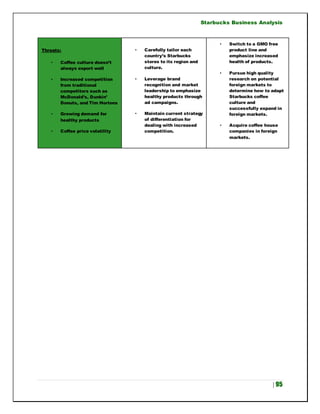
  • 94.
    Michel, Kozak, Knoll,Robben 94 | SWOT Analysis SWOT Strategies and Analysis Strengths: • Strong market positions in the US • Global brand recognition • High-quality coffee and pastry products • Strong customer loyalty Weaknesses: • Kraft contract issue • GMO controversies • Premium pricing • US overdependence • Market saturation Opportunities: • Expansion into emerging markets in China, Brazil, India and Russia • Expanding product lines to non-brewed coffee products such as energy drinks, lunch items, alcohol, and single serve at home brewing items like K-Cups • Take advantage of technological advances such as Apple Pay, smartphone apps and touch screen kiosks • Expand into the lunch day part • Positive growth projections for the single-serve market • Utilize global brand recognition in order to fuel expansion efforts into foreign markets. • Expand into organic and natural food and beverage market with items such as sodas, home brewing, and lunch menu items. • Support advancing technological trends by implementing new phone apps and phone based payment methods. • Partner with well established, ethical, quality brands in foreign markets to make international expansion easier and alleviate Starbucks’ dependence on the US market. • To help deal with GMO controversies, Starbucks can expand Teavana and other organic company labels across single-serve markets and into the workplace. • Expand beverage lines such as Fizzio, Evolution Fresh, Starbucks Refreshers and other beverages into Keurig Cold so reduce Starbucks’ reliance on the saturated coffee market.
  • 95.
    Starbucks Business Analysis |95 Threats: • Coffee culture doesn’t always export well • Increased competition from traditional competitors such as McDonald’s, Dunkin’ Donuts, and Tim Hortons • Growing demand for healthy products • Coffee price volatility • Carefully tailor each country’s Starbucks stores to its region and culture. • Leverage brand recognition and market leadership to emphasize healthy products through ad campaigns. • Maintain current strategy of differentiation for dealing with increased competition. • Switch to a GMO free product line and emphasize increased health of products. • Pursue high quality research on potential foreign markets to determine how to adapt Starbucks coffee culture and successfully expand in foreign markets. • Acquire coffee house companies in foreign markets.
  • 96.
    Michel, Kozak, Knoll,Robben 96 | Executive Summary: There are a wide variety of strategies that Starbucks can pursue based on a SWOT analysis of the company. Overall, Starbucks should focus its efforts on expanding its product line into more health conscious foods and ingredients. From the company’s strengths and weaknesses, the most important strategy for Starbucks to pursue is to expand into the organic and natural food and beverage markets. The most important strategy for Starbucks to pursue from the company’s weaknesses and opportunities is to expand the Teavana and other organic company labels across single-serve markets and into the workplace. The most important strategy for Starbucks to pursue from the company’s strengths and threats is carefully tailoring each country’s Starbucks stores to the local region and culture. Finally, the most important strategy for Starbucks to pursue from the company’s weaknesses and threats is to switch to a GMO free product line and emphasize the health of these GMO free products. STRENGTHS/OPPORTUNITIES Starbucks maintains a variety of strengths and opportunities which can effectively fuel growth and expansion. The company’s strong global brand recognition eases their expansion into the global marketplace. In conjunction with an equally strong brand image, Starbucks expansion efforts will be maximized. Moving into the organic and natural foods market will keep Starbucks ahead of the organic food movement. Starbucks current product line Evolution Fresh is at the forefront of customer wellness trends and illustrates the importance of expansion into organic, natural foods. The juice is created from all natural raw fruits and vegetables. According to Starbucks, the super-premium green juice is greatly outpacing the growth of the $1.6 billion super-premium juice category as a whole.234 The further expansion of organic product lines will allow Starbucks to broaden their current market targets and facilitate long term financial growth. The organic food market as a whole is also increasing in the US, with a compound annual growth rate of 14% expected through 2018.235 This growth rate, along with the estimated $35 billion size of the market in 2014, shows that the organic food market is one that Starbucks should enter.236 Starbucks technological advances are also at the forefront of the company’s success and further implementing the newest technologies will facilitate growth. An example of a rapidly evolving trend is the smartphone. As of mid-2013, over half of the US adult population owned a smartphone.237 Starbucks has been attempting to take advantage of this trend. According to computerworld.com, 10% of Starbucks transactions in the U.S. are made with a phone. Starbucks’s loyalty cards in North America booked 30% year- over-year growth in dollars loaded. Starbucks is currently installing wireless charging mats in Starbucks’ technological implementations allows them to maintain a competitive advantage. (boston.com)
  • 97.
    Starbucks Business Analysis |97 more stores, illustrating the necessity to maintain a competitive edge by utilizing the newest technologies.238 Other technology trends include touch-screen kiosks and online ordering.239 WEAKNESS/OPPORTUNITIES Expansion into international markets has many barriers. The company must adhere to language barriers, cultural barriers, legal barriers, etc.240 Therefore, to expand internationally, it is in the best interest of the company to locate a well-established supplier and retailer within the market. Starbucks has been successful with locating quality suppliers of their coffee beans and has used this approach with segments of the company’s international expansion to date. However, to maintain the company image it is vitally important to seek out partnerships with companies that are ethically sound and provide quality products. The company cannot risk tarnishing their image like that of McDonalds due to their international expansion campaigns.241 Other markets the company must consider are the single-serve market and the office workplace market. The single-serve or notably called Ready to Drink (RTD) market was forecasted to grow to 125 billion by 2017; therefore, growing at a Compound Annual Growth Rate (CAGR) of 10.9%.242 Additionally, tea is the second most consumed beverage worldwide behind water. More recently, the US market has had a surge of consumption of tea via a wellness spring.243 Therefore, Starbucks should leverage their current 5 year partnership with Keurig Green Mountain to produce and sell Teavana, other organic K-Cups in retail locations, and provide them to business operations through the company’s office coffee and vending service.244 Considering the information mentioned previously such as the wellness trend, growth projections for the single-serve market, and the known saturation of the US market; the company must consider expansion of their alternative beverages such as Fizzio, Evolution Fresh, Starbucks Refreshers, and their other bottled alternatives with that of the Keurig Cold, which is set to reach the market in 2015. The company’s current partnership with the company would allow for easy transition of this new product line and enable the company to reach their consumers in the convenience of their home, and workplace. According to Tom Novik, 15 percent of US households have one thing in common; they own a Keurig coffee brewer.245 The Keurig Cold is a great opportunity for continual expansion into the beverage industry. (www.shoffeeblog.com)
  • 98.
    Michel, Kozak, Knoll,Robben 98 | STRENGTHS/THREATS Despite Starbucks’ internal strengths, its external threats put the company at a disadvantage. Starbucks has strong market positions, global brand recognition, quality products, and customer loyalty it can use to withstand and overcome external threats. According to Forbes, the company is considered one of the world’s most valuable brand, and therefore facilitates global expansion.246 Because its coffee culture does not always export well to other countries, Starbucks should become more adaptive in each regional venue. The American model does not succeed in every country. In some countries, such as China, Starbucks needs to emphasize the third place aspect of its business, while in Brazil, where coffee is already extremely cheap, Starbucks needs to find ways to reduce prices if it hopes to attain a significant market share.247 Another threat is the growing demand for healthy products. Many of the drinks Starbucks serves are high calorie and considered unhealthy, such as the classic 16oz café latte with 190 calories or a 16oz Caramel Macchiato with 240 calories.248 Starbucks can overcome this obstacle by emphasizing its green teas or black teas in its ad campaigns. Finally, one of Starbucks’ greatest obstacles is increased competition in the US and Canadian market from retailers like McCafe and Tim Hortons. This is especially true in the Canadian market, where McCafe has seen significant growth and Tim Hortons is working to maintain its position as market leader with a new dark roast coffee.249 People go to these venues because the coffee is cheaper, but if Starbucks cut its prices, that could threaten its image as the premium, high-quality coffee company. Some customers Starbucks may have to write off. If it reduced its prices, Starbucks would threaten its own image, so maintaining the current course remains the best option in this case. Starbucks’ strategy is based on differentiation, not on being a low-cost leader. WEAKNESS/THREATS Starbucks has a variety of threats and weaknesses that the company needs to deal with if they are going to grow in the future. A major weakness that Starbucks has is a series of controversies over the use of GMO ingredients in their products. For example, in November 2014 rock star Neil Young encouraged his fans to boycott Starbucks over the company’s GMO policy.250 A major threat to Starbucks is the growing demand for healthy food products.251 To deal with these two issues, Starbucks can investigate switching to a GMO free product line. The advertising for this switch can focus on the increased health of GMO free products. This will help alleviate Starbucks’ weakness to GMO controversies while also increasing the health of their products overall. Other major weaknesses that Starbucks has are an overdependence on the One of Starbucks’ most important challenges is expanding into developing markets like India. (http://blogs.ubc.ca)
  • 99.
    Starbucks Business Analysis |99 US market and general market saturation in the US. As of September 2014 over 68% of Starbucks’ stores are located in the US.252 This weakness is compounded by the threat of coffee culture not exporting well to foreign markets making foreign expansion difficult. Starbucks explains this weakness at length in their 10k, acknowledging that foreign expansion is critical to future growth while simultaneously being very difficult to achieve.253 In order to handle these issues, Starbucks should increase their market research on foreign markets in order to determine what markets are best for Starbucks coffee culture. Without this market research, Starbucks runs the risk wasting money building stores in areas that aren’t profitable. Starbucks can also deal with these issues by looking to acquire or benchmark against coffee houses or similar businesses that are already successful in foreign markets. For example, when moving into India Starbucks can benchmark against the Indian café chain Café Coffee Day, a popular chain with over 1,000 stores in India.254 By taking the habits of these successful businesses, Starbucks can better ensure their success in foreign markets. Anti-GMO advertisements such as these are a major weakness for Starbucks. (gmoinside.org)
  • 100.
    Michel, Kozak, Knoll,Robben 100 | Analysis of Competing Hypotheses Executive Summary: The two hypotheses that we tested using an ACH matrix are whether it is likely or unlikely that Starbucks will expand into the GMO free, organic and natural food and beverage market to remain competitive. This matrix found that it is most likely in Starbucks’ favor to expand into the GMO free and organic food market. Some of the key pieces of evidence that led to this conclusion are that Starbucks has seen success with GMO free and organic foods in the past, the market increasingly desires GMO and organic foods, and GMO free and organic food will be expensive to implement.
  • 101.
  • 102.
    Michel, Kozak, Knoll,Robben 102 | Strategy Map KEY FINDINGS Starbucks’ top priorities focus on three dynamic functions of the company: increasing profitability, satisfying customers and selling new products. Starbucks’ profit margin is usually between 10 and 11%. This high profit margin is fueling the company’s important moves to expand globally. Starbucks also must maintain a high level of customer satisfaction, despite increased competition. Lastly, it is important for Starbucks to continue developing new products to stay competitive in a saturated market. By succeeding in these key areas, Starbucks will increase its success and promote strong brand image and customer loyalty. INCREASE PROFITABILITY Increasing profitability is critical to the success of several Starbucks strategic initiatives. The company typically has a profit margin of 10-11%, with the recent exception of 2013, where litigation fees essentially wiped out corporate profits for the year. Increasing profitability remains essential in supporting continued global expansion new product development.255 Starbucks will be able to maintain increased profitability by reducing overhead and product costs while avoiding unnecessary spending. Starbucks’ profitability is fueling its current rate of global expansion and its growing product line. After dealing with the Kraft litigation charge, Starbucks will likely continue to focus on increasing profitability to maintain its position as industry leader.256 Starbucks’ profit margins are higher in Asia and the company expects its overall profit margins will grow as it expands into this market segment. It also expects higher profits through its retail beverages. The company is also enhancing profits by expanding its operational day parts. By 2019, the company plans to offer the Starbucks Evenings --which includes beer, wine, and hors d’oeuvres in 20-25% of locations.257 CUSTOMER SATISFACTION Customer satisfaction is at the core of any business in the food industry. By focusing heavily on customer satisfaction and individual experience, Starbucks can effectively maintain its advantage against competitors. The company can provide a unique experience for customers with the individualized setting and ambiance of each storefront. Starbucks’s quality and experience is responsible for increasing their profitability, strengthening their corporate image and increasing consumer brand loyalty. Starbucks can measure customer satisfaction through increases in sales, store foot traffic and social media analysis. Starbucks recently fell in customer satisfaction ratings, to a ranking of 76, behind Wendy’s at 78, Little Caesar’s and Domino’s Pizza, and Papa John’s and Pizza Hut at 82.258
  • 103.
    Starbucks Business Analysis |103 NEW PRODUCTS Starbucks’ constant focus on delivering new products is critical to its strategy of maintaining a strong brand image and loyal customers. Focusing on new products gives Starbucks a unique advantage over competitors by offering customers a diverse selection of quality products. This drives customer satisfaction, which in turn increases brand loyalty and profitability. Due to the high level of brand loyalty among Starbucks customers, new products are highly likely to succeed, increase sales, and expand Starbucks’ customer base.259 The success of new products allows Starbucks to increase its profitability and carry out expansion strategies as well as investing in new products and acquisitions.260 For example, Starbucks recently launched the Chestnut Praline Latte, a drink the R&D team started developing in late 2012. This latte received one of Starbucks’ highest product rating scores. Starbucks’ R&D team in Seattle searches worldwide for new recipe ideas and tests out trends, then tests them out in the lab to see what works. When they find something that works well, the team releases it in a limited number of Starbucks markets to test the product before rolling it out nation or worldwide.261
  • 105.
    Business Planning Scorecard FINANCIALPERSPECTIVE Goals Measures Increased Profitability  New product releases  Revenue  Foreign growth  New store openings Decrease Overhead  Cost vs quality analysis  Average costs of products  Marginal costs analysis Avoid Unnecessary Spending  Cost of legal fees  Amount of market research  Debt to asset ratio CUSTOMER PERSPECTIVE Goals Measures Improve customer satisfaction  Foot traffic to stores  Sales  Customer surveys  Social media analysis Increase corporate social responsibility  Number of positive mentions on social media  Number of partnerships with CSR groups  Amount of money spent on CSR footprint Produce high-quality products  Number of awards  Amount of sales  Customer surveys Create a positive in-store atmosphere  Customer time spent in store  Customer surveys  Amount of money spent on store design
  • 106.
    Michel, Kozak, Knoll,Robben 106 | INTERNAL BUSINESS Goals Measures New product lines  Number of new products  Sales of new products  Ratio of planned vs. actual releases Improve supply chain management  Costs of product  Benchmarking vs. Competitors Invest in technology  Money spent on technology products and research  Benchmark technology against competitors  Age of current equipment LEARNING AND GROWTH PERSPECTIVE Goals Measures Increase workforce satisfaction  Average employee retention  Employee Surveys  Customer satisfaction reports  Complaints and manager reports Increase workforce training  Money spent on employee training  Time spent on employee training  Customer satisfaction reports  Number of incorrect orders Attract skilled employees  Wages and benefits vs. competition  Customer satisfaction reports  Average education level of employees
  • 107.
    Starbucks Business Analysis |107 Annex 1: Dining Debacle THE 2008 FISCAL CRISIS AND ITS EFFECTS ON THE RESTAURANT INDUSTRY SUMMARY:THE FINANCIAL CRISES OF 2008 The year 2008 brought a myriad of problems for the restaurant business: rising costs of food and gas, a credit crunch, and a faltering economy, all exacerbated by a financial crisis. By summer 2008, several small national chains had already closed down. Village Inn declared bankruptcy on April 3. Steak and Ale and Bennigan’s both declared on July 29. In June, the Restaurant at Doneckers in Ephrata, PA, closed, followed a month later by the Log Cabin in Warwick, PA. At 75 years old, the Log Cabin had made it through the Great Depression, but couldn’t survive the recession of 2008. The restaurant’s closure also meant the layoff of 47 staff.262 And then the investment bank, Lehman Brothers, declared bankruptcy on Sept. 15, 2008, exacerbating the credit crunch and recession, bringing about a widespread financial panic, and making it harder for businesses to obtain loans. The effects of the financial crisis could be felt in restaurants big and small. Effect on the small restaurant business In San Francisco, business owners and brothers Nathan and Brett Niebergall, said the financial crisis was hurting patronage at their local fine dining establishment, Frisée. On some weeknights, business was down 50% over the previous year. “We are one of the first things people tend to cut out when things are tight,” they told the San Francisco Chronicle. “Going out to dinner, spending a lot of money on food and wine is not what people are thinking about when the rest of the world is screaming, ‘Hold on to everything you’ve got.’” To save $2,500 per month, they cut ties with all vendors except their meat provider. The other food they needed they got from shopping at farmers’ markets and wholesalers, but this required longer hours, often including 15-hour days. One of the brothers stated, “It has got to the point now where the margins are so thin that we have to cut everywhere.”263 Their story wasn’t uncommon among small businesses during 2008. In September, 67% of business owners reported being affected by the credit crunch, according to the National Small Business Association (NSBA). That figure was up from 55% in February 2008. 32% reported a deterioration in the terms of available bank loans, up from 27% in February. According to the Nathan and Brett Niebergall, owners of Frisée in San Francisco. (SFGate.com)
  • 108.
    Michel, Kozak, Knoll,Robben 108 | NSBA, when banks have to cut credit, small businesses are the ones affected first.264 Other assessments of the credit crisis’s effects were more optimistic. The National Federation of Independent Business, a similar organization, reported only 10% of its members found loans harder to come by. Community banks were less affected by the credit crunch, and still able to give out loans to small businesses.265 One restaurant industry analyst noted that franchisees looking for $200,000 or below could probably find such a loan at regional banks, but larger restaurant chains would have a harder time. “It will never be as easy as it was before,” said WD Partners’ Dennis Lombardi. “Banks will be under much more pressure to make sure they don’t over-leverage the recipient of the loan.”266 One business owner in Vermont wanted to add a $350,000 fine dining restaurant to his ski resort, but couldn’t get any bank financing. With the banks not able to help him out, he approached customers about investing.267 Among the small restaurant business, the crises of 2008 hit the fine dining segment the hardest. Some fine dining chefs, used to serving $300 entrees, turned to fast food to make up for losses caused by the financial crisis. Among them was Paul Bocuse, nicknamed the Pope of French cuisine. He added a fast food restaurant serving sandwiches and hamburgers to his fine dining chain serving lavish French meals. Guy Martin, another fine dining celebrity chef, opened a snack food counter.268 At Rayuela in New York, management noticed customers were sharing dishes, ordering expensive entrees less, and skipping dessert and appetizers more. Like others, its manager, Héctor Sanz, felt slightly safer in the bad economic conditions because he had opened a more casual restaurant with lower prices a few months prior. One fine dining restaurant, Citrus at Social in Hollywood, opened in February with $40 entrees, but had to re-do its menu for smaller portions and lower prices. This was part of a larger trend of restaurants cutting prices to attract customers.269 The effect on restaurants wasn’t limited to the U.S. either. In Britain, 100 restaurants closed shop in January 2009. Gordon Ramsay Holdings was among the businesses affected. The chain closed two restaurants in London in 2008, and cut business hours at other restaurants. It had incurred a £10.5 ($17.14) million debt with the Royal Bank of Scotland, giving Ramsay good reason to be upset.270 The Citrus at Social in Hollywood had to rethink their business plan after opening in February 2008 to a poor market. (TBIMG)
  • 109.
    Starbucks Business Analysis |109 EFFECT ON LARGER CHAINS The effects were arguably worse for larger chains. Bank of America stopped loans to McDonald’s that the burger chain had been using to build and market coffee bars in 14,000 locations. McDonald’s executive Cindy Fuller issued a memo to franchisees warning them that “now is not the time to be shopping for loans based on interest rates.”271 Many large chains had to slow or stop expansion. O’Charley’s put a halt to building any new restaurants, and postponed remodeling work on its existing restaurants. P.F. Chang’s opened about 42 restaurants in 2008, but expected to open about half as many in 2009. Ruby Tuesday also announced it would stop opening new stores in 2008 as the “business sector is overbuilt and demand has declined.” Smaller chains, like Buffalo Wild Wings and BJ’s, didn’t feel the effects as acutely, and planned to continue opening new restaurants in 2009 at the same pace as they had before in 2008.272 Yum Brands’ CFO also admitted franchisees were struggling to obtain loans, and admitted the situation had “affected our refranchising efforts.” Like McDonald’s, Yum Brands was also in the process of renovation, adding Wing Streets to 1,700 of its 7,500 Pizza Huts. One Subway franchisee said he had to put down 30% - 50% to get a loan, whereas before, he only had to put down 20%.273 Traffic fell at restaurants. Wait times at restaurants fell from 17 minutes on average in 2007 to 14 minutes in 2008.274 Technomic restaurant consultancy’s figures for Q3 2008 showed sales were down 2.6% over the previous year, based on an analysis of public companies. The price of food also increased 9%, and declining tourism in late 2008 hurt restaurants in major destinations like New York and Los Angeles. Restaurants typically operate on only a 4% margin. The economic conditions saw some customers eschewing casual dining for fast food or fast casual. Full-service restaurants expected a 5% decline in sales.275 A survey by the National Restaurant Association in October 2008 found that 53% of restaurant owners cited either rising food costs or the sluggish economy as their primary concern.276 Another survey by Technomic, Inc., found 74% of consumers were planning to visit restaurants less often than before and to 50% planned to spend less when they did visit.277 A September 2008 customer survey from Booz & Company (featured above) showed the recession would cause a major shift in consumer behavior. It showed customers were dining out less and planned to continue curbing their restaurant consumption.278 This consumer spending survey from September 2008 predicted a sharp decline in restaurants’ foot traffic. (Booz & Co.)
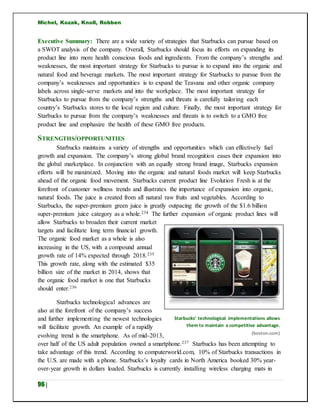
  • 110.
    Michel, Kozak, Knoll,Robben 110 | APPLICATION TO STARBUCKS:HOW THEY WEATHERED THE CRISIS BEFORE THE RECESSION Starbucks Corporation was expanding exponentially before the recession. They had developed a cost-efficient value chain to reduce the average store opening costs and reduce day- to-day costs. Starbucks created economies of scale by using centralized buying and developing standard contracts and fixed fees, as well as using highly regarded contractors who displayed good cost-control. Additionally, the company was successful in nearly becoming vertically integrated both backward and forward. Because Starbucks was able to source their beans from a number of areas due to their contracts and vertical integration, the company was at less exposure to bad weather, price fluctuations, and volatile economic and political conditions in coffee growing countries. Similarly, the company created a means of value for their customers by providing a comfortable ambiance that attributed to the overall experience. They sought to create a third place between home and work where customers could relax and unwind. They wanted customers to come to their stores to meet friends, read a book, surf the Internet, or listen to the company’s in-house music. Starbucks had expanded briskly across the U.S. prior to the recession. The company had a powerful and well-known brand name that was easily transferable to other businesses, allowing them to pursue joint ventures and diversify their portfolio. Through their joint ventures, they made their product more accessible to both existing and new customers. DURING THE RECESSION Starbucks was facing a management crisis and a recession simultaneously. “For some reason,” Howard Schultz told Harvard Business Review, by 2007, “we seemed to become the poster child for excess. It’s easy to laugh about it now, but people said that buying a latte at Starbucks wasn’t smart. McDonald’s put up billboards saying that four dollars for a coffee is
  • 111.
    Starbucks Business Analysis |111 dumb. Gas went as high as five dollars in some places, coupled with the financial crisis—and all of a sudden we saw a seismic change in consumer behavior.”279 In 2007, Starbucks’ customer traffic fell for the first time ever. And from 2006 to 2008, their stock lost half its value.280 The recession hit the Starbucks experience hard. Sources indicate that during the leadership of Jim Donald, the company emphasized expansion and efficiency at the expense of customer service, effectively watering down the high-quality coffee experience that customers had enjoyed about Starbucks. In 2008, the board of directors asked Howard Schultz to return as CEO. The board reinstated Schultz as CEO on Jan. 8, 2008. Upon arrival Schultz laid out his plan before the top 10 executives of the company and asked simply “are you in or are you out?” Eight of the 10 top executives left the company.281 Schultz had his work cut out for him as CEO. He had to take a long, hard look at how other major visionaries, such as Charles Schwab and Steve Jobs, had turned their own companies around. His first objective was to remake Starbucks’ image, beginning with its mission statement. The company’s old mission was “to establish Starbucks as the premier purveyor of the finest coffees in the world while maintaining our uncompromising principles as we grow.” The new statement was, “to inspire and nurture the human spirit – One person, One cup, and One Neighborhood at a time.” This new mission statement marketed the company as more than just a beverage seller but an avenue of unique costumer experiences. It also emphasized Starbucks’ social responsibility: contributing to communities and charities, running an environmentally-friendly business, and treating employees well. Schultz conducted an overhaul of the company from top-to-bottom. He asked Arthur Rubinfield to return to redesign the company stores with ambiance that more closely resembled the Italian coffeehouse feel that had inspired Schultz to begin with. He had over 7,000 stores close early on Feb. 26, 2008, to retrain baristas on making great coffee. He consulted outsiders on the best ways to turn the company around. The company also invested in major advertising, including a commercial that on during Saturday Night Live during the 2008 presidential campaign, promising customers if they vote, they get a free cup of coffee.282 Howard Schultz (Starbucks.com) (Wall Street Journal)
  • 112.
    Michel, Kozak, Knoll,Robben 112 | Schultz’s greatest fear was losing core customers during the recession. “The issue at hand ... is the cost of losing your core customer,” he said. “It’s very hard to get them back.”283 To retain core customers, Starbucks introduced the Gold Card, which gave customers a variety of benefits. For $25 a year, they got free refills, 10% off almost all purchases, two hours of free Wi-Fi per day, and surprise offers through e-mail.284 After changing the mission statement, Schultz ran a situation analysis using SWOT. A SWOT analysis evaluates the internal and external strengths, weaknesses, opportunities and threats. Internal strengths for Starbucks include their strong brand identity, their ability to sell diverse products and their joint venture with PepsiCo. Their many retail locations and their joint venture allow them to leverage their value chain relationships into a competitive advantage. But relying on a joint venture can also be a weakness. The company also risks erosion of their values and goals if they expand too much. This was said to be the case leading up to the recession.285 Starbucks was becoming just a place; their coffee was often burnt and the experience was far from personal. 286 International expansion also provided a great opportunity for Starbucks. They already had a presence in major countries such as China, India, and Japan.287 They also demonstrate social responsibility through fair trade coffee purchases,288 their cooperation with growers to practice environmentally friendly work habits as well as treating their employees exceptionally well. Another venue they could approach is being “green” to attract environmentally conscious clientele. However, threats that Starbucks is faced with include but are not limited to, a saturated US market, fierce competition in the industry and substitute products. Many of these factors played a role in the erosion of sales during the recession as well as the return to profitable growth in 2010. Schultz came in and capitalized on the company’s strengths by improving existing supply chain activities and improved on the company’s weaknesses by closing 900 underperforming stores, trimming the workforce by roughly 6,700 employees and giving renewed attention to employee training that focused on enthusiasm for customer service.289 He also took advantage of the company’s opportunities by expanding their food menu, adding healthier bakery options, introducing new products such as Starbucks VIA and investing in international markets such as China, India, and Vietnam, while keeping the threats in mind. In February, Starbucks closed early in 7,100 locations to retrain its employees on how to make quality coffee. (BusinessInsider.com)
  • 113.
    Starbucks Business Analysis |113 By Q2 of FY2010 the company saw net revenues increase and a net income of $217 million. The same quarter a year prior the company’s net income was $25 million. Schultz therefore, successfully turned the company around and gained back its position in the market by bringing in new innovation while still staying true to the principles he used to build the company up from 1982 to 2000.
  • 114.
    Michel, Kozak, Knoll,Robben 114 | KEY FINDINGS & FURTHER INVESTIGATION THE ADVANTAGE OF BEING CHEAP Fast food and especially fast casual are well-positioned to benefit from recessions. The recession of 2008 may have worked to the benefit of the fast casual segment of the industry while working to the detriment of casual dining and, most of all, fine dining. The chart at right, from the Cleveland Plain Dealer, illustrates how fast casual restaurants continued to enjoy a decent growth rate while other restaurant types contracted.290 In 2013, Darden Restaurants, owners of Olive Garden and Red Lobster, saw declining sales. Applebee’s and Chili’s slashed their revenue projections. While fast food, casual dining, and fine dining aren’t going away, these segments should expect their growth to slow or decline in comparison to fast casual. Many larger chains would do well to follow Yum Brands’ model and start testing out various fast casual shops to find one that sticks with consumers. Yum Brands is still invested in Pizza Hut, Taco Bell, and KFC, but it’s also experimenting with several fast casual brands, including U.S. Taco Company, Bahn Shop, and Super Chix.291 Fast food also fared well during the recession. Despite whatever problems the credit crunch created for McDonald’s in attaining loans, the recession boosted foot traffic and sales to McDonald’s as customers sought out healthier options. In November 2008, McDonald’s announced their sales for October were up 8.2% over the previous year’s results.292 In the end, Chipotle, Qdoba, Starbucks, Burger King, and Panera Bread posted 2008 sales growth of 20.7%, 17.8%, 6.9%, 6.6%, and 16.2%, respectively. But the big winner of the recession was fast casual. And the fast casual market will only continue to grow. Of 3,000 costumers surveyed by Brand Keys consultancy group in September 2014, 32% of Baby Boomers, 11% of Generation X, and 20% of Millennials are frequenting fast food less than they used to. Among Millennials, 90% say they want food that’s “tastier, healthier, and more customized” and are willing to pay more for it.293
  • 115.
    Starbucks Business Analysis |115 CHANGE CAN BE FOR GOODOR ILL Starbucks found a great business strategy under Schultz’s guidance, then lost sight of it. Many analysts say Starbucks’ problem in 2008 is that they lost sight of their founding vision. That’s true enough, but they lost sight of their founding vision in 1982, when Schultz took over the company and transformed it from a coffee and spice retailer to a coffeehouse. Change can be for good or ill. Schultz found a formula that worked and guided the company’s expansion until 2000, but his successors lost sight of his vision despite his continued presence as chairman. According to analyst Simon Sinek, the biggest reason Starbucks struggled in 2007-09 isn’t even the financial crisis: it was because Schultz picked the wrong people to succeed. “The mistake all these visionary CEOs make,” Sinek said, “is that they choose someone who is an operator to become the visionary. So Howard Schultz picked his COO and Starbucks went into decline. Shultz had to come back. Michael Dell picked his COO. Dell went into decline and Michael Dell had to come back. Bill Gates picked his COO. Microsoft is in decline. Steve Jobs made the same mistake. He picked Tim Cook. Tim Cook is described as a man able to look at vast amounts of information and find the problems. You don’t want a man who finds problems; you want a guy who sees opportunity.”294 Schultz faced incredible pressure in his first few months back to streamline the company even further than his successors/predecessors did – cut employee benefits, franchise the stores – instead, he brought it back to his original vision of offering premium coffee while maintaining a socially responsible image. “There was tremendous pressure in the first three or four months after my return,” Schultz said in 2010, “to dramatically change the strategy and the business model of the company. The marketplace was saying, ‘Starbucks needs to undo all these company-owned stores and franchise the system.’ That would have given us a war chest of cash and significantly increased return on capital. It’s a good argument economically. It’s a good argument for shareholder value. But it would have fractured the culture of the company.”295 The culture was what mattered. It was what made a $4 cup of coffee seem reasonably to customers and Schultz knew it. As soon as Schultz returned, Starbucks’ stock shot up 8%. He successfully turned the company around, but at age 61, he won’t be there forever to run it. Someday, Starbucks’ board will have to appoint a new CEO and if they make the same mistake as before, Schultz might not be there to save the day again.
  • 116.
    Michel, Kozak, Knoll,Robben 116 | Endnotes 1 Statista.2014. ‘Number Of Coffee And Snack Shops In The U.S. 2016c’.Accessed December 11 2014. http://www.statista.com/statistics/196590/total-number-of-snack-and-coffee-shops-in-the-us-since-2002/. 2 Statista.2014. ‘Starbucks: Number of Stores U.S. 2014’. Accessed December 11 2014. http://www.statista.com/statistics/218360/number-of-starbucks-stores-in-the-us/. 3 Trefis,. 2014. ‘Why Starbucks Has An Edge Over Competitors Despite Rising Coffee Prices -- Trefis’. Accessed December 11 2014. http://www.trefis.com/stock/sbux/articles/239308/marywhy-starbucks-has-an-edge-over- competitors-despite-rising-coffee-prices/2014-05-30. 4 Allison, Melissa. 9 March 2008. ‘StarbucksCo-Founder Talks About Early Days, Launching Redhook And Seattle Weekly, Too’. Accessed December 11 2014. http://seattletimes.com/html/businesstechnology 5 Smith, Daniel P. September 2011. ‘Starbucks CEO Has Grand Plans For Coffee Brand’. Accessed December 11 2014. http://www.qsrmagazine.com/executive-insights/over-hill-40-years-sbux. 6 Starbucks.com “StarbucksCompany Timeline.” N.p., n.d. Web. 20 Sept. 2014. http://globalassets.starbucks.com/assets/5deaa36b7f454011a8597d271f552106.pdf 7 Entrepreneur. 10 October 2008. ‘Howard Schultz’. Accessed December 11 2014. http://www.entrepreneur.com/article/197692. 8 Larimore, Rachael.2014. ‘Starbucks CEO Howard Schultz Got The World Hooked On Lattes. Here’S How.’. Slate Magazine. Accessed December 11 2014. http://www.slate.com/articles/business/when_big_businesses_were_small 9 Bio.com.”Howard SchultzBiography.” A&E Networks Television, n.d. Web. 22 Sept. 2014. http://www.biography.com/people/howard-schultz-21166227#birth-of-the-modern-starbucks 10 REI. “Starbucks’International Operations.” N.p., n.d. Web. 22 Sept. 2014. http://www.mi.rei.ase.ro/Site%20MI/Starbucks_EN.pdf 11 Starbucks.com“Starbucks Company Timeline.” N.p., n.d. Web. 20 Sept. 2014. http://globalassets.starbucks.com/assets/5deaa36b7f454011a8597d271f552106.pdf 12 Geereddy, Nithin . “Strategic AnalysisOf Starbucks Corporation.” http://scholar.harvard.edu/files/nithingeereddy/files/starbucks_case_analysis.pdf 13 Simonetti, Betsina. “Examples of Backward Vertical Integration Strategies.” N.p., n.d. Web. 22 Sept. 2014. http://smallbusiness.chron.com/examples-backward-vertical-integration-strategies-14703.html 14 JVHero.com. “Strategic alliancesboost a business both partners.” N.p., n.d. Web. 22 Sept. 2014. http://www.jvhero.com/strategic-alliance-examples/ 15 Seattle Times. “Starbucks,Pepsi Join to Create Drinks.”Advanced.N.p., 11 Aug. 1994. Web. 22 Sept. 2014. http://community.seattletimes.nwsource.com/archive/?date=19940811&slug=1924821
  • 117.
    Starbucks Business Analysis |117 16 Seattle PI. “Starbucksand Unileverteam up over ice cream.” N.p., n.d. Web. 22 Sept. 2014. http://www.seattlepi.com/business/article/Starbucks-and-Unilever-team-up-over-ice-cream-1285251.php 17 Glover, Katherine. “StarbucksGoes All Out in Via Instant Coffee Launch.” CBSNews. CBS Interactive, 29 Sept. 2009. Web. 22 Sept. 2014. http://www.cbsnews.com/news/starbucks-goes-all-out-in-via-instant-coffee-launch/ 18 AdsoftheWorld.com,. 2014. ‘Starbucks Verismo: Impossible Until Now’. Accessed December 11 2014. http://adsoftheworld.com/media/tv/starbucks_verismo_impossible_until_now 19 USA Today. “Starbucks,Green Mountain expand partnership.” N.p., 21 Mar. 2012. Web. 22 Sept. 2014. http://usatoday30.usatoday.com/money/industries/food/story/2012-03-21/starbucks-green-mountain-partnership- expands/53684378/1 20 Starbucks Newsroom. “Starbucksand Danone Announce Strategic Agreement to Create and Develop an Exclusive Line of Evolution Fresh, Inspired by Dannon-branded Fresh Dairy Products.” N.p., 23 July 2013. Web. 22 Sept. 2014. http://news.starbucks.com/news/starbucks-and-danone-announce-strategic-agreement-to-create-and- develop-an- 21 The Wall Street Journal. “StarbucksInvests in Square.”, n.d. Web. 22 Sept. 2014. http://online.wsj.com/news/articles/SB10000872396390444423704577575803898185594 22 US Fed News Service. 18 May 2013. Starbucks Reports Multipled Transactions by CEO Schultz. Retrieved 10 December 2014,from http://www.highbeam.com/doc/1P3-2973171111.html 23 Gasparro,Annie. 2014.‘Starbucks Shuffles Global Management Team’. WSJ. Accessed December 11 2014. http://www.wsj.com/articles/SB10001424127887324766604578458862109746202 24 Biography.com. 2014. Howard Schultz.Retrieved 20 September 2014, from http://www.biography.com/people/howard-schultz-21166227#early-life-and-career 25 Mergentonline.com.ezproxy.mercyhurst.edu. 2014. Retrieved 20 September 2014, from http://www.mergentonline.com.ezproxy.mercyhurst.edu/companyexecutives.php?pagetype=officers&compnumber= 73271&exe 26 Entrepreneur. 2014. Howard Schultz.Retrieved 20 September 2014, from http://www.entrepreneur.com/article/197692 27 BusinessWeek. 2014. Clifford Burrows: Executive Profile & Biography.Retrieved 20 September 2014, from http://investing.businessweek.com/research/stocks/people/person.asp?personId=10202309&ticker=SBUX 28 Allison, Ibid. 29 MergentOnline.com.ezproxy.Mercyhurst.edu. 2014. Retrieved 20 September 2014, from http://www.mergentonline.com.ezproxy.mercyhurst.edu/companyexecutives.php?compnumber=73271&pagetype=o fficers&execid 30 Allison, Melissa. 2014. Building Starbucks one store at a time. The Seattle Times. Retrieved 20 September 2014, from http://seattletimes.com/html/businesstechnology/ 31 Starbucks Newsroom. 2014. Cliff Burrows | Starbucks Newsroom. Retrieved 20 September 2014, from http://news.starbucks.com/leadership/cliff-burrows 32 LeviStrauss.com. 2014. Leadership.Retrieved 20 September 2014, from http://www.levistrauss.com/who-we- are/leadership/
  • 118.
    Michel, Kozak, Knoll,Robben 118 | 33 Mergentonline.com.ezproxy.mercyhurst.edu. 2014. Retrieved 20 September 2014, from http://www.mergentonline.com.ezproxy.mercyhurst.edu/companyexecutives.php?compnumber=73271&pagetype=o fficers&execid 34 Starbucks Newsroom. 2014. Troy Alstead. Retrieved 20 September 2014, from http://news.starbucks.com/leadership/troy-alstead 35 Businessweek.com. 2014. Annie Young-Scrivner:Executive Profile & Biography. Retrieved 20 September 2014, from http://investing.businessweek.com/research/stocks/people/person.asp?personId=62658752&ticker=SBUX 36 Linkedin.com. 2014. Annie Young-Scrivner. Retrieved 20 September 2014, from https://www.linkedin.com/pub/annie-young-scrivner/14/b6/b67 37 BusinessWeek.com. 2014. Annie Young-Scrivner:Executive Profile & Biography.Retrieved 20 September 2014, from http://investing.businessweek.com/research/stocks/people/person.asp?personId=62658752&ticker=SBUX 38 MergentOnline.com.ezproxy.Mercyhurst.edu. (2014). Retrieved 20 September 2014, from http://www.mergentonline.com.ezproxy.mercyhurst.edu/companyexecutives.php?compnumber=73271&pagetype=o fficers&execid 39 York, E. 2010. The Global CMO Interview: Annie Young-Scrivner,Starbucks.AdAge.com. Retrieved 20 September 2014, from http://adage.com/article/cmo-interviews/global-cmo-interview-annie-young-scrivner- starbucks/144390/ 40 LinkedIn.com. 2014. Adam Brotman. Retrieved 20 September 2014, from https://www.linkedin.com/in/adambrotman 41 Starbucks Newsroom. 2014. Adam Brotman. Retrieved 20 September 2014, from http://news.starbucks.com/leadership/adam-brotman 42 Engleman, Eric. 2014. Q&A: Starbucks’Adam Brotman on the coffee giant’s digital push. Puget Sound Business Journal. Retrieved 20 September 2014, from http://www.bizjournals.com/seattle/blog/techflash/2010/09/qa_adam_brotman_on_starbucks_big_digital_push.html? page=all 43 MergentOnline.com.ezproxy.Mercyhurst.edu. (2014). Retrieved 20 September 2014, from http://www.mergentonline.com.ezproxy.mercyhurst.edu/companyexecutives .php?compnumber=73271&pagetype=o fficers&execid 44 BusinessWeek.com. 2014. John Culver: Executive Profile & Biography.Retrieved 20 September 2014, from http://investing.businessweek.com/research/stocks/people/person.asp?personId=35346233&ticker=SBUX 45 Starbucks Newsroom. 2014. Arthur Rubinfeld.Retrieved 20 September 2014, from http://news.starbucks.com/leadership/arthur-rubinfeld 46 MergentOnline.com.ezproxy.Mercyhurst.edu. (2014). Retrieved 20 September 2014, from http://www.mergentonline.com.ezproxy.mercyhurst.edu/companyexecutives.php?compnumber=73271&pagetype=o fficers&execid=7269030 47 Starbucks Newsroom. 2014. John Culver. Retrieved 20 September 2014, from http://news.starbucks.com/leadership/john-culver 48 LinkedIn.com. 2014. Matt Ryan. Retrieved 20 September 2014, from https://www.linkedin.com/pub/matt- ryan/69/1a5/201
  • 119.
    Starbucks Business Analysis |119 49 Starbucks Newsroom. 2014. Matthew Ryan. Retrieved 20 September 2014, from http://news.starbucks.com/leadership/matthew-ryan 50 Businessweek.Com. 2014. ‘Matthew Ryan: Executive Profile & Biography’. Accessed December 11 2014. http://investing.businessweek.com/research/stocks/people/person.asp?personId=234697375&ticker=SBUX. 51 Starbucks Coffee Company. 2014. ‘Our Brands’. Accessed September 23 2014. http://www.starbucks.com/careers/brands. 52 Thestreet.com. 2014. Accessed September 23 2014. http://www.thestreet.com/story/12886177/1/can-apple-pay- trump-starbucks-mobile-app-payment-success.html. 53 Starbucks Coffee Company. 2014. ‘Our Relationships’. Accessed September 23 2014. http://www.starbucks.com/responsibility/learn-more/relationships. 54Starbucksocs.com. 2014. ‘Torrefazione Italia® Coffee | Coffee | Starbucks Office Coffee’. Accessed September 23 2014. http://starbucksocs.com/Coffee/Torrefazione. 55 American Marketing Association. “About AMA.” American Marketing Association. 2014. https://www.ama.org/AboutAMA/Pages/Definition-of-Marketing.aspx. 56 Marketingweek.co.uk. 2014. ‘Starbucks Marketing Strategy & Marketing Campaigns | Marketing Week’. Accessed September 23 2014. http://www.marketingweek.co.uk/brands/starbucks/. 57 Ruiz, Joseph.2011. ‘6 Reasons Starbucks Marketing Communications Strategy Is So Effective | Strategic Driven’. Strategicdriven.Com. Accessed September 23 2014. http://www.strategicdriven.com/marketing-insights-blog/6- Reasons-Starbucks-marketing-communications-strategy-is-so-effective/. 58 Twitter.com. 2014. ‘Starbucks Coffee (Starbucks) | Twitter’. Accessed September 23 2014. https://twitter.com/Starbucks. 59 Facebook. 2014. ‘Starbucks’. Accessed September 23 2014. https://www.facebook.com/Starbucks. 60 Noff, Ayelet. 2010. ‘The Starbucks Formula For Social Media Success - The Next Web’. The Next Web. Accessed September 23 2014. http://thenextweb.com/2010/01/11/starbucks-formula-social-media-success/. 61 Voteforus.com. 2014. ‘ Starbucks Marketing Strategy’. Accessed September 23 2014. http://www.voteforus.com/starbucksmarketingstrategy.html. 62 Starbucks.com. 2014. ‘Responsibility’. Accessed September 23 2014. http://www.starbucks.com/responsibility. 63 Co.Design. 2012. ‘An Experimental New Starbucks Store:Tiny, Portable, And Hyper Local’. Accessed September 23 2014. http://www.fastcodesign.com/1670889/an-experimental-new-starbucks-store-tiny-portable-and-hyper- local. 64 Brantley, Chris. 2014. ‘ What StarbucksHas To Gain By Expanding Its Alcohol Sales (SBUX) ‘. The Motley Fool. Accessed September 23 2014. http://www.fool.com/investing/general/2014/04/21/what-starbucks-has-to-gain-by- expanding-their-alco.aspx. 65 Bruce Horovitz. 2014. ‘StarbucksTo Try Tasting Room; Express Stores’. USAToday.com. Accessed September 23 2014. http://www.usatoday.com/story/money/2014/09/05/starbucks-fast-food-restaurants/15106295/. 66 SEC.gov. 2014. ‘SBUX - 9.29.2013 - 10K’. Accessed September 23 2014. http://www.sec.gov/Archives/edgar/data/829224/000082922413000044/sbux-9292013x10k.htm
  • 120.
    Michel, Kozak, Knoll,Robben 120 | 67 Ibid. 68 Violet Law, GlobalPost. 2014. ‘StarbucksPushes Major Expansion In China As Coffee Culture Emerges’. NBC News. Accessed September 23 2014. http://www.nbcnews.com/news/asian-america/starbucks-pushes-major- expansion-china-coffee-culture-emerges-n175141. 69 Starbucks Coffee Company. 2014. ‘Manufacturing And Distribution’. Accessed September 23 2014. http://www.starbucks.com/careers/manufacturing-distribution. 70 DCVelocity.com. May 6, 2010. ‘Conference Reports - WERC Annual Conference 2010 - Starbucks’Supply Chain Finds Success Through Simplicity’.Accessed September 23 2014. http://www.dcvelocity.com/conference_reports/werc2010/20100526starbucks_supply_chain/. 71 Glassdoor. 2014. ‘Working At Starbucks’.Accessed September 23 2014. http://www.glassdoor.com/Overview/Working-at-Starbucks-EI_IE2202.11,20.htm. 72 LexisNexis Starbucks Profile 73 LexisNexis Starbucks Profile 74 Team, Trefis. 2014. ‘StarbucksTo Enter Into New Beverage Segments With Teavana & Fizzio Brands’. Forbes. Accessed September 23 2014. http://www.forbes.com/sites/greatspeculations/2014/09/02/starbucks-to-enter-into- new-beverage-segments-with-teavana-fizzio-brands/. 75 Guenette, Ryan. 2014. ‘StarbucksIs Under-Stored In The U.S. -- Wait, What?’. Fool.com. Accessed September 21 2014. http://www.fool.com/investing/general/2014/07/15/starbucks-is-under-stored-in-the-us-wait-what.aspx. 76 Starbucks Newsroom. 2011. ‘StarbucksCompany Timeline.’ Accessed September 23, 2014. http://www.starbucks.com/assets/ba6185aa2f9440379ce0857d89de8412.pdf 77 Transcripts, SA. 2014. ‘Starbucks’CEO Discusses F2Q2014 Results - Earnings Call Transcript’. Seekingalpha.Com. Accessed September 21 2014. http://seekingalpha.com/article/2164683-starbucks-ceo-discusses- f2q2014-results-earnings-call-transcript?part=single. 78 Gardner, T. 2014. Why Drive-Thru Locations Are So Important for Starbucks (SBUX).Fool.com. Accessed 21 September 2014. http://www.fool.com/investing/general/2013/04/09/why-drive-thru-locations-are-so-important-for- star.aspx 79 Starbucks.com. StarbucksCoffee 2012 Biennial Investor Conference – John Culver. Accessed 20 September 2014. http://phx.corporate- ir.net/External.File?item=UGFyZW50SUQ9NDg3NzMxfENoaWxkSUQ9NTIzOTgyfFR5cGU9MQ==&t=1 80 NetLeaseAdvisor.com. 2014. ‘StarbucksNet Lease Information’. Accessed September 21 2014. http://www.netleaseadvisor.com/tenant.php?t=17. 81 Burkitt, Laurie. 2014. ‘StarbucksPlaysTo Local Chinese Tastes’. WSJ. Accessed September 21 2014. http://online.wsj.com/news/articles/SB10001424127887324784404578142931427720970?mg=reno64- wsj&url=http%3A%2F%2Fonline.wsj.com%2Farticle 82 Examiner.com. 2014. ‘StarbucksChina Launches Internet Promotion To Lure Customers’. Accessed September 21 2014. http://www.examiner.com/article/starbucks-china-launches-internet-promotion-to-lure-customers.
  • 121.
    Starbucks Business Analysis |121 83 Reuters. 2014. ‘China Food Scandal Spreads,Drags In Starbucks, Burger King And Mcnuggets In Japan’. Accessed September 21 2014. http://www.reuters.com/article/2014/07/22/us-china-food- idUSKBN0FR07K20140722. 84 The Brazil Business.2011. ‘4 Lessons To Learn From Starbucks In Brazil’. Accessed September 21 2014. http://thebrazilbusiness.com/article/4-lessons-to-learn-from-starbucks-in-brazil. 85 SeattleTimes.com. 2014. ‘StarbucksEnters Brazilian Coffee Market With 2 Sao Paulo Stores’. Accessed September 21 2014. http://seattletimes.com/html/businesstechnology 86 The Economic Times. 2014. ‘Coffee Chain Starbucks Expanding Aggressively In India’. Accessed September 21 2014. http://articles.economictimes.indiatimes.com/2014-04-14/news/49126396_1_costa-coffee-cafe-coffee-day- coffee-chain. 87 Starbucks.com. 2013. Global Responsibility Report.Accessed September 21, 2014. http://news.starbucks.com/uploads/documents/Responsibility_Report_2013.pdf 88 Dan Ritter, Wall St. Cheat Sheet. 2014. ‘3 Reasons It’s Hard To Hate Starbucks’.USAToday.Com. Accessed September 21 2014. http://www.usatoday.com/story/money/business/2014/07/06/why-its-hard-to-hate- starbucks/12022699/ 89 Starbucks Coffee Company. 2014. ‘Coffee Purchasing’. Accessed September 22 2014. http://www.starbucks.com/responsibility/global-report/ethical-sourcing/coffee-purchasing. 90 Starbucks Coffee Company. 2014. ‘Building Greener Stores’. Accessed September 22 2014. http://www.starbucks.com/responsibility/environment/green-building. 91 Ho, Erica, and Erica Ho. 2014. ‘StarbucksIntroduces Environmentally-Friendly $1 Reusable Cups’.TIME.Com. Accessed September 21 2014. http://newsfeed.time.com/2013/01/03/starbucks-introduces-environmentally-friendly- 1-reusable-cups 92 Fortune. 2010. ‘ StarbucksSpendsMore On Health Care Than Coffee’. Accessed September 21 2014. http://archive.fortune.com/2010/06/07/news/companies 93 The Seattle Times. 2014. ‘Howard Schultz Talks To Harvard Business Review: A Preview Of His Upcoming Book?’Accessed September 22 2014. http://seattletimes.com/html/coffeecity/2012378067_howard_schultz_talks_to_harvar.html. 94 Starbucks Newsroom. 2014. ‘StarbucksAccelerates Path Toward One Million Community Service Hours In 2013 Through 3Rd Annual Global Month Of Service’. Accessed September 22 2014. http://news.starbucks.com/news/starbucks-accelerates-path-toward-one-million-community-service-hours-in-20. 95 NewStatesman.com. 2012. ‘Nothing Says ‘Have A Nice Day, Now Get Out!; Like A Paper Cup’. Accessed September 21 2014. http://www.newstatesman.com/business/business/2012/05/simon-sinek-starbucks-steve-jobs- lady-gaga. 96 Trefis. June 4, 2014. ‘Why Starbucks Has An Edge Over Competitors Despite Rising Coffee Prices.’ NASDAQ.com. Accessed October 20, 2014. http://www.nasdaq.com/article/why-starbucks-has-an-edge-over-competitors- despite-rising-coffee-prices-cm358945 97 Simonetti, Betsina.“Examples of Backward Vertical Integration Strategies.” N.p., n.d. Web. 22 Sept. 2014. http://smallbusiness.chron.com/examples-backward-vertical-integration-strategies-14703.html
  • 122.
    Michel, Kozak, Knoll,Robben 122 | 98 Trefis,. 2014.‘Why Starbucks Has An Edge Over Competitors Despite RisingCoffee Prices -- Trefis’. Accessed December 11 2014. http://www.trefis.com/stock/sbux/articles/239308/marywhy-starbucks-has-an-edge-over- competitors-despite-rising-coffee-prices/2014-05-30. 99 Starbucks InvestorRelations. 2014. ‘Quarterly Results’. Accessed September 23 2014. http://investor.starbucks.com/phoenix.zhtml?c=99518&p=quarterlyearnings. 100 Stynes, Tess.Jul 24 2014. ‘Starbucks Posts Higher Profit, Revenue ‘. WSJ. Accessed September 23 2014. http://online.wsj.com/articles/starbucks-posts-higher-profit-revenue-as-traffic-improves-1406232968. 101 Ibid. 102 Stynes, Ibid. 103 Csimarket.com. 2014. ‘StarbucksCapital Expenditures Growth Rates (SBUX), Current And Historic Growth - Csimarket’. Accessed September 23 2014. http://csimarket.com/stocks/single_growth_rates.php?code=SBUX&capx. 104 Peterson, Hayley. 2014. ‘ShareholdersSue Starbucks For $2.8 Billion Over Dispute With Kraft’. Business Insider. Accessed September 23 2014. http://www.businessinsider.com/shareholders-sue-starbucks-over-kraft- dispute-2014-1. 105 Golson, Jordan. 2014. ‘StarbucksHas Already Shown Us The Future Of Mobile Payments’. Techrepublic. Accessed September 23 2014. http://www.techrepublic.com/article/starbucks-has-already-shown-us-the-future-of- mobile-payments/. 106 The Huffington Post. 2014. ‘StarbucksBaristas Fight To Show Tattoos’. Accessed September 23 2014. http://www.huffingtonpost.com/2014/09/12/starbucks-tattoos_n_5811888.html. 107 Pew Research Center for the People and the Press. 2007. ‘A Portrait Of “Generation Next”‘. Accessed September 23 2014. http://www.people-press.org/2007/01/09/a-portrait-of-generation-next/. 108 The Seattle Times. 2014. ‘StarbucksMay Let Baristas Bare Their Tattoos’. Accessed September 23 2014. http://seattletimes.com/html/businesstechnology/2024508750_starbuckstattooxml.html. 109 http://www.nbcnews.com/news/asian-america/starbucks-pushes-major-expansion-china-coffee-culture-emerges- n175141 110 The Street. 2014. ‘Could Weaker China Economy Derail U.S. Retailer’s Plans For Asia?’. Accessed September 23 2014. http://www.thestreet.com/story/12878966/1/could-weaker-china-economy-derail-us-retailers-plans-for- asia.html. 111 CBSnews.com. 2014. ‘McDonald’s, KFC Operations In China Affected By Food Scandal’.Accessed September 23 2014. http://www.cbsnews.com/news/mcdonalds-kfc-operations-in-china-affected-by-food-scandal/. 112 Barber, Elizabeth. 2014. ‘‘Gutter Oil’ Sparks Food Fears Once Again In Greater China’. TIME.Com. Accessed September 23 2014. http://time.com/3300093/taiwan-gutter-oil-hong-kong-chang-guann-maxims-cakes-starbucks-7- eleven/. 113 Burritt, Chris. 2013. ‘StarbucksTo Pay $2.79 Billion To Settle Coffee Dispute’. Bloomberg. Accessed October28 2014. http://www.bloomberg.com/news/2013-11-12/starbucks-to-pay-2-76-billion-to-settle-grocery-dispute.html. 114 Ibid.
  • 123.
    Starbucks Business Analysis |123 115 NASDAQ.com,. 2014. ‘Starbucks Corporation (SBUX) PE Ratio’. Accessed October28 2014. http://www.nasdaq.com/symbol/sbux/pe-ratio. 116 NASDAQ.com, Ibid. 117 Burritt, Ibid. 118 Adamy, Janet, and Nick Wingfield. 2014. ‘Starbucks To Present Recession Strategy’.WSJ. Accessed September 30 2014. http://online.wsj.com/articles/SB123723335325646025 119 Digital Spark Marketing. 2013. ‘Starbucks Marketing Makes Social Media A Difference Maker’. Accessed October 15 2014. http://www.digitalsparkmarketing.com/creative-marketing/social-media/starbucks-marketing/. 120 Gembarski, Robert. 2012. ‘How Starbucks Built An Engaging Brand On Social Media - Social Media Content Creation & Lead Generation By Branding Personality’.Social Media Content Creation & Lead Generation By Branding Personality. Accessed October15 2014. http://www.brandingpersonality.com/how-starbucks-built-an- engagin-brand-on-social-media/. 121 Starbucks Newsroom. 2014. ‘Sharing (Some) Secrets Of The Starbucks Partner Social Media Team’. Accessed October 15 2014. http://news.starbucks.com/news/sharing-some-secrets-of-the-starbucks-partner-social-media-team. 122 Technology, Massachusetts.2013. ‘How Starbucks Has Gone Digital’. MIT Sloan Management Review. Accessed October15 2014. http://sloanreview.mit.edu/article/how-starbucks-has-gone-digital/. 123 Google.com. 2014. ‘Google Trends’. Accessed October15 2014. http://www.google.com/trends/explore#q=Starbucks 124 Alexa.com. 2014. ‘Alexa Site Overview’. Accessed October15 2014. http://www.alexa.com/siteinfo#?sites=timhortons.com&sites=dunkindonuts.com. 125 TweetReach. 2014. ‘Twitter Reach Report Results For Starbucks’.Accessed October15 2014. http://tweetreach.com/reports/11981395. 126 TweetReach. 2014. ‘Twitter Reach Report Results For Dunkin’Donuts’. Accessed October15 2014. https://tweetreach.com/reports/11981401. 127 TweetReach. 2014. ‘Twitter Reach Report Results For Tim Hortons’. Accessed October15 2014. https://tweetreach.com/reports/11981405. 128 SocialMention.com. 2014. ‘FAQ’. Accessed October15 2014. http://socialmention.com/faq. 129 SocialMention.com. 2014. ‘Loading...’. Accessed October15 2014. http://www.socialmention.com/search?q=Starbucks&t=all&btnG=Search. 130 SocialMention.com. 2014. ‘Starbucks’.Accessed October14 2014. http://socialmention.com/search?q=starbucks&t=blogs&btnG=Search. 131 BoardReader.com. 2014. ‘Starbucks’.Accessed October14 2014. http://boardreader.com/s/starbucks.html. 132 RivalIQ.com. 2014. ‘CompetitorAnalysis For Digital Marketers’. Accessed October14 2014. https://www.rivaliq.com/overview.
  • 124.
    Michel, Kozak, Knoll,Robben 124 | 133 Google.com. 2014. ‘Web Search Interest’. Accessed October14 2014. http://www.google.com/trends/explore#q=starbucks%2C%20%2Fm%2F02ccc5%2C%20%2Fm%2F018l04&cmpt= q. 134 Iol.co.za. 2014. ‘StarbucksMust Pay Damages To Kraft’. Accessed October14 2014. http://www.iol.co.za/business/international/starbucks-must-pay-damages-to-kraft-1.1606300#.VDyCUvldWSo. 135 YouTube. 2014. ‘StarbucksCoffee’. Accessed October14 2014. https://www.YouTube.com/user/Starbucks. 136 Facebook. 2014. ‘Starbucks’.Accessed October14 2014. https://www.facebook.com/Starbucks. 137 IceRocket.com. 2014. ‘MeltwaterIcerocket Blog Search’. Accessed October14 2014. http://www.icerocket.com/search?tab=blog&fr=h&q=starbucks. 138 Instagram. 2014. ‘StarbucksOn Instagram’. Accessed October14 2014. http://instagram.com/starbucks. 139 MyStarbucksIdea.force.com. 2014. ‘List of Ideas’. Accessed October14 2014. http://mystarbucksidea.force.com/ideaList?ext=0&lsi=0&category=Atmosphere+%26+Locatio 140 August 29, 2014. ‘Report: Diners More Likely to Order Healthy,Familiar Foods.’ QSR Magazine. Accessed October 10, 2014. http://www.qsrmagazine.com/news/report-diners-more-likely-order-healthy-familiar-foods. 141 Ibid. 142 Kelso, Alicia. October 17, 2014. ‘Industry Trends: Consumers Will Spend More for Transparency, Authenticity, Safety.’ FastCasual.com. Accessed October18, 2014. http://www.fastcasual.com/articles/industry-trends-consumers- will-spend-more-for-transparency-authenticity-safety/. 143 Callum-Penso, Lillia. October 19, 2014. ‘As Millennials grow up they are shaping the dining landscape.’ GreenvilleOnline. Accessed October20, 2014. http://www.greenvilleonline.com/story/entertainment/dining/2014/10/18/millennials -grow-shaping-dining- landscape/17502137/ 144 Gerdeman, Dina. 2014. ‘Why Would Consumers Want To Adopt Apple Pay?’. Forbes. Accessed October17 2014. http://www.forbes.com/sites/hbsworkingknowledge/2014/10/15/why-would-consumers-want-to-adopt-apple-pay/. 145 Thomas, Owen. 2014. ‘You Actually Can’t Use Apple Pay To Buy A Latte At Starbucks’.Accessed October17 2014. Readwrite.com. http://readwrite.com/2014/10/16/starbucks-apple-pay-launch. 146 Shein, Esther. 2014. ‘NFC: A Bust Already?’. Accessed October17 2014. http://www.informationweek.com/wireless/nfc-a-bust-already/d/d-id/1106700?. 147 Nichols, Chris. 2014. ‘Restaurant Technology Isn’t Replacing Humans Yet’. Yahoo Finance. Accessed October 22 2014. http://finance.yahoo.com/news/restaurant-technology-isn-t-replacing-humans-yet-170615778.html. 148 Mediaroom.marlinfinance.com,. 2014. ‘Technology Next On The Menu For Some Restaurants | Marlin Equipment Finance Media Room’. Accessed October22 2014. http://mediaroom.marlinfinance.com/food-service- equipment/technology-next-on-the-menu-for-some-restaurants/. 149 Caruthers, Renee. Oct. 14, 2014. ‘JPMorgan Will Double Cybersecurity Spending But Many Other Companies May Cut Costs’. FierceFinanceIT. Accessed October22 2014. http://www.fiercefinanceit.com/story/jpmorgan-will- double-cybersecurity-spending-many-other-companies-may-cut-co/2014-10-14.
  • 125.
    Starbucks Business Analysis |125 150 Samson, Adam. Aug.28, 2014. ‘Sophisticated Bank Cyber Attack Said To Target Core Infrastructure’. Fox Business.Accessed October22 2014. http://www.foxbusiness.com/technology/2014/08/28/sophisticated-bank- cyber-attack-said-to-target-core-infrastructure/. 151 Vinton, Kate. Sept. 30, 2014. ‘Data Breach Bulletin:Supervalu,Jimmy John’s, Shellshock,American Family Care’. Forbes. Accessed October22 2014. http://www.forbes.com/sites/katevinton/2014/09/30/data-breach-bulletin- supervalu-jimmy-johns-shellshock-american-family-care/. 152 Williams, Martyn. Sep. 26, 2014. ‘Credit Card Breach That Hit Jimmy John’s Is Larger Than Originally Thought’. Pcworld. Accessed October22 2014. http://www.pcworld.com/article/2688452/credit-card-breach-that- hit-jimmy-johns-is-larger-than-originally-thought.html. 153 Lee, Brianna. 2014. ‘Brazil Drought Boosts Coffee Prices, Threatens Sugar Production’.International Business Times. Accessed October17 2014. http://www.ibtimes.com/brazil-drought-boosts-coffee-prices-threatens-sugar- production-1704093. 154 Caldwell, Kyle. 2014. ‘Coffee Prices Are Rising - How Can You Invest?’. Telegraph.Co.Uk. Accessed October 17 2014. http://www.telegraph.co.uk/finance/personalfinance/investing/11159602/Why-the-price-of-coffee-is- rising-and-how-to-profit-from-it.html. 155 Sozzi, Brian. 2014. ‘What Do Exploding Coffee Prices Mean For Starbucks In 2015?’. Accessed October17 2014. http://www.thestreet.com/story/12901457/1/what-do-exploding-coffee-prices-mean-for-starbucks-in- 2015.html. 156 Baertlein. Sep. 30, 2014. ‘U.S. Restaurant Patrons Support Minimum Wage Hike: Survey’. Accessed October22 2014. http://www.reuters.com/article/2014/09/30/us-usa-restaurants-wage-idUSKCN0HP2DC20140930. 157 Dreier, Peter. Oct. 1, 2014. ‘The War Over Wages, City By City’. The Huffington Post. Accessed October22 2014. http://www.huffingtonpost.com/peter-dreier/the-war-over-wages-city- b_b_5916154.html?utm_hp_ref=politics. 158 O’Donnell, Carl. Oct. 13, 2014. ‘StocksTumble In Worst Three Day Slide Since 2011’. Forbes. Accessed October 22 2014. http://www.forbes.com/sites/carlodonnell/2014/10/13/stocks-tumble-in-worst-three-day-slide-since-2011/. 159 Tobey, John. Oct. 20, 2014. ‘‘Corrected’ Stock Market At Crossroads - How To Decide Next Direction’. Forbes. Accessed October22 2014. http://www.forbes.com/sites/johntobey/2014/10/20/corrected-stock-market-at- crossroads-how-to-decide-next-direction/. 160 Insana, Ron. Oct. 21, 2014. ‘Is The Stock-Market Correction Over?’.CNBC. Accessed October22 2014. http://www.cnbc.com/id/102106829. 161 Josie Sexton. 2014. ‘As GMO Issue Heads To Ballot,Two Sides Still At Odds’. Coloradoan.com. Accessed October 17 2014. http://www.coloradoan.com/story/news/local/2014/10/13/safety-fairness-heart-gmo-labeling- issue/17236095/. 162 OregonLive.com. 2014. ‘GMO Labeling In Oregon: Measure 92 Turns State Into ‘Battleground For Food Culture’’. Accessed October17 2014. http://www.oregonlive.com/politics/index.ssf/2014 163 The Daily Meal. 2014. ‘StarbucksUrged To Stop Using Milk From GMO-Fed Cows’. Accessed October17 2014. http://www.thedailymeal.com/news/starbucks-urged-stop-using-milk-gmo-fed-cows/100214. 164 Responsibility, Global. June 17, 2014. ‘ Global Consumers Are Willing To Put Their Money Where Their Heart Is When It Comes To Goods And Services From Companies Committed To Social Responsibility ‘.Nielsen.Com.
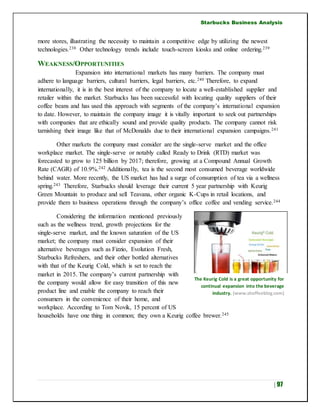
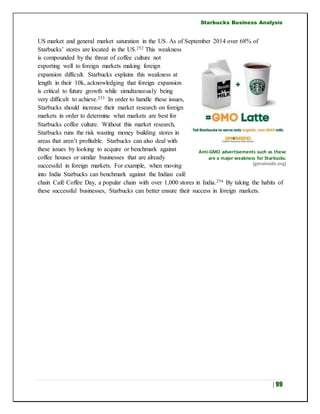
  • 126.
    Michel, Kozak, Knoll,Robben 126 | Accessed October22 2014. http://www.nielsen.com/content/corporate/us/en/press-room/2014/global-consumers- are-willing-to-put-their-money-where-their-heart-is.html. 165 How, Veronica Maria. Oct. 18, 2014. ‘How Do Consumers Perceive Corporate Social Responsibility?’ MarketingProfs. Accessed October22 2014. http://www.marketingprofs.com/chirp/2014/26265/how-do-consumers- perceive-corporate-social-responsibility-infographic. 166 Starbucks Coffee Company. 2013. ‘Global Responsibility Report Goals & Progress 2013’.Accessed October22 2014. http://www.starbucks.com/responsibility/global-report. 167 Faber, Scott. March 1, 2014. ‘Bay Journal - Article: Demand For Organic Food Growing Faster Than Domestic Supply’.Bayjournal.com. Accessed October22 2014. http://www.bayjournal.com/article/demand_for_organic_food_growing_faster_than_domestic_supply 168 Hopkinson, Jenny.2014. ‘Will Wal-Mart Gobble Up Organic Food Supply?’.Politico. Accessed October22 2014. http://www.politico.com/story/2014/04/walmart-organic-food-105631.html. 169 Lomax, Alyce. July 14, 2014. Supply,Demand, and Organic Industry RiskFool.com. Accessed October22 2014. http://www.fool.com/investing/general/2014/07/14/supply-demand-and-organic-industry-risk.aspx. 170 Patton, Leslie. Oct. 21, 2014. ‘McDonald’s May Sell More Organic Foods’. Businessweek.Com. Accessed October 22 2014. http://www.businessweek.com/news/2014-10-21/mcdonald-s-may-sell-more-organic-foods. 171 Starbucks Coffee Company. 2014. ‘An Open Letter From Howard Schultz,CEO Of Starbucks Coffee Company’. Accessed October17 2014. http://www.starbucks.com/blog/an-open-letter-from-howard-schultz-ceo-of-starbucks- coffee-company/1268. 172 chrishernandezauthor. 2014. ‘Please, Open Carriers, Stop “Defending My Rights”‘. Accessed October17 2014. http://chrishernandezauthor.com/2014/07/06/please-open-carriers-stop-defending-my-rights/. 173 2acheck.com. 2014. ‘StarbucksBans Guns.’ Second Amendment Check. Accessed October17 2014. http://www.2acheck.com/tag/starbucks-bans-guns/. 174 Jing, Wang. NortonRoseFulbright.com. September 2014. ‘Food Safety; China Set To Strengthen Food Safety Regulations’.Accessed October22 2014. http://www.nortonrosefulbright.com/au/knowledge/publications/120853/food-safety-china-set-to-strengthen-food- safety- 175 Schrieber, Andrew. Oct. 9, 2014. ‘Over Half Of Food Inspections In Mainland China Failed Last Quarter’. FoodNavigator-Asia.com. Accessed October22 2014. http://www.foodnavigator-asia.com/Policy/Over-half-of- food-inspections-in-mainland-China-failed-last-quarter. 176 CBSnews.com. 2014. ‘McDonald’s, KFC Operations In China Affected By Food Scandal’.Accessed September 23 2014. http://www.cbsnews.com/news/mcdonalds-kfc-operations-in-china-affected-by-food-scandal 177 Barber, Elizabeth. 2014. ‘‘Gutter Oil’ Sparks Food Fears Once Again In Greater China’. TIME.Com. Accessed September 23 2014. http://time.com/3300093/taiwan-gutter-oil-hong-kong-chang-guann-maxims-cakes-starbucks-7- eleven/. 178 Yen, Queena. Oct. 22, 2014. ‘Wei Indicted Over Fraud, Food Safety Violations,Forgery’. The China Post. Accessed October22 2014. http://www.chinapost.com.tw/taiwan/national/national-news/2014/10/22/420038/Wei- indicted.htm.
  • 127.
    Starbucks Business Analysis |127 179 Kaufman, Alex. Oct. 7, 2014. ‘Adding An ‘Obamacare Surcharge’To Restaurant Bills Is A Terrible Idea’. The Huffington Post.Accessed October22 2014. http://www.huffingtonpost.com/2014/10/07/obamacare- surcharge_n_5945732.html. 180 Staff, Washington.2014. ‘Obamacare Hurting Restaurants in Pennsylvania’.Washington Free Beacon. Accessed October22 2014. http://freebeacon.com/issues/obamacare-hurting-restaurants-in-pennsylvania/. 181 Berman, Jillian. 2014. ‘StarbucksCEO Howard Schultz: Obamacare Is ‘A Net Positive’’. The Huffington Post. Accessed October22 2014. http://www.huffingtonpost.com/2014/06/17/howard-schultz- obamacare_n_5504128.html. 182 The Huffington Post. Oct. 30, 2014. ‘Starbucks CEO: Obamacare Has Gone ‘Off The Rails’’. Accessed October 22 2014. http://www.huffingtonpost.com/2013/10/30/starbucks-obamacare-off-the-rails_n_4179271.html. 183 Ho, Solarina. September 16, 2014. ‘Amid coffee rivalry, McDonald’s Canada to sell java in grocery stores.’ Investing.com. Accessed October20, 2014. http://www.investing.com/news/stock-market-news/amid-coffee- rivalry,-mcdonald’s-canada-to-sell-java-in-grocery-stores-309664 184 Ho, Solarina. September 16, 2014. ‘Amid coffee rivalry, McDonald’s Canada to sell java in grocery stores.’ Investing.com. Accessed October20, 2014. http://www.investing.com/news/stock-market-news/amid-coffee- rivalry,-mcdonald’s-canada-to-sell-java-in-grocery-stores-309664 185 Smith, Daniel. August 2014. ‘Uncommon Ground.’ QSR Magazine. Accessed October20, 2014. http://www.qsrmagazine.com/competition/uncommon-ground 186 Yagalla, Mark. May 2, 2014. ‘StarbucksContinues to Blow Away the Competition. The Motley Fool. Accessed October 20, 2014. http://www.fool.com/investing/general/2014/05/02/starbucks-continues-to-blow-away-the- competition.aspx 187 Stephens,Steve. June 2, 2013. ‘Coffee tours help educate bean buyers and consumers.’ Dispatch. Accessed October 20, 2014. http://www.dispatch.com/content/stories/travel/2013/06/02/1-coffee-tours-help-educate-bean- buyers-consumers.html 188 Trefis. June 4, 2014. ‘Why StarbucksHas An Edge Over Competitors Despite Rising Coffee Prices.’ NASDAQ.com. Accessed October20, 2014. http://www.nasdaq.com/article/why-starbucks-has-an-edge-over- competitors-despite-rising-coffee-prices-cm358945 189 Shayon, Sheila. March 8, 2013. ‘Why Starbucks’Customer Loyalty is More Lucrative Than Any Ad Campaign.’ BrandChannel. Accessed October20, 2014. http://www.brandchannel.com/home/post/Starbucks-Customer-Loyalty- 030813.aspx 190 SCS Global Services. 2014. ‘StarbucksC.A.F.E. Practices’ SCS Global Services. Accessed October20, 2014. http://www.scsglobalservices.com/starbucks-cafe-practices 191 Starbucks. 2014. ‘Coffee.’ Starbucks. Accessed October20, 2014. http://www.starbucks.com/responsibility/sourcing/coffee 192 Trefis. June 4, 2014. ‘Why StarbucksHas An Edge Over Competitors Despite Rising Coffee Prices.’ NASDAQ.com. Accessed October20, 2014. http://www.nasdaq.com/article/why-starbucks-has-an-edge-over- competitors-despite-rising-coffee-prices-cm358945
  • 128.
    Michel, Kozak, Knoll,Robben 128 | 193 Jourdan, Adam. July 22, 2014. ‘China food scandal spreads, drags in Starbucks,Burger King and McNuggetsin Japan’ Reuters. Accessed October20, 2014. http://www.reuters.com/article/2014/07/22/us-china-food- idUSKBN0FR07K20140722 194 ABC7 San Francisco.8 December 2014. ‘McDonalds To Expand ‘Create Your Taste’ Program’. Accessed December 11 2014. http://abc7news.com/food/mcdonalds-to-expand-create-your-taste-program/428831/. 195 Williams, Martyn. 2014. ‘Credit Card Breach That Hit Jimmy John’s Is Larger Than Originally Thought’. Pcworld. Accessed December 10 2014. http://www.pcworld.com/article/2688452/credit-card-breach-that-hit-jimmy- johns-is-larger-than-originally-thought.html. 196 Li, Shan. 2 November 2014. ‘Bye-Bye, Burgers: New Fast-Food Chains Bet On Healthy Eating’.LAtimes.Com. Accessed December 10 2014. http://www.latimes.com/business/la-fi-healthy-fast-food-20141102- story.html#page=1. 197 Patton, Leslie. 2014. ‘McDonald’S Bringing Back Mcrib In 75% Of U.S. Restaurants’. Bloomberg. Accessed December 11 2014. http://www.bloomberg.com/news/2014-11-05/mcdonald-s-bringing-back-mcrib-in-75-of-u-s-restaurants.html. 198 Staff, CNN. 2014. ‘Can StarbucksDelivery Deliver?’. CNN. Accessed December 10 2014. http://www.cnn.com/2014/10/31/living/starbucks-delivery-pros-cons/. 199 Stynes, Tess.2014. StarbucksDelivery Is Coming; Sales Rise 10%. WSJ.com. Accessed December 10 2014. http://www.wsj.com/articles/starbucks-sales-growth-disappoints-1414700141. 200 Lutz, Ashley. 21 October 2014. ‘Chipotle’s CEO Describes A Seismic Shift In American Consumers ‘. Business Insider. Accessed December 10 2014. http://www.businessinsider.com/chipotles-ceo-comments-on-consumers- 2014-10#ixzz3Gvh9yl5S. 201 Nichols, Chris. 22 October 2014. ‘At McDonald’s Despair, At Chipotle Arrogance’.Yahoo Finance. Accessed December 10 2014. http://finance.yahoo.com/news/at-mcdonald-s-despair--at-chipotle-arrogance-165813219.html. 202 News-Medical.Net. 21 October 2014. ‘Frozen Meals Have Better Diet Quality Than QSR Meals, Shows Research’. Accessed December 10 2014. http://www.news-medical.net/news/20141021/Frozen-meals-have-better- diet-quality-than-QSR-meals-shows-research.aspx. 203 Stallard, Brian. 22 October 2014. ‘Prepackaged Frozen Meals Are Healthier Than Fast Food’. Nature World News,. Accessed December 10 2014. http://www.natureworldnews.com/articles/9787/20141022/prepackaged- frozen-meals-healthier-fast-food.htm. 204 Reuters. 15 October 2014. ‘U.S. Retail Sales Give Cautionary Sign On Consumer Demand’. Accessed December 10 2014. http://www.reuters.com/article/2014/10/15/us-retail-sales-idUSKCN0I41EA20141015. 205 Kell, John. 2014. ‘Gas Prices Are Falling,So Why Aren’t Consumers Spending?’.Fortune. Accessed December 10 2014. http://fortune.com/2014/10/15/gasoline-retail-sales/. 206 Baertlein, Lisa. 30 September 2014. Wage Hike: Survey’. Accessed December 10 2014. http://www.reuters.com/article/2014/09/30/us-usa-restaurants-wage-idUSKCN0HP2DC20140930. 207 Drier, Peter. 1 October 2014. ‘The War Over Wages, City By City’. Accessed December 10 2014. http://www.huffingtonpost.com/peter-dreier/the-war-over-wages-city-b_b_5916154.html?utm_hp_ref=politics.
  • 129.
    Starbucks Business Analysis |129 208 Nichols, Chris. 29 September 2014. ‘Restaurant Technology Isn’t Replacing Humans Yet’. Yahoo Finance. Accessed December 10 2014. http://finance.yahoo.com/news/restaurant-technology-isn-t-replacing-humans-yet- 170615778.html. 209 Mediaroom.MarlinFinance.com,. 25 September 2014. ‘Technology Next On The Menu For Some Restaurants’. Accessed December 10 2014. http://mediaroom.marlinfinance.com/food-service-equipment/technology-next-on-the- menu-for-some-restaurants/. 210 Weisberg, Lori. 2014. ‘Fine Dining On Upswing, Fast Food Flat’. U-T San Diego. Accessed December 10 2014. http://www.utsandiego.com/news/2014/sep/26/fine-dining-up-fast-food-restaurants-flat/. 211 Bruce Horovitz, USA Today.28 September 2014. ‘Fine-Dining Grows; Fast-Food Business Slows’. Tennessean.Com. Accessed December 10 2014. http://www.tennessean.com/story/money/2014/09/29/fine-dining- grows-fast-food-business-slows/16411271/. 212 Vinton, Kate. 2014. ‘Data Breach Bulletin:Supervalu,Jimmy John’s, Shellshock,American Family Care’. Forbes. Accessed December 10 2014. http://www.forbes.com/sites/katevinton/2014/09/30/data-breach-bulletin- supervalu-jimmy-johns-shellshock-american-family-care/. 213 Williams, Martyn. 26 September 2014. ‘Credit Card Breach That Hit Jimmy John’s Is Larger Than Originally Thought’. Pcworld. Accessed December 10 2014. http://www.pcworld.com/article/2688452/credit-card-breach-that- hit-jimmy-johns-is-larger-than-originally-thought.html. 214 White, Robert C. 24 September 2014. ‘Alibaba’S Record IPO – How Will It Affect U.S. Technology Companies?’. Accessed December 11 2014. http://www.thesecuritiesedge.com/2014/09/alibabas-record-ipo-how- will-it-affect-u-s-technology-companies/. 215 “Johnny Rockets Launches Drive-Thru Spinoff.” tamara. N.p., n.d. Web. 18 Sept. 2014. http://www.qsrmagazine.com/news/johnny-rockets-launches-drive-thru-spinoff 216 National Restaurant Association.17 September 2014. ‘More Higher-Income Households Good News For Restaurants’. Accessed December 11 2014. http://www.restaurant.org/News-Research/News/More-higher-income- households-good-news-for-restau. 217 “South African President Zuma: Fast-Growing Africa Must Rethink Its Global Role.” The World Economic Forum. N.p., n.d. Web. 17 Sept. 2014. http://www.weforum.org/news/south-african-president-zuma-fast-growing- africa-must-rethink-its-global-role 218 Kew, Janice. “Pizza Hut Returns to South Africa With Take Out Market Focus.”Bloomberg.com. Bloomberg, 17 Sept. 2014. Web. 17 Sept. 2014. http://www.bloomberg.com/news/2014-09-17/pizza-hut-returns-to-south-africa- with-focus-on-take-out-market.html 219 Bruce Horovitz. 10 September 2014. ‘Starbucks May Lift Workers’ Visible Tattoo Ban’. Usatoday.Com. Accessed December 11 2014. http://www.usatoday.com/story/money/business/2014/09/10/starbucks-tattoos-dress- codes-fast-food-restaurants/15406069/. 220 Jamieson, Dave. “House RepublicansGo To Bat For McDonald’s In Fast-Food Fight.” The Huffington Post. TheHuffingtonPost.com, 9 Sept. 2014. Web. 18 Sept. 2014. http://www.huffingtonpost.com/2014/09/09/nlrb- mcdonalds-house-republicans_n_5792034.html
  • 130.
    Michel, Kozak, Knoll,Robben 130 | 221 “McDonald’s Can Be Liable For Issues At Franchise-Owned Restaurants,NLRB Rules.” The Huffington Post. TheHuffingtonPost.com, 29 July 2014. Web.18 Sept. 2014. http://www.huffingtonpost.com/2014/07/29/mcdonalds- nlrb-joint-employer-ruling_n_5630902.html 222 Morrison, Maureen. 2013. ‘StarbucksJumps On Food-Sourcing Trend In Upcoming Campaign’. Adage.Com. Accessed November 5 2014. http://adage.com/article/news/starbucks-launches-campaign-focused-bean- quality/244263/. 223 McArdle, Megan. 2010. ‘StarbucksPuts Quality Over Quantity’. The Atlantic. Accessed November 5 2014. http://www.theatlantic.com/business/archive/2010/10/starbucks-puts-quality-over-quantity/64511/. 224 Forbes.com,. 2014. ‘Welcome To Forbes’. Accessed November 5 2014. http://www.forbes.com/fdc/welcome_mjx.shtml. 225 SEC.gov. 2014. ‘SBUX - 9.29.2013 - 10K’. Accessed September 23 2014. http://www.sec.gov/Archives/edgar/data/829224/000082922413000044/sbux-9292013x10k.htm 226 SEC.gov. 2014.‘SBUX - 9.29.2013 - 10K’. Accessed September 23 2014. http://www.sec.gov/Archives/edgar/data/829224/000082922413000044/sbux-9292013x10k.htm 227 Epstein-Reeves, James. 2012. ‘Six Reasons Companies Should Embrace CSR’. Forbes. Accessed November 5 2014. http://www.forbes.com/sites/csr/2012/02/21/six-reasons-companies-should-embrace-csr/. 228 Starbucks Coffee Company,. 2014. ‘Responsibly Grown And Fair Trade Coffee’. Accessed November 5 2014. http://www.starbucks.com/responsibility/sourcing/coffee. 229 StarbucksGlobal Responsibility Report.2013. Accessed November 5 2014. http://globalassets.starbucks.com/assets/98e5a8e6c7b1435ab67f2368b1c7447a 230 Fortune. 2012. ‘StarbucksRanked No.73’. Accessed November 4 2014. http://archive.fortune.com/magazines/fortune/best-companies/2012/snapshots/73.html. 231 Cooper, Ted. March 5, 2014. ‘Wall Street Won’t Tell You About Starbucks’Magic Bullet’. The Motley Fool. Accessed November 4 2014. http://www.fool.com/investing/general/2014/03/05/starbucks-magic-bullet.aspx. 232 TheACSI.org. June 17, 2014. ‘Small Restaurant Chains Improve Customer Satisfaction,Large Chains Deteriorate American Customer Satisfaction Index’. Accessed November 4 2014. http://www.theacsi.org/news-and- resources/press-releases/press-2014/press-release-restaurants-2014. 233 Co.Design,. 2014. ‘Can StarbucksMake 23,000 Coffee Shops Feel Unique?’. Accessed November 4, 2014. http://www.fastcodesign.com/3034441/starbucks-secrets-to-make-every-store-feel-unique. 234 Starbucks Newsroom. 2014. ‘Evolution Fresh At The Forefront Of Customer Wellness Trends | Starbucks Newsroom’. Accessed November 23 2014. http://news.starbucks.com/news/evolution-fresh-at-the-forefront-of- customer-wellness-trends. 235 Daniells, Stephen. “US Organic Food Market to Grow 14% from 2013-18.” Food Navigator USA. January 3, 2014. http://www.foodnavigator-usa.com/Markets/US-organic-food-market-to-grow-14-from-2013-18. 236 USDA. “Organic Market Overview.” United States Department of Agriculture. April 7, 2014. http://www.ers.usda.gov/topics/natural-resources-environment/organic-agriculture/organic-market-overview.aspx.
  • 131.
    Starbucks Business Analysis |131 237 Mark, Rogowsky. “More Than Half Of Us Have Smartphones, Giving Apple And Google Much To Smile About.” Forbes. June 6, 2013. http://www.forbes.com/sites/markrogowsky/2013/06/06/more-than-half-of-us-have- smartphones-giving-apple-and-google-much-to-smile-about/. 238 Elgan, Mike. 2014. ‘Forget Coffee, Starbucks Is A Tech Company’. Computerworld.Accessed November 23 2014. http://www.computerworld.com/article/2490746/retail-it/forget-coffee--starbucks-is-a-tech-company.html. 239 STEEP, Technology Trends, Incorporation of Touch-Screen Kiosks and Online Ordering 240 Kauffman - Test,.2014. ‘Expanding Abroad I: Strategic Issues’.Accessed November 22 2014. http://www.entrepreneurship.org/resource-center/expanding-abroad-i-strategic-issues.aspx. 241 Yan, Alanna. 2014. ‘New China Food Scandal Hits Mcdonald’s,KFC’. Cnnmoney. Accessed November 22 2014. http://money.cnn.com/2014/07/21/news/companies/kfc-mcdonalds-china/. 242. Marketsandmarkets.com,. 2014. ‘Ready To Drink Tea Market & Ready To Drink Coffee Market Worth $125 Billion By 2017’. Accessed November 22 2014. http://www.marketsandmarkets.com/PressReleases/rtd-coffee- tea.asp. 243 Interpack.com,. 2014. ‘Tea: Wellness In A Cup’. Accessed November 22 2014. http://www.interpack.com/cipp/md_interpack/custom/pub/content,oid,12855/lang,2/ticket,g_u_e_s_t/~/Tea_Wellnes s_in_a_Cup.html. 244 Starbucksocs.com,. 2014. ‘Starbucks Office Coffee’. Accessed November 22 2014. http://starbucksocs.com/. 245 Seven Days,. 2014. ‘Volunteer Tasters Test What’s New At Keurig Green Mountain’. Accessed November 22 2014. http://www.sevendaysvt.com/vermont/volunteer-tasters-test-whats-new-at-keurig-green- mountain/Content?oid=2444787. 246 Worstall, Tim, Kelly Erb, Tim Worstall, The Muse,Ryan Mac, Ryan Mac, and Samantha Sharf et al. 2014. 'Starbucks On The Forbes World's Most Valuable Brands List'. Forbes. Accessed December 11 2014. http://www.forbes.com/companies/starbucks/. 247 Strategies, International Growth 248 Starbucks. “Explore Our Menu.” Starbucks. January 1, 2014. http://www.starbucks.com/menu/catalog/nutrition?drink=all#view_control=nutrition. 249 Porter’s Five Forces, Rivalry, Canadian Competition Intensifies 250 White, Adam. “Rocker Neil Young Calls for Starbucks Boycott over GMOs.” USA Today.November 18, 2014. http://www.usatoday.com/story/news/nation/2014/11/17/singer-neil-young-takes-vermonts-side-on-gmo- issue/19205671/. 251 STEEP, Social Trends, Health and Wellness 252 SEC.gov. 2014. ‘SBUX - 9.28.2014 - 10K’. Accessed December 6 2014. http://www.sec.gov/Archives/edgar/data/829224/000082922414000041/sbux-9282014x10k.htm 253 Ibid 254 Bailay, Rasul. “Coffee Chain Starbucks Expanding Aggressively in India.” Economic Times. April 14, 2014. http://articles.economictimes.indiatimes.com/2014-04-14/news/49126396_1_costa-coffee-cafe-coffee-day-coffee- chain.
  • 132.
    Michel, Kozak, Knoll,Robben 132 | 255 Burritt, Chris. 2013. ‘StarbucksTo Pay $2.79 Billion To Settle Coffee Dispute’. Bloomberg. Accessed October28 2014. http://www.bloomberg.com/news/2013-11-12/starbucks-to-pay-2-76-billion-to-settle-grocery-dispute.html. 256 Peterson, Kim. 2014. ‘Starbucks’Growth Strategy? Open More Starbucks’.CBS News. Accessed November 12 2014. http://www.cbsnews.com/news/starbucks-growth-strategy-open-more-starbucks/. 257 Bowman, Jeremy. 2014. ‘ StarbucksHas A Plan For World Domination (SBUX) ‘. Fool.Com. Accessed December 11 2014. http://www.fool.com/investing/general/2014/12/09/starbucks-has-a-plan-for-world- domination.aspx. 258 Miller, Ben. June 17, 2014. ‘StarbucksFalls In Customer Satisfaction Ratings’. Puget Sound Business Journal. Accessed November 13 2014. http://www.bizjournals.com/seattle/morning_call/2014/06/starbucks-falls-in- customer-satisfaction-ratings.html. 259 Team, Trefis. October 31, 2014. ‘Starbucks’Top-Line Growth In FY2014 Driven By Higher Pricing;Accelerated Expansion In New Beverage Segments’. Forbes. Accessed November 11 2014. http://www.forbes.com/sites/greatspeculations/2014/10/31/starbucks-top-line-growth-in-fy2014-driven-by-higher- pricing-accelerated-expansion-in-new-beverage-segments/. 260 Team, Trefis. September 5, 2013. ‘Starbucks Has Big Plans To Diversify Beyond Coffee’. Forbes. Accessed November 12 2014. http://www.forbes.com/sites/greatspeculations/2013/09/05/starbucks-has-big-plans-to-diversify- beyond-coffee/. 261 McCormack, Caitlin. 25 November 2014. ‘How Does Starbucks Create A New Beverage?’. Shine From Yahoo Canada. Accessed December 11 2014. https://ca.shine.yahoo.com/blogs/shine-on/how-does-starbucks-create-a-new- beverage-181945004.html. 262 Beuscher, James. LancasterOnline. Dec. 29, 2008. ‘Fine Dining Adapts To Changing Economy’.Accessed September 26 2014. http://lancasteronline.com/business/fine-dining-adapts-to-changing-economy/article_fbd6e45f- 0148-5ac6-bfe0-117a0439b624.html. 263 SFGate. 2014. ‘Brothers Cut Back To Keep Restaurant Open’. Accessed September 26 2014. http://www.sfgate.com/business/article/Brothers-cut-back-to-keep-restaurant-open-3192709.php. 264 Money.CNN.com. 2014. ‘Credit Crunch Freezes Small Business Hiring, Expansion’.Accessed September 25 2014. http://money.cnn.com/2008/09/24/smallbusiness/small_biz_credit_freeze.smb/. 265 Bandyk, Matthew. 2008. ‘Does The Financial Crisis Mean A Credit Crisis For Small Businesses?’. US News & World Report. Accessed September 26 2014. http://money.usnews.com/money/business-economy/small- business/articles/2008/10/03/does-the-financial-crisis-mean-a-credit-crisis-for-small-businesses. 266 Tutor, Laura. 2014. ‘Chain RestaurantsDeal With Economic Crisis In 2009.’ QSR Magazine. Accessed September 26 2014. http://www2.qsrmagazine.com/articles/features/122/hunker_down-1.phtml. 267 Taulli, Tom. 2008. ‘Raising Capital From Customers’. Businessweek.Com. Accessed September 26 2014. http://www.businessweek.com/stories/2008-11-18/raising-capital-from-customersbusinessweek-business-news- stock-market-and-financial-advice. 268 Allen, Peter. 2009. ‘Top French Chefs Turning To Fast Food Because Of Financial Crisis’. Telegraph.co.uk. Accessed September 26 2014. http://www.telegraph.co.uk/news/worldnews/europe/france/4284514/Top-French- chefs-turning-to-fast-food-because-of-financial-crisis.html.
  • 133.
    Starbucks Business Analysis |133 269 Parsons, Russ.2014. ‘High-End Restaurants On A Tightrope Of Economic Uncertainty’. LATimes.com. Accessed September 26 2014. http://www.latimes.com/local/la-fo-economy8-2008oct08-story.html 270 The Independent.2009. ‘Munch Crunch: Britain’s Restaurant Crisis’. Accessed September 26 2014. http://www.independent.co.uk/life-style/food-and-drink/features/munch-crunch-britains-restaurant-crisis- 1605279.html. 271 York, Emily. 2008. ‘Credit Crunch Takes Bite Out Of McDonald’s’. AdAge.Com. Accessed September 24 2014. http://adage.com/article/news/credit-crunch-takes-bite-mcdonald-s/131320/. 272 Singh, Shivani. Oct. 2, 2014. ‘Growth At Casual Dining Chains Hit By Credit Woes’. Reuters. Accessed September 26 2014. http://www.reuters.com/article/2008/10/02/us-restaurants-casual-idUSTRE49175Z20081002. 273 York, Emily. Oct. 13, 2008. ‘Credit Crisis Knocks Down Domino’s Franchisees’. Adage.Com. Accessed September 26 2014. http://adage.com/article/news/credit-crisis-knocks-domino-s-franchisees/131671/. 274 Eatmedaily.com. Dec. 31, 2008. ‘Wait Times Down At Corporate Casual Dining Chains’. Accessed September 26 2014. http://www.eatmedaily.com/2008/12/wait-times-down-at-corporate-casual-dining-chains/. 275 Pace, Gina. 2008. ‘NYC RestaurantsSlammed By Financial Crisis’. MSNBC.com. Accessed September 26 2014. http://www.nbcnews.com/id/27106533/ns/business-local_business/t/nyc-restaurants-slammed-financial- crisis/#.VCTKENXF-m1. 276 Caplan, Jeremy. Oct. 10, 2008. ‘Restaurants Face Lean Times in the Economic Downturn’. TIME.com. Accessed September 26 2014. http://content.time.com/time/nation/article/0,8599,1848402,00.html 277 QSRmagazine.com. 2014. ‘Economic Crisis Hits Restaurants’.Accessed September 26 2014. http://www.qsrmagazine.com/news/economic-crisis-hits-restaurants. 278 Leinwand, Paul; Moeller, Leslie H.; Shriram, K.B. ‘Consumer Spending in the Economic Downturn: The wide ranging impact on consumer behavior.’ Accessed September 29, 2014. Booz & Co. http://www.strategyand.pwc.com/media/file/Consumer-Spending-in-the-Economic-Downturn.pdf 279 Ignatius, Adi. July 2010. ‘The HBR Interview: “We Had To Own The Mistakes”‘. Harvard Business Review. Accessed September 30 2014. http://hbr.org/2010/07/the-hbr-interview-we-had-to-own-the-mistakes/ar/1. 280 ‘Review Of “Onward: How Starbucks Fought For Its Life Without Losing Its Soul” By Howard Schultz’. 2014. Accessed September 28 2014. http://www.richardprice.io/post/72232496547/review-of-onward-how-starbucks- fought-for-its-life. 281 NYTimes.com. 2014. ‘Starbucks’S Chief Tries To Recapture Its Heyday’. Accessed September 28 2014. http://www.nytimes.com/2011/03/13/business/13coffee.html?pagewanted=all. 282 Groth, Aimee. June 19, 2011. ‘19 Amazing Ways CEO Howard Schultz Saved Starbucks ‘. Business Insider. Accessed September 30 2014. http://www.businessinsider.com/howard-schultz-turned-starbucks-around-2011- 6?op=1. 283 Adamy, Janet, and Nick Wingfield. 2014. ‘Starbucks To Present Recession Strategy’.WSJ. Accessed September 30 2014. http://online.wsj.com/articles/SB123723335325646025 284 Johnson,David. 2008. ‘Beat The Recession: Reward Loyal Customers - Epiphany Marketing’s Strategic Marketing Blog’.Epiphany Marketing’s Strategic Marketing Blog. Accessed September 30 2014. http://www.epiphanymarketing.com/blog/2008/11/26/beat-the-recession-reward-loyal-customers/.
  • 134.
    Michel, Kozak, Knoll,Robben 134 | 285 The Huffington Post. 2014. ‘Starbucks CEO On Company’s Spiritual Crisis’. Accessed September 28 2014. http://www.huffingtonpost.com/2013/12/11/howard-schultz_n_4421766.html. 286 Web.a.ebscohost.com.2014. ‘ Starbucks Corporation: Ebscohost ‘. Accessed September 28 2014. http://web.a.ebscohost.com/ehost/pdfviewer/pdfviewer?sid=84e2034e-21ca-41bd-bfa7- 526a90186676%40sessionmgr4005&vid=2&hid=4214. 287 GoUpstate.com. 2014. ‘Recession Changed Starbucks CEO Howard Schultz’. Accessed September 28 2014. http://www.goupstate.com/article/20110313/ZNYT01/103133003?p=8&tc=pg. 288 Organicconsumers.org. 2014. ‘Starbucks Purchasing Guidelines Miss The Mark’. Accessed September 28 2014. http://www.organicconsumers.org/starbucks/purchasing.cfm. 289 Groth, Aimee. 2011. ‘19 Amazing Ways CEO Howard Schultz Saved Starbucks ‘. Business Insider. Accessed September 28 2014. http://www.businessinsider.com/howard-schultz-turned-starbucks-around-2011-6?op=1. 290 Cho, Janet. March 10, 2013. ‘More Diners Choosing Fast-Casual Eateries Like Old Carolina Barbecue Over Traditional Sit-Down Restaurants’. Cleveland.com. Accessed September 30 2014. http://www.cleveland.com/business/index.ssf/2013/03/more_diners_choosing_fast- casual_eateries_like_old_carolina_barbecue_over_traditional_sit-down_restaurants.html. 291 Bruce Horovitz, USA TODAY. 2014. ‘Yum Opens New Banh Shop Concept’.USAToday.Com. Accessed September 30 2014. http://www.usatoday.com/story/money/business/2014/09/14/yum-brands-banh-shop- shophouse-chipotle-fast-casual-restaurants/15513213/. 292 Gutierrez, Carl. November 10, 2008. ‘McDonald’s Recession-Proof Menu’. Forbes. Accessed September 30 2014. http://www.forbes.com/2008/11/10/mcdonalds-restaurants-update-markets-equity- cx_cg_1110markets32.html. 293 QSRweb.com. 2014. ‘MillennialsWilling To Pay More For Better, More Customizable Food’. Accessed September 30 2014. http://www.qsrweb.com/news/millennials-willing-to-pay-more-for-better-more-customizable- food/. 294 Newstatesman.com. May 8, 2012. ‘Nothing Says “Have A Nice Day, Now Get Out!” Like A Paper Cup’. Accessed September 30 2014. http://www.newstatesman.com/business/business/2012/05/simon-sinek-starbucks- steve-jobs-lady-gaga. 295 Ignatius, Ibid.