Supply Chain Management: Strategic Issues


 Vertical and horizontal cooperation in a
 Supply Chain
 November, 9th 2011


                      Supply Chain Management // Prof. Dr. Wollny
Agenda


    1.   Introduction
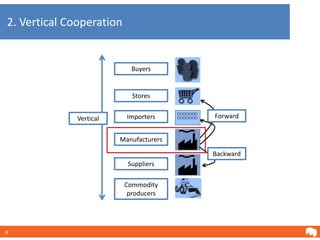
    2.   Vertical Cooperation
    3.   Horizontal Cooperation
    4.   Conclusion


2
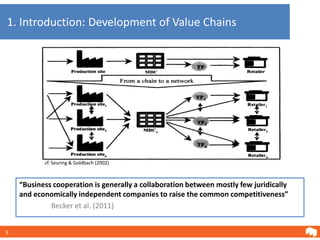
1. Introduction: Development of Value Chains


           cf. Seuring & Goldbach (2002)


    “Business cooperation is generally a collaboration between mostly few juridically
    and economically independent companies to raise the common competitiveness”
             Becker et al. (2011)


3
1. Introduction: Development of Value Chains –
                 Triggers for rising cooperation in SC

    •   Increasing competition
    •   Increased customer requirements due to the development from seller‘s to buyer‘s
        market (push  pull)
    •   Cost reduction and efficiency potentials are stronger in processes than in products
    •   Outsourcing of operations with little strategic importance in order to concentrate
        on own core competences
    •   Lack of own (financial) resources
    •   Bullwhip Effect
    •   Modern technologies allow efficient networking between companies


4
1. Introduction: Objectives of cooperation


    •   Improving costs, productivity and flexibility
    •   Meeting the customer expectations
    •   Generating synergies
         –   Pooling the resources
         –   Sharing specific strengths and capabilities
         –   Sharing Know-How
         –   Gaining an effective governance (only cooperation with centralized management)
    •   Gaining of stability and sustainability of supply chains


5
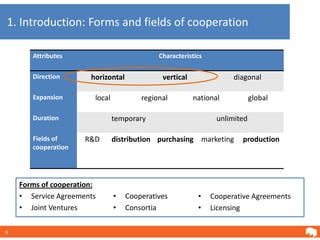
1. Introduction: Forms and fields of cooperation

       Attributes                            Characteristics

       Direction       horizontal             vertical               diagonal

       Expansion        local           regional         national           global

       Duration                 temporary                       unlimited

       Fields of      R&D       distribution purchasing marketing      production
       cooperation


    Forms of cooperation:
    • Service Agreements        •   Cooperatives          •    Cooperative Agreements
    • Joint Ventures            •   Consortia             •    Licensing

6
2. Vertical Cooperation


    •   Companies of different stages of the value chain are working together

    •   Aim: Gain a benefit out of the cooperation

    •   Cooperating companies stay legally and economically independent

    •   Can be limited to a part of business of a company

    •   Cooperation are often limited in time

    •   Types of cooperation
         – Forward cooperation: working together with companies closer to the final customer
         – Backward cooperation: working together with companies in the direction of
           procurement


7
2. Vertical Cooperation


                            Buyers


                            Stores


              Vertical     Importers     Forward


                         Manufacturers

                                         Backward
                           Suppliers

                          Commodity
                           producers


8
2.1 Vertical Cooperation: Alternatives


    Vertical Integration

    •   “When a company expands its business into areas that are at different points of
        the same production path”
    •   Types of integration
         – Forward integration: Acquisition of activities closer to the final customer
         – Backward integration: Acquisition of activities in the direction of procurement
    •   Important factors: costs and control
    •   The level of vertical integration depends on the relations with suppliers (form of
        cooperation, type of contract)

    •   Goal: Achieving the optimal vertical integration


9
2.2 Vertical Cooperation vs. Integration

                                          Common Advantages
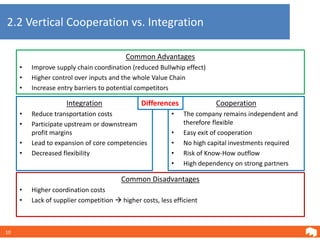
     •   Improve supply chain coordination (reduced Bullwhip effect)
     •   Higher control over inputs and the whole Value Chain
     •   Increase entry barriers to potential competitors

                     Integration               Differences               Cooperation
     •   Reduce transportation costs                      •    The company remains independent and
     •   Participate upstream or downstream                    therefore flexible
         profit margins                                   •    Easy exit of cooperation
     •   Lead to expansion of core competencies           •    No high capital investments required
     •   Decreased flexibility                            •    Risk of Know-How outflow
                                                          •    High dependency on strong partners

                                        Common Disadvantages
     •   Higher coordination costs
     •   Lack of supplier competition  higher costs, less efficient


10
2.3 Vertical Cooperation: Example


     Vertical Cooperation: Toyota

     •   Supplier Organization (Level of responsibility)
          – 1st Tier Supplier: In depth relation ship to Toyota
          – 2nd Tier Supplier: Produce individual parts
     •   Scale of Cooperation
          –   Product development teams
          –   Cross-sharing of Personal (Workers and Mangers are exchanged)
          –   Sophisticated communication between Toyota and Suppliers
          –   Suppliers are Partners
          –   Build up and training of suppliers
          –   Focus on long term relationship
     •   SCM Concepts in use
          – Kaizen
          – JiT

11
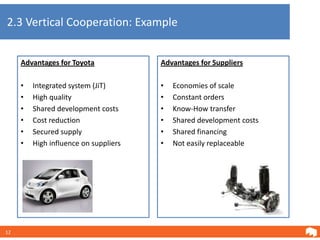
2.3 Vertical Cooperation: Example


     Advantages for Toyota             Advantages for Suppliers

     •   Integrated system (JiT)       •   Economies of scale
     •   High quality                  •   Constant orders
     •   Shared development costs      •   Know-How transfer
     •   Cost reduction                •   Shared development costs
     •   Secured supply                •   Shared financing
     •   High influence on suppliers   •   Not easily replaceable


12
2.4 Vertical Integration: Example


     Vertical Integration: Starbucks

     •   Overview
          – Biggest Coffee House Company in the world
          – About 17,000 Stores in over 50 countries
          – Mission: To supply the customer with “...the finest coffee in the world...“
     • Past strategy:
          – Buy beans from Suppliers, ensuring quality via high price (incentive) and quality control
          – Bean Roasting fully integrated into the Supply Chain, to grant top quality coffee
     •   New strategy
          –   Complete backward integration
          –   Purchase of a coffee-bean farm in china
          –   Training and educating employees
          –   Ensure quality with own farms and Know-How


13
2.4 Vertical Integration: Example


     •   Reasons for Starbucks decision
          –   Opening of the Chinese Market and the continues rapid growth
          –   Limited supply of high quality Arabica beans
          –   Increasing prices (+50% in price for Arabica beans)
          –   Direct control of quality in all stages of production
          –   Ability to maintain perfect quality through-out the whole value chain
          –   Ability to control the full customer experience
          –   Control of the moral hazard issue (bad reputation of coffee production)


14
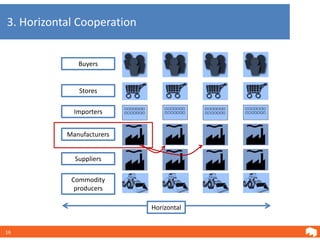
3. Horizontal Cooperation


     •   Two companies of the same industry and in the same stage of production work
         together

     •   These companies belong to the same supply chain stage and normally produce or
         trade the same products

     •   Firms add their strength to gain benefits

     •   Affects the processes and structure design of distribution networks

     •   Cooperation creates a change of existing hubs

     •   Requires inter-firm coordination


15
3. Horizontal Cooperation


              Buyers


              Stores

             Importers


           Manufacturers


             Suppliers

            Commodity
             producers

                            Horizontal


16
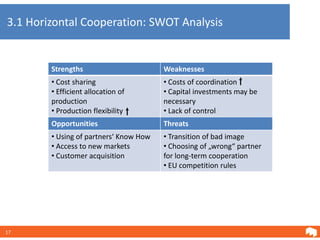
3.1 Horizontal Cooperation: SWOT Analysis


        Strengths                       Weaknesses
        • Cost sharing                  • Costs of coordination
        • Efficient allocation of       • Capital investments may be
        production                      necessary
        • Production flexibility        • Lack of control
        Opportunities                   Threats
        • Using of partners‘ Know How   • Transition of bad image
        • Access to new markets         • Choosing of „wrong“ partner
        • Customer acquisition          for long-term cooperation
                                        • EU competition rules


17
3.2 Horizontal Cooperation: Examples


     Joint Venture

     •   Set up a completely new company

     •   Legally independent

     •   Companies give their resources to the new founded Joint Venture

     •   Example: VW Sharan and Ford Galaxy

     •   Development and production identical

     •   Aim: Cut down costs


18
3.2 Horizontal Cooperation: Examples


     Strategic Alliance

     •   Strategic relationship between two or more companies

     •   Join the individual strengths to follow common goals

     •   Concentrated on certain business segments

     •   Example: Star Alliance

     •   Strategic Alliance of 27 Airlines

     •   Coordinate their flights to cut down the travel time of connected flights


19
4. Conclusion


     •   Globalization and scare resources require more control over the supply chain
     •   High level of competition requires better cost efficiency
     •   Others drivers are:
          –   Political and trade barriers
          –   Investment barriers
          –   Competition
          –   Enter new markets
          –   Companies internal situation (Financial and labor situation, Know-How, etc.)


                Both cooperation and integration are strategic approaches that meet those
                global challenges
                There is no universal solution: The choice of strategy depends on the
                individual situation of a company


20
Thank you for your attention


21
Bibliography

     Beckmann, H. (2004). Supply Chain Management: Strategien und Entwicklungstendenzen in Spitzenunternehmen. Berlin: Springer Verlag.
     Becker et al. (2011). Netzwerkmanagement: Mit Kooperation zum Unternehmenserfolg. Berlin: Springer Verlag.
     George Von Krogh,Johan Roos (2000). Managing knowledge: perspectives on cooperation and competition
     Hertel et al. (2011). Supply-Chain-Management und Warenwirtschaftssysteme im Handel. Berlin: Springer Verlag.
     Röderstein R. (2009). Erfolgsfaktoren im Supply Chain Management der DIY-Branche. Wiesbaden: Gabler Verlag
     Seuring S. & Goldbach M. (2002). Cost Management in Supply Chains. Heidelberg: Physica-Verlag
     Sunil Chopra, S./ Meindl, P (2007): Supply Chain Management. Strategy, Planning, and Operation, Third Edition.
     Wannenwetsch, H. (2005). Vernetztes Supply Chain Management: SCM-Integration über die gesamte Wertschöpfungskette. Berlin: Springer
     Verlag.
     http://www.investopedia.com/terms/v/verticalintegration.asp#axzz1cHvyisYa
     http://www.economist.com/node/13396061
     http://www.12manage.com/methods_vertical_integration_de.html
     http://ig.cs.tu-berlin.de/lehre/w2005/ir1/uebref/NaQuRo-VertikaleIntegrationUndWettbewerb-2005-12-15.pdf
     http://www.quickmba.com/strategy/vertical-integration/
     http://www.strategy-train.eu/index.php?id=138&L=1
     EU Guidelines on horizontal cooperation agreements
     http://blogs.hbr.org/hbr/mcgrath/2009/12/vertical-integration-can-work.html
     http://www.techiteasy.org/2007/07/28/starbucks-an-example-of-vertical-integration/
     http://online.wsj.com/article/SB10001424052748704462704575609733431622088.html
     http://www.independent.co.uk/news/business/news/starbucks-to-more-than-double-store-opening-rate-2132888.html
     http://www.economics.phil.uni-erlangen.de/bwl/exist_gr/koop.pdf
     http://www.wirtschaftslexikon24.net/d/kooperation/kooperation.htm


22

Vertical and horizontal cooperation in a Supply Chain

  • 1.
    Supply Chain Management:Strategic Issues Vertical and horizontal cooperation in a Supply Chain November, 9th 2011 Supply Chain Management // Prof. Dr. Wollny
  • 2.
    Agenda 1. Introduction 2. Vertical Cooperation 3. Horizontal Cooperation 4. Conclusion 2
  • 3.
    1. Introduction: Developmentof Value Chains cf. Seuring & Goldbach (2002) “Business cooperation is generally a collaboration between mostly few juridically and economically independent companies to raise the common competitiveness” Becker et al. (2011) 3
  • 4.
    1. Introduction: Developmentof Value Chains – Triggers for rising cooperation in SC • Increasing competition • Increased customer requirements due to the development from seller‘s to buyer‘s market (push  pull) • Cost reduction and efficiency potentials are stronger in processes than in products • Outsourcing of operations with little strategic importance in order to concentrate on own core competences • Lack of own (financial) resources • Bullwhip Effect • Modern technologies allow efficient networking between companies 4
  • 5.
    1. Introduction: Objectivesof cooperation • Improving costs, productivity and flexibility • Meeting the customer expectations • Generating synergies – Pooling the resources – Sharing specific strengths and capabilities – Sharing Know-How – Gaining an effective governance (only cooperation with centralized management) • Gaining of stability and sustainability of supply chains 5
  • 6.
    1. Introduction: Formsand fields of cooperation Attributes Characteristics Direction horizontal vertical diagonal Expansion local regional national global Duration temporary unlimited Fields of R&D distribution purchasing marketing production cooperation Forms of cooperation: • Service Agreements • Cooperatives • Cooperative Agreements • Joint Ventures • Consortia • Licensing 6
  • 7.
    2. Vertical Cooperation • Companies of different stages of the value chain are working together • Aim: Gain a benefit out of the cooperation • Cooperating companies stay legally and economically independent • Can be limited to a part of business of a company • Cooperation are often limited in time • Types of cooperation – Forward cooperation: working together with companies closer to the final customer – Backward cooperation: working together with companies in the direction of procurement 7
  • 8.
    2. Vertical Cooperation Buyers Stores Vertical Importers Forward Manufacturers Backward Suppliers Commodity producers 8
  • 9.
    2.1 Vertical Cooperation:Alternatives Vertical Integration • “When a company expands its business into areas that are at different points of the same production path” • Types of integration – Forward integration: Acquisition of activities closer to the final customer – Backward integration: Acquisition of activities in the direction of procurement • Important factors: costs and control • The level of vertical integration depends on the relations with suppliers (form of cooperation, type of contract) • Goal: Achieving the optimal vertical integration 9
  • 10.
    2.2 Vertical Cooperationvs. Integration Common Advantages • Improve supply chain coordination (reduced Bullwhip effect) • Higher control over inputs and the whole Value Chain • Increase entry barriers to potential competitors Integration Differences Cooperation • Reduce transportation costs • The company remains independent and • Participate upstream or downstream therefore flexible profit margins • Easy exit of cooperation • Lead to expansion of core competencies • No high capital investments required • Decreased flexibility • Risk of Know-How outflow • High dependency on strong partners Common Disadvantages • Higher coordination costs • Lack of supplier competition  higher costs, less efficient 10
  • 11.
    2.3 Vertical Cooperation:Example Vertical Cooperation: Toyota • Supplier Organization (Level of responsibility) – 1st Tier Supplier: In depth relation ship to Toyota – 2nd Tier Supplier: Produce individual parts • Scale of Cooperation – Product development teams – Cross-sharing of Personal (Workers and Mangers are exchanged) – Sophisticated communication between Toyota and Suppliers – Suppliers are Partners – Build up and training of suppliers – Focus on long term relationship • SCM Concepts in use – Kaizen – JiT 11
  • 12.
    2.3 Vertical Cooperation:Example Advantages for Toyota Advantages for Suppliers • Integrated system (JiT) • Economies of scale • High quality • Constant orders • Shared development costs • Know-How transfer • Cost reduction • Shared development costs • Secured supply • Shared financing • High influence on suppliers • Not easily replaceable 12
  • 13.
    2.4 Vertical Integration:Example Vertical Integration: Starbucks • Overview – Biggest Coffee House Company in the world – About 17,000 Stores in over 50 countries – Mission: To supply the customer with “...the finest coffee in the world...“ • Past strategy: – Buy beans from Suppliers, ensuring quality via high price (incentive) and quality control – Bean Roasting fully integrated into the Supply Chain, to grant top quality coffee • New strategy – Complete backward integration – Purchase of a coffee-bean farm in china – Training and educating employees – Ensure quality with own farms and Know-How 13
  • 14.
    2.4 Vertical Integration:Example • Reasons for Starbucks decision – Opening of the Chinese Market and the continues rapid growth – Limited supply of high quality Arabica beans – Increasing prices (+50% in price for Arabica beans) – Direct control of quality in all stages of production – Ability to maintain perfect quality through-out the whole value chain – Ability to control the full customer experience – Control of the moral hazard issue (bad reputation of coffee production) 14
  • 15.
    3. Horizontal Cooperation • Two companies of the same industry and in the same stage of production work together • These companies belong to the same supply chain stage and normally produce or trade the same products • Firms add their strength to gain benefits • Affects the processes and structure design of distribution networks • Cooperation creates a change of existing hubs • Requires inter-firm coordination 15
  • 16.
    3. Horizontal Cooperation Buyers Stores Importers Manufacturers Suppliers Commodity producers Horizontal 16
  • 17.
    3.1 Horizontal Cooperation:SWOT Analysis Strengths Weaknesses • Cost sharing • Costs of coordination • Efficient allocation of • Capital investments may be production necessary • Production flexibility • Lack of control Opportunities Threats • Using of partners‘ Know How • Transition of bad image • Access to new markets • Choosing of „wrong“ partner • Customer acquisition for long-term cooperation • EU competition rules 17
  • 18.
    3.2 Horizontal Cooperation:Examples Joint Venture • Set up a completely new company • Legally independent • Companies give their resources to the new founded Joint Venture • Example: VW Sharan and Ford Galaxy • Development and production identical • Aim: Cut down costs 18
  • 19.
    3.2 Horizontal Cooperation:Examples Strategic Alliance • Strategic relationship between two or more companies • Join the individual strengths to follow common goals • Concentrated on certain business segments • Example: Star Alliance • Strategic Alliance of 27 Airlines • Coordinate their flights to cut down the travel time of connected flights 19
  • 20.
    4. Conclusion • Globalization and scare resources require more control over the supply chain • High level of competition requires better cost efficiency • Others drivers are: – Political and trade barriers – Investment barriers – Competition – Enter new markets – Companies internal situation (Financial and labor situation, Know-How, etc.) Both cooperation and integration are strategic approaches that meet those global challenges There is no universal solution: The choice of strategy depends on the individual situation of a company 20
  • 21.
    Thank you foryour attention 21
  • 22.
    Bibliography Beckmann, H. (2004). Supply Chain Management: Strategien und Entwicklungstendenzen in Spitzenunternehmen. Berlin: Springer Verlag. Becker et al. (2011). Netzwerkmanagement: Mit Kooperation zum Unternehmenserfolg. Berlin: Springer Verlag. George Von Krogh,Johan Roos (2000). Managing knowledge: perspectives on cooperation and competition Hertel et al. (2011). Supply-Chain-Management und Warenwirtschaftssysteme im Handel. Berlin: Springer Verlag. Röderstein R. (2009). Erfolgsfaktoren im Supply Chain Management der DIY-Branche. Wiesbaden: Gabler Verlag Seuring S. & Goldbach M. (2002). Cost Management in Supply Chains. Heidelberg: Physica-Verlag Sunil Chopra, S./ Meindl, P (2007): Supply Chain Management. Strategy, Planning, and Operation, Third Edition. Wannenwetsch, H. (2005). Vernetztes Supply Chain Management: SCM-Integration über die gesamte Wertschöpfungskette. Berlin: Springer Verlag. http://www.investopedia.com/terms/v/verticalintegration.asp#axzz1cHvyisYa http://www.economist.com/node/13396061 http://www.12manage.com/methods_vertical_integration_de.html http://ig.cs.tu-berlin.de/lehre/w2005/ir1/uebref/NaQuRo-VertikaleIntegrationUndWettbewerb-2005-12-15.pdf http://www.quickmba.com/strategy/vertical-integration/ http://www.strategy-train.eu/index.php?id=138&L=1 EU Guidelines on horizontal cooperation agreements http://blogs.hbr.org/hbr/mcgrath/2009/12/vertical-integration-can-work.html http://www.techiteasy.org/2007/07/28/starbucks-an-example-of-vertical-integration/ http://online.wsj.com/article/SB10001424052748704462704575609733431622088.html http://www.independent.co.uk/news/business/news/starbucks-to-more-than-double-store-opening-rate-2132888.html http://www.economics.phil.uni-erlangen.de/bwl/exist_gr/koop.pdf http://www.wirtschaftslexikon24.net/d/kooperation/kooperation.htm 22