Presented To:
Prof.Sajjad Mohsin
Introduction
 Starbucks Corporation - an American global coffee
company based in Seattle, Washington.
 Largest coffee-house company in the world with 20,891
stores in 62 countries.
 President and CEO - Howard Schultz.
 Places high value on ethical behavior and company-wide
diversity.
 Offers espresso menu items, refreshments and pastries,
merchandise, brewing accessories, gifts and books.
Company Profile
 Starbucks’s logo is inspired by the sea featuring a twin-tailed
siren from Greek mythology.
• Our Coffee: Believes in serving the best coffee possible - goal
is to grow our coffee under the highest standards of quality
using ethical sourcing practices- our coffee buyers personally
travel to coffee farms in Latin America, Africa and Asia to
select the highest quality arabica beans.
• Our Stores: Perfect place for meeting friends and family or
enjoying a quiet moment alone with a book.
• Our Partners:
Our employees, who we call partners, are at the heart of the Starbucks
Experience- our store partners are committed to coffee knowledge,
product expertise and customer service.
• Our Products:
1) Coffee: More than 30 blends and single-origin premium Arabica
coffees.
2) Handcrafted beverages: Fresh-brewed coffee, hot and iced espresso
beverages, coffee and non-coffee blended beverages, Vivanno
smoothies and Tazo teas.
3) Merchandise: Coffee and tea brewing equipment, mugs and
accessories, packaged goods, music, books and gift items.
4) Fresh Food: Baked-pastries, sandwiches, salad, oatmeal, fruit-cups.
Vision statement
“Establish starbucks as the premier provider
of the finest coffee in the world while
maintaining our uncompromising principles
while we grow”
Mission Statement
“ to inspire and nurture the human spirit – one
person, one cup and one neighborhood at a
time”.
Starbucks marketing strategy
Starbucks marketing strategy technique is able to attract
and reach out millions of customer all over the world. Here
are some of marketing strategies of Starbucks:
• “Perfect cup of coffee” – placing emphasis on product
quality
• “Third Place”_ focusing on creating the “third place” for
everyone to go between home and work.
• “Customer satisfaction”_ it is important for customers
experience the uniqueness of the coffee experience
• “Creating a Starbucks community” – creating a
community around the brand, locally and globally
• “Smart partnerships” _a way to grow business is to
partner smart
• “Innovations”_ creative and innovative ideas to add to
their product line and services (for example, Starbucks was
first to offer free Wi-Fi within its stores)
• “Brand Marketing” Word of mouth focus, letting the
high quality of their products speak for themselves. . This
marketing strategy plays an important role to the success
of the company.
Starbucks Coffee Marketing
• The company has developed greatly individualized
marketing strategies in order to fit the advertisements of
the company brand because it applies to the exceptional
idea it was built on.
• Nevertheless, the marketing strategy of Starbucks has led
its present achievement and success. This information is
enough for business owner to understand that there can be
more to learn from what Starbucks has obtained to do well
than a lot of small business.
TARGET MARKET:
 Starbucks says that they do not target a specific market.
 Products are consumed by people who want to take a break
from the daily work routine and those who want a caffeine
stimulant.
 Distinguished from traditional ‘coffee shop’ because of the
taste of the coffee and the ‘hip’ or ‘fashionable’ store
environment.
4 P,s Analysis
PRODUCT:
• Starbucks sells brewed coffees, espresso beverages, cold
blended beverages, food items, teas, branded coffee drinks,
a line of ice creams, and a line of compact discs through
its retail stores.
• Also offers pastries, sodas, juices, games, seasonal novelty
items, and coffee-related accessories and equipment.
PRICE:
• Starbucks has always offered a range of products that vary in
price.
• With the economy slowing starting to gain momentum,
Starbucks’ main objective must be to keep prices on par with
competitors.
• In addition, a market opportunity presented itself during the
recession – at home coffee drinkers.
• In order to capitalize on this market segment, Starbucks must
price there at home coffee selections closely to competitors such
as Dunkin’ Donuts, while also balancing economic factors such
as distribution costs, fair-market costs, and more.
PROMOTIONS:
• Starbucks has been able to use a standardized advertisement
theme around the world in order to incorporate different
cultures.
• An active participation on Web 2.0 platforms, televisions
advertisements, and email marketing will all be utilized to
promote products and initiatives
• Initiating contests for customers to participate in will be a main
focus. These can range from coffee bag design contests, to
social media contests integrating platforms such as Instagram
and Twitter.
PLACE:
• Operates in all 50 states plus the District of Columbia.
• They also operates in 34 countries outside the United States
such as Australia, Canada, China, Germany, Singapore, and
others.
• Starbucks retail stores are typically located in high-traffic, high-
visibility locations. Because the Company can vary the size and
format, its stores are located in or near a variety of settings,
including downtown and sub urban retail centers, office
buildings and university campuses.
• The Company selectively locates stores in shopping malls, it
focuses on locations that provide convenient access for
pedestrians and drivers.
Customer focus
• Starbucks’ goal is to create brand awareness through the
“Starbucks experience”. Starbucks does this by providing
excellent service to the customer.
• Starbuck’s excellent customer service is based on their
customer-driven marketing strategy. The products of Starbucks
are being differentiated, which leads to a global successful
positioning of Starbucks.
• The whole idea of Starbucks is to let the customers enjoy their
cup of coffee or tea in a convenient area. Besides that, Starbucks
is being innovative by providing all different/special kinds of
coffee or tea.
• The Starbuck shops give the customers a comfort feeling, like
they are home.
• The main reason for Starbucks success is the fact that they
provide a personal service to their customer. This service
includes the greeting, the flexible choices of customers’ drinks,
excellent service, genuine smile,, friendly spirit and remember
the favorite order of the customers.
• The importance of our social media expertise continues to grow,
and we evolve the conversation with our core customers.
• By being more intimate with the customer, each client feels
recognized and special. Sometimes it is not only about serving
the customers as fast as you can, but it is also important to create
a great customer experience.
FOCUS ON STRATEGY
Starbucks offers a focused differentiation strategy. This
strategy is described as "concentrating on a narrow buyer
segment and outcompeting rivals by offering niche
members customized attributes that meet their tastes and
requirements better than rivals' products."
MARKET ORIENTATION
• Starbucks in terms of marketing leans more towards the
market orientation side. Starbucks being a company that
relies on their consumers to survive would have to
constantly change or add new products for the customer’s
changing tastes.
• They need to adapt to the different local tastes and
constantly add a bit of their own flavor to welcome
customers.
• They start with the customer and understand their needs.
• They focus on market research first and then adjust their
drinks to local tastes.
• For example, in Asian countries where Starbucks is
active they have in recent years added the green tea flavor
into their drinks to satisfy our tastes.
• Another example would be that in Christmas, their cups
are adjusted to the season spirit and atmosphere and have
red and Christmas decorations on them to appeal to their
audience and customers.
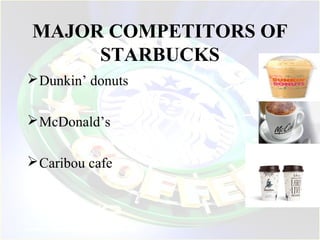
MAJOR COMPETITORS OF
STARBUCKS
Dunkin’ donuts
McDonald’s
Caribou cafe
COMPETITIVE INTELLIGENCE
Starbucks have following competitive intelligence on
which it is working.
9 Things Starbucks Does Better Than Almost Any
Competitor they are as follows:
• With two registers and a full staff, Starbucks can churn
through 220 customers/hour*
• "From the moment a customer walks through the door, we
want to get them through in 3 minutes," a longtime
Starbucks manager tells us. "Or 3-5 minutes if it's busy."
• Employees know the difference between a cappuccino
and a latte.
• Starbucks never serves coffee that has been sitting for
longer than 30 minutes.
• The store claims to serve 87,000 different drink
combinations, all of which a barista can make without
hesitation.
• Select stores have the top-of-the-line single-brew
Clover, which makes probably the best coffee you've
ever tasted.
• Baristas who work at least 20 hours/week are eligible
for health insurance. This could have something to do
with the famously cheery demeanor of "partners"
• Customers can pay with their iPhone and
Blackberrys .
• Starbucks provides free WiFi, and there's no
restriction on laptop use.
MARKET DRIVEN-STRATEGY
 Starbucks is a good example of a market-driving
retailer in the coffee market, who achieves sustainable
growth worldwide.
 Starbucks demonstrates several core competencies
when providing quality products and services, namely,
a comprehensive employee training program, its sole
ownership of high quality Narino Supremo coffee
beans, and the reputation of its largest coffeehouse
chains.
 These core competencies provide Starbucks with a
competitive advantage, and enable it to develop
globally by offering customers a higher level of value
than competitors, which in turn, justifies charging
higher prices.
Starbucks' overall retention strategy has cleverly
covered the 5Ps, among others i.e.:
• Product Quality
• Consistency
• Customized and Seasonal Products
• Convenience Through Location
• Strong Brand Equity
• Customer Bonds and Loyalty Programs
• An Affordable Experience
• The Relationship with Customers
THANK YOU!
Starbucks final project

Starbucks final project

  • 2.
  • 3.
    Introduction  Starbucks Corporation- an American global coffee company based in Seattle, Washington.  Largest coffee-house company in the world with 20,891 stores in 62 countries.  President and CEO - Howard Schultz.  Places high value on ethical behavior and company-wide diversity.  Offers espresso menu items, refreshments and pastries, merchandise, brewing accessories, gifts and books.
  • 4.
    Company Profile  Starbucks’slogo is inspired by the sea featuring a twin-tailed siren from Greek mythology. • Our Coffee: Believes in serving the best coffee possible - goal is to grow our coffee under the highest standards of quality using ethical sourcing practices- our coffee buyers personally travel to coffee farms in Latin America, Africa and Asia to select the highest quality arabica beans. • Our Stores: Perfect place for meeting friends and family or enjoying a quiet moment alone with a book.
  • 5.
    • Our Partners: Ouremployees, who we call partners, are at the heart of the Starbucks Experience- our store partners are committed to coffee knowledge, product expertise and customer service. • Our Products: 1) Coffee: More than 30 blends and single-origin premium Arabica coffees. 2) Handcrafted beverages: Fresh-brewed coffee, hot and iced espresso beverages, coffee and non-coffee blended beverages, Vivanno smoothies and Tazo teas. 3) Merchandise: Coffee and tea brewing equipment, mugs and accessories, packaged goods, music, books and gift items. 4) Fresh Food: Baked-pastries, sandwiches, salad, oatmeal, fruit-cups.
  • 6.
    Vision statement “Establish starbucksas the premier provider of the finest coffee in the world while maintaining our uncompromising principles while we grow”
  • 7.
    Mission Statement “ toinspire and nurture the human spirit – one person, one cup and one neighborhood at a time”.
  • 8.
    Starbucks marketing strategy Starbucksmarketing strategy technique is able to attract and reach out millions of customer all over the world. Here are some of marketing strategies of Starbucks: • “Perfect cup of coffee” – placing emphasis on product quality • “Third Place”_ focusing on creating the “third place” for everyone to go between home and work. • “Customer satisfaction”_ it is important for customers experience the uniqueness of the coffee experience
  • 9.
    • “Creating aStarbucks community” – creating a community around the brand, locally and globally • “Smart partnerships” _a way to grow business is to partner smart • “Innovations”_ creative and innovative ideas to add to their product line and services (for example, Starbucks was first to offer free Wi-Fi within its stores) • “Brand Marketing” Word of mouth focus, letting the high quality of their products speak for themselves. . This marketing strategy plays an important role to the success of the company.
  • 10.
    Starbucks Coffee Marketing •The company has developed greatly individualized marketing strategies in order to fit the advertisements of the company brand because it applies to the exceptional idea it was built on. • Nevertheless, the marketing strategy of Starbucks has led its present achievement and success. This information is enough for business owner to understand that there can be more to learn from what Starbucks has obtained to do well than a lot of small business.
  • 11.
    TARGET MARKET:  Starbuckssays that they do not target a specific market.  Products are consumed by people who want to take a break from the daily work routine and those who want a caffeine stimulant.  Distinguished from traditional ‘coffee shop’ because of the taste of the coffee and the ‘hip’ or ‘fashionable’ store environment.
  • 12.
    4 P,s Analysis PRODUCT: •Starbucks sells brewed coffees, espresso beverages, cold blended beverages, food items, teas, branded coffee drinks, a line of ice creams, and a line of compact discs through its retail stores. • Also offers pastries, sodas, juices, games, seasonal novelty items, and coffee-related accessories and equipment.
  • 13.
    PRICE: • Starbucks hasalways offered a range of products that vary in price. • With the economy slowing starting to gain momentum, Starbucks’ main objective must be to keep prices on par with competitors. • In addition, a market opportunity presented itself during the recession – at home coffee drinkers. • In order to capitalize on this market segment, Starbucks must price there at home coffee selections closely to competitors such as Dunkin’ Donuts, while also balancing economic factors such as distribution costs, fair-market costs, and more.
  • 14.
    PROMOTIONS: • Starbucks hasbeen able to use a standardized advertisement theme around the world in order to incorporate different cultures. • An active participation on Web 2.0 platforms, televisions advertisements, and email marketing will all be utilized to promote products and initiatives • Initiating contests for customers to participate in will be a main focus. These can range from coffee bag design contests, to social media contests integrating platforms such as Instagram and Twitter.
  • 15.
    PLACE: • Operates inall 50 states plus the District of Columbia. • They also operates in 34 countries outside the United States such as Australia, Canada, China, Germany, Singapore, and others. • Starbucks retail stores are typically located in high-traffic, high- visibility locations. Because the Company can vary the size and format, its stores are located in or near a variety of settings, including downtown and sub urban retail centers, office buildings and university campuses. • The Company selectively locates stores in shopping malls, it focuses on locations that provide convenient access for pedestrians and drivers.
  • 16.
    Customer focus • Starbucks’goal is to create brand awareness through the “Starbucks experience”. Starbucks does this by providing excellent service to the customer. • Starbuck’s excellent customer service is based on their customer-driven marketing strategy. The products of Starbucks are being differentiated, which leads to a global successful positioning of Starbucks. • The whole idea of Starbucks is to let the customers enjoy their cup of coffee or tea in a convenient area. Besides that, Starbucks is being innovative by providing all different/special kinds of coffee or tea. • The Starbuck shops give the customers a comfort feeling, like they are home.
  • 17.
    • The mainreason for Starbucks success is the fact that they provide a personal service to their customer. This service includes the greeting, the flexible choices of customers’ drinks, excellent service, genuine smile,, friendly spirit and remember the favorite order of the customers. • The importance of our social media expertise continues to grow, and we evolve the conversation with our core customers. • By being more intimate with the customer, each client feels recognized and special. Sometimes it is not only about serving the customers as fast as you can, but it is also important to create a great customer experience.
  • 18.
    FOCUS ON STRATEGY Starbucksoffers a focused differentiation strategy. This strategy is described as "concentrating on a narrow buyer segment and outcompeting rivals by offering niche members customized attributes that meet their tastes and requirements better than rivals' products."
  • 19.
    MARKET ORIENTATION • Starbucksin terms of marketing leans more towards the market orientation side. Starbucks being a company that relies on their consumers to survive would have to constantly change or add new products for the customer’s changing tastes. • They need to adapt to the different local tastes and constantly add a bit of their own flavor to welcome customers. • They start with the customer and understand their needs.
  • 20.
    • They focuson market research first and then adjust their drinks to local tastes. • For example, in Asian countries where Starbucks is active they have in recent years added the green tea flavor into their drinks to satisfy our tastes. • Another example would be that in Christmas, their cups are adjusted to the season spirit and atmosphere and have red and Christmas decorations on them to appeal to their audience and customers.
  • 21.
    MAJOR COMPETITORS OF STARBUCKS Dunkin’donuts McDonald’s Caribou cafe
  • 22.
    COMPETITIVE INTELLIGENCE Starbucks havefollowing competitive intelligence on which it is working. 9 Things Starbucks Does Better Than Almost Any Competitor they are as follows: • With two registers and a full staff, Starbucks can churn through 220 customers/hour* • "From the moment a customer walks through the door, we want to get them through in 3 minutes," a longtime Starbucks manager tells us. "Or 3-5 minutes if it's busy."
  • 23.
    • Employees knowthe difference between a cappuccino and a latte. • Starbucks never serves coffee that has been sitting for longer than 30 minutes. • The store claims to serve 87,000 different drink combinations, all of which a barista can make without hesitation.
  • 24.
    • Select storeshave the top-of-the-line single-brew Clover, which makes probably the best coffee you've ever tasted. • Baristas who work at least 20 hours/week are eligible for health insurance. This could have something to do with the famously cheery demeanor of "partners" • Customers can pay with their iPhone and Blackberrys . • Starbucks provides free WiFi, and there's no restriction on laptop use.
  • 25.
    MARKET DRIVEN-STRATEGY  Starbucksis a good example of a market-driving retailer in the coffee market, who achieves sustainable growth worldwide.  Starbucks demonstrates several core competencies when providing quality products and services, namely, a comprehensive employee training program, its sole ownership of high quality Narino Supremo coffee beans, and the reputation of its largest coffeehouse chains.
  • 26.
     These corecompetencies provide Starbucks with a competitive advantage, and enable it to develop globally by offering customers a higher level of value than competitors, which in turn, justifies charging higher prices. Starbucks' overall retention strategy has cleverly covered the 5Ps, among others i.e.:
  • 27.
    • Product Quality •Consistency • Customized and Seasonal Products • Convenience Through Location • Strong Brand Equity • Customer Bonds and Loyalty Programs • An Affordable Experience • The Relationship with Customers
  • 28.