
Introduction
Starbucks India or it can be called asTatabucks. As
Starbucks Corporation andTata Global Beverages
announced 50:50 joint venture calledTata Starbucks
Ltd. in January 2012 which operate and own outlets
branded Starbucks “ATata Alliance”. An agreement
was also signed between Starbucks andTata coffee
that coffee would 100% locally sourced and roasted.
VISSION
• Starbucks vision statement is “To establish Starbucks as the
premier purveyor of the finest coffee in the world while
maintaining our uncompromising principles while we
grow.”
• Starbucks mission statement is “To inspire and nurture the
human spirit – one person, one cup and one neighborhood
at a time.”
MISSION
• Starbucks is building one of the powerful brand in2 decades.
• They started expanding their business globally .
• Currently operating in over 64 countries &23000 stores
• It uses aggressive marketing technique so that they can become the
threat for higher & lower entrant into the market.
• they also try to reach out in Indian market with merging tata global
beverages.
What is the case about?
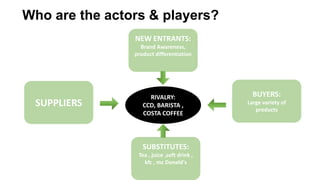
Who are the actors & players?
NEW ENTRANTS:
Brand Awareness,
product differentiation
BUYERS:
Large variety of
products
SUBSTITUTES:
Tea , juice ,soft drink ,
kfc , mc Donald's
SUPPLIERS
RIVALRY:
CCD, BARISTA ,
COSTA COFFEE
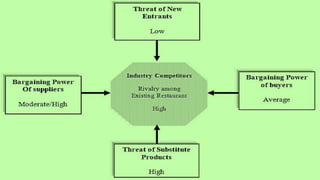
Threats from new entrants: According to the current market environment, it is difficult for a
new firm to enter in the market with large investment. However, retail market is highly
competitive sector and investors will not appreciate a new company to invest for them due
to global financial crisis. Aronin, Fetterman & Liu (2004) stated that the entry barriers for
selling specialty coffee in rural regions are relatively low, as it opens outlets in places with no
close competition;
Bargaining power of the suppliers:The major suppliers of Starbucks are coffee beans
suppliers, machinery, and other raw material suppliers.The supply of various food
ingredients, for example, green coffee beans are being produced all over the world, but the
price of coffee beans is subject to significant instability. According to the annual report 2009
of Starbucks, this bargaining power of the suppliers depends on several factors like
producing areas, bad weather, and the actions of certain organizations, political situation,
and financial circumstances.
Bargaining power of the buyers: The buyers have a moderate level of bargaining power
though quality, quick services, and other supportive factors like lower price and tastes of
unique brand items influence the purchaser.
Threats of substitute products:The threat of substitute products of Coffee is reducing, but
most challenging substitute products for Starbucks are Pepsi, Coca-Cola and other energy
drinks;
Rivalry among existing competitors: The competition is extremely high, and Starbucks
faces competition from restaurants and other specialty Coffee brands, retailers. However,
McDonald, KFC, Dunn Brothers Franchise are the nearest competitors of the company
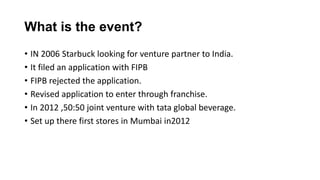
• IN 2006 Starbuck looking for venture partner to India.
• It filed an application with FIPB
• FIPB rejected the application.
• Revised application to enter through franchise.
• In 2012 ,50:50 joint venture with tata global beverage.
• Set up there first stores in Mumbai in2012
What is the event?
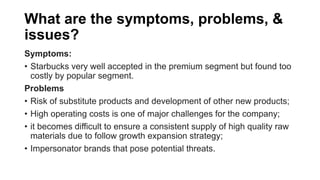
Symptoms:
• Starbucks very well accepted in the premium segment but found too
costly by popular segment.
Problems
• Risk of substitute products and development of other new products;
• High operating costs is one of major challenges for the company;
• it becomes difficult to ensure a consistent supply of high quality raw
materials due to follow growth expansion strategy;
• Impersonator brands that pose potential threats.
What are the symptoms, problems, &
issues?
• The major challenge that Starbucks is dealing with is the current
financial crisis in the world economy forcing them to call closures of
many stores around the world. Another challenge that Starbucks is
dealing with is competitors
Issues:
• The case is primarily designed to help students understand the idea
of market mix and how to achieve competitive advantage.
• It is meant to help identify the challenges faced by Tata Starbucks
and to explore the strategies which Tata Starbucks might adopt to
overcome these challenges..
• Should they continue to remain as a niche player in the premium
segment?
• Could they start a subsidiary to reach out across town classes.
• Starbucks applied the niche marketing strategy for high urban cities.
• Starbucks needed to maintain their quality & its flexibility.
• Product innovation & new-growth platforms.
• Expanding the international & operating segment
• Expand in Chinese market.
• Global consumers product group
What have been actions taken?
What actions need to be taken?
•What in your opinion are the
uncontrollable factors affecting mobile
phone industry in India?
Tata Starbucks Pestle Analysis
Political Factors
• The Economy in India is more stable in terms of government and political issues as
compared to other countries. That creates a good working environment for companies
like Starbucks.
• Starbucks needs to vary about the possible opposition from existing competitors
(CCD, Barista, Costa Coffee etc.) through the use of political influence and delaying
tactics.
• As we all know that Indian market is huge enough that can accommodate more
players in Indian Coffee Industry.
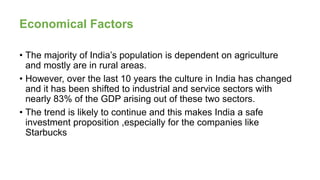
Economical Factors
• The majority of India’s population is dependent on agriculture
and mostly are in rural areas.
• However, over the last 10 years the culture in India has changed
and it has been shifted to industrial and service sectors with
nearly 83% of the GDP arising out of these two sectors.
• The trend is likely to continue and this makes India a safe
investment proposition ,especially for the companies like
Starbucks
Social Factors
• Changes in social trends can impact on the demand of Starbucks
products and the availability and willingness of individuals to work
• India has a population of more than 1.2 billion people with about
70% between the ages of 15 and 65. The young population always
wants to taste international brands.
Technological Factors
• Technological factors always influences product development and
also introduces cost-cutting processes. Indian coffee has been
improving in quality continuously and almost 80 % of India’s coffee
is exported.
• Indian coffee growers are seriously working at improving the
standards to meet the international coffee standards.
Legal Factors
• Legal factors can affect a firm's costs and demand. The Indian
judicial system remains largely free from the political interference
and pressures. It can help international brands to easily enter in
India.
Environmental Factors
• Environmental factors include the weather and climate change.
Changes in temperature can impact on many industries. It can also
affect Tata coffee which is supplying coffee to Starbucks in India.
•What strategic choices does STARBUCKS have
under the circumstances defined above? You
may use applications of SWOT Matrix to
generate the options available to STARFBUCKS
•Brand image
•Premium quality
•Excellent customer service
•Known for ethical business
•well managed supply chain
•High priced products
•Imitation by others
•Expansion in the emerging
markets
•Diversification of the product
mix
•Cobranding or partnership
with other brands
•Heavy competition from the rival
brands
•Consumer trends
•Imitation of its premium products
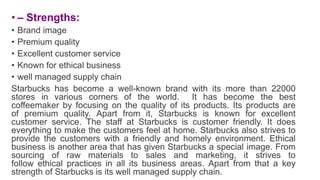
• – Strengths:
• Brand image
• Premium quality
• Excellent customer service
• Known for ethical business
• well managed supply chain
Starbucks has become a well-known brand with its more than 22000
stores in various corners of the world. It has become the best
coffeemaker by focusing on the quality of its products. Its products are
of premium quality. Apart from it, Starbucks is known for excellent
customer service. The staff at Starbucks is customer friendly. It does
everything to make the customers feel at home. Starbucks also strives to
provide the customers with a friendly and homely environment. Ethical
business is another area that has given Starbucks a special image. From
sourcing of raw materials to sales and marketing, it strives to
follow ethical practices in all its business areas. Apart from that a key
strength of Starbucks is its well managed supply chain.
•– Weaknesses:
• High priced products
• Imitation by others
The high price of Starbucks products is a major weakness of the
brand. While its products are premium in quality, they are higher priced
than most competitors. This is an important factor since Starbucks
loses a large number of customers for its high prices. The products it
sells are also imitated easily by the competitors who sell them at lower
prices. These are the two major weaknesses of Starbucks. Only if
Starbucks could bring the prices of its products lower, it could attract
customers in larger numbers. Its quality rich coffee and excellent
service come at a price that is not affordable for all.
•– Opportunities:
• Expansion in the emerging markets
• Diversification of the product mix
• Cobranding or partnership with other brands
Starbucks has a significant opportunity before it in the form of the
large and untapped emerging markets. Markets like India and China
can prove important sources of customers and revenue. However,
Starbucks should also try to align its products as per the cultural
standards of these markets. Diversifying its product line can also
help the brand grow and improve its brand value. Currently, the
brand is mainly known for its premium quality coffee. It can add
other products including beverages and snacks to its product line to
provide its customers with variety. Its assortment of products is
limited.
• – Threats:
• Heavy competition from the rival brands
• Consumer trends
• Imitation of its premium products
The Starbucks brand is facing heavy competition from its rivals.
Particularly, it is the smaller competitors whose products are
available at much lower prices that pose a major threat. The lower
end consumers are attracted towards the rivals for the lower costs of
their products. The changing consumer trends have also affected its
business to a small extent. The people are looking for healthier
products. The sales of juices and other healthy drinks has gone up.
While Coffee is not considered an unhealthy drink, still its sales are
slightly affected. Another major threat comes from the imitation of
the products. Starbucks sells premium quality products. However,
they are not inimitable. The rival brands make the same products
available at lower costs. It increases the competitive threat for
Starbucks.
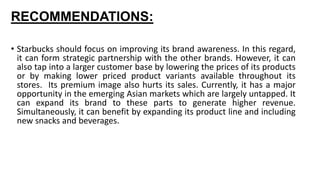
RECOMMENDATIONS:
• Starbucks should focus on improving its brand awareness. In this regard,
it can form strategic partnership with the other brands. However, it can
also tap into a larger customer base by lowering the prices of its products
or by making lower priced product variants available throughout its
stores. Its premium image also hurts its sales. Currently, it has a major
opportunity in the emerging Asian markets which are largely untapped. It
can expand its brand to these parts to generate higher revenue.
Simultaneously, it can benefit by expanding its product line and including
new snacks and beverages.
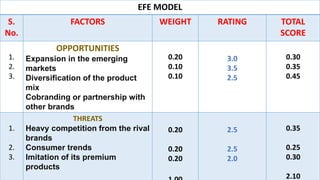
EFE MODEL
S.
No.
FACTORS WEIGHT RATING TOTAL
SCORE
1.
2.
3.
OPPORTUNITIES
Expansion in the emerging
markets
Diversification of the product
mix
Cobranding or partnership with
other brands
0.20
0.10
0.10
3.0
3.5
2.5
0.30
0.35
0.45
1.
2.
3.
THREATS
Heavy competition from the rival
brands
Consumer trends
Imitation of its premium
products
0.20
0.20
0.20
2.5
2.5
2.0
0.35
0.25
0.30
2.10
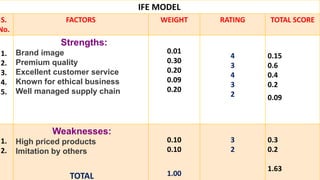
IFE MODEL
S.
No.
FACTORS WEIGHT RATING TOTAL SCORE
1.
2.
3.
4.
5.
Strengths:
Brand image
Premium quality
Excellent customer service
Known for ethical business
Well managed supply chain
0.01
0.30
0.20
0.09
0.20
4
3
4
3
2
0.15
0.6
0.4
0.2
0.09
1.
2.
Weaknesses:
High priced products
Imitation by others
TOTAL
0.10
0.10
1.00
3
2
0.3
0.2
1.63
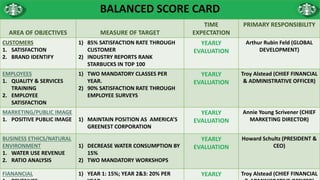
BALANCED SCORE CARD
AREA OF OBJECTIVES MEASURE OF TARGET
TIME
EXPECTATION
PRIMARY RESPONSIBILITY
CUSTOMERS
1. SATISFACTION
2. BRAND IDENTIFY
1) 85% SATISFACTION RATE THROUGH
CUSTOMER
2) INDUSTRY REPORTS RANK
STARBUCKS IN TOP 100
YEARLY
EVALUATION
Arthur Rubin Feld (GLOBAL
DEVELOPMENT)
EMPLOYEES
1. QUALITY & SERVICES
TRAINING
2. EMPLOYEE
SATISFACTION
1) TWO MANDATORY CLASSES PER
YEAR.
2) 90% SATISFACTION RATE THROUGH
EMPLOYEE SURVEYS
YEARLY
EVALUATION
Troy Alstead (CHIEF FINANCIAL
& ADMINISTRATIVE OFFICER)
MARKETING/PUBLIC IMAGE
1. POSITIVE PUBLIC IMAGE 1) MAINTAIN POSITION AS AMERICA’S
GREENEST CORPORATION
YEARLY
EVALUATION
Annie Young Scrivener (CHIEF
MARKETING DIRECTOR)
BUSINESS ETHICS/NATURAL
ENVIRONMENT
1. WATER USE REVENUE
2. RATIO ANALYSIS
1) DECREASE WATER CONSUMPTION BY
15%
2) TWO MANDATORY WORKSHOPS
YEARLY
EVALUATION
Howard Schultz (PRESIDENT &
CEO)
FIANANCIAL 1) YEAR 1: 15%; YEAR 2&3: 20% PER YEARLY Troy Alstead (CHIEF FINANCIAL
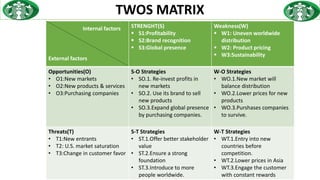
Internal factors
External factors
STRENGHT(S)
 S1:Profitability
 S2:Brand recognition
 S3:Global presence
Weakness(W)
 W1: Uneven worldwide
distribution
 W2: Product pricing
 W3:Sustainability
Opportunities(O)
• O1:New markets
• O2:New products & services
• O3:Purchasing companies
S-O Strategies
• SO.1. Re-invest profits in
new markets
• SO.2. Use its brand to sell
new products
• SO.3.Expand global presence
by purchasing companies.
W-O Strategies
• WO.1.New market will
balance distribution
• WO.2.Lower prices for new
products
• WO.3.Purshases companies
to survive.
Threats(T)
• T1:New entrants
• T2: U.S. market saturation
• T3:Change in customer favor
S-T Strategies
• ST.1.Offer better stakeholder
value
• ST.2.Ensure a strong
foundation
• ST.3.Introduce to more
people worldwide.
W-T Strategies
• WT.1.Entry into new
countries before
competition.
• WT.2.Lower prices in Asia
• WT.3.Engage the customer
with constant rewards
TWOS MATRIX
SPACE MATRIX
QUADRANT 2 QUADRANT 1
 Market Development
 Market Penetration
 Product Development
 Horizontal Integration
 Divestiture
 Liquidation
 Market Development
 Market Penetration
 Product Development
 Forward Integration
 Backward Integration
 Horizontal Integration
 Related Diversification
QUADRANT 3 QUADRANT 4
 Retrenchment
 Related Diversification
 Unrelated Diversification
 Divestiture
 Liquidation
 Related Diversification
 Unrelated Diversification
 Joint Ventures
Rapid Market
Growth
Strong
Competitive
Position
Slow Market
Growth
Weak
Competitive
Position
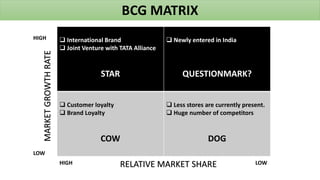
BCG MATRIX
 International Brand
 Joint Venture with TATA Alliance
STAR
 Newly entered in India
QUESTIONMARK?
 Customer loyalty
 Brand Loyalty
COW
 Less stores are currently present.
 Huge number of competitors
DOG
HIGH
LOW
MARKET
GROWTH
RATE
RELATIVE MARKET SHARE
HIGH LOW
 STARBUCKS STRATEGIC MANAGEMENT.pptx

STARBUCKS STRATEGIC MANAGEMENT.pptx

  • 2.
    Introduction Starbucks India orit can be called asTatabucks. As Starbucks Corporation andTata Global Beverages announced 50:50 joint venture calledTata Starbucks Ltd. in January 2012 which operate and own outlets branded Starbucks “ATata Alliance”. An agreement was also signed between Starbucks andTata coffee that coffee would 100% locally sourced and roasted.
  • 3.
    VISSION • Starbucks visionstatement is “To establish Starbucks as the premier purveyor of the finest coffee in the world while maintaining our uncompromising principles while we grow.” • Starbucks mission statement is “To inspire and nurture the human spirit – one person, one cup and one neighborhood at a time.” MISSION
  • 4.
    • Starbucks isbuilding one of the powerful brand in2 decades. • They started expanding their business globally . • Currently operating in over 64 countries &23000 stores • It uses aggressive marketing technique so that they can become the threat for higher & lower entrant into the market. • they also try to reach out in Indian market with merging tata global beverages. What is the case about?
  • 5.
    Who are theactors & players? NEW ENTRANTS: Brand Awareness, product differentiation BUYERS: Large variety of products SUBSTITUTES: Tea , juice ,soft drink , kfc , mc Donald's SUPPLIERS RIVALRY: CCD, BARISTA , COSTA COFFEE
  • 7.
    Threats from newentrants: According to the current market environment, it is difficult for a new firm to enter in the market with large investment. However, retail market is highly competitive sector and investors will not appreciate a new company to invest for them due to global financial crisis. Aronin, Fetterman & Liu (2004) stated that the entry barriers for selling specialty coffee in rural regions are relatively low, as it opens outlets in places with no close competition; Bargaining power of the suppliers:The major suppliers of Starbucks are coffee beans suppliers, machinery, and other raw material suppliers.The supply of various food ingredients, for example, green coffee beans are being produced all over the world, but the price of coffee beans is subject to significant instability. According to the annual report 2009 of Starbucks, this bargaining power of the suppliers depends on several factors like producing areas, bad weather, and the actions of certain organizations, political situation, and financial circumstances. Bargaining power of the buyers: The buyers have a moderate level of bargaining power though quality, quick services, and other supportive factors like lower price and tastes of unique brand items influence the purchaser. Threats of substitute products:The threat of substitute products of Coffee is reducing, but most challenging substitute products for Starbucks are Pepsi, Coca-Cola and other energy drinks; Rivalry among existing competitors: The competition is extremely high, and Starbucks faces competition from restaurants and other specialty Coffee brands, retailers. However, McDonald, KFC, Dunn Brothers Franchise are the nearest competitors of the company
  • 8.
    • IN 2006Starbuck looking for venture partner to India. • It filed an application with FIPB • FIPB rejected the application. • Revised application to enter through franchise. • In 2012 ,50:50 joint venture with tata global beverage. • Set up there first stores in Mumbai in2012 What is the event?
  • 9.
    Symptoms: • Starbucks verywell accepted in the premium segment but found too costly by popular segment. Problems • Risk of substitute products and development of other new products; • High operating costs is one of major challenges for the company; • it becomes difficult to ensure a consistent supply of high quality raw materials due to follow growth expansion strategy; • Impersonator brands that pose potential threats. What are the symptoms, problems, & issues?
  • 10.
    • The majorchallenge that Starbucks is dealing with is the current financial crisis in the world economy forcing them to call closures of many stores around the world. Another challenge that Starbucks is dealing with is competitors Issues: • The case is primarily designed to help students understand the idea of market mix and how to achieve competitive advantage. • It is meant to help identify the challenges faced by Tata Starbucks and to explore the strategies which Tata Starbucks might adopt to overcome these challenges.. • Should they continue to remain as a niche player in the premium segment? • Could they start a subsidiary to reach out across town classes.
  • 11.
    • Starbucks appliedthe niche marketing strategy for high urban cities. • Starbucks needed to maintain their quality & its flexibility. • Product innovation & new-growth platforms. • Expanding the international & operating segment • Expand in Chinese market. • Global consumers product group What have been actions taken? What actions need to be taken?
  • 12.
    •What in youropinion are the uncontrollable factors affecting mobile phone industry in India?
  • 13.
    Tata Starbucks PestleAnalysis Political Factors • The Economy in India is more stable in terms of government and political issues as compared to other countries. That creates a good working environment for companies like Starbucks. • Starbucks needs to vary about the possible opposition from existing competitors (CCD, Barista, Costa Coffee etc.) through the use of political influence and delaying tactics. • As we all know that Indian market is huge enough that can accommodate more players in Indian Coffee Industry.
  • 14.
    Economical Factors • Themajority of India’s population is dependent on agriculture and mostly are in rural areas. • However, over the last 10 years the culture in India has changed and it has been shifted to industrial and service sectors with nearly 83% of the GDP arising out of these two sectors. • The trend is likely to continue and this makes India a safe investment proposition ,especially for the companies like Starbucks
  • 15.
    Social Factors • Changesin social trends can impact on the demand of Starbucks products and the availability and willingness of individuals to work • India has a population of more than 1.2 billion people with about 70% between the ages of 15 and 65. The young population always wants to taste international brands. Technological Factors • Technological factors always influences product development and also introduces cost-cutting processes. Indian coffee has been improving in quality continuously and almost 80 % of India’s coffee is exported. • Indian coffee growers are seriously working at improving the standards to meet the international coffee standards.
  • 16.
    Legal Factors • Legalfactors can affect a firm's costs and demand. The Indian judicial system remains largely free from the political interference and pressures. It can help international brands to easily enter in India. Environmental Factors • Environmental factors include the weather and climate change. Changes in temperature can impact on many industries. It can also affect Tata coffee which is supplying coffee to Starbucks in India.
  • 17.
    •What strategic choicesdoes STARBUCKS have under the circumstances defined above? You may use applications of SWOT Matrix to generate the options available to STARFBUCKS
  • 18.
    •Brand image •Premium quality •Excellentcustomer service •Known for ethical business •well managed supply chain •High priced products •Imitation by others •Expansion in the emerging markets •Diversification of the product mix •Cobranding or partnership with other brands •Heavy competition from the rival brands •Consumer trends •Imitation of its premium products
  • 19.
    • – Strengths: •Brand image • Premium quality • Excellent customer service • Known for ethical business • well managed supply chain Starbucks has become a well-known brand with its more than 22000 stores in various corners of the world. It has become the best coffeemaker by focusing on the quality of its products. Its products are of premium quality. Apart from it, Starbucks is known for excellent customer service. The staff at Starbucks is customer friendly. It does everything to make the customers feel at home. Starbucks also strives to provide the customers with a friendly and homely environment. Ethical business is another area that has given Starbucks a special image. From sourcing of raw materials to sales and marketing, it strives to follow ethical practices in all its business areas. Apart from that a key strength of Starbucks is its well managed supply chain.
  • 20.
    •– Weaknesses: • Highpriced products • Imitation by others The high price of Starbucks products is a major weakness of the brand. While its products are premium in quality, they are higher priced than most competitors. This is an important factor since Starbucks loses a large number of customers for its high prices. The products it sells are also imitated easily by the competitors who sell them at lower prices. These are the two major weaknesses of Starbucks. Only if Starbucks could bring the prices of its products lower, it could attract customers in larger numbers. Its quality rich coffee and excellent service come at a price that is not affordable for all.
  • 21.
    •– Opportunities: • Expansionin the emerging markets • Diversification of the product mix • Cobranding or partnership with other brands Starbucks has a significant opportunity before it in the form of the large and untapped emerging markets. Markets like India and China can prove important sources of customers and revenue. However, Starbucks should also try to align its products as per the cultural standards of these markets. Diversifying its product line can also help the brand grow and improve its brand value. Currently, the brand is mainly known for its premium quality coffee. It can add other products including beverages and snacks to its product line to provide its customers with variety. Its assortment of products is limited.
  • 22.
    • – Threats: •Heavy competition from the rival brands • Consumer trends • Imitation of its premium products The Starbucks brand is facing heavy competition from its rivals. Particularly, it is the smaller competitors whose products are available at much lower prices that pose a major threat. The lower end consumers are attracted towards the rivals for the lower costs of their products. The changing consumer trends have also affected its business to a small extent. The people are looking for healthier products. The sales of juices and other healthy drinks has gone up. While Coffee is not considered an unhealthy drink, still its sales are slightly affected. Another major threat comes from the imitation of the products. Starbucks sells premium quality products. However, they are not inimitable. The rival brands make the same products available at lower costs. It increases the competitive threat for Starbucks.
  • 23.
    RECOMMENDATIONS: • Starbucks shouldfocus on improving its brand awareness. In this regard, it can form strategic partnership with the other brands. However, it can also tap into a larger customer base by lowering the prices of its products or by making lower priced product variants available throughout its stores. Its premium image also hurts its sales. Currently, it has a major opportunity in the emerging Asian markets which are largely untapped. It can expand its brand to these parts to generate higher revenue. Simultaneously, it can benefit by expanding its product line and including new snacks and beverages.
  • 24.
    EFE MODEL S. No. FACTORS WEIGHTRATING TOTAL SCORE 1. 2. 3. OPPORTUNITIES Expansion in the emerging markets Diversification of the product mix Cobranding or partnership with other brands 0.20 0.10 0.10 3.0 3.5 2.5 0.30 0.35 0.45 1. 2. 3. THREATS Heavy competition from the rival brands Consumer trends Imitation of its premium products 0.20 0.20 0.20 2.5 2.5 2.0 0.35 0.25 0.30 2.10
  • 25.
    IFE MODEL S. No. FACTORS WEIGHTRATING TOTAL SCORE 1. 2. 3. 4. 5. Strengths: Brand image Premium quality Excellent customer service Known for ethical business Well managed supply chain 0.01 0.30 0.20 0.09 0.20 4 3 4 3 2 0.15 0.6 0.4 0.2 0.09 1. 2. Weaknesses: High priced products Imitation by others TOTAL 0.10 0.10 1.00 3 2 0.3 0.2 1.63
  • 26.
    BALANCED SCORE CARD AREAOF OBJECTIVES MEASURE OF TARGET TIME EXPECTATION PRIMARY RESPONSIBILITY CUSTOMERS 1. SATISFACTION 2. BRAND IDENTIFY 1) 85% SATISFACTION RATE THROUGH CUSTOMER 2) INDUSTRY REPORTS RANK STARBUCKS IN TOP 100 YEARLY EVALUATION Arthur Rubin Feld (GLOBAL DEVELOPMENT) EMPLOYEES 1. QUALITY & SERVICES TRAINING 2. EMPLOYEE SATISFACTION 1) TWO MANDATORY CLASSES PER YEAR. 2) 90% SATISFACTION RATE THROUGH EMPLOYEE SURVEYS YEARLY EVALUATION Troy Alstead (CHIEF FINANCIAL & ADMINISTRATIVE OFFICER) MARKETING/PUBLIC IMAGE 1. POSITIVE PUBLIC IMAGE 1) MAINTAIN POSITION AS AMERICA’S GREENEST CORPORATION YEARLY EVALUATION Annie Young Scrivener (CHIEF MARKETING DIRECTOR) BUSINESS ETHICS/NATURAL ENVIRONMENT 1. WATER USE REVENUE 2. RATIO ANALYSIS 1) DECREASE WATER CONSUMPTION BY 15% 2) TWO MANDATORY WORKSHOPS YEARLY EVALUATION Howard Schultz (PRESIDENT & CEO) FIANANCIAL 1) YEAR 1: 15%; YEAR 2&3: 20% PER YEARLY Troy Alstead (CHIEF FINANCIAL
  • 27.
    Internal factors External factors STRENGHT(S) S1:Profitability  S2:Brand recognition  S3:Global presence Weakness(W)  W1: Uneven worldwide distribution  W2: Product pricing  W3:Sustainability Opportunities(O) • O1:New markets • O2:New products & services • O3:Purchasing companies S-O Strategies • SO.1. Re-invest profits in new markets • SO.2. Use its brand to sell new products • SO.3.Expand global presence by purchasing companies. W-O Strategies • WO.1.New market will balance distribution • WO.2.Lower prices for new products • WO.3.Purshases companies to survive. Threats(T) • T1:New entrants • T2: U.S. market saturation • T3:Change in customer favor S-T Strategies • ST.1.Offer better stakeholder value • ST.2.Ensure a strong foundation • ST.3.Introduce to more people worldwide. W-T Strategies • WT.1.Entry into new countries before competition. • WT.2.Lower prices in Asia • WT.3.Engage the customer with constant rewards TWOS MATRIX
  • 28.
    SPACE MATRIX QUADRANT 2QUADRANT 1  Market Development  Market Penetration  Product Development  Horizontal Integration  Divestiture  Liquidation  Market Development  Market Penetration  Product Development  Forward Integration  Backward Integration  Horizontal Integration  Related Diversification QUADRANT 3 QUADRANT 4  Retrenchment  Related Diversification  Unrelated Diversification  Divestiture  Liquidation  Related Diversification  Unrelated Diversification  Joint Ventures Rapid Market Growth Strong Competitive Position Slow Market Growth Weak Competitive Position
  • 29.
    BCG MATRIX  InternationalBrand  Joint Venture with TATA Alliance STAR  Newly entered in India QUESTIONMARK?  Customer loyalty  Brand Loyalty COW  Less stores are currently present.  Huge number of competitors DOG HIGH LOW MARKET GROWTH RATE RELATIVE MARKET SHARE HIGH LOW