Presented by : Group 2
B008 Indrajit
B009 Vipul
B015 Tanmay
B021 Dhruv
B051 Pratik
B056 Gaurav
Brand
Analysis
What is Café Coffee Day?
• India's largest coffee conglomerate,
Amalgamated Bean Coffee Trading
Company Ltd
• Pioneer of the café culture and the first
to launch the ‘coffee bar’ concept in
India
• Network strength: Over 1400 cafés in
200 cities/towns across India and growing
• Average Footfalls: 200 per café per day
Market Analysis
• Coffee – a sunrise industry
• Growing young population and
promotion of coffee culture
• Coffee Segmentation:
Robusta and Arabica Beans
Different growth culture
Pure and blended coffee
Cheaper products like chicory, vanilla, mocha
Filter coffee and instant coffee
43% share of filter coffee
Café Coffee Day Network
of 1450 cafes across India
185 cafes
64 cafes
172 cafes
191 cafes
Market Analysis
60%
30%
10%
Growth Target
Tier I Tier II Tier III
• Network strength of over 1450 cafes in 200 cities
and towns with average footfalls of 200 per café per
day
• Distribution Strategy:
• Single unit at Chikmagalur with capacity of
70,000 tonnes per annum
• Packaging industry:
• Serving hot coffee 210ml and cold coffee 350ml
• CCD merchandises
• Regional Distribution:
• Targeting expansion in smaller towns
• New café formats in metros –
• Lounge
• Square
300
150
50
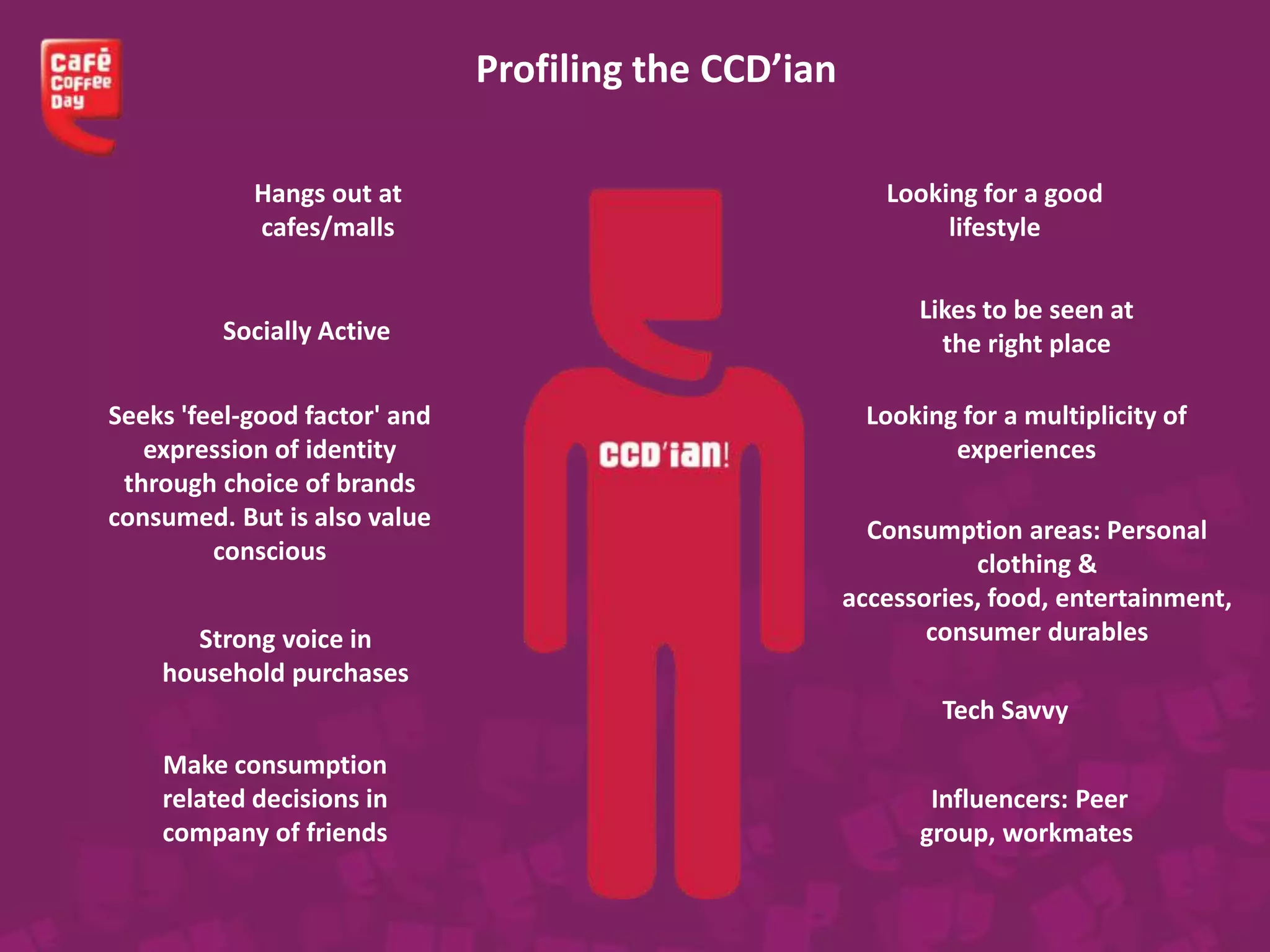
Hangs out at
cafes/malls
Looking for a good
lifestyle
Looking for a multiplicity of
experiences
Seeks 'feel-good factor' and
expression of identity
through choice of brands
consumed. But is also value
conscious
Likes to be seen at
the right placeSocially Active
Profiling the CCD’ian
Strong voice in
household purchases
Consumption areas: Personal
clothing &
accessories, food, entertainment,
consumer durables
Make consumption
related decisions in
company of friends
Tech Savvy
Influencers: Peer
group, workmates
• Average dwell time at café: 45 minutes
• Meeting place for 15-35 year olds
• The place they frequent most after “home and
workplace/college”
• A place where they meet friends and colleagues,
in groups of 3 or more
• A place where they rejuvenate and are free to be
themselves rather than a place to be “seen at”
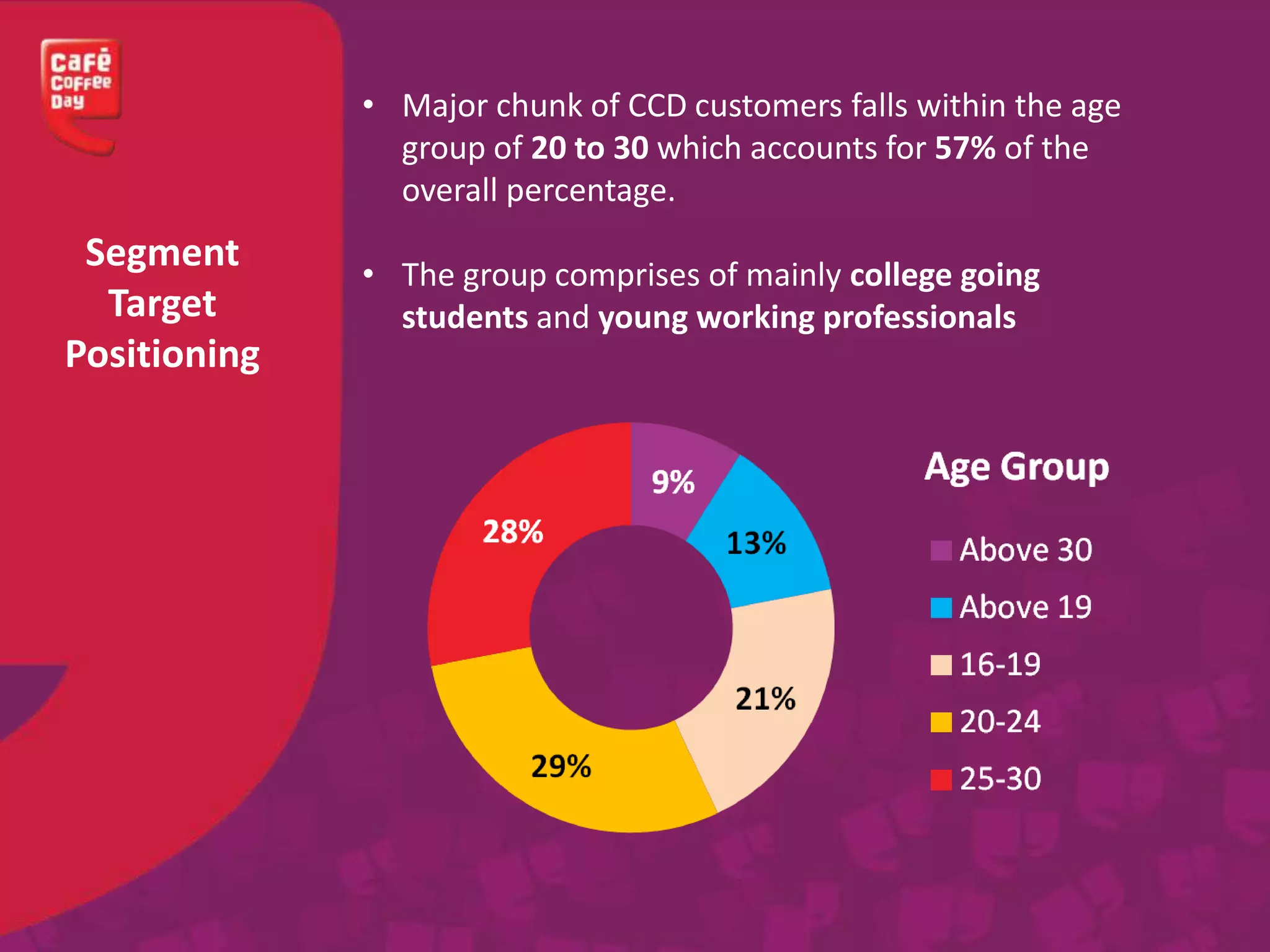
• Major chunk of CCD customers falls within the age
group of 20 to 30 which accounts for 57% of the
overall percentage.
• The group comprises of mainly college going
students and young working professionals
Segment
Target
Positioning
Segment
Target
Positioning
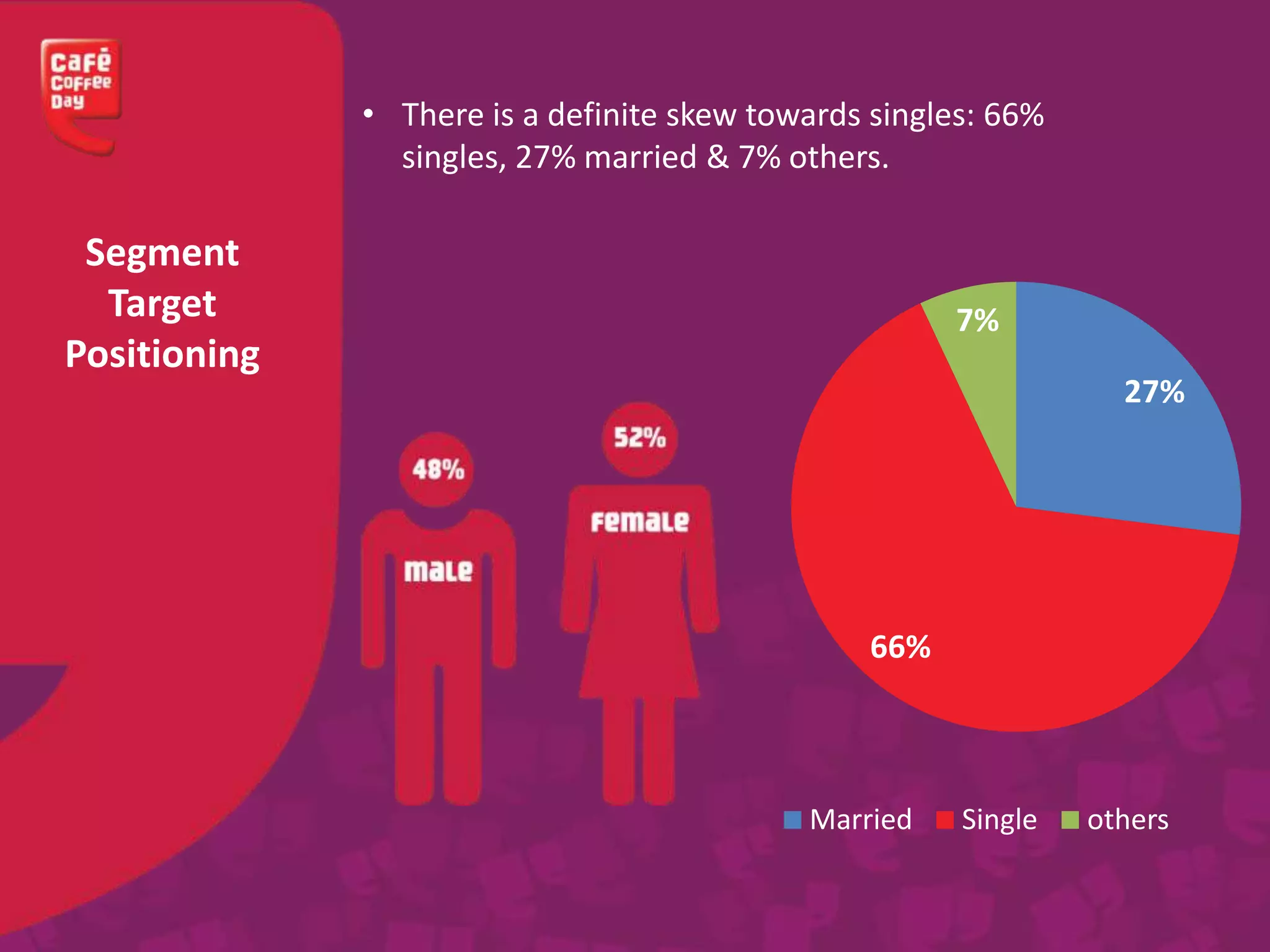
• There is a definite skew towards singles: 66%
singles, 27% married & 7% others.
27%
66%
7%
Married Single others
Business
Professionals : 23%
Special occasions :
20%
Hangout for youth:
57%
Segmentation Target Positioning
Who hangs out at CCD?
Ansoff’s Matrix
Entered with basic
products
Winning customers of
competitors
Was used as promotion
and cost cutting
techniques
Come out with new and
different products
Eg. Pasta in food and new
flavor in beverages
Existing customers  New
Products
New customers  Old
Products
Eg. increased sales in
Western India due to new
products launched
Launch Café Coffee Day in a
new market
Eg. In Africa where coffee
has never been launched
before
PresentNew
Present New
Market
Products
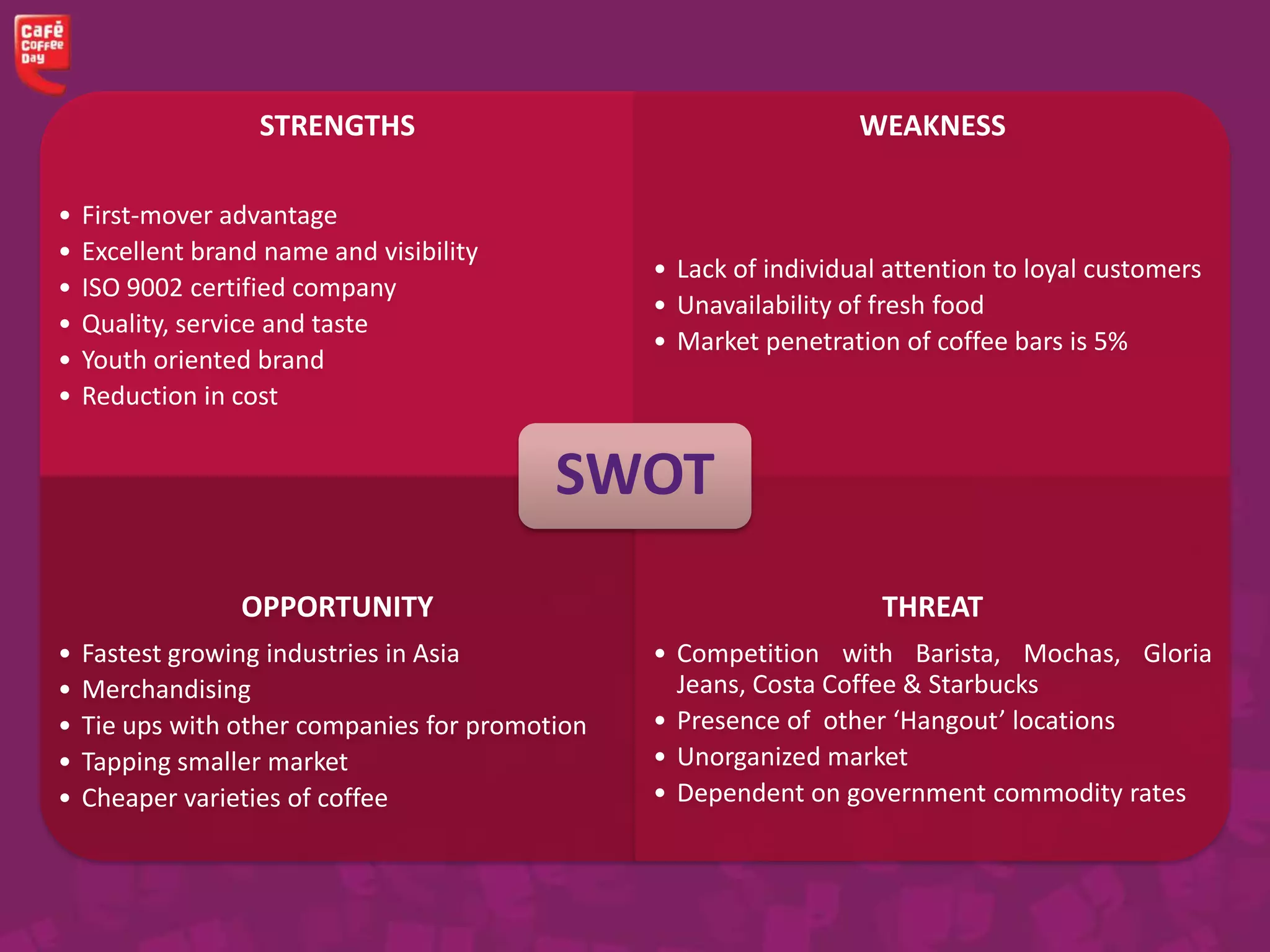
STRENGTHS
• First-mover advantage
• Excellent brand name and visibility
• ISO 9002 certified company
• Quality, service and taste
• Youth oriented brand
• Reduction in cost
WEAKNESS
• Lack of individual attention to loyal customers
• Unavailability of fresh food
• Market penetration of coffee bars is 5%
OPPORTUNITY
• Fastest growing industries in Asia
• Merchandising
• Tie ups with other companies for promotion
• Tapping smaller market
• Cheaper varieties of coffee
THREAT
• Competition with Barista, Mochas, Gloria
Jeans, Costa Coffee & Starbucks
• Presence of other ‘Hangout’ locations
• Unorganized market
• Dependent on government commodity rates
SWOT
Product
•Wide range
•Frappe – Summer
•Cappuccino -
Winter
•Merchandizing
Price
•Range from Rs45 to
Rs100
•Over the years only
minor changes in
pricing policy
Place
•All locations
•Strategically
located outlets
•Coffee machines in
college canteens
•Kiosks in offices
Promotion
•Channel [V]’s “Get
Gorgeous” Contest
•Tie up with youth
brands
•Khakee and Main
Hun Na
•Sales Promotion
Process
•Self service to table
service
•Complaints and
feedback
•Response time
People
•“People are hired for
what they know but
fired for how they
behave”
•Motivation and
personal skills
Physical
Evidence
•Logo in “Dialogue
Box”
•Architecture and
décor
•Coffee table books
•Tag line : “A lot can
happen over coffee”
Marketing Mix
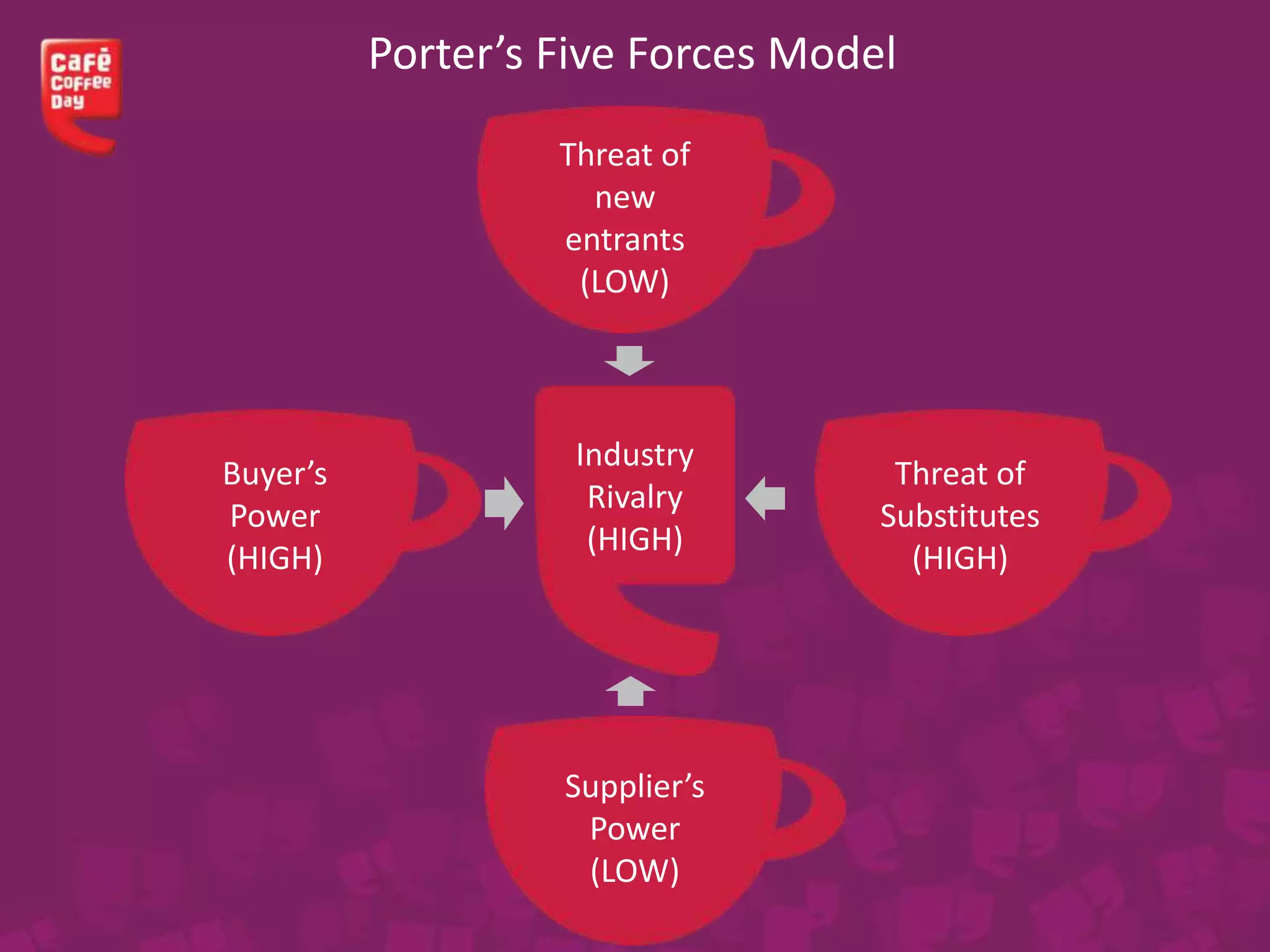
Porter’s Five Forces Model
Threat of
new
entrants
(LOW)
Buyer’s
Power
(HIGH)
Supplier’s
Power
(LOW)
Threat of
Substitutes
(HIGH)
Industry
Rivalry
(HIGH)
Porter’s Five Forces Model
Threat of new entrants - Medium
•Presence of several established brands/hangout places/fast food joints
•High costs for starting a coffee shop chain
•Government policies promoting FDI (Starbucks)
Buyer’s Power - High
•Low switching cost
•Variety of products
•Variety of services
Supplier’s Power - Low
•Absence of cartelization
•Government regulations on prices of milk and coffee
•Backward integration
Threat of substitutes - High
•Aerated drinks, milk beverages, juice centres and tea shops
•Fast food joints like Pizza Hut, Mcdonalds etc
•Hangout places like Hukka parlours and Bistro
Industry Rivalry - High
•Local Coffee chains like Barista, Mochas
•Entry of international coffee chains such as Starbucks, Costa Coffee, Gloria Jeans
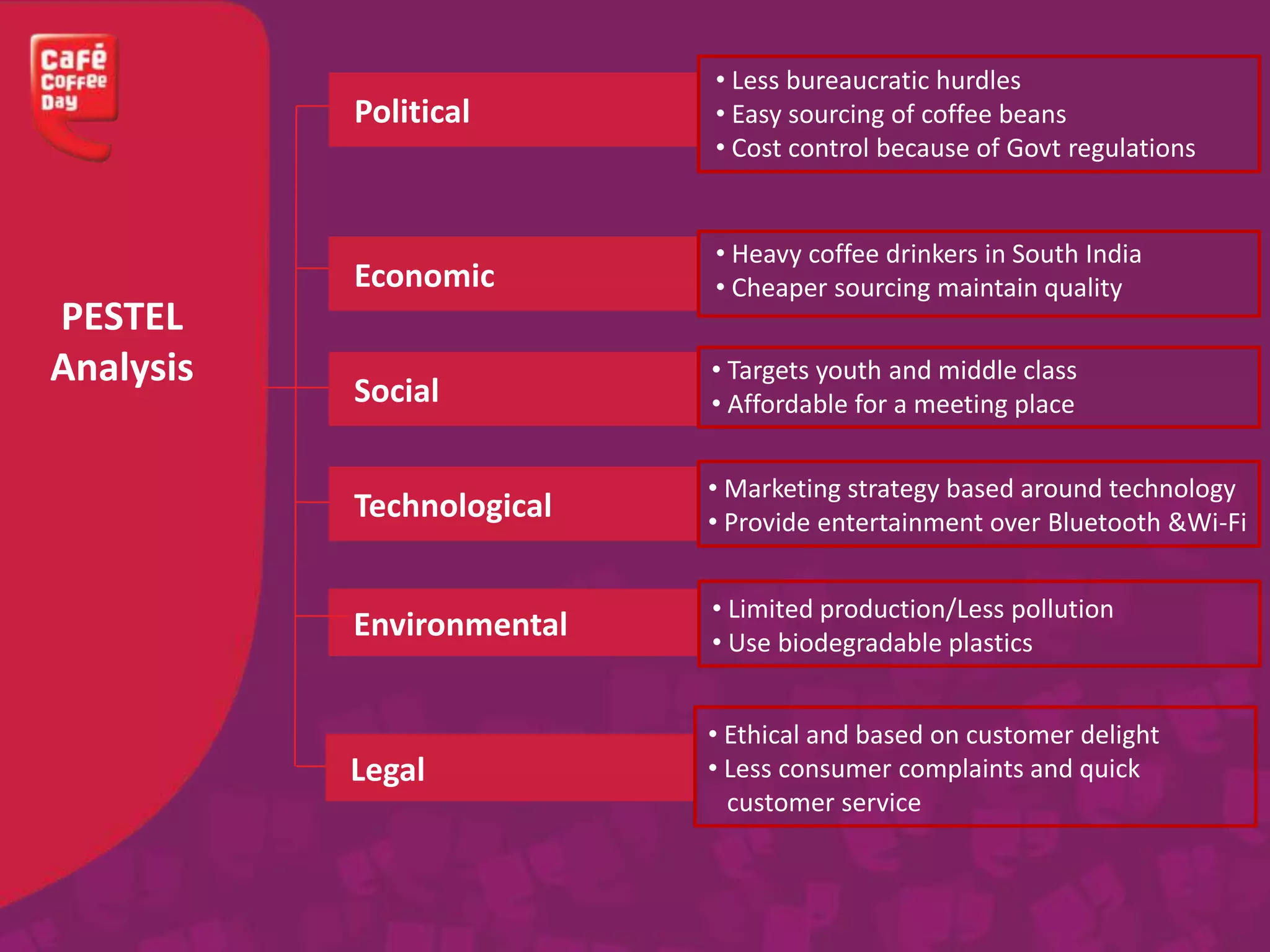
Economic
Social
Technological
Environmental
• Less bureaucratic hurdles
• Easy sourcing of coffee beans
• Cost control because of Govt regulations
• Heavy coffee drinkers in South India
• Cheaper sourcing maintain quality
• Targets youth and middle class
• Affordable for a meeting place
• Marketing strategy based around technology
• Provide entertainment over Bluetooth &Wi-Fi
Political
PESTEL
Analysis
• Limited production/Less pollution
• Use biodegradable plastics
Legal
• Ethical and based on customer delight
• Less consumer complaints and quick
customer service
Competitor Analysis
CCD
54%Barista
26%
costa coffee
14%
others
6%
Market Share
CCD
68%
Starbucks
12%
Gloria
Jeans
3%
Barista
17%
Share of mind
CCD
33%
Chandu
Chaiwala
67%
Unorganised sector
Sample size – 150+
STRENGTHS
• Excellent brand name and brand visibility
• Excellent human resource – ambience and
décor
• Strong brand recall and popularity
• Has over 200 stores across India
• Creating of Moment of Truths for couples
WEAKNESSES
• Perceived as expensive brand
• Dependent on TATA suppliers for coffee beans
• Competition from other coffee
chains, restaurants and fast food joints
• More known for coffee, less known for its food
products
OPPORTUNITIES
• Introduce cheaper & unique versions of coffee
• Tap smaller towns/cities
• Increase promotion to change the perception
of being an expensive brand
THREATS
• Threat from existing coffee chains and fast
food outlets
• Dependent on government commodity rates
SWOT
Product•Wide range but not
as CCD
•Traditional product
with traditional
names
Price•Skim pricing policy
•Prices are
lower, but still
higher when
compared to CCD
Place•Strategically
located outlets
•Malls, cinemas, offi
ce areas, high
streets
Promotion•Promotion through
Press, TV and Radio
medias
Process
•Self service
•Complaints and
feedback
People
•Pleasant, polite and
positive
•Uniforms in sober
shades of brown
and orange
•Personal skills
Physical
Evidence
•Colors in
logo, interiors and
posters
•Uses shades of
brown and orange
to promote its laid
back atmosphere
Marketing Mix
STRENGTHS
• Global brand name coupled with the
trustworthiness of TATA
• Experience of expanding into emerging
markets
• Perception of Higher quality products
• Youth oriented brand
• Excellent brand and service
• Reduction in cost
WEAKNESS
• Starbucks is recognized for its high prices
• Considered a place for elite class to hangout
• Lack of presence in non-metro cities
• Relatively small product breadth
OPPORTUNITY
• Interest in Western Brands in Indian minds
• Targeting rapidly growing Indian urban youth
• Well defined plan to expand in the next 5
years
THREAT
• Global Policy Conflicts
• Presence of other ‘Hangout’ locations
• Largely unorganized market
• Established competitions
SWOT
Advertising
• As a reaction to the launch of
Starbucks in India, CCD debuted
with TV Ad – Sit down-ism
• Gives customer a purpose for
hanging out
• Word of mouth
• Subtle advertising in movies and TV
serials
• Print and social media
• Sponsoring college events and giving
out discount coupons
• Tie up with different corporates
• Presence of outlets in all areas
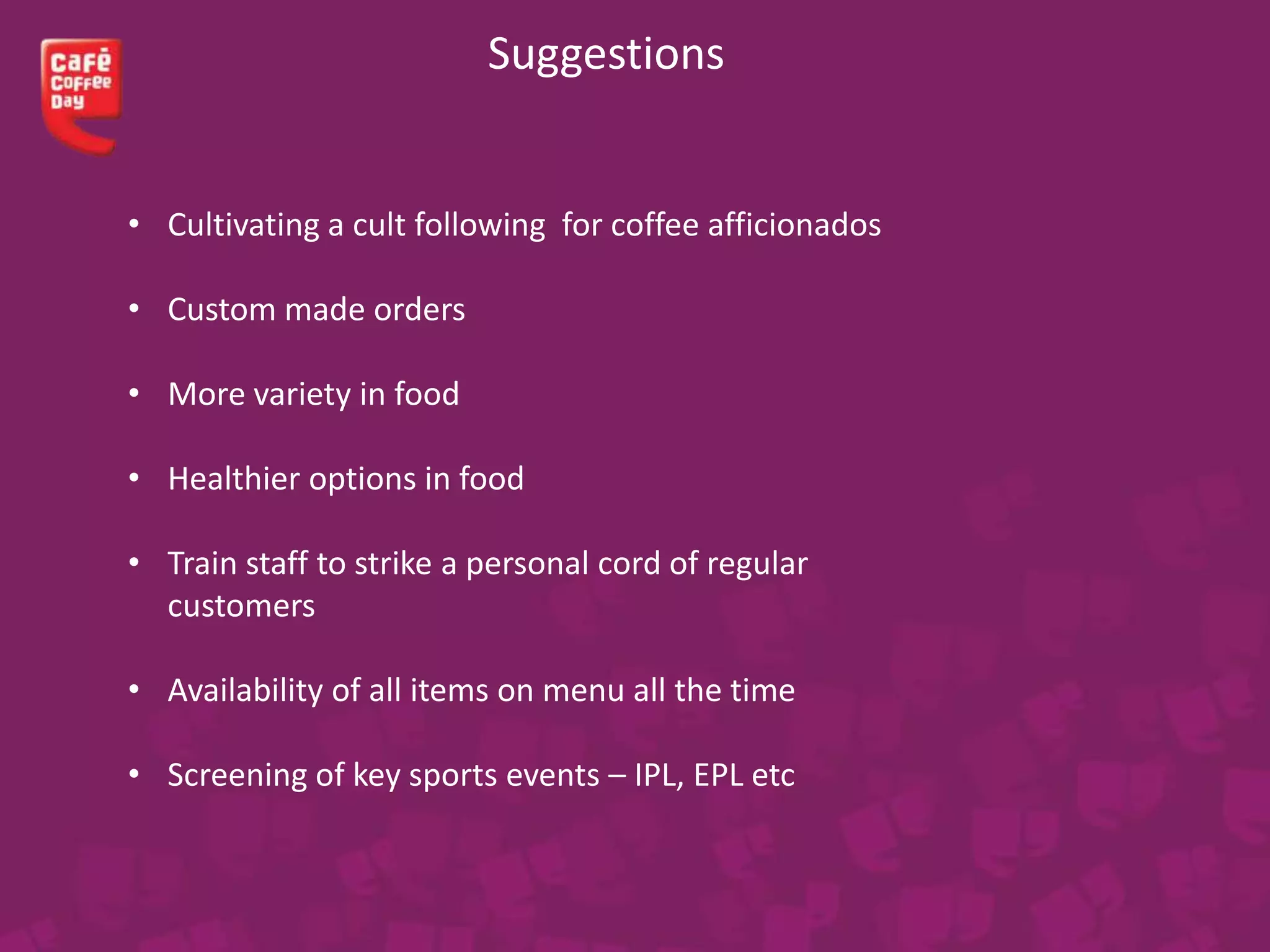
Suggestions
• Cultivating a cult following for coffee afficionados
• Custom made orders
• More variety in food
• Healthier options in food
• Train staff to strike a personal cord of regular
customers
• Availability of all items on menu all the time
• Screening of key sports events – IPL, EPL etc
cafe coffee day

cafe coffee day

  • 1.
    Presented by :Group 2 B008 Indrajit B009 Vipul B015 Tanmay B021 Dhruv B051 Pratik B056 Gaurav Brand Analysis
  • 2.
    What is CaféCoffee Day? • India's largest coffee conglomerate, Amalgamated Bean Coffee Trading Company Ltd • Pioneer of the café culture and the first to launch the ‘coffee bar’ concept in India • Network strength: Over 1400 cafés in 200 cities/towns across India and growing • Average Footfalls: 200 per café per day
  • 3.
    Market Analysis • Coffee– a sunrise industry • Growing young population and promotion of coffee culture • Coffee Segmentation: Robusta and Arabica Beans Different growth culture Pure and blended coffee Cheaper products like chicory, vanilla, mocha Filter coffee and instant coffee 43% share of filter coffee
  • 4.
    Café Coffee DayNetwork of 1450 cafes across India 185 cafes 64 cafes 172 cafes 191 cafes
  • 5.
    Market Analysis 60% 30% 10% Growth Target TierI Tier II Tier III • Network strength of over 1450 cafes in 200 cities and towns with average footfalls of 200 per café per day • Distribution Strategy: • Single unit at Chikmagalur with capacity of 70,000 tonnes per annum • Packaging industry: • Serving hot coffee 210ml and cold coffee 350ml • CCD merchandises • Regional Distribution: • Targeting expansion in smaller towns • New café formats in metros – • Lounge • Square 300 150 50
  • 6.
    Hangs out at cafes/malls Lookingfor a good lifestyle Looking for a multiplicity of experiences Seeks 'feel-good factor' and expression of identity through choice of brands consumed. But is also value conscious Likes to be seen at the right placeSocially Active Profiling the CCD’ian Strong voice in household purchases Consumption areas: Personal clothing & accessories, food, entertainment, consumer durables Make consumption related decisions in company of friends Tech Savvy Influencers: Peer group, workmates
  • 7.
    • Average dwelltime at café: 45 minutes • Meeting place for 15-35 year olds • The place they frequent most after “home and workplace/college” • A place where they meet friends and colleagues, in groups of 3 or more • A place where they rejuvenate and are free to be themselves rather than a place to be “seen at”
  • 8.
    • Major chunkof CCD customers falls within the age group of 20 to 30 which accounts for 57% of the overall percentage. • The group comprises of mainly college going students and young working professionals Segment Target Positioning
  • 9.
    Segment Target Positioning • There isa definite skew towards singles: 66% singles, 27% married & 7% others. 27% 66% 7% Married Single others
  • 10.
    Business Professionals : 23% Specialoccasions : 20% Hangout for youth: 57% Segmentation Target Positioning Who hangs out at CCD?
  • 11.
    Ansoff’s Matrix Entered withbasic products Winning customers of competitors Was used as promotion and cost cutting techniques Come out with new and different products Eg. Pasta in food and new flavor in beverages Existing customers  New Products New customers  Old Products Eg. increased sales in Western India due to new products launched Launch Café Coffee Day in a new market Eg. In Africa where coffee has never been launched before PresentNew Present New Market Products
  • 12.
    STRENGTHS • First-mover advantage •Excellent brand name and visibility • ISO 9002 certified company • Quality, service and taste • Youth oriented brand • Reduction in cost WEAKNESS • Lack of individual attention to loyal customers • Unavailability of fresh food • Market penetration of coffee bars is 5% OPPORTUNITY • Fastest growing industries in Asia • Merchandising • Tie ups with other companies for promotion • Tapping smaller market • Cheaper varieties of coffee THREAT • Competition with Barista, Mochas, Gloria Jeans, Costa Coffee & Starbucks • Presence of other ‘Hangout’ locations • Unorganized market • Dependent on government commodity rates SWOT
  • 13.
    Product •Wide range •Frappe –Summer •Cappuccino - Winter •Merchandizing Price •Range from Rs45 to Rs100 •Over the years only minor changes in pricing policy Place •All locations •Strategically located outlets •Coffee machines in college canteens •Kiosks in offices Promotion •Channel [V]’s “Get Gorgeous” Contest •Tie up with youth brands •Khakee and Main Hun Na •Sales Promotion Process •Self service to table service •Complaints and feedback •Response time People •“People are hired for what they know but fired for how they behave” •Motivation and personal skills Physical Evidence •Logo in “Dialogue Box” •Architecture and décor •Coffee table books •Tag line : “A lot can happen over coffee” Marketing Mix
  • 14.
    Porter’s Five ForcesModel Threat of new entrants (LOW) Buyer’s Power (HIGH) Supplier’s Power (LOW) Threat of Substitutes (HIGH) Industry Rivalry (HIGH)
  • 15.
    Porter’s Five ForcesModel Threat of new entrants - Medium •Presence of several established brands/hangout places/fast food joints •High costs for starting a coffee shop chain •Government policies promoting FDI (Starbucks) Buyer’s Power - High •Low switching cost •Variety of products •Variety of services Supplier’s Power - Low •Absence of cartelization •Government regulations on prices of milk and coffee •Backward integration Threat of substitutes - High •Aerated drinks, milk beverages, juice centres and tea shops •Fast food joints like Pizza Hut, Mcdonalds etc •Hangout places like Hukka parlours and Bistro Industry Rivalry - High •Local Coffee chains like Barista, Mochas •Entry of international coffee chains such as Starbucks, Costa Coffee, Gloria Jeans
  • 16.
    Economic Social Technological Environmental • Less bureaucratichurdles • Easy sourcing of coffee beans • Cost control because of Govt regulations • Heavy coffee drinkers in South India • Cheaper sourcing maintain quality • Targets youth and middle class • Affordable for a meeting place • Marketing strategy based around technology • Provide entertainment over Bluetooth &Wi-Fi Political PESTEL Analysis • Limited production/Less pollution • Use biodegradable plastics Legal • Ethical and based on customer delight • Less consumer complaints and quick customer service
  • 17.
    Competitor Analysis CCD 54%Barista 26% costa coffee 14% others 6% MarketShare CCD 68% Starbucks 12% Gloria Jeans 3% Barista 17% Share of mind CCD 33% Chandu Chaiwala 67% Unorganised sector Sample size – 150+
  • 18.
    STRENGTHS • Excellent brandname and brand visibility • Excellent human resource – ambience and décor • Strong brand recall and popularity • Has over 200 stores across India • Creating of Moment of Truths for couples WEAKNESSES • Perceived as expensive brand • Dependent on TATA suppliers for coffee beans • Competition from other coffee chains, restaurants and fast food joints • More known for coffee, less known for its food products OPPORTUNITIES • Introduce cheaper & unique versions of coffee • Tap smaller towns/cities • Increase promotion to change the perception of being an expensive brand THREATS • Threat from existing coffee chains and fast food outlets • Dependent on government commodity rates SWOT
  • 19.
    Product•Wide range butnot as CCD •Traditional product with traditional names Price•Skim pricing policy •Prices are lower, but still higher when compared to CCD Place•Strategically located outlets •Malls, cinemas, offi ce areas, high streets Promotion•Promotion through Press, TV and Radio medias Process •Self service •Complaints and feedback People •Pleasant, polite and positive •Uniforms in sober shades of brown and orange •Personal skills Physical Evidence •Colors in logo, interiors and posters •Uses shades of brown and orange to promote its laid back atmosphere Marketing Mix
  • 20.
    STRENGTHS • Global brandname coupled with the trustworthiness of TATA • Experience of expanding into emerging markets • Perception of Higher quality products • Youth oriented brand • Excellent brand and service • Reduction in cost WEAKNESS • Starbucks is recognized for its high prices • Considered a place for elite class to hangout • Lack of presence in non-metro cities • Relatively small product breadth OPPORTUNITY • Interest in Western Brands in Indian minds • Targeting rapidly growing Indian urban youth • Well defined plan to expand in the next 5 years THREAT • Global Policy Conflicts • Presence of other ‘Hangout’ locations • Largely unorganized market • Established competitions SWOT
  • 21.
    Advertising • As areaction to the launch of Starbucks in India, CCD debuted with TV Ad – Sit down-ism • Gives customer a purpose for hanging out • Word of mouth • Subtle advertising in movies and TV serials • Print and social media • Sponsoring college events and giving out discount coupons • Tie up with different corporates • Presence of outlets in all areas
  • 22.
    Suggestions • Cultivating acult following for coffee afficionados • Custom made orders • More variety in food • Healthier options in food • Train staff to strike a personal cord of regular customers • Availability of all items on menu all the time • Screening of key sports events – IPL, EPL etc

Editor's Notes