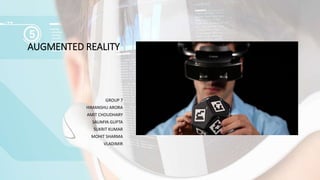
AUGMENTED REALITY
GROUP 7
HIMANSHU ARORA
AMIT CHOUDHARY
SAUMYA GUPTA
SUKRIT KUMAR
MOHIT SHARMA
VLADIMIR
FLOW OF
PRESENTATION
Is AR is a new Technology
What is AR?
AR vs VR
AR Hype Cycle
Uses of AR
Display technologies
Assembly
Maintenance, Service, Repair and Inspection
Manufacturing layout
Tele-Robotics
Product Development
Cost-Benefit analysis
Advantages & Disadvantages
Future Scope
IS AR A NEW
TECHNOLOGY?
Live Telecast of football match
HAWK EYE
WHAT IS AR? • A combination of
• A real scene viewed by a user and
• A virtual scene generated by a
computer that augments the scene
with additional information
Augmented reality is defined as a real time
direct or indirect view of a physical real world
environment that has been augmented by
adding virtual computer generated
information to it.
AUGMENTED REALITY
VS VIRTUAL REALITY
AR
System augments real
world scene
User maintains sense
of presence in real
world
Needs mechanism to
combine virtual & real
worlds
Hard to register real &
virtual
VR
Totally immersive
environment
Senses are under
control of system
Need mechanism to
feed virtual world to
user
Hard to make VR world
interesting
AR Hype Cycle
•AR grabs marketer’s attention.
•Research needs to be carried out.
•As AR moves up on the slope, it should really
take care on how it can use these new
developments in providing a good and
valuable experience to the user
•The Gartner curve seems to be progressing
slowly with the help of 2D images and videos
USES OF AR In the following slides we will be
covering the application in
Manufacturing in detail…
• Entertainment
• Military training
• Engineering design
• Manufacturing and other processes
• Marketing
• Simulation
• Navigation
• Medical
DISPLAY
TECHNOLOGIES
• Monitor based
• Laptops
• Cell phones
• Projectors
• Head mounted displays
• Video see-through
• Optical see-through
Augmented reality can be created on
multiple platforms depending on the use and
maturity in technology
MONITOR BASED AR • Simplest available
• Treat laptops/PDA/cell phones as a
window through which you can see
AR world
Majorly used in Product development &
Prototyping
OPTICAL SEE-
THROUGH HMD
Optical see through HMD’s work by
placing optical combiners in front of
the user’s eyes. These combiners
are partially transmissive, so that
the user can look directly through
them to see the world
Used in Assembly and Servicing
ASSEMBLY • Examples
• Boeing –For assembly of airplanes. -
information to workers inform of
diagrams, voice over instructions and
illustrations
• Furniture assembly system –
ARToolkit is used for tracking and
assembly instruction augmentation.
• Training-Deliverance of assembly
information and instructions
• Information about assembly (instruction
manuals, drawings or semantics)
• detached from equipments
• paper manual or electronic manual
• It leads to inefficiency and error because
of switching in workspace
• It places the digital assembly
information in the area of view of
operator
• Roadblock -what kind of information has
to be shared virtually and where and in
what proportion
MAINTENANCE,
SERVICE, REPAIR AND
INSPECTION
Examples
• An aircraft mechanic can see virtual
information panels ->real image of a jet
engine +‘‘see through’’ machinery without
disassembling it.
• A technician working on CPU and receives
step-by-step instructions servicing it
• Remotely operated vehicles (ROVs) in a
dangerous environment where user cannot
go
• Underground pipe inspection, maintenance
• Used for aircraft maintenance and repair .
• Quality assurance of inspectors in food
processing
Superimposition of images, voice instructions
over the actual equipment providing step by
step information
MANUFACTURING
LAYOUT
• A physically existing production
environment is superimposed with
virtual objects
• AR based systems provide an
interactive interface
• It assists users in modelling,
validation of the simulation model,
and the subsequent optimization of
the production system
• Focus is on design-test-verify
approach
AR simulation is used to create effective and
efficient production systems
Through this method product and process
development cycles are sought to be
shortened
TELE-ROBOTICS
• AR used to enhance interaction between
humans and robots
• Operator uses a visual image that
contains details and other significant
points about the scene and superimposes
it over the scene
• This allows operation & inspection of
equipment in difficult and/or hazardous
environments
• This process reduces the learning time
and increases the intuitiveness of the
programming process
It involves controlling robots remotely to
perform certain activities in the real world
However, currently tele-robotics doesn’t
come with the desired level of accuracy or
control
PRODUCT
DEVELOPMENT
New Augmented Tangible Interfaces
(ATI) -can be used for
• 3D browsing
• 3D position/orientation
• 3D assembly/disassembly
• To take care of the design process
Multiuser collaborative AR
• Help in interaction between experts
that are located at geographically
dispersed locations
AR can be used as a tool to simulate the
product development
Mixed prototyping approach- Mock non-
reconfigurable parts with 3D prototypes.
User to assess and evaluate the synthetic
prototypes in the environment directly.
COSTS & BENEFITS
Business
UsersCOST
BENEFIT
Software
and
Hardwar
e Cost
Training
Cost
PrivacyInformation
Overload
Lost
Attention
Business
Users
Marketing
Better
Decision
Making
Easier Access of surrounding
information
ADVANTAGES
• Tool for marketing
• Personalization
• It’s unique
• Virality
• Content
DISADVANTAGES
• Unauthorized augmented
advertising
• Profiling
• Augmented behavioral targeting
• Spams
• Loss of privacy
IMPLEMENTATION
COST CONSIDERATION
COST OF AR TECHNOLOGY IN MANUFACTURING (BOSCH)
INITIAL INVESTMENT* 1000000
LICENSING(FOR 2 YRS) 300000
1 2 3 4 5
Investment 1000000 0 0 0 0
ANNUAL MAINT. COST 35000 Licensing 0 0 0 300000 0
Maintenance# 0 35000 38500 42350 46585
SAVINGS** 150000 Savings 150000 165000 181500 199650 219615
-850000 165000 181500 199650 219615
* for three years NPV -2,46,707
** labour and time
will increase by 10% every yr
# 10% increase every year
FUTURE SCOPE Content for AR Applications
• Better content and/or contexts are required to make better
AR research and prototypes.
• Better applications are mostly in a better position to drive
the research into new groundbreaking projects.
A Need for Cross Fields Research
• Tracking and Positioning are some of the Major problems
for AR
• Artificial Intelligence as a field can provide various
technologies that can be extremely helpful in creating AR
systems that can be implemented in several specific
problem domains common systems.
It is following a sciatic process which is a
rather slow moving process
It should primarily focus on developing and
exploring the basic ideas and enabling
technologies of Augmented Reality.
“AN ARTIST’S VISION IS AN INVENTOR’S
REALITY”
THANK YOU
We hope you liked our work!

Augmented reality

  • 1.
    AUGMENTED REALITY GROUP 7 HIMANSHUARORA AMIT CHOUDHARY SAUMYA GUPTA SUKRIT KUMAR MOHIT SHARMA VLADIMIR
  • 2.
    FLOW OF PRESENTATION Is ARis a new Technology What is AR? AR vs VR AR Hype Cycle Uses of AR Display technologies Assembly Maintenance, Service, Repair and Inspection Manufacturing layout Tele-Robotics Product Development Cost-Benefit analysis Advantages & Disadvantages Future Scope
  • 3.
    IS AR ANEW TECHNOLOGY? Live Telecast of football match HAWK EYE
  • 4.
    WHAT IS AR?• A combination of • A real scene viewed by a user and • A virtual scene generated by a computer that augments the scene with additional information Augmented reality is defined as a real time direct or indirect view of a physical real world environment that has been augmented by adding virtual computer generated information to it.
  • 6.
    AUGMENTED REALITY VS VIRTUALREALITY AR System augments real world scene User maintains sense of presence in real world Needs mechanism to combine virtual & real worlds Hard to register real & virtual VR Totally immersive environment Senses are under control of system Need mechanism to feed virtual world to user Hard to make VR world interesting
  • 7.
    AR Hype Cycle •ARgrabs marketer’s attention. •Research needs to be carried out. •As AR moves up on the slope, it should really take care on how it can use these new developments in providing a good and valuable experience to the user •The Gartner curve seems to be progressing slowly with the help of 2D images and videos
  • 8.
    USES OF ARIn the following slides we will be covering the application in Manufacturing in detail… • Entertainment • Military training • Engineering design • Manufacturing and other processes • Marketing • Simulation • Navigation • Medical
  • 9.
    DISPLAY TECHNOLOGIES • Monitor based •Laptops • Cell phones • Projectors • Head mounted displays • Video see-through • Optical see-through Augmented reality can be created on multiple platforms depending on the use and maturity in technology
  • 10.
    MONITOR BASED AR• Simplest available • Treat laptops/PDA/cell phones as a window through which you can see AR world Majorly used in Product development & Prototyping
  • 11.
    OPTICAL SEE- THROUGH HMD Opticalsee through HMD’s work by placing optical combiners in front of the user’s eyes. These combiners are partially transmissive, so that the user can look directly through them to see the world Used in Assembly and Servicing
  • 12.
    ASSEMBLY • Examples •Boeing –For assembly of airplanes. - information to workers inform of diagrams, voice over instructions and illustrations • Furniture assembly system – ARToolkit is used for tracking and assembly instruction augmentation. • Training-Deliverance of assembly information and instructions • Information about assembly (instruction manuals, drawings or semantics) • detached from equipments • paper manual or electronic manual • It leads to inefficiency and error because of switching in workspace • It places the digital assembly information in the area of view of operator • Roadblock -what kind of information has to be shared virtually and where and in what proportion
  • 13.
    MAINTENANCE, SERVICE, REPAIR AND INSPECTION Examples •An aircraft mechanic can see virtual information panels ->real image of a jet engine +‘‘see through’’ machinery without disassembling it. • A technician working on CPU and receives step-by-step instructions servicing it • Remotely operated vehicles (ROVs) in a dangerous environment where user cannot go • Underground pipe inspection, maintenance • Used for aircraft maintenance and repair . • Quality assurance of inspectors in food processing Superimposition of images, voice instructions over the actual equipment providing step by step information
  • 15.
    MANUFACTURING LAYOUT • A physicallyexisting production environment is superimposed with virtual objects • AR based systems provide an interactive interface • It assists users in modelling, validation of the simulation model, and the subsequent optimization of the production system • Focus is on design-test-verify approach AR simulation is used to create effective and efficient production systems Through this method product and process development cycles are sought to be shortened
  • 16.
    TELE-ROBOTICS • AR usedto enhance interaction between humans and robots • Operator uses a visual image that contains details and other significant points about the scene and superimposes it over the scene • This allows operation & inspection of equipment in difficult and/or hazardous environments • This process reduces the learning time and increases the intuitiveness of the programming process It involves controlling robots remotely to perform certain activities in the real world However, currently tele-robotics doesn’t come with the desired level of accuracy or control
  • 17.
    PRODUCT DEVELOPMENT New Augmented TangibleInterfaces (ATI) -can be used for • 3D browsing • 3D position/orientation • 3D assembly/disassembly • To take care of the design process Multiuser collaborative AR • Help in interaction between experts that are located at geographically dispersed locations AR can be used as a tool to simulate the product development Mixed prototyping approach- Mock non- reconfigurable parts with 3D prototypes. User to assess and evaluate the synthetic prototypes in the environment directly.
  • 18.
    COSTS & BENEFITS Business UsersCOST BENEFIT Software and Hardwar eCost Training Cost PrivacyInformation Overload Lost Attention Business Users Marketing Better Decision Making Easier Access of surrounding information
  • 19.
    ADVANTAGES • Tool formarketing • Personalization • It’s unique • Virality • Content DISADVANTAGES • Unauthorized augmented advertising • Profiling • Augmented behavioral targeting • Spams • Loss of privacy
  • 20.
    IMPLEMENTATION COST CONSIDERATION COST OFAR TECHNOLOGY IN MANUFACTURING (BOSCH) INITIAL INVESTMENT* 1000000 LICENSING(FOR 2 YRS) 300000 1 2 3 4 5 Investment 1000000 0 0 0 0 ANNUAL MAINT. COST 35000 Licensing 0 0 0 300000 0 Maintenance# 0 35000 38500 42350 46585 SAVINGS** 150000 Savings 150000 165000 181500 199650 219615 -850000 165000 181500 199650 219615 * for three years NPV -2,46,707 ** labour and time will increase by 10% every yr # 10% increase every year
  • 21.
    FUTURE SCOPE Contentfor AR Applications • Better content and/or contexts are required to make better AR research and prototypes. • Better applications are mostly in a better position to drive the research into new groundbreaking projects. A Need for Cross Fields Research • Tracking and Positioning are some of the Major problems for AR • Artificial Intelligence as a field can provide various technologies that can be extremely helpful in creating AR systems that can be implemented in several specific problem domains common systems. It is following a sciatic process which is a rather slow moving process It should primarily focus on developing and exploring the basic ideas and enabling technologies of Augmented Reality.
  • 22.
    “AN ARTIST’S VISIONIS AN INVENTOR’S REALITY”
  • 23.
    THANK YOU We hopeyou liked our work!