STARBUC
KS
DELIVERING
CUSTOMER
SERVICE
SUMMARY
• 1971 – Gerald Baidwin , Gordon Bowker & Ziev siegl opened a small coffee shop in Seatle’s
pike place market selling whole arabica beans to a niche market of coffee purists.
• 1982 Schultz joined the Starbucks marketing team , later he introduced the idea of selling
coffee in espresso bars as an experimental setup. Later Schultz acquired the company.
• Schultz began opening new stores focusing on expresso bars, by 1992 there were 140 stores.
• By 2002 Schultz had established Starbucks as the dominant speciality coffee brand in
North America with CAGR of 40 %, 20 million customers in well over 5000 stores.
• Value Proposition – Coffee, Customer intimacy & Atmosphere
• Channels of Distribution - Company operated stores, Non company operated retail
channels -specialty operations
• Starbucks partners- All employees were called partners – 60000 partners.
• Delivering on Service – Partners learns two types of skills - Hard skills & Soft skills. “ JUST
SAY YES “ policy .
• Measuring Service Performance – Service , Cleanliness , Product Quality Speed of Service &
Legendary service. Tool – Mystery shopper program called Customer snapshot.
• Competition – small scale specialty coffee chains.
• Company objective – to reach most recognized and respected brand in the world
• Retail expansion – increased coffee consumption , 8 states still left & far from reaching
saturation levels.
• Product innovation - new product were launched on regular basis
• Service innovation – Stored value card
• Starbucks Market research – Trouble in brewing
• Starbucks brand meaning – The difference in identity between Starbucks & its competitors
• The changing Customer – 27 % of customer are new belonging to age group of 24-44 and
lower income levels.
• Customer behaviour – most frequent customers averaged 18 visits a month.
• Measuring and driving the customer satisfaction – not meeting expectations- service gap
• Rediscovering the Starbucks Customer – to invest $40 million annually in the company’s
4500 stores, which increases additional 20 hours of labour a week.
Reasons for extraordinary success for
Starbucks
 Quality Coffee & Control over supply chain
• Sourced coffee from Africa, Central & South America and Asia Pacific
regions
• Worked directly with the growers and oversaw the roasting process
 Service- ‘Customer Intimacy’
• Making a connect with the customer
• ‘Just Say Yes’ strategy
• Partner satisfaction played a vital role
 Atmosphere
• ‘Third place for Americans’
Contd.
 Channels of Distribution
• All stores located in high traffic and high visibility areas
• Stores also offered variety of pastries, sodas, ice-creams and music CDs
along with coffee accessories
 Service performance measurement
• Mystery shopper program called Customer Snapshot
• Reported on Service, Cleanliness, Product Quality, Speed of Service
Value Proposition
 Customers are the priority
 No compromise in the service provided to them
 Not only about coffee but about the memorable experience
Impact- Loyal customers visited the store 18 times in a month
Customer satisfaction declined:
 Imperfect tool for measuring customer satisfaction:
1. Mystery shoppers program
2. Rated based on 4 criteria : service, cleanliness, product quality, speed of
service
3. Legendary services : behaviour that created memorable experience for
customer
 Perceived differentiation between Starbucks and others was very less
 Rough brand image of making money primarily and building more stores.
 Low speed of service- customized drinks slowed down the process of
delivering.
 The new customer base had different perception and expectation from brand.
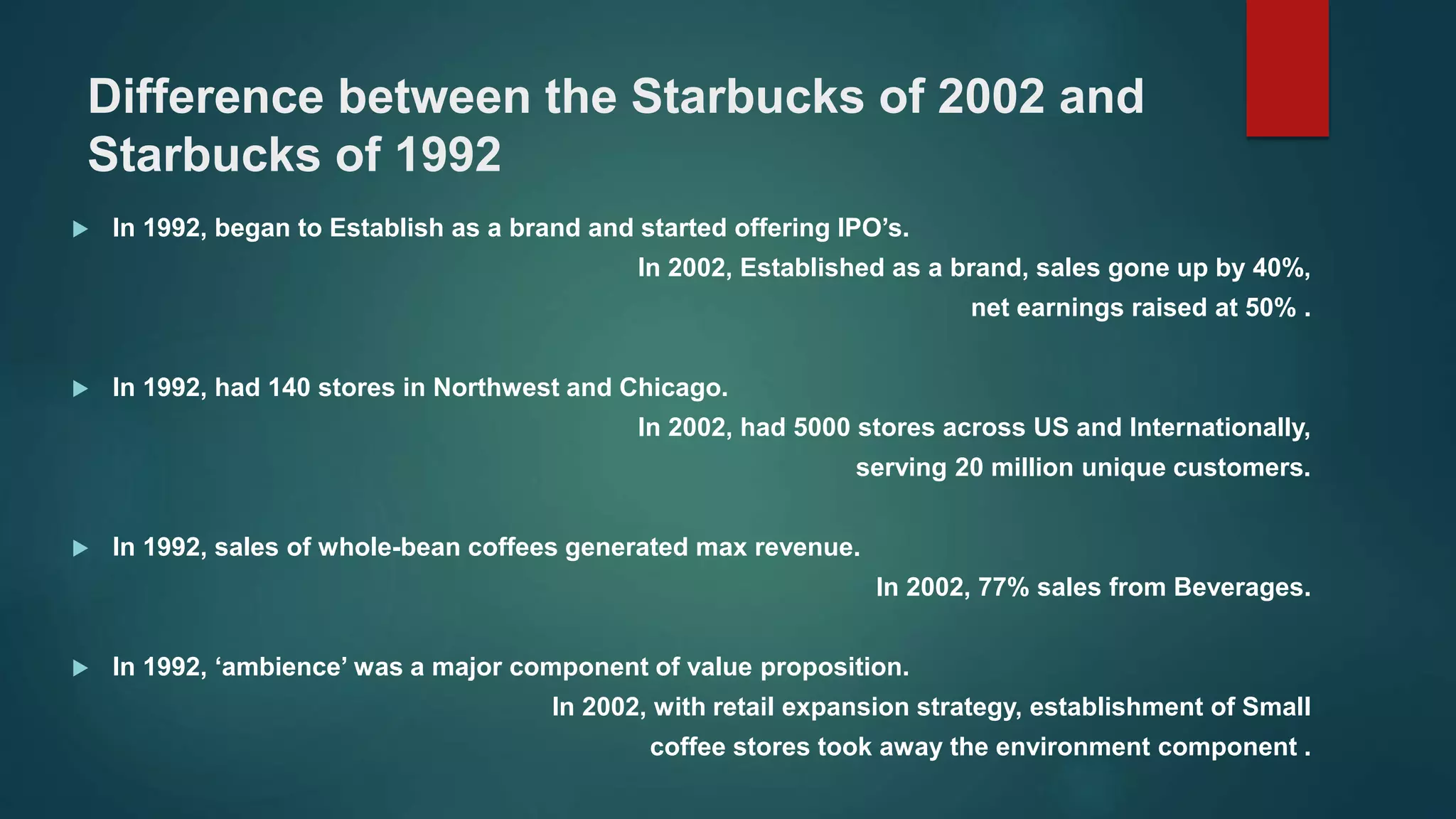
Difference between the Starbucks of 2002 and
Starbucks of 1992
 In 1992, began to Establish as a brand and started offering IPO’s.
In 2002, Established as a brand, sales gone up by 40%,
net earnings raised at 50% .
 In 1992, had 140 stores in Northwest and Chicago.
In 2002, had 5000 stores across US and Internationally,
serving 20 million unique customers.
 In 1992, sales of whole-bean coffees generated max revenue.
In 2002, 77% sales from Beverages.
 In 1992, ‘ambience’ was a major component of value proposition.
In 2002, with retail expansion strategy, establishment of Small
coffee stores took away the environment component .
Contd.
 In 2002, beverage menu expanded along with drink customization lead to
more complex process and slow delivery process.
Not prevalent in 1992.
 In 1992, customer base was affluent, mid to upper class professionals.
In 2002, the customer base was changed to younger,
less-educated and lower-income profile.
 In 1992, renowned as third place after home and work place.
In 2002, image changed to a convenient place
to meet and drink coffee.
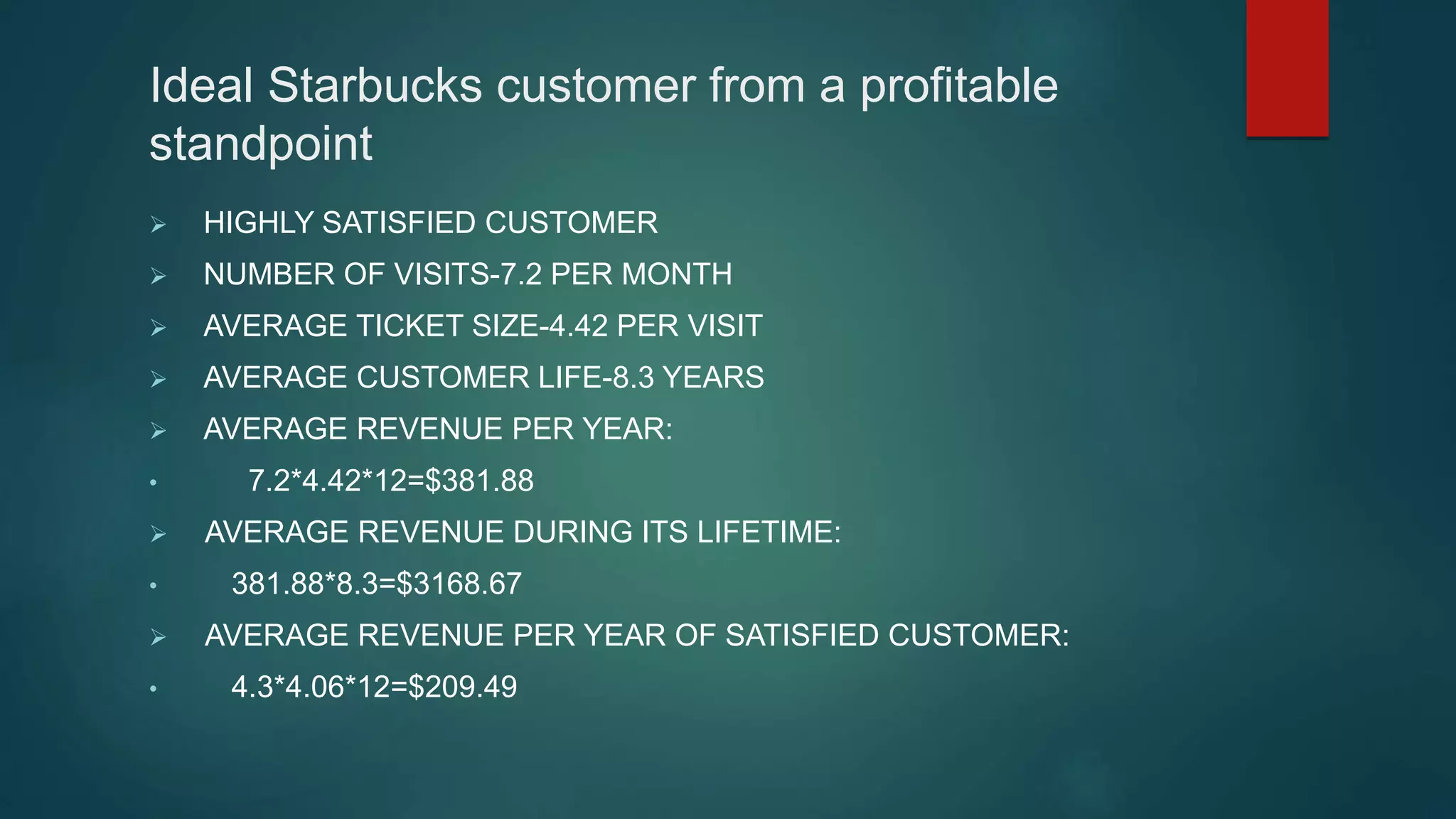
Ideal Starbucks customer from a profitable
standpoint
 HIGHLY SATISFIED CUSTOMER
 NUMBER OF VISITS-7.2 PER MONTH
 AVERAGE TICKET SIZE-4.42 PER VISIT
 AVERAGE CUSTOMER LIFE-8.3 YEARS
 AVERAGE REVENUE PER YEAR:
• 7.2*4.42*12=$381.88
 AVERAGE REVENUE DURING ITS LIFETIME:
• 381.88*8.3=$3168.67
 AVERAGE REVENUE PER YEAR OF SATISFIED CUSTOMER:
• 4.3*4.06*12=$209.49
To ensure that the customer is highly satisfied:
 CUSTOMER SATISFACTION
 FASTER SERVICE
 MORE EMPHASIS ON “SOFT SKILLS”
 PROMOTION OF STORED-VALUE CARD
$40 million investment in labor?
 Goal- Increase customer satisfaction
 Money should be allocated based on size of the stores, location and
customer base.
 Eliminate problems associated with fast service.
 Establish strategic marketing group for faster feedback.
 Re-evaluate the value proposition and reasons for deterioration of brand
image.
Thank You

Starbucks Strategy Management

  • 1.
  • 2.
    SUMMARY • 1971 –Gerald Baidwin , Gordon Bowker & Ziev siegl opened a small coffee shop in Seatle’s pike place market selling whole arabica beans to a niche market of coffee purists. • 1982 Schultz joined the Starbucks marketing team , later he introduced the idea of selling coffee in espresso bars as an experimental setup. Later Schultz acquired the company. • Schultz began opening new stores focusing on expresso bars, by 1992 there were 140 stores. • By 2002 Schultz had established Starbucks as the dominant speciality coffee brand in North America with CAGR of 40 %, 20 million customers in well over 5000 stores. • Value Proposition – Coffee, Customer intimacy & Atmosphere • Channels of Distribution - Company operated stores, Non company operated retail channels -specialty operations • Starbucks partners- All employees were called partners – 60000 partners. • Delivering on Service – Partners learns two types of skills - Hard skills & Soft skills. “ JUST SAY YES “ policy .
  • 3.
    • Measuring ServicePerformance – Service , Cleanliness , Product Quality Speed of Service & Legendary service. Tool – Mystery shopper program called Customer snapshot. • Competition – small scale specialty coffee chains. • Company objective – to reach most recognized and respected brand in the world • Retail expansion – increased coffee consumption , 8 states still left & far from reaching saturation levels. • Product innovation - new product were launched on regular basis • Service innovation – Stored value card • Starbucks Market research – Trouble in brewing • Starbucks brand meaning – The difference in identity between Starbucks & its competitors • The changing Customer – 27 % of customer are new belonging to age group of 24-44 and lower income levels. • Customer behaviour – most frequent customers averaged 18 visits a month. • Measuring and driving the customer satisfaction – not meeting expectations- service gap • Rediscovering the Starbucks Customer – to invest $40 million annually in the company’s 4500 stores, which increases additional 20 hours of labour a week.
  • 4.
    Reasons for extraordinarysuccess for Starbucks  Quality Coffee & Control over supply chain • Sourced coffee from Africa, Central & South America and Asia Pacific regions • Worked directly with the growers and oversaw the roasting process  Service- ‘Customer Intimacy’ • Making a connect with the customer • ‘Just Say Yes’ strategy • Partner satisfaction played a vital role  Atmosphere • ‘Third place for Americans’
  • 5.
    Contd.  Channels ofDistribution • All stores located in high traffic and high visibility areas • Stores also offered variety of pastries, sodas, ice-creams and music CDs along with coffee accessories  Service performance measurement • Mystery shopper program called Customer Snapshot • Reported on Service, Cleanliness, Product Quality, Speed of Service
  • 6.
    Value Proposition  Customersare the priority  No compromise in the service provided to them  Not only about coffee but about the memorable experience Impact- Loyal customers visited the store 18 times in a month
  • 7.
    Customer satisfaction declined: Imperfect tool for measuring customer satisfaction: 1. Mystery shoppers program 2. Rated based on 4 criteria : service, cleanliness, product quality, speed of service 3. Legendary services : behaviour that created memorable experience for customer  Perceived differentiation between Starbucks and others was very less  Rough brand image of making money primarily and building more stores.  Low speed of service- customized drinks slowed down the process of delivering.  The new customer base had different perception and expectation from brand.
  • 8.
    Difference between theStarbucks of 2002 and Starbucks of 1992  In 1992, began to Establish as a brand and started offering IPO’s. In 2002, Established as a brand, sales gone up by 40%, net earnings raised at 50% .  In 1992, had 140 stores in Northwest and Chicago. In 2002, had 5000 stores across US and Internationally, serving 20 million unique customers.  In 1992, sales of whole-bean coffees generated max revenue. In 2002, 77% sales from Beverages.  In 1992, ‘ambience’ was a major component of value proposition. In 2002, with retail expansion strategy, establishment of Small coffee stores took away the environment component .
  • 9.
    Contd.  In 2002,beverage menu expanded along with drink customization lead to more complex process and slow delivery process. Not prevalent in 1992.  In 1992, customer base was affluent, mid to upper class professionals. In 2002, the customer base was changed to younger, less-educated and lower-income profile.  In 1992, renowned as third place after home and work place. In 2002, image changed to a convenient place to meet and drink coffee.
  • 10.
    Ideal Starbucks customerfrom a profitable standpoint  HIGHLY SATISFIED CUSTOMER  NUMBER OF VISITS-7.2 PER MONTH  AVERAGE TICKET SIZE-4.42 PER VISIT  AVERAGE CUSTOMER LIFE-8.3 YEARS  AVERAGE REVENUE PER YEAR: • 7.2*4.42*12=$381.88  AVERAGE REVENUE DURING ITS LIFETIME: • 381.88*8.3=$3168.67  AVERAGE REVENUE PER YEAR OF SATISFIED CUSTOMER: • 4.3*4.06*12=$209.49
  • 11.
    To ensure thatthe customer is highly satisfied:  CUSTOMER SATISFACTION  FASTER SERVICE  MORE EMPHASIS ON “SOFT SKILLS”  PROMOTION OF STORED-VALUE CARD
  • 12.
    $40 million investmentin labor?  Goal- Increase customer satisfaction  Money should be allocated based on size of the stores, location and customer base.  Eliminate problems associated with fast service.  Establish strategic marketing group for faster feedback.  Re-evaluate the value proposition and reasons for deterioration of brand image.
  • 13.