Star Tec Seminar  Marketing Your Startup to the Next Level
Seminar Overview About Martin Original State of Ceelox Marketing Efforts Successes Drive for Funding Q & A
About Martin Background Communications Marketing Media  Education
About Martin Background Communications Marketing Media  Education  All I Really Need to Know I Learned in Kindergarten
Biometric Devices
Product Segmentation Identity Access Management Data and File Encryption Email and Messaging Security
The Marketing of Ceelox Marketing Initiatives PR Initiatives Sales Team Needs GSA Initiatives
Marketing Initiatives  Advertising Magazine, AdWords, banner ads Tradeshows InfoSec, ICBA, Data Connectors Collateral Sales slicks, website, presentations, CD artwork, pocket folders Documentation User and admin guides, quick starts
PR Initiatives  Press Releases Product, Events & Partnerships Articles St Pete Times, TBBJ, Gulf Coast Bus Review Speaking Engagements Association events, webinars, seminars Interviews Newspapers, online portals
SEO
SEO
GSA Initiatives  Getting on the GSA Hired marketing firm Events NASA, MacDill AFB Relationships Local Congressman, government agencies
Successes  Aberdeen Interview SecureMail analyst interview findBiometrics.com Interviews Year in Review  CEO interview SC Magazine Product Reviews ID 4 stars Vault 5 stars Frost & Sullivan Award
The Business Plan
Funding Basics Business Plan vs. Executive Summary Steps to being the “Chosen One” SWOT Analysis Strengths, Weaknesses, Opportunity, Threats The 4 Ps Products, Promotion, Price, Place Operations and Financial Plan Generating Cash Flow
VC Wisdom Key take away messages  The biggest mistakes  How do you find your opportunities or how do you prefer to be introduced All things being equal, what makes you choose one investing opportunity vs. another
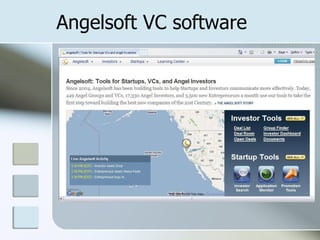
Angelsoft VC software
Conclusion  Presentation Distribution  Questions Please Marketing Collateral Review
Thank You Contact Info: Martin Grobisen [email_address] 813-731-5629

Star Tec Presentation.12.08.09

  • 1.
    Star Tec Seminar Marketing Your Startup to the Next Level
  • 2.
    Seminar Overview AboutMartin Original State of Ceelox Marketing Efforts Successes Drive for Funding Q & A
  • 3.
    About Martin BackgroundCommunications Marketing Media Education
  • 4.
    About Martin BackgroundCommunications Marketing Media Education All I Really Need to Know I Learned in Kindergarten
  • 5.
  • 6.
    Product Segmentation IdentityAccess Management Data and File Encryption Email and Messaging Security
  • 7.
    The Marketing ofCeelox Marketing Initiatives PR Initiatives Sales Team Needs GSA Initiatives
  • 8.
    Marketing Initiatives Advertising Magazine, AdWords, banner ads Tradeshows InfoSec, ICBA, Data Connectors Collateral Sales slicks, website, presentations, CD artwork, pocket folders Documentation User and admin guides, quick starts
  • 9.
    PR Initiatives Press Releases Product, Events & Partnerships Articles St Pete Times, TBBJ, Gulf Coast Bus Review Speaking Engagements Association events, webinars, seminars Interviews Newspapers, online portals
  • 10.
  • 11.
  • 12.
    GSA Initiatives Getting on the GSA Hired marketing firm Events NASA, MacDill AFB Relationships Local Congressman, government agencies
  • 13.
    Successes AberdeenInterview SecureMail analyst interview findBiometrics.com Interviews Year in Review CEO interview SC Magazine Product Reviews ID 4 stars Vault 5 stars Frost & Sullivan Award
  • 14.
  • 15.
    Funding Basics BusinessPlan vs. Executive Summary Steps to being the “Chosen One” SWOT Analysis Strengths, Weaknesses, Opportunity, Threats The 4 Ps Products, Promotion, Price, Place Operations and Financial Plan Generating Cash Flow
  • 16.
    VC Wisdom Keytake away messages The biggest mistakes How do you find your opportunities or how do you prefer to be introduced All things being equal, what makes you choose one investing opportunity vs. another
  • 17.
  • 18.
    Conclusion PresentationDistribution Questions Please Marketing Collateral Review
  • 19.
    Thank You ContactInfo: Martin Grobisen [email_address] 813-731-5629

Editor's Notes

  • #2 I would like to thank: I would like to thank the STAR TEC team. Daniel James TEC Accelerator Manager Kelly Evers, STAR TEC, Client Services Coordinator Sean Lucey Business Development Manager with Intagras
  • #5 These are the things I learned: Share everything. Play fair. Don't hit people. Put things back where you found them. Clean up your own mess. Don't take things that aren't yours. Say you're sorry when you hurt somebody. Wash your hands before you eat. Flush. Warm cookies and cold milk are good for you.
  • #14 2009 Frost and Sullivan Emerging Biometric Solution of the Year Award.
  • #16 Step 1: Business Plan Submission The first step in approaching a VC is to submit a business plan. At minimum, your plan should include: 1. a description of the opportunity and market size; 2. resumes of your management team; 3. a review of the competitive landscape and solutions; 4. detailed financial projections; and 5. a capitalization table. You should also include an executive summary of your business proposal along with the business plan. Step 2: Introductory Conversation/Meeting If your firm has the potential to fit with the VC’s investment preferences, you will be contacted in order to discuss your business in more depth. If, after this phone conversation, a mutual fit is still seen, you’ll be asked to visit with the VC for a one- totwo hour meeting to discuss the opportunity in more detail. After this meeting, the VC will determine whether or not to move forward to the due diligence stage of the process. Step 3: Due Diligence The due diligence phase will vary depending upon the nature of your business proposal. The process may last from three weeks to three months, and you should expect multiple phone calls, emails, management interviews, customer references, product and business strategy evaluations and other such exchanges of information during this time period. Step 4: Term Sheets and Funding If the due diligence phase is satisfactory, the VC will offer you a term sheet. This is a non-binding document that spells out the basic terms and conditions of the investment agreement. The term sheet is generally negotiable and must be agreed upon by all parties, after which you should expect a wait of roughly three to four weeks for completion of legal documents and legal due diligence before funds are made available. Focus on the 4 P’s. They are: Products, Promotions, Price, and Place.
  • #17 1. Key take away messages Investing in start-ups is about timing and tenacity. Getting in front of the right people at the right time is critical. Also beware of the investor and make sure you are getting a "fair" deal for your company. One thing I tell entrepreneurs looking for money is to remember that investors are looking for the one red flag as to why NOT to invest, rather than the entrepreneurs viewpoint which is all the reasons why they SHOULD invest. Go after government grants and contracts right now (SBIR, DOD) as traditional VC funding is tight. Borrow as much seed money from Friends & Family in order to develop / demonstrate a prototype product / service 1. Know your business and the metrics. Nothing is more frustrating than an entrepreneur who is in love with his idea but knows little of the challenges of monetization. 2. Understand that consideration and due diligence will always take longer than you think so don't assume that any investor will "hurry up" just because you are cash-poor. 3. Make sure you have a sustainable competitive advantage. Investors don't like 'commodity plays' with a low barrier-to-entry. And outside equity investments won't come without expectations of out-sized returns 2. The biggest mistakes The biggest mistake I see is the entrepreneur really not understanding the market and competitive landscape. The financial projections don't make sense in many cases and have not been thoroughly scrubbed to make sure they are realistic. Biggest mistake is not getting the story/pitch right. It's got to be extremely compelling. The quote of "no one else is doing this" sends a dual message to me. First, I will always validate the quote in my due diligence and I find it to be rarely true. Secondly, this is not a positive as it communicates there is not a market that has been vetted. Just look at most of the most successful companies in history and they were not the first to bring the product to market but rather executed their business model the best. VC presentation mistakes: entire team is inexperienced; hockey stick revenue pro forma; unrealistic assessment of competitors (known & unknown); unrealistic assessment as to how much money is needed for each round; pitching a VC without any form of introduction is pretty useless these days; don't try to pitch the VC that the elephant can be eaten in one bite. The biggest mistake I see in VC pitches is not adhering to the time allotted. Nothing hacks these guys off more than feeling disrespected, except maybe wasting time getting to the point. They will communicate how much time is given for the pitch and Q&A... it's up to the entrepreneur to adapt accordingly and prepare effectively for each situation. 3. How do you find your opportunities or how do you prefer to be introduced The best way to get deals through the clutter is to be introduced to us by someone who we trust. Use affinity groups such as alumni of prior jobs, universities, etc. as well as the usual friends and family. It's a long process in raising this type of money so be persistent. VC prefer be introduced to deals by "friends", just like lots of folks like to meet people through Facebook, VC like to meet deals through referrals. 4. All things being equal, makes you choose one investing opportunity vs. another Management, management, management. It's all about the people. Have they done this before and are they reasonable about the time and money it will take to get to a viable company from where they are now. We also look for people who understand they are not experts in all areas of management and operations and look to fill those gaps along the way. What is your unique competitive advantage and how good is your team? All things being equal, a proposition that has actually managed to extract money from a customer is very attractive over one which has simply generated a lot of interest. It speaks volumes about the product, the market and the ability of the people in the start-up to sell. Some management teams are able to sell consulting or problem solving even when their product is not fully developed. This is a fantastic skill and helps fund cashflow and adapt the product to something that will actually be valuable when fully developed. All other things being equal, I'll choose people every time. I'd rather have a 'B' idea backed by an 'A' team than the opposite anytime. Choose your partners carefully and with an eye to the future.