Star Topology
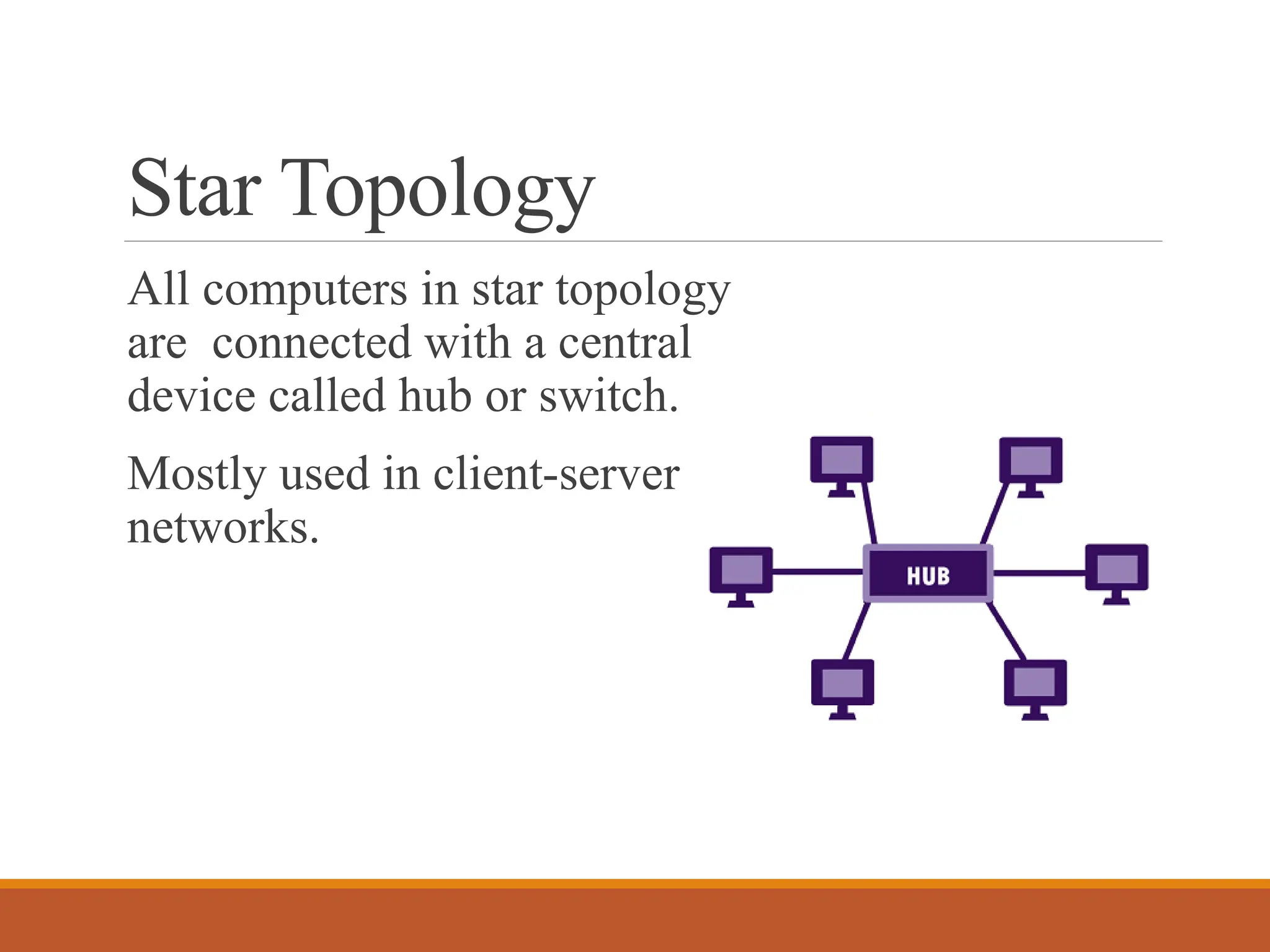
All computers in star topology
are connected with a central
device called hub or switch.
Mostly used in client-server
networks.
Working of Star Network
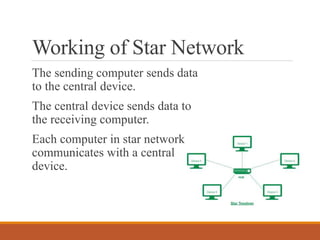
The sending computer sends data
to the central device.
The central device sends data to
the receiving computer.
Each computer in star network
communicates with a central
device.
Advantages
of Star
Topology
Easy to maintain and modify network.
Adding or removing computers can be
done without disturbing the network.
Finding faults becomes very simple.
Single computer failure does not bring
down the whole network.
More flexible than other topologies.
Disadvantages of Star
Topology
If central hub fails, the entire network breaks
down.
Requires a large length of cable to connect
computers.
More expensive.
Ring Topology
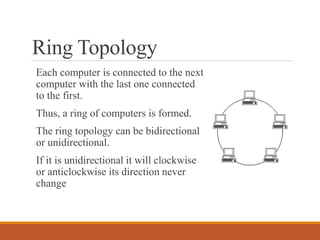
Each computer is connected to the next
computer with the last one connected
to the first.
Thus, a ring of computers is formed.
The ring topology can be bidirectional
or unidirectional.
If it is unidirectional it will clockwise
or anticlockwise its direction never
change
Working of Ring Network
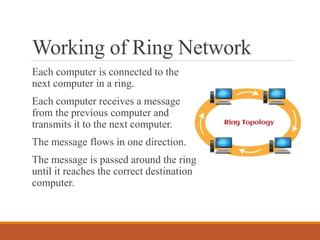
Each computer is connected to the
next computer in a ring.
Each computer receives a message
from the previous computer and
transmits it to the next computer.
The message flows in one direction.
The message is passed around the ring
until it reaches the correct destination
computer.
Advantages of Ring Topology
Less expensive
than star
topology.
Every computer
has equal access
to the network.
Disadvantages
of Ring
Topology
Failure of one computer
in the ring can affect the
whole network.
Difficult to
troubleshoot.
Adding or removing
computers affects the
whole network.
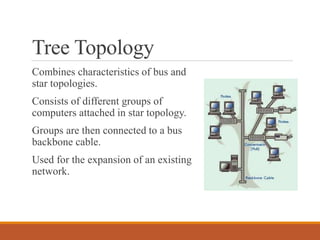
Tree Topology
Combines characteristics of bus and
star topologies.
Consists of different groups of
computers attached in star topology.
Groups are then connected to a bus
backbone cable.
Used for the expansion of an existing
network.
Advantages of Tree Topology
Provides point-to-point wiring
for individual segments.
Supported by several hardware
and software vendors.
/
Disadvantages of Tree Topology
Overall length of each segment is limited by
the type of cabling used.
Entire network goes down if the backbone line
breaks.
More difficult to configure and wire than other
topologies.
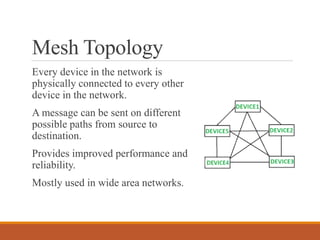
Mesh Topology
Every device in the network is
physically connected to every other
device in the network.
A message can be sent on different
possible paths from source to
destination.
Provides improved performance and
reliability.
Mostly used in wide area networks.
Advantages and Disadvantages of Mesh
Topology
If one device on a mesh network fails, the network
can still function.
Performance is not affected with heavy load of
data transmission.
Easy to troubleshoot.
A full mesh network can be very expensive.
Difficult to install and reconfigure.

star ring tree and mesh topologies .pptx

  • 1.
    Star Topology All computersin star topology are connected with a central device called hub or switch. Mostly used in client-server networks.
  • 2.
    Working of StarNetwork The sending computer sends data to the central device. The central device sends data to the receiving computer. Each computer in star network communicates with a central device.
  • 3.
    Advantages of Star Topology Easy tomaintain and modify network. Adding or removing computers can be done without disturbing the network. Finding faults becomes very simple. Single computer failure does not bring down the whole network. More flexible than other topologies.
  • 4.
    Disadvantages of Star Topology Ifcentral hub fails, the entire network breaks down. Requires a large length of cable to connect computers. More expensive.
  • 5.
    Ring Topology Each computeris connected to the next computer with the last one connected to the first. Thus, a ring of computers is formed. The ring topology can be bidirectional or unidirectional. If it is unidirectional it will clockwise or anticlockwise its direction never change
  • 6.
    Working of RingNetwork Each computer is connected to the next computer in a ring. Each computer receives a message from the previous computer and transmits it to the next computer. The message flows in one direction. The message is passed around the ring until it reaches the correct destination computer.
  • 7.
    Advantages of RingTopology Less expensive than star topology. Every computer has equal access to the network.
  • 8.
    Disadvantages of Ring Topology Failure ofone computer in the ring can affect the whole network. Difficult to troubleshoot. Adding or removing computers affects the whole network.
  • 9.
    Tree Topology Combines characteristicsof bus and star topologies. Consists of different groups of computers attached in star topology. Groups are then connected to a bus backbone cable. Used for the expansion of an existing network.
  • 10.
    Advantages of TreeTopology Provides point-to-point wiring for individual segments. Supported by several hardware and software vendors.
  • 11.
    / Disadvantages of TreeTopology Overall length of each segment is limited by the type of cabling used. Entire network goes down if the backbone line breaks. More difficult to configure and wire than other topologies.
  • 12.
    Mesh Topology Every devicein the network is physically connected to every other device in the network. A message can be sent on different possible paths from source to destination. Provides improved performance and reliability. Mostly used in wide area networks.
  • 13.
    Advantages and Disadvantagesof Mesh Topology If one device on a mesh network fails, the network can still function. Performance is not affected with heavy load of data transmission. Easy to troubleshoot. A full mesh network can be very expensive. Difficult to install and reconfigure.