Topology
Submitted to,
Md. Akhtaruzaman Adnan
Assistant Professor
Dept of CSE, UAP
August 23, 2022
Submitted by,
Bidita Sarkar Diba
ID: 20101016
Section: A1
Dept of CSE, UAP
 Network topology is the interconnected pattern of network elements.
 A network topology may be physical, mapping hardware configuration, or
logical, mapping the path that the data must take in order to travel around
the network.
 There are many identified topologies but they are not strict, which means
that any of them can be combined. However, each topology has a different
standard and may use different hardware methods so they are not
interchangeable.
 Physical topology refers to the physical design of the network, while logical
topology refers to how data is handled within the network regardless of its
physical topology.
What is Topology?
Topology Types
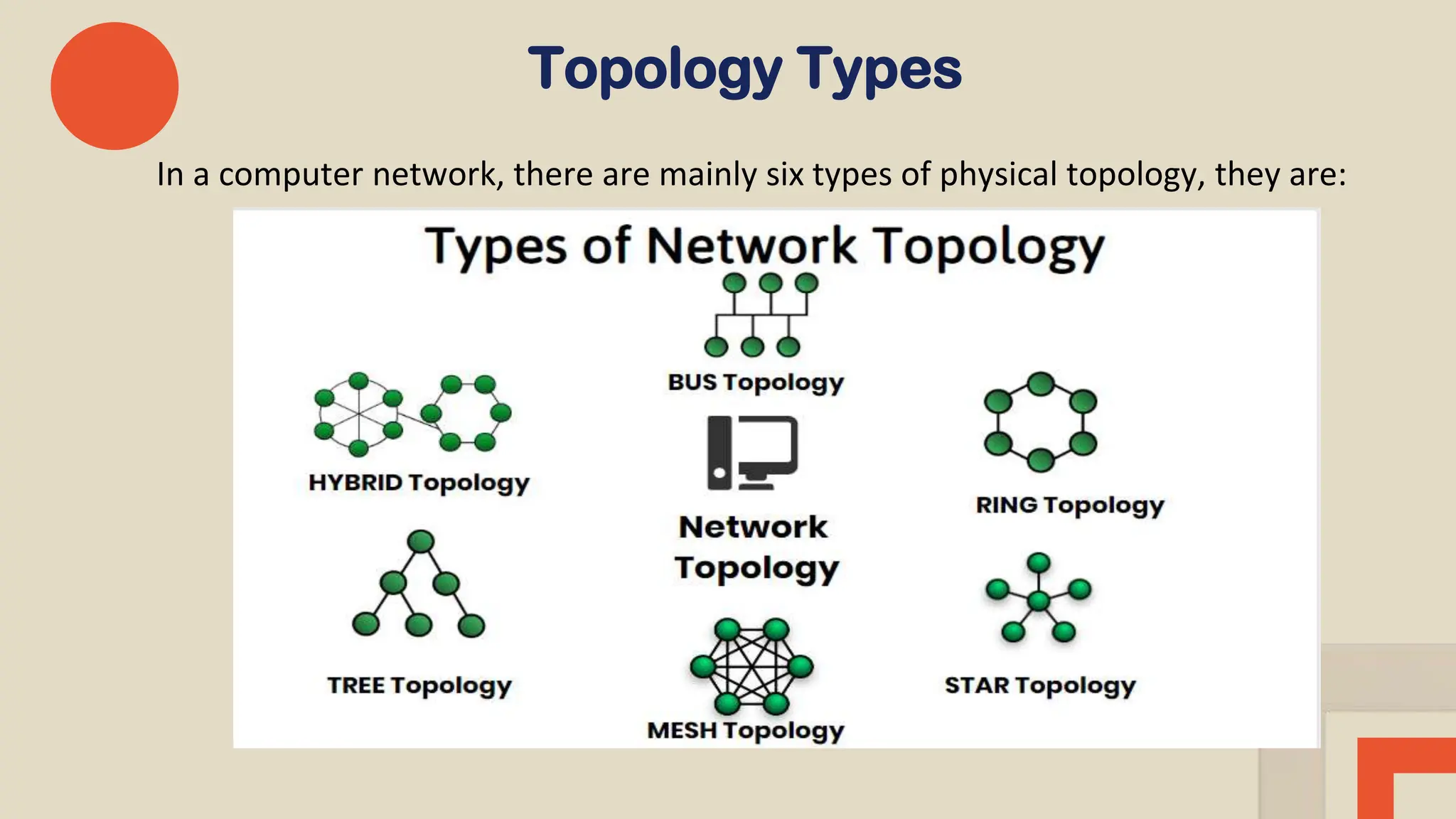
In a computer network, there are mainly six types of physical topology, they are:
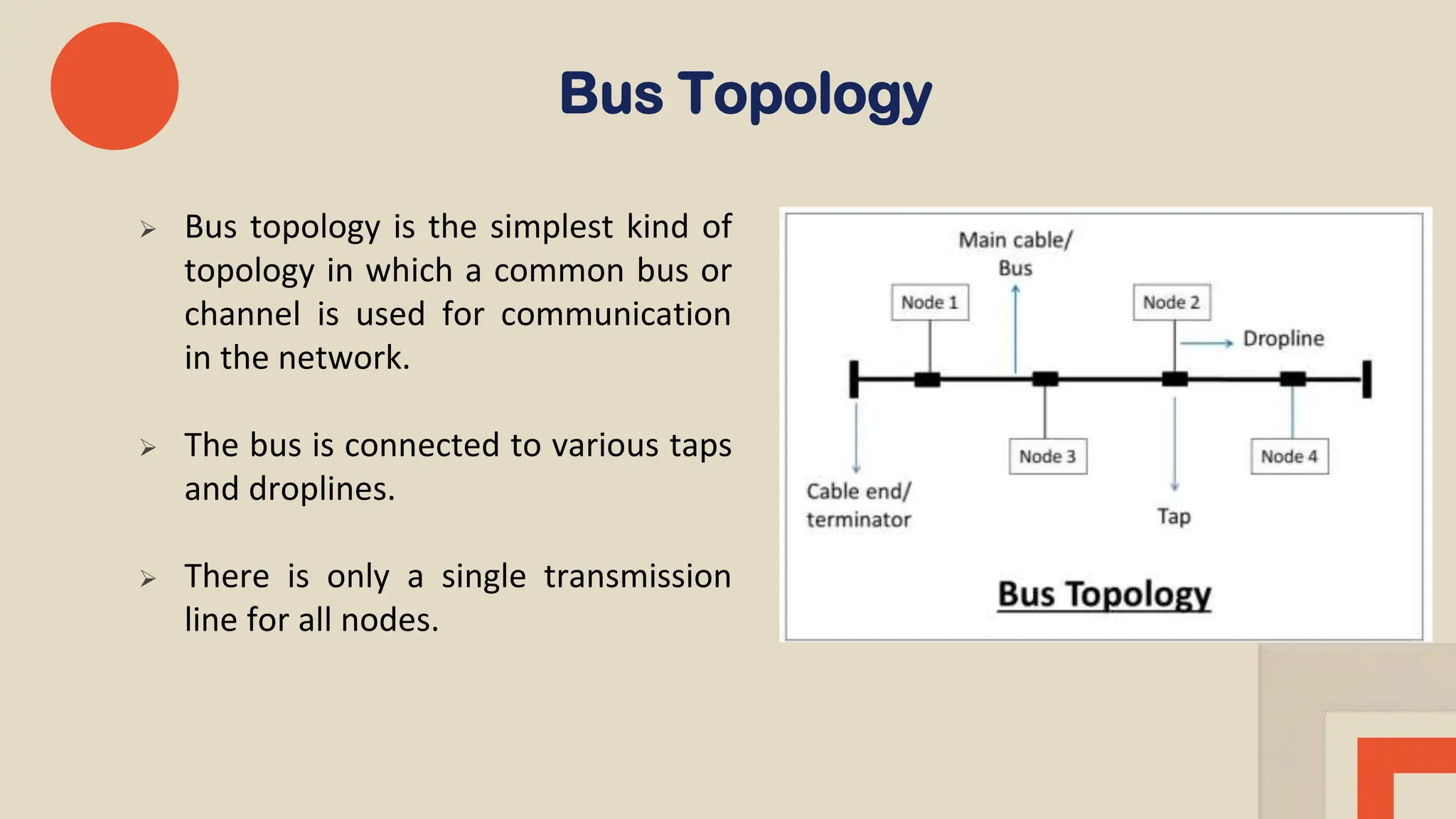
 Bus topology is the simplest kind of
topology in which a common bus or
channel is used for communication
in the network.
 The bus is connected to various taps
and droplines.
 There is only a single transmission
line for all nodes.
Bus Topology
Bus Topology
Following are the advantages of Bus topology:
• Simple to use and install.
• If a node fails, it will not affect other nodes.
• Less cabling is required.
• Cost-efficient to implement.
Following are the disadvantages of Bus topology:
• Efficiency is less when nodes are more(strength of signal decreases).
• If the bus fails, the network will fail.
• A limited number of nodes can connect to the bus due to limited bus length.
• Security issues and risks are more as messages are broadcasted to all nodes.
• Congestion and traffic on the bus as it is the only source of communication.
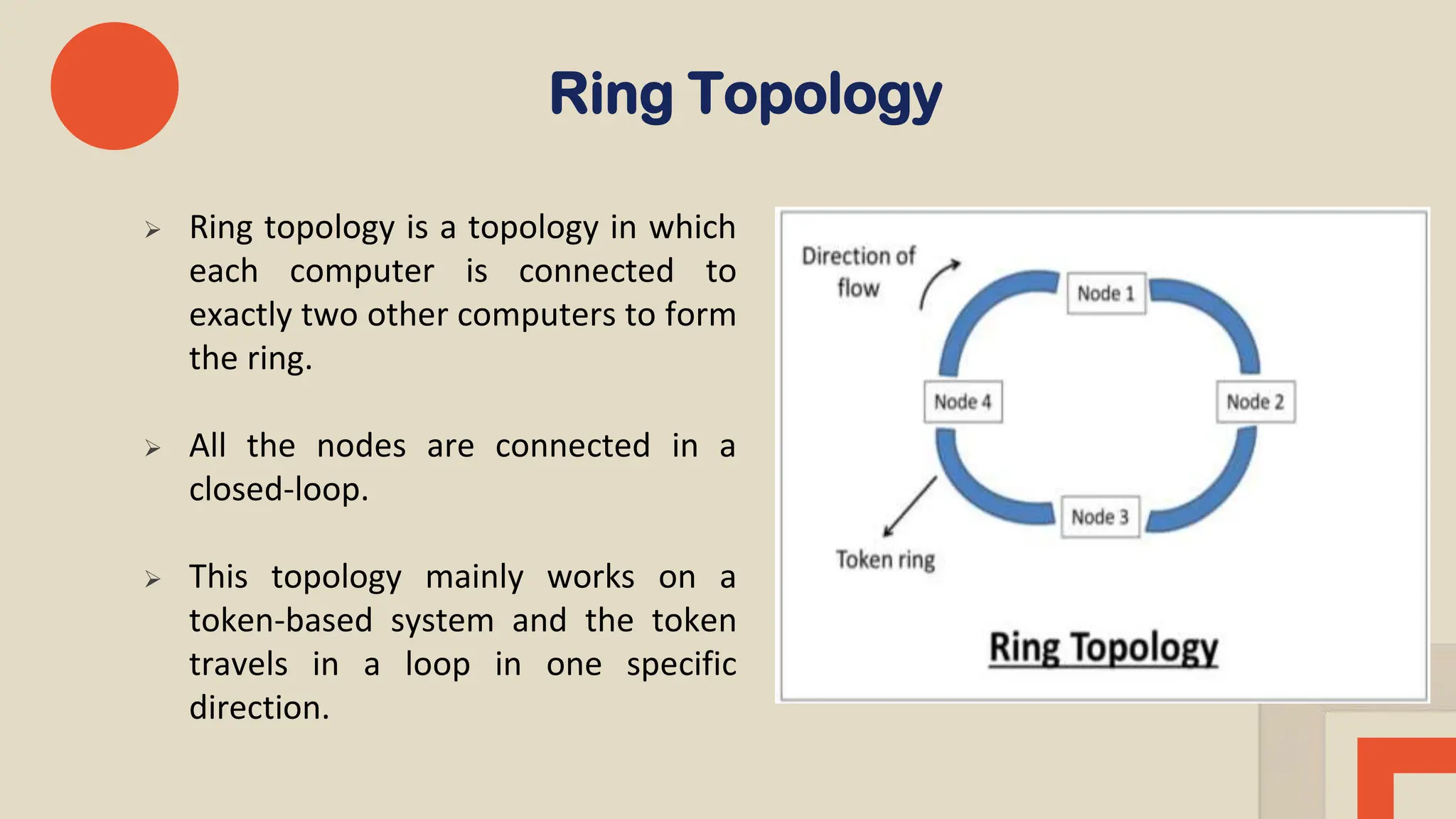
 Ring topology is a topology in which
each computer is connected to
exactly two other computers to form
the ring.
 All the nodes are connected in a
closed-loop.
 This topology mainly works on a
token-based system and the token
travels in a loop in one specific
direction.
Ring Topology
Ring Topology
Following are the advantages of Ring topology:
• Easy Installation.
• Less Cabling Required.
• Reduces chances of data collision(unidirectional).
• Easy to troubleshoot(the faulty node does not pass the token).
• Each node gets the same access time.
Following are the disadvantages of Ring topology:
• If a node fails, the whole network will fail.
• Slow data transmission speed(each message has to go through the ring path).
• Difficult to reconfigure(we have to break the ring).
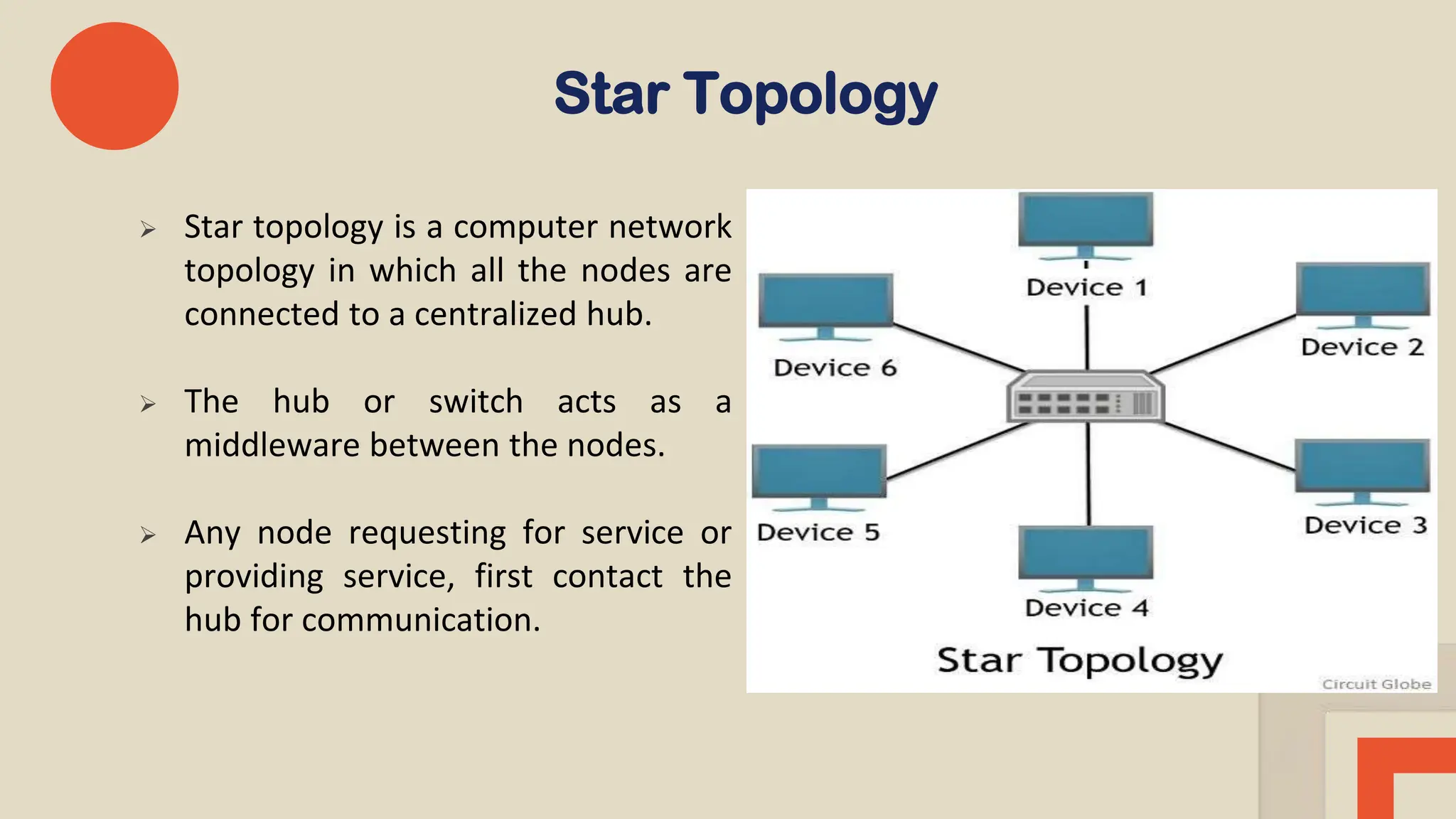
 Star topology is a computer network
topology in which all the nodes are
connected to a centralized hub.
 The hub or switch acts as a
middleware between the nodes.
 Any node requesting for service or
providing service, first contact the
hub for communication.
Star Topology
Star Topology
Following are the advantages of Star topology:
• Centralized control.
• Less Expensive.
• Easy to troubleshoot(the faulty node does not give response).
• Good fault tolerance due to centralized control on nodes.
• Easy to scale(nodes can be added or removed to the network easily).
• If a node fails, it will not affect other nodes.
• Easy to reconfigure and upgrade(configured using a central device).
Following are the disadvantages of Star topology:
• If the central device fails, the network will fail.
• The number of devices in the network is limited.
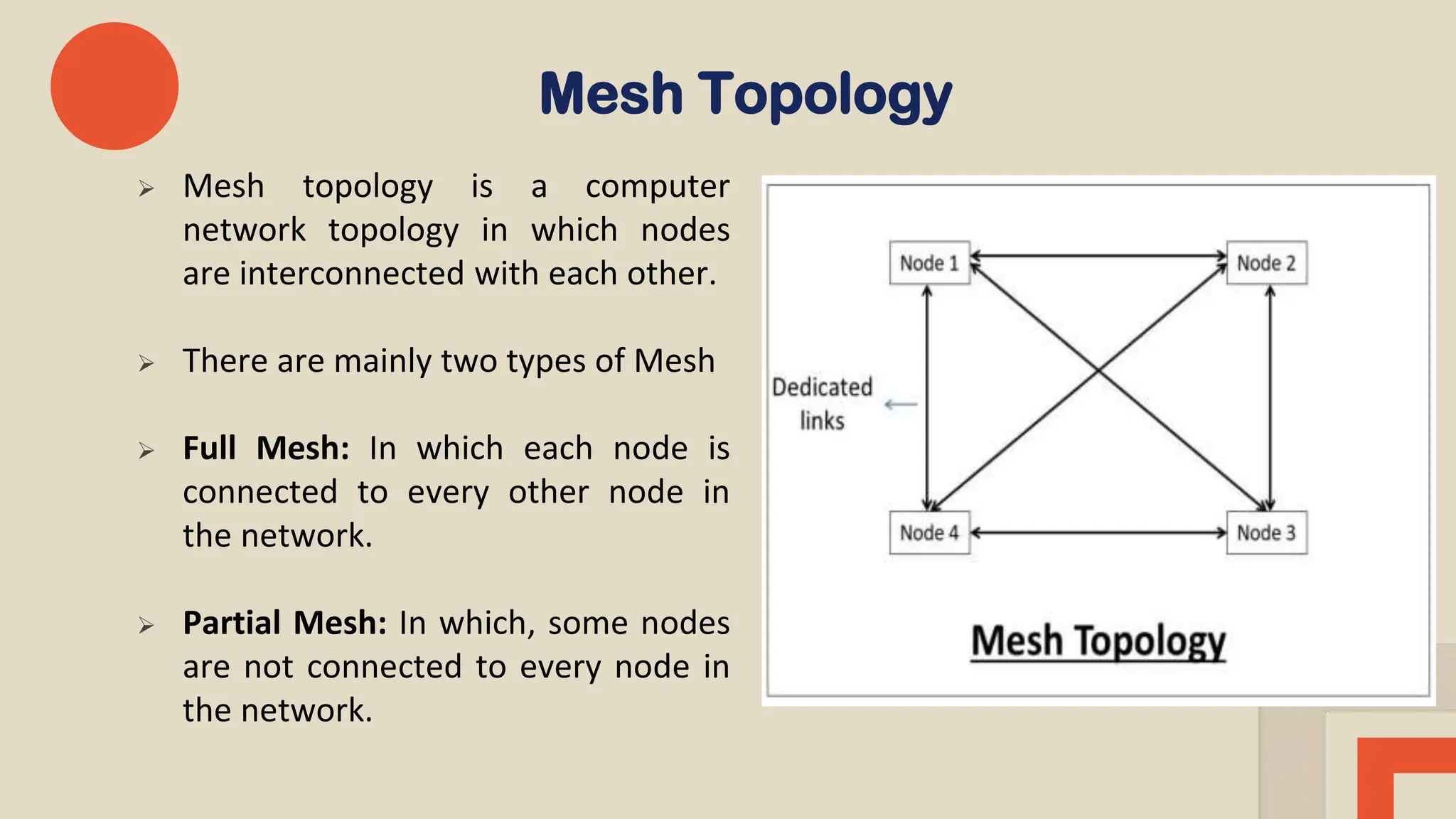
 Mesh topology is a computer
network topology in which nodes
are interconnected with each other.
 There are mainly two types of Mesh
 Full Mesh: In which each node is
connected to every other node in
the network.
 Partial Mesh: In which, some nodes
are not connected to every node in
the network.
Mesh Topology
Mesh Topology
Following are the advantages of Mesh topology:
• Dedicated links facilitate direct communication.
• No congestion or traffic problems on the channels.
• Good Fault tolerance due to the dedicated path for each node.
• Very fast communication.
• Maintains privacy and security due to a separate channel for communication.
• If a node fails, other alternatives are present in the network.
Following are the disadvantages of Mesh topology:
• Very high cabling required.
• Cost inefficient to implement.
• Complex to implement and takes large space to install the network.
• Installation and maintenance are very difficult.
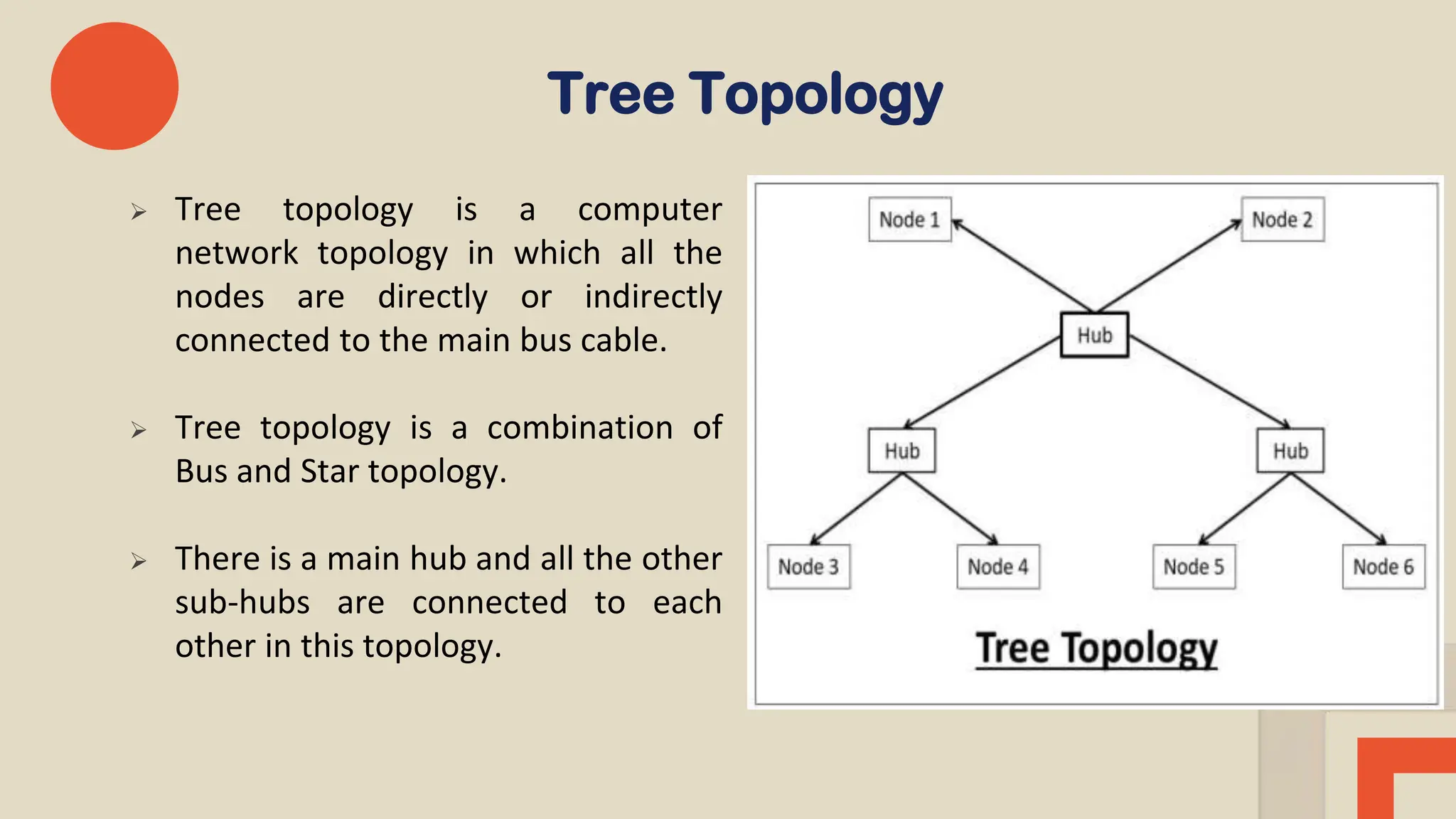
 Tree topology is a computer
network topology in which all the
nodes are directly or indirectly
connected to the main bus cable.
 Tree topology is a combination of
Bus and Star topology.
 There is a main hub and all the other
sub-hubs are connected to each
other in this topology.
Tree Topology
Tree Topology
Following are the advantages of Tree topology:
• Large distance network coverage.
• Fault finding is easy by checking each hierarchy.
• Least or no data loss.
• A Large number of nodes can be connected directly or indirectly.
• Other hierarchical networks are not affected if one of them fails.
Following are the disadvantages of Tree topology:
• Cabling and hardware cost is high.
• Hub cabling is also required.
• A large network using tree topology is hard to manage.
• It requires very high maintenance.
• If the main bus fails, the network will fail.
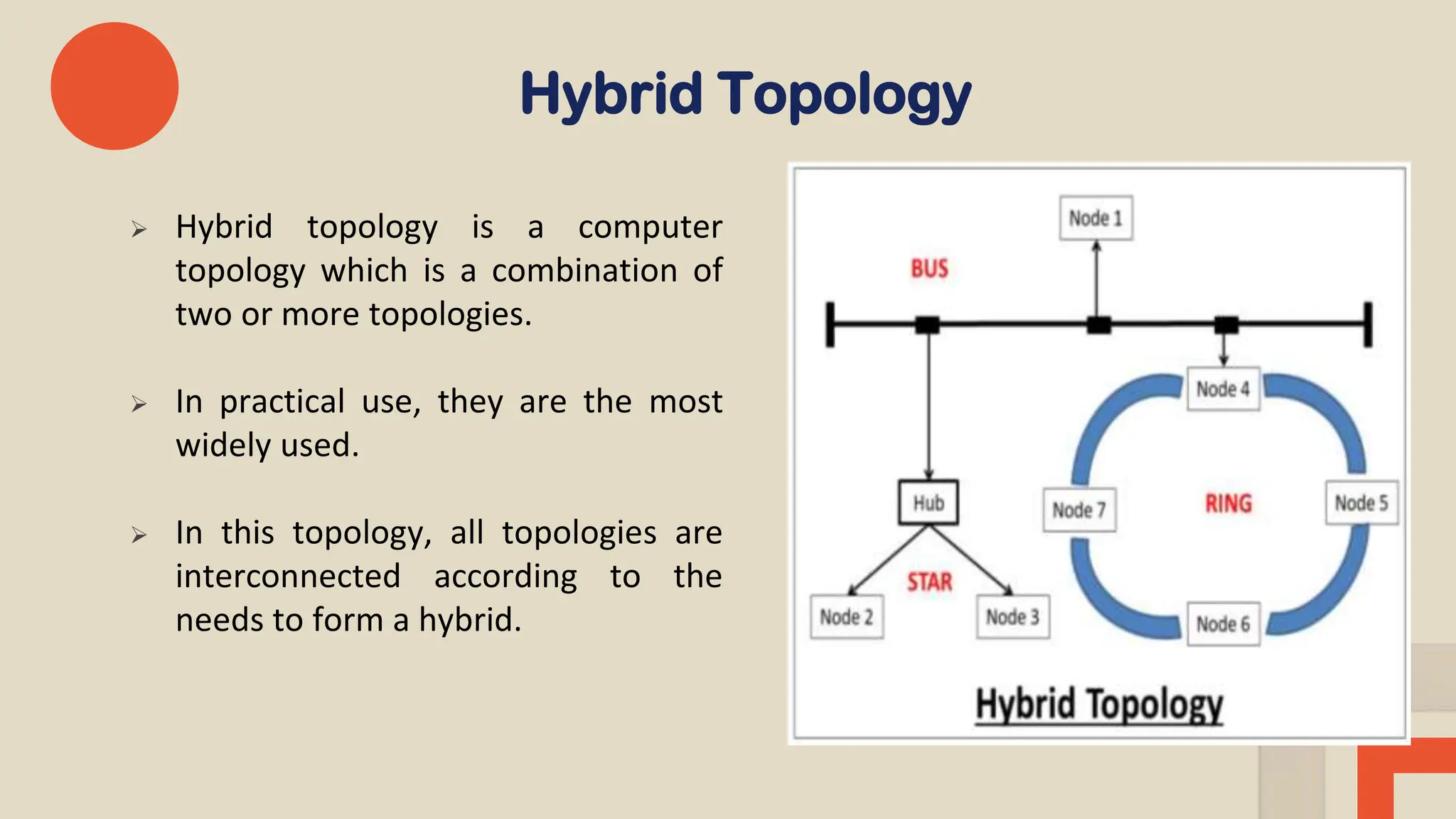
 Hybrid topology is a computer
topology which is a combination of
two or more topologies.
 In practical use, they are the most
widely used.
 In this topology, all topologies are
interconnected according to the
needs to form a hybrid.
Hybrid Topology
Hybrid Topology
Following are the advantages of Hybrid topology:
• It can handle a large volume of nodes.
• It provides flexibility to modify the network according to our needs.
• Very Reliable(if one node fails it will not affect the whole network).
Following are the disadvantages of Hybrid topology:
• Complex design.
• Expensive to implement.
• Multi-Station Access Unit(MSAL) required.
CREDITS: This presentation template was
created by Slidesgo, including icons by
Flaticon, infographics & images by Freepik
and illustrations by Storyset
THANKS
FOR YOUR ATTENTION

Assignment assignment a 2 Topology.pptx

  • 1.
    Topology Submitted to, Md. AkhtaruzamanAdnan Assistant Professor Dept of CSE, UAP August 23, 2022 Submitted by, Bidita Sarkar Diba ID: 20101016 Section: A1 Dept of CSE, UAP
  • 2.
     Network topologyis the interconnected pattern of network elements.  A network topology may be physical, mapping hardware configuration, or logical, mapping the path that the data must take in order to travel around the network.  There are many identified topologies but they are not strict, which means that any of them can be combined. However, each topology has a different standard and may use different hardware methods so they are not interchangeable.  Physical topology refers to the physical design of the network, while logical topology refers to how data is handled within the network regardless of its physical topology. What is Topology?
  • 3.
    Topology Types In acomputer network, there are mainly six types of physical topology, they are:
  • 4.
     Bus topologyis the simplest kind of topology in which a common bus or channel is used for communication in the network.  The bus is connected to various taps and droplines.  There is only a single transmission line for all nodes. Bus Topology
  • 5.
    Bus Topology Following arethe advantages of Bus topology: • Simple to use and install. • If a node fails, it will not affect other nodes. • Less cabling is required. • Cost-efficient to implement. Following are the disadvantages of Bus topology: • Efficiency is less when nodes are more(strength of signal decreases). • If the bus fails, the network will fail. • A limited number of nodes can connect to the bus due to limited bus length. • Security issues and risks are more as messages are broadcasted to all nodes. • Congestion and traffic on the bus as it is the only source of communication.
  • 6.
     Ring topologyis a topology in which each computer is connected to exactly two other computers to form the ring.  All the nodes are connected in a closed-loop.  This topology mainly works on a token-based system and the token travels in a loop in one specific direction. Ring Topology
  • 7.
    Ring Topology Following arethe advantages of Ring topology: • Easy Installation. • Less Cabling Required. • Reduces chances of data collision(unidirectional). • Easy to troubleshoot(the faulty node does not pass the token). • Each node gets the same access time. Following are the disadvantages of Ring topology: • If a node fails, the whole network will fail. • Slow data transmission speed(each message has to go through the ring path). • Difficult to reconfigure(we have to break the ring).
  • 8.
     Star topologyis a computer network topology in which all the nodes are connected to a centralized hub.  The hub or switch acts as a middleware between the nodes.  Any node requesting for service or providing service, first contact the hub for communication. Star Topology
  • 9.
    Star Topology Following arethe advantages of Star topology: • Centralized control. • Less Expensive. • Easy to troubleshoot(the faulty node does not give response). • Good fault tolerance due to centralized control on nodes. • Easy to scale(nodes can be added or removed to the network easily). • If a node fails, it will not affect other nodes. • Easy to reconfigure and upgrade(configured using a central device). Following are the disadvantages of Star topology: • If the central device fails, the network will fail. • The number of devices in the network is limited.
  • 10.
     Mesh topologyis a computer network topology in which nodes are interconnected with each other.  There are mainly two types of Mesh  Full Mesh: In which each node is connected to every other node in the network.  Partial Mesh: In which, some nodes are not connected to every node in the network. Mesh Topology
  • 11.
    Mesh Topology Following arethe advantages of Mesh topology: • Dedicated links facilitate direct communication. • No congestion or traffic problems on the channels. • Good Fault tolerance due to the dedicated path for each node. • Very fast communication. • Maintains privacy and security due to a separate channel for communication. • If a node fails, other alternatives are present in the network. Following are the disadvantages of Mesh topology: • Very high cabling required. • Cost inefficient to implement. • Complex to implement and takes large space to install the network. • Installation and maintenance are very difficult.
  • 12.
     Tree topologyis a computer network topology in which all the nodes are directly or indirectly connected to the main bus cable.  Tree topology is a combination of Bus and Star topology.  There is a main hub and all the other sub-hubs are connected to each other in this topology. Tree Topology
  • 13.
    Tree Topology Following arethe advantages of Tree topology: • Large distance network coverage. • Fault finding is easy by checking each hierarchy. • Least or no data loss. • A Large number of nodes can be connected directly or indirectly. • Other hierarchical networks are not affected if one of them fails. Following are the disadvantages of Tree topology: • Cabling and hardware cost is high. • Hub cabling is also required. • A large network using tree topology is hard to manage. • It requires very high maintenance. • If the main bus fails, the network will fail.
  • 14.
     Hybrid topologyis a computer topology which is a combination of two or more topologies.  In practical use, they are the most widely used.  In this topology, all topologies are interconnected according to the needs to form a hybrid. Hybrid Topology
  • 15.
    Hybrid Topology Following arethe advantages of Hybrid topology: • It can handle a large volume of nodes. • It provides flexibility to modify the network according to our needs. • Very Reliable(if one node fails it will not affect the whole network). Following are the disadvantages of Hybrid topology: • Complex design. • Expensive to implement. • Multi-Station Access Unit(MSAL) required.
  • 16.
    CREDITS: This presentationtemplate was created by Slidesgo, including icons by Flaticon, infographics & images by Freepik and illustrations by Storyset THANKS FOR YOUR ATTENTION