NETWORK
MODELS
Overview of Different Network Models
Different Network
Models
There are two models of
computer networks:
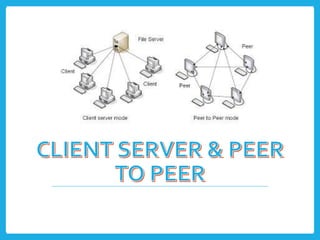
1. Client-Server Model
2. Peer-to-Peer Model
3. Hybrid
Client-Server Model
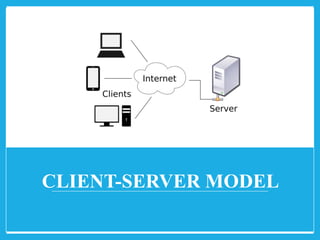
•One or more computers work as servers, others
as clients.
•Server controls the whole network.
•Used to store data and programs.
•May share resources like printers.
•Server is more powerful, performs most
processing.
•Client requests services, server provides them.
CLIENT-SERVER MODEL
Dedicated
Server
Network
Dedicated servers perform specific
tasks (e.g., file server, print server).
File server is used to store and
manage files
Print server is used to manage
printers and printing tasks
Network server manage network
resources
Advantages of Client-Server
Model
•Reduces data traffic volume on the network.
•Provides faster responses to clients.
•Uses less powerful computers as clients.
Disadvantages of Client-Server
Model
EXPENSIVE DUETO COSTLY
SERVERS.
NETWORK OPERATIONS STOP
WHEN SERVER GOES DOWN.
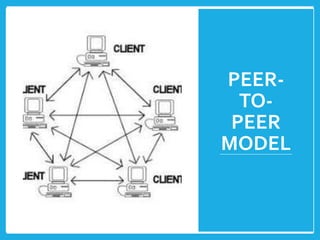
Peer-to-Peer Model
All computers have the same status, no
server.
Each computer can access devices and files
on others.
Each computer stores its own software and
info.
PEER-
TO-
PEER
MODEL
Advantages of Peer-to-
Peer Model
•Easy to setup.
•Easy to maintain.
•No expensive server needed.
•Suitable for small offices (ten or
fewer computers).
Disadvantages of Peer-to-Peer
Model
HEAVY USE CAN SLOW DOWNTHE
NETWORK.
LESS SECURITY OF DATA, FILES
STOREDAT DIFFERENT LOCATIONS.
Hybrid Model
Combination of
client/server and
peer-to-peer
models.
Uses advantages
of both models.

types of Network_Models client server and peer to peer.pptx