Texas STaR Chart  2010-2011
Agenda Introduction : What is STaR Chart What do we use it for? Where is our weakness Teaching and Learning Educator Preparation Change – growing as a campus summary
What is STaR Chart ?  The Texas Teacher STaR Charts is an assessment tool developed around the four key areas of the Texas Long Range Plan for Technology:  Teaching and Learning  Educator Preparation and Development  Leadership Administration and Instructional Support  Infrastructure for Technology The Texas Teacher STaR Chart can assist in the measurement of the impact of state and local efforts to improve student learning through the use of technology as specified in No Child Left Behind, Title II, Part D. It can also identify needs for on-going professional development and raise awareness of research-based instructional goals. All certified classroom teachers and librarians are required to complete the Teacher STaR Chart. The district can determine the deadline for teacher star chart submission based on the district intended needs: Campus STaR Chart, technology plan submission, E-Rate guidelines.
Why do we need STaR Chart? Technology Instruction is now mandated by:  NCLB – all students must be technology literate by the end of 8th grade  NCLB – all teachers must be technology literate  NCLB – technology must be fully integrated across all curriculum areas by Dec 31, 2005  Texas SBOE has mandated that all enrichment TEKS will be taught (K-8 Technology TEKS are enrichment TEKS)  Texas TEKS for secondary courses all have technology expectations  SBEC now requires technology competencies of all beginning teachers  Technology applications textbooks are available for adoption http://starchart.esc12.net/faqWhy.html
What do we use it for? The Teacher STaR Chart is designed to help teachers, campuses, and districts determine their progress toward meeting the goals of the Long-Range Plan for Technology, as well as meeting the goals of the district.  The Teacher STaR Chart survey enables teachers to see what the expectations for Technology and Instruction are for all Texas teachers and to self-assess their progress toward meeting these expectations.  Teachers are then able to use the results and the expectations to plan not only for their own staff development, but also to plan for the integration of technology according to the state guidelines into their curricular area. http://starchart.esc12.net/faqWhy.html
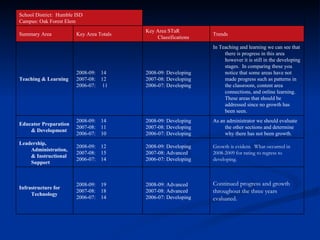
Continued progress and growth throughout the three years evaluated. 2008-09: Advanced 2007-08: Advanced 2006-07: Developing 2008-09:  19 2007-08:  18 2006-07:  14 Infrastructure for Technology Growth is evident.  What occurred in 2008-2009 for rating to regress to developing. 2008-09: Developing 2007-08: Advanced 2006-07: Developing 2008-09:  12 2007-08:  15 2006-07:  14  Leadership, Administration, & Instructional Support As an administrator we should evaluate the other sections and determine why there has not been growth. 2008-09: Developing 2007-08: Developing 2006-07: Developing 2008-09:  14 2007-08:  11 2006-07:  10 Educator Preparation & Development In Teaching and learning we can see that there is progress in this area however it is still in the developing stages.  In comparing these you notice that some areas have not made progress such as patterns in the classroom, content area connections, and online learning.  These areas that should be addressed since no growth has been seen. 2008-09: Developing 2007-08: Developing 2006-07: Developing 2008-09:  14 2007-08:  12 2006-07:  11 Teaching & Learning Trends Key Area STaR Classifications Key Area Totals Summary Area    School District:  Humble ISD Campus: Oak Forest Elem
Teaching and Learning What is our focus for growth and development.  By understanding the STaR Chart assessment we are able to see our campus’ area of weakness   L1- Patterns of classroom use. Where we are:   Teachers primarily use technology to direct instruction, improve productivity, model technology skills, and direct students in the use of productivity applications for technology integration Students use technology to access, communicate and present information Where we want to go 2011:   Teachers primarily use technology in teacher led and some student centered learning experiences to develop higher-order thinking skills and provide opportunities for collaboration with content experts, peers, parents, and community Students evaluate and analyze data to solve problems Technology Applications (TEKS) implementations Where we  are: Teachers are aware of the TA TEKS appropriate to content areas and regularly include technology skills in planning and implementing instruction; use adopted TA materials Where we want to go 2011:  Teachers are knowledgeable of and seamlessly integrate the TA TEKS as appropriate for content area and grade level Online Learning Where we are:  Most teachers use a few web-based learning activities Where we want to be 2011:  Most teachers create web-based lessons, which include online TEKS-based content, resources, learning activities, and interactive communications that support learning objectives
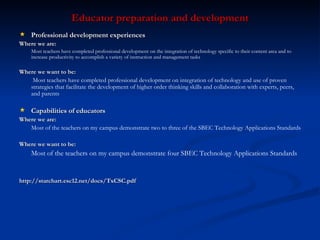
Educator preparation and development Professional development experiences Where we are:  Most teachers have completed professional development on the integration of technology specific to their content area and to increase productivity to accomplish a variety of instruction and management tasks Where we want to be:   Most teachers have completed professional development on integration of technology and use of proven strategies that facilitate the development of higher order thinking skills and collaboration with experts, peers, and parents Capabilities of educators Where we are: Most of the teachers on my campus demonstrate two to three of the SBEC Technology Applications Standards Where we want to be: Most of the teachers on my campus demonstrate four SBEC Technology Applications Standards http://starchart.esc12.net/docs/TxCSC.pdf
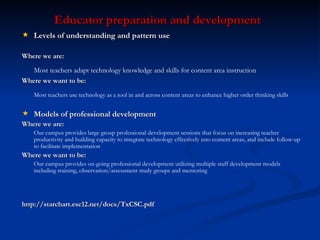
Educator preparation and development Levels of understanding and pattern use Where we are: Most teachers adapt technology knowledge and skills for content area instruction Where we want to be: Most teachers use technology as a tool in and across content areas to enhance higher order thinking skills Models of professional development Where we are: Our campus provides large group professional development sessions that focus on increasing teacher productivity and building capacity to integrate technology effectively into content areas, and include follow-up to facilitate implementation Where we want to be: Our campus provides on-going professional development utilizing multiple staff development models including training, observation/assessment study groups and mentoring http://starchart.esc12.net/docs/TxCSC.pdf
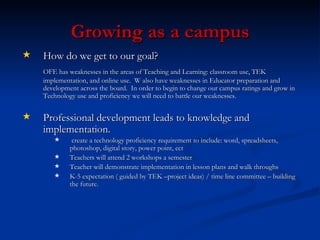
Growing as a campus How do we get to our goal? OFE has weaknesses in the areas of Teaching and Learning: classroom use, TEK implementation, and online use.  W also have weaknesses in Educator preparation and development across the board.  In order to begin to change our campus ratings and grow in Technology use and proficiency we will need to battle our weaknesses. Professional development leads to knowledge and implementation. create a technology proficiency requirement to include: word, spreadsheets, photoshop, digital story, power point, ect Teachers will attend 2 workshops a semester Teacher will demonstrate implementation in lesson plans and walk throughs K-5 expectation ( guided by TEK –project ideas) / time line committee – building the future.

STaR Chart -OFE

  • 1.
    Texas STaR Chart 2010-2011
  • 2.
    Agenda Introduction :What is STaR Chart What do we use it for? Where is our weakness Teaching and Learning Educator Preparation Change – growing as a campus summary
  • 3.
    What is STaRChart ? The Texas Teacher STaR Charts is an assessment tool developed around the four key areas of the Texas Long Range Plan for Technology: Teaching and Learning Educator Preparation and Development Leadership Administration and Instructional Support Infrastructure for Technology The Texas Teacher STaR Chart can assist in the measurement of the impact of state and local efforts to improve student learning through the use of technology as specified in No Child Left Behind, Title II, Part D. It can also identify needs for on-going professional development and raise awareness of research-based instructional goals. All certified classroom teachers and librarians are required to complete the Teacher STaR Chart. The district can determine the deadline for teacher star chart submission based on the district intended needs: Campus STaR Chart, technology plan submission, E-Rate guidelines.
  • 4.
    Why do weneed STaR Chart? Technology Instruction is now mandated by: NCLB – all students must be technology literate by the end of 8th grade NCLB – all teachers must be technology literate NCLB – technology must be fully integrated across all curriculum areas by Dec 31, 2005 Texas SBOE has mandated that all enrichment TEKS will be taught (K-8 Technology TEKS are enrichment TEKS) Texas TEKS for secondary courses all have technology expectations SBEC now requires technology competencies of all beginning teachers Technology applications textbooks are available for adoption http://starchart.esc12.net/faqWhy.html
  • 5.
    What do weuse it for? The Teacher STaR Chart is designed to help teachers, campuses, and districts determine their progress toward meeting the goals of the Long-Range Plan for Technology, as well as meeting the goals of the district. The Teacher STaR Chart survey enables teachers to see what the expectations for Technology and Instruction are for all Texas teachers and to self-assess their progress toward meeting these expectations.  Teachers are then able to use the results and the expectations to plan not only for their own staff development, but also to plan for the integration of technology according to the state guidelines into their curricular area. http://starchart.esc12.net/faqWhy.html
  • 6.
    Continued progress andgrowth throughout the three years evaluated. 2008-09: Advanced 2007-08: Advanced 2006-07: Developing 2008-09: 19 2007-08: 18 2006-07: 14 Infrastructure for Technology Growth is evident. What occurred in 2008-2009 for rating to regress to developing. 2008-09: Developing 2007-08: Advanced 2006-07: Developing 2008-09: 12 2007-08: 15 2006-07: 14 Leadership, Administration, & Instructional Support As an administrator we should evaluate the other sections and determine why there has not been growth. 2008-09: Developing 2007-08: Developing 2006-07: Developing 2008-09: 14 2007-08: 11 2006-07: 10 Educator Preparation & Development In Teaching and learning we can see that there is progress in this area however it is still in the developing stages. In comparing these you notice that some areas have not made progress such as patterns in the classroom, content area connections, and online learning. These areas that should be addressed since no growth has been seen. 2008-09: Developing 2007-08: Developing 2006-07: Developing 2008-09: 14 2007-08: 12 2006-07: 11 Teaching & Learning Trends Key Area STaR Classifications Key Area Totals Summary Area   School District: Humble ISD Campus: Oak Forest Elem
  • 7.
    Teaching and LearningWhat is our focus for growth and development. By understanding the STaR Chart assessment we are able to see our campus’ area of weakness L1- Patterns of classroom use. Where we are: Teachers primarily use technology to direct instruction, improve productivity, model technology skills, and direct students in the use of productivity applications for technology integration Students use technology to access, communicate and present information Where we want to go 2011: Teachers primarily use technology in teacher led and some student centered learning experiences to develop higher-order thinking skills and provide opportunities for collaboration with content experts, peers, parents, and community Students evaluate and analyze data to solve problems Technology Applications (TEKS) implementations Where we are: Teachers are aware of the TA TEKS appropriate to content areas and regularly include technology skills in planning and implementing instruction; use adopted TA materials Where we want to go 2011: Teachers are knowledgeable of and seamlessly integrate the TA TEKS as appropriate for content area and grade level Online Learning Where we are: Most teachers use a few web-based learning activities Where we want to be 2011: Most teachers create web-based lessons, which include online TEKS-based content, resources, learning activities, and interactive communications that support learning objectives
  • 8.
    Educator preparation anddevelopment Professional development experiences Where we are: Most teachers have completed professional development on the integration of technology specific to their content area and to increase productivity to accomplish a variety of instruction and management tasks Where we want to be: Most teachers have completed professional development on integration of technology and use of proven strategies that facilitate the development of higher order thinking skills and collaboration with experts, peers, and parents Capabilities of educators Where we are: Most of the teachers on my campus demonstrate two to three of the SBEC Technology Applications Standards Where we want to be: Most of the teachers on my campus demonstrate four SBEC Technology Applications Standards http://starchart.esc12.net/docs/TxCSC.pdf
  • 9.
    Educator preparation anddevelopment Levels of understanding and pattern use Where we are: Most teachers adapt technology knowledge and skills for content area instruction Where we want to be: Most teachers use technology as a tool in and across content areas to enhance higher order thinking skills Models of professional development Where we are: Our campus provides large group professional development sessions that focus on increasing teacher productivity and building capacity to integrate technology effectively into content areas, and include follow-up to facilitate implementation Where we want to be: Our campus provides on-going professional development utilizing multiple staff development models including training, observation/assessment study groups and mentoring http://starchart.esc12.net/docs/TxCSC.pdf
  • 10.
    Growing as acampus How do we get to our goal? OFE has weaknesses in the areas of Teaching and Learning: classroom use, TEK implementation, and online use. W also have weaknesses in Educator preparation and development across the board. In order to begin to change our campus ratings and grow in Technology use and proficiency we will need to battle our weaknesses. Professional development leads to knowledge and implementation. create a technology proficiency requirement to include: word, spreadsheets, photoshop, digital story, power point, ect Teachers will attend 2 workshops a semester Teacher will demonstrate implementation in lesson plans and walk throughs K-5 expectation ( guided by TEK –project ideas) / time line committee – building the future.