PRESENTATION
KINESIOLOGY
1
Presented by
Insha Ur Rahman
Presented to
Dr. Muhammad Arshid
2
Derived Positions
3
There are five fundamental positions
 Standing
 Kneeling
 Sitting
 Lying
 Hanging
4
Standing Position
 Standing, is a human position in which the body is
held in an upright ("orthostatic")position and
supported only by the feet.
 The base is small and the centre of gravity is high.
 Easier to maintain than kneeling.
5
By altering of arm
6
Wing Standing
It is used as starting position for a number of free-
standing exercises.
Muscle work :
 The adductors of the shoulder joint•
 Extensors of the elbow work slightly to press the hand to the
trunk.
Effect and use :
 As the arms are held away from the trunk from the axilla to the
iliac crests, the positions allow the phys. To grasp the patient
round the shoulder during some trunk exercise.
 The fixed position of arm prevents their swinging during trunk
exercises.
 As this swing usually amplifies the movement and leaves the
thorax free, the position should be avoided unless it serves
some definite and useful purpose
7
Bend Standing
Stand in the middle of your mat with your legs together and
your weight centered on the balls of your feet.
Muscle work :
 The lateral rotator and adductors of the shoulder work
strongly.
 The retractors and depressors of the scapulae work strongly
as fixators.
 The flexor of the elbows and Supinator of fore arm work to
maintain the position of forearms.
 The flexor of the wrists and finger may work slightly.
Effect and uses :
 The position is corrective for the position of the upper back,
and the thorax is expanded. It may therefore be held during
some trunk exercises to intensify their effect or used prior to
arm stretching exercises.
 Full flexion of the elbow is reduced the leverage of the
abductor muscles of the shoulder joint, making it a suitable
position from which to perform abduction movements when
these muscles are weak
8
Reach Standing
It is used for performing and Set up exercises by the grasping
Bar with hand.
Muscle work :
 The shoulder flexors maintain the position against gravity.
 The transverse back muscles control the forward movement of
the scapulae round the chest wall, which is associated with
shoulder flexion.
 The extensors of the elbow, Radial flexors of the wrist and
Extensor of the Finger work slightly to keep the arm straight.
Effect and uses :
 The position is used prior to some arm and trunk exercises in
sagittal plane, and to assist balance during balance walking
sideways.
 The hand may be supported on, or may grasp, some
apparatus and this obviate the use of the shoulder flexors
muscles when the arm are used to control or steady the body
for leg or head exercises.
9
Yard Standing
It is used for to performing trunk rotation and bending exercises
Muscle work :
 The abductors, extensors and lateral Rotators of the
shoulder work Rotators of the Scapulae to stabilize the
arms.
 The Extensors of the Elbows, Wrists, and Fingers work to
hold the limb in a straight line.
 The tendency to elevate the shoulder girdle is controlled
by the scapulae depressors.
Effect and uses :
 The abductors of the shoulder work at a marked
mechanical disadvantage as the length of the weight arm
of the lever so greatly exceeds that of the power arm. The
position is corrective for the posture of the upper back,
facilitates body balance and is convenient for arm swinging
exercises.
10
BY ALTERNATION OF THE LEGS
11
Toe standing
Standing up with both bare feet on the floor, perform heel raises. You do this
by slowly raising your heel off the ground but keeping your toes flat.
Muscle work :
 The Planter flexors of the Ankle Joint work Strongly against
gravity to keep the heels elevated.
 All the leg Muscle work more strongly than in the fundamental
position to keep the balance
Effect and uses :
 The base is reduced and the center of gravity raised, so this is
used as balance position.
 Strong work of the foot muscles braces the longitudinal arches
and there is a tendency for whole body to stretch, which is of
value in the treatment of postural flat feet and posture training
generally.
12
Stride Standing
Tension on of the forward leg prevents forward tilting of the
pelvis in trunk flexion exercises.
Muscle work :
 The abductors of the hips may work to prevent the leg
from sliding
Effect and uses :
 The effective base is much enlarges laterally, making
this as easy and stable position from which to perform
exercises, especially those in frontal plane.
13
Walk Standing
Walk-standing. - Is taken by moving one foot about two foot-
lengths forward in the sagittal plane, maintaining the same angle
between the feet.
Muscle work :
 The Extensor of hip and Knee of the leg work strongly to maintain
the position
Effect and uses :
 The base is much enlarges in the antero-posterior direction
stabilizing the body for exercises in a sagittal plane.
 Rotation of the pelvis towards the side of the forward leg is
prevented by the position of the back leg; the position therefore
may be used to localize rotation to the spine.
 Tension of the hamstrings of the forward leg likewise prevents
forward tilting of the pelvis in the trunk flexion exercises.
14
BY ALTERNATION OF THE TRUNK
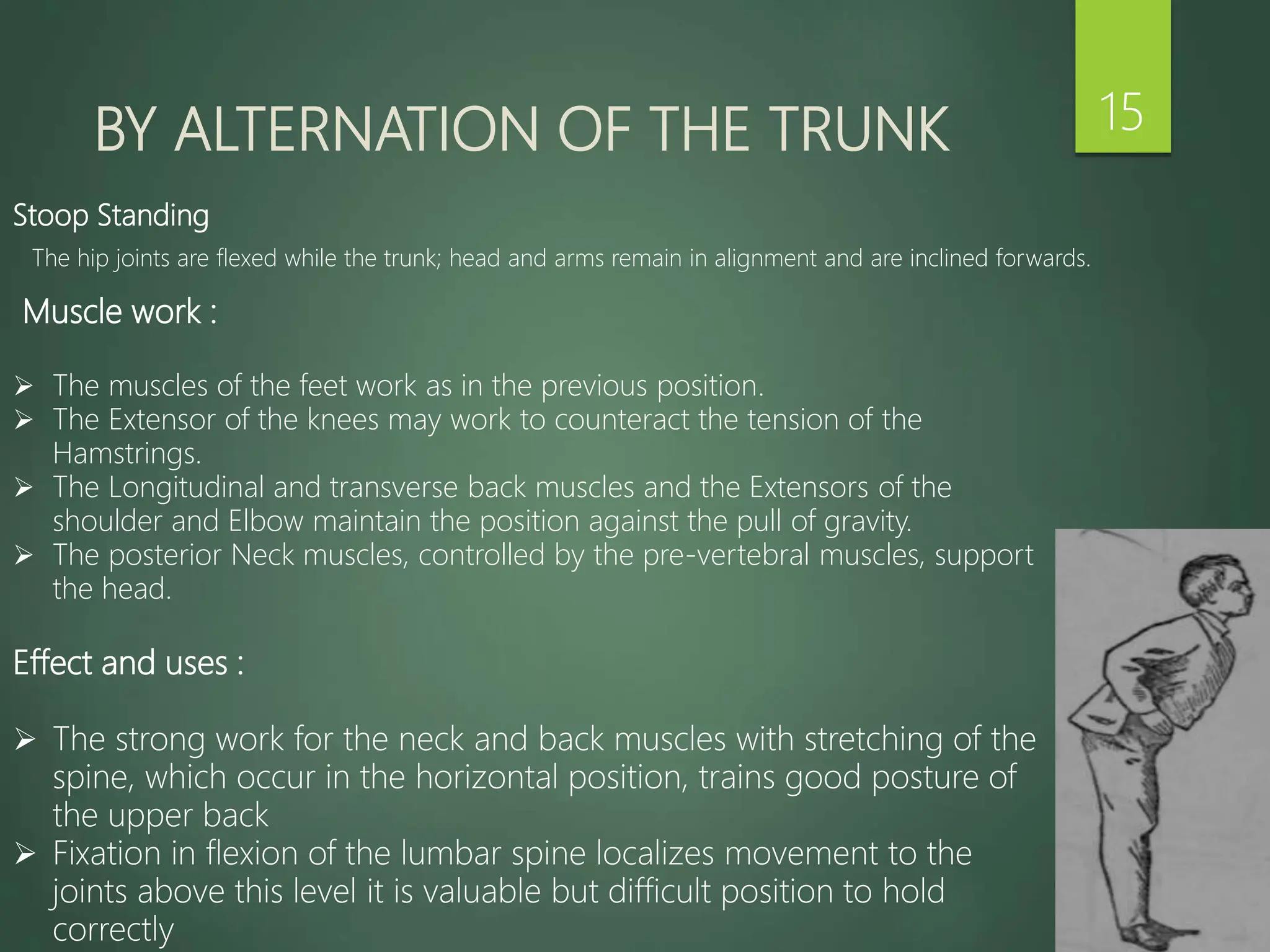
Stoop Standing
The hip joints are flexed while the trunk; head and arms remain in alignment and are inclined forwards.
Muscle work :
 The muscles of the feet work as in the previous position.
 The Extensor of the knees may work to counteract the tension of the
Hamstrings.
 The Longitudinal and transverse back muscles and the Extensors of the
shoulder and Elbow maintain the position against the pull of gravity.
 The posterior Neck muscles, controlled by the pre-vertebral muscles, support
the head.
Effect and uses :
 The strong work for the neck and back muscles with stretching of the
spine, which occur in the horizontal position, trains good posture of
the upper back
 Fixation in flexion of the lumbar spine localizes movement to the
joints above this level it is valuable but difficult position to hold
correctly
15
Lax Stoop standing
Taken by forward and downward falling of the body in the hip joints and
joints of the lumbar spine as far as possible. It relaxes the anterior abdominal
wall, and was used formerly in treating the abdominal organs by massage.
Muscle work :
 Very little muscle work is required except in the region of the ankle
joint
 Dorsiflexion stabilize the position of the joint
 Intrinsic foot muscles grip the floor
Effect and uses :
 The amount of forward flexion is dictated by the tension, which
develops in the hamstrings and lumbar muscles. The position may
be used to train local relaxation and the upper body and to assist
expiration.
 It is used prior to extension exercises of hips and spine, particularly
those that occur progressively, as in uncurling to the upright
position. The position is not suitable for weak and elderly patient.
16
KNEELING
Kneeling is a basic human position where
one or both knees touch the ground. It can
be used: as a resting position.
17
Half Kneeling
The first step to a perfect half-kneeling position is getting into a legit 90-
90 position. The “down” knee is at a 90-degree angle, and directly
underneath the hip and shoulder. The “up” knee is also at a 90-degree
angle, with the weight balanced evenly on the foot.
Muscle work :
 The abductors of the hip joint of the supporting leg, and the
lumbar side flexors of the opposite side, work to balance the
trunk
 The extensor of the hip and the knee of the forward legwork
slightly to assist the balance
Effect and uses :
 The pelvis is well fixed in the position for trunk side bending and
rotation exercise when the trunk moves in a direction away from
the supporting leg.
18
Kneel Sitting
where the thighs are near horizontal and the
buttocks sit back on the heels with the upper
body vertical
The knees and hip are flexed so that the patient
sits on his heels. The position is some time used
for small children, but most people find it very
uncomfortable
19
Side sitting
Cross-legged sitting is generally
a good position for the hips and
back. It is important to alternate
which leg is in front to prevent
tightness on one side.
20
Prone Kneeling
Trunk and neck muscle strength to
maintain stability as the limbs are
moved.
21
SITTING
Sitting is a basic human resting position. The body weight is supported
primarily by the buttocks in contact with the ground or a horizontal
object such as a chair seat. The torso is more or less upright.
22
Stride Sitting
Is taken by the patient sitting astride a plinth,
chair, form, or other suitable apparatus. The
feet are often fixed by some support. This
position fixes the legs and pelvis most firmly of
all, and this effect can be increased by fixing a
broad strap over the legs
23
Ride Sitting
Riding-like sitting or balanced seating is the most suitable position for
long periods of sitting.
The patient sits astride suitable apparatus, such as a
gymnastic form, which may be gripped between the knees
by the adductor muscles of the hips, making it a very steady
position for head arm and trunk exercises. When the
position is taken on a high plinth, the thigh may be
strapped to the plinth to afford additional fixation, in which
case no muscles work is required in the legs.
24
Crook Sitting
Knee and Hip are flexed in, and feet are kept forward
while sitting in the floor Movement: ...
Cross Sitting Uses in Exercise Therapy: Breathing
exercise and reduce the respiratory distress.
25
High Sitting
In medicine, Fowler's position is a standard
patient position in which the patient
is seated in a semi-upright sitting position (45-
60 degrees) and may have knees either bent or
straight.
26
Cross Sitting
If someone is sitting cross-legged,
they are sitting on the floor with
their legs bent so that their knees
point outwards. He sat cross-
legged on the floor.
27
Long Sitting
Long sitting or sitting with the legs
out in front stretches the hamstring and
calf muscles and also helps develop core
strength.
28
LYING
Lying position. A lateral recumbent position in
which the individual rests on the right or left side,
usually with the knees slightly flexed.
29
Crook lying
The subject was asked to
Lye Supine with his/her both hip joints
45 degrees and foot lying flat on the
couch with the arms resting by the
side of the subject.
30
Crook Lying with pelvis lifted
From the previous position the pelvis is elevated so that the trunk rests on the
shoulders and is brought into line with the thighs. A firm pillow may be used to
support the buttocks, or the Extensors of the hips may work toehold the position.
Effect and uses :
 Pressure of the viscera on the pelvic floor is relieved by
gravity as the weight of the viscera is directed backwards
and upwards towards the diaphragm; because of this,
breathing may be hampered slightly.
 The position is useful during re-education of muscles of
the pelvic floor, in such a cases as visceroptosis or after
child birth
31
Half Lying
Body is bent at the hips and trunk is raised from
lying to any angle up to 90
Effect and uses :
 The body is relaxed and comfortable in this position
and it is suitable for weak and elderly people because
breathing is easier than in lying, the thorax being less
fixed by the weight of the trunk.
32
Prone Lying
prone position, which is facedown. ... Using anatomical terms of location, the
dorsal side is down, and the ventral side is up, when supine.
Muscle work :
 The pre and post-vertebral neck muscles work to
maintain the position of the head.
 The Retractors and Depressors of the scapulae
work to brace the upper back
 The Lateral Rotators of the Hips keep the heels
together
33
HANGING
hanging position has its height automatically set correctly and it
moves with the hanging position. A load that is attached to
hanging position can be moved off of the position.
34
Half Hanging
35
Flexed arm hanging
The flexed arm hang is a popular military
testing exercise. It's purpose is to measure
upper body strength and endurance by
timing how long someone can hang with
their chin above a bar.
36
Hanging knee exercise 37
Thanks !
38

derivedposition exercise therapy -190209185235.pdf

  • 1.
  • 2.
    Presented by Insha UrRahman Presented to Dr. Muhammad Arshid 2
  • 3.
  • 4.
    There are fivefundamental positions  Standing  Kneeling  Sitting  Lying  Hanging 4
  • 5.
    Standing Position  Standing,is a human position in which the body is held in an upright ("orthostatic")position and supported only by the feet.  The base is small and the centre of gravity is high.  Easier to maintain than kneeling. 5
  • 6.
  • 7.
    Wing Standing It isused as starting position for a number of free- standing exercises. Muscle work :  The adductors of the shoulder joint•  Extensors of the elbow work slightly to press the hand to the trunk. Effect and use :  As the arms are held away from the trunk from the axilla to the iliac crests, the positions allow the phys. To grasp the patient round the shoulder during some trunk exercise.  The fixed position of arm prevents their swinging during trunk exercises.  As this swing usually amplifies the movement and leaves the thorax free, the position should be avoided unless it serves some definite and useful purpose 7
  • 8.
    Bend Standing Stand inthe middle of your mat with your legs together and your weight centered on the balls of your feet. Muscle work :  The lateral rotator and adductors of the shoulder work strongly.  The retractors and depressors of the scapulae work strongly as fixators.  The flexor of the elbows and Supinator of fore arm work to maintain the position of forearms.  The flexor of the wrists and finger may work slightly. Effect and uses :  The position is corrective for the position of the upper back, and the thorax is expanded. It may therefore be held during some trunk exercises to intensify their effect or used prior to arm stretching exercises.  Full flexion of the elbow is reduced the leverage of the abductor muscles of the shoulder joint, making it a suitable position from which to perform abduction movements when these muscles are weak 8
  • 9.
    Reach Standing It isused for performing and Set up exercises by the grasping Bar with hand. Muscle work :  The shoulder flexors maintain the position against gravity.  The transverse back muscles control the forward movement of the scapulae round the chest wall, which is associated with shoulder flexion.  The extensors of the elbow, Radial flexors of the wrist and Extensor of the Finger work slightly to keep the arm straight. Effect and uses :  The position is used prior to some arm and trunk exercises in sagittal plane, and to assist balance during balance walking sideways.  The hand may be supported on, or may grasp, some apparatus and this obviate the use of the shoulder flexors muscles when the arm are used to control or steady the body for leg or head exercises. 9
  • 10.
    Yard Standing It isused for to performing trunk rotation and bending exercises Muscle work :  The abductors, extensors and lateral Rotators of the shoulder work Rotators of the Scapulae to stabilize the arms.  The Extensors of the Elbows, Wrists, and Fingers work to hold the limb in a straight line.  The tendency to elevate the shoulder girdle is controlled by the scapulae depressors. Effect and uses :  The abductors of the shoulder work at a marked mechanical disadvantage as the length of the weight arm of the lever so greatly exceeds that of the power arm. The position is corrective for the posture of the upper back, facilitates body balance and is convenient for arm swinging exercises. 10
  • 11.
    BY ALTERNATION OFTHE LEGS 11
  • 12.
    Toe standing Standing upwith both bare feet on the floor, perform heel raises. You do this by slowly raising your heel off the ground but keeping your toes flat. Muscle work :  The Planter flexors of the Ankle Joint work Strongly against gravity to keep the heels elevated.  All the leg Muscle work more strongly than in the fundamental position to keep the balance Effect and uses :  The base is reduced and the center of gravity raised, so this is used as balance position.  Strong work of the foot muscles braces the longitudinal arches and there is a tendency for whole body to stretch, which is of value in the treatment of postural flat feet and posture training generally. 12
  • 13.
    Stride Standing Tension onof the forward leg prevents forward tilting of the pelvis in trunk flexion exercises. Muscle work :  The abductors of the hips may work to prevent the leg from sliding Effect and uses :  The effective base is much enlarges laterally, making this as easy and stable position from which to perform exercises, especially those in frontal plane. 13
  • 14.
    Walk Standing Walk-standing. -Is taken by moving one foot about two foot- lengths forward in the sagittal plane, maintaining the same angle between the feet. Muscle work :  The Extensor of hip and Knee of the leg work strongly to maintain the position Effect and uses :  The base is much enlarges in the antero-posterior direction stabilizing the body for exercises in a sagittal plane.  Rotation of the pelvis towards the side of the forward leg is prevented by the position of the back leg; the position therefore may be used to localize rotation to the spine.  Tension of the hamstrings of the forward leg likewise prevents forward tilting of the pelvis in the trunk flexion exercises. 14
  • 15.
    BY ALTERNATION OFTHE TRUNK Stoop Standing The hip joints are flexed while the trunk; head and arms remain in alignment and are inclined forwards. Muscle work :  The muscles of the feet work as in the previous position.  The Extensor of the knees may work to counteract the tension of the Hamstrings.  The Longitudinal and transverse back muscles and the Extensors of the shoulder and Elbow maintain the position against the pull of gravity.  The posterior Neck muscles, controlled by the pre-vertebral muscles, support the head. Effect and uses :  The strong work for the neck and back muscles with stretching of the spine, which occur in the horizontal position, trains good posture of the upper back  Fixation in flexion of the lumbar spine localizes movement to the joints above this level it is valuable but difficult position to hold correctly 15
  • 16.
    Lax Stoop standing Takenby forward and downward falling of the body in the hip joints and joints of the lumbar spine as far as possible. It relaxes the anterior abdominal wall, and was used formerly in treating the abdominal organs by massage. Muscle work :  Very little muscle work is required except in the region of the ankle joint  Dorsiflexion stabilize the position of the joint  Intrinsic foot muscles grip the floor Effect and uses :  The amount of forward flexion is dictated by the tension, which develops in the hamstrings and lumbar muscles. The position may be used to train local relaxation and the upper body and to assist expiration.  It is used prior to extension exercises of hips and spine, particularly those that occur progressively, as in uncurling to the upright position. The position is not suitable for weak and elderly patient. 16
  • 17.
    KNEELING Kneeling is abasic human position where one or both knees touch the ground. It can be used: as a resting position. 17
  • 18.
    Half Kneeling The firststep to a perfect half-kneeling position is getting into a legit 90- 90 position. The “down” knee is at a 90-degree angle, and directly underneath the hip and shoulder. The “up” knee is also at a 90-degree angle, with the weight balanced evenly on the foot. Muscle work :  The abductors of the hip joint of the supporting leg, and the lumbar side flexors of the opposite side, work to balance the trunk  The extensor of the hip and the knee of the forward legwork slightly to assist the balance Effect and uses :  The pelvis is well fixed in the position for trunk side bending and rotation exercise when the trunk moves in a direction away from the supporting leg. 18
  • 19.
    Kneel Sitting where thethighs are near horizontal and the buttocks sit back on the heels with the upper body vertical The knees and hip are flexed so that the patient sits on his heels. The position is some time used for small children, but most people find it very uncomfortable 19
  • 20.
    Side sitting Cross-legged sittingis generally a good position for the hips and back. It is important to alternate which leg is in front to prevent tightness on one side. 20
  • 21.
    Prone Kneeling Trunk andneck muscle strength to maintain stability as the limbs are moved. 21
  • 22.
    SITTING Sitting is abasic human resting position. The body weight is supported primarily by the buttocks in contact with the ground or a horizontal object such as a chair seat. The torso is more or less upright. 22
  • 23.
    Stride Sitting Is takenby the patient sitting astride a plinth, chair, form, or other suitable apparatus. The feet are often fixed by some support. This position fixes the legs and pelvis most firmly of all, and this effect can be increased by fixing a broad strap over the legs 23
  • 24.
    Ride Sitting Riding-like sittingor balanced seating is the most suitable position for long periods of sitting. The patient sits astride suitable apparatus, such as a gymnastic form, which may be gripped between the knees by the adductor muscles of the hips, making it a very steady position for head arm and trunk exercises. When the position is taken on a high plinth, the thigh may be strapped to the plinth to afford additional fixation, in which case no muscles work is required in the legs. 24
  • 25.
    Crook Sitting Knee andHip are flexed in, and feet are kept forward while sitting in the floor Movement: ... Cross Sitting Uses in Exercise Therapy: Breathing exercise and reduce the respiratory distress. 25
  • 26.
    High Sitting In medicine,Fowler's position is a standard patient position in which the patient is seated in a semi-upright sitting position (45- 60 degrees) and may have knees either bent or straight. 26
  • 27.
    Cross Sitting If someoneis sitting cross-legged, they are sitting on the floor with their legs bent so that their knees point outwards. He sat cross- legged on the floor. 27
  • 28.
    Long Sitting Long sittingor sitting with the legs out in front stretches the hamstring and calf muscles and also helps develop core strength. 28
  • 29.
    LYING Lying position. Alateral recumbent position in which the individual rests on the right or left side, usually with the knees slightly flexed. 29
  • 30.
    Crook lying The subjectwas asked to Lye Supine with his/her both hip joints 45 degrees and foot lying flat on the couch with the arms resting by the side of the subject. 30
  • 31.
    Crook Lying withpelvis lifted From the previous position the pelvis is elevated so that the trunk rests on the shoulders and is brought into line with the thighs. A firm pillow may be used to support the buttocks, or the Extensors of the hips may work toehold the position. Effect and uses :  Pressure of the viscera on the pelvic floor is relieved by gravity as the weight of the viscera is directed backwards and upwards towards the diaphragm; because of this, breathing may be hampered slightly.  The position is useful during re-education of muscles of the pelvic floor, in such a cases as visceroptosis or after child birth 31
  • 32.
    Half Lying Body isbent at the hips and trunk is raised from lying to any angle up to 90 Effect and uses :  The body is relaxed and comfortable in this position and it is suitable for weak and elderly people because breathing is easier than in lying, the thorax being less fixed by the weight of the trunk. 32
  • 33.
    Prone Lying prone position,which is facedown. ... Using anatomical terms of location, the dorsal side is down, and the ventral side is up, when supine. Muscle work :  The pre and post-vertebral neck muscles work to maintain the position of the head.  The Retractors and Depressors of the scapulae work to brace the upper back  The Lateral Rotators of the Hips keep the heels together 33
  • 34.
    HANGING hanging position hasits height automatically set correctly and it moves with the hanging position. A load that is attached to hanging position can be moved off of the position. 34
  • 35.
  • 36.
    Flexed arm hanging Theflexed arm hang is a popular military testing exercise. It's purpose is to measure upper body strength and endurance by timing how long someone can hang with their chin above a bar. 36
  • 37.
  • 38.