Dr. Tooba Asif, PT
Lecturer
DPT (RIU), MS-OMPT (RIU)
Certified Kinesio Taping Practitioner (CKTP, USA)
Certified Dry Needling Practitioner (CDNP, UK)
DERIVED POSITIONS
BY ALTERATION OF LEGS
• Close standing
• Toe standing
• Stride standing
• Walk standing
• Half standing
CLOSE STANDING
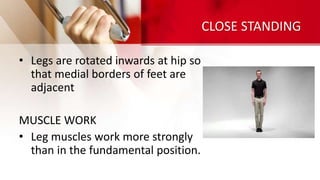
• Legs are rotated inwards at hip so
that medial borders of feet are
adjacent
MUSCLE WORK
• Leg muscles work more strongly
than in the fundamental position.
EFFECTS & USES OF
CLOSE STANDING
• Size of the base is reduced & balance is more difficult
• Progression to standing
• Relaxation of the lateral rotators of hip often results
in a loss of bracing effect on whole leg Including
longitudinal arches of feet.
TOE STANDING
• Heels are pressed together & raised
from the floor.
MUSCLE WORK
• Plantarflexor of ankle joint work
strongly against gravity to keep heels
elevated.
• All leg muscles work more strongly
than in fundamental position to keep
balance
EFFECTS & USES OF
TOE STANDING
• Base is reduced &center of gravity is raised so used in
balance
• Strong work for foot muscles stretch
• Value in treatment of flat foot & posture training
STRIDE STANDING
• Legs are abducted so that the heels
are two foot lengths apart
• Feet remain same as in fundamental
position & weight is equally
distributed btw them.
MUSCLE WORK
• Adductors of hip may work to prevent
the legs from sliding further apart if
position is taken on a slippery floor
EFFECTS & USES OF
STRIDE STANDING
• Effective base is much enlarge laterally, making this
an easy & suitable position from which to perform
exercises especially in a frontal plane.
WALK STANDING
• One leg is placed directly forwards so that the heels
are two foot-lengths apart & are on same line.
• Body weight is equally distributed btw them.
MUSCLE WORK
• Tension on the structure anterior to hip & on calf
muscles of posterior leg,
• Extensors of hip & knee of this leg work strongly to
maintain position.
EFFECTS & USES OF
WALK STANDING
• Base is much enlarged in antero posterior direction
stabilizing body for exercises in sagittal plane.
• Rotation of pelvis towards side of forward leg is
prevented by position of back leg, so it used to
localize rotation to spine.
• Tension on hamstrings of forward leg likewise
prevents tilting of pelvis in trunk flexion exercises.
HALF STANDING
• Whole weight of the body is supported
on one leg, other may be free or
supported in a variety of position.
MUSCLE WORK
• Abductors of the hip of standing leg
work to maintain center of gravity over
the base by a Slight lateral tilting of
pelvis
• Lumber side flexors of opposite side work to bring
trunk into alignment
• All muscles of supporting leg work more strongly
than in standing to support additional weight &
preserve balance
EFFFECTS & USES OF
HALF STANDING
• Unsupporting leg is free to move
• Difficulty in balancing
• PROGRESSION IN HALF STANDING
• Leg free from body weight may rest in different
positions.
STEP STANDING
• on a stool with hip & knee bent
BY ALTERATION OF
THE TRUNK
LAX STOOP STANDING
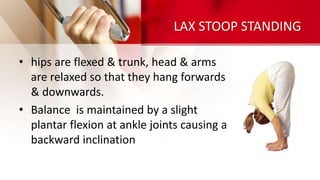
• hips are flexed & trunk, head & arms
are relaxed so that they hang forwards
& downwards.
• Balance is maintained by a slight
plantar flexion at ankle joints causing a
backward inclination
EFFECTS & USES OF
LAX STOOP STANDING
• Amount of forward flexion is dictated by tension,
develops in hamstrings & lumbar ms,
• Position used to train relaxation of upper body & to
assist expiration.
• Position used prior to extension exercises of hips &
spine.
• Position is unsuitable for weak or elderly patients as
dependent position of body causes an increase
• Blood flow to head which maybe followed by
depletion on raising to upright position &
consequent feeling of giddiness.
STOOP STANDING
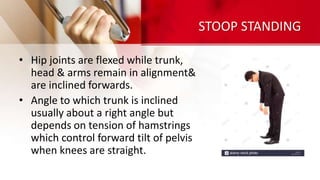
• Hip joints are flexed while trunk,
head & arms remain in alignment&
are inclined forwards.
• Angle to which trunk is inclined
usually about a right angle but
depends on tension of hamstrings
which control forward tilt of pelvis
when knees are straight.
MUSCLE WORK
• Extensor of knees may work to counteract tension of
hamstrings
• Longitudinal & transverse back muscles & extensors
of shoulder & elbows maintain position against pull
of gravity
• Posterior neck muscles controlled by pre-vertebral
muscles support head.
EFFECTS & USES
• Strong work for neck & back muscles with stretching
of spine, trains good posture of back muscles.
• Fixation in flexion of lumber spine localizes
movement to joints above this level, it is valuable but
difficult position to hold correctly.
BY ALTERATION OF
THE LEGS & TRUNK
FALLOUT STANDING
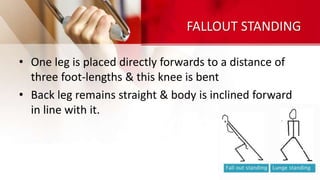
• One leg is placed directly forwards to a distance of
three foot-lengths & this knee is bent
• Back leg remains straight & body is inclined forward
in line with it.
MUSCLE WORK
• Extensors & foot muscles of forward leg work strongly to
support most of weight
• Extensors of back leg keep trunk & leg straight
• Dorsiflexor of this foot work to keep the heel on ground
• Head & trunk muscles work but there is a degree of
rotation & lateral tilt of pelvis away from forward
leg,balance is maintained by action of trunk rotators &
lumber muscles on this side.
EFFECTS & USES
• position used in treatment of spinal curvature
• When support is given to arms & shoulders,it is an
excellent position to utilize body weight either for
giving pressure or resistance in direction of fallout.
13. Derived Positions kinesiology slides

13. Derived Positions kinesiology slides

  • 2.
    Dr. Tooba Asif,PT Lecturer DPT (RIU), MS-OMPT (RIU) Certified Kinesio Taping Practitioner (CKTP, USA) Certified Dry Needling Practitioner (CDNP, UK) DERIVED POSITIONS
  • 3.
    BY ALTERATION OFLEGS • Close standing • Toe standing • Stride standing • Walk standing • Half standing
  • 4.
    CLOSE STANDING • Legsare rotated inwards at hip so that medial borders of feet are adjacent MUSCLE WORK • Leg muscles work more strongly than in the fundamental position.
  • 5.
    EFFECTS & USESOF CLOSE STANDING • Size of the base is reduced & balance is more difficult • Progression to standing • Relaxation of the lateral rotators of hip often results in a loss of bracing effect on whole leg Including longitudinal arches of feet.
  • 6.
    TOE STANDING • Heelsare pressed together & raised from the floor. MUSCLE WORK • Plantarflexor of ankle joint work strongly against gravity to keep heels elevated. • All leg muscles work more strongly than in fundamental position to keep balance
  • 7.
    EFFECTS & USESOF TOE STANDING • Base is reduced &center of gravity is raised so used in balance • Strong work for foot muscles stretch • Value in treatment of flat foot & posture training
  • 8.
    STRIDE STANDING • Legsare abducted so that the heels are two foot lengths apart • Feet remain same as in fundamental position & weight is equally distributed btw them. MUSCLE WORK • Adductors of hip may work to prevent the legs from sliding further apart if position is taken on a slippery floor
  • 9.
    EFFECTS & USESOF STRIDE STANDING • Effective base is much enlarge laterally, making this an easy & suitable position from which to perform exercises especially in a frontal plane.
  • 10.
    WALK STANDING • Oneleg is placed directly forwards so that the heels are two foot-lengths apart & are on same line. • Body weight is equally distributed btw them. MUSCLE WORK • Tension on the structure anterior to hip & on calf muscles of posterior leg, • Extensors of hip & knee of this leg work strongly to maintain position.
  • 11.
    EFFECTS & USESOF WALK STANDING • Base is much enlarged in antero posterior direction stabilizing body for exercises in sagittal plane. • Rotation of pelvis towards side of forward leg is prevented by position of back leg, so it used to localize rotation to spine. • Tension on hamstrings of forward leg likewise prevents tilting of pelvis in trunk flexion exercises.
  • 12.
    HALF STANDING • Wholeweight of the body is supported on one leg, other may be free or supported in a variety of position. MUSCLE WORK • Abductors of the hip of standing leg work to maintain center of gravity over the base by a Slight lateral tilting of pelvis
  • 13.
    • Lumber sideflexors of opposite side work to bring trunk into alignment • All muscles of supporting leg work more strongly than in standing to support additional weight & preserve balance
  • 14.
    EFFFECTS & USESOF HALF STANDING • Unsupporting leg is free to move • Difficulty in balancing • PROGRESSION IN HALF STANDING • Leg free from body weight may rest in different positions.
  • 15.
    STEP STANDING • ona stool with hip & knee bent
  • 16.
  • 17.
    LAX STOOP STANDING •hips are flexed & trunk, head & arms are relaxed so that they hang forwards & downwards. • Balance is maintained by a slight plantar flexion at ankle joints causing a backward inclination
  • 18.
    EFFECTS & USESOF LAX STOOP STANDING • Amount of forward flexion is dictated by tension, develops in hamstrings & lumbar ms, • Position used to train relaxation of upper body & to assist expiration. • Position used prior to extension exercises of hips & spine.
  • 19.
    • Position isunsuitable for weak or elderly patients as dependent position of body causes an increase • Blood flow to head which maybe followed by depletion on raising to upright position & consequent feeling of giddiness.
  • 20.
    STOOP STANDING • Hipjoints are flexed while trunk, head & arms remain in alignment& are inclined forwards. • Angle to which trunk is inclined usually about a right angle but depends on tension of hamstrings which control forward tilt of pelvis when knees are straight.
  • 21.
    MUSCLE WORK • Extensorof knees may work to counteract tension of hamstrings • Longitudinal & transverse back muscles & extensors of shoulder & elbows maintain position against pull of gravity • Posterior neck muscles controlled by pre-vertebral muscles support head.
  • 22.
    EFFECTS & USES •Strong work for neck & back muscles with stretching of spine, trains good posture of back muscles. • Fixation in flexion of lumber spine localizes movement to joints above this level, it is valuable but difficult position to hold correctly.
  • 23.
  • 24.
    FALLOUT STANDING • Oneleg is placed directly forwards to a distance of three foot-lengths & this knee is bent • Back leg remains straight & body is inclined forward in line with it.
  • 25.
    MUSCLE WORK • Extensors& foot muscles of forward leg work strongly to support most of weight • Extensors of back leg keep trunk & leg straight • Dorsiflexor of this foot work to keep the heel on ground • Head & trunk muscles work but there is a degree of rotation & lateral tilt of pelvis away from forward leg,balance is maintained by action of trunk rotators & lumber muscles on this side.
  • 26.
    EFFECTS & USES •position used in treatment of spinal curvature • When support is given to arms & shoulders,it is an excellent position to utilize body weight either for giving pressure or resistance in direction of fallout.