RANGE
NADEEM UDDIN
ASSOCIATE PROFESSOR
OF STATISTICS
HTTPS://WWW.SLIDESHARE.NET/NADEEMUDDIN17
HTTPS://NADEEMSTATS.WORDPRESS.COM/LISTOFBOOKS/
Absolute Measure of Dispersion:
Gives an idea about the amount of dispersion/spread in a set of
observations. These quantities measures the dispersion in the
same units as the units of original data. Absolute measures
cannot be used to compare the variation of two or more series/
data set. A measure of absolute dispersion does not in itself, tell
whether the variation is large or small.
Relative Measure of Dispersion:
Relative measures are not expressed in units but it is a pure
number. It is useful for compairing two or more sets of data.
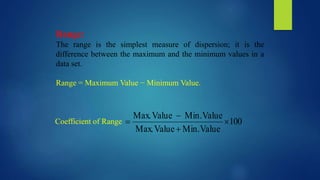
Range:
The range is the simplest measure of dispersion; it is the
difference between the maximum and the minimum values in a
data set.
Range = Maximum Value − Minimum Value.
Coefficient of Range 100
Value
Min.
Value
Max.
Value
Min.
Value
Max.




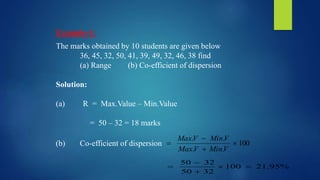
Example-1:
The marks obtained by 10 students are given below
36, 45, 32, 50, 41, 39, 49, 32, 46, 38 find
(a) Range (b) Co-efficient of dispersion
Solution:
(a) R = Max.Value – Min.Value
= 50 – 32 = 18 marks
100
.
.
.
.




V
Min
V
Max
V
Min
V
Max
50 32
100 21.95%
50 32

  

(b) Co-efficient of dispersion
Example-2:
Find range and coefficient of Dispersion.
C.B F
4 – 8 5
8 – 12 10
12 – 16 15
16 – 20 8
20 – 24 6
Solution:
R = U.C.B of last interval – L.C.B of first interval
R = 24 – 4 = 20
Coefficient of dispersion %
43
.
71
100
4
24
4
24






Range

  • 1.
    RANGE NADEEM UDDIN ASSOCIATE PROFESSOR OFSTATISTICS HTTPS://WWW.SLIDESHARE.NET/NADEEMUDDIN17 HTTPS://NADEEMSTATS.WORDPRESS.COM/LISTOFBOOKS/
  • 2.
    Absolute Measure ofDispersion: Gives an idea about the amount of dispersion/spread in a set of observations. These quantities measures the dispersion in the same units as the units of original data. Absolute measures cannot be used to compare the variation of two or more series/ data set. A measure of absolute dispersion does not in itself, tell whether the variation is large or small. Relative Measure of Dispersion: Relative measures are not expressed in units but it is a pure number. It is useful for compairing two or more sets of data.
  • 3.
    Range: The range isthe simplest measure of dispersion; it is the difference between the maximum and the minimum values in a data set. Range = Maximum Value − Minimum Value. Coefficient of Range 100 Value Min. Value Max. Value Min. Value Max.    
  • 4.
    Example-1: The marks obtainedby 10 students are given below 36, 45, 32, 50, 41, 39, 49, 32, 46, 38 find (a) Range (b) Co-efficient of dispersion Solution: (a) R = Max.Value – Min.Value = 50 – 32 = 18 marks 100 . . . .     V Min V Max V Min V Max 50 32 100 21.95% 50 32      (b) Co-efficient of dispersion
  • 5.
    Example-2: Find range andcoefficient of Dispersion. C.B F 4 – 8 5 8 – 12 10 12 – 16 15 16 – 20 8 20 – 24 6 Solution: R = U.C.B of last interval – L.C.B of first interval R = 24 – 4 = 20 Coefficient of dispersion % 43 . 71 100 4 24 4 24     