Managerial Accounting Project
Presented By: Teesha Gehani
Presented To: Ma’am Nadia Anjum ( Lecturer Finance)
Chapter 10
Standard costs and variances
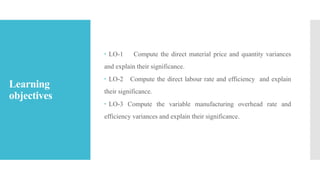
Learning
objectives
 LO-1 Compute the direct material price and quantity variances
and explain their significance.
 LO-2 Compute the direct labour rate and efficiency and explain
their significance.
 LO-3 Compute the variable manufacturing overhead rate and
efficiency variances and explain their significance.
The Definition
of Standard
Costs
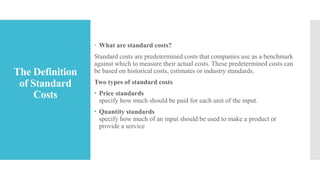
 What are standard costs?
Standard costs are predetermined costs that companies use as a benchmark
against which to measure their actual costs. These predetermined costs can
be based on historical costs, estimates or industry standards.
Two types of standard costs
• Price standards
specify how much should be paid for each unit of the input.
• Quantity standards
specify how much of an input should be used to make a product or
provide a service
Variance:
Meaning and
Significance
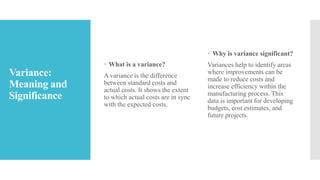
 What is a variance?
A variance is the difference
between standard costs and
actual costs. It shows the extent
to which actual costs are in sync
with the expected costs.
 Why is variance significant?
Variances help to identify areas
where improvements can be
made to reduce costs and
increase efficiency within the
manufacturing process. This
data is important for developing
budgets, cost estimates, and
future projects.
Setting
Standards for
Direct Materials
 Standard quantity per unit
It defines the amount of direct
materials that should be used
for each unit of finished
product.
• Summarized in bill of
materials.
• Such as: scarp or spoilage
 Standard price per unit
It defines the price that should
be paid of each unit of direct
material.
• Final , delivered cost of
materials
Setting
Standards for
Direct Labour
 Standard hours per unit
It defines the amount of direct
labour hours that should be used
to produce one unit of finished
goods.
 Standard rate per hour
It defines the company’s
expected direct labour wage
rate per hour.
Setting Variable
Manufacturing
Overhead
Standards
 What is manufacturing
overhead?
All indirect costs incurred by
the manufacturing process, such
as utilities and rent.
 The standard cost card
It shows the standard quantity
(or hours)and standard price (or
rate) of inputs required to
produce a unit of specific
product.
 The standard cost per unit
The standard quantity (or hours)
per units multiplied by standard
price(or rate) per unit to obtain
the standard cost per unit
A General
Model for
Standard Cost
Variance
Analysis
 Step One
Determine the actual costs for each element of direct material, direct
labour, and manufacturing overhead.
 Step Two
Calculate the total actual costs for the manufacturing process.
 Step Three
Compute the expected or standard costs for each element of direct
material, direct labour, and manufacturing overhead, and the total
expected costs.
 Step Four
Compare actual costs with expected costs, calculate the material
variance, labour variance, and overhead variance.
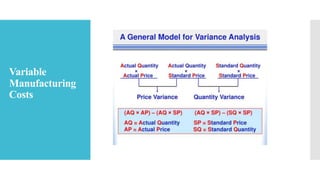
Variable
Manufacturing
Costs
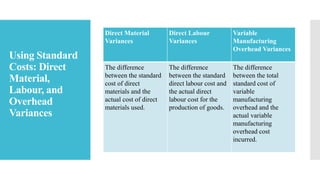
Using Standard
Costs: Direct
Material,
Labour, and
Overhead
Variances
Direct Material
Variances
Direct Labour
Variances
Variable
Manufacturing
Overhead Variances
The difference
between the standard
cost of direct
materials and the
actual cost of direct
materials used.
The difference
between the standard
direct labour cost and
the actual direct
labour cost for the
production of goods.
The difference
between the total
standard cost of
variable
manufacturing
overhead and the
actual variable
manufacturing
overhead cost
incurred.
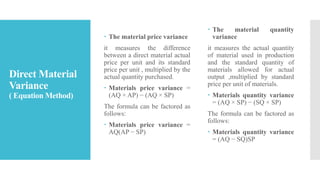
Direct Material
Variance
( Equation Method)
 The material price variance
it measures the difference
between a direct material actual
price per unit and its standard
price per unit , multiplied by the
actual quantity purchased.
 Materials price variance =
(AQ × AP) − (AQ × SP)
The formula can be factored as
follows:
 Materials price variance =
AQ(AP − SP)
 The material quantity
variance
it measures the actual quantity
of material used in production
and the standard quantity of
materials allowed for actual
output ,multiplied by standard
price per unit of materials.
 Materials quantity variance
= (AQ × SP) − (SQ × SP)
The formula can be factored as
follows:
 Materials quantity variance
= (AQ − SQ)SP
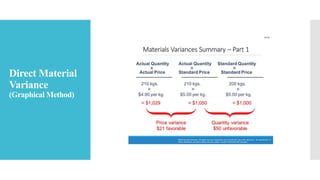
Direct Material
Variance
(Graphical Method)
Responsibility
For Material
Variance
 The production manager is responsible for materials quantity
variance.
 The purchasing manager is responsible for price material variance.
 The standard price is used to compute the quantity variance
so that the production manager is not held responsible for
the purchasing manager’s performance.
Controllability
of Materials
Variances
.
• The materials variances are not always entirely controllable by one
person or department. For example:
• The purchasing manager may purchase lower quality raw
materials resulting in an unfavourable materials quantity variance
for the production manager.
• The production manager may schedule production in such a way
that it requires express delivery of raw materials resulting in an
unfavourable materials price variance
Direct labour
Variance
( Equation Method)
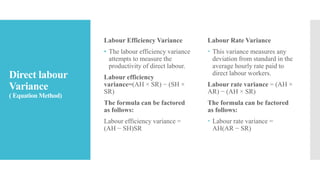
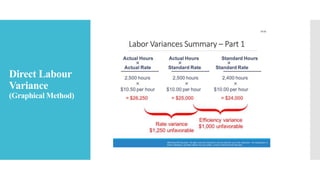
Labour Efficiency Variance
• The labour efficiency variance
attempts to measure the
productivity of direct labour.
Labour efficiency
variance=(AH × SR) − (SH ×
SR)
The formula can be factored
as follows:
Labour efficiency variance =
(AH − SH)SR
Labour Rate Variance
 This variance measures any
deviation from standard in the
average hourly rate paid to
direct labour workers.
Labour rate variance = (AH ×
AR) − (AH × SR)
The formula can be factored
as follows:
 Labour rate variance =
AH(AR − SR)
Direct Labour
Variance
(Graphical Method)
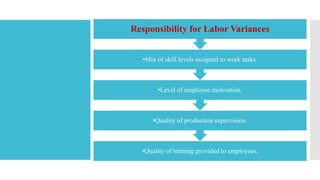
•Quality of training provided to employees.
•Quality of production supervision.
•Level of employee motivation.
•Mix of skill levels assigned to work tasks.
Responsibility for Labor Variances
Controllability
of Labor
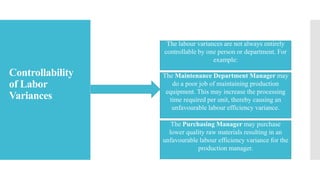
Variances
The labour variances are not always entirely
controllable by one person or department. For
example:
The Maintenance Department Manager may
do a poor job of maintaining production
equipment. This may increase the processing
time required per unit, thereby causing an
unfavourable labour efficiency variance.
The Purchasing Manager may purchase
lower quality raw materials resulting in an
unfavourable labour efficiency variance for the
production manager.
Variable
Manufacturing
Overhead
Variances
(Equation Method)
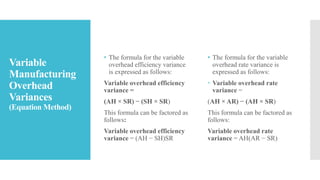
• The formula for the variable
overhead efficiency variance
is expressed as follows:
Variable overhead efficiency
variance =
(AH × SR) − (SH × SR)
This formula can be factored as
follows:
Variable overhead efficiency
variance = (AH − SH)SR
• The formula for the variable
overhead rate variance is
expressed as follows:
 Variable overhead rate
variance =
(AH × AR) − (AH × SR)
This formula can be factored as
follows:
Variable overhead rate
variance = AH(AR − SR)
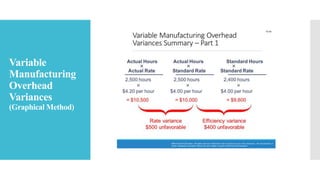
Variable
Manufacturing
Overhead
Variances
(Graphical Method)
Advantages of
Standard
Costing
• Assists in Accurate Budgeting. ...
• Expedites Inventory Costing. ...
• Makes It Simple to Appropriately Price Things. ...
• Provides Fruitful Financial Records Management. ...
• Helps Production Benchmarking.
• Increase efficiency
Potential
Problems with
Standard Costs
 Standard cost report may not be timely.
 Continuous improvements may be more important than meeting
standard
 Invalid assumption about relationship between labor cost and output
 Implementation Challenges
 Inaccurate Assumptions
 Obsolescence of Standards
About Sukkur IBA
University
Kandh-Kot
Campus
 About Sukkur IBA University Kandh-Kot Campus has been
established with a goal to offer access to quality education to the people of
underprivileged areas of Pakistan. With its geographical importance in
Kandhkot city, the campus provides easy access to the students hailing
from south Punjab, northern Sindh, and south-east Balochis tan. The
campus offers admission in various programs including undergraduate,
foundation semester, summer program, and short courses.
Thankyou

Managerial Accounting Project.pptx

  • 1.
    Managerial Accounting Project PresentedBy: Teesha Gehani Presented To: Ma’am Nadia Anjum ( Lecturer Finance)
  • 2.
  • 3.
    Learning objectives  LO-1 Computethe direct material price and quantity variances and explain their significance.  LO-2 Compute the direct labour rate and efficiency and explain their significance.  LO-3 Compute the variable manufacturing overhead rate and efficiency variances and explain their significance.
  • 4.
    The Definition of Standard Costs What are standard costs? Standard costs are predetermined costs that companies use as a benchmark against which to measure their actual costs. These predetermined costs can be based on historical costs, estimates or industry standards. Two types of standard costs • Price standards specify how much should be paid for each unit of the input. • Quantity standards specify how much of an input should be used to make a product or provide a service
  • 5.
    Variance: Meaning and Significance  Whatis a variance? A variance is the difference between standard costs and actual costs. It shows the extent to which actual costs are in sync with the expected costs.  Why is variance significant? Variances help to identify areas where improvements can be made to reduce costs and increase efficiency within the manufacturing process. This data is important for developing budgets, cost estimates, and future projects.
  • 6.
    Setting Standards for Direct Materials Standard quantity per unit It defines the amount of direct materials that should be used for each unit of finished product. • Summarized in bill of materials. • Such as: scarp or spoilage  Standard price per unit It defines the price that should be paid of each unit of direct material. • Final , delivered cost of materials
  • 7.
    Setting Standards for Direct Labour Standard hours per unit It defines the amount of direct labour hours that should be used to produce one unit of finished goods.  Standard rate per hour It defines the company’s expected direct labour wage rate per hour.
  • 8.
    Setting Variable Manufacturing Overhead Standards  Whatis manufacturing overhead? All indirect costs incurred by the manufacturing process, such as utilities and rent.  The standard cost card It shows the standard quantity (or hours)and standard price (or rate) of inputs required to produce a unit of specific product.  The standard cost per unit The standard quantity (or hours) per units multiplied by standard price(or rate) per unit to obtain the standard cost per unit
  • 9.
    A General Model for StandardCost Variance Analysis  Step One Determine the actual costs for each element of direct material, direct labour, and manufacturing overhead.  Step Two Calculate the total actual costs for the manufacturing process.  Step Three Compute the expected or standard costs for each element of direct material, direct labour, and manufacturing overhead, and the total expected costs.  Step Four Compare actual costs with expected costs, calculate the material variance, labour variance, and overhead variance.
  • 10.
  • 11.
    Using Standard Costs: Direct Material, Labour,and Overhead Variances Direct Material Variances Direct Labour Variances Variable Manufacturing Overhead Variances The difference between the standard cost of direct materials and the actual cost of direct materials used. The difference between the standard direct labour cost and the actual direct labour cost for the production of goods. The difference between the total standard cost of variable manufacturing overhead and the actual variable manufacturing overhead cost incurred.
  • 12.
    Direct Material Variance ( EquationMethod)  The material price variance it measures the difference between a direct material actual price per unit and its standard price per unit , multiplied by the actual quantity purchased.  Materials price variance = (AQ × AP) − (AQ × SP) The formula can be factored as follows:  Materials price variance = AQ(AP − SP)  The material quantity variance it measures the actual quantity of material used in production and the standard quantity of materials allowed for actual output ,multiplied by standard price per unit of materials.  Materials quantity variance = (AQ × SP) − (SQ × SP) The formula can be factored as follows:  Materials quantity variance = (AQ − SQ)SP
  • 13.
  • 14.
    Responsibility For Material Variance  Theproduction manager is responsible for materials quantity variance.  The purchasing manager is responsible for price material variance.  The standard price is used to compute the quantity variance so that the production manager is not held responsible for the purchasing manager’s performance.
  • 15.
    Controllability of Materials Variances . • Thematerials variances are not always entirely controllable by one person or department. For example: • The purchasing manager may purchase lower quality raw materials resulting in an unfavourable materials quantity variance for the production manager. • The production manager may schedule production in such a way that it requires express delivery of raw materials resulting in an unfavourable materials price variance
  • 16.
    Direct labour Variance ( EquationMethod) Labour Efficiency Variance • The labour efficiency variance attempts to measure the productivity of direct labour. Labour efficiency variance=(AH × SR) − (SH × SR) The formula can be factored as follows: Labour efficiency variance = (AH − SH)SR Labour Rate Variance  This variance measures any deviation from standard in the average hourly rate paid to direct labour workers. Labour rate variance = (AH × AR) − (AH × SR) The formula can be factored as follows:  Labour rate variance = AH(AR − SR)
  • 17.
  • 18.
    •Quality of trainingprovided to employees. •Quality of production supervision. •Level of employee motivation. •Mix of skill levels assigned to work tasks. Responsibility for Labor Variances
  • 19.
    Controllability of Labor Variances The labourvariances are not always entirely controllable by one person or department. For example: The Maintenance Department Manager may do a poor job of maintaining production equipment. This may increase the processing time required per unit, thereby causing an unfavourable labour efficiency variance. The Purchasing Manager may purchase lower quality raw materials resulting in an unfavourable labour efficiency variance for the production manager.
  • 20.
    Variable Manufacturing Overhead Variances (Equation Method) • Theformula for the variable overhead efficiency variance is expressed as follows: Variable overhead efficiency variance = (AH × SR) − (SH × SR) This formula can be factored as follows: Variable overhead efficiency variance = (AH − SH)SR • The formula for the variable overhead rate variance is expressed as follows:  Variable overhead rate variance = (AH × AR) − (AH × SR) This formula can be factored as follows: Variable overhead rate variance = AH(AR − SR)
  • 21.
  • 22.
    Advantages of Standard Costing • Assistsin Accurate Budgeting. ... • Expedites Inventory Costing. ... • Makes It Simple to Appropriately Price Things. ... • Provides Fruitful Financial Records Management. ... • Helps Production Benchmarking. • Increase efficiency
  • 23.
    Potential Problems with Standard Costs Standard cost report may not be timely.  Continuous improvements may be more important than meeting standard  Invalid assumption about relationship between labor cost and output  Implementation Challenges  Inaccurate Assumptions  Obsolescence of Standards
  • 24.
    About Sukkur IBA University Kandh-Kot Campus About Sukkur IBA University Kandh-Kot Campus has been established with a goal to offer access to quality education to the people of underprivileged areas of Pakistan. With its geographical importance in Kandhkot city, the campus provides easy access to the students hailing from south Punjab, northern Sindh, and south-east Balochis tan. The campus offers admission in various programs including undergraduate, foundation semester, summer program, and short courses.
  • 25.