DRESS
MAKING/
TAILORING
SEWING TOOLS AND EQUIPMENT
• MEASURING TOOLS
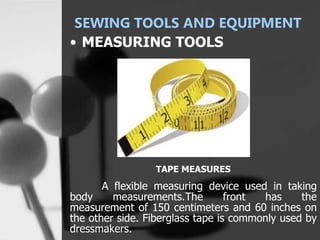
TAPE MEASURES
A flexible measuring device used in taking
body measurements.The front has the
measurement of 150 centimeters and 60 inches on
the other side. Fiberglass tape is commonly used by
dressmakers.
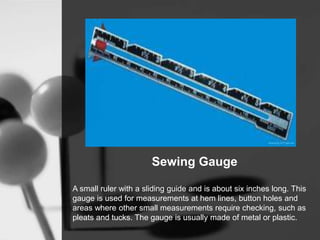
Sewing Gauge
A small ruler with a sliding guide and is about six inches long. This
gauge is used for measurements at hem lines, button holes and
areas where other small measurements require checking, such as
pleats and tucks. The gauge is usually made of metal or plastic.
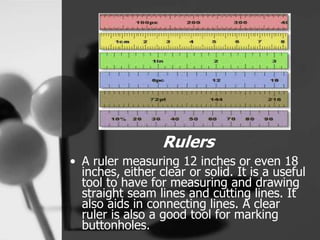
Rulers
• A ruler measuring 12 inches or even 18
inches, either clear or solid. It is a useful
tool to have for measuring and drawing
straight seam lines and cutting lines. It
also aids in connecting lines. A clear
ruler is also a good tool for marking
buttonholes.
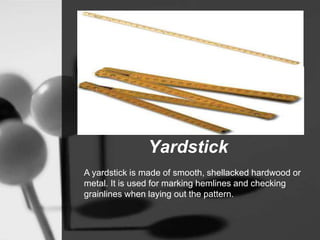
Yardstick
A yardstick is made of smooth, shellacked hardwood or
metal. It is used for marking hemlines and checking
grainlines when laying out the pattern.
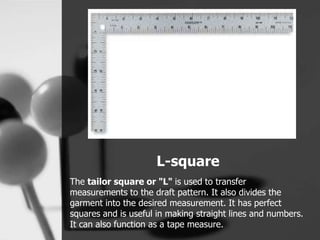
L-square
The tailor square or "L" is used to transfer
measurements to the draft pattern. It also divides the
garment into the desired measurement. It has perfect
squares and is useful in making straight lines and numbers.
It can also function as a tape measure.
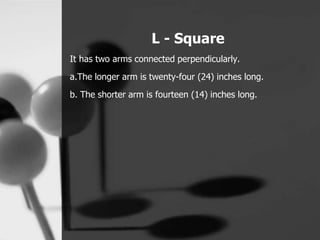
L - Square
It has two arms connected perpendicularly.
a.The longer arm is twenty-four (24) inches long.
b. The shorter arm is fourteen (14) inches long.
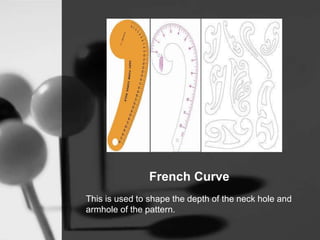
French Curve
This is used to shape the depth of the neck hole and
armhole of the pattern.
CUTTING TOOLS
• Cutting tools are instruments that serve well if
properly maintained. Sharp cutting tools make
clean cuts and well-defined notches and they
do not damage fabric. On the other hand, dull
tools slow the cutting process, and make your
hand and wrist tire easily. Sewing cutting tools
should not be used for other household task.
Cutting tools must be sharpened regularly and
the joints are oiled occasionally for better use.
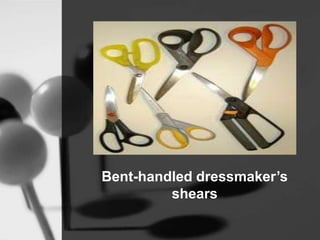
Bent-handled dressmaker’s
shears
• These are made of quality steel and hold a
sharp cutting edge. The blades move easily
and cut smoothly along the entire length and
the points should come together. Shears have
the length of 7- 12 inches and are satisfactory
for most apparel fabrics.
• a. All steels, chrome-plated shears are for
heavy duty cutting
• b. Stainless steel blades and plastic handles are
fine for lightweight fabrics
• c. A serrated edge shears give maximum
cutting control and is used for synthetic fibers
and slippery knits
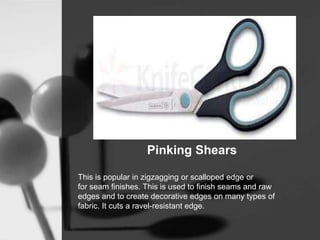
Pinking Shears
This is popular in zigzagging or scalloped edge or
for seam finishes. This is used to finish seams and raw
edges and to create decorative edges on many types of
fabric. It cuts a ravel-resistant edge.
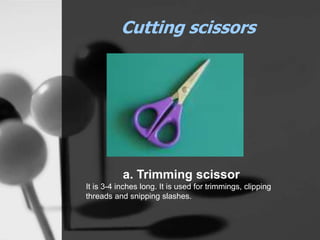
Cutting scissors
a. Trimming scissor
It is 3-4 inches long. It is used for trimmings, clipping
threads and snipping slashes.
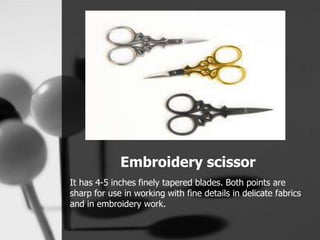
Embroidery scissor
It has 4-5 inches finely tapered blades. Both points are
sharp for use in working with fine details in delicate fabrics
and in embroidery work.
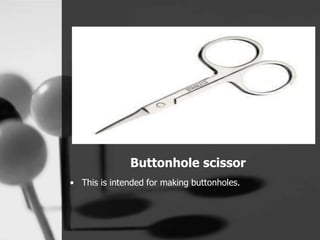
Buttonhole scissor
• This is intended for making buttonholes.
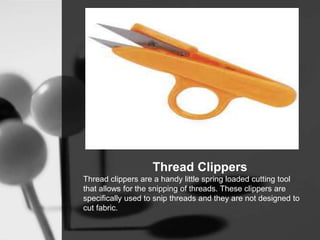
Thread Clippers
Thread clippers are a handy little spring loaded cutting tool
that allows for the snipping of threads. These clippers are
specifically used to snip threads and they are not designed to
cut fabric.
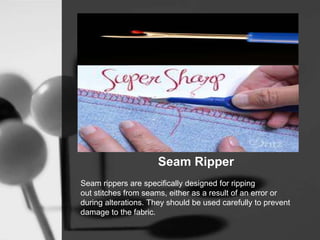
Seam Ripper
Seam rippers are specifically designed for ripping
out stitches from seams, either as a result of an error or
during alterations. They should be used carefully to prevent
damage to the fabric.
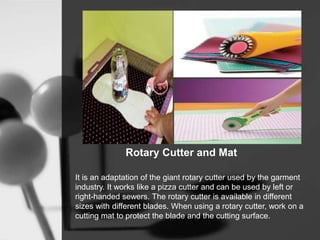
Rotary Cutter and Mat
It is an adaptation of the giant rotary cutter used by the garment
industry. It works like a pizza cutter and can be used by left or
right-handed sewers. The rotary cutter is available in different
sizes with different blades. When using a rotary cutter, work on a
cutting mat to protect the blade and the cutting surface.
MARKING TOOLS
Marking tools are required for
transferring pattern markings to
garment fabric pieces and for
making alterations on garments.
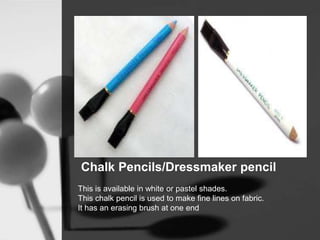
Chalk Pencils/Dressmaker pencil
This is available in white or pastel shades.
This chalk pencil is used to make fine lines on fabric.
It has an erasing brush at one end
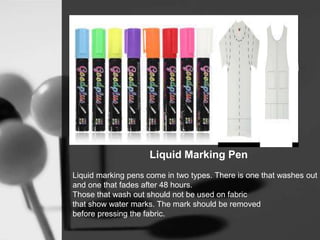
Liquid Marking Pen
Liquid marking pens come in two types. There is one that washes out
and one that fades after 48 hours.
Those that wash out should not be used on fabric
that show water marks. The mark should be removed
before pressing the fabric.
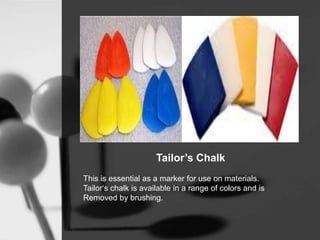
Tailor’s Chalk
This is essential as a marker for use on materials.
Tailor‘s chalk is available in a range of colors and is
Removed by brushing.
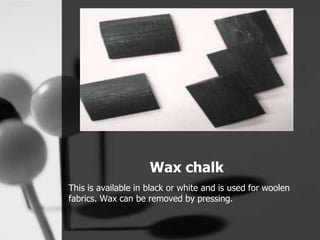
Wax chalk
This is available in black or white and is used for woolen
fabrics. Wax can be removed by pressing.
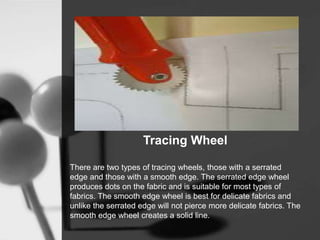
Tracing Wheel
There are two types of tracing wheels, those with a serrated
edge and those with a smooth edge. The serrated edge wheel
produces dots on the fabric and is suitable for most types of
fabrics. The smooth edge wheel is best for delicate fabrics and
unlike the serrated edge will not pierce more delicate fabrics. The
smooth edge wheel creates a solid line.
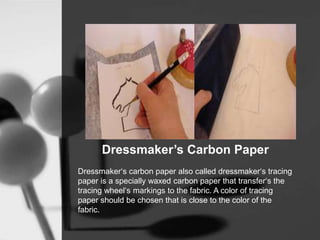
Dressmaker’s Carbon Paper
Dressmaker‘s carbon paper also called dressmaker‘s tracing
paper is a specially waxed carbon paper that transfer‘s the
tracing wheel‘s markings to the fabric. A color of tracing
paper should be chosen that is close to the color of the
fabric.
PINNING AND
SEWING TOOL
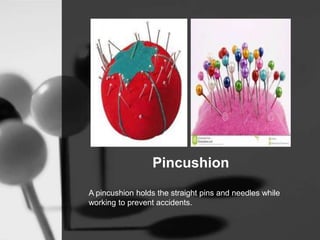
Pincushion
A pincushion holds the straight pins and needles while
working to prevent accidents.
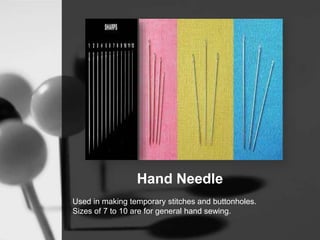
Hand Needle
Used in making temporary stitches and buttonholes.
Sizes of 7 to 10 are for general hand sewing.
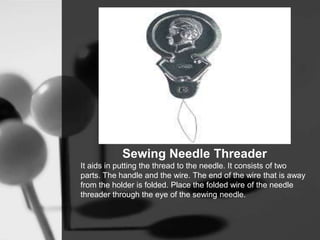
Sewing Needle Threader
It aids in putting the thread to the needle. It consists of two
parts. The handle and the wire. The end of the wire that is away
from the holder is folded. Place the folded wire of the needle
threader through the eye of the sewing needle.
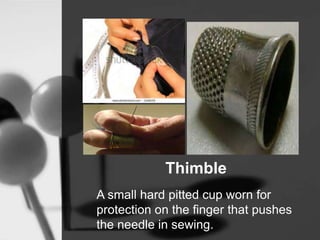
Thimble
A small hard pitted cup worn for
protection on the finger that pushes
the needle in sewing.
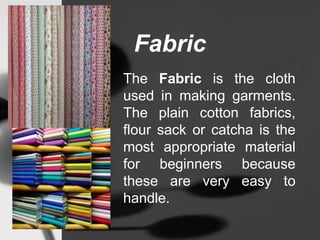
Fabric
The Fabric is the cloth
used in making garments.
The plain cotton fabrics,
flour sack or catcha is the
most appropriate material
for beginners because
these are very easy to
handle.
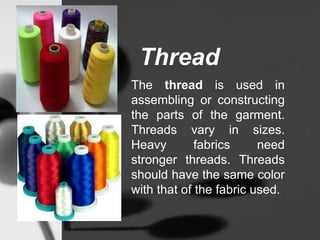
Thread
The thread is used in
assembling or constructing
the parts of the garment.
Threads vary in sizes.
Heavy fabrics need
stronger threads. Threads
should have the same color
with that of the fabric used.
TYPES OF SEWING MACHINE
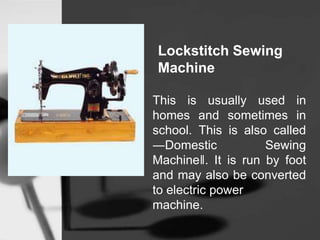
Lockstitch Sewing
Machine
This is usually used in
homes and sometimes in
school. This is also called
―Domestic Sewing
Machine‖. It is run by foot
and may also be converted
to electric power
machine.
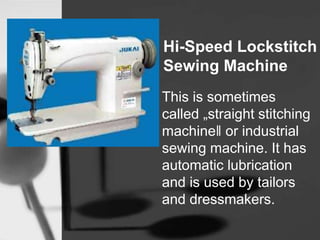
Hi-Speed Lockstitch
Sewing Machine
This is sometimes
called „straight stitching
machine‖ or industrial
sewing machine. It has
automatic lubrication
and is used by tailors
and dressmakers.
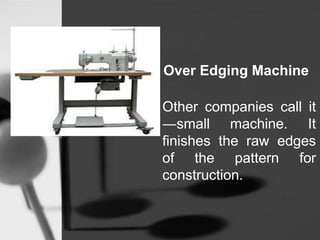
Over Edging Machine
Other companies call it
―small machine. It
finishes the raw edges
of the pattern for
construction.

Dress making

  • 1.
  • 2.
    SEWING TOOLS ANDEQUIPMENT • MEASURING TOOLS TAPE MEASURES A flexible measuring device used in taking body measurements.The front has the measurement of 150 centimeters and 60 inches on the other side. Fiberglass tape is commonly used by dressmakers.
  • 3.
    Sewing Gauge A smallruler with a sliding guide and is about six inches long. This gauge is used for measurements at hem lines, button holes and areas where other small measurements require checking, such as pleats and tucks. The gauge is usually made of metal or plastic.
  • 4.
    Rulers • A rulermeasuring 12 inches or even 18 inches, either clear or solid. It is a useful tool to have for measuring and drawing straight seam lines and cutting lines. It also aids in connecting lines. A clear ruler is also a good tool for marking buttonholes.
  • 5.
    Yardstick A yardstick ismade of smooth, shellacked hardwood or metal. It is used for marking hemlines and checking grainlines when laying out the pattern.
  • 6.
    L-square The tailor squareor "L" is used to transfer measurements to the draft pattern. It also divides the garment into the desired measurement. It has perfect squares and is useful in making straight lines and numbers. It can also function as a tape measure.
  • 7.
    L - Square Ithas two arms connected perpendicularly. a.The longer arm is twenty-four (24) inches long. b. The shorter arm is fourteen (14) inches long.
  • 8.
    French Curve This isused to shape the depth of the neck hole and armhole of the pattern.
  • 9.
  • 10.
    • Cutting toolsare instruments that serve well if properly maintained. Sharp cutting tools make clean cuts and well-defined notches and they do not damage fabric. On the other hand, dull tools slow the cutting process, and make your hand and wrist tire easily. Sewing cutting tools should not be used for other household task. Cutting tools must be sharpened regularly and the joints are oiled occasionally for better use.
  • 11.
  • 12.
    • These aremade of quality steel and hold a sharp cutting edge. The blades move easily and cut smoothly along the entire length and the points should come together. Shears have the length of 7- 12 inches and are satisfactory for most apparel fabrics. • a. All steels, chrome-plated shears are for heavy duty cutting • b. Stainless steel blades and plastic handles are fine for lightweight fabrics • c. A serrated edge shears give maximum cutting control and is used for synthetic fibers and slippery knits
  • 13.
    Pinking Shears This ispopular in zigzagging or scalloped edge or for seam finishes. This is used to finish seams and raw edges and to create decorative edges on many types of fabric. It cuts a ravel-resistant edge.
  • 14.
    Cutting scissors a. Trimmingscissor It is 3-4 inches long. It is used for trimmings, clipping threads and snipping slashes.
  • 15.
    Embroidery scissor It has4-5 inches finely tapered blades. Both points are sharp for use in working with fine details in delicate fabrics and in embroidery work.
  • 16.
    Buttonhole scissor • Thisis intended for making buttonholes.
  • 17.
    Thread Clippers Thread clippersare a handy little spring loaded cutting tool that allows for the snipping of threads. These clippers are specifically used to snip threads and they are not designed to cut fabric.
  • 18.
    Seam Ripper Seam rippersare specifically designed for ripping out stitches from seams, either as a result of an error or during alterations. They should be used carefully to prevent damage to the fabric.
  • 19.
    Rotary Cutter andMat It is an adaptation of the giant rotary cutter used by the garment industry. It works like a pizza cutter and can be used by left or right-handed sewers. The rotary cutter is available in different sizes with different blades. When using a rotary cutter, work on a cutting mat to protect the blade and the cutting surface.
  • 20.
    MARKING TOOLS Marking toolsare required for transferring pattern markings to garment fabric pieces and for making alterations on garments.
  • 21.
    Chalk Pencils/Dressmaker pencil Thisis available in white or pastel shades. This chalk pencil is used to make fine lines on fabric. It has an erasing brush at one end
  • 22.
    Liquid Marking Pen Liquidmarking pens come in two types. There is one that washes out and one that fades after 48 hours. Those that wash out should not be used on fabric that show water marks. The mark should be removed before pressing the fabric.
  • 23.
    Tailor’s Chalk This isessential as a marker for use on materials. Tailor‘s chalk is available in a range of colors and is Removed by brushing.
  • 24.
    Wax chalk This isavailable in black or white and is used for woolen fabrics. Wax can be removed by pressing.
  • 25.
    Tracing Wheel There aretwo types of tracing wheels, those with a serrated edge and those with a smooth edge. The serrated edge wheel produces dots on the fabric and is suitable for most types of fabrics. The smooth edge wheel is best for delicate fabrics and unlike the serrated edge will not pierce more delicate fabrics. The smooth edge wheel creates a solid line.
  • 26.
    Dressmaker’s Carbon Paper Dressmaker‘scarbon paper also called dressmaker‘s tracing paper is a specially waxed carbon paper that transfer‘s the tracing wheel‘s markings to the fabric. A color of tracing paper should be chosen that is close to the color of the fabric.
  • 27.
  • 28.
    Pincushion A pincushion holdsthe straight pins and needles while working to prevent accidents.
  • 29.
    Hand Needle Used inmaking temporary stitches and buttonholes. Sizes of 7 to 10 are for general hand sewing.
  • 30.
    Sewing Needle Threader Itaids in putting the thread to the needle. It consists of two parts. The handle and the wire. The end of the wire that is away from the holder is folded. Place the folded wire of the needle threader through the eye of the sewing needle.
  • 31.
    Thimble A small hardpitted cup worn for protection on the finger that pushes the needle in sewing.
  • 32.
    Fabric The Fabric isthe cloth used in making garments. The plain cotton fabrics, flour sack or catcha is the most appropriate material for beginners because these are very easy to handle.
  • 33.
    Thread The thread isused in assembling or constructing the parts of the garment. Threads vary in sizes. Heavy fabrics need stronger threads. Threads should have the same color with that of the fabric used.
  • 34.
  • 35.
    Lockstitch Sewing Machine This isusually used in homes and sometimes in school. This is also called ―Domestic Sewing Machine‖. It is run by foot and may also be converted to electric power machine.
  • 36.
    Hi-Speed Lockstitch Sewing Machine Thisis sometimes called „straight stitching machine‖ or industrial sewing machine. It has automatic lubrication and is used by tailors and dressmakers.
  • 37.
    Over Edging Machine Othercompanies call it ―small machine. It finishes the raw edges of the pattern for construction.