Measuring Length
and Conversions
Linear Measurements
Life Performance Outcome
I am a mindful, self-directed learner and role
model, consciously expressing my Faith.
Essential Performance
Outcome
Have the initiative to seek and learn new
mathematical skills, then apply them on their
own.
Intended Learning Outcome
Have the initiative to visualize, represent, and
convert common units of measure from larger to
smaller units and vice versa, then apply them on
their own.
TAKE A LOOK Back!
A long time ago, the Babylonians, and Egyptians' standards of measurement
were based on body parts (digit, palm, span, cubit, foot). These are examples
of nonstandard units. But people have different sizes of body parts. So, to
avoid confusion, there was a need to have the same standard of
measurement.
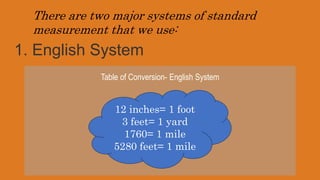
Table of Conversion- English System
12 inches= 1 foot
3 feet= 1 yard
1760= 1 mile
5280 feet= 1 mile
1. English System
There are two major systems of standard
measurement that we use:
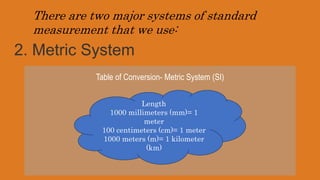
Table of Conversion- Metric System (SI)
Length
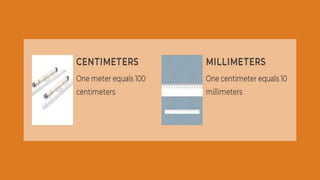
1000 millimeters (mm)= 1
meter
100 centimeters (cm)= 1 meter
1000 meters (m)= 1 kilometer
(km)
2. Metric System
There are two major systems of standard
measurement that we use:
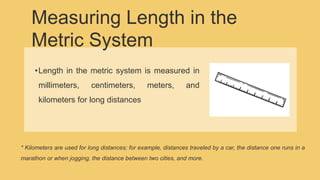
Measuring Length in the
Metric System
•Length in the metric system is measured in
millimeters, centimeters, meters, and
kilometers for long distances
* Kilometers are used for long distances; for example, distances traveled by a car, the distance one runs in a
marathon or when jogging, the distance between two cities, and more.
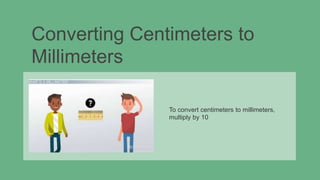
Converting Centimeters to
Millimeters
To convert centimeters to millimeters,
multiply by 10
Converting Millimeters to
Centimeters
To convert millimeters to centimeters, divide
by 10
Converting Meters to Centimeters
To convert meters to centimeters, multiply
by 100
Converting Centimeters to Meters
To convert centimeters to meters, divide by
100
Converting Kilometers to Meters
To convert kilometers to meters, multiply by
1000
Converting Meters to Kilometers
To convert meters to kilometers, divide by
1000
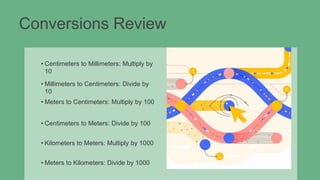
Conversions Review
• Centimeters to Millimeters: Multiply by
10
• Millimeters to Centimeters: Divide by
10
• Meters to Centimeters: Multiply by 100
• Centimeters to Meters: Divide by 100
• Kilometers to Meters: Multiply by 1000
• Meters to Kilometers: Divide by 1000
Explore Further
Activity: Solve on your own.

Lesson 4............................pptx

  • 1.
  • 2.
    Life Performance Outcome Iam a mindful, self-directed learner and role model, consciously expressing my Faith.
  • 3.
    Essential Performance Outcome Have theinitiative to seek and learn new mathematical skills, then apply them on their own.
  • 4.
    Intended Learning Outcome Havethe initiative to visualize, represent, and convert common units of measure from larger to smaller units and vice versa, then apply them on their own.
  • 5.
    TAKE A LOOKBack! A long time ago, the Babylonians, and Egyptians' standards of measurement were based on body parts (digit, palm, span, cubit, foot). These are examples of nonstandard units. But people have different sizes of body parts. So, to avoid confusion, there was a need to have the same standard of measurement.
  • 6.
    Table of Conversion-English System 12 inches= 1 foot 3 feet= 1 yard 1760= 1 mile 5280 feet= 1 mile 1. English System There are two major systems of standard measurement that we use:
  • 7.
    Table of Conversion-Metric System (SI) Length 1000 millimeters (mm)= 1 meter 100 centimeters (cm)= 1 meter 1000 meters (m)= 1 kilometer (km) 2. Metric System There are two major systems of standard measurement that we use:
  • 8.
    Measuring Length inthe Metric System •Length in the metric system is measured in millimeters, centimeters, meters, and kilometers for long distances * Kilometers are used for long distances; for example, distances traveled by a car, the distance one runs in a marathon or when jogging, the distance between two cities, and more.
  • 11.
    Converting Centimeters to Millimeters Toconvert centimeters to millimeters, multiply by 10
  • 12.
    Converting Millimeters to Centimeters Toconvert millimeters to centimeters, divide by 10
  • 13.
    Converting Meters toCentimeters To convert meters to centimeters, multiply by 100
  • 14.
    Converting Centimeters toMeters To convert centimeters to meters, divide by 100
  • 15.
    Converting Kilometers toMeters To convert kilometers to meters, multiply by 1000
  • 16.
    Converting Meters toKilometers To convert meters to kilometers, divide by 1000
  • 17.
    Conversions Review • Centimetersto Millimeters: Multiply by 10 • Millimeters to Centimeters: Divide by 10 • Meters to Centimeters: Multiply by 100 • Centimeters to Meters: Divide by 100 • Kilometers to Meters: Multiply by 1000 • Meters to Kilometers: Divide by 1000
  • 19.
  • 20.