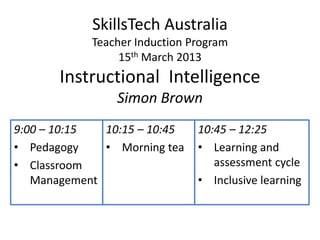


SkillsTech Australia
            Teacher Induction Program
                 15th March 2013
       Instructional Intelligence
                Simon Brown
9:00 – 10:15  10:15 – 10:45    10:45 – 12:25
• Pedagogy    • Morning tea    • Learning and
• Classroom                       assessment cycle
   Management                  • Inclusive learning
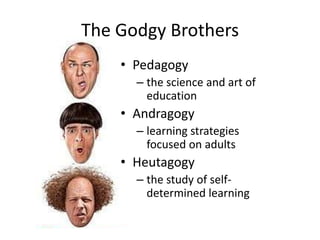
The Godgy Brothers
    • Pedagogy
      – the science and art of
        education
    • Andragogy
      – learning strategies
        focused on adults
    • Heutagogy
      – the study of self-
        determined learning
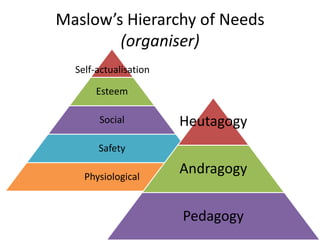
Maslow’s Hierarchy of Needs
        (organiser)
  Self-actualisation

       Esteem

       Social          Heutagogy
       Safety

    Physiological
                       Andragogy


                       Pedagogy
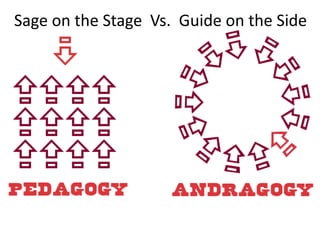
Sage on the Stage Vs. Guide on the Side
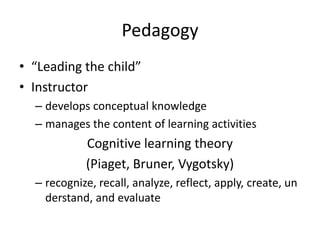
Pedagogy
• “Leading the child”
• Instructor
  – develops conceptual knowledge
  – manages the content of learning activities
            Cognitive learning theory
            (Piaget, Bruner, Vygotsky)
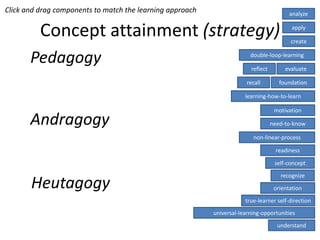
  – recognize, recall, analyze, reflect, apply, create, un
    derstand, and evaluate
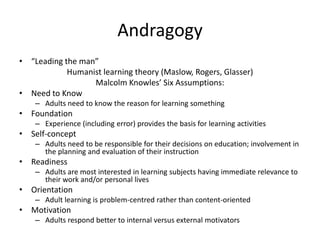
Andragogy
• “Leading the man”
            Humanist learning theory (Maslow, Rogers, Glasser)
                  Malcolm Knowles’ Six Assumptions:
• Need to Know
    – Adults need to know the reason for learning something
• Foundation
    – Experience (including error) provides the basis for learning activities
• Self-concept
    – Adults need to be responsible for their decisions on education; involvement in
      the planning and evaluation of their instruction
• Readiness
    – Adults are most interested in learning subjects having immediate relevance to
      their work and/or personal lives
• Orientation
    – Adult learning is problem-centred rather than content-oriented
• Motivation
    – Adults respond better to internal versus external motivators
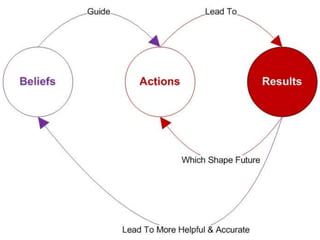
Double loop learning
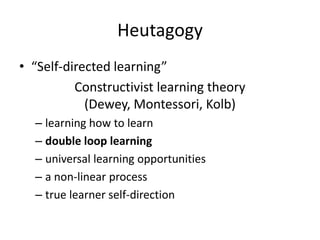
Heutagogy
• “Self-directed learning”
          Constructivist learning theory
            (Dewey, Montessori, Kolb)
  – learning how to learn
  – double loop learning
  – universal learning opportunities
  – a non-linear process
  – true learner self-direction
Click and drag components to match the learning approach                                  analyze


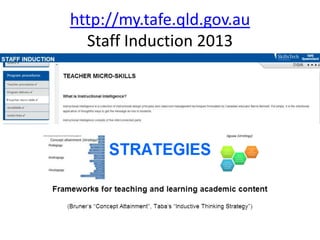
          Concept attainment (strategy)                                                    apply

                                                                                          create


       Pedagogy                                                          double-loop-learning

                                                                         reflect        evaluate

                                                                        recall        foundation

                                                                       learning-how-to-learn

                                                                                    motivation
       Andragogy                                                                   need-to-know

                                                                          non-linear-process

                                                                                    readiness

                                                                                    self-concept

                                                                                      recognize
       Heutagogy                                                                    orientation

                                                                       true-learner self-direction
                                                           universal-learning-opportunities

                                                                                     understand
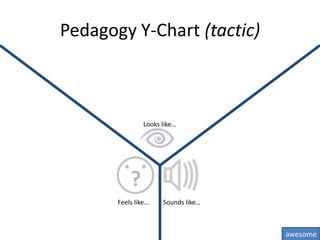
Pedagogy Y-Chart (tactic)


                Looks like…


       Feels like…    Sounds like…


                                     awesome
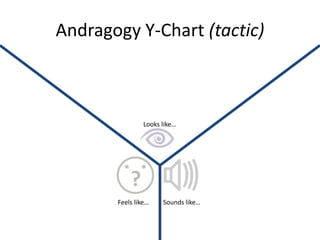
Andragogy Y-Chart (tactic)


                Looks like…


       Feels like…    Sounds like…
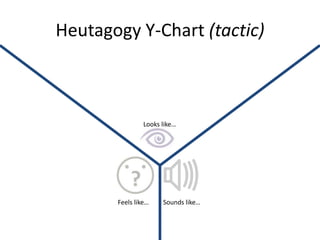
Heutagogy Y-Chart (tactic)


                Looks like…


       Feels like…    Sounds like…
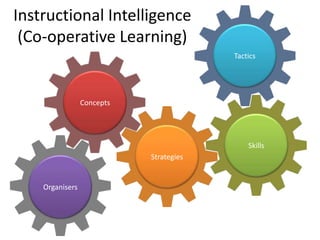
Instructional Intelligence
 (Co-operative Learning)
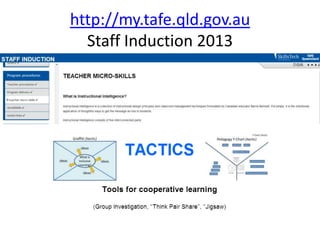
                                         Tactics


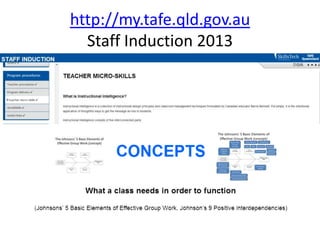
                 Concepts


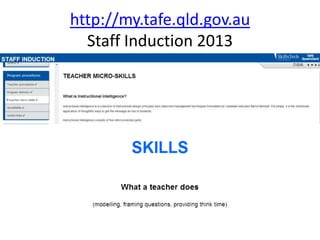
                                             Skills
                            Strategies


    Organisers
Think – Pair - Share (tactic)
 Question for reflection and discussion:
 In the context of students learning skills in
 your own trade area, is it better for them to
 Compete or to Co-operate?
1. Think about this question for about thirty seconds
2. Discuss your thoughts with your partner for about one
   minute
3. If you are comfortable, share your partner’s views on
   this matter with the group for no longer than one
   minute
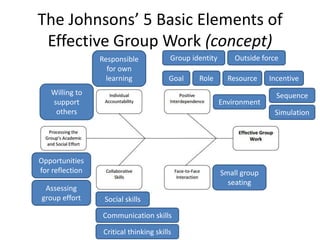
The Johnsons’ 5 Basic Elements of
 Effective Group Work (concept)
                 Responsible             Group identity       Outside force
                   for own
                   learning              Goal    Role       Resource    Incentive
   Willing to                                                             Sequence
   support                                                Environment
    others                                                               Simulation


Opportunities
for reflection                                            Small group
                                                            seating
 Assessing
group effort      Social skills

                 Communication skills

                  Critical thinking skills
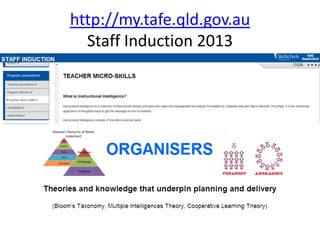
http://my.tafe.qld.gov.au
  Staff Induction 2013
http://my.tafe.qld.gov.au
  Staff Induction 2013
http://my.tafe.qld.gov.au
  Staff Induction 2013
http://my.tafe.qld.gov.au
  Staff Induction 2013
http://my.tafe.qld.gov.au
  Staff Induction 2013
Morning tea 10:15 – 10:45
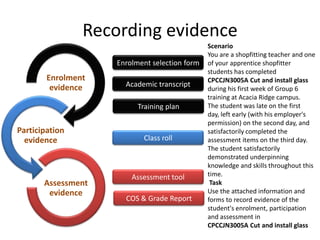
Recording evidence
                                               Scenario
                                               You are a shopfitting teacher and one
                    Enrolment selection form   of your apprentice shopfitter
                                               students has completed
        Enrolment                              CPCCJN3005A Cut and install glass
         evidence     Academic transcript
                                               during his first week of Group 6
                                               training at Acacia Ridge campus.
                          Training plan        The student was late on the first
                                               day, left early (with his employer's
                                               permission) on the second day, and
Participation                                  satisfactorily completed the
  evidence                 Class roll          assessment items on the third day.
                                               The student satisfactorily
                                               demonstrated underpinning
                                               knowledge and skills throughout this
                        Assessment tool        time.
       Assessment                               Task
        evidence                               Use the attached information and
                      COS & Grade Report       forms to record evidence of the
                                               student's enrolment, participation
                                               and assessment in
                                               CPCCJN3005A Cut and install glass
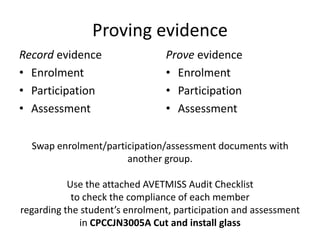
Proving evidence
Record evidence                 Prove evidence
• Enrolment                     • Enrolment
• Participation                 • Participation
• Assessment                    • Assessment

  Swap enrolment/participation/assessment documents with
                      another group.

           Use the attached AVETMISS Audit Checklist
            to check the compliance of each member
regarding the student’s enrolment, participation and assessment
              in CPCCJN3005A Cut and install glass
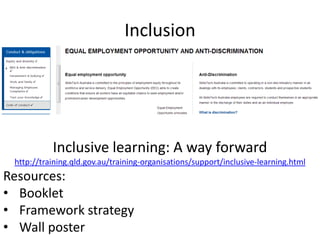
Inclusion


           Inclusive learning: A way forward
 http://training.qld.gov.au/training-organisations/support/inclusive-learning.html
Resources:
• Booklet
• Framework strategy
• Wall poster
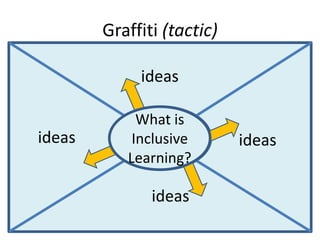
Graffiti (tactic)

             ideas

             What is
ideas         Topic
            Inclusive       ideas
           Learning?

               ideas
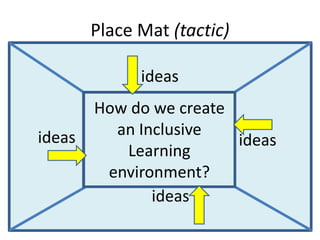
Place Mat (tactic)

              ideas
        How do we create
ideas     an Inclusive
             Topic       ideas
           Learning
         environment?
               ideas
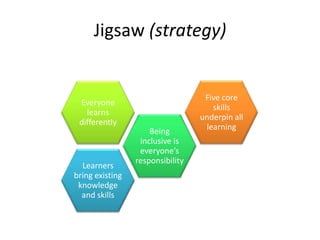
Jigsaw (strategy)


                                   Five core
 Everyone
                                     skills
   learns
                                  underpin all
 differently
                     Being         learning
                  inclusive is
                  everyone’s
                 responsibility
  Learners
bring existing
 knowledge
  and skills
Inclusive learning: A way forward
     Actions for Teachers/trainers
Study the resources and report how you and
your training delivery team will embed these
four principles into day-to-day practice:
1. Everyone learns differently
2. Being inclusive is everyone’s responsibility
3. Learners bring existing knowledge and skills
4. Five core skills underpin all learning
Resources
• Anti-Discrimination Act 1991
• Code of Conduct for the Queensland Public Service
• principles of equity and diversity as outlined in
  POL005 - Equity and Diversity
• SkillsTech Australia Equity and Diversity policy
• Department’s Equity and Diversity resources page
  at http://training.qld.gov.au/information/equity-
  diversity/index.html
• Reasonable Adjustment in teaching, learning and assessment for
  learners with a disability - a guide for VET practitioners
• Inclusive Technology factsheets
• Training and Work: inclusive environments (2009)
Thank you for your participation today.

   Wishing you many years of happy teaching

                Simon Brown
                0408 521 826


PLEASE COMPLETE THE
 EVALUATION SURVEY
New teacher induction - SkillsTech Australia

New teacher induction - SkillsTech Australia

  • 1.
    SkillsTech Australia Teacher Induction Program 15th March 2013 Instructional Intelligence Simon Brown 9:00 – 10:15 10:15 – 10:45 10:45 – 12:25 • Pedagogy • Morning tea • Learning and • Classroom assessment cycle Management • Inclusive learning
  • 2.
    The Godgy Brothers • Pedagogy – the science and art of education • Andragogy – learning strategies focused on adults • Heutagogy – the study of self- determined learning
  • 3.
    Maslow’s Hierarchy ofNeeds (organiser) Self-actualisation Esteem Social Heutagogy Safety Physiological Andragogy Pedagogy
  • 4.
    Sage on theStage Vs. Guide on the Side
  • 5.
    Pedagogy • “Leading thechild” • Instructor – develops conceptual knowledge – manages the content of learning activities Cognitive learning theory (Piaget, Bruner, Vygotsky) – recognize, recall, analyze, reflect, apply, create, un derstand, and evaluate
  • 6.
    Andragogy • “Leading theman” Humanist learning theory (Maslow, Rogers, Glasser) Malcolm Knowles’ Six Assumptions: • Need to Know – Adults need to know the reason for learning something • Foundation – Experience (including error) provides the basis for learning activities • Self-concept – Adults need to be responsible for their decisions on education; involvement in the planning and evaluation of their instruction • Readiness – Adults are most interested in learning subjects having immediate relevance to their work and/or personal lives • Orientation – Adult learning is problem-centred rather than content-oriented • Motivation – Adults respond better to internal versus external motivators
  • 7.
  • 8.
    Heutagogy • “Self-directed learning” Constructivist learning theory (Dewey, Montessori, Kolb) – learning how to learn – double loop learning – universal learning opportunities – a non-linear process – true learner self-direction
  • 9.
    Click and dragcomponents to match the learning approach analyze Concept attainment (strategy) apply create Pedagogy double-loop-learning reflect evaluate recall foundation learning-how-to-learn motivation Andragogy need-to-know non-linear-process readiness self-concept recognize Heutagogy orientation true-learner self-direction universal-learning-opportunities understand
  • 10.
    Pedagogy Y-Chart (tactic) Looks like… Feels like… Sounds like… awesome
  • 11.
    Andragogy Y-Chart (tactic) Looks like… Feels like… Sounds like…
  • 12.
    Heutagogy Y-Chart (tactic) Looks like… Feels like… Sounds like…
  • 13.
    Instructional Intelligence (Co-operativeLearning) Tactics Concepts Skills Strategies Organisers
  • 14.
    Think – Pair- Share (tactic) Question for reflection and discussion: In the context of students learning skills in your own trade area, is it better for them to Compete or to Co-operate? 1. Think about this question for about thirty seconds 2. Discuss your thoughts with your partner for about one minute 3. If you are comfortable, share your partner’s views on this matter with the group for no longer than one minute
  • 15.
    The Johnsons’ 5Basic Elements of Effective Group Work (concept) Responsible Group identity Outside force for own learning Goal Role Resource Incentive Willing to Sequence support Environment others Simulation Opportunities for reflection Small group seating Assessing group effort Social skills Communication skills Critical thinking skills
  • 16.
  • 17.
  • 18.
  • 19.
  • 20.
  • 21.
  • 22.
    Recording evidence Scenario You are a shopfitting teacher and one Enrolment selection form of your apprentice shopfitter students has completed Enrolment CPCCJN3005A Cut and install glass evidence Academic transcript during his first week of Group 6 training at Acacia Ridge campus. Training plan The student was late on the first day, left early (with his employer's permission) on the second day, and Participation satisfactorily completed the evidence Class roll assessment items on the third day. The student satisfactorily demonstrated underpinning knowledge and skills throughout this Assessment tool time. Assessment Task evidence Use the attached information and COS & Grade Report forms to record evidence of the student's enrolment, participation and assessment in CPCCJN3005A Cut and install glass
  • 23.
    Proving evidence Record evidence Prove evidence • Enrolment • Enrolment • Participation • Participation • Assessment • Assessment Swap enrolment/participation/assessment documents with another group. Use the attached AVETMISS Audit Checklist to check the compliance of each member regarding the student’s enrolment, participation and assessment in CPCCJN3005A Cut and install glass
  • 24.
    Inclusion Inclusive learning: A way forward http://training.qld.gov.au/training-organisations/support/inclusive-learning.html Resources: • Booklet • Framework strategy • Wall poster
  • 25.
    Graffiti (tactic) ideas What is ideas Topic Inclusive ideas Learning? ideas
  • 26.
    Place Mat (tactic) ideas How do we create ideas an Inclusive Topic ideas Learning environment? ideas
  • 27.
    Jigsaw (strategy) Five core Everyone skills learns underpin all differently Being learning inclusive is everyone’s responsibility Learners bring existing knowledge and skills
  • 28.
    Inclusive learning: Away forward Actions for Teachers/trainers Study the resources and report how you and your training delivery team will embed these four principles into day-to-day practice: 1. Everyone learns differently 2. Being inclusive is everyone’s responsibility 3. Learners bring existing knowledge and skills 4. Five core skills underpin all learning
  • 29.
    Resources • Anti-Discrimination Act1991 • Code of Conduct for the Queensland Public Service • principles of equity and diversity as outlined in POL005 - Equity and Diversity • SkillsTech Australia Equity and Diversity policy • Department’s Equity and Diversity resources page at http://training.qld.gov.au/information/equity- diversity/index.html • Reasonable Adjustment in teaching, learning and assessment for learners with a disability - a guide for VET practitioners • Inclusive Technology factsheets • Training and Work: inclusive environments (2009)
  • 30.
    Thank you foryour participation today. Wishing you many years of happy teaching Simon Brown 0408 521 826 PLEASE COMPLETE THE EVALUATION SURVEY