UNIT - 6 STAFFING
UNIT - 6 STAFFING
Concept andImportanceof staffing
Staffing as apart of HRM- concept
Staffing - Process
Recruitment – Sources
Selection - Process
TrainingandDevelopment
 Concept andimportance
 Methods of training
• Onthejobtraining
 Inductiontraining
 Apprenticeship training
 Internshiptraining
• Off thejobtraining
 Vestibuletraining
TOPICS COVERED
STAFFING
Fillingand Keeping FilledPosts withPeople.
It maintains coordinationbetweenthepost andtheIndividual andIncludes:
 Recruitment
 Selection
 Training
 Promotions
 Transfers. etc
“Our Assets walk out of the Door each evening. We have to
make sure that they come back the next morning.” - Narayana
Murthy, CEO Infosys
CHARACTERISTICS OF STAFFING
Relatedto HumanBeing
SeparateManagerial Function
Essential at all Managerial Level
Relatedto Social Responsibility
Effects of Internal andExternal
Environment
IMPORTANCEOF STAFFING
Discovering andObtainingCompetent Personnel
Better Performance
Continuous Survival and Growthof Enterprise
OptimumUtilizationof HumanResource
Improvement of JobSatisfaction&Moraleof Employees
HUMAN RESOURCEMANAGEMENT
Branch of Management which is Concerned with the Recruitment,
Selection, Development and Optimum use of Employees
Ensures availability of Efficient Human Resource Available in the
Company
Ensures that every employee makes his maximum contribution to the
achievement of business goals
EVOLUTION OF HRM
LaborWelfareStage
Personnel
Management
Stage
HRMStage
Labor Welfare Officers were
appointed to act as a mediator
between employees and employers
Personnel Officers / Personnel
Managers were appointed to make
people available for a company
Human Resource Managers were
appointed to manage people to retain
them for a long time
STAFFINGAS A PART OF HRM
Recruitment
ProvidingExpert Services
DevelopingCompensationandIncentivePlans
Handling GrievancesandComplaints
Providingof Social SecurityandWelfareof
Employees
DefendingtheCompany inLawSuits
Keeping Personnel Records
Developing theOrganizational Structure
STAFFINGPROCESS
Estimatingthemanpower requirement
Recruitment
Selection
Placement andOrientation
Traininganddevelopment
Performanceappraisal
Promotionandcareer planning
Compensation
COMPONENTS OF STAFFING
Recruitment
 Process under which different sources for FutureEmployees aresearched for
Selection
 Selectingpre-determined number of candidates with thehelpof various tests
Training
 Process under which efficiencyof employees isincreased todoaparticular job
RECRUITMENT
“Process of searching for prospective employees and stimulating
them to apply for job in the organization.”
RECRUITMENT PROCESS
R
E
C
R
U
I
T
M
E
N
T
P
R
O
C
E
S
S
SOURCES OF RECRUITMENT
Internal Sources of Recruitment
 Transfer
 Promotion
 Lay-off
SOURCES OF RECRUITMENT
Meritsof Internal Sourcesof Recruitment
 IncreaseinMotivation
 Industrial Peace
 Easy Selection
 Noneedof Induction
 Adjustment of surplus employees
 Economical Source
Limitationsof Internal Sourceof Recruitment
 Stopstheentry of youngblood
 Employees becomelethargic
 Not availableinneworganizations
 Senseof competitionamongemployees hampered
 Frequent transfers hit productivity negatively
SOURCEOFRECRUITMENT: PROMOTION ASWELL ASDEMOTION
Chief Executive
Officer
(Vacant
Post)
Marketing
Manager
Financ
e
Manag
er
Senior
Executive
(Vacant Post)
Senior Executive
Demotio
n
Promotio
n
Finance
Manager
SOURCES OF RECRUITMENT
External Sourcesof Recruitment
 Direct Recruitment
 Casual Callings
 MediaAdvertisements
 Employment Exchanges
 Placement Agencies
 Management Consultantsor Head Hunters
 Campus Recruitment
 Recommendations
 Labor Contractors
 Telecasting
 Webpublishing
SOURCES OF RECRUITMENT
Meritsof External Sourcesof Recruitment
 Qualifiedpersonnel
 Wider choice
 Fresh talent
 Competitivespirit
 Less chances of favoritism
Limitationsof External Sourcesof Recruitment
 Dissatisfactionamongexistingstaff
 Lengthy process
 Costly process
 Chances of wrong selection
 Increaseinlabour turnover
SELECTION
“Process of Screening Job Applicants to ensure that the Most
Appropriate Candidates are hired.”
SELECTION PROCESS
S
E
L
E
C
T
I
O
N
P
R
O
C
E
S
S
1.Preliminary Screening
2.Job Offer
3. Referenceand Background Check
4.Employment Interview
5. Selection Test
6. Selection Decision
7.Medical Examination
8. Contract of Employment
SELECTION PROCESS
• Preliminary Screening
 Preliminary Interview
 Face to face interaction between the interviewer and the
applicant with a view to find the suitability of candidates as
per the job.
 Filling up the blank application forms
• Forms include information about
qualification, Personal Information,
Minimum Acceptable Salary,
References etc.
SELECTION PROCESS
Selection Tests
 Proficiency Tests
• SpecializationTest
• Dexterity Test
 Psychological Tests
• Interest Test
• IntelligenceTest
• AptitudeTest
• Personality Test
 Other Tests
• Knowledgeof Language
Test
• General KnowledgeTest
SELECTION PROCESS
Employment Interview
Conduct to see the looks of the candidate, way of talking, his conduct and
temperament, his interests, presence of mind etc.
Reference and Background Check
Information about the candidate is gathered from his references, his past and
present employers.
Selection Decision
Opinion of concerned manager is sought
Medical Examination
Candidate is put to medical examination to check physical fitness.
Job offer
Appointment letter is handed over to the candidate
Contract of Employment
In the last a contract of employment is signed by both the parties which
includes job title, responsibilities, date of regular service etc.
TRAININGANDDEVELOPMENT
Training:
A process designed to maintain and improve current job performance.
Development:
A process to improve the employees at their current post and to prepare
them for handling responsibilities in future.
FEATURES OF TRAINING
ExpenseontrainingisInvestment not Wastage
Relates toaSpecial Job
Beneficial toboth - OrganizationandEmployees
Continuous Process
TrainingandDevelopment aredifferent
TrainingandEducation aredifferent
IMPORTANCEOF TRAINING
Benefits totheOrganization
 Best useof Material andEquipments
 Improvement inQualityandQuantityof Output
 Less Requirement of Supervision
 Reduced Labour Turnover andAbsenteeism
 Improvement inAdaptability
Benefits totheEmployees
 IncreaseinCapacity
andEfficiency
 Increasetheir Market Value
 Fewer Accidents
 JobSatisfaction
METHODSOF TRAINING
On-the-job Training
•It refers to that method of training, the basic theme of which is – learning
while doing. This method is applied to the workplace.
Induction Training
Apprenticeship Programmers'
Internship Training
Off-the-job Training
•It refers to that method of training, the basic theme of which is – learning
before doing. This method is used away from the workplace.
Vestibule Training
EMPLOYEE DEVELOPMENT
It refers to a process designed to develop skills necessary for
future work activities.
Features
Related to managers
More focused on future
Emphasis on all round development
Used to develop hidden talent
Train employees for accepting challenging
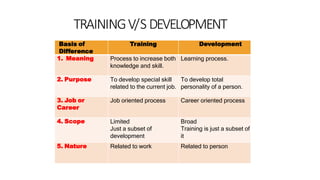
Basis of
Difference
Training Development
1. Meaning Process to increase both
knowledge and skill.
Learning process.
2. Purpose To develop special skill
related to the current job.
To develop total
personality of a person.
3. Job or
Career
Job oriented process Career oriented process
4. Scope Limited
Just a subset of
development
Broad
Training is just a subset of
it
5. Nature Related to work Related to person
TRAININGV/S DEVELOPMENT
Please be free to write query at:
Dr.Ramesh C Sharma
rameshchandersharma@gmail.com
http://rameshchandersharma.blogsspot.in
+91-94180-45154

Business studies +2 Unit 6

  • 1.
    UNIT - 6STAFFING UNIT - 6 STAFFING
  • 2.
    Concept andImportanceof staffing Staffingas apart of HRM- concept Staffing - Process Recruitment – Sources Selection - Process TrainingandDevelopment  Concept andimportance  Methods of training • Onthejobtraining  Inductiontraining  Apprenticeship training  Internshiptraining • Off thejobtraining  Vestibuletraining TOPICS COVERED
  • 3.
    STAFFING Fillingand Keeping FilledPostswithPeople. It maintains coordinationbetweenthepost andtheIndividual andIncludes:  Recruitment  Selection  Training  Promotions  Transfers. etc
  • 4.
    “Our Assets walkout of the Door each evening. We have to make sure that they come back the next morning.” - Narayana Murthy, CEO Infosys
  • 5.
    CHARACTERISTICS OF STAFFING RelatedtoHumanBeing SeparateManagerial Function Essential at all Managerial Level Relatedto Social Responsibility Effects of Internal andExternal Environment
  • 6.
    IMPORTANCEOF STAFFING Discovering andObtainingCompetentPersonnel Better Performance Continuous Survival and Growthof Enterprise OptimumUtilizationof HumanResource Improvement of JobSatisfaction&Moraleof Employees
  • 7.
    HUMAN RESOURCEMANAGEMENT Branch ofManagement which is Concerned with the Recruitment, Selection, Development and Optimum use of Employees Ensures availability of Efficient Human Resource Available in the Company Ensures that every employee makes his maximum contribution to the achievement of business goals
  • 8.
    EVOLUTION OF HRM LaborWelfareStage Personnel Management Stage HRMStage LaborWelfare Officers were appointed to act as a mediator between employees and employers Personnel Officers / Personnel Managers were appointed to make people available for a company Human Resource Managers were appointed to manage people to retain them for a long time
  • 9.
    STAFFINGAS A PARTOF HRM Recruitment ProvidingExpert Services DevelopingCompensationandIncentivePlans Handling GrievancesandComplaints Providingof Social SecurityandWelfareof Employees DefendingtheCompany inLawSuits Keeping Personnel Records Developing theOrganizational Structure
  • 10.
  • 11.
    COMPONENTS OF STAFFING Recruitment Process under which different sources for FutureEmployees aresearched for Selection  Selectingpre-determined number of candidates with thehelpof various tests Training  Process under which efficiencyof employees isincreased todoaparticular job
  • 12.
    RECRUITMENT “Process of searchingfor prospective employees and stimulating them to apply for job in the organization.”
  • 13.
  • 14.
    SOURCES OF RECRUITMENT InternalSources of Recruitment  Transfer  Promotion  Lay-off
  • 15.
    SOURCES OF RECRUITMENT MeritsofInternal Sourcesof Recruitment  IncreaseinMotivation  Industrial Peace  Easy Selection  Noneedof Induction  Adjustment of surplus employees  Economical Source Limitationsof Internal Sourceof Recruitment  Stopstheentry of youngblood  Employees becomelethargic  Not availableinneworganizations  Senseof competitionamongemployees hampered  Frequent transfers hit productivity negatively
  • 16.
    SOURCEOFRECRUITMENT: PROMOTION ASWELLASDEMOTION Chief Executive Officer (Vacant Post) Marketing Manager Financ e Manag er Senior Executive (Vacant Post) Senior Executive Demotio n Promotio n Finance Manager
  • 17.
    SOURCES OF RECRUITMENT ExternalSourcesof Recruitment  Direct Recruitment  Casual Callings  MediaAdvertisements  Employment Exchanges  Placement Agencies  Management Consultantsor Head Hunters  Campus Recruitment  Recommendations  Labor Contractors  Telecasting  Webpublishing
  • 18.
    SOURCES OF RECRUITMENT MeritsofExternal Sourcesof Recruitment  Qualifiedpersonnel  Wider choice  Fresh talent  Competitivespirit  Less chances of favoritism Limitationsof External Sourcesof Recruitment  Dissatisfactionamongexistingstaff  Lengthy process  Costly process  Chances of wrong selection  Increaseinlabour turnover
  • 19.
    SELECTION “Process of ScreeningJob Applicants to ensure that the Most Appropriate Candidates are hired.”
  • 20.
    SELECTION PROCESS S E L E C T I O N P R O C E S S 1.Preliminary Screening 2.JobOffer 3. Referenceand Background Check 4.Employment Interview 5. Selection Test 6. Selection Decision 7.Medical Examination 8. Contract of Employment
  • 21.
    SELECTION PROCESS • PreliminaryScreening  Preliminary Interview  Face to face interaction between the interviewer and the applicant with a view to find the suitability of candidates as per the job.  Filling up the blank application forms • Forms include information about qualification, Personal Information, Minimum Acceptable Salary, References etc.
  • 22.
    SELECTION PROCESS Selection Tests Proficiency Tests • SpecializationTest • Dexterity Test  Psychological Tests • Interest Test • IntelligenceTest • AptitudeTest • Personality Test  Other Tests • Knowledgeof Language Test • General KnowledgeTest
  • 23.
    SELECTION PROCESS Employment Interview Conductto see the looks of the candidate, way of talking, his conduct and temperament, his interests, presence of mind etc. Reference and Background Check Information about the candidate is gathered from his references, his past and present employers. Selection Decision Opinion of concerned manager is sought Medical Examination Candidate is put to medical examination to check physical fitness. Job offer Appointment letter is handed over to the candidate Contract of Employment In the last a contract of employment is signed by both the parties which includes job title, responsibilities, date of regular service etc.
  • 24.
    TRAININGANDDEVELOPMENT Training: A process designedto maintain and improve current job performance. Development: A process to improve the employees at their current post and to prepare them for handling responsibilities in future.
  • 25.
    FEATURES OF TRAINING ExpenseontrainingisInvestmentnot Wastage Relates toaSpecial Job Beneficial toboth - OrganizationandEmployees Continuous Process TrainingandDevelopment aredifferent TrainingandEducation aredifferent
  • 26.
    IMPORTANCEOF TRAINING Benefits totheOrganization Best useof Material andEquipments  Improvement inQualityandQuantityof Output  Less Requirement of Supervision  Reduced Labour Turnover andAbsenteeism  Improvement inAdaptability
  • 27.
    Benefits totheEmployees  IncreaseinCapacity andEfficiency Increasetheir Market Value  Fewer Accidents  JobSatisfaction
  • 28.
    METHODSOF TRAINING On-the-job Training •Itrefers to that method of training, the basic theme of which is – learning while doing. This method is applied to the workplace. Induction Training Apprenticeship Programmers' Internship Training
  • 29.
    Off-the-job Training •It refersto that method of training, the basic theme of which is – learning before doing. This method is used away from the workplace. Vestibule Training
  • 30.
    EMPLOYEE DEVELOPMENT It refersto a process designed to develop skills necessary for future work activities. Features Related to managers More focused on future Emphasis on all round development Used to develop hidden talent Train employees for accepting challenging
  • 31.
    Basis of Difference Training Development 1.Meaning Process to increase both knowledge and skill. Learning process. 2. Purpose To develop special skill related to the current job. To develop total personality of a person. 3. Job or Career Job oriented process Career oriented process 4. Scope Limited Just a subset of development Broad Training is just a subset of it 5. Nature Related to work Related to person TRAININGV/S DEVELOPMENT
  • 32.
    Please be freeto write query at: Dr.Ramesh C Sharma rameshchandersharma@gmail.com http://rameshchandersharma.blogsspot.in +91-94180-45154