Unit 2
HRM functions and HR audit
Megharaja E N
Recruitment
• Recruitment is the process of searching for prospective employee and
stimulating them to apply for job in the organisation when more
person apply for jobs then there will be a scope for recruiting better
person
Definition of recruitment
• According to Yoder, “recruitment is a process to discover the source of
Manpower to meet the recruitments of the staffing schedule and to
employee effective measures for attracting the manpower in adequate
numbers to facilitate effective selection of an efficient working force”.
• According to Flippo, “ Recruitment is the process of searching
prospective employees and stimulating and encouraging them to apply for
job in an organisation”
• According to Dale S. Beach “ Recruitment is the development and
maintenance of adequate manpower reresource. It involves the creation of
a pool of available labour upon whom the organisation can depend when it
needs additional employees.”
Recruitment needs are of three types
• Planned: The need arising from changes in organization and
retirement
• Anticipated: Anticipated needs are those movements in personnel,
which an organization can predict by studying in trends in internal and
external environment.
• Unexpected: deaths, accidents, illness give rise to Unexpected needs.
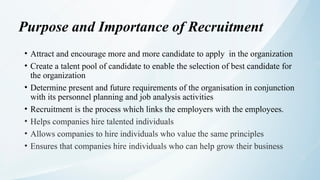
Purpose and Importance of Recruitment
• Attract and encourage more and more candidate to apply in the organization
• Create a talent pool of candidate to enable the selection of best candidate for
the organization
• Determine present and future requirements of the organisation in conjunction
with its personnel planning and job analysis activities
• Recruitment is the process which links the employers with the employees.
• Helps companies hire talented individuals
• Allows companies to hire individuals who value the same principles
• Ensures that companies hire individuals who can help grow their business
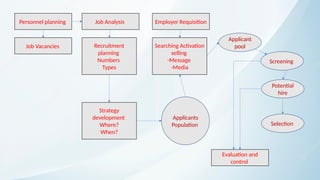
Personnel planning Job Analysis Employer Requisition
Job Vacancies Recruitment
planning
Numbers
Types
Searching Activation
selling
-Message
-Media
Strategy
development
Where?
When?
Applicants
Population
Applicant
pool
Screening
Potential
hire
Selection
Evaluation and
control
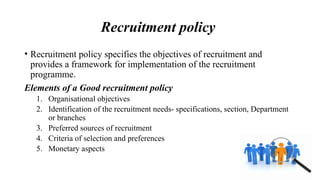
Recruitment policy
• Recruitment policy specifies the objectives of recruitment and
provides a framework for implementation of the recruitment
programme.
Elements of a Good recruitment policy
1. Organisational objectives
2. Identification of the recruitment needs- specifications, section, Department
or branches
3. Preferred sources of recruitment
4. Criteria of selection and preferences
5. Monetary aspects
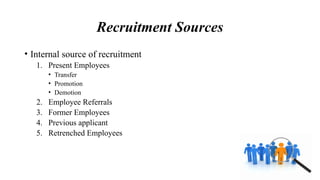
Recruitment Sources
• Internal source of recruitment
1. Present Employees
• Transfer
• Promotion
• Demotion
2. Employee Referrals
3. Former Employees
4. Previous applicant
5. Retrenched Employees
Advantages of Internal recruitment
• It helps you keep your best people
• It’s less time, effort and money
• Shorter learning curve
• No need of training
• Build strong relationships with Employees
• Proven cultural fit
• Easy to pick best talents within an organization very quickly
• Long stay with the company when promoted to high position
Disadvantages of Internal recruitment
• Limit your pool of applicants
• There is a partiality in promoting employees
• No new opportunities for external candidates
• Dissatisfied employees may quit if his co-worker is promoted to high
position
• The position of the persons who is promoted will be vacant
Recruitment Sources
External source of recruitment
1. Advertisement
2. Employment exchange
3. Professional organization
4. Labour contractor
5. Campus recruitment
6. Employees referals
7. Recruitment at factory gate
Advantages of External recruitment
• Create new opportunities for external employees
• Best candidates can be placed for the roles
• Increases in the selection ratio
• There is a less chance of partiality
• Able to recruit the skills is needed
• Cost of Employees can be minimized
Disadvantages of External recruitment
• Time consuming and expensive
• Employees unfamiliar with organization and need of training and
orientation
• If higher level jobs are filled from external sources, motivated and
loyalty of existing staff effected
• Recruiting quality candidate become difficult for the company - cost
Challenges of Recruitment
• Image of the organization – goodwill, unsafe working condition, poor
quality
• Unattractive jobs: boring, monotonous, hazardous etc.
• Internal policies of organization- management will have to select
candidates on the basis of issue like caste, religion, race, friendship
etc.
• Budgetory support
• Government interference- central, state, local bodies –reservation
Selection
• Human resource selection is the process of choosing qualified individuals
who are available to fill positions in an organization. In the ideal
personnel situation, selection involves choosing the best applicant to fill a
position. Selection is the process of choosing people by obtaining and
assessing information about the applicants with a view to matching these
with the job requirements.
According to Dale Yoder, “Selection is the process in which candidates for employment are
divided into two classes-those who are to be offered employment and those who are not”.
According to Thomas Stone, “Selection is the process of differentiating between applicants
in order to identify (and hire) those with a greater likelihood of success in a job”.
In the words of Michael Jucius, “The selection procedure is the system of functions and
devices adopted in a given company for the purpose of ascertaining whether or not
candidates possess the qualifications called for by a specific job or for progression through
a series of jobs.”
According to Keith Davis, “Selection is the process by which an organisation chooses from
a list of screened applicants, the person or persons who best meet the selection criteria for
the position available.”
Definition
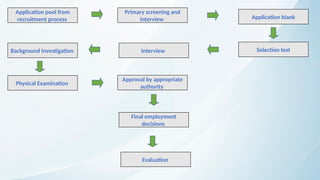
Application pool from
recruitment process
Primary screening and
interview Application blank
Selection test
Interview
Background Investigation
Physical Examination
Approval by appropriate
authority
Final employment
decisions
Evaluation
Steps in Selection Process
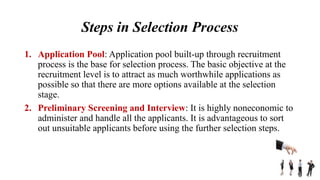
1. Application Pool: Application pool built-up through recruitment
process is the base for selection process. The basic objective at the
recruitment level is to attract as much worthwhile applications as
possible so that there are more options available at the selection
stage.
2. Preliminary Screening and Interview: It is highly noneconomic to
administer and handle all the applicants. It is advantageous to sort
out unsuitable applicants before using the further selection steps.
3. Application Blank or Application Form
(a) Biographical Data: Name, father’s name, data and place of birth, age, gender, nationality, height, weight, identification
marks, physical disability, if any, marital status, and number of dependents.
(b) Educational Attainment: Education (subjects offered and grades secured), training acquired in special fields and
knowledge gained from professional/technical institutes or through correspondence courses.
(c) Work Experience: Previous experience, the number of jobs held with the same or other employers, including the nature of
duties, and responsibilities and the duration of various assignments, salary received, grades, and reasons for leaving the present
employer.
(d) Salary and Benefits: Present and expected.
(e) Other Items: Names and addresses of previous employers, references, etc. An application
blank is a brief history sheet of an employee’s background and can be used for future reference,
in case needed.
4. Selection Tests
Aptitude test, Personality test, interest test, Performance test, Intelligent test, knowledge test etc.
5. Interview
Structured, unstructured, formal or informal etc.
6. Background Investigation
7. Physical Examination
8. Approval by Appropriate Authority
9. Final Employment Decision
10. Evaluation
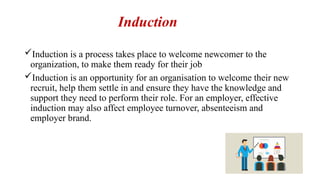
Induction
Induction is a process takes place to welcome newcomer to the
organization, to make them ready for their job
Induction is an opportunity for an organisation to welcome their new
recruit, help them settle in and ensure they have the knowledge and
support they need to perform their role. For an employer, effective
induction may also affect employee turnover, absenteeism and
employer brand.
Placement
• Placement is the process of assigning specific jobs and work places to the selected
candidates. It involves putting square pegs in to square holes i.e. matching the individual
and the job. Correct placement is in no way less important than accurate selection. Even a
competent employee maybe inefficient and dissatisfied if put on a wrong job.
• Correct placement helps to improve efficiency and satisfaction of employees. While
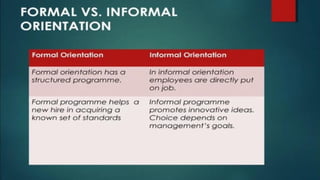
placing employees on the job the requirements of both the organization and the employee
should be considered requirements of the organization include nature of job, number of
vacancies in a particular branch or unit degree of difficulty in the job etc. Age, marital
status, language patterns, qualifications and experience of a particular candidate should
also be considered while placing the right man on the right job.
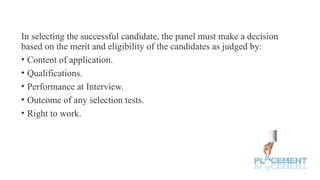
In selecting the successful candidate, the panel must make a decision
based on the merit and eligibility of the candidates as judged by:
• Content of application.
• Qualifications.
• Performance at Interview.
• Outcome of any selection tests.
• Right to work.
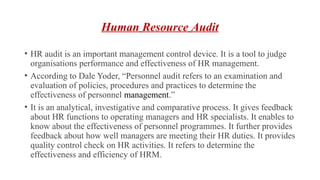
Human Resource Audit
• HR audit is an important management control device. It is a tool to judge
organisations performance and effectiveness of HR management.
• According to Dale Yoder, “Personnel audit refers to an examination and
evaluation of policies, procedures and practices to determine the
effectiveness of personnel management.”
• It is an analytical, investigative and comparative process. It gives feedback
about HR functions to operating managers and HR specialists. It enables to
know about the effectiveness of personnel programmes. It further provides
feedback about how well managers are meeting their HR duties. It provides
quality control check on HR activities. It refers to determine the
effectiveness and efficiency of HRM.
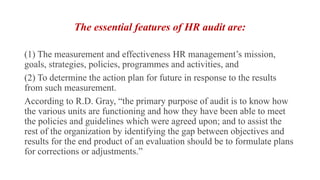
The essential features of HR audit are:
(1) The measurement and effectiveness HR management’s mission,
goals, strategies, policies, programmes and activities, and
(2) To determine the action plan for future in response to the results
from such measurement.
According to R.D. Gray, “the primary purpose of audit is to know how
the various units are functioning and how they have been able to meet
the policies and guidelines which were agreed upon; and to assist the
rest of the organization by identifying the gap between objectives and
results for the end product of an evaluation should be to formulate plans
for corrections or adjustments.”
Objectives of HR Audit:
1. To review every aspect of management of HR to determine the
effectiveness of each programmes in an organisation.
2. To seek explanation and information in respect of failure and
success of HR.
3. To evaluate implementation of policies.
4. To evaluate the performance of personnel staff and employees.
5. To seek priorities, values and goals of management philosophy.
Human resource audit significance
1. Essential for organization success
2. It provides required feedback
3. Managing rising labour cost
4. Increasing opportunities for competitive advantage of HRM
5. HR audit can avoid government intervention
6. Human resource audit protect employees interest
Scope of HR audit
Programmes and practices
Personnel results
Research and innovation
Planning
Scheduling
Staffing and development
Negotiation
Organizing
Motivation and commitment
Delegation
Leadership style
Supervision
HR philosophy
policies
Use of HR audit
Basic purpose of HR Audit is to find:
 How various units are functioning?
 How they met policies and guidelines pre-agreed upon?
 To assist rest of organization locating gaps between objective and results.
 Formulate plans for correction
Benefits of HR audit
 Identifies contribution of HR department
 Improve HR department’s responsibilities and duties
 Fosters greater responsibility and professionalism amongst HR staff
 Classifies HR department’s responsibilities and duties
 Stimulates uniformity of personnel policies and practices
 Identifies critical personnel problems
 Ensure timely legal compliance requirements
Fit falls of HR audit
 Full audit may be time consuming
 May not be as objective and impartial as desired
 Impact of certain action may not be clear
 Lack of management commitment
 Lack of knowledge and training of auditors
 Lack of communication between management and employees about
importance of HR audit
Audit of HR function
Involves all activities of HR functions, major areas are;
 Planning and forecasting
 Scheduling
 Staffing and development
 Organizing
 Motivation and commitment
 Administration
 Research and innovation
Auditor’s role
For each activity in the HR audit functions auditors must;
 Determine objective of activity
 Identify who is responsible for its performance
 Review the performance
 Develop action plan to correct deviation, between results and goals
 Follow up action plan
Five approaches of HR audit
Auditors may choose any of the five approaches for the purpose of evaluation.
1) Comparative approach
2) Outside authority approach
3) Statistical approach
4) Compliance approach
5) MBO approach
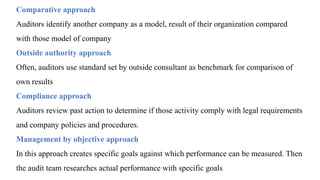
Comparative approach
Auditors identify another company as a model, result of their organization compared
with those model of company
Outside authority approach
Often, auditors use standard set by outside consultant as benchmark for comparison of
own results
Compliance approach
Auditors review past action to determine if those activity comply with legal requirements
and company policies and procedures.
Management by objective approach
In this approach creates specific goals against which performance can be measured. Then
the audit team researches actual performance with specific goals
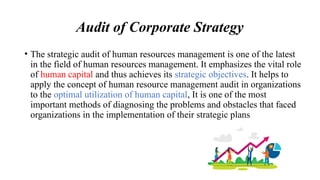
Audit of Corporate Strategy
• The strategic audit of human resources management is one of the latest
in the field of human resources management. It emphasizes the vital role
of human capital and thus achieves its strategic objectives. It helps to
apply the concept of human resource management audit in organizations
to the optimal utilization of human capital, It is one of the most
important methods of diagnosing the problems and obstacles that faced
organizations in the implementation of their strategic plans
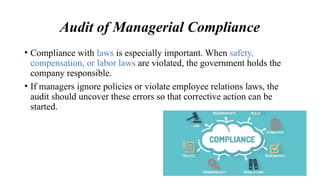
Audit of Managerial Compliance
• Compliance with laws is especially important. When safety,
compensation, or labor laws are violated, the government holds the
company responsible.
• If managers ignore policies or violate employee relations laws, the
audit should uncover these errors so that corrective action can be
started.
Audit of Employee satisfaction
• Employee satisfaction refers to an employee’s general attitude toward
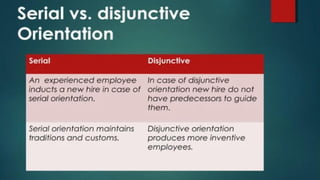
his or her job.
• When employee needs are unmet, turnover, absenteeism, and union
activity are more likely. To learn how well employee needs are met,
the audit team gathers data from workers.
• The team collects information about wages, benefits, supervisory
practices, career planning assistance, and other dimensions of job
Human resource management unit 2 , HRM.pptx

Human resource management unit 2 , HRM.pptx

  • 1.
    Unit 2 HRM functionsand HR audit Megharaja E N
  • 2.
    Recruitment • Recruitment isthe process of searching for prospective employee and stimulating them to apply for job in the organisation when more person apply for jobs then there will be a scope for recruiting better person
  • 3.
    Definition of recruitment •According to Yoder, “recruitment is a process to discover the source of Manpower to meet the recruitments of the staffing schedule and to employee effective measures for attracting the manpower in adequate numbers to facilitate effective selection of an efficient working force”. • According to Flippo, “ Recruitment is the process of searching prospective employees and stimulating and encouraging them to apply for job in an organisation” • According to Dale S. Beach “ Recruitment is the development and maintenance of adequate manpower reresource. It involves the creation of a pool of available labour upon whom the organisation can depend when it needs additional employees.”
  • 4.
    Recruitment needs areof three types • Planned: The need arising from changes in organization and retirement • Anticipated: Anticipated needs are those movements in personnel, which an organization can predict by studying in trends in internal and external environment. • Unexpected: deaths, accidents, illness give rise to Unexpected needs.
  • 5.
    Purpose and Importanceof Recruitment • Attract and encourage more and more candidate to apply in the organization • Create a talent pool of candidate to enable the selection of best candidate for the organization • Determine present and future requirements of the organisation in conjunction with its personnel planning and job analysis activities • Recruitment is the process which links the employers with the employees. • Helps companies hire talented individuals • Allows companies to hire individuals who value the same principles • Ensures that companies hire individuals who can help grow their business
  • 6.
    Personnel planning JobAnalysis Employer Requisition Job Vacancies Recruitment planning Numbers Types Searching Activation selling -Message -Media Strategy development Where? When? Applicants Population Applicant pool Screening Potential hire Selection Evaluation and control
  • 7.
    Recruitment policy • Recruitmentpolicy specifies the objectives of recruitment and provides a framework for implementation of the recruitment programme. Elements of a Good recruitment policy 1. Organisational objectives 2. Identification of the recruitment needs- specifications, section, Department or branches 3. Preferred sources of recruitment 4. Criteria of selection and preferences 5. Monetary aspects
  • 8.
    Recruitment Sources • Internalsource of recruitment 1. Present Employees • Transfer • Promotion • Demotion 2. Employee Referrals 3. Former Employees 4. Previous applicant 5. Retrenched Employees
  • 9.
    Advantages of Internalrecruitment • It helps you keep your best people • It’s less time, effort and money • Shorter learning curve • No need of training • Build strong relationships with Employees • Proven cultural fit • Easy to pick best talents within an organization very quickly • Long stay with the company when promoted to high position
  • 10.
    Disadvantages of Internalrecruitment • Limit your pool of applicants • There is a partiality in promoting employees • No new opportunities for external candidates • Dissatisfied employees may quit if his co-worker is promoted to high position • The position of the persons who is promoted will be vacant
  • 11.
    Recruitment Sources External sourceof recruitment 1. Advertisement 2. Employment exchange 3. Professional organization 4. Labour contractor 5. Campus recruitment 6. Employees referals 7. Recruitment at factory gate
  • 12.
    Advantages of Externalrecruitment • Create new opportunities for external employees • Best candidates can be placed for the roles • Increases in the selection ratio • There is a less chance of partiality • Able to recruit the skills is needed • Cost of Employees can be minimized
  • 13.
    Disadvantages of Externalrecruitment • Time consuming and expensive • Employees unfamiliar with organization and need of training and orientation • If higher level jobs are filled from external sources, motivated and loyalty of existing staff effected • Recruiting quality candidate become difficult for the company - cost
  • 14.
    Challenges of Recruitment •Image of the organization – goodwill, unsafe working condition, poor quality • Unattractive jobs: boring, monotonous, hazardous etc. • Internal policies of organization- management will have to select candidates on the basis of issue like caste, religion, race, friendship etc. • Budgetory support • Government interference- central, state, local bodies –reservation
  • 15.
    Selection • Human resourceselection is the process of choosing qualified individuals who are available to fill positions in an organization. In the ideal personnel situation, selection involves choosing the best applicant to fill a position. Selection is the process of choosing people by obtaining and assessing information about the applicants with a view to matching these with the job requirements.
  • 16.
    According to DaleYoder, “Selection is the process in which candidates for employment are divided into two classes-those who are to be offered employment and those who are not”. According to Thomas Stone, “Selection is the process of differentiating between applicants in order to identify (and hire) those with a greater likelihood of success in a job”. In the words of Michael Jucius, “The selection procedure is the system of functions and devices adopted in a given company for the purpose of ascertaining whether or not candidates possess the qualifications called for by a specific job or for progression through a series of jobs.” According to Keith Davis, “Selection is the process by which an organisation chooses from a list of screened applicants, the person or persons who best meet the selection criteria for the position available.” Definition
  • 17.
    Application pool from recruitmentprocess Primary screening and interview Application blank Selection test Interview Background Investigation Physical Examination Approval by appropriate authority Final employment decisions Evaluation
  • 18.
    Steps in SelectionProcess 1. Application Pool: Application pool built-up through recruitment process is the base for selection process. The basic objective at the recruitment level is to attract as much worthwhile applications as possible so that there are more options available at the selection stage. 2. Preliminary Screening and Interview: It is highly noneconomic to administer and handle all the applicants. It is advantageous to sort out unsuitable applicants before using the further selection steps.
  • 19.
    3. Application Blankor Application Form (a) Biographical Data: Name, father’s name, data and place of birth, age, gender, nationality, height, weight, identification marks, physical disability, if any, marital status, and number of dependents. (b) Educational Attainment: Education (subjects offered and grades secured), training acquired in special fields and knowledge gained from professional/technical institutes or through correspondence courses. (c) Work Experience: Previous experience, the number of jobs held with the same or other employers, including the nature of duties, and responsibilities and the duration of various assignments, salary received, grades, and reasons for leaving the present employer. (d) Salary and Benefits: Present and expected. (e) Other Items: Names and addresses of previous employers, references, etc. An application blank is a brief history sheet of an employee’s background and can be used for future reference, in case needed.
  • 20.
    4. Selection Tests Aptitudetest, Personality test, interest test, Performance test, Intelligent test, knowledge test etc. 5. Interview Structured, unstructured, formal or informal etc. 6. Background Investigation 7. Physical Examination 8. Approval by Appropriate Authority 9. Final Employment Decision 10. Evaluation
  • 21.
    Induction Induction is aprocess takes place to welcome newcomer to the organization, to make them ready for their job Induction is an opportunity for an organisation to welcome their new recruit, help them settle in and ensure they have the knowledge and support they need to perform their role. For an employer, effective induction may also affect employee turnover, absenteeism and employer brand.
  • 29.
    Placement • Placement isthe process of assigning specific jobs and work places to the selected candidates. It involves putting square pegs in to square holes i.e. matching the individual and the job. Correct placement is in no way less important than accurate selection. Even a competent employee maybe inefficient and dissatisfied if put on a wrong job. • Correct placement helps to improve efficiency and satisfaction of employees. While placing employees on the job the requirements of both the organization and the employee should be considered requirements of the organization include nature of job, number of vacancies in a particular branch or unit degree of difficulty in the job etc. Age, marital status, language patterns, qualifications and experience of a particular candidate should also be considered while placing the right man on the right job.
  • 30.
    In selecting thesuccessful candidate, the panel must make a decision based on the merit and eligibility of the candidates as judged by: • Content of application. • Qualifications. • Performance at Interview. • Outcome of any selection tests. • Right to work.
  • 31.
    Human Resource Audit •HR audit is an important management control device. It is a tool to judge organisations performance and effectiveness of HR management. • According to Dale Yoder, “Personnel audit refers to an examination and evaluation of policies, procedures and practices to determine the effectiveness of personnel management.” • It is an analytical, investigative and comparative process. It gives feedback about HR functions to operating managers and HR specialists. It enables to know about the effectiveness of personnel programmes. It further provides feedback about how well managers are meeting their HR duties. It provides quality control check on HR activities. It refers to determine the effectiveness and efficiency of HRM.
  • 32.
    The essential featuresof HR audit are: (1) The measurement and effectiveness HR management’s mission, goals, strategies, policies, programmes and activities, and (2) To determine the action plan for future in response to the results from such measurement. According to R.D. Gray, “the primary purpose of audit is to know how the various units are functioning and how they have been able to meet the policies and guidelines which were agreed upon; and to assist the rest of the organization by identifying the gap between objectives and results for the end product of an evaluation should be to formulate plans for corrections or adjustments.”
  • 33.
    Objectives of HRAudit: 1. To review every aspect of management of HR to determine the effectiveness of each programmes in an organisation. 2. To seek explanation and information in respect of failure and success of HR. 3. To evaluate implementation of policies. 4. To evaluate the performance of personnel staff and employees. 5. To seek priorities, values and goals of management philosophy.
  • 34.
    Human resource auditsignificance 1. Essential for organization success 2. It provides required feedback 3. Managing rising labour cost 4. Increasing opportunities for competitive advantage of HRM 5. HR audit can avoid government intervention 6. Human resource audit protect employees interest
  • 35.
    Scope of HRaudit Programmes and practices Personnel results Research and innovation Planning Scheduling Staffing and development Negotiation Organizing Motivation and commitment Delegation Leadership style Supervision HR philosophy policies
  • 36.
    Use of HRaudit Basic purpose of HR Audit is to find:  How various units are functioning?  How they met policies and guidelines pre-agreed upon?  To assist rest of organization locating gaps between objective and results.  Formulate plans for correction
  • 37.
    Benefits of HRaudit  Identifies contribution of HR department  Improve HR department’s responsibilities and duties  Fosters greater responsibility and professionalism amongst HR staff  Classifies HR department’s responsibilities and duties  Stimulates uniformity of personnel policies and practices  Identifies critical personnel problems  Ensure timely legal compliance requirements
  • 38.
    Fit falls ofHR audit  Full audit may be time consuming  May not be as objective and impartial as desired  Impact of certain action may not be clear  Lack of management commitment  Lack of knowledge and training of auditors  Lack of communication between management and employees about importance of HR audit
  • 39.
    Audit of HRfunction Involves all activities of HR functions, major areas are;  Planning and forecasting  Scheduling  Staffing and development  Organizing  Motivation and commitment  Administration  Research and innovation
  • 40.
    Auditor’s role For eachactivity in the HR audit functions auditors must;  Determine objective of activity  Identify who is responsible for its performance  Review the performance  Develop action plan to correct deviation, between results and goals  Follow up action plan
  • 41.
    Five approaches ofHR audit Auditors may choose any of the five approaches for the purpose of evaluation. 1) Comparative approach 2) Outside authority approach 3) Statistical approach 4) Compliance approach 5) MBO approach
  • 42.
    Comparative approach Auditors identifyanother company as a model, result of their organization compared with those model of company Outside authority approach Often, auditors use standard set by outside consultant as benchmark for comparison of own results Compliance approach Auditors review past action to determine if those activity comply with legal requirements and company policies and procedures. Management by objective approach In this approach creates specific goals against which performance can be measured. Then the audit team researches actual performance with specific goals
  • 43.
    Audit of CorporateStrategy • The strategic audit of human resources management is one of the latest in the field of human resources management. It emphasizes the vital role of human capital and thus achieves its strategic objectives. It helps to apply the concept of human resource management audit in organizations to the optimal utilization of human capital, It is one of the most important methods of diagnosing the problems and obstacles that faced organizations in the implementation of their strategic plans
  • 44.
    Audit of ManagerialCompliance • Compliance with laws is especially important. When safety, compensation, or labor laws are violated, the government holds the company responsible. • If managers ignore policies or violate employee relations laws, the audit should uncover these errors so that corrective action can be started.
  • 45.
    Audit of Employeesatisfaction • Employee satisfaction refers to an employee’s general attitude toward his or her job. • When employee needs are unmet, turnover, absenteeism, and union activity are more likely. To learn how well employee needs are met, the audit team gathers data from workers. • The team collects information about wages, benefits, supervisory practices, career planning assistance, and other dimensions of job