Lectures 5 –
8
STACK
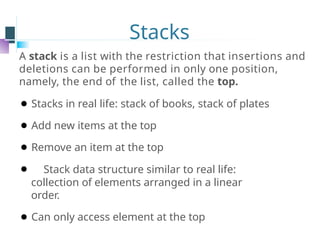
Stacks
A stack is a list with the restriction that insertions and
deletions can be performed in only one position,
namely, the end of the list, called the top.
⚫ Stacks in real life: stack of books, stack of plates
⚫ Add new items at the top
⚫ Remove an item at the top
⚫ Stack data structure similar to real life:
collection of elements arranged in a linear
order.
⚫ Can only access element at the top
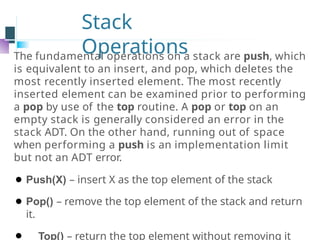
Stack
Operations
The fundamental operations on a stack are push, which
is equivalent to an insert, and pop, which deletes the
most recently inserted element. The most recently
inserted element can be examined prior to performing
a pop by use of the top routine. A pop or top on an
empty stack is generally considered an error in the
stack ADT. On the other hand, running out of space
when performing a push is an implementation limit
but not an ADT error.
⚫ Push(X) – insert X as the top element of the stack
⚫ Pop() – remove the top element of the stack and return
it.
⚫ Top() – return the top element without removing it
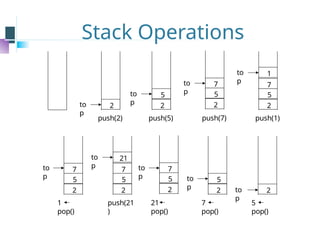
Stack Operations
push(2)
to
p
2
push(5)
to
p 2
5
push(7)
to
p
2
5
7
push(1)
to
p
2
5
7
1
1
pop()
to
p
2
5
7
push(21
)
to
p
2
5
7
21
21
pop()
to
p
2
5
7
7
pop()
2
5
to
p
5
pop()
2
to
p
Stack
Operation
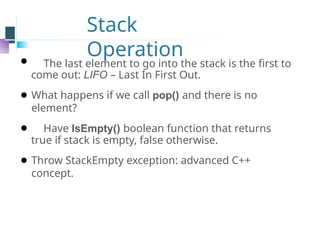
⚫ The last element to go into the stack is the first to
come out: LIFO – Last In First Out.
⚫ What happens if we call pop() and there is no
element?
⚫ Have IsEmpty() boolean function that returns
true if stack is empty, false otherwise.
⚫ Throw StackEmpty exception: advanced C++
concept.
Stack Implementation:
Array
⚫ Worst case for insertion and deletion from an
array when insert and delete from the
beginning: shift elements to the left.
⚫ Best case for insert and delete is at the end of the
array – no need to shift any elements.
⚫ Implement push() and pop() by inserting and
deleting at the end of an array.
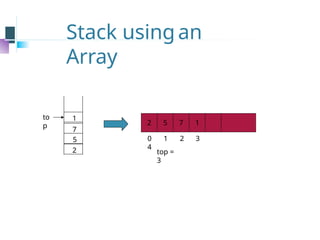
Stack usingan
Array
to
p
2
5
7
1
2 5 7 1
0 1 2 3
4
top =
3
Stack usingan
Array
⚫ In case of an array, it is possible that the array
may “fill- up” if we push enough elements.
⚫ Have a boolean function IsFull() which returns
true if the stack (array) is full, false otherwise.
⚫ We would call this function before calling push(x).
Stack Operations with
Array
int pop()
{
return
A[current--];
}
void push(int x)
{
A[++current] =
x;
}
Stack Operations with
Array
int top()
{
return A[current];
}
int IsEmpty()
{
return ( current == -1 );
}
int IsFull()
{
return ( current == size-1);
}
⚫ A quick examination shows that all five operations take constant
time.
Stack Using Linked
List
⚫ We can avoid the size limitation of a stack
implemented with an array by using a linked list to
hold the stack elements.
⚫ As with array, however, we need to decide where
to insert elements in the list and where to delete
them so that push and pop will run the fastest.
Stack Using Linked
List
⚫ For a singly-linked list, insert at start or
end takes constant time using the head and
current pointers respectively.
⚫ Removing an element at the start is
constant time but removal at the end
required traversing the list to the node one
before the last.
⚫ Make sense to place stack elements at the
start of the list because insert and removal
are constant time.
Stack Using Linked
List
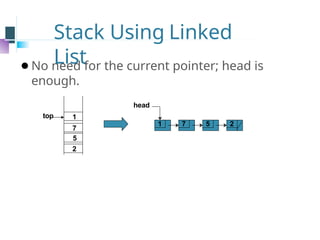
⚫No need for the current pointer; head is
enough.
top
2
5
7
1
1 7 5 2
head
Stack Operation: List
top
2
5
7
1 7 5 2
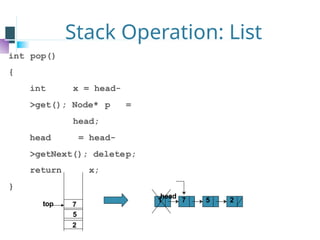
int pop()
{
int x = head-
>get(); Node* p =
head;
head = head-
>getNext(); deletep;
return x;
}
head
Stack Operation: List
top
2
5
7
9
7 5 2
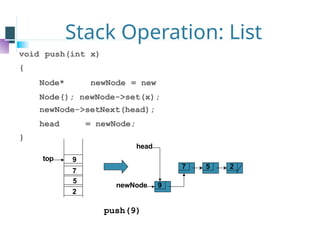
void push(int x)
{
Node* newNode = new
Node(); newNode->set(x);
newNode->setNext(head);
head = newNode;
}
head
push(9)
9
newNode
Stack Operation: List
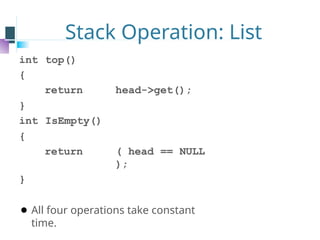
int top()
{
return head->get();
}
int IsEmpty()
{
return ( head == NULL
);
}
⚫ All four operations take constant
time.
Stack: Array or List
Since both implementations support stack operations
in constant time, any reason to choose one over the
other?
⚫ Allocating and deallocating memory for list
nodes does take more time than preallocated
array.
⚫ List uses only as much memory as required
by the nodes; array requires allocation ahead
of time.
⚫List pointers (head, next) require extra
memory.
⚫ Array has an upper limit; List is limited by
Use of
Stack
⚫ Example of use: prefix, infix, postfix expressions.
⚫ Consider the expression A+B: we think of applying
the
operator “+” to the operands A and B.
⚫ “+” is termed a binary operator: it takes two
operands.
⚫ Writing the sum as A+B is called the infix form
of the expression.
Prefix, Infix, Postfix
⚫ Two other ways of writing the expression are
+ A B prefix
A B + postfix
⚫ The prefixes “pre” and “post” refer to the position
of the operator with respect to the two operands.
⚫ In prefix the operator is placed before the operands.
⚫ In postfix the operator is placed after the operands.
Prefix, Infix, Postfix
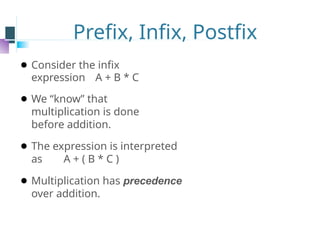
⚫ Consider the infix
expression A + B * C
⚫ We “know” that
multiplication is done
before addition.
⚫ The expression is interpreted
as A + ( B * C )
⚫ Multiplication has precedence
over addition.
Prefix, Infix, Postfix
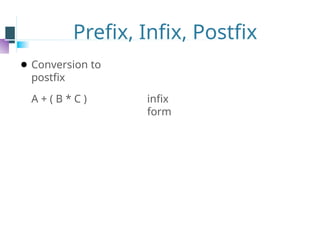
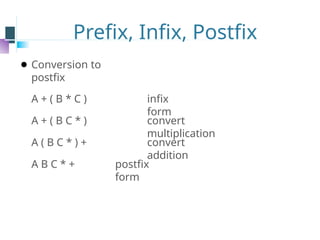
⚫ Conversion to
postfix
A + ( B * C ) infix
form
Prefix, Infix, Postfix
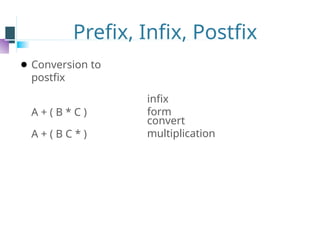
⚫ Conversion to
postfix
A + ( B * C )
A + ( B C * )
infix
form
convert
multiplication
Prefix, Infix, Postfix
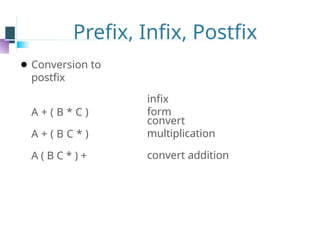
⚫ Conversion to
postfix
A + ( B * C )
A + ( B C * )
A ( B C * ) +
infix
form
convert
multiplication
convert addition
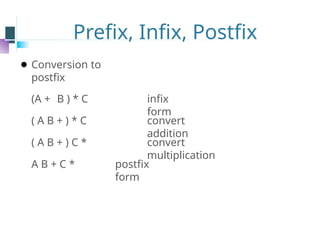
Prefix, Infix, Postfix
⚫ Conversion to
postfix
A + ( B * C ) infix
form
A + ( B C * ) convert
multiplication
A ( B C * ) + convert
addition
A B C * + postfix
form
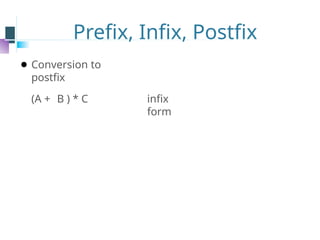
Prefix, Infix, Postfix
⚫ Conversion to
postfix
(A + B ) * C infix
form
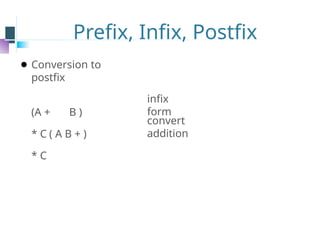
Prefix, Infix, Postfix
⚫ Conversion to
postfix
(A + B )
* C ( A B + )
* C
infix
form
convert
addition
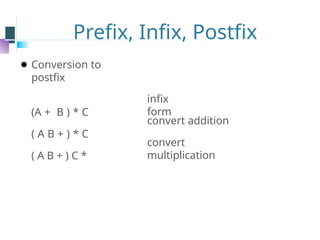
Prefix, Infix, Postfix
⚫ Conversion to
postfix
(A + B ) * C
( A B + ) * C
( A B + ) C *
infix
form
convert addition
convert
multiplication
Prefix, Infix, Postfix
⚫ Conversion to
postfix
(A + B ) * C infix
form
( A B + ) * C convert
addition
( A B + ) C * convert
multiplication
A B + C * postfix
form
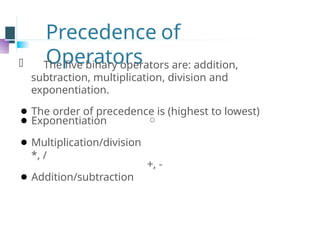
Precedence of
Operators
⚫ The five binary operators are: addition,
subtraction, multiplication, division and
exponentiation.
⚫ The order of precedence is (highest to lowest)

⚫ Exponentiation
⚫ Multiplication/division
*, /
⚫ Addition/subtraction
+, -
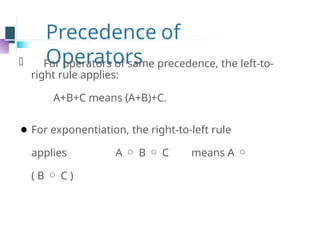
Precedence of
Operators
⚫ For operators of same precedence, the left-to-
right rule applies:
A+B+C means (A+B)+C.
⚫ For exponentiation, the right-to-left rule
applies A  B  C means A 
( B  C )
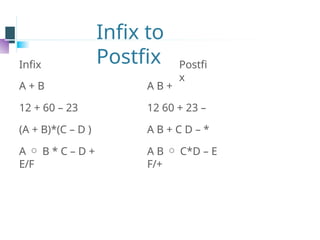
Infix to
Postfix
Infix
A + B
12 + 60 – 23
(A + B)*(C – D )
A  B * C – D +
E/F
Postfi
x
A B +
12 60 + 23 –
A B + C D – *
A B  C*D – E
F/+
Infix to
Postfix
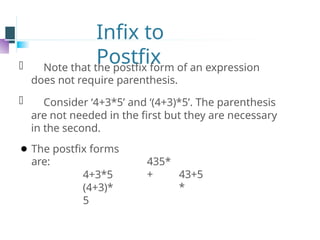
⚫ Note that the postfix form of an expression
does not require parenthesis.
⚫ Consider ‘4+3*5’ and ‘(4+3)*5’. The parenthesis
are not needed in the first but they are necessary
in the second.
⚫ The postfix forms
are:
4+3*5
(4+3)*
5
435*
+ 43+5
*
Evaluating
Postfix
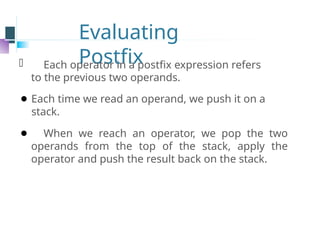
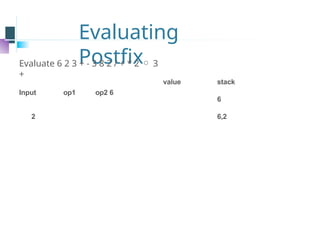
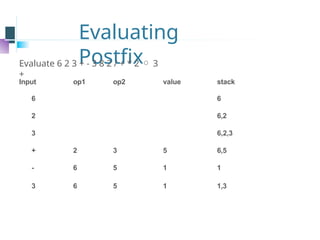
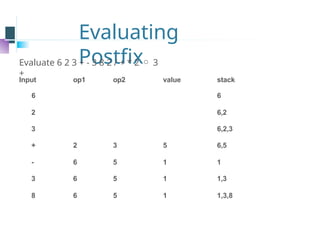
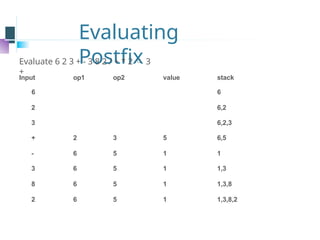
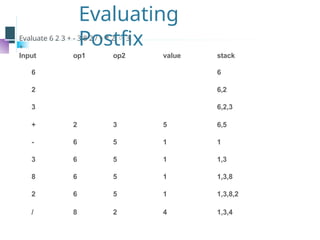
⚫ Each operator in a postfix expression refers
to the previous two operands.
⚫ Each time we read an operand, we push it on a
stack.
⚫ When we reach an operator, we pop the two
operands from the top of the stack, apply the
operator and push the result back on the stack.
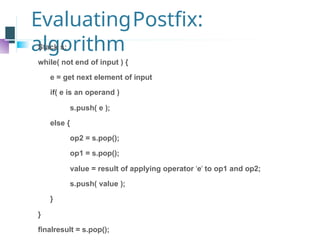
EvaluatingPostfix:
algorithm
Stack s;
while( not end of input ) {
e = get next element of input
if( e is an operand )
s.push( e );
else {
op2 = s.pop();
op1 = s.pop();
value = result of applying operator ‘e’ to op1 and op2;
s.push( value );
}
}
finalresult = s.pop();
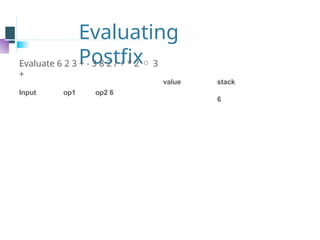
Evaluating
Postfix
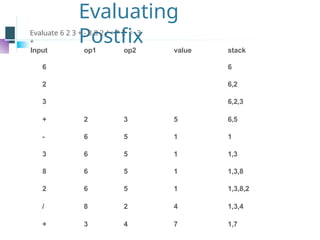
Evaluate 6 2 3 + - 3 8 2 / + * 2  3
+
Input op1 op2 6
value stack
6
Evaluating
Postfix
Evaluate 6 2 3 + - 3 8 2 / + * 2  3
+
Input op1 op2 6
value stack
6
2 6,2
Evaluating
Postfix
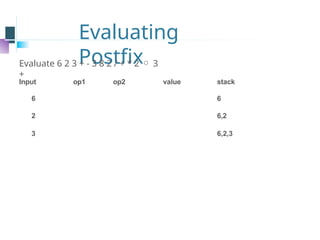
Evaluate 6 2 3 + - 3 8 2 / + * 2  3
+
Input op1 op2 value stack
6 6
2 6,2
3 6,2,3
Evaluating
Postfix
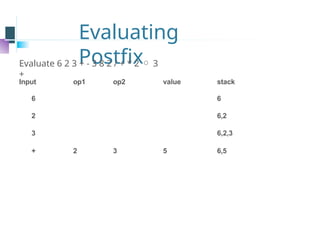
Evaluate 6 2 3 + - 3 8 2 / + * 2  3
+
Input op1 op2 value stack
6 6
2 6,2
3 6,2,3
+ 2 3 5 6,5
Evaluating
Postfix
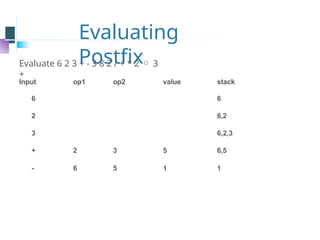
Evaluate 6 2 3 + - 3 8 2 / + * 2  3
+
Input op1 op2 value stack
6 6
2 6,2
3 6,2,3
+ 2 3 5 6,5
- 6 5 1 1
Evaluating
Postfix
Evaluate 6 2 3 + - 3 8 2 / + * 2  3
+
Input op1 op2 value stack
6 6
2 6,2
3 6,2,3
+ 2 3 5 6,5
- 6 5 1 1
3 6 5 1 1,3
Evaluating
Postfix
Evaluate 6 2 3 + - 3 8 2 / + * 2  3
+
Input
6
op1 op2 value stack
6
2 6,2
3 6,2,3
+ 2 3 5 6,5
- 6 5 1 1
3 6 5 1 1,3
8 6 5 1 1,3,8
Evaluating
Postfix
Evaluate 6 2 3 + - 3 8 2 / + * 2  3
+
Input
6
op1 op2 value stack
6
2 6,2
3 6,2,3
+ 2 3 5 6,5
- 6 5 1 1
3 6 5 1 1,3
8 6 5 1 1,3,8
2 6 5 1 1,3,8,2
Evaluating
Postfix
Evaluate 6 2 3 + - 3 8 2 / + * 2  3
+
Input op1 op2 value stack
6 6
2 6,2
3 6,2,3
+ 2 3 5 6,5
- 6 5 1 1
3 6 5 1 1,3
8 6 5 1 1,3,8
2 6 5 1 1,3,8,2
/ 8 2 4 1,3,4
Evaluating
Postfix
Evaluate 6 2 3 + - 3 8 2 / + * 2  3
+
Input op1 op2 value stack
6 6
2 6,2
3 6,2,3
+ 2 3 5 6,5
- 6 5 1 1
3 6 5 1 1,3
8 6 5 1 1,3,8
2 6 5 1 1,3,8,2
/ 8 2 4 1,3,4
+ 3 4 7 1,7
Evaluating
Postfix
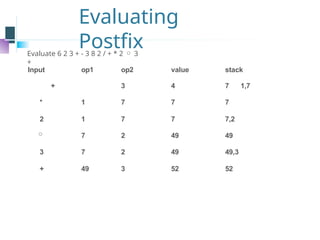
Evaluate 6 2 3 + - 3 8 2 / + * 2  3
+
Input op1 op2 value stack
+ 3 4 7 1,7
* 1 7 7 7
2 1 7 7 7,2
 7 2 49 49
3 7 2 49 49,3
+ 49 3 52 52
Converting Infix
to Postfix
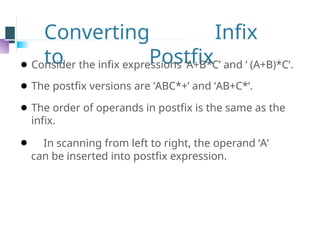
⚫ Consider the infix expressions ‘A+B*C’ and ‘ (A+B)*C’.
⚫ The postfix versions are ‘ABC*+’ and ‘AB+C*’.
⚫ The order of operands in postfix is the same as the
infix.
⚫ In scanning from left to right, the operand ‘A’
can be inserted into postfix expression.
Converting Infix
to Postfix
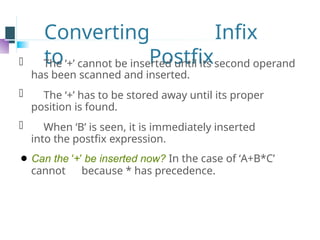
⚫ The ‘+’ cannot be inserted until its second operand
has been scanned and inserted.
⚫ The ‘+’ has to be stored away until its proper
position is found.
⚫ When ‘B’ is seen, it is immediately inserted
into the postfix expression.
⚫ Can the ‘+’ be inserted now? In the case of ‘A+B*C’
cannot because * has precedence.
Converting Infix
to Postfix
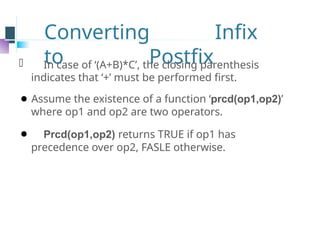
⚫ In case of ‘(A+B)*C’, the closing parenthesis
indicates that ‘+’ must be performed first.
⚫ Assume the existence of a function ‘prcd(op1,op2)’
where op1 and op2 are two operators.
⚫ Prcd(op1,op2) returns TRUE if op1 has
precedence over op2, FASLE otherwise.
Converting Infix
to Postfix
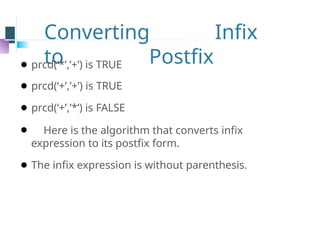
⚫ prcd(‘*’,’+’) is TRUE
⚫ prcd(‘+’,’+’) is TRUE
⚫ prcd(‘+’,’*’) is FALSE
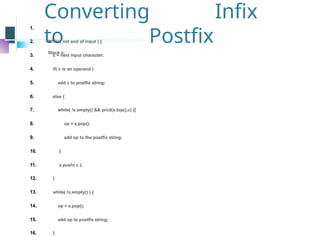
⚫ Here is the algorithm that converts infix
expression to its postfix form.
⚫ The infix expression is without parenthesis.
1.
Converting Infix
to Postfix
Stack s;
2. While( not end of input ) {
3. c = next input character;
4. if( c is an operand )
5. add c to postfix string;
6. else {
7. while( !s.empty() && prcd(s.top(),c) ){
8. op = s.pop();
9. add op to the postfix string;
10. }
11. s.push( c );
12. }
13. while( !s.empty() ) {
14. op = s.pop();
15. add op to postfix string;
16. }
Converting Infix
to Postfix
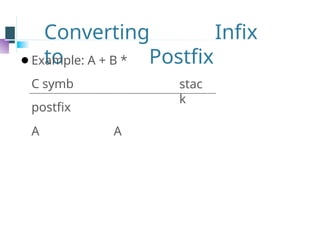
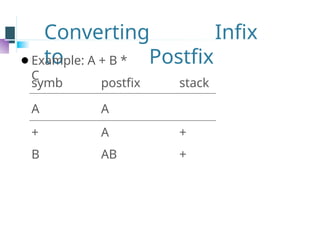
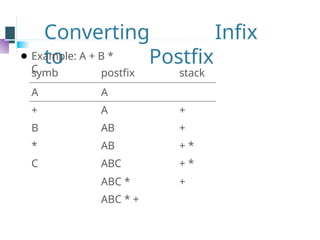
⚫Example: A + B *
C symb
postfix
A A
stac
k
Converting Infix
to Postfix
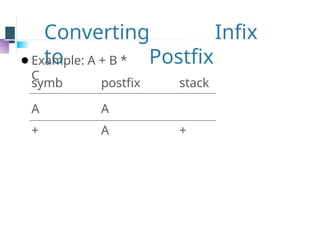
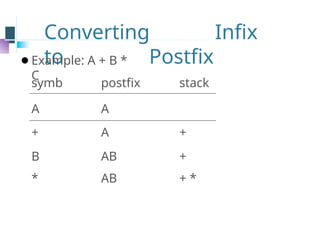
⚫Example: A + B *
C
symb postfix stack
A A
+ A +
Converting Infix
to Postfix
⚫Example: A + B *
C
symb postfix stack
A A
+ A +
B AB +
Converting Infix
to Postfix
⚫Example: A + B *
C
symb postfix stack
A A
+ A +
B AB +
* AB + *
Converting Infix
to Postfix
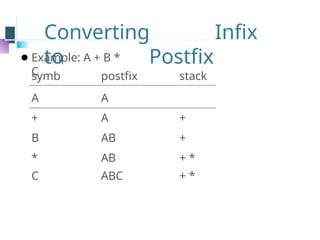
⚫Example: A + B *
C
symb postfix stack
A A
+ A +
B AB +
* AB + *
C ABC + *
Converting Infix
to Postfix
⚫ Example: A + B *
C
symb postfix stack
A A
+ A +
B AB +
* AB + *
C ABC + *
ABC * +
Converting Infix
to Postfix
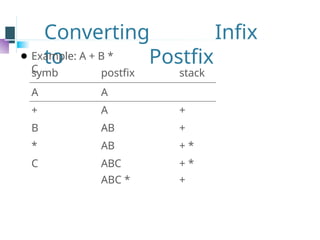
⚫ Example: A + B *
C
symb postfix stack
A A
+ A +
B AB +
* AB + *
C ABC + *
ABC *
ABC * +
+
Converting Infix
to Postfix
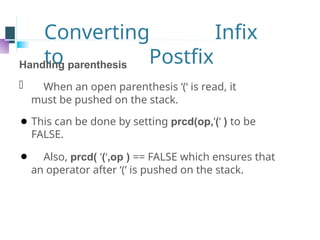
Handling parenthesis
⚫ When an open parenthesis ‘(‘ is read, it
must be pushed on the stack.
⚫ This can be done by setting prcd(op,‘(‘ ) to be
FALSE.
⚫ Also, prcd( ‘(‘,op ) == FALSE which ensures that
an operator after ‘(‘ is pushed on the stack.
Converting Infix
to Postfix
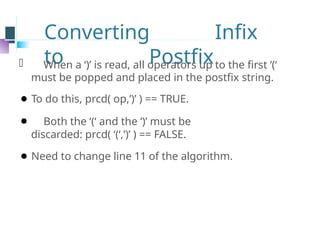
⚫ When a ‘)’ is read, all operators up to the first ‘(‘
must be popped and placed in the postfix string.
⚫ To do this, prcd( op,’)’ ) == TRUE.
⚫ Both the ‘(‘ and the ‘)’ must be
discarded: prcd( ‘(‘,’)’ ) == FALSE.
⚫ Need to change line 11 of the algorithm.
Converting Infix
to Postfix
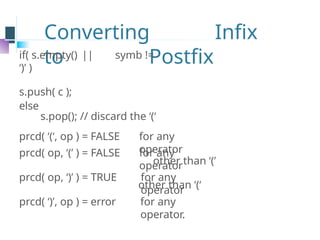
if( s.empty() || symb !=
‘)’ )
s.push( c );
else
s.pop(); // discard the ‘(‘
prcd( ‘(‘, op ) = FALSE
prcd( op, ‘(’ ) = FALSE
for any
operator
for any
operator
other than ‘(’
prcd( op, ‘)’ ) = TRUE for any
operator
other than ‘(‘
prcd( ‘)’, op ) = error for any
operator.
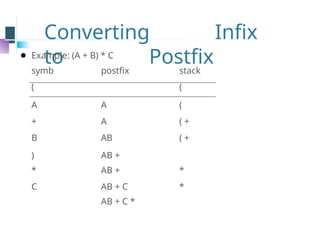
Converting Infix
to Postfix
⚫ Example: (A + B) * C
symb postfix stack
( (
A A (
+ A ( +
B
)
AB
AB +
( +
* AB + *
C AB + C *
AB + C *
FunctionCall Stack
⚫ Stacks play a key role in implementation of
function calls in programming languages.
⚫ In C++, for example, the “call stack” is used to
pass function arguments and receive return
values.
⚫ The call stack is also used for “local variables”
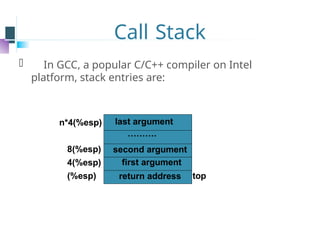
Call Stack
⚫ In GCC, a popular C/C++ compiler on Intel
platform, stack entries are:
last argument
……….
second argument
first argument
return address
n*4(%esp)
top
8(%esp)
4(%esp)
(%esp)
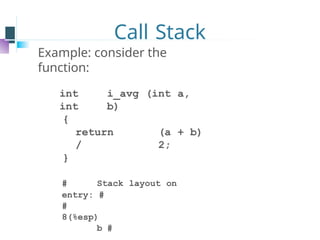
Call Stack
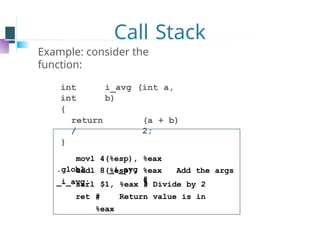
Example: consider the
function:
int i_avg (int a,
int b)
{
return (a + b)
/ 2;
}
# Stack layout on
entry: #
#
8(%esp)
b #
Call Stack
Example: consider the
function:
int i_avg (int a,
int b)
{
return (a + b)
/ 2;
}
.globl _i_avg
_i_avg:
movl 4(%esp), %eax
addl 8(%esp), %eax
#
Add the args
sarl $1, %eax # Divide by 2
ret # Return value is in
%eax
Memory Organization
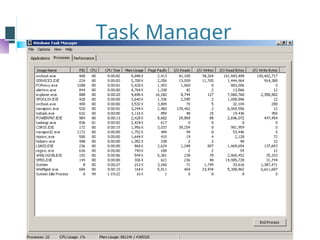
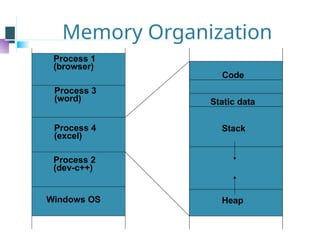
⚫ When a program (.exe)
is run, it is loaded in
memory. It becomes a
process.
⚫ The process is
given a block of
memory.
⚫ [Control-Alt-DEL]
Process 1
(browser)
Process 3
(word)
Process 4
(excel)
Process 2
(dev-c++)
Windows OS
Task Manager
Memory Organization
Code
Static data
Stack
Heap
Process 1
(browser)
Process 3
(word)
Process 4
(excel)
Process 2
(dev-c++)
Windows OS
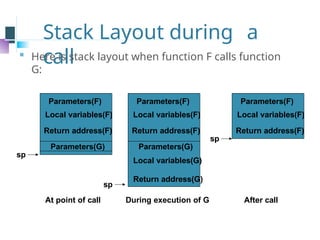
Stack Layout during a
call
 Here is stack layout when function F calls function
G:
Parameters(F)
Local variables(F)
Return address(F)
Parameters(G)
Parameters(F)
Local variables(F)
Return address(F)
Parameters(F)
Local variables(F)
Return address(F)
Parameters(G)
Local variables(G)
Return address(G)
During execution of G After call
At point of call
sp
sp
sp

Data Structure and Algorithms by Sabeen Memon03.pptx

  • 1.
  • 2.
    Stacks A stack isa list with the restriction that insertions and deletions can be performed in only one position, namely, the end of the list, called the top. ⚫ Stacks in real life: stack of books, stack of plates ⚫ Add new items at the top ⚫ Remove an item at the top ⚫ Stack data structure similar to real life: collection of elements arranged in a linear order. ⚫ Can only access element at the top
  • 3.
    Stack Operations The fundamental operationson a stack are push, which is equivalent to an insert, and pop, which deletes the most recently inserted element. The most recently inserted element can be examined prior to performing a pop by use of the top routine. A pop or top on an empty stack is generally considered an error in the stack ADT. On the other hand, running out of space when performing a push is an implementation limit but not an ADT error. ⚫ Push(X) – insert X as the top element of the stack ⚫ Pop() – remove the top element of the stack and return it. ⚫ Top() – return the top element without removing it
  • 4.
  • 5.
    Stack Operation ⚫ The lastelement to go into the stack is the first to come out: LIFO – Last In First Out. ⚫ What happens if we call pop() and there is no element? ⚫ Have IsEmpty() boolean function that returns true if stack is empty, false otherwise. ⚫ Throw StackEmpty exception: advanced C++ concept.
  • 6.
    Stack Implementation: Array ⚫ Worstcase for insertion and deletion from an array when insert and delete from the beginning: shift elements to the left. ⚫ Best case for insert and delete is at the end of the array – no need to shift any elements. ⚫ Implement push() and pop() by inserting and deleting at the end of an array.
  • 7.
  • 8.
    Stack usingan Array ⚫ Incase of an array, it is possible that the array may “fill- up” if we push enough elements. ⚫ Have a boolean function IsFull() which returns true if the stack (array) is full, false otherwise. ⚫ We would call this function before calling push(x).
  • 9.
    Stack Operations with Array intpop() { return A[current--]; } void push(int x) { A[++current] = x; }
  • 10.
    Stack Operations with Array inttop() { return A[current]; } int IsEmpty() { return ( current == -1 ); } int IsFull() { return ( current == size-1); } ⚫ A quick examination shows that all five operations take constant time.
  • 11.
    Stack Using Linked List ⚫We can avoid the size limitation of a stack implemented with an array by using a linked list to hold the stack elements. ⚫ As with array, however, we need to decide where to insert elements in the list and where to delete them so that push and pop will run the fastest.
  • 12.
    Stack Using Linked List ⚫For a singly-linked list, insert at start or end takes constant time using the head and current pointers respectively. ⚫ Removing an element at the start is constant time but removal at the end required traversing the list to the node one before the last. ⚫ Make sense to place stack elements at the start of the list because insert and removal are constant time.
  • 13.
    Stack Using Linked List ⚫Noneed for the current pointer; head is enough. top 2 5 7 1 1 7 5 2 head
  • 14.
    Stack Operation: List top 2 5 7 17 5 2 int pop() { int x = head- >get(); Node* p = head; head = head- >getNext(); deletep; return x; } head
  • 15.
    Stack Operation: List top 2 5 7 9 75 2 void push(int x) { Node* newNode = new Node(); newNode->set(x); newNode->setNext(head); head = newNode; } head push(9) 9 newNode
  • 16.
    Stack Operation: List inttop() { return head->get(); } int IsEmpty() { return ( head == NULL ); } ⚫ All four operations take constant time.
  • 17.
    Stack: Array orList Since both implementations support stack operations in constant time, any reason to choose one over the other? ⚫ Allocating and deallocating memory for list nodes does take more time than preallocated array. ⚫ List uses only as much memory as required by the nodes; array requires allocation ahead of time. ⚫List pointers (head, next) require extra memory. ⚫ Array has an upper limit; List is limited by
  • 18.
    Use of Stack ⚫ Exampleof use: prefix, infix, postfix expressions. ⚫ Consider the expression A+B: we think of applying the operator “+” to the operands A and B. ⚫ “+” is termed a binary operator: it takes two operands. ⚫ Writing the sum as A+B is called the infix form of the expression.
  • 19.
    Prefix, Infix, Postfix ⚫Two other ways of writing the expression are + A B prefix A B + postfix ⚫ The prefixes “pre” and “post” refer to the position of the operator with respect to the two operands. ⚫ In prefix the operator is placed before the operands. ⚫ In postfix the operator is placed after the operands.
  • 20.
    Prefix, Infix, Postfix ⚫Consider the infix expression A + B * C ⚫ We “know” that multiplication is done before addition. ⚫ The expression is interpreted as A + ( B * C ) ⚫ Multiplication has precedence over addition.
  • 21.
    Prefix, Infix, Postfix ⚫Conversion to postfix A + ( B * C ) infix form
  • 22.
    Prefix, Infix, Postfix ⚫Conversion to postfix A + ( B * C ) A + ( B C * ) infix form convert multiplication
  • 23.
    Prefix, Infix, Postfix ⚫Conversion to postfix A + ( B * C ) A + ( B C * ) A ( B C * ) + infix form convert multiplication convert addition
  • 24.
    Prefix, Infix, Postfix ⚫Conversion to postfix A + ( B * C ) infix form A + ( B C * ) convert multiplication A ( B C * ) + convert addition A B C * + postfix form
  • 25.
    Prefix, Infix, Postfix ⚫Conversion to postfix (A + B ) * C infix form
  • 26.
    Prefix, Infix, Postfix ⚫Conversion to postfix (A + B ) * C ( A B + ) * C infix form convert addition
  • 27.
    Prefix, Infix, Postfix ⚫Conversion to postfix (A + B ) * C ( A B + ) * C ( A B + ) C * infix form convert addition convert multiplication
  • 28.
    Prefix, Infix, Postfix ⚫Conversion to postfix (A + B ) * C infix form ( A B + ) * C convert addition ( A B + ) C * convert multiplication A B + C * postfix form
  • 29.
    Precedence of Operators ⚫ Thefive binary operators are: addition, subtraction, multiplication, division and exponentiation. ⚫ The order of precedence is (highest to lowest)  ⚫ Exponentiation ⚫ Multiplication/division *, / ⚫ Addition/subtraction +, -
  • 30.
    Precedence of Operators ⚫ Foroperators of same precedence, the left-to- right rule applies: A+B+C means (A+B)+C. ⚫ For exponentiation, the right-to-left rule applies A  B  C means A  ( B  C )
  • 31.
    Infix to Postfix Infix A +B 12 + 60 – 23 (A + B)*(C – D ) A  B * C – D + E/F Postfi x A B + 12 60 + 23 – A B + C D – * A B  C*D – E F/+
  • 32.
    Infix to Postfix ⚫ Notethat the postfix form of an expression does not require parenthesis. ⚫ Consider ‘4+3*5’ and ‘(4+3)*5’. The parenthesis are not needed in the first but they are necessary in the second. ⚫ The postfix forms are: 4+3*5 (4+3)* 5 435* + 43+5 *
  • 33.
    Evaluating Postfix ⚫ Each operatorin a postfix expression refers to the previous two operands. ⚫ Each time we read an operand, we push it on a stack. ⚫ When we reach an operator, we pop the two operands from the top of the stack, apply the operator and push the result back on the stack.
  • 34.
    EvaluatingPostfix: algorithm Stack s; while( notend of input ) { e = get next element of input if( e is an operand ) s.push( e ); else { op2 = s.pop(); op1 = s.pop(); value = result of applying operator ‘e’ to op1 and op2; s.push( value ); } } finalresult = s.pop();
  • 35.
    Evaluating Postfix Evaluate 6 23 + - 3 8 2 / + * 2  3 + Input op1 op2 6 value stack 6
  • 36.
    Evaluating Postfix Evaluate 6 23 + - 3 8 2 / + * 2  3 + Input op1 op2 6 value stack 6 2 6,2
  • 37.
    Evaluating Postfix Evaluate 6 23 + - 3 8 2 / + * 2  3 + Input op1 op2 value stack 6 6 2 6,2 3 6,2,3
  • 38.
    Evaluating Postfix Evaluate 6 23 + - 3 8 2 / + * 2  3 + Input op1 op2 value stack 6 6 2 6,2 3 6,2,3 + 2 3 5 6,5
  • 39.
    Evaluating Postfix Evaluate 6 23 + - 3 8 2 / + * 2  3 + Input op1 op2 value stack 6 6 2 6,2 3 6,2,3 + 2 3 5 6,5 - 6 5 1 1
  • 40.
    Evaluating Postfix Evaluate 6 23 + - 3 8 2 / + * 2  3 + Input op1 op2 value stack 6 6 2 6,2 3 6,2,3 + 2 3 5 6,5 - 6 5 1 1 3 6 5 1 1,3
  • 41.
    Evaluating Postfix Evaluate 6 23 + - 3 8 2 / + * 2  3 + Input 6 op1 op2 value stack 6 2 6,2 3 6,2,3 + 2 3 5 6,5 - 6 5 1 1 3 6 5 1 1,3 8 6 5 1 1,3,8
  • 42.
    Evaluating Postfix Evaluate 6 23 + - 3 8 2 / + * 2  3 + Input 6 op1 op2 value stack 6 2 6,2 3 6,2,3 + 2 3 5 6,5 - 6 5 1 1 3 6 5 1 1,3 8 6 5 1 1,3,8 2 6 5 1 1,3,8,2
  • 43.
    Evaluating Postfix Evaluate 6 23 + - 3 8 2 / + * 2  3 + Input op1 op2 value stack 6 6 2 6,2 3 6,2,3 + 2 3 5 6,5 - 6 5 1 1 3 6 5 1 1,3 8 6 5 1 1,3,8 2 6 5 1 1,3,8,2 / 8 2 4 1,3,4
  • 44.
    Evaluating Postfix Evaluate 6 23 + - 3 8 2 / + * 2  3 + Input op1 op2 value stack 6 6 2 6,2 3 6,2,3 + 2 3 5 6,5 - 6 5 1 1 3 6 5 1 1,3 8 6 5 1 1,3,8 2 6 5 1 1,3,8,2 / 8 2 4 1,3,4 + 3 4 7 1,7
  • 45.
    Evaluating Postfix Evaluate 6 23 + - 3 8 2 / + * 2  3 + Input op1 op2 value stack + 3 4 7 1,7 * 1 7 7 7 2 1 7 7 7,2  7 2 49 49 3 7 2 49 49,3 + 49 3 52 52
  • 46.
    Converting Infix to Postfix ⚫Consider the infix expressions ‘A+B*C’ and ‘ (A+B)*C’. ⚫ The postfix versions are ‘ABC*+’ and ‘AB+C*’. ⚫ The order of operands in postfix is the same as the infix. ⚫ In scanning from left to right, the operand ‘A’ can be inserted into postfix expression.
  • 47.
    Converting Infix to Postfix ⚫The ‘+’ cannot be inserted until its second operand has been scanned and inserted. ⚫ The ‘+’ has to be stored away until its proper position is found. ⚫ When ‘B’ is seen, it is immediately inserted into the postfix expression. ⚫ Can the ‘+’ be inserted now? In the case of ‘A+B*C’ cannot because * has precedence.
  • 48.
    Converting Infix to Postfix ⚫In case of ‘(A+B)*C’, the closing parenthesis indicates that ‘+’ must be performed first. ⚫ Assume the existence of a function ‘prcd(op1,op2)’ where op1 and op2 are two operators. ⚫ Prcd(op1,op2) returns TRUE if op1 has precedence over op2, FASLE otherwise.
  • 49.
    Converting Infix to Postfix ⚫prcd(‘*’,’+’) is TRUE ⚫ prcd(‘+’,’+’) is TRUE ⚫ prcd(‘+’,’*’) is FALSE ⚫ Here is the algorithm that converts infix expression to its postfix form. ⚫ The infix expression is without parenthesis.
  • 50.
    1. Converting Infix to Postfix Stacks; 2. While( not end of input ) { 3. c = next input character; 4. if( c is an operand ) 5. add c to postfix string; 6. else { 7. while( !s.empty() && prcd(s.top(),c) ){ 8. op = s.pop(); 9. add op to the postfix string; 10. } 11. s.push( c ); 12. } 13. while( !s.empty() ) { 14. op = s.pop(); 15. add op to postfix string; 16. }
  • 51.
    Converting Infix to Postfix ⚫Example:A + B * C symb postfix A A stac k
  • 52.
    Converting Infix to Postfix ⚫Example:A + B * C symb postfix stack A A + A +
  • 53.
    Converting Infix to Postfix ⚫Example:A + B * C symb postfix stack A A + A + B AB +
  • 54.
    Converting Infix to Postfix ⚫Example:A + B * C symb postfix stack A A + A + B AB + * AB + *
  • 55.
    Converting Infix to Postfix ⚫Example:A + B * C symb postfix stack A A + A + B AB + * AB + * C ABC + *
  • 56.
    Converting Infix to Postfix ⚫Example: A + B * C symb postfix stack A A + A + B AB + * AB + * C ABC + * ABC * +
  • 57.
    Converting Infix to Postfix ⚫Example: A + B * C symb postfix stack A A + A + B AB + * AB + * C ABC + * ABC * ABC * + +
  • 58.
    Converting Infix to Postfix Handlingparenthesis ⚫ When an open parenthesis ‘(‘ is read, it must be pushed on the stack. ⚫ This can be done by setting prcd(op,‘(‘ ) to be FALSE. ⚫ Also, prcd( ‘(‘,op ) == FALSE which ensures that an operator after ‘(‘ is pushed on the stack.
  • 59.
    Converting Infix to Postfix ⚫When a ‘)’ is read, all operators up to the first ‘(‘ must be popped and placed in the postfix string. ⚫ To do this, prcd( op,’)’ ) == TRUE. ⚫ Both the ‘(‘ and the ‘)’ must be discarded: prcd( ‘(‘,’)’ ) == FALSE. ⚫ Need to change line 11 of the algorithm.
  • 60.
    Converting Infix to Postfix if(s.empty() || symb != ‘)’ ) s.push( c ); else s.pop(); // discard the ‘(‘ prcd( ‘(‘, op ) = FALSE prcd( op, ‘(’ ) = FALSE for any operator for any operator other than ‘(’ prcd( op, ‘)’ ) = TRUE for any operator other than ‘(‘ prcd( ‘)’, op ) = error for any operator.
  • 61.
    Converting Infix to Postfix ⚫Example: (A + B) * C symb postfix stack ( ( A A ( + A ( + B ) AB AB + ( + * AB + * C AB + C * AB + C *
  • 62.
    FunctionCall Stack ⚫ Stacksplay a key role in implementation of function calls in programming languages. ⚫ In C++, for example, the “call stack” is used to pass function arguments and receive return values. ⚫ The call stack is also used for “local variables”
  • 63.
    Call Stack ⚫ InGCC, a popular C/C++ compiler on Intel platform, stack entries are: last argument ………. second argument first argument return address n*4(%esp) top 8(%esp) 4(%esp) (%esp)
  • 64.
    Call Stack Example: considerthe function: int i_avg (int a, int b) { return (a + b) / 2; } # Stack layout on entry: # # 8(%esp) b #
  • 65.
    Call Stack Example: considerthe function: int i_avg (int a, int b) { return (a + b) / 2; } .globl _i_avg _i_avg: movl 4(%esp), %eax addl 8(%esp), %eax # Add the args sarl $1, %eax # Divide by 2 ret # Return value is in %eax
  • 66.
    Memory Organization ⚫ Whena program (.exe) is run, it is loaded in memory. It becomes a process. ⚫ The process is given a block of memory. ⚫ [Control-Alt-DEL] Process 1 (browser) Process 3 (word) Process 4 (excel) Process 2 (dev-c++) Windows OS
  • 67.
  • 68.
    Memory Organization Code Static data Stack Heap Process1 (browser) Process 3 (word) Process 4 (excel) Process 2 (dev-c++) Windows OS
  • 69.
    Stack Layout duringa call  Here is stack layout when function F calls function G: Parameters(F) Local variables(F) Return address(F) Parameters(G) Parameters(F) Local variables(F) Return address(F) Parameters(F) Local variables(F) Return address(F) Parameters(G) Local variables(G) Return address(G) During execution of G After call At point of call sp sp sp