Organisational Behaviour


     SOFT SKILLS WORLD
Workshop plan
►Structure    of the workshop

►Issues   to explore in the workshop

►Historical   overview
Structure of the workshop
► Day long session
► Duration: 6 to 8 hours
►   Any question?
SOME RECOMMENDED SOURCES

 Organization Studies
 Organizational Science
 Organization Behaviour
 Human Relations
 Harvard Business Review
 Introduction to Organizational behaviour
 Research in Organizational Behavior
 Economists, Financial times…
Issues to explore in the
   workshop

Organizational behaviour (OB)

“the study of human behaviour in organizational
contexts with a focus on individual and group
processes and actions” (pp.2)
Issues to explore in the workshop


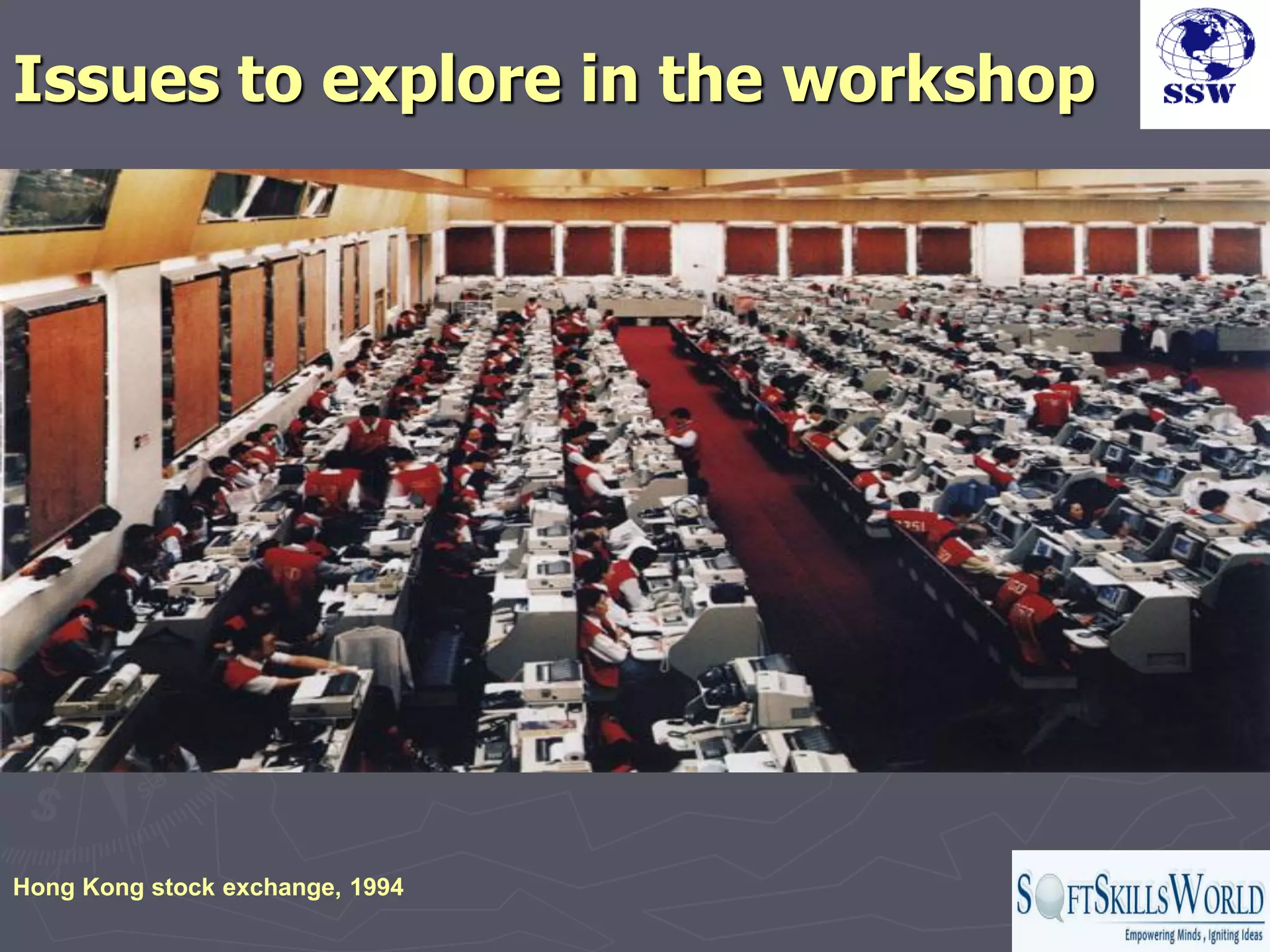
Hong Kong stock exchange, 1994
Issues to explore in the workshop
    “An entitative approach [to organisations]
    fails to represent what it means to be human,
    misrepresents the qualities of the relational
    processes and, more
    generally, grossly distorts
    the relationships between
    person and organisation”
    (Hoskings and Morley 1991:IX)
Issues to explore in the
             workshop
“The relationship between a person
and a context involves accommodation
(changing oneself) and assimilation
(changing the context)… people are
both products of their contexts and
participants in the shaping of those
contexts.” (Hoskings and Morley, 1991:5)
                             Any Question?
Historical overview
    The notion of an organisation as an imperative,
    absolute entity, is the direct outcome of historical
    transformations occurred in Europe and North America
    from the end of the 18th century onwards:
Before the 19th Century:
►   Experience of Artisan work (e.g. Ironsmith)
      Technical skills, personal competence and craft pride
       constitutive of the working process.

Industrial revolution in the 19th Century
      Close relationship between the subject of work and his/her
       activity was lost
Historical overview

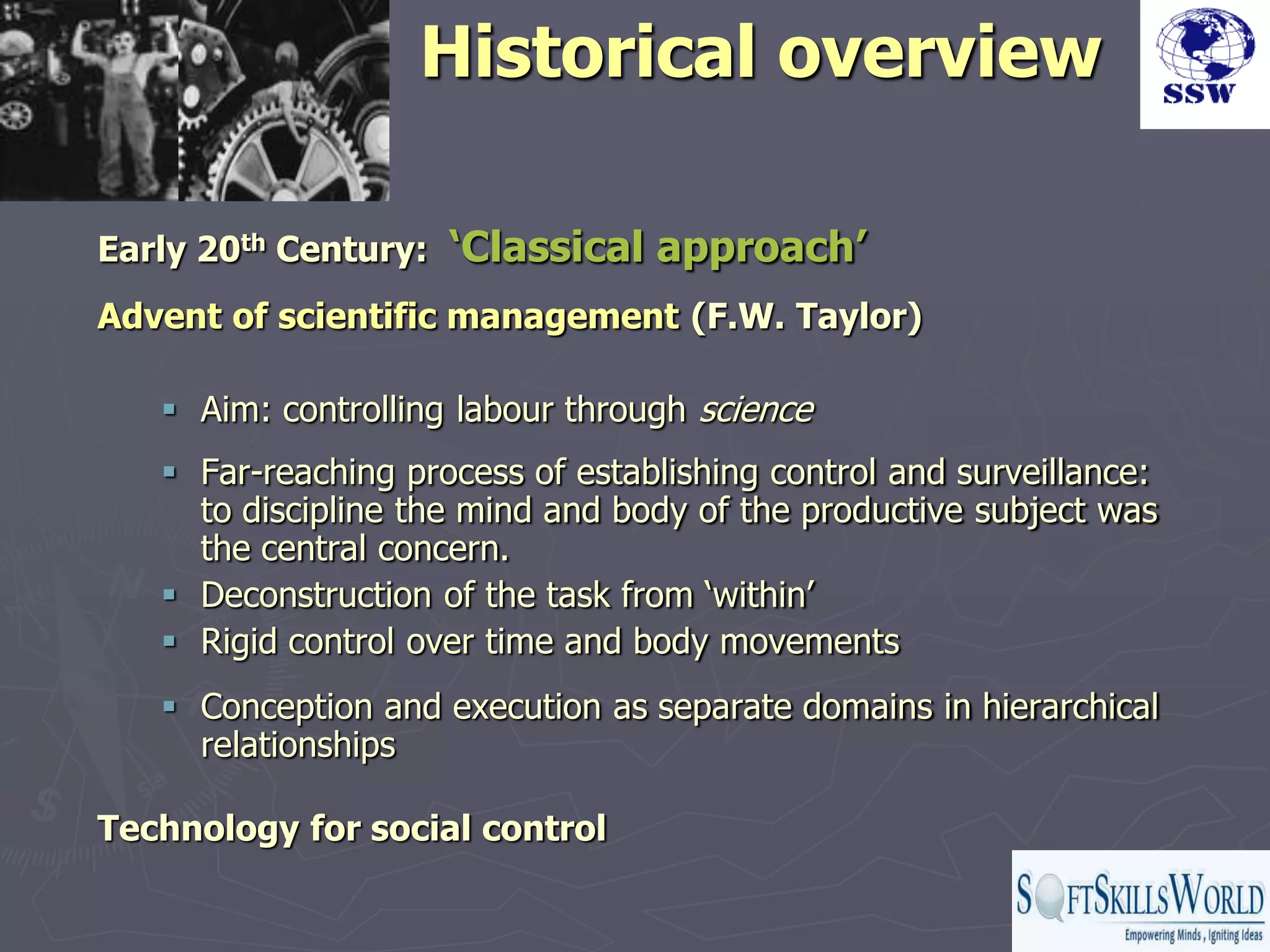
Early 20th Century:   ‘Classical approach’
Advent of scientific management (F.W. Taylor)

    Aim: controlling labour through science
    Far-reaching process of establishing control and surveillance:
     to discipline the mind and body of the productive subject was
     the central concern.
    Deconstruction of the task from „within‟
    Rigid control over time and body movements
    Conception and execution as separate domains in hierarchical
     relationships

Technology for social control
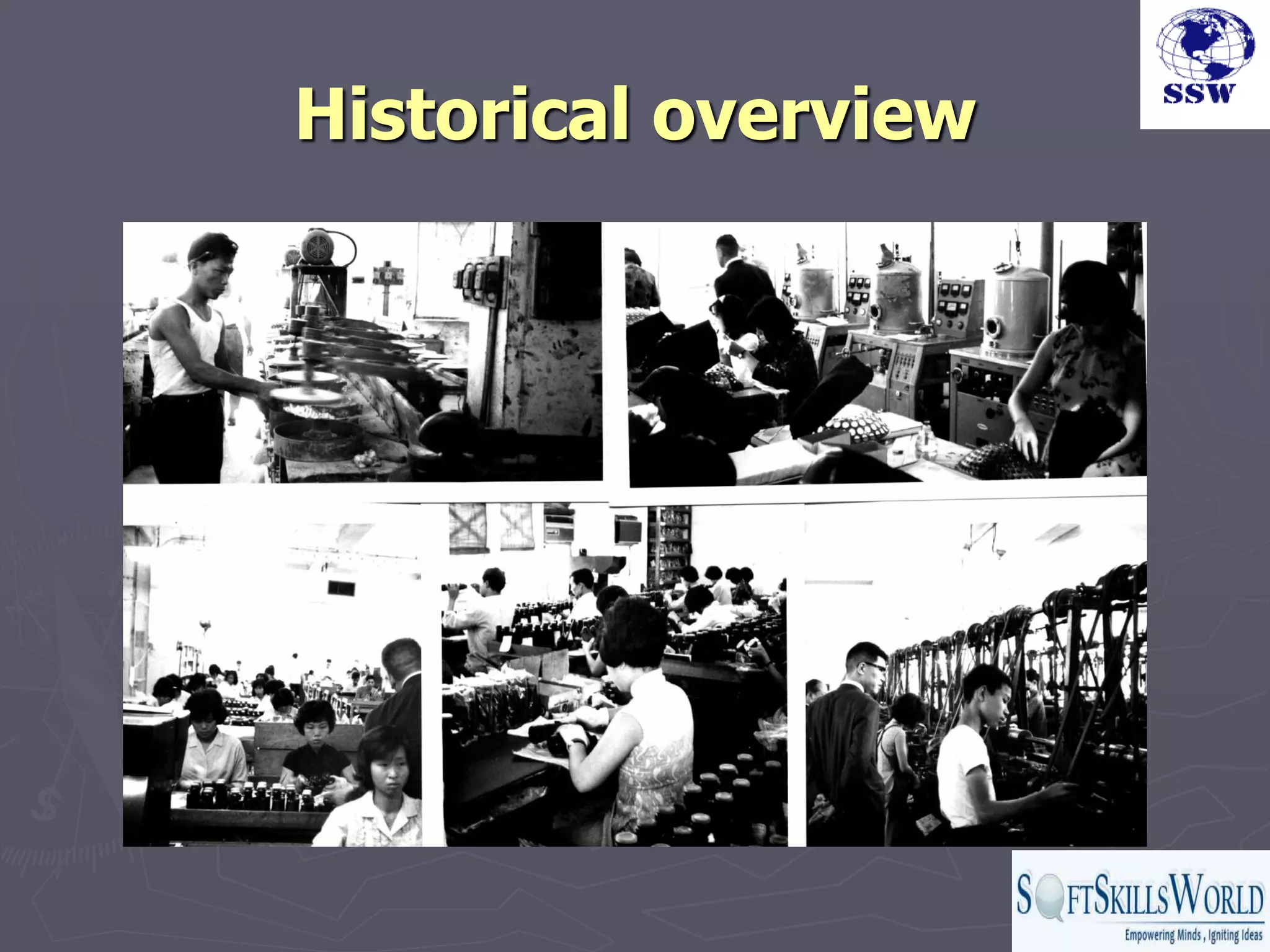
Historical overview
Historical overview
Hawthorne Studies and the Human Relations
Movement (Elton Mayo, 1923-1933)

    Hawthorne studies: environment and productivity?
    Results: organizations are social systems, not just technical
     economical systems
    Groups, teamwork, different job roles, human relations are of great
     significance in organizations
    We are motivated by many needs
    Leadership should be modified to include concepts of human
     relations

   A new discipline of human behaviour and, by extension,
     Organisational behaviour. (1960s)
Historical overview
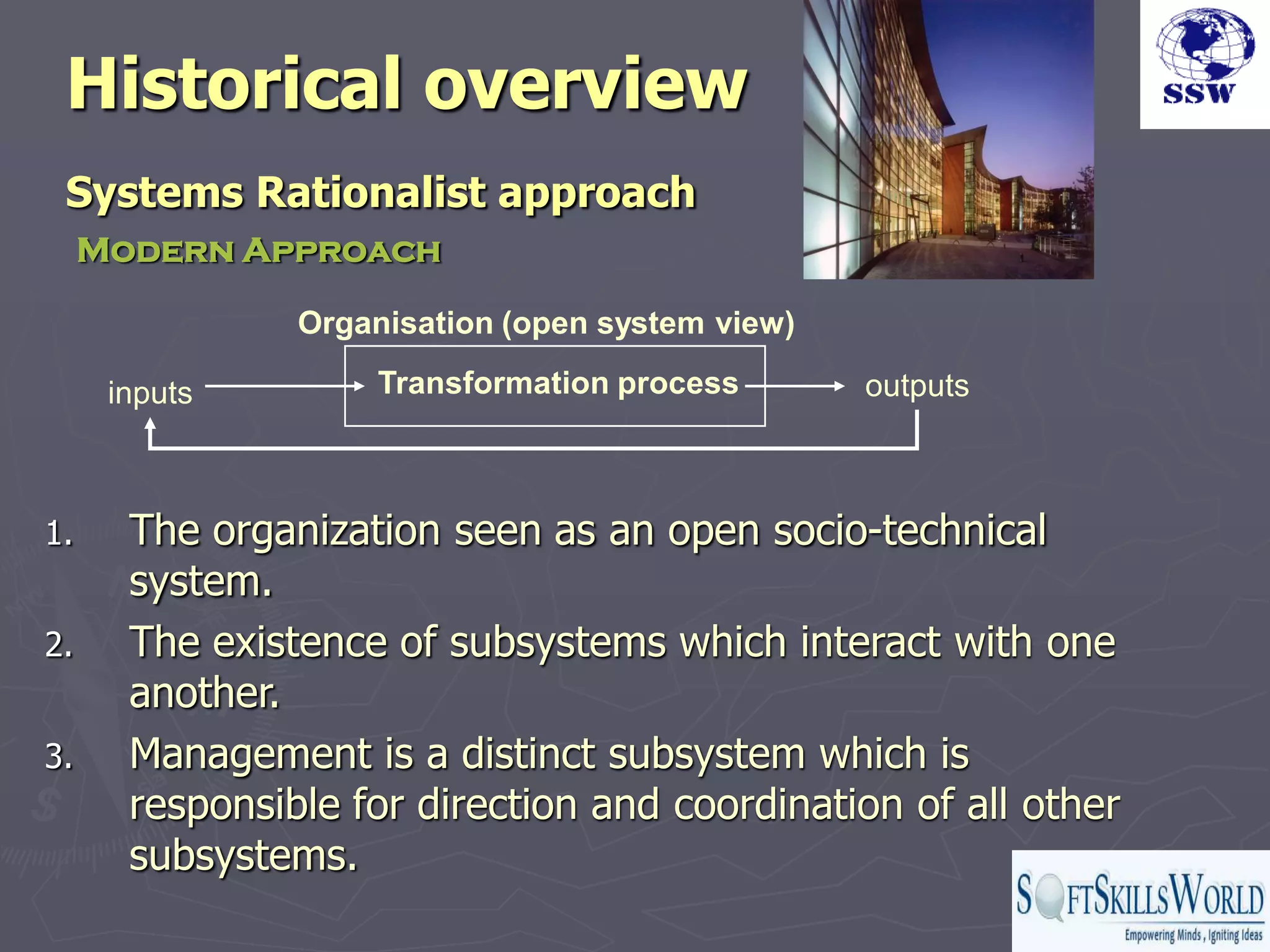
 Systems Rationalist approach
     Modern Approach

                Organisation (open system view)

      inputs        Transformation process        outputs


1.     The organization seen as an open socio-technical
       system.
2.     The existence of subsystems which interact with one
       another.
3.     Management is a distinct subsystem which is
       responsible for direction and coordination of all other
       subsystems.
Historical overview

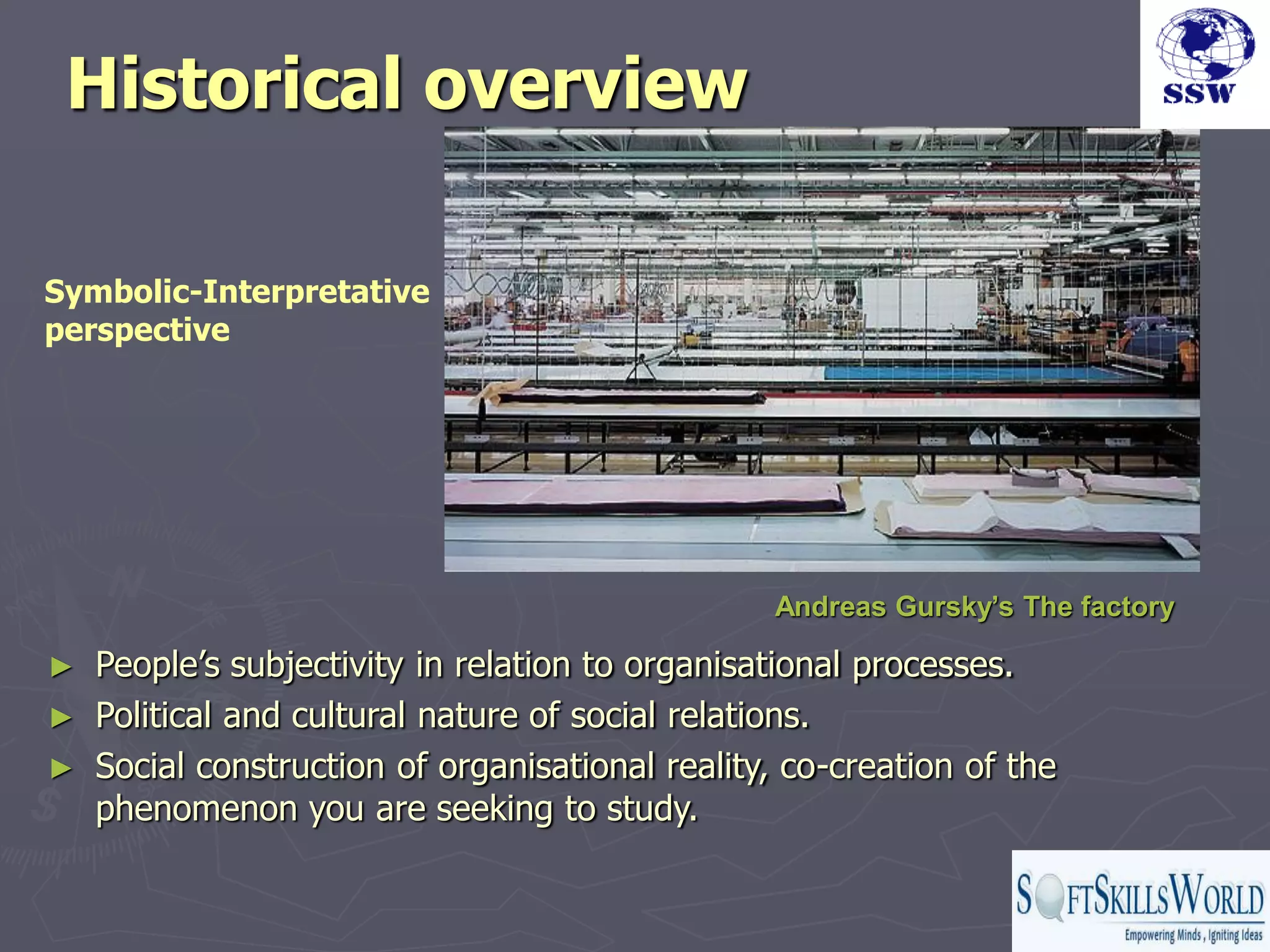
Symbolic-Interpretative
perspective


                                                Andreas Gursky’s The factory

► People‟s subjectivity in relation to organisational processes.
► Political and cultural nature of social relations.
► Social construction of organisational reality, co-creation of the
  phenomenon you are seeking to study.
To explore in the workshop

BY INTRODUCING
DIFFERENT PERSPECTIVES
TO THE UNDERSTANDING
OF PEOPLE AND
ORGANISATIONS, WE HOPE:


TO STIMULATE YOUR SEARCH
FOR NEW KNOWLEDGE,
CREATIVITY AND SKILLS AS
ORGANISATIONAL
PRACTITIONERS

Ssw presents organisational behaviour workshop ppt

  • 1.
    Organisational Behaviour SOFT SKILLS WORLD
  • 2.
    Workshop plan ►Structure of the workshop ►Issues to explore in the workshop ►Historical overview
  • 3.
    Structure of theworkshop ► Day long session ► Duration: 6 to 8 hours ► Any question?
  • 4.
    SOME RECOMMENDED SOURCES Organization Studies Organizational Science Organization Behaviour Human Relations Harvard Business Review Introduction to Organizational behaviour Research in Organizational Behavior Economists, Financial times…
  • 5.
    Issues to explorein the workshop Organizational behaviour (OB) “the study of human behaviour in organizational contexts with a focus on individual and group processes and actions” (pp.2)
  • 6.
    Issues to explorein the workshop Hong Kong stock exchange, 1994
  • 7.
    Issues to explorein the workshop “An entitative approach [to organisations] fails to represent what it means to be human, misrepresents the qualities of the relational processes and, more generally, grossly distorts the relationships between person and organisation” (Hoskings and Morley 1991:IX)
  • 8.
    Issues to explorein the workshop “The relationship between a person and a context involves accommodation (changing oneself) and assimilation (changing the context)… people are both products of their contexts and participants in the shaping of those contexts.” (Hoskings and Morley, 1991:5) Any Question?
  • 9.
    Historical overview The notion of an organisation as an imperative, absolute entity, is the direct outcome of historical transformations occurred in Europe and North America from the end of the 18th century onwards: Before the 19th Century: ► Experience of Artisan work (e.g. Ironsmith)  Technical skills, personal competence and craft pride constitutive of the working process. Industrial revolution in the 19th Century  Close relationship between the subject of work and his/her activity was lost
  • 10.
    Historical overview Early 20thCentury: ‘Classical approach’ Advent of scientific management (F.W. Taylor)  Aim: controlling labour through science  Far-reaching process of establishing control and surveillance: to discipline the mind and body of the productive subject was the central concern.  Deconstruction of the task from „within‟  Rigid control over time and body movements  Conception and execution as separate domains in hierarchical relationships Technology for social control
  • 11.
  • 12.
    Historical overview Hawthorne Studiesand the Human Relations Movement (Elton Mayo, 1923-1933)  Hawthorne studies: environment and productivity?  Results: organizations are social systems, not just technical economical systems  Groups, teamwork, different job roles, human relations are of great significance in organizations  We are motivated by many needs  Leadership should be modified to include concepts of human relations A new discipline of human behaviour and, by extension, Organisational behaviour. (1960s)
  • 13.
    Historical overview SystemsRationalist approach Modern Approach Organisation (open system view) inputs Transformation process outputs 1. The organization seen as an open socio-technical system. 2. The existence of subsystems which interact with one another. 3. Management is a distinct subsystem which is responsible for direction and coordination of all other subsystems.
  • 14.
    Historical overview Symbolic-Interpretative perspective Andreas Gursky’s The factory ► People‟s subjectivity in relation to organisational processes. ► Political and cultural nature of social relations. ► Social construction of organisational reality, co-creation of the phenomenon you are seeking to study.
  • 15.
    To explore inthe workshop BY INTRODUCING DIFFERENT PERSPECTIVES TO THE UNDERSTANDING OF PEOPLE AND ORGANISATIONS, WE HOPE: TO STIMULATE YOUR SEARCH FOR NEW KNOWLEDGE, CREATIVITY AND SKILLS AS ORGANISATIONAL PRACTITIONERS