Historical Foundations of
Management
Prepared By : ZAREEN SHAIKH, SZABIST Larkana
Session-2
Class-BBA.2
It gives executives a way of thinking, a way of
searching for patterns and understanding
trends. It provides a context or environment
in which to interpret current problems.
Forces: Social, political, economic
Why is history Important?
Management and Organization
 Social Forces:
– The aspect of culture that guide and influence relationship
among people – their values, needs and standard of
behaviors ( Sindhi Values, American Culture, African
Culture)
 Political Forces:
– The influence of political and legal institution on
organization and people ( Courts, Company Reg.Act 1973,
Labor Law)
 Economic Forces:
– Allocation of Resources, Employment, Inflation etc
Historical Background Of Management
 Organizations Have Existed for Thousands of Years
– testifies to the existence of early management practice
• ability to create the Pyramids, Great Wall of China
 Significant Pre-Twentieth-Century Events
– Wealth of Nations - Adam Smith
• division of labor - breakdown of jobs into narrow and repetitive
tasks increased productivity
– Industrial Revolution
• substitution of machine power for human power
• large organizations required formal management
Development Of Major Management Theories
Historical
Background Scientific
Management
General
Administrative
Theorists
Quantitative
Approach
Management Theories
Industrial
Revolution
Adam Smith
Early Advocates
Hawthorne Studies
Organizational
Behavior
Early Examples
of Management
Management Approaches
Classical
Humanistic
Management Science
Recent Trends
– Systems Theory
– Contingency View
– Total Quality Management
First Perspective:
CLASSICAL
Classical Perspective
Emerged during the 19th and 20th centuries
Factory systems appearing in 1800’s
Problems:
– Tooling the plants
– Organizing managerial structure
– Training employees (many immigrants)
– Scheduling complex manufacturing operations
– Increased labor dissatisfaction; strikes
Classical Approaches
 Scientific Management
– Frederick Winslow Taylor (1856-1915)
– Henry Gantt
– Frank B. and Lillian M. Gilbreth
 Bureaucratic Organizations
– Max Weber (1864-1920)
 Administrative Principles
– Henri Fayol (1841-1925)
– Mary Parker Follett (1868 – 1933)
– Chester I. Barnard (1886-1961)
Scientific Management
Classical Perspective
Frederick Taylor, Engineer Father of
Scientific Management
 Problem in labor productivity lies with poor
management practices, not labor.
 Manner of change can be determined only by
scientific study.
 Replace rules of thumb and tradition with precise
procedures developed after careful study.
 Work with Bethlehem Steel plant in 1898
Henry Gantt
 Gantt Chart – a bar graph that measures planned
and completed work along each stage of
production by time elapsed.
Frank B. Gilbreth
(1868 – 1924)
 Pioneered time and motion study
 Stressed efficiency; “one best way” to do work.
 Early work with bricklayers
 Greatest impact on medical surgery by drastically
reducing the time patients spent on the operating
table.
Lillian M. Gilbreth
1878-1972
 Widowed in 1924 with 12 children, ages 2 – 19.
 “First Lady of Management”
 Pioneered in the field of industrial psychology and
made substantial contributions to human resource
management.
Bureaucratic Organizations
Classical Perspective
Max Weber, German Theorist
 Envisioned organizations managed on an impersonal,
rational basis.
 An organization based on rational authority would be more
efficient and adaptable to change.
 Employee selection and advancement based on
competence.
 Rely on rules and written records for continuity.
 Manager relies on legal power of his/her position instead
of personality.
EXHIBIT 2.4: WEBER’S IDEAL BUREAUCRACY
2-17
Administrative Principles
Classical Perspective
Henri Fayol, French Engineer
 General and Industrial Management
 Proposed 14 general principles of management
– Unity of command (one supervisor)
– Division of work (specialization)
– Unity of direction (group similar activities)
– Scalar chain (chain of authority)
Mary Parker Follett
 Trained in philosophy and political science
 Stressed the importance of people rather than engineering
techniques
 “Don’t Hug Your Blueprints”
 Analyzed dynamics of management-organization
interactions
 Addressed ethics, power and leadership
 Proposed concept of empowerment
Chester I. Barnard
 Studied Economics at Harvard; no degree
 President of New Jersey Bell in 1927
 Proposed the concept of the informal organization
 Includes cliques and naturally occurring social groupings
 Acceptance theory of authority – people have free will and
can choose whether to follow management orders.
Second Perspective:
Humanistic
Humanistic Perspective
 Human Relations Movement
– Hawthorne Studies (1927-1932), Western Electric
Hawthorne Works in Chicago
– CIL, Thomas Edison, Honorary Chair, 1924-1927
– Elton Mayo, Harvard Business School examined
productivity and work conditions
 Human Resources Perspective
– Abraham Maslow (1908-1970)
– Douglas McGregor (1906-1964)
 Behavioral Sciences Approach
The Hawthorne Effect
 The rewards you reap when you pay attention to
people. The mere act of showing people that
you’re concerned about them usually spurs them
to better job performance.
 When people spend a large portion of their time at
work, they must have a sense of belonging, of
being part of a team.
Hawthorne Studies
 1895 – struggle develops between manufacturers of gas
and electric lighting fixtures for control of the residential
and industrial market.
 More light results in more productivity, they say
 6 year Study Result: Money was not the cause of the
increased output. Employees’ output increased sharply
when managers treated them in a positive manner.
The Human Relations Movement
Humanistic Perspective
The human relations school of thought
considers that truly effective control comes
from within the individual workers rather
than from strict, authoritarian control.
The Human Resources
Perspective
Humanistic Perspective
Abraham Maslow, Psychologist
 Observed that patients’ problems stemmed from inability
to satisfy their needs.
 Proposed a hierarchy of needs
– Physiological needs
– Safety
– Belongingness
– Esteem
– Self-actualization
 Basis for motivational techniques
Douglas McGregor, College
President
 Challenged assumptions about human behavior
based on his experiences as a manager, consultant,
his training as a psychologist, and Maslow’s work.
 Theory X and Theory Y
 Workers are best described by Theory Y
 Take advantage of the imagination and intellect of
all employees.
Behavioral Sciences Approach
Humanistic Perspective
Behavioral Sciences Approach
 It is based on scientific methods and study.
 Draws from sociology, psychology, anthropology,
economics and other disciplines to understand
employee behavior and interaction in an
organizational setting.
 Impacts motivation, communication, leadership
and human resource management.
Third Perspective:
Management Science
Management Science Perspective
 World War II created sophisticated tools for modern global
warfare.
 Applies mathematics, statistics and other quantitative
techniques to management decision-making and problem-
solving.
 Operations Research
 Operations Management
 Management Information Systems
Fourth Perspective:
Emerging Trends
Systems Theory
Contingency View
Total Quality Management (Deming)
Systems Theory
A set of interrelated parts that function as a
whole to achieve a common purpose.
– Inputs
– Transformation process
– Outputs
– Feedback
– Environment
System Theory : Current Theories
 System: A set of related parts that work together in order to achieve a
common objective
 Open System: A system that interact with external environment
 Close System: A system that does not interact with environment.
 Entropy: A tendency of system to run down or die
 Synergy: In organization every department depends upon each other
 Subsystems: Parts of system that depend upon each other.
Contingency View
 Universalist View (classical perspective) – management
concepts are universal
 Case View – Each situation is unique.
 Contingency View – A manager’s response depends on
identifying key variables in an organizational situation.
What works in one setting may not work in another.
Contingencies include the environment, industry,
technology and international cultures.
Total Quality Management
 Shift from inspection approach to quality control
emphasizing employee involvement in the prevention of
quality problems.
 Managing the total organization to deliver quality to
customers.
 Significant Elements of TQM
– Employee involvement
– Focus on the customer
– Benchmarking
– Continuous improvement
Dr. W. Edwards Deming (1900-1993)
“Father of Quality Movement”
 Developed theory and methods to improve the
quality an dependability of manufactured
products.
 Application of his work in Japan sparked the
Japanese Industrial Miracle-the transformation of
Japanese business
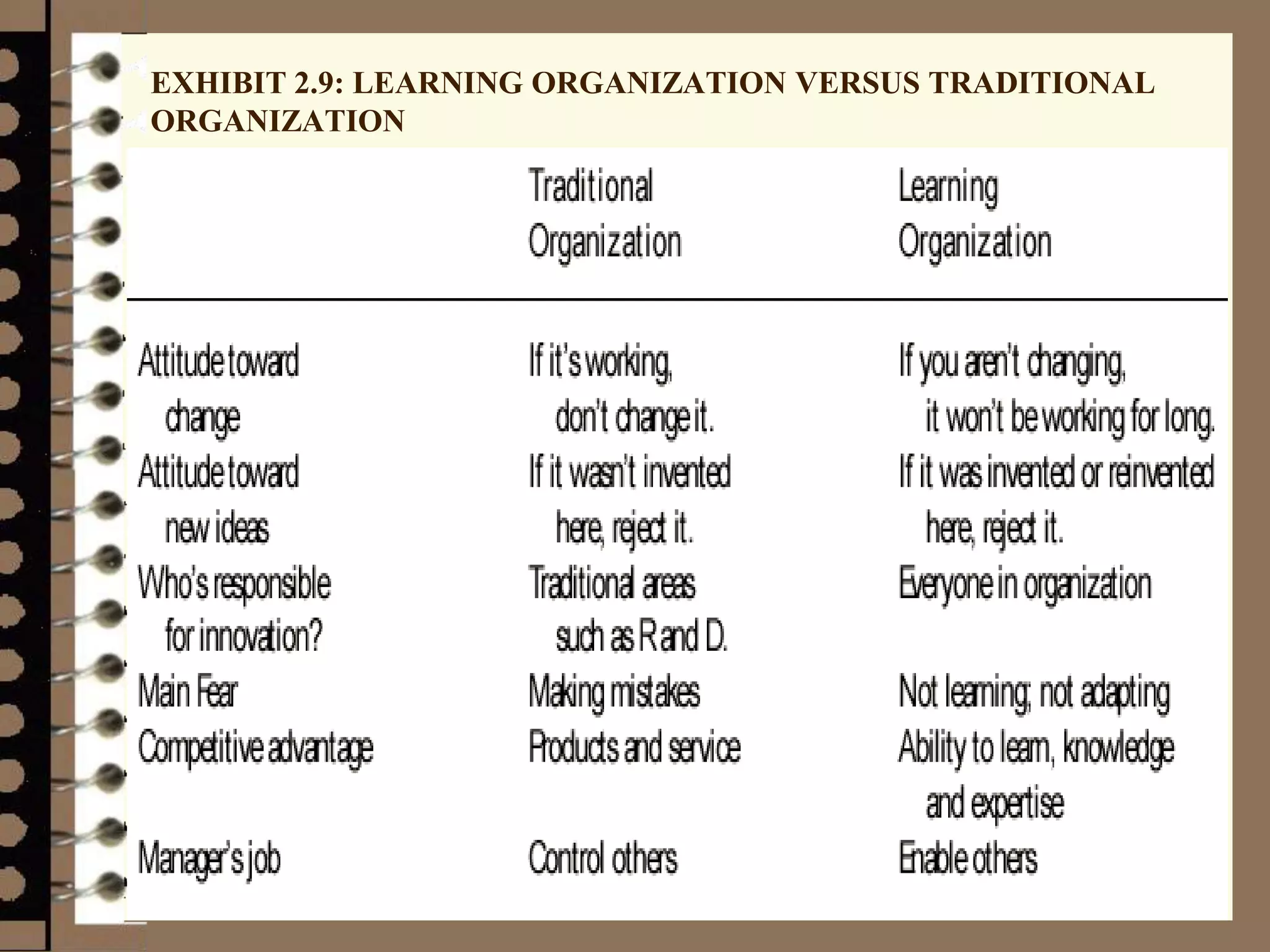
EXHIBIT 2.9: LEARNING ORGANIZATION VERSUS TRADITIONAL
ORGANIZATION
2-40
Current Trends And Issues
 Learning Organizations and Knowledge Management
– Learning Organization - one that has developed the
capacity to continuously learn, adapt, and change
– create learning capabilities throughout the organization
• understanding that knowledge is an important resource
– Knowledge Management - involves cultivating a learning
culture where organizational members systematically gather
knowledge and share it with others in the organization so as
to achieve better performance
– managers must transform themselves from bosses to team
leaders
• learn to listen, motivate, coach, and nurture
2-41
Any Question

Historical Foundation Of Management

  • 1.
    Historical Foundations of Management PreparedBy : ZAREEN SHAIKH, SZABIST Larkana Session-2 Class-BBA.2
  • 2.
    It gives executivesa way of thinking, a way of searching for patterns and understanding trends. It provides a context or environment in which to interpret current problems. Forces: Social, political, economic Why is history Important?
  • 3.
    Management and Organization Social Forces: – The aspect of culture that guide and influence relationship among people – their values, needs and standard of behaviors ( Sindhi Values, American Culture, African Culture)  Political Forces: – The influence of political and legal institution on organization and people ( Courts, Company Reg.Act 1973, Labor Law)  Economic Forces: – Allocation of Resources, Employment, Inflation etc
  • 4.
    Historical Background OfManagement  Organizations Have Existed for Thousands of Years – testifies to the existence of early management practice • ability to create the Pyramids, Great Wall of China  Significant Pre-Twentieth-Century Events – Wealth of Nations - Adam Smith • division of labor - breakdown of jobs into narrow and repetitive tasks increased productivity – Industrial Revolution • substitution of machine power for human power • large organizations required formal management
  • 5.
    Development Of MajorManagement Theories Historical Background Scientific Management General Administrative Theorists Quantitative Approach Management Theories Industrial Revolution Adam Smith Early Advocates Hawthorne Studies Organizational Behavior Early Examples of Management
  • 6.
    Management Approaches Classical Humanistic Management Science RecentTrends – Systems Theory – Contingency View – Total Quality Management
  • 7.
  • 8.
    Classical Perspective Emerged duringthe 19th and 20th centuries Factory systems appearing in 1800’s Problems: – Tooling the plants – Organizing managerial structure – Training employees (many immigrants) – Scheduling complex manufacturing operations – Increased labor dissatisfaction; strikes
  • 9.
    Classical Approaches  ScientificManagement – Frederick Winslow Taylor (1856-1915) – Henry Gantt – Frank B. and Lillian M. Gilbreth  Bureaucratic Organizations – Max Weber (1864-1920)  Administrative Principles – Henri Fayol (1841-1925) – Mary Parker Follett (1868 – 1933) – Chester I. Barnard (1886-1961)
  • 10.
  • 11.
    Frederick Taylor, EngineerFather of Scientific Management  Problem in labor productivity lies with poor management practices, not labor.  Manner of change can be determined only by scientific study.  Replace rules of thumb and tradition with precise procedures developed after careful study.  Work with Bethlehem Steel plant in 1898
  • 12.
    Henry Gantt  GanttChart – a bar graph that measures planned and completed work along each stage of production by time elapsed.
  • 13.
    Frank B. Gilbreth (1868– 1924)  Pioneered time and motion study  Stressed efficiency; “one best way” to do work.  Early work with bricklayers  Greatest impact on medical surgery by drastically reducing the time patients spent on the operating table.
  • 14.
    Lillian M. Gilbreth 1878-1972 Widowed in 1924 with 12 children, ages 2 – 19.  “First Lady of Management”  Pioneered in the field of industrial psychology and made substantial contributions to human resource management.
  • 15.
  • 16.
    Max Weber, GermanTheorist  Envisioned organizations managed on an impersonal, rational basis.  An organization based on rational authority would be more efficient and adaptable to change.  Employee selection and advancement based on competence.  Rely on rules and written records for continuity.  Manager relies on legal power of his/her position instead of personality.
  • 17.
    EXHIBIT 2.4: WEBER’SIDEAL BUREAUCRACY 2-17
  • 18.
  • 19.
    Henri Fayol, FrenchEngineer  General and Industrial Management  Proposed 14 general principles of management – Unity of command (one supervisor) – Division of work (specialization) – Unity of direction (group similar activities) – Scalar chain (chain of authority)
  • 20.
    Mary Parker Follett Trained in philosophy and political science  Stressed the importance of people rather than engineering techniques  “Don’t Hug Your Blueprints”  Analyzed dynamics of management-organization interactions  Addressed ethics, power and leadership  Proposed concept of empowerment
  • 21.
    Chester I. Barnard Studied Economics at Harvard; no degree  President of New Jersey Bell in 1927  Proposed the concept of the informal organization  Includes cliques and naturally occurring social groupings  Acceptance theory of authority – people have free will and can choose whether to follow management orders.
  • 22.
  • 23.
    Humanistic Perspective  HumanRelations Movement – Hawthorne Studies (1927-1932), Western Electric Hawthorne Works in Chicago – CIL, Thomas Edison, Honorary Chair, 1924-1927 – Elton Mayo, Harvard Business School examined productivity and work conditions  Human Resources Perspective – Abraham Maslow (1908-1970) – Douglas McGregor (1906-1964)  Behavioral Sciences Approach
  • 24.
    The Hawthorne Effect The rewards you reap when you pay attention to people. The mere act of showing people that you’re concerned about them usually spurs them to better job performance.  When people spend a large portion of their time at work, they must have a sense of belonging, of being part of a team.
  • 25.
    Hawthorne Studies  1895– struggle develops between manufacturers of gas and electric lighting fixtures for control of the residential and industrial market.  More light results in more productivity, they say  6 year Study Result: Money was not the cause of the increased output. Employees’ output increased sharply when managers treated them in a positive manner.
  • 26.
    The Human RelationsMovement Humanistic Perspective The human relations school of thought considers that truly effective control comes from within the individual workers rather than from strict, authoritarian control.
  • 27.
  • 28.
    Abraham Maslow, Psychologist Observed that patients’ problems stemmed from inability to satisfy their needs.  Proposed a hierarchy of needs – Physiological needs – Safety – Belongingness – Esteem – Self-actualization  Basis for motivational techniques
  • 29.
    Douglas McGregor, College President Challenged assumptions about human behavior based on his experiences as a manager, consultant, his training as a psychologist, and Maslow’s work.  Theory X and Theory Y  Workers are best described by Theory Y  Take advantage of the imagination and intellect of all employees.
  • 30.
  • 31.
    Behavioral Sciences Approach It is based on scientific methods and study.  Draws from sociology, psychology, anthropology, economics and other disciplines to understand employee behavior and interaction in an organizational setting.  Impacts motivation, communication, leadership and human resource management.
  • 32.
  • 33.
    Management Science Perspective World War II created sophisticated tools for modern global warfare.  Applies mathematics, statistics and other quantitative techniques to management decision-making and problem- solving.  Operations Research  Operations Management  Management Information Systems
  • 34.
    Fourth Perspective: Emerging Trends SystemsTheory Contingency View Total Quality Management (Deming)
  • 35.
    Systems Theory A setof interrelated parts that function as a whole to achieve a common purpose. – Inputs – Transformation process – Outputs – Feedback – Environment
  • 36.
    System Theory :Current Theories  System: A set of related parts that work together in order to achieve a common objective  Open System: A system that interact with external environment  Close System: A system that does not interact with environment.  Entropy: A tendency of system to run down or die  Synergy: In organization every department depends upon each other  Subsystems: Parts of system that depend upon each other.
  • 37.
    Contingency View  UniversalistView (classical perspective) – management concepts are universal  Case View – Each situation is unique.  Contingency View – A manager’s response depends on identifying key variables in an organizational situation. What works in one setting may not work in another. Contingencies include the environment, industry, technology and international cultures.
  • 38.
    Total Quality Management Shift from inspection approach to quality control emphasizing employee involvement in the prevention of quality problems.  Managing the total organization to deliver quality to customers.  Significant Elements of TQM – Employee involvement – Focus on the customer – Benchmarking – Continuous improvement
  • 39.
    Dr. W. EdwardsDeming (1900-1993) “Father of Quality Movement”  Developed theory and methods to improve the quality an dependability of manufactured products.  Application of his work in Japan sparked the Japanese Industrial Miracle-the transformation of Japanese business
  • 40.
    EXHIBIT 2.9: LEARNINGORGANIZATION VERSUS TRADITIONAL ORGANIZATION 2-40
  • 41.
    Current Trends AndIssues  Learning Organizations and Knowledge Management – Learning Organization - one that has developed the capacity to continuously learn, adapt, and change – create learning capabilities throughout the organization • understanding that knowledge is an important resource – Knowledge Management - involves cultivating a learning culture where organizational members systematically gather knowledge and share it with others in the organization so as to achieve better performance – managers must transform themselves from bosses to team leaders • learn to listen, motivate, coach, and nurture 2-41
  • 42.